startup
28 TopicsAlphaLife Sciences powers regulatory-compliant AI workflows with PostgreSQL on Azure
by: Maxim Lukiyanov, PhD, Principal PM Manager and Sharon Chen, CEO and Founder at AlphaLife Sciences In life sciences, every document is deeply interconnected and highly regulated. Each clinical trial, regulatory submission, safety report, or protocol amendment is expected to stand up to rigorous audit. For AlphaLife Sciences, that challenge became an opportunity to rethink how AI could support expert human judgment. At Microsoft Ignite, AlphaLife Sciences CEO and Founder Sharon Chen shared how her team is building an AI-powered content authoring platform on top of Azure Database for PostgreSQL, designed specifically for the demands of regulated life sciences workflows. She also explained why the team is excited about Azure HorizonDB as a new PostgreSQL service that is built to meet the needs of modern enterprise workloads. This post explores how AlphaLife Sciences uses PostgreSQL as more than a data store. It’s a semantic foundation for compliant, auditable AI agents. Bringing AI into regulated workflows Life sciences organizations are under constant pressure. R&D pipelines are growing and patent windows are shrinking. A single clinical study report can take six months or more to complete, involving multiple teams and hundreds of source documents. Building efficiency into these processes is critical, but only if it doesn’t compromise accuracy, traceability, or compliance. That’s where many AI solutions fall short. Generating text is one thing, but generating verifiable, version-controlled, regulation-aware content is another. AlphaLife Sciences needed agents that could: Work across massive volumes of structured and unstructured data (Word, PDF, Excel, PowerPoint) Maintain full traceability from generated content back to source documents Support audits, amendments, and regulatory review Minimize hallucinations in a zero-tolerance environment Integrate naturally into the tools writers already use Bringing data, search, and AI together in one system At the core of AlphaLife Sciences’ platform is Azure Database for PostgreSQL. The team chose it for flexibility, extensibility, and for how well it supports modern AI workloads. Instead of stitching together separate systems for SQL queries, vector search, text indexing, and metadata tracking, AlphaLife Sciences consolidated everything into PostgreSQL. One of its flagship use cases is clinical trial protocol authoring, a process that typically involves: Designing trial objectives and endpoints Pulling references from previous studies Writing and revising hundreds of pages of structured content Managing multiple rounds of amendments and regulatory feedback With AI agents backed by PostgreSQL, that workflow changes dramatically. When a writer generates a protocol section, the system can automatically retrieve relevant references from a centralized document pool, using semantic search rather than manual lookup. Writers select the sources they want, apply rules or prompts, and let AI draft the section - complete with citations tied back to the original documents. Reviewers can inspect the source, adjust the output, or insert it directly into the document. For protocol amendments, the platform allows teams to upload inputs (Word or Excel), analyze which sections are affected, and generate structured suggestions. Changes are clearly highlighted, compared against previous versions, and summarized in amendment tables. AI agents that respect the rules A recurring theme in Chen’s talk was restraint. “We don’t just need AI that can write,” she said. “We need intelligent agents that understand data structures, follow regulatory laws, and manage version control.” This is where PostgreSQL-backed AI agents shine. By grounding AI behavior in structured schemas, controlled access, and auditable records, automation works hand-in-hand with human experts. AI accelerates first drafts, consistency checks, discrepancy detection, and cross-document analysis, but final accountability stays firmly with professionals. In some cases, the time to complete processes has been reduced by more than 50%. Azure Database for PostgreSQL has become more than a database for AlphaLife Sciences. It’s a semantic knowledge base that supports: Structured and unstructured data Vector similarity search Metadata-driven traceability Compliance, security, and auditability AI agents operating safely inside enterprise constraints By grounding AI agents directly in the database, reasoning, retrieval, and generation all operate against the same governed source of truth. “AI agents are not here to replace human beings,” said Chen. “They extend structured, compliant, and auditable thinking.” What’s next for AlphaLife Sciences with PostgreSQL on Azure Looking ahead, Chen shared her excitement about Azure HorizonDB and the capabilities it brings to PostgreSQL on Azure. Features like in-database AI model management, semantic operators for classification and summarization, and faster vector search with DiskANN align closely with AlphaLife Sciences’ needs as their platform continues to scale. “We’re extremely happy to see the launch of Azure HorizonDB and the more powerful tools coming with it,” Chen said. “By putting everything together in PostgreSQL, we don’t have to rely on different systems for vector search, text indexing, or SQL queries. Everything happens in one streamlined system. The code becomes cleaner, efficiency improves, and the AI agents perform much more elegantly.” Learn more AlphaLife Sciences’ journey was featured during the Microsoft Ignite session “The Blueprint for Intelligent AI Agents Backed by PostgreSQL.” Watch the session to learn more and see a demo of how Azure Database for PostgreSQL transforms the protocol and protocol amendment process. When AI is anchored in a strong PostgreSQL foundation, innovation and compliance don’t have to compete - they can reinforce each other.908Views4likes0Comments
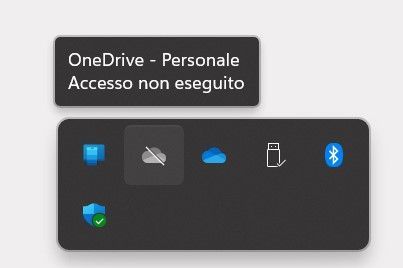
Double istances of the app
Goodmorning, at the startup of windows 11, two istances of ondrive start: one, the wanted one, is the one I'm logged in with my business account, the second one is OneDrive - Personal - not logged in. I'm not able to avoid the second one. Non way. I tryied with various reg key. Can you help me please?6.6KViews1like8Comments
OneDrive on Mac: OneDrive folder always opens at startup - How can I stop this?
Hello, I run the latest version of OneDrive (Version 24.132.0701.0001) on a Mac running macOS 14.5. When I start a session, the OneDrive folder always opens. How can I stop this? I want a "silent" run of OneDrive... I couldn't find any option in the preferences for this... By the way, I have the same " issue " with Windows10 and Windows11. (I consider it an issue, but maybe it's not considered an issue by Microsoft...) Many thanks in advance for any help.12KViews2likes5Comments
Open all tabs from previous session but load only last used one
I'm used to work with a lot of tabs organized in several groups and I don't want to lose such tabs when I close and then reopen Edge. This is achievable through settings and I've no complains over it. However, when I open Edge, I expect only the last used tab to load, or at most the tabs from the last group I was using. It is absurd that all the 50+ tabs, splitted in 10+ groups, are loaded all at once, making the startup process very slow. I come from Firefox, where all the tabs from the previous session appears, but only the last used one actually loads. The other ones are loaded only once the user browse on them. The very existence of groups assumes an user is expected to keep a lot of tabs open but to work only with a very small subset of them at a given time. So it's absurd to waste resources, increase power consumption and reduce startup performances by loading all the tabs from the last session, even if most of them will probably not be used.298Views2likes2CommentsKickoff the 2025 Imagine Cup: Unleash Your Innovation Potential!
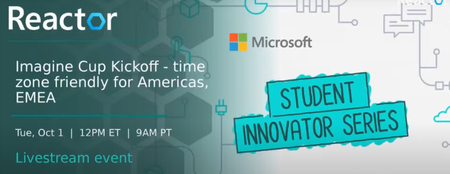
Get ready to embark on an exciting journey with the 2025 Imagine Cup! 🎉 Join us live to celebrate the launch of the new season and discover Microsoft’s premier global technology competition for student founders. This event is packed with valuable insights into the competition’s structure, goals, and benefits, helping you learn how to participate and succeed.1.7KViews2likes0CommentsGenerative AI for Beginners - A 12-Lesson Course
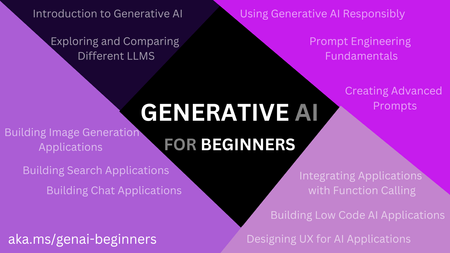
Are you fascinated by the world of Artificial Intelligence and its endless possibilities? Are you a beginner eager to dive into the realm of Generative AI? If so, you're in the right place! In this blog post, we're excited to introduce you to a comprehensive 12-lesson course designed to teach you everything you need to know to start building Generative AI applications57KViews12likes7CommentsEthical AI: Nurup Naimji’s Vision for Responsible Growth in AI Entrepreneurship
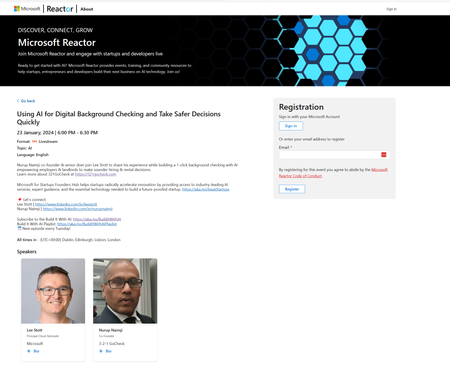
Learn more from Microsoft Startup 3-2-1 Go Check and how to Centralise Your Checking Flow 3-2-1-GoCheck enables HR, risk, compliance, hiring managers, candidates, previous employers and other third parties to all be on the same platform. Make lengthy e-mail exchanges, phone calls and time consuming inquiries tedious tasks for everyone involved in the checking journey all with the Power of Microsoft AI and Microsoft Foundershub2.5KViews1like0CommentsThe 2024 Imagine Cup is your gateway to AI innovation and entrepreneurship
Join the 2024 Imagine Cup and unleash your AI innovation and entrepreneurship potential . Learn from Microsoft experts, access cutting-edge tools and resources, and compete for global recognition and prizes. Register now and submit your proof of concept by January 24, 20243.2KViews1like1Comment