sqlserveronlinux
42 TopicsMicrosoft ODBC Driver 18.6.2 for SQL
What Is the Microsoft ODBC Driver for SQL? The Microsoft ODBC Driver for SQL provides native connectivity from Windows, Linux, and macOS applications to SQL Server, Azure SQL Database, Azure SQL Managed Instance, and Microsoft Fabric. It is the recommended driver for new application development using the ODBC API, and it supports , Always Encrypted, distributed transactions, and modern authentication methods including Microsoft Entra ID (formerly Azure Active Directory). Whether you're building high-throughput data pipelines, managing enterprise databases, or developing cloud-native applications on Microsoft Fabric, the ODBC driver is a foundational component of the SQL Server connectivity stack. What's New in 18.6.2 Improved Vector Parameter Handling for Prepared Statements Version 18.6.2 improves the handling of output and input/output vector parameters when using prepared statements. This enhancement benefits applications that rely on parameterized queries with array bindings — a common pattern in batch processing and high-performance data access layers. Microsoft Fabric Redirection Support (Up to 10 Redirections) The driver now allows up to 10 server redirections per connection attempt, up from previous limits. This change directly supports Microsoft Fabric redirection scenarios, where connections may be transparently routed through multiple endpoints before reaching the target workspace. If your applications connect to Fabric SQL endpoints, this update ensures more reliable connectivity in complex routing topologies. Alpine Linux Packaging Improvements Architecture detection and packaging have been improved for Alpine Linux environments, making it easier to deploy the driver in lightweight, container-based workloads that use Alpine as a base image. Bug Fixes This release addresses several important issues reported by the community and identified through internal testing: Parameter Array Processing SQL_ATTR_PARAMS_PROCESSED_PTR accuracy — Fixed an issue where the number of processed parameter sets was not reported correctly when executing parameter arrays. Applications that inspect SQL_ATTR_PARAMS_PROCESSED_PTR after batch execution will now see the correct count. SQL_PARAM_IGNORE handling — Fixed SQL_ATTR_PARAMS_PROCESSED_PTR and row counting when SQL_PARAM_IGNORE is used within parameter arrays, ensuring that ignored parameters are accounted for properly. Crash Fixes SQLNumResultCols segmentation fault — Resolved a segfault that occurred when calling SQLNumResultCols in describe-only scenarios where no parameter bindings are present. Table-valued parameter (TVP) NULL handling — Fixed a segmentation fault triggered by NULL values in TVP arguments. Applications passing TVPs with nullable columns should no longer experience unexpected crashes. bcp_bind Consecutive Field Terminators (Known Issue from 18.6.1) bcp_bind fix — Corrected bcp_bind to properly handle consecutive field terminators without misinterpreting them as empty fields. This resolves a known issue introduced in version 18.6.1, where consecutive terminators were incorrectly interpreted as NULL values instead of empty strings. If you deferred upgrading to 18.6.1 because of this issue, 18.6.2 is the recommended target version. Linux Packaging Debian EULA acceptance — Fixed Debian package installation to correctly honor EULA acceptance and complete successfully, eliminating a friction point for automated deployments. RPM side-by-side installation — Fixed RPM packaging rules to allow installing multiple driver versions side by side, which is important for environments that need to maintain backward compatibility or perform staged rollouts. Distributed Transactions XA recovery — Fixed XA recovery to compute transaction IDs correctly, avoiding scenarios where recoverable transactions could be missed during the recovery process. This is a critical fix for applications using distributed transactions with XA transaction managers. Upgrading from Older Versions If you are upgrading from a version prior to 18.6.1, you will also benefit from the features introduced in that release: Vector data type support — Native support for the vector data type (float32), enabling AI and machine learning scenarios directly through ODBC. ConcatNullYieldsNull property — Connection-level control over null concatenation behavior. New platform support — Azure Linux 3.0 ARM, Debian 13, Red Hat 10, and Ubuntu 25.10. Version 18.6.2 builds on these additions with the stability and correctness fixes described above. Download & Installation Windows Platform Download Link x64 Download x86 Download ARM64 Download Linux & macOS Installation packages for supported Linux distributions and macOS are available on Microsoft Learn: Download ODBC Driver for SQL Server (Linux/macOS) Documentation & Release Notes For the full list of changes, platform support details, and known issues, see the official release notes: Windows Release Notes Linux & macOS Release Notes Bug Fixes Get Started We encourage all users to upgrade to version 18.6.2.1 to take advantage of the fixes and improvements in this release — particularly if you are using parameter arrays, table-valued parameters, bcp operations, or connecting to Microsoft Fabric endpoints. As always, we welcome your feedback. If you encounter issues, please report them through the SQL Server feedback channel or open an issue on the Microsoft ODBC Driver GitHub repository. Happy coding!2.3KViews0likes3Comments
BULKADMIN role support for SQL Server on Linux is now Generally Available
Starting with SQL Server 2025 CU9 and SQL Server 2022 CU27, SQL Server on Linux supports the bulkadmin fixed server role and the ADMINISTER BULK OPERATIONS permission for performing bulk data import operations without requiring users to be members of the sysadmin fixed server role. This capability enables you to use operations such as BULK INSERT and OPENROWSET(BULK...) while following a least-privilege security model. Previously on SQL Server on Linux, these operations required sysadmin membership. With this GA (Generally Available) release, organizations running SQL Server on Linux can provide users with the permissions required for bulk data loading without granting broader sysadmin privileges, improving alignment with the principle of least privilege. The feature applies to SQL Server on Linux, including on-premises, SQL Server on Azure VMs and container deployments. Learn more: BULK INSERT (Transact-SQL) - SQL Server | Microsoft Learn Announcing Preview of bulkadmin role support for SQL Server on Linux | Microsoft Community Hub181Views0likes0CommentsMove to Modern SQL Server Licensing with Confidence
Why eligible customers should move to pay-as-you-go licensing (PAYG) For eligible SQL Server workloads, PAYG should be the preferred licensing approach when moving away from licenses and Software Assurance. It aligns billing with measured usage, adapts as the estate changes, and reduces the operational burden of managing fixed license quantities. The transition requires deliberate resource-configuration updates, but the result is a more flexible and manageable licensing model. Align cost with measured usage: Adopt consumption-based billing for eligible SQL Server resources instead of maintaining fixed license allocations. Scale without repeated license true-ups: Let billing adjust as workloads are added, removed, migrated, resized, or used intermittently. Manage licensing through Azure: Use Azure-based controls to review resource-level licensing and improve visibility across the estate. Reduce license administration: Spend less time tracking fixed quantities and aligning individual resources with license inventory. Optimize committed consumption: After establishing stable PAYG usage, evaluate applicable Azure savings plans or reservations to help reduce costs. Guidance for transitioning your resource settings Once your organization decides to adopt PAYG for eligible SQL Server workloads, update the license configuration on each resource so billing reflects that decision. A commercial or licensing change alone does not update resource-level settings. Plan this configuration work as part of the transition rather than treating it as a follow-up. Starting early gives teams time to validate security, networking, Azure Arc connectivity, billing, and operational processes before switching the broader estate. Automate the transition to pay-as-you-go SQL licensing at scale Choose the transition approach that fits your estate PowerShell for a controlled bulk change Use PowerShell when you need a targeted transition across a defined tenant, subscription, resource group, or resource scope. Discover and review resources before making changes. Test the transition with a limited scope. Update eligible resources in bulk when the organization is ready. Validate the resulting license configuration and billing signals. Azure Policy for ongoing governance Use Azure Policy to transition existing SQL resources to PAYG and continuously enforce the desired licensing configuration. Azure Policy helps identify configuration drift, maintain compliance, and automatically remediate non-compliant resources at scale. Define the approved license configuration for eligible resources. Assign policy at the appropriate subscription or resource group scope. Monitor compliance through centralized Azure views. Remediate resources that drift from the approved configuration. Recommended path to PAYG Commit to the PAYG target. Confirm which eligible workloads will move and identify the teams responsible for licensing, Azure, security, networking, and SQL operations. Prepare the estate. For SQL Server running outside of Azure, connect to Azure Arc. Inventory eligible SQL resources and confirm that Azure Arc connectivity and required organizational approvals are in place. Prove the transition. Test resource updates and billing behavior in a limited resource group or subscription. Move at scale. Use PowerShell for a controlled bulk transition, then apply Azure Policy for ongoing governance where appropriate. Verify and operate. Review the resulting configuration, monitor compliance, and reassess as the SQL estate grows or changes. Evaluate commitment-based savings. After establishing a stable PAYG usage pattern, assess whether an applicable Azure savings plan or reservation could reduce costs. Review eligibility, coverage, and commitment terms with your Microsoft representative. Learn more Automate the transition to pay-as-you-go SQL licensing at scale Manage licensing and billing of SQL Server enabled by Azure Arc Pricing guidance for SQL Server on Azure VMs Azure SQL Database pricing Eligibility, billing treatment, prerequisites, and available licensing options vary by resource and licensing arrangement. Review the applicable Microsoft terms and product guidance, and consult your Microsoft representative or licensing specialist as needed.859Views0likes2CommentsMicrosoft ODBC Driver 17.11.1 for SQL Server Released
We are pleased to announce the general availability of Microsoft ODBC Driver 17.11.1 for SQL Server, released on April 30, 2026. This servicing update delivers important bug fixes and expands Linux platform support. Key Highlights Stability and correctness fixes for parameter array processing, including accurate updates to SQL_ATTR_PARAMS_PROCESSED_PTR and improved row counting when SQL_PARAM_IGNORE is used in parameter arrays. Fixed a connection error that could occur when processing Data Classification metadata in ODBC asynchronous mode. Updated RPM packaging rules to allow installation of multiple driver versions side by side. Corrected XA recovery to ensure proper computation of transaction IDs and recovery of missing transactions. Debian package installation now honors license acceptance for successful completion. New Platform Support Platform Versions macOS 14, 15, 26 Debian 13 Red Hat Enterprise Linux 10 Oracle Linux 9, 10 SUSE Linux Enterprise Server 16 Ubuntu 24.04, 25.10 Alpine Linux 3.21, 3.22, 3.23 Download The driver is available for download from the Microsoft ODBC Driver for SQL Server documentation page. Linux Installation Install or update using your distribution's package manager: Debian/Ubuntu: sudo apt-get update sudo apt-get install msodbcsql17 Red Hat/Oracle Linux: sudo yum install msodbcsql17 SUSE: sudo zypper install msodbcsql17 Alpine: sudo apk add msodbcsql17 Feedback We welcome your feedback. Please report issues on the SQL Server feedback site or open an issue on the ODBC Driver GitHub repository.1KViews0likes2CommentsIntroducing Pacemaker HA Agent v2 for SQL Server on Linux (In Preview)
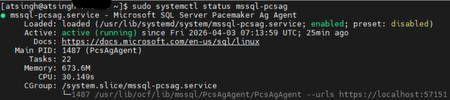
We are excited to introduce the next generation of high availability (HA) Agent for SQL Server on Linux: Pacemaker HA Agent v2. This release is a major step forward, designed to reduce planned and unplanned failover times, compared to the previous agent, based on internal engineering improvements. Why Pacemaker Is Required for SQL Server HA on Linux For users new to Linux, it’s important to understand how high availability works on this platform. On Windows Server, Always On availability groups use an underlying Windows Server Failover Cluster (WSFC) to: Monitor node health Detect failures Orchestrate automatic failovers Always On availability groups on Linux rely on an external cluster orchestrator for health monitoring and failover coordination, with Pacemaker HA Agent being one of the cluster orchestrators, responsible for: Monitoring node and application health Coordinating failover decisions Helping mitigate split‑brain scenarios through improved write‑lease evaluation Managing resources such as availability groups and listeners The Pacemaker HA Agent is the integration layer that allows Pacemaker to understand SQL Server health and manage availability groups safely. Evolution of the SQL Server Pacemaker HA Agent With SQL Server 2025 CU3 and later, Pacemaker HA Agent v2 is available in preview for Red Hat Enterprise Linux and Ubuntu through the mssql-server-ha package. Pacemaker HA agent v2 uses a service‑based architecture. The agent runs as a dedicated system service named mssql-pcsag, which is responsible for handling SQL Server–specific high availability operations and communication with Pacemaker. You can manage mssql-pcsag service by using standard system service controls to start, restart, status and stop this service by using the operating system's service manager (for example, systemctl). # Start the mssql-pcsag service sudo systemctl start mssql-pcsag # Restart the mssql-pcsag service sudo systemctl restart mssql-pcsag # Check the status of the mssql-pcsag service sudo systemctl status mssql-pcsag # Stop the mssql-pcsag service sudo systemctl stop mssql-pcsag Limitations of Pacemaker HA Agent v1 While the original agent enabled SQL Server HA on Linux, customers running production workloads encountered several challenges: Failover delays of 30 seconds to 2 minutes during planned or unplanned events Limited health detection, missing conditions such as I/O stalls and memory pressure Rigid failover behavior, unlike the flexible policies available on Windows (WSFC) Incomplete write‑lease handling, requiring custom logic No support for TLS1.3 for Pacemaker and SQL Server communications How Pacemaker HA Agent v2 Addresses These Gaps Pacemaker HA Agent v2 is a ground‑up improvement, designed to improve the reliability characteristics of SQL Server HA on Linux. 1. Faster & Smarter Failover Decisions The new agent introduces a service‑based health monitoring architecture, moving beyond basic polling. This allows SQL Server to report detailed diagnostic signals - improving detection speed and helping reduce failover delays in supported configurations. 2. Flexible Automatic Failover Policies inspired by the WSFC health model Pacemaker HA Agent v2 supports failure‑condition levels (1–5) and health‑check timeout model aligned with those available in Always On availability groups on Windows. This provides: Fine‑grained control over failover sensitivity, allowing administrators to tune when failover should occur. Improved detection of internal SQL Server conditions, such as memory pressure, internal deadlocks, orphaned spinlocks, and other engine‑level failures. Failover decisions are now driven by detailed diagnostics from sp_server_diagnostics, enabling faster and more accurate response to unhealthy states and providing enhanced resiliency capabilities for SQL Server AG on Linux. You can configure the failure condition level and health check timeout using the following commands: -- Setting failure condition level ALTER AVAILABILITY GROUP pacemakerag SET (FAILURE_CONDITION_LEVEL = 2); -- Setting health check timeout ALTER AVAILABILITY GROUP pacemakerag SET (HEALTH_CHECK_TIMEOUT = 60000); After applying the configuration, validate the setting using the sys.availability_groups DMV: 3. Robust Write Lease Validity Handling To prevent split‑brain scenarios, SQL Server on Linux uses an external write‑lease mechanism. In v1, lease information was not fully integrated into failover decisions. In v2, the agent actively evaluates the write-lease validity, before initiating transitions. This supports controlled role changes and improved data consistency behavior during failover events, depending on cluster configuration. 4. TLS 1.3 Support Pacemaker HA agent v2 includes design updates to support TLS 1.3–based communication for health checks and failover operations, when TLS 1.3 is enabled. Supported Versions & Distributions Pacemaker HA Agent v2 supports: SQL Server 2025 CU3 or later RHEL 9 or later Ubuntu 22.04 or higher. Preview upgrade & migration guidance for non-production environments New or existing non-prod deployments running SQL Server 2025 (17.x) can migrate from Pacemaker HA Agent v1 to v2 using following approach: Drop the existing AG resource sudo pcs resource delete <NameForAGResource> This temporarily pauses AG synchronization but does not delete the availability group (AG). After the resource is recreated, Pacemaker resumes management and AG synchronization automatically. Create a new AG resource using the v2 agent (ocf:mssql:agv2) sudo pcs resource create <NameForAGResource> ocf:mssql:agv2 ag_name=<AGName> meta failure-timeout=30s promotable notify=true Validate cluster health sudo pcs status Resume normal operations References Create and Configure an Availability Group for SQL Server on Linux - SQL Server | Microsoft Learn Thank You, Engineering: David Liao Attinder Pal Singh639Views2likes3CommentsCreating a Contained Availability Group and Enabling Database Creation via CAG Listener
A Contained Availability Group (CAG) is designed to simplify high availability and disaster recovery by encapsulating system databases (master, msdb) within the availability group itself. This means that logins, jobs, credentials, and other metadata are automatically replicated across replicas, eliminating the need for manual synchronization and reducing operational complexity. Starting with SQL Server 2025 CU1, you can create or restore databases directly through the CAG listener - without connecting to the physical instance - by enabling a session context key. Why Contained AGs Matter Self-contained HA unit: Each CAG has its own copy of master and msdb, making it independent of the physical SQL instance. Simplified failover: When the AG fails over, all associated metadata moves with it, ensuring applications continue to function without manual intervention. Improved automation: Supports scenarios where direct access to the SQL instance is restricted, enabling operations through the AG listener. Enhanced security: Reduces exposure by limiting instance-level access; operations can be scoped to the AG context. Streamlined management: Eliminates the need for login and job replication scripts across replicas. Step 1: Prepare the Database for Availability Group This example uses SQL Server on Linux; however, the steps are identical for SQL Server on Windows. In this walkthrough, an existing database named CAGDB is added to a Contained Availability Group (CAG). Before adding the database to the CAG, verify that it is configured for FULL recovery mode and perform a full database backup. ALTER DATABASE CAGDB SET RECOVERY FULL; GO BACKUP DATABASE CAGDB TO DISK = N'/var/opt/mssql/backups/CAGDB.bak' WITH INIT, COMPRESSION; GO Note: On Linux, ensure that the backup target directory exists and is owned by the mssql user. sudo mkdir -p /var/opt/mssql/backups sudo chown mssql:mssql /var/opt/mssql/backups Step 2: Create the Contained Availability Group On your Linux SQL Server nodes, run: CREATE AVAILABILITY GROUP [CAGDemo] WITH ( CLUSTER_TYPE = EXTERNAL, CONTAINED ) FOR DATABASE [CAGDB] REPLICA ON N'node1' WITH ( ENDPOINT_URL = N'tcp://node1:5022', AVAILABILITY_MODE = SYNCHRONOUS_COMMIT, FAILOVER_MODE = EXTERNAL, SEEDING_MODE = AUTOMATIC ), N'node2' WITH ( ENDPOINT_URL = N'tcp://node2:5022', AVAILABILITY_MODE = SYNCHRONOUS_COMMIT, FAILOVER_MODE = EXTERNAL, SEEDING_MODE = AUTOMATIC ); GO #Connect to secondary replicas and join the AG: ALTER AVAILABILITY GROUP [CAGDemo] JOIN WITH (CLUSTER_TYPE = EXTERNAL); ALTER AVAILABILITY GROUP [CAGDemo] GRANT CREATE ANY DATABASE; Step 3: Configure Listener and Connect Create a listener and connect using SSMS or sqlcmd: ALTER AVAILABILITY GROUP [CAGDemo] ADD LISTENER N'CAGDemoListener' ( WITH IP ( (N'*.*.*.*', N'255.255.255.0') ), PORT = 1453 ); GO Step 4: Connect to CAGDemoListener and attempt Database Creation (Failure) When connected through the listener: CREATE DATABASE TestCAGDB; Result:\ Msg 262, Level 14, State 1: CREATE DATABASE is not allowed in this context.\ This happens because database creation is blocked by default in a contained AG session. Step 5: Enable Database Creation in CAG Session or Instance master EXEC sp_set_session_context key = N'allow_cag_create_db', @value = 1; This enables database creation for your current session. Step 6: Retry Database Creation (Success) CREATE DATABASE TestCAGDB; Result: Database created successfully within the contained AG context. Users with dbcreator role in the CAG context can perform this action. Step 7: Backup the database. ALTER DATABASE TestCAGDB SET RECOVERY FULL; BACKUP DATABASE TestCAGDB TO DISK = N'/var/opt/mssql/data/backups/TestCAGDB.bak'; Step 8: Add database to the CAG ALTER AVAILABILITY GROUP [CAGDemo] ADD DATABASE [TestCAGDB]; Optional: To automate Steps 4 - 8, you can create a stored procedure (for example: [dbo].[sp_cag_create_db]) and execute it while connected through the Contained Availability Group (CAG) listener context. CREATE OR ALTER PROCEDURE [dbo].[sp_cag_create_db] @database_name sysname, @createdb_sql NVARCHAR(MAX) = NULL AS BEGIN SET NOCOUNT ON DECLARE @fIsContainedAGSession int EXECUTE @fIsContainedAGSession = sys.sp_MSIsContainedAGSession if (@fIsContainedAGSession = 1) BEGIN DECLARE @SQL NVARCHAR(MAX); EXEC sp_set_session_context = N'allow_cag_create_db', @value = 1; IF @createdb_sql IS NULL SET @SQL = 'CREATE DATABASE ' + QUOTENAME(@database_name); ELSE SET @SQL = @createdb_sql; PRINT @SQL EXEC sp_executesql @SQL; SET @SQL = 'ALTER DATABASE ' + QUOTENAME(@database_name) + ' SET RECOVERY FULL'; PRINT @SQL EXEC sp_executesql @SQL; SET @SQL = 'BACKUP DATABASE ' + QUOTENAME(@database_name) + ' TO DISK = N''NUL'''; PRINT @SQL EXEC sp_executesql @SQL; DECLARE _Name sysname; set _Name = (SELECT name FROM sys.availability_groups ags INNER JOIN sys.dm_exec_sessions des ON ags.group_id = des.contained_availability_group_id WHERE @@SPID = des.session_id); SET @SQL = 'use master; ALTER AVAILABILITY GROUP ' + QUOTENAME(@AG_Name) + ' add DATABASE ' + QUOTENAME (@database_name) PRINT @SQL EXEC sp_executesql @SQL; EXEC sp_set_session_context key = N'allow_cag_create_db', @value = 0; END ELSE BEGIN RAISERROR('This can only be used with a contained availability group connection.', 16, 1); END END GO At a high level, this procedure simplifies database onboarding into a CAG by orchestrating the following actions as a single workflow: Creating (or restoring) the database Setting the recovery model to FULL Taking the initial backup required for availability group seeding Adding the database to the target Contained Availability Group Example: Create a database Execute the following command to create NewTestDB and add it to the target CAG. EXEC [dbo].sp_cag_create_db @database_name = [NewTestDB]; Example: Restore a database The stored procedure also supports an optional parameter, @createdb_sql, which allows you to provide a custom SQL statement to create or restore a database (for example, restoring from a backup). Once the database backup file exists and is accessible to SQL Server, you can use this parameter to perform the operation. Important: When @createdb_sql is used, the procedure executes that SQL statement directly. Ensure the SQL statement is from a secured and trusted source. DECLARE @restoreSql NVARCHAR(MAX); SET @restoreSql = N' RESTORE DATABASE AdventureWorks2022 FROM DISK = ''/var/opt/mssql/backups/AdventureWorks2022.bak'' WITH MOVE ''AdventureWorks2022'' TO ''/var/opt/mssql/data/AdventureWorks2022.mdf'', MOVE ''AdventureWorks2022_log'' TO ''/var/opt/mssql/data/AdventureWorks2022_log.ldf'', RECOVERY; '; EXEC dbo.sp_cag_create_db @database_name = N'AdventureWorks2022', @createdb_sql = @restoreSql; Conclusion Contained Availability Groups represent a major step forward in simplifying high availability for SQL Server. By encapsulating system databases within the AG context, they eliminate the complexity of synchronizing logins, jobs, and credentials across replicas. With the new capability in SQL Server 2025 CU1 to create or restore databases directly through the AG listener using sp_set_session_context, organizations can streamline automation and reduce operational overhead. References What Is a Contained Availability Group Deploy a Pacemaker Cluster for SQL Server on Linux1.1KViews1like0CommentsAnnouncing Preview of bulkadmin role support for SQL Server on Linux
Bulk data import using operations like BULK INSERT and OPENROWSET(BULK…) BULK INSERT (Transact-SQL) - SQL Server | Microsoft Learn is fundamental to ETL and data ingestion workflows. On SQL Server running on Linux, these operations have traditionally required sysadmin privileges, making it difficult to follow least‑privilege security practices. With the preview of BULKADMIN role support for SQL Server on Linux, this gap is addressed. Starting with SQL Server 2025 (17.x) CU3 and SQL Server 2022 CU24, administrators can grant the bulkadmin role or the ADMINISTER BULK OPERATIONS permission to enable bulk imports without full administrative access. This capability has long been available on SQL Server on Windows and is now extended to Linux, bringing consistent and more secure bulk data operations across platforms. Bulk import operation Bulk import operations enable fast, large‑volume data loading into SQL Server tables by reading data directly from external files instead of row‑by‑row inserts. Learn more Use BULK INSERT or OPENROWSET (BULK...) to Import Data to SQL Server - SQL Server | Microsoft Learn Who this is for DBAs, Data engineers, ETL developers and application engineers who want to perform bulk data imports without over‑privileging users. Why this matters Improved security posture: Eliminates the need for sysadmin access for bulk operations, enforcing least‑privilege security principle and reducing security risk. Better operational flexibility: Allows DBAs to safely delegate bulk data ingestion to application, ETL, and operational teams without expanding the attack surface. Parity with SQL Server on Windows: Closes a long‑standing gap between SQL Server on Windows and Linux, simplifying cross‑platform administration. Designed with layered security controls on Linux Bulk operations on Linux continue to enforce additional security checks beyond SQL permissions. Administrators must explicitly configure: Linux file system permissions for the SQL Server service account Approved bulk load directories using mssql-conf (by configuring the path through bulkadmin.allowedpathslist setting in mssql-conf) This ensures, SQL Server can only read data from explicitly allowed locations, reducing the risk of unauthorized file access. Learn more: For a quick overview, the typical flow to enable bulk import operations on SQL Server on Linux looks like this: Install SQL Server 2025 (17.x) CU3 Grant BULKADMIN role or ADMINISTER BULK OPERATIONS permission Configure allowed directories and required filesystem permissions Run bulk import operations using BULK INSERT or OPENROWSET (BULK...) For detailed guidance and example, refer to the official documentation: 👉 Configure bulk import operations for SQL Server on Linux Summary With BULKADMIN role support on SQL Server for Linux, customers can now enable bulk data imports without compromising security. This enhancement delivers better role separation, security best practices, and a smoother operational experience for SQL Server on Linux. We encourage customers to explore this capability and adopt least privileged bulk data workflows in their Linux environments.414Views0likes0CommentsAnnouncing GA of SQL Server 2025 on RHEL 10 and Ubuntu 24.04, with additional enhancements for Linux deployments
We are excited to announce the General Availability (GA) of SQL Server 2025 on Red Hat Enterprise Linux (RHEL) 10 and Ubuntu 24.04, starting with the CU1 release. This milestone empowers enterprises to deploy SQL Server 2025 on the latest Linux distributions, ensuring robust compatibility, enhanced security, and optimal performance for mission-critical workloads. The GA reinforces our commitment to delivering a modern, secure, and AI-ready database platform across diverse Linux environments. CU1 Release Highlights Key Features: Production-Ready Support: GA support for RHEL 10 and Ubuntu 24.04, enabling production deployments on the newest Linux platforms. Important: Update your SQL Server repository To ensure you are installing the production-ready GA version of SQL Server 2025, it is essential to update your repository from mssql-server-preview.repo to mssql-server-2025.repo. Continuing to use the preview repository may result in installing pre-release builds that are not intended for production workloads. You can proceed with the installation steps as described in the official documentation: RHEL: Install SQL Server on Linux Ubuntu: Install SQL Server on Linux Enable database creation or restoration in Contained Availability Group sessions You can now use the session context key 'allow_cag_create_db' set via the existing stored procedure sp_set_session_contex to enable database creation and restoration directly within a contained availability group (CAG) session through the CAG listener. Only users with the dbcreator role can create databases in a CAG session, and only users with the db_owner or sysadmin role can restore databases. Example: EXEC sp_set_session_context @key = N'allow_cag_create_db', @value = 1; This command enables the feature for your session. To disable it, set @value = 0. Enhanced Observability: SQL Server 2025 on Linux introduces new Dynamic Management Views (DMVs) that provides comprehensive, system-level insights. These DMVs collect and expose metrics from the underlying operating system, allowing administrators to monitor and diagnose not only SQL Server’s performance, but also the impact of other processes running on the same host. This holistic visibility helps distinguish between issues caused by SQL Server and those originating from other workloads or infrastructure bottlenecks, enabling more effective troubleshooting and optimization for mission-critical deployments. sys.dm_os_linux_cpu_stats: Enables users to identify CPU saturation, investigate I/O waits, analyze system responsiveness, and correlate SQL Server performance with broader OS activity, helping to separate database-specific bottlenecks from infrastructure-wide challenges. sys.dm_os_linux_disk_stats: Facilitates detection of log flush slowness, assessment of checkpoint or read-heavy workloads, and identification of external I/O pressure from noisy neighbors on shared hosts, helping teams optimize storage tiers and queue settings. sys.dm_os_linux_net_stats: Provides real-time visibility into network interface statistics, enabling proactive monitoring and troubleshooting of connectivity and throughput issues. Collectively, these DMVs equip database professionals with actionable, OS-level metrics to maintain stability, optimize performance, and ensure reliability in mission-critical Linux deployments. References What’s New in SQL Server 2025 Contained Availability Group You can share your feedback using any of the following methods: Submit your ideas on Azure Ideas (Use the SQL Server on Linux Group on the left side of the page) Alternatively, you can open issues: Issues · microsoft/mssql-docker (github.com) on GitHub. We hope you give SQL Server 2025 CU1 on RHEL10 or Ubuntu 24.04 a try - and we look forward to hearing what you think!969Views1like1CommentSQL Server 2025: Deeply Integrated and Feature-rich on Linux
SQL Server continues to power mission-critical workloads across enterprises, and with SQL Server 2025, we’re delivering innovations that redefine performance, security, developer experience, AI innovation and flexibility along with additional features tailored for Linux environments. Momentum on SQL Server for Linux The adoption of SQL Server on Linux has been phenomenal. The public preview of SQL Server 2025 has seen remarkable adoption, with Linux based deployments experiencing substantial growth reflecting strong demand for cross-platform capabilities. Enterprises are embracing Linux for cloud native architectures, containers, and Kubernetes deployments and SQL Server is meeting them where they are, enabling customers to run their modern production workloads seamlessly. We’ve collaborated closely with partners such as Canonical, DH2i, PortWorx, and Red Hat (listed alphabetically) to ensure support for the latest distributions and maintain robust high-availability solutions through clustering stacks provided by our partners What’s new in SQL Server 2025 on Linux Here are the highlights: Security Enhancements TLS 1.3 Support for stronger encryption option for data that is transmitted across a network between the client application and SQL Server instance. For details, refer: Encrypt Connections to SQL Server on Linux - SQL Server | Microsoft Learn Ability to Configure Custom password policies via Active Directory (adutil) or mssql.conf for non-domain setups. This allows you to define parameters like minimum password length similar to Windows domain policies whether or not your SQL Server instance on Linux is domain joined. This upgrade gives SQL Server authentication the flexibility and security that enterprises need. Learn more here: Use Custom Password Policy for SQL Logins on Linux - SQL Server | Microsoft Learn Container Images for SQL Server 2025 are now signed to ensure image integrity. Expanded Platform Support Preview support for RHEL 10 and Ubuntu 24.04, expanding enterprise Linux coverage to include support for latest releases from Red Hat and Canonical. For details refer: Get Started with SQL Server 2025 on RHEL 10- preview and Get started with SQL Server 2025 on Ubuntu 24.04- Preview Starting with SQL Server 2025, SUSE Linux Enterprise Server (SLES) is not supported. If you are currently using SQL Server 2022 or an earlier version on SLES, you will continue to receive cumulative updates and support as outlined in the SQL Server 2022 Lifecycle policy or the relevant policies for earlier versions, with no changes to your existing experience for existing deployments. To upgrade to SQL Server 2025, back up your databases and restore them to a supported distribution. Performance Optimizations Tmpfs Support for SQL Server on Linux: For SQL Server on Linux running on physical machines, virtual machines, or containers, you can now host tempdb data and log files on the tmpfs filesystem. This enhancement significantly improves performance for workloads prone to tempdb disk spills, delivering faster throughput and efficiency in this scenario. For containers-based SQL deployment, you can also host all data and log files including user and system database on the tmpfs filesystem, delivering ultra-fast I/O for development and testing scenarios. However, note that data stored on tmpfs is ephemeral and will be lost when the container restarts. Therefore, only use this option for databases where data loss after restart is acceptable, such as in development or test environments. Learn more about tmpfs support here: Enable and Run tempdb on tmpfs for SQL Server 2025 on Linux - SQL Server | Microsoft Learn Advanced Analytics Generic ODBC Data Source Support with PolyBase Seamlessly query external data sources from Linux-based SQL Server using bring your own driver (BYOD) similar to SQL Server on Windows. This feature uses an external service to securely isolate and load drivers, ensuring safe usage. For details refer: Use ODBC Data Source with SQL Server on Linux - SQL Server | Microsoft Learn Developer Experience VS Code – SQL Server (mssql) Extension: Deploy SQL Server 2025 local containers directly from Visual Studio Code using the SQL Server (mssql) extension for a streamlined developer workflow. For details refer: SQL Server (mssql) - Visual Studio Marketplace Validated Pattern with Red Hat We’ve partnered with Red Hat to deliver a validated deployment pattern for SQL Server on RHEL Supercharging Financial Insights with RAG-Based Search on Microsoft SQL Server. The validated patterns are an advanced form of reference architecture, offering a streamlined approach to deploying complex business solutions. To learn more about Validated patterns and how it's different from traditional reference architecture please refer: About Validated Patterns | Validated Patterns. Quotes from our partners: "The work we’re doing with Microsoft to optimize SQL Server on Red Hat Enterprise Linux is a powerful testament to the strength of our collaboration. With the new features in SQL Server, including support for Red Hat Enterprise Linux 10 and enabling streamlined deployment via Red Hat Ansible Automation Platform, we are making it easier than ever for customers to deploy and manage this critical workload across the hybrid cloud. This collaboration extends beyond just enabling core performance to deliver innovative, validated patterns, such as leveraging Red Hat Enterprise Linux AI with SQL Server for retrieval-augmented generation (RAG) and generative AI scenarios, and providing a more consistent experience for customers, whether they are deploying via the Azure Marketplace or on-premises. Our mutual goal is to minimize complexity, increase confidence and help enterprises harness the full potential of their data and AI investments on a trusted, open foundation." Gunner Hellekson, vice president and general manager, Red Hat Enterprise Linux, Red Hat "The availability of SQL Server 2025 on Ubuntu 24.04 provides developers and enterprises a robust foundation for building and deploying demanding AI-driven applications." Jehudi Castro-Sierra, Public Cloud Alliance Director, Canonical “As a leading provider of high availability and database management software, we're thrilled about the performance enhancements and features added to SQL Server 2025. New capabilities like Vector Search and AI-powered optimization will allow our customers to drive business success through data-driven decision-making, faster query execution, improved throughput, and reduced downtime. The automated tuning and maintenance capabilities will also significantly improve operational efficiency, and reduce the complexity and cost associated with database management. Our participation in the SQL Server 2025 EAP has allowed us to ensure that we will provide comprehensive high availability support for our customers’ mission-critical database deployments of SQL Server 2025, including native TLS 1.3 support for encrypted communications, ensuring modern, secure, and high-performance connectivity across all environments. Whether our customers are deploying native or containerized instances on Windows or Linux, DH2i software solutions will ensure nearest-to-zero downtime and fully automatic failover. Additionally, we will be ready to provide secure and intelligent HA for the complex, cross-platform data estates that our customers will be building to support their SQL Server 2025-backed AI applications.” -OJ Ngo, Co-Founder & CTO, DH2i Learn More Explore the full list of features: What's New for SQL Server 2025 Preview on Linux - SQL Server | Microsoft Learn Join us at Microsoft Ignite for deep-dive sessions and demos.2.3KViews2likes4CommentsUnlocking Enterprise AI: SQL Server 2025 and NVIDIA Nemotron RAG Accelerate AI
Today, most of the world’s data still remains untapped, sitting in databases, documents, and systems across organizations. Enterprises are racing to unlock this data’s value by building the next wave of generative AI applications—solutions that can answer questions, summarize documents, and drive smarter decisions. At the heart of these innovations are retrieval-augmented generation (RAG) pipelines, which enable users to interactively engage with large amount of data that continuously evolves. Yet, as promising as RAG pipelines are, enterprises face real challenges in making them work at scale. Handling both structured and unstructured data, processing massive volumes efficiently, and ensuring privacy and security are just a few hurdles. This is where the integration between SQL Server 2025 and NVIDIA Nemotron RAG models, deployed as NVIDIA NIM microservices, comes in, offering a new approach that streamlines AI deployment and delivers enterprise-grade performance—whether you’re running workloads in the cloud or on-premises. “As AI becomes core to every enterprise, organizations need efficient and compliant ways to bring intelligence to their data,” said Joey Conway, Senior Director of Generative AI software at NVIDIA. “With SQL Server 2025’s built-in AI and NVIDIA Nemotron RAG, deployed as NIM microservices, enterprises can deploy and run AI models close to their data on premises or in the cloud without complex integration, accelerating innovation while maintaining data sovereignty and control.” Overcoming the complexity of generating embeddings at scale Customer challenge Building responsive AI applications using RAG requires converting SQL data into vector embeddings—a process that feeds huge amounts of text through complex neural networks. This is inherently parallel and compute-intensive, often creating performance bottlenecks that prevent real-time data indexing. The result? Slow applications and poor user experiences. Moreover, enterprises need flexibility. Different embedding models excel at different tasks—semantic search, recommendations, classification—and each comes with its own tradeoffs in accuracy, speed, and cost. Businesses want to mix and match models, balance premium performance with budget constraints, and stay resilient against model deprecation or API changes. Furthermore, rapid experimentation and adaptation are key to staying ahead and thus developers want models that offer flexible customization and full transparency. The Solution: SQL Server 2025 + NVIDIA Nemotron RAG SQL Server 2025 brings AI closer to your data, allowing you to natively and securely connect to any model hosted anywhere. You can generate embeddings directly in SQL using extensions to T-SQL —no need for new languages, frameworks, or third-party tools. By connecting SQL Server 2025 to the llama-nemotron-embed-1b-v2 embedding model from NVIDIA, you eliminate bottlenecks and deliver the massive throughput needed for real-time embedding generation. llama-nemotron-embed-1b-v2 is a best in class embedding model that offers multilingual and cross-lingual text question-answering retrieval with long context support and optimized data storage. This model is part of NVIDIA Nemotron RAG models, a collection of extraction, embedding, reranking models, fine-tuned with the Nemotron RAG datasets and scripts, to achieve the best accuracy. These models offer flexible customization, enabling easy fine-tuning and rapid experimentation. They also offer full transparency with open access to models, datasets, and scripts. Llama-nemotron-embed-1b-v2 is the model of choice for embedding workflows, but this high-speed inference pipeline is not limited to this model and can potentially call any optimized AI model as an NVIDIA NIM microservice, seamlessly powering every stage of the RAG pipeline. From multimodal data ingestion and advanced retrieval to reranking, all operations run directly on your data within SQL Server. Such RAG systems can be applied across a wide range of use cases, enabling intelligent, context-aware applications across industries. Customer Benefits: With GPU acceleration and built-in AI of SQL Server 2025, you can achieve optimal inference, ensuring performance that meets the demands of modern applications. Our flexible approach lets you mix and match models to suit different use cases, striking the right balance between accuracy and cost. And with open models that enable vendor flexibility and rapid adaptation, you gain resilience to stay ahead of the curve in an ever-changing AI landscape. Streamlining AI Model Deployment with Enterprise-Grade Confidence Customer Challenge Integrating advanced AI models into enterprise workflows has historically been slow and complex. Specialized teams must manage intricate software dependencies, configure infrastructure, and handle ongoing maintenance—all while navigating the risks of deploying unsupported models in mission-critical environments. This complexity slows innovation, drains engineering resources, and increases risk. The Solution: Simplified, Secure Model Deployment with NVIDIA NIM This collaboration simplifies and de-risks AI deployment. The llama-nemotron-embed-1b-v2 model is available as an NVIDIA NIM microservice for secure, reliable deployment across multiple Azure compute platforms. Prebuilt NIM containers for a broad spectrum of AI models and can be deployed with a single command for easy integration into enterprise-grade AI applications using built-in REST APIs of SQL Server 2025 and just a few lines of code, regardless where you run SQL Server workloads and NVIDIA NIM, on premises or in the cloud. NIM containers package the latest AI models together with the best inference technology from NVIDIA and the community and all dependencies into a ready-to-run container, abstracting away the complexity of environment setup so customers can spin up AI services quickly. Furthermore, NVIDIA NIM is enterprise-grade and is continuously managed by NVIDIA with dedicated software branches, rigorous validation processes, and support. As a result, developers can confidently integrate state-of-the-art AI into their data applications. This streamlined approach significantly reduces development overhead and provides the reliability needed for mission-critical enterprise systems. NVIDIA NIM containers are discoverable and deployable via Microsoft Azure AI Foundry’s model catalog. Customer Benefits Rapid deployment with minimal setup means you can start leveraging AI without specialized engineering, and SQL Server 2025 makes it even easier with built-in support for AI workloads and native REST APIs. Enterprise-grade security and monitoring ensure safe, reliable operations, while SQL Server’s integration with Entra ID and advanced compliance features provide added protection. Direct integration into SQL workflows reduces complexity and risk, and with SQL Server’s hybrid flexibility, you can run seamlessly across on-premises and cloud environments—simplifying modernization while maintaining control. Innovating Without Compromise on Security or Flexibility Customer Challenge Organizations in regulated industries often face a tough choice: adopt powerful AI or maintain strict data residency and compliance. Moving sensitive data to external services is often not an option, and many companies run AI inference workloads both in the cloud and on-premises to balance scalability, privacy, regulatory compliance, and low-latency requirements. The Solution: Flexible, Secure Integration—On-Premises and Cloud SQL Server 2025 enables organizations in regulated environments to securely integrate locally hosted AI models, ensuring data residency and compliance while minimizing network overhead. This architecture boosts throughput by keeping sensitive data on-premises and leveraging SQL Server’s native extensibility for direct model invocation. With SQL Server 2025 and Nemotron RAG, deployed as NVIDIA NIM microservices, you get the best of both worlds. This solution can be seamlessly deployed in the cloud with serverless NVIDIA GPUs on Azure Container Apps (ACA) or on-premises with NVIDIA GPUs on Azure Local. Sensitive data never leaves your secure environment, allowing you to harness the full power of Nemotron models while maintaining complete data sovereignty and meeting the strictest compliance mandates. Customer Benefits SQL Server 2025 helps you maintain compliance by supporting data residency and meeting regulatory standard requirements across regions. Sensitive data stays protected on-premises with enterprise-grade security, including consistent access controls, ledger support, and advanced encryption to minimize risk. At the same time, SQL Server’s hybrid flexibility lets you deploy AI workloads wherever they’re needed—on-premises, in the cloud, or across a hybrid environment—while leveraging built-in AI features like vector search and secure integration with locally hosted models for performance and control. Conclusion: Powering the Next Wave of Enterprise AI The collaboration between Microsoft and NVIDIA is more than a technical integration. It’s designed to help enterprises overcome the toughest challenges in AI deployment. By streamlining vector embedding and vector search, delivering enterprise-grade performance, and enabling secure, flexible integration across cloud and on-premises environments, this joint solution empowers organizations to unlock the full value of their data. Whether you’re building conversational AI, automating document analysis, or driving predictive insights, SQL Server 2025 and NVIDIA Nemotron RAG models, deployed as NIM, provide the tools you need to innovate with confidence. The future of enterprise AI is here and it’s flexible, secure, and built for real business impact. Get started today: Learn more about SQL Server 2025 and download it today Learn more about our joint solution from NVIDIA’s Technical Blog GitHub: Microsoft SQL Server 2025 and NVIDIA Nemotron RAG1.8KViews1like0Comments