sqlserver2022
120 Topics
Announcing SQLCon 2026: Better Together with FabCon!
We’re thrilled to unveil SQLCon 2026, the premier Microsoft SQL Community Conference, co-located with the Microsoft Fabric Community Conference (FabCon) from March 16–20, 2026! This year, we’re bringing the best of both worlds under one roof—uniting the vibrant SQL and Fabric communities for a truly next-level experience. Whether you’re passionate about SQL Server, Azure SQL, SQL in Fabric, SQL Tools, migration and modernization, database security, or building AI-powered apps with SQL, SQLCon 2026 has you covered. Dive into 50+ breakout sessions and 4 expert-led workshops designed to help you optimize, innovate, and connect. Why are SQLCon + FabCon better together? One registration, double the value: Register for either conference and get full access to both—mix and match sessions, keynotes, and community events to fit your interests. Shared spaces, shared energy: Enjoy the same expo hall, registration desk, conference app, and community lounge. Network with peers across the data platform spectrum. Unforgettable experiences: Join us for both keynotes at the State Farm Arena and celebrate at the legendary attendee party at the Georgia Aquarium. Our goal is to reignite the SQL Community spirit—restoring the robust networks, friendships, and career-building opportunities that make this ecosystem so special. SQLCon is just the beginning of a renewed commitment to connect at conferences, user groups, online, and at regional events. Early Access Pricing Extended! Register by November 14th and save $200 with code SQLCMTY200. Register Now! Want to share your expertise? The Call for Content is open until November 20th for both conferences! Let’s build the future of data—together. See you at SQLCon + FabCon!7.8KViews8likes1CommentUpcoming changes for SQL Server Management Studio (SSMS) - Part 2
This is the second post in a series of three about SQL Server Management Studio, and upcoming changes to the SSMS 20 connection dialog. This post also announces the SSMS 20 Preview 1 build, which is available to download.18KViews7likes7CommentsAnnouncement: New Features and changes to SQL IaaS Agent Extension
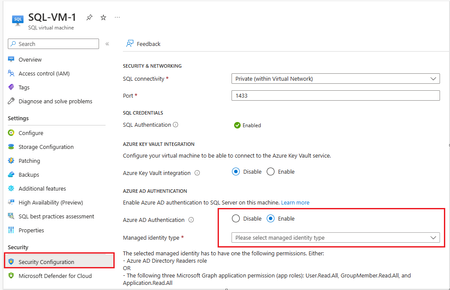
SQL Server on Azure Virtual Machines is powered by the SQL IaaS Agent extension which provides many features that make managing your SQL Server easy. This blog will discuss new features and changes we’ve recently released in this extension. Retiring Modes: SQL IaaS Agent extension traditionally used to have two modes, Lightweight and Full mode. In the Lightweight mode, customers were able to do license management, whereas the Full mode offers all the other manageability features. This differentiation of modes made it tough for customers to adopt the manageability features that the SQL IaaS agent extension offers. To address this, starting today there will be no management modes for SQL IaaS agent extension. Going forward, customers register with the SQL IaaS Agent extension and enable the required features they would like for their SQL Server on Azure virtual machines. Based on the features selected, the SQL IaaS agent extension would assume only the permissions required on the SQL Server to enable those features. If no features are enabled, there will be no Windows services installed. Upon enabling a specific feature, the extension will create Windows services to perform the tasks required by the feature. Licensing mode changes do not require any Windows services and can be managed from the SQL VM (virtual machines) portal immediately after the SQL IaaS Agent extension is enabled. Announcing General Availability of AAD authentication for SQL Server on Azure VMs: AAD authentication is one of the most important features that is introduced in SQL Server 2022. Enabling this feature is easy when you run your workload on Azure VMs. Customers simply need to follow 3 steps to get this enabled. Choose the managed identity they would like to use to enable AAD authentication. Both system and user-managed identities are supported. Make sure the selected managed identity has the necessary permissions in AAD. Please follow the instructions mentioned here to give the required permission. Click on Apply to enable AAD authentication. With GA, Azure also will check whether required permissions were assigned to the managed identity selected before going ahead and starting the deployment, hence customers do not have to wait for the deployment to complete to validate whether the specified managed identity has the correct permissions. Auto upgrade of the SQL IaaS Agent extension: SQL IaaS agent extension adds new features and improvements over time and customers currently get these features through lazy upgrades. A lazy upgrade occurs whenever a customer interacts with SQL VM portal or through CLI. Customers often want to keep extensions in all their VMs on the same version. This new auto upgrade option will keep all the SQL VMs on the same version of extension by upgrading extension to the latest version every month. This is now a default feature for all the new VMs being deployed in Azure. VMs that are already deployed can take advantage of this by going to the SQL VM portal and going to SQL IaaS Agent Extension Settings page.6.7KViews5likes0Comments
Cumulative Update #18 for SQL Server 2022 RTM
The 18th cumulative update release for SQL Server 2022 RTM is now available for download at the Microsoft Downloads site. Please note that registration is no longer required to download Cumulative updates. To learn more about the release or servicing model, please visit: CU18 KB Article: https://learn.microsoft.com/troubleshoot/sql/releases/sqlserver-2022/cumulativeupdate18 Starting with SQL Server 2017, we adopted a new modern servicing model. Please refer to our blog for more details on Modern Servicing Model for SQL Server Microsoft® SQL Server® 2022 RTM Latest Cumulative Update: https://www.microsoft.com/download/details.aspx?familyid=105013 Update Center for Microsoft SQL Server: https://learn.microsoft.com/en-us/troubleshoot/sql/releases/download-and-install-latest-updates4.9KViews4likes0CommentsAnnouncing General Availability of the mssql-python Driver
We’re thrilled to announce that the mssql-python driver is now Generally Available! 🎉 This milestone marks a major step forward in delivering a modern, high-performance, and developer-friendly experience for Python developers working with SQL Server, Azure SQL and SQL databases in Fabric. Why mssql-python? The mssql-python driver is a DB-API 2.0 compliant driver designed from the ground up to provide speed, simplicity, and security for Python applications connecting to SQL Server. We think data and devops engineers, analysts, and developers who use Python for configuration, analysis or AI will all find something they like. Here’s what makes it stand out: 🚀 Fast and Cross-platform The mssql-python driver is built on an optimized C++ core that delivers high performance and a consistent API across operating systems. Internal benchmarks show that the mssql-python driver performs well across common SQL operations such as SELECT, INSERT, UPDATE, and DELETE. Complex queries, joins, and stored procedures also perform well, making it ideal for both transactional and analytical workloads. 📦 One-Line Installation Whether you are just getting started or sharing scripts you have written, the mssql_python driver makes it easier than ever. Install the driver with a single command: pip install mssql-python No extra dependencies on Windows, no complicated configurations - just install and start coding. 🔐 Simplified Entra ID Authentication Security shouldn’t be hard. The mssql-python driver offers built-in support for Microsoft Entra ID (formerly Azure AD) authentication, reducing complexity and eliminating the need for custom token handling. This makes it easier to build secure, enterprise-grade applications without extra overhead. The mssql-python driver supports Active Directory Default authentication across all operating systems, making it easier to remove credentials from your code while still allowing you to share a script that just works. Key Highlights Cross-Platform Support: Works seamlessly on Windows, Linux, and macOS (including Apple Silicon). Connection Pooling: Efficient, configurable pooling for high-performance applications. Modern Python Experience: Clean APIs, better diagnostics, and improved error handling. Get Started Today Upgrade your Python data workflows with the new mssql-python driver: pip install mssql-python Check out the GitHub repository for documentation, examples, and to join the community. You can also go directly to our PyPI page to download the latest release. Visit the aka.ms/mssql-python#get-started to view more quickstarts. What’s Next? We’re committed to continuous improvement. Upcoming releases will focus on bulk insert optimizations, ORM integrations, and community-driven enhancements. Stay tuned for updates and share your feedback on GitHub!5KViews3likes0CommentsSQL Server 2022 for RHEL 9 and Ubuntu 22.04 is now Generally Available (GA)
We are happy to announce that Starting CU 10 release for SQL Server 2022 , SQL Server 2022 on RHEL 9 and Ubuntu 22.04 is now generally available (GA), meaning you can run production workload on SQL Server 2022 deployed on Red Hat Enterprise Linux (RHEL) 9 and Ubuntu 22.04. For SQL Server 2022 on RHEL 9, the SELinux integration that enables you to run SQL Server 2022 on RHEL 9 as confined application is also now generally available. If you've had the preview packages installed previously, we recommend that you please uninstall the preview bits and upgrade to SQL Server 2022 GA packages available at the following repos, for steps on how to update repos refer the Configure repositories for installing and upgrading SQL Server on Linux - SQL Server | Microsoft Learn documentation. For RHEL 9 use the repo: https://packages.microsoft.com/config/rhel/9/ For Ubuntu 22.04 use the repo: https://packages.microsoft.com/config/ubuntu/22.04/ For further details on getting started with the installation of SQL Server 2022 on RHEL 9 refer: RHEL: Install SQL Server on Linux - SQL Server | Microsoft Learn & for SQL Server on Ubuntu 22.04 refer: Ubuntu: Install SQL Server on Linux - SQL Server | Microsoft Learn SQL Server 2022 container images on RHEL 9 & Ubuntu 22.04 also generally available: SQL Server 2022 on RHEL 9 and Ubuntu 22.04 are also available as container images and generally available (GA). It is easy for you to get started. Like always, you can use both podman and/or docker tool. To pull and run the production ready SQL Server 2022 images on RHEL 9 use the tag: 2022-CU10-rhel-9.1 #Pull the image podman pull mcr.microsoft.com/mssql/rhel/server:2022-CU10-rhel-9.1 #Run a container using the above image podman run -e 'ACCEPT_EULA=Y' -e 'MSSQL_SA_PASSWORD=<YourP@ssword>' -e 'MSSQL_PID=Developer' -h sql22rhel9 --name sql22rhel9 -p 1433:1433 -d mcr.microsoft.com/mssql/rhel/server:2022-CU10-rhel-9.1 To pull and run the production ready SQL Server 2022 images on Ubuntu 22.04 use the tag: 2022-CU10-ubuntu-22.04 #Pull the image docker pull mcr.microsoft.com/mssql/server:2022-CU10-ubuntu-22.04 #Run a container use the above image docker run -e 'ACCEPT_EULA=Y' -e 'MSSQL_SA_PASSWORD=<YourP@ssword>' -e 'MSSQL_PID=Developer' -h sql22ubu2204 --name sql22ubu2204 -p 1433:1433 -d mcr.microsoft.com/mssql/server:2022-CU10-ubuntu-22.048.5KViews3likes6Comments