onedrive
634 Topics
OneDrive Shared Files Not Appearing in “Shared” or Windows 11 File Explorer
Hi everyone, I'm experiencing some issues with shared files in my personal OneDrive and was wondering if anyone has encountered a similar problem or knows how to fix it. Here's the situation: I've shared several Excel files with a friend. Whenever I share a file, she receives an email with a link that allows her to open and edit it without any problems. However, despite the sharing process being successful, the files don't appear in her “Shared” or “Shared with you” section, either on the OneDrive website or in the OneDrive folder on her Windows 11 PC. The only way she can access the files is by going back to the original sharing emails and clicking the links each time. I've already checked the permissions, and both read and write access are correctly configured. However, I haven't been able to find a way to make the files appear directly in her OneDrive or have them synced to her PC. Does anyone have any suggestions or know how to resolve this issue? Thanks in advance for your help!20Views0likes1CommentSimple, Smart, and Secure: The next step in sharing files in Microsoft 365
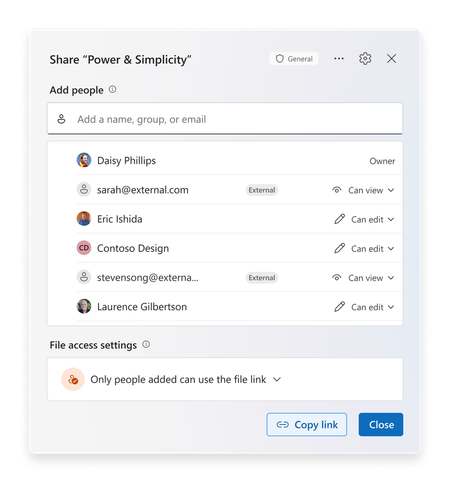
Today at the Microsoft 365 Community Conference, we announced the next generation of sharing for Microsoft 365. Not just an experience refresh, this year we are improving the underlying model that enables collaboration within oM365. We are making it simpler to use, more intelligent, and ensuring that users can keep their content secure by default. In 2011, the cloud revolutionized collaboration and SharePoint Online launched with direct permissioning to enable sharing. Three years later, the on-going cloud transformation led to the invention of “link-based sharing” to allow users to forward and share URLs that grant access within defined, yet secure scopes. Over the last decade, collaboration flourished with over 1.2 Billon people using the share dialog in M365 per month. But as we look ahead, we see new demands emerging to meet the needs of collaborative, agentic workplaces. We are excited to give you a walkthrough of the third generation of sharing in Microsoft 365 and introduce the hero link, the power behind the next decade of collaboration. Meet the hero link The next generation of sharing makes you the hero of collaboration! Each file gets a single hero link which controls all access to the file. Whether you’re clicking “Copy Link”, sending an e-mail, or yes, even copying the URL out of the address bar, it’s all the hero link! This removes the need to create, delete, and manage multiple links on your files, creating a vastly simpler experience. Sharing files with your company has never been easier: simply update the hero link and anyone with the link in your company will get access. Need to lock down a file? Change the link to only allow access for people you directly add, keeping your files secured. We know that users don’t always check file permissions before they send out a link, which can lead to frustrating “Access Denied” page. With hero links, users are empowered to update the link that they already sent, enabling them to quickly increase or decrease the scope of the hero link to match their needs. Secure by default Every hero link starts by working for only the people who have already been added to the document. As users embark on their collaboration journey, they can add more people and teams directly to the document or update the hero link as needed to broaden access. For files that are shared externally, the new share experience explicitly tags external users and guests to make sure they stand out and can be managed appropriately. Administrators will be able to change this default on a per-site collection or OneDrive basis, as needed. With the next generation of sharing, users can further secure their content by controlling who can add people or update access of the file or folder, which gives users the granular control they need to protect their most important content. At a glance access The next generation of sharing requires easy understanding of not only who has access to a file, but how they have access. The Share Dialog and Manage Access experiences are now unified into a single, powerful interface, ensuring users can see and manage their documents and folders with effortless precision. Updates to permissions now appear in real-time, giving users confidence and real-time feedback as they share! With this new sharing model, you can now update permissions in bulk. It is now easier than ever to change or remove permissions for multiple people in a single session. Changes appear instantly, helping you stay in control! If a user wants additional granularity, they can even create additional sharing links to be used for specific purposes. These links can even be named, to help users track and assign them to specific tasks. Copilot + Sharing Save time for your coworkers and keep your team up to speed by using Copilot when you share. With a single click, generate a summary of your document that will be included in the notification mail. Recipients can now understand what the file is about, without needing to open it and read the content. This is a great way to save time and help get your collaborators up to speed! Choose when you notify Have you ever had those days where your notifications are going crazy from teammates adding you to files? We hear your frustration-and we are happy to tell you that you can now choose whether to send an e-mail notification or not when you add people to your file. This update puts you in control of how you share and notify teammates – simply check the box or not based on your preference! This control is critical when you’re bringing a colleague up to speed on multiple documents, or just want to make sure that your file is shared correctly before incorporating into a SharePoint News Post or Amplify! Looking Ahead This new sharing experience and model will be rolling in late 2025! You can track the latest timelines and updates via the Microsoft 365 Message Center or the Microsoft 365 Roadmap (ID: 492622). We know change management is top of mind with any product change, and especially one’s as critical to your organization as collaboration.In addition to the standard updates at Microsoft Docs, we’ll also be uploading how to videos for end users and IT Pros to the Microsoft Community Learning YouTube Channel, walking through the changes in depth on the Sync Up Podcast and in the OneDrive Customer Office Hours. We’re excited to share the future with you! Frequently Asked Questions We know how important collaboration is to your organization! Here are answers to a few of the common questions we’ve heard! If you have others, let us know in the comments below! Q - What do I need to do to prepare for this change? A – For now, keep an eye on the roadmap id and Message Center for more information! As we get closer to release, we’ll ensure you have the content you need to update and prepare your users, admins and security teams. Q - What happens to my existing collaboration experience? A – Nothing! The new sharing model is fully backwards compatible. All the links and permissions you have today will continue to work and will show up in the “Other Links” section of the dialog! Q - Where will this change happen? A - Everywhere! OneDrive powers the sharing experience across 64 apps in M365. This change will be updated consistently across the entire ecosystem.39KViews18likes48Comments
OneDrive won't reinstall after Force Removal with Geek Uninstaller: existing OneDrive instance"error
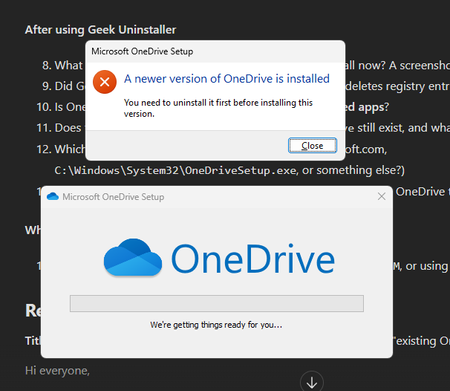
a { text-decoration: none; color: #464feb; } tr th, tr td { border: 1px solid #e6e6e6; } tr th { background-color: #f5f5f5; } Hi everyone, I have a OneDrive problem that started as a sign-in issue and has now turned into an install issue. At this point OneDrive won't reinstall on my laptop at all. Setup Laptop: my own personal device (not managed by my school), about 2 years old, Windows reinstalled several times OS: Edition Windows 11 Pro Version 25H2 Installed on 15.04.2026 OS build 26200.9457 Experience Windows Feature Experience Pack 1000.26100.360.0 Account: school Microsoft 365 account OneDrive: downloaded from the official Microsoft website The original problem When I tried to sign in to OneDrive with my school account, it got stuck in a loading loop right after I entered my email address. It never got any further, so I could never sync my files locally. We don't know what caused it, and no error code ever came up. Signing in with the same school account works fine in other apps like Teams and Outlook. Only OneDrive has the problem. I wasn't able to test with any account other than my own. What we tried with the school IT office Disconnected my school account from Windows (Settings → Accounts → Access work or school) and signed in again Uninstalled and reinstalled OneDrive Reset OneDrive with: %localappdata%\Microsoft\OneDrive\onedrive.exe /reset None of this fixed the sign-in loop. Where it broke completely Next, the IT staff removed OneDrive with Geek Uninstaller using "Force Removal". Since then, the OneDrive installer from the Microsoft website won't run. It says there is already a OneDrive instance on the PC that has to be removed first: Current state OneDrive is not listed under Settings → Apps → Installed apps The folder %localappdata%\Microsoft\OneDrive no longer exists So I can't find any visible trace of OneDrive, but the installer still thinks it's installed I haven't run sfc /scannow or DISM yet, and I haven't tested with a new Windows user What I'm looking for I'd really like to avoid reinstalling Windows again, especially since OneDrive might fail the same way afterwards. I'm hoping for either: A way to clean up whatever is left of OneDrive so it installs properly again, or A workaround to use my OneDrive files locally (in File Explorer, not only in the browser) Thanks to everyone who reads this. I hope it helps others with the same problem too. -Kemal :)137Views0likes4Comments
OneDrive + Copilot event — Your file system and photo solution for the AI era
Your files are more than documents. They're the ideas, projects, and moments that move work and life forward. Discover how OneDrive is evolving for the AI era, helping you move from files to outcomes with intelligence built into the experiences you use every day. 🔴 LIVE AMA INCLUDED This event includes a live Ask Microsoft Anything (AMA). To submit your question, login or create an account and submit your question below as a Comment. Register here and explore OneDrive resources: https://aka.ms/OneDriveEvent Additional links: OneDrive Customer Office Hours: https://aka.ms/OneDriveOfficeHours Listen to the Sync Up podcast: https://aka.ms/SyncUp Explore the OneDrive community: https://aka.ms/OneDriveBlog #Microsoft #OneDrive #Copilot #DigitalEvent #OneDriveEvent670Views0likes0Comments
Recuperação do Onedrive não funciona.
Não sei o que aconteceu, mas nos dias 04 e 08, dois dias que não acessei meu onedrive, milhares de arquivos meus foram deletados. Foram parar na lixeira, tentei de várias formas restaurá-los, mas o onedrive não permite restaurar todos de uma vez e depois de horas tentando, percebi que nunca iria conseguir terminar. Resolvi tentar a restauração do onedrive para o dia 04/09 as 00h00, mas a restauração nunca funciona, para pelo meio do caminho e a todo instante pede nova autenticação, tornando também inviável a recuperação dos arquivos. Não posso perdê-los e amanhã é o prazo de retenção dos arquivos e isso se tornará irreversível. Preciso de ajuda URGENTE para resolver esse problema, pois nada está funcionando e não encontro respostas para solucioná-lo. Tenho várias imagens de tela gravadas provando que depois de horas, nunca sai do 0% e também das constantes solicitações de verificação que impedem a restauração de forma funcional. Espero realmente que resolvam esse problema e restaurem meu onedrive por completo para o dia 04/09 as 00h00 ou precisarei tomar as medidas necessárias por terem eliminado definitivamente meus arquivos sem que eu tivesse a chance de recuperá-los. Agradeço a atenção e aguardo providências URGENTES!226Views0likes2CommentsSave the Date: Join us October 20 for the OneDrive + Copilot Digital Event
Files and photos are at the center of how we work, create, and collaborate. As AI and Copilot transform the way we use content, OneDrive is evolving for this era - helping people get more from their files with Copilot, delivering a faster and more dependable core file experience, making collaboration effortless, and creating new ways to discover, enjoy, and share photos and videos. So, join us on October 20 for the 4th Annual OneDrive + Copilot Digital Event, a free online experience showcasing the latest innovations across OneDrive and Copilot. ✨ Hear directly from Jeff Teper, Executive Vice President of Microsoft Apps and Agents, Adam Harmetz, Corporate Vice President of Product, OneDrive and SharePoint, and Arwa Tyebkhan, Head of Product, OneDrive, alongside product leaders, engineers, and experts from across the OneDrive team as they share the latest innovations, demonstrating how AI is transforming the way people work with files and content. 💡 You'll see real product demos, hearing from the people building the product, and get a closer look at the experiences that will help you get the most out of OneDrive and Microsoft 365. 🗣️ Following the broadcast, you are invited to join our live Q&A with members of the OneDrive team and get answers directly from the experts behind the product. Event Details Event: OneDrive + Copilot - Your file system and photo solution for the AI Era Date: October 20, 2026, 9:00 AM PST Cost: Free Format: Digital event followed by a live Q&A Register here: https://aka.ms/OneDriveEvent Join the AMA Live: https://aka.ms/OneDriveEventonMTC This event is open to everyone – whether you’re an IT professional, a knowledge worker, or a fan who uses OneDrive to relive your favorite memories! Register today and join us to see what's next for OneDrive in the Copilot and AI era. See you there!2.9KViews3likes1CommentWorking with ONE DRIVE
Good evening, everyone. I’d like to ask a few questions about OneDrive: If I have OneDrive active and am working on a Word document stored on my local drive, when I finish and click "Save," where is it saved—locally or on OneDrive? If I pause synchronization with OneDrive—or, better yet, uninstall the OneDrive app—what happens to the files currently in the OneDrive cloud? Will they be lost? I would appreciate your feedback. Regards. Luis Fernando.200Views0likes2Comments
MCP Integration for OneDrive/SharePoint
Hi OneDrive Team, I'm reaching out to explore Model Context Protocol (MCP) server integration for OneDrive and SharePoint. I am looking to integrate OneDrive/SharePoint data access into ThoughtSpot application using MCP solution. Are there existing MCP server implementations (official or community-driven) for OneDrive/SharePoint? If available, what are the connection endpoints and authentication details needed to set up the MCP server? If no MCP server currently exists, are there any upcoming plan on this and is there any alternate recommended approach present. Also could you please provide a SPOC from your team who can support further discussions and technical guidance on this integration? I'd like to schedule a follow-up conversation to explore the best path forward and discuss the use case. Thanks in advance for your help.182Views0likes0CommentsOneDrive stuck on "Processing 7 changes" for weeks. Can't identify what the 7 files are.
After upgrading from windows 10 to 11 and reinstalling onedrive several weeks ago, it got stuck "processing 7 changes". It was actually more than 7 at first, but I was able to find some of the files that were stuck and deleting them reduced the number to 7. But now I can't find the last 7 that are stuck processing. The files I managed to find had the wheel icon that indicates they are syncing, but I can't find any more files with that icon now. I have thousands of files in thousand of folders/subfolders, so I can't manually check every folder to see if a file has the syncing icon. Other than that everything seems to be working. Onedrive syncs new files and downloads files on demand correctly. It's just that "processing 7 changes" message never goes away. If Onedrive named the files it was trying to process, I could easily go to them and delete or replace them, but there doesn't seem to be a way to identify the files.286Views0likes1CommentIntroducing Markdown support in SharePoint and OneDrive
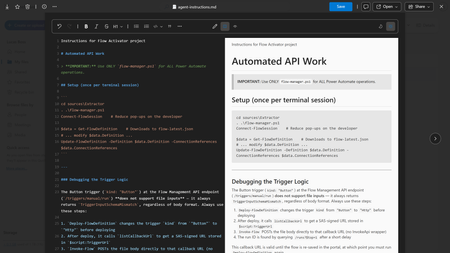
Today, we’re introducing native Markdown support in SharePoint and OneDrive, now rolling out to general availability across both consumer and commercial audiences. As AI and agents increasingly create and update Markdown files to carry out work, teams need a reliable place to manage that content. SharePoint and OneDrive make it easy to view and edit these files in the browser when precision, intent, or changes are required, with built‑in versioning and governance. Markdown files are now fully integrated into the Microsoft 365 file experience, behaving like any other file in your workflow.53KViews4likes16Comments