msignite
3 TopicsGenerally Available: Azure SQL Managed Instance Next-gen General Purpose
Overview Next-gen General Purpose is the evolution of General Purpose service tier that brings significantly improved performance and scalability to power up your existing Azure SQL Managed Instance fleet and helps you bring more mission-critical SQL workloads to Azure. We are happy to announce that Next-gen General Purpose is now Generally Available (GA) delivering even more scalability, flexibility, and value for organizations looking to modernize their data platform in a cost-effective way. The new #SQLMINextGen General Purpose tier delivers a built-in performance upgrade available to all customers at no extra cost. If you are an existing SQL MI General Purpose user, you get faster I/O, higher database density, and expanded storage - automatically. Summary Table: Key Improvements Capability Current GP Next-gen GP Improvement Average I/O Latency 5-10 ms 3-4 ms 2x lower Max Data IOPS 30-50k 80k 60% better Max Storage 16 TB 32 TB 2x better Max Databases/Instance 100 500 5x better Max vCores 80 128 40% better But that’s just the beginning. The new configuration sliders for additional IOPS and memory provide enhanced flexibility to tailor performance according to your requirements. Whether you require more resources for your application or seek to optimize resource utilization, you can adjust your instance settings to maximize efficiency and output. This release isn’t just about speed - It’s about giving you improved performance where it matters, and mechanisms to go further when you need them. Customer story - A recent customer case highlights how Hexure reduced processing time by up to 97.2% using Azure SQL Managed Instance on Next-gen General Purpose. What’s new in Next-gen General Purpose (Nov 2025)? 1. Improved baseline performance with the latest storage tech Azure SQL Managed Instance is built on Intel® Xeon® processors, ensuring a strong foundation for enterprise workloads. With the next-generation General Purpose tier, we’ve paired Intel’s proven compute power with advanced storage technology to deliver faster performance, greater scalability, and enhanced flexibility - helping you run more efficiently and adapt to growing business needs. The SQL Managed Instance General Purpose tier is designed with full separation of compute and storage layers. The Classic GP version uses premium page blobs for the storage layer, while the Next-generation GP tier has transitioned to Azure’s latest storage solution, Elastic SAN. Azure Elastic SAN is a cloud-native storage service that offers high performance and excellent scalability, making it a perfect fit for the storage layer of a data-intensive PaaS service like Azure SQL Managed Instance. Simplified Performance Management With ESAN as the storage layer, the performance quotas for the Next-gen General Purpose tier are no longer enforced for each database file. The entire performance quota for the instance is shared across all the database files, making performance management much easier (one fewer thing to worry about). This adjustment brings the General Purpose tier into alignment with the Business Critical service tier experience. 2. Resource flexibility and cost optimization The GA of Next-gen General Purpose comes together with the GA of a transformative memory slider, enabling up to 49 memory configurations per instance. This lets you right-size workloads for both performance and cost. Memory is billed only for the additional amount beyond the default allocation. Users can independently configure vCores, memory, and IOPS for optimal efficiency. To learn more about the new option for configuring additional memory, check the article: Unlocking More Power with Flexible Memory in Azure SQL Managed Instance. 3. Enhanced resource elasticity through decoupled compute and storage scaling operations With Next-gen GP, both storage and IOPS can be resized independently of the compute infrastructure, and these changes now typically finish within five minutes - a process known as an in-place upgrade. There are three distinct types of storage upgrade experiences depending on the kind of storage upgrade performed and whether failover occurs. In-place update: same storage (no data copy), same compute (no failover) Storage re-attach: Same storage (no data copy), changed compute (with failover) Data copy: Changed storage (data copy), changed compute (with failover) The following matrix describes user experience with management operations: Operation Data copying Failover Storage upgrade type IOPS scaling No No In-place Storage scaling* No* No In-place vCores scaling No Yes** Re-attach Memory scaling No Yes** Re-attach Maintenance Window change No Yes** Re-attach Hardware change No Yes** Re-attach Update policy change Yes Yes Data copy * If scale down is >5.5TB, seeding ** In case of update operations that do not require seeding and are not completed in place (examples are scaling vCores, scaling memory, changing hardware or maintenance window), failover duration of databases on the Next-gen General Purpose service tier scales with the number of databases, up to 10 minutes. While the instance becomes available after 2 minutes, some databases might be available after a delay. Failover duration is measured from the moment when the first database goes offline, until the moment when the last database comes online. Furthermore, resizing vCores and memory is now 50% faster following the introduction of the Faster scaling operations release. No matter if you have end-of-month peak periods, or there are ups and downs of usage during the weekdays and the weekend, with fast and reliable management operations, you can run multiple configurations over your instance and respond to peak usage periods in a cost-effective way. 4. Reserved instance (RI) pricing With Azure Reservations, you can commit to using Azure SQL resources for either one or three years, which lets you benefit from substantial discounts on compute costs. When purchasing a reservation, you'll need to choose the Azure region, deployment type, performance tier, and reservation term. Reservations are only available for products that have reached general availability (GA), and with this update, next-generation GP instances now qualify as well. What's even better is that classic and next-gen GP share the same SKU, just with different remote storage types. This means any reservations you've purchased automatically apply to Next-gen GP, whether you're upgrading an existing classic GP instance or creating a new one. What’s Next? The product group has received considerable positive feedback and welcomes continued input. The initial release will not include zonal redundancy; however, efforts are underway to address this limitation. Next-generation General Purpose (GP) represents the future of the service tier, and all existing classic GP instances will be upgraded accordingly. Once upgrade plans are finalized, we will provide timely communication regarding the announcement. Conclusion Now in GA, Next-gen General Purpose sets a new standard for cloud database performance and flexibility. Whether you’re modernizing legacy applications, consolidating workloads, or building for the future, these enhancements put more power, scalability, and control in your hands - without breaking the bank. If you haven’t already, try out the Next-gen General Purpose capabilities for free with Azure SQL Managed Instance free offer. For users operating SQL Managed Instance on the General Purpose tier, it is recommended to consider upgrading existing instances to leverage the advantages of next-gen upgrade – for free. Welcome to #SQLMINextGen. Boosted by default. Tuned by you. Learn more What is Azure SQL Managed Instance Try Azure SQL Managed Instance for free Next-gen General Purpose – official documentation Analyzing the Economic Benefits of Microsoft Azure SQL Managed Instance How 3 customers are driving change with migration to Azure SQL Accelerate SQL Server Migration to Azure with Azure Arc4.6KViews5likes4Comments2025 Year in Review: What’s new across SQL Server, Azure SQL and SQL database in Fabric
What a year 2025 has been for SQL! ICYMI and are looking for some hype, might I recommend you start with this blog from Priya Sathy, the product leader for all of SQL at Microsoft: One consistent SQL: The launchpad from legacy to innovation. In this blog post, Priya explains how we have developed and continue to develop one consistent SQL which “unifies your data estate, bringing platform consistency, performance at scale, advanced security, and AI-ready tools together in one seamless experience and creates one home for your SQL workloads in the era of AI.” For the FIFTH(!!) year in a row (my heart is warm with the number, I love SQL and #SQLfamily, and time is flying), I am sharing my annual Year in Review blog with all the SQL Server, Azure SQL and SQL database in Fabric news this year. Of course, you can catch weekly episodes related to what’s new and diving deeper on the Azure SQL YouTube channel at aka.ms/AzureSQLYT. This year, in addition to Data Exposed (52 new episodes and over 70K views!). We saw many new series related to areas like GitHub Copilot, SSMS, VS Code, and Azure SQL Managed Instance land in the channel, in addition to Data Exposed. Microsoft Ignite announcements Of course, if you’re looking for the latest announcements from Microsoft Ignite, Bob Ward and I compiled this slide of highlights. Comprehensive list of 2025 updates You can read this blog (or use AI to reference it later) to get all the updates and references from the year (so much happened at Ignite but before it too!). Here’s all the updates from the year: SQL Server, Arc-enabled SQL Server, and SQL Server on Azure VMs Generally Available SQL Server 2025 is Now Generally Available Backup/Restore capabilities in SQL Server 2025 SQL Server 2025: Deeply Integrated and Feature-rich on Linux Resource Governor for Standard Edition Reimagining Data Excellence: SQL Server 2025 Accelerated by Pure Storage Security Update for SQL Server 2022 RTM CU21 Cumulative Update #22 for SQL Server 2022 RTM Backup/Restore enhancements in SQL Server 2025 Unified configuration and governance Expanding Azure Arc for Hybrid and Multicloud Management US Government Virginia region support I/O Analysis for SQL Server on Azure VMs NVIDIA Nemotron RAG Integration Preview Azure Arc resource discovery in Azure Migrate Multicloud connector support for Google Cloud Migrations Generally Available SQL Server migration in Azure Arc Azure Database Migration Service Hub Experience SQL Server Migration Assistant (SSMA) v10.3, including Db2 SKU recommendation (preview) Database Migration Service: PowerShell, Azure CLI, and Python SDK SQL Server Migration Assistant (SSMA) v10.4, including SQL Server 2025 support, Oracle conversion Copilot Schema migration support in Azure Database Migration Service Preview Azure Arc resource discovery in Azure Migrate Azure SQL Managed Instance Generally Available Next-gen General Purpose Service Tier Improved connectivity types in Azure SQL Managed Instance Improved resiliency with zone redundancy for general purpose, improved log rate for business critical Apply reservation discount for zone redundant Business Critical databases Free offer Windows principals use to simplify migrations Data exfiltration improvements Preview Windows Authentication for Cloud-Native Identities New update policy for Azure SQL Managed Instance Azure SQL Database Generally Available LTR Backup Immutability Free Azure SQL Database Offer updates Move to Hyperscale while preserving existing geo-replication or failover group settings Improve redirect connection type to require only port 1433 and promote to default Bigint support in DATEADD for extended range calculations Restart your database from the Azure portal Replication lag metric Enhanced server audit and server audit action groups Read-access geo-zone redundant storage (RA-GZRS) as a backup storage type for non-Hyperscale Improved cutover experience to Hyperscale SLA-compliant availability metric Use database shrink to reduced allocated space for Hyperscale databases Identify causes of auto-resuming serverless workloads Preview Multiple geo-replicas for Azure SQL Hyperscale Backup immutability for Azure SQL Database LTR backups Updates across SQL Server, Azure SQL and Fabric SQL database Generally Available Regex Support and fuzzy-string matching Geo-replication and Transparent Data Encryption key management Optimized locking v2 Azure SQL hub in the Azure portal UNISTR intrinsic function and ANSI SQL concatenation operator (||) New vector data type JSON index JSON data type and aggregates Preview Stream data to Azure Event Hubs with Change Event Streaming (Azure SQL DB Public Preview/Fabric SQL Private Preview) DiskANN vector indexing SQL database in Microsoft Fabric and Mirroring Generally Available Fabric Databases SQL database in Fabric Unlocking Enterprise ready SQL database in Microsoft Fabric: ALM improvements, Backup customizations and retention, Copilot enhancements & more update details Mirroring for SQL Server Mirroring for Azure SQL Managed Instance in Microsoft Fabric Connect to your SQL database in Fabric using Python Notebook Updates to database development tools for SQL database in Fabric Using Fast Copy for data ingestion Copilot for SQL analytics endpoint Any updates across Microsoft Fabric that apply to the SQL analytics endpoint are generally supported in mirrored databases and Fabric SQL databases via the SQL analytics endpoint. This includes many exciting areas, like Data Agents. See the Fabric blog to get inspired Preview Data virtualization support Workspace level Private Link support (Private Preview) Customer-managed keys in Fabric SQL Database Auditing for Fabric SQL Database Fabric CLI: Create a SQL database in Fabric SQL database workload in Fabric with Terraform Spark Connector for SQL databases Tools and developer Blog to Read: How the Microsoft SQL team is investing in SQL tools and experiences SQL Server Management Studio (SSMS) 22.1 GitHub Copilot Walkthrough (Preview): Guided onboarding from the Copilot badge. Copilot right-click actions (Preview): Document, Explain, Fix, and Optimize. Bring your own model (BYOM) support in Copilot (Preview). Copilot performance: improved response time after the first prompt in a thread. Fixes: addressed Copilot “Run ValidateGeneratedTSQL” loop and other stability issues. SQL Server Management Studio (SSMS) 22 Support for SQL Server 2025 Modern connection dialog as default + Fabric browsing on the Browse tab. Windows Arm64 support (initial) for core scenarios (connect + query). GitHub Copilot in SSMS (Preview) is available via the AI Assistance workload in the VS Installer. T-SQL/UX improvements: open execution plan in new tab, JSON viewer, results grid zooms. New index support: create JSON and Vector indexes from Object Explorer SQL Server Management Studio (SSMS) 21 Installation and automatic updates via Visual Studio Installer. Workloads/components model: smaller footprint + customizable install. Git integration is available via the Code tools workload. Modern connection dialog experience (Preview). New customization options (e.g., vertical tabs, tab coloring, results in grid NULL styling). Always Encrypted Assessment in the Always Encrypted Wizard. Migration assistance via the Hybrid and Migration workload. mssql-python Driver ODBC: Microsoft ODBC Driver 18.5.2.1 for SQL Server OLE DB: Microsoft OLE DB Driver 19.4.1 for SQL Server JDBC (latest train): Microsoft JDBC Driver for SQL Server 13.2.1 Also updated in 2025: supported JDBC branches received multiple servicing updates (including Oct 13, 2025, security fixes). See the same JDBC release notes for the full list. .NET: Microsoft.Data.SqlClient 6.0.2 Related - some notes on drivers released/updated in 2025 (recap): MSSQL extension for VS Code 1.37.0 GitHub Copilot integration : Ask/Agent modes, slash commands, onboarding. Edit Data : interactive grid for editing table data (requires mssql.enableExperimentalFeatures: true). Data-tier Application dialog : deploy/extract .dacpac and import/export .bacpac (requires mssql.enableExperimentalFeatures: true). Publish SQL Project dialog : deploy .sqlproj to an existing DB or a local SQL dev container. Added “What’s New” panel + improved query results grid stability/accessibility. MSSQL extension for VS Code 1.36.0 Fabric connectivity : browse Fabric workspaces and connect to SQL DBs / SQL analytics endpoints. SQL database in Fabric provisioning : create Fabric SQL databases from Deployments. GitHub Copilot slash commands : connection, schema exploration, query tasks. Schema Compare extensibility: new run command for external extensions/SQL Projects (incl. Update Project from Database support). Query results in performance/reliability improvements (incremental streaming, fewer freezes, better settings handling). SqlPackage 170.0.94 release notes (April 2025) Vector: support for vector data type in Azure SQL Database target platform (import/export/extract/deploy/build). SQL projects: default compatibility level for Azure SQL Database and SQL database in Fabric set to 170. Parquet: expanded supported types (including json, xml, and vector) + bcp fallback for unsupported types. Extract: unpack a .dacpac to a folder via /Action:Extract. Platform: Remove .NET 6 support; .NET Framework build updated to 4.7.2. SqlPackage 170.1.61 release notes (July 2025) Data virtualization (Azure SQL DB): added support for data virtualization objects in import/export/extract/publish. Deployment: new publishing properties /p:IgnorePreDeployScript and /p:IgnorePostDeployScript. Permissions: support for ALTER ANY EXTERNAL MIRROR (Azure SQL DB + SQL database in Fabric) for exporting mirrored tables. SQL Server 2025 permissions: support for CREATE ANY EXTERNAL MODEL, ALTER ANY EXTERNAL MODEL, and ALTER ANY INFORMATION PROTECTION. Fixes: improved Fabric compatibility (e.g., avoid deploying unsupported server objects; fixes for Fabric extraction scripting). SqlPackage 170.2.70 release notes (October 2025) External models: support for external models in Azure SQL Database and SQL Server 2025. AI functions: support for AI_GENERATE_CHUNKS and AI_GENERATE_EMBEDDINGS. JSON: support for JSON indexes + functions JSON_ARRAYAGG, JSON_OBJECTAGG, JSON_QUERY. Vector: vector indexes + VECTOR_SEARCH and expanded vector support for SQL Server 2025. Regex: support for REGEXP_LIKE. Microsoft.Build.Sql 1.0.0 (SQL database projects SDK) Breaking: .NET 8 SDK required for dotnet build (Visual Studio build unchanged). Globalization support. Improved SDK/Templates docs (more detailed README + release notes links). Code analyzer template defaults DevelopmentDependency. Build validation: check for duplicate build items. Microsoft.Build.Sql 2.0.0 (SQL database projects SDK) Added SQL Server 2025 target platform (Sql170DatabaseSchemaProvider). Updated DacFx version to 170.2.70. .NET SDK targets imported by default (includes newer .NET build features/fixes; avoids full rebuilds with no changes Azure Data Studio retirement announcement (retirement February 28, 2026) Anna’s Pick of the Month Year It’s hard to pick a highlight representative of the whole year, so I’ll take the cheesy way out: people. I get to work with great people working on a great set of products for great people (like you) solving real world problems for people. So, thank YOU and you’re my pick of the year 🧀 Until next time… That’s it for now! We release new episodes on Thursdays and new #MVPTuesday episodes on the last Tuesday of every month at aka.ms/azuresqlyt. The team has been producing a lot more video content outside of Data Exposed, which you can find at that link too! Having trouble keeping up? Be sure to follow us on twitter to get the latest updates on everything, @AzureSQL. And if you lose this blog, just remember aka.ms/newsupdate2025 We hope to see you next YEAR, on Data Exposed! --Anna and Marisa1.4KViews1like1Comment
Stream data in near real time from SQL to Azure Event Hubs - Public preview
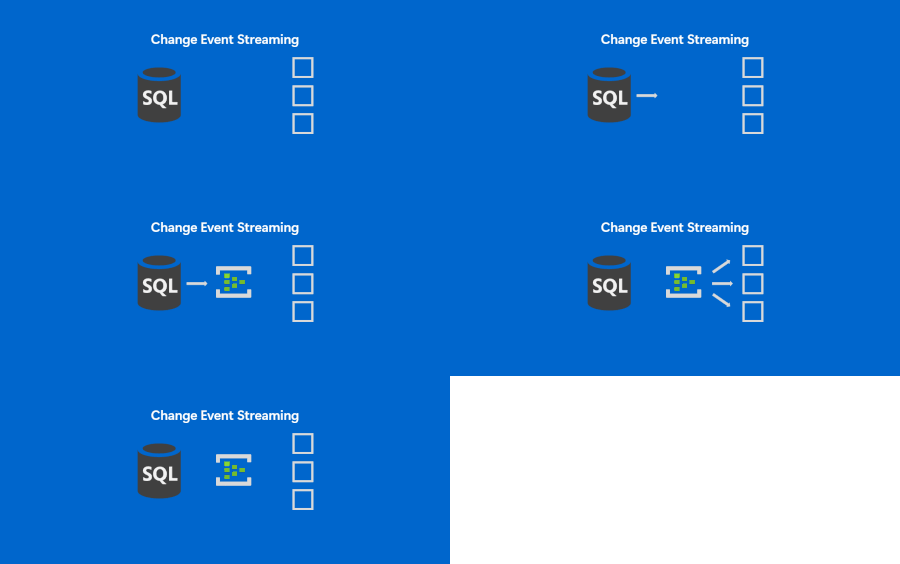
If near-real time integration is something you are looking to implement and you were looking for a simpler way to get the data out of SQL, keep reading. SQL is making it easier to integrate and Change Event Streaming is a feature continuing this trend. Modern applications and analytics platforms increasingly rely on event-driven architectures and real-time data pipelines. As the businesses speed up, real time decisioning is becoming especially important. Traditionally, capturing changes from a relational database requires complex ETL jobs, periodic polling, or third-party tools. These approaches often consume significant cycles of the data source, introduce operational overhead, and pose challenges with scalability, especially if you need one data source to feed into multiple destinations. In this context, we are happy to release Change Event Streaming ("CES") feature into Public Preview for Azure SQL Database. This feature enables you to stream row-level changes - inserts, updates, and deletes - from your database directly to Azure Event Hubs in near real time. Change Event Streaming addresses the above challenges by: Reducing latency: Changes are streamed (pushed by SQL) as they happen. This is in contrast with traditional CDC (change data capture) or CT (change tracking) based approaches, where an external component needs to poll SQL at regular intervals. Traditional approaches allow you to increase polling frequency, but it gets difficult to find a sweet spot between minimal latency and minimal overhead due to too frequent polls. Simplifying architecture: No need for Change Data Capture (CDC), Change Tracking, custom polling or external connectors - SQL streams directly to configured destination. This means simpler security profile (fewer authentication points), fewer failure points, easier monitoring, lower skill bar to deploy and run the service. No need to worry about cleanup jobs, etc. SQL keeps track of which changes are successfully received by the destination, handles the retry logic and releases log truncation point. Finally, with CES you have fewer components to procure and get approved for production use. Decoupling: The integration is done on the database level. This eliminates the problem of dual writes - the changes are streamed at transaction boundaries, once your source of truth (the database) has saved the changes. You do not need to modify your app workloads to get the data streamed - you tap right onto the data layer - this is useful if your apps are dated and do not possess real-time integration capabilities. In case of some 3rd party apps, you may not even have an option to do anything other than database level integration, and CES makes it simpler. Also, the publishing database does not concern itself with the final destination for the data - Stream the data once to the common message bus, and you can consume it by multiple downstream systems, irrespective of their number or capacity - the (number of) consumers does not affect publishing load on the SQL side. Serving consumers is handled by the message bus, Azure Event Hubs, which is purpose built for high throughput data transfers. onceptually visualizing data flow from SQL Server, with an arrow towards Azure Event Hubs, from where a number of arrows point to different final destinations. Key Scenarios for CES Event-driven microservices: They need to exchange data, typically thru a common message bus. With CES, you can have automated data publishing from each of the microservices. This allows you to trigger business processes immediately when data changes. Real-time analytics: Stream operational data into platforms like Fabric Real Time Intelligence or Azure Stream Analytics for quick insights. Breaking down the monoliths: Typical monolithic systems with complex schemas, sitting on top of a single database can be broken down one piece at a time: create a new component (typically a microservice), set up the streaming from the relevant tables on the monolith database and tap into the stream by the new components. You can then test run the components, validate the results against the original monolith, and cutover when you build the confidence that the new component is stable. Cache and search index updates: Keep distributed caches and search indexes in sync without custom triggers. Data lake ingestion: Capture changes continuously into storage for incremental processing. Data availability: This is not a scenario per se, but the amount of data you can tap into for business process mining or intelligence in general goes up whenever you plug another database into the message bus. E.g. You plug in your eCommerce system to the message bus to integrate with Shipping providers, and consequently, the same data stream is immediately available for any other systems to tap into. How It Works CES uses transaction log-based capture to stream changes with minimal impact on your workload. Events are published in a structured JSON format following the CloudEvents standard, including operation type, primary key, and before/after values. You can configure CES to target Azure Event Hubs via AMQP or Kafka protocols. For details on configuration, message format, and FAQs, see the official documentation: Feature Overview CES: Frequently Asked Questions Get Started Public preview CES is available today in public preview for Azure SQL Database and as a preview feature in SQL Server 2025. Private preview CES is also available as a private preview for Azure SQL Managed Instance and Fabric SQL database: you can request to join the private preview by signing up here: https://aka.ms/sql-ces-signup We encourage you to try the feature out and start building real-time integrations on top of your existing data. We welcome your feedback—please share your experience through Azure Feedback portal or support channels. The comments below on this blog post will also be monitored, if you want to engage with us. Finally, CES team can be reached via email: sqlcesfeedback [at] microsoft [dot] com. Useful resources Free Azure SQL Database. Free Azure SQL Managed Instance.1.2KViews0likes0Comments