mcp server
6 TopicsEnterprise Deployment Architecture for Agentic AI: ChatGPT-Style UI on IIS over Agents & MCP Servers
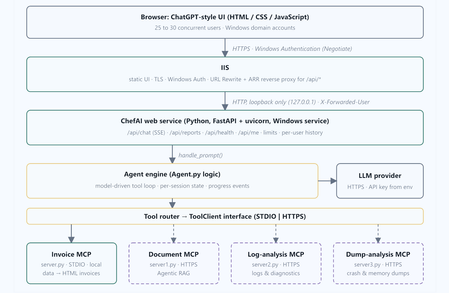
Research Disclaimer: This article is a technical research paper intended solely for educational, research, and illustrative purposes. It reflects the author’s personal technical perspectives. All concepts, architectural designs, diagrams, and implementation approaches are provided “AS IS” for technical exploration and review, not as production-ready development guidance. Organizations considering implementing these approaches should consult their internal software development standards, enterprise architecture teams, corporate security policies, and governance requirements. Any production implementation must undergo appropriate end-to-end architectural, security, privacy, compliance, and responsible AI or ethics reviews, along with necessary testing and organizational approvals before deployment. Abstract. Large language model agents that call tools through the Model Context Protocol (MCP) are usually shown from a console or a developer IDE. Enterprise users expect something different. They want a familiar chat interface, single sign-on and steady behavior when many people use the system at once. This paper gives architectural guidance for a ChatGPT-style web interface, hosted in Microsoft Internet Information Services (IIS) with Windows Authentication, that fronts an MCP-based agent for 25 to 30 concurrent users. The work is broken into nine steps: the engine boundary, state isolation, a streaming API, the chat UI, a Windows service host, IIS reverse-proxy configuration, security, testing and deployment. The paper explains why a long-running Python service behind IIS beats launching Python for every request, and why no Kerberos delegation (the double hop) is needed. It also describes a small transport-neutral tool-client layer, so the same agent can call a local STDIO MCP server and several remote MCP servers over HTTPS without any change to the user interface. The reference scenario is ChefAI, a fictitious restaurant-operations assistant that needs real-time answers, invoice generation, and log and crash-dump analysis for technical troubleshooting. Its STDIO server generates invoices. Three HTTP servers handle document retrieval through an Agentic RAG system, log analysis and dump analysis. The agent logic itself is treated as a black box. The paper closes with a threat model, a capacity argument and an evaluation methodology. Keywords: Model Context Protocol, agent user interface, IIS, Windows Authentication, reverse proxy, Server-Sent Events, agentic RAG, concurrency control, tool routing 1. Introduction Tool-using language model agents have become practical because protocols such as the Model Context Protocol (MCP) standardize how an agent discovers and calls external capabilities [1]. A typical agent loop sends a user request and the list of available tools to a model, receives a tool choice, runs the tool, and feeds the result back until the model can answer. The loop is easy to demonstrate in a terminal. Putting it in front of a team is harder, because the interface, identity, concurrency, streaming and deployment all become real concerns. This paper addresses that gap for a common enterprise setting: Windows infrastructure, an intranet, Active Directory identities and IIS as the standard web host. It is written as a reference architecture. It describes the components, what each one is responsible for, the trust boundaries between them and the order in which to build them. A fictitious reference application, ChefAI (Section 1.2), keeps the discussion concrete. End users reach the application through a browser chat window with their Windows identity, while the agent behind the scenes talks to one local MCP server over STDIO and to several remote MCP servers over HTTPS. 1.1 Contributions A nine-step design for a ChatGPT-style web interface that fronts an MCP agent and is hosted on IIS with Windows Authentication (Sections 4 and 5). A concurrency design sized for 25 to 30 simultaneous users, with explicit queues, per-user limits, timeouts and cleanup (Sections 5.2, 5.5 and 10). A transport-neutral tool-client layer made of an interface, a server registry and a router, which keeps the UI independent of how tools are reached (Section 6). A reference fleet of four MCP servers with different capabilities and data sensitivities, including an Agentic RAG document server, used to reason about routing and security (Section 7). An analysis of identity flow showing that no Kerberos delegation is needed, a threat model and an evaluation methodology (Sections 8 to 10). 1.2 The ChefAI reference application What ChefAI is. ChefAI is a fictitious restaurant-operations application used throughout this paper as the reference scenario. It is an AI assistant for a restaurant business. Staff need real-time answers during service, invoices generated from purchasing data, and help with technical troubleshooting when systems such as point-of-sale terminals, kitchen displays or online-ordering services misbehave. Staff describe what they need in plain language in a browser. The assistant decides which capability to use and answers with figures, documents, diagnostics or a generated report. How it is structured. The application is split into an agent and four MCP servers. Agent.py is the agent. It receives a request, consults a language model and calls tools exposed by MCP servers. The first server, server.py , is a local STDIO server and acts as the invoice generator. It reads purchasing data and produces HTML invoices and reports. The other three servers are remote HTTP(S) servers ( server1.py , server2.py and server3.py ), not STDIO, and the agent calls them to get information and to support technical issues. They are a document processor that answers questions by retrieving data and documents from an Agentic RAG system, a log analyzer and a dump analyzer. Table 0 summarizes the scenario. Capability Example request from staff Served by Transport Real-time spend answers “What did we spend on tomatoes last year?” Invoice server ( server.py ) STDIO, local Invoice generation “Generate the year-to-date invoice.” Invoice server ( server.py ) STDIO, local Knowledge and documents “What is our return policy for dairy deliveries?” “How do we descale the combi oven?” Document processor with Agentic RAG ( server1.py ) HTTPS, remote Log analysis “Why did the point-of-sale terminals time out on Friday evening?” Log analyzer ( server2.py ) HTTPS, remote Dump analysis “The kitchen display crashed. What does this dump show?” Dump analyzer ( server3.py ) HTTPS, remote Table 0. The ChefAI reference scenario: capabilities, the server that provides each, and its transport. The scenario deliberately mixes a business need (spend, invoices, policies) with an operational need (logs, dumps and runbooks). One interface therefore has to route between servers with very different data and risk profiles. The restaurant details, hostnames and example questions are illustrative and do not describe a real business. 1.3 Scope The focus is the user-interface tier and its hosting. The agent internals are out of scope except for the configuration the UI depends on, namely how the agent is invoked and how it reaches tools. The tool names, capacity figures and timeouts in this paper are illustrative design values. They show how to reason about a deployment and should be checked against the real workload (Section 10). 2. Background 2.1 The Model Context Protocol and its transports MCP defines how a client discovers a server’s tools, resources and prompts and calls them using JSON- RPC messages [1]. Two standard transports matter here. STDIO launches the server as a child process and exchanges messages over standard input and output. It is simple and local and needs no network port, but it ties the server’s lifetime to the client process. Streamable HTTP exposes the server at a URL. That allows servers on other machines, shared by several clients and protected by TLS and HTTP authentication. The official SDKs let the same tool code be exposed over either transport, so a server can move from one to the other without rewriting its tools. 2.2 Server-Sent Events for progress Agent requests can last tens of seconds because they chain model calls and tool calls. Server-Sent Events (SSE) let the server push a one-way stream of text events over an ordinary HTTP response [2]. This suits a chat interface that wants to show “queued”, “analyzing logs” and “building invoice” before the final answer. SSE also passes through reverse proxies more easily than WebSockets, as long as buffering is turned off. 2.3 IIS, ARR and Windows Authentication IIS can authenticate users with the Negotiate provider, which uses Kerberos where available and falls back to NTLM [3]. With the URL Rewrite and Application Request Routing (ARR) extensions, IIS can act as a reverse proxy. It forwards selected paths to a back-end service and can copy server variables such as LOGON_USER into request headers [4]. 2.4 The double-hop problem A “double hop” happens when a server has to use the caller’s Windows identity to reach a second server on the caller’s behalf. That requires Kerberos delegation. Section 8 shows why this design avoids it. 3. Requirements and Constraints Category Requirement Interface ChatGPT-style chat in a browser, real-time progress, a stop button, report cards with preview, and no CDN so it works offline on an intranet. Identity Windows Authentication in IIS. The application knows the user’s name and never handles user passwords. Concurrency 25 to 30 simultaneous users without cross-user data leakage, orphaned processes or unbounded resource use. Tools A local STDIO MCP server and several remote HTTPS MCP servers. The UI must not change when servers are added or moved. Security LLM keys never in files, logs or the browser. Loopback-only back end, output escaping, restrictive report serving and allow-listed remote servers. Operations Runs as a Windows service with restart on failure, structured logs and idempotent deployment scripts. Constraints System Python without virtual environments, standard-library HTTP for model calls, IIS as the only public listener and no Kerberos delegation. 4. System Architecture Figure 1 shows the end-to-end architecture. Users reach IIS over HTTPS and authenticate with Windows credentials. IIS serves the static single-page interface and reverse-proxies /api/* over loopback to a Python web service. The service owns the agent engine, which plans with a language model and calls tools through a router. The router reaches the local invoice server over STDIO and the remote servers over HTTPS. Figure 1. End-to-end architecture. Solid boxes and arrows are local components and the local STDIO server. Dashed boxes and arrows are remote MCP servers reached over HTTPS. Adding a server only touches the service and the tool layer. The browser and IIS tiers stay the same. 4.1 Request lifecycle Figure 2 follows a single prompt. The browser posts to /api/chat . IIS authenticates the user, overwrites the identity header and proxies the call. The service queues and admits the request, then streams status events while the engine consults the model and calls tools. The loop repeats, up to a fixed number of tool calls, until the model reports completion or, for report requests, an HTML file exists. The final answer and report links go out as the last events. Figure 2. Request lifecycle for one prompt. Messages 3 and 12 are Server-Sent Events returned through IIS on the original HTTP response. The browser never talks to the engine, the model or any MCP server directly. 4.2 Why a web service sits between the browser and the agent, and why the browser cannot call MCP servers directly The browser cannot call the agent directly, for reasons of feasibility and of fitness. On feasibility, clientside JavaScript can only issue HTTP requests and cannot start or import a Python program. IIS, as a static-file and ASP.NET host, has no in-process Python runtime. An agent is also a script and not a network endpoint, so something has to listen for requests and invoke it. On fitness, an agent request is long-lived, stateful and costly. It chains model and tool calls for tens of seconds, spawns MCP child processes that must be cleaned up on timeout or disconnect, keeps per-conversation state and has to stream progress. It therefore needs a persistent process that can enforce admission control (per-user gates, a bounded queue, semaphores and timeouts), isolate sessions, emit Server-Sent Events and hold the model key and service credentials in a service account, not in the client or the IIS application pool. Launching Python for every request would add seconds of start-up cost and make streaming, cancellation and cleanup fragile. Letting IIS supervise the process, for example through FastCGI or HttpPlatformHandler, changes who restarts it but not the need for it. The browser also cannot call the MCP servers directly. A STDIO server has no network listener at all. A Streamable HTTP server does carry MCP’s JSON-RPC over HTTP, so transport is not the real obstacle. The real obstacle is that an MCP server exposes typed tools and does not understand natural language, so some component must decide which tool to call with which arguments and iterate on the results. That component is the modeldriven agent loop, and it needs the LLM key. Direct access would also place server tokens or client certificates in every browser and expose the sensitive log and dump servers to every desktop. It would bypass central rate limiting, audit, allow-listing and redaction, remove the agent’s defence against prompt injection in tool results, and force the interface to carry discovery, routing and namespacing logic for every server, so adding a server would change the UI. Putting the service in between reduces the browser’s contract to a single HTTP endpoint, /api/chat , and keeps MCP, model credentials and trust decisions on the server side. 5. User-Interface-Centered Design in Nine Steps The design is organized as nine steps (Figure 3). Steps 1 and 2 define the boundary to the agent, Steps 3 and 4 deliver the API and the interface, Steps 5 and 6 host it, Step 7 secures it, Step 8 tests it and Step 9 documents and deploys it. Figure 3. The nine-step roadmap. Amber is the agent boundary, green is the API and interface, grey is hosting, red is security, and purple is verification and delivery. 5.1 Step 1: Define an engine boundary the UI can call An agent is often first written as a console program that mixes the planning loop with prompts and printing. The first step separates them. The agent exposes one asynchronous function, handle_prompt(prompt, history, progress_callback) , that returns {answer, html_files, tool_trace, error} and reports progress through a callback instead of printing. It never reads from or writes to a console. A single prompt box replaces any menu of modes, and the model decides from the live tool list whether the request needs a generated file or only an answer. Recent conversation turns, six by default, are passed as context so that follow-ups such as “now compare it to 2026” work. Only aggregates and provenance go back to the model, and raw rows stay on the server. This boundary is the only contract between the interface tier and the agent. 5.2 Step 2: Remove shared mutable state Agents and tool servers often keep module-level state, such as loaded data and cached query results. With 25 to 30 concurrent users, that state becomes a correctness and privacy hazard. The design therefore does three things. It loads and parses reference data once into an immutable shared dataset, reloaded only when the source file’s size or modification time changes and guarded by a lock. It keeps query results in a per-session store, so each query identifier belongs to exactly one session. And it gives each request an isolated tool connection, or a bounded pool of server processes with per-request session identifiers. Shared outputs are written atomically (a temporary file, then a rename) so a reader never sees a half-written file. 5.3 Step 3: Provide a streaming API The service exposes four endpoints (Table 1). The chat endpoint returns a Server-Sent Event stream. Conversation history is kept per user and conversation with a time-to-live and a cap, and no other user can read it. Endpoint Behavior POST /api/chat Body {prompt, conversation id} . The prompt is validated and capped at 2000 characters. Streams status , tool , result , done and error events (Appendix A). GET /api/reports/{name} Serves generated HTML from one folder only. Filenames are allow-listed and the resolved path must stay inside the folder. Sends a restrictive Content-Security-Policy and nosniff . Reports are scoped per user, plus shared built-in reports. GET /api/health Status, provider, model, data-loaded flag, queue depth and running count. Never keys or paths outside the project. GET /api/me Authenticated display name taken from the trusted header. Table 1. API surface of the web service. 5.4 Step 4: Build the ChatGPT-style interface The interface is plain HTML, CSS and vanilla JavaScript. There is no framework and no CDN, so it works on an isolated intranet and adds no supply-chain exposure. Figure 4 shows the layout. The sidebar lists this browser’s recent conversations from localStorage . The main pane shows user and assistant bubbles, a live status line fed by the event stream, and report cards that open in a new tab or preview in a sandboxed iframe with scripts disabled. The composer grows with its content, sends on Enter, inserts a newline on Shift+Enter, shows a character counter and is disabled while that user has a request running. A Stop button aborts the stream, which in turn cancels the server-side run. Example prompts fill an empty chat. Figure 4. Wireframe of the chat interface. (1) Conversation sidebar, (2) message bubbles, (3) live status line from the event stream, (4) report card with Open and Preview, (5) composer with Send and Stop, (6) data-egress notice. All model and server text is inserted as escaped text. Minimal formatting (line breaks, bold, simple tables) is added by the interface itself and never by interpreting model output as HTML. Errors are visible and actionable. Network loss, 401 and 403, 409 (a request is already running), 429 (system busy, with a retry hint) and timeouts each show a message and a Retry button. Figure 5. Typical event sequence for an invoice request. The browser adds each event to the status line as it arrives and renders the final answer and report cards when the closing done event comes in. 5.5 Step 5: Host the service The Python application runs under a Windows service wrapper (for example NSSM or WinSW), bound to 127.0.0.1 on a fixed port, with automatic restart and a dedicated low-privilege account. It reads the provider name, the model override, the data path and the limits from environment variables, and it reads the LLM key from the service environment only. The account gets read access to the project and data, and write access only to the report output and log folders. Capacity is protected by explicit limits (Figure 6). There is a per-user gate (one running request and a rate limit), a bounded queue that reports “queued, position N” through the stream and returns HTTP 429 when full, a semaphore on concurrent agent runs (default 8) and a separate semaphore on concurrent model calls (default 6). Every request has a wall-clock timeout (default 120 s). On timeout, cancellation or browser disconnect, the request’s child processes are terminated and its slots released, so no orphaned processes remain. Blocking work such as file and network I/O runs off the event loop, so one slow call cannot stall other users. Figure 6. Admission control and cleanup. A request has to pass the per-user gate and the queue before it gets an agent slot, and model calls are throttled separately. 5.6 Step 6: Configure IIS IIS is configured as a thin front end. The site’s application pool uses “No Managed Code” because IIS only serves static files and proxies. URL Rewrite forwards /api/* to the loopback service and, in the same rule, sets an X-Forwarded-User header from the authenticated LOGON_USER value, overwriting anything the client sent. The ARR proxy is enabled with a timeout longer than the engine’s request timeout, and response buffering and dynamic compression are turned off so the event stream is delivered live. Request size is capped, risky file extensions ( .py , .csv , .env , .log , .md ) are denied and an HTTPS binding is required. Windows Authentication is enabled and Anonymous is disabled. Those sections are locked at server level by default, so they are set through appcmd at the application-host scope. Appendix C lists the key settings. 5.7 Step 7: Secure the system Section 8 covers the security controls in detail. In short, identity comes only from IIS and the service accepts connections from loopback only. The model key is read from the service environment and scrubbed from every error and log. All text is escaped in the browser. Reports are served with a restrictive policy from one folder. Tools are read-only against the data and write only to report folders. Users are told that aggregated figures are sent to the external model provider. 5.8 Step 8: Test Tests use a mocked model, so no paid calls are made and results are repeatable (Section 10.1). They cover the API contract, path traversal, cross-user isolation, malformed model output and missing keys. They also run a simulated 30-user mixed workload, check cleanup on timeout and disconnect, scan responses and logs to confirm the key never appears, and exercise the tool router with fake clients. 5.9 Step 9: Document and deploy Two idempotent PowerShell scripts install the service and configure IIS. The README documents installation, service commands, key rotation and troubleshooting. Idempotence matters because configuration drift is a frequent cause of failure in reverse-proxy deployments, and a script that can be safely rerun repairs drift instead of adding to it. 6. The Agent Boundary and a Transport-Neutral Tool Layer The agent is treated as a black box that takes a prompt and history and returns an answer, files and a trace. Only one part of its configuration matters to the interface design, and that is how it reaches tools. A deployment may reach a tool server as a local STDIO child process or as a remote HTTPS endpoint, and may move a server from one to the other. Neither choice should change the browser, IIS or the API contract. Three small abstractions achieve this (Figure 7). ToolClient interface. Three asynchronous operations: list_tools() , which returns name, description and input schema, call_tool(name, arguments) , which returns a result object, and close() . An STDIO client, an in-process fallback and a Streamable HTTP client all implement it. Server registry. A list of entries, each with a name, transport, command or URL, the name of the environment variable holding its credential, a timeout and an enabled flag. A deployment can start with a single entry, such as the local invoice server over STDIO, and grow by loading more entries from a configuration file. Tool router. It combines the tools of every enabled client into one live list for the model and sends each call to the client that owns the tool. Once more than one server is registered, it namespaces tool names ( server__tool ) so collisions cannot happen. A slow or unreachable server is skipped with a status event and does not fail the whole request. Application-specific behavior, such as the data summary sent to the model, query identifiers and the rule that report requests must produce an HTML file, lives in an adapter and not in the generic loop. That way, servers that know nothing about invoices can still be used. Figure 7. The transport-neutral tool layer. A remote server is added with a registry entry. One HTTP client implementation serves all remote servers, and no code above the router changes. 6.1 Registry example The following shows the shape of the registry for the four ChefAI servers. Credentials are referenced by environment-variable name, and the secrets themselves never appear in the file. Here docs , logs and dumps correspond to server1.py , server2.py and server3.py . With several servers registered, the model sees namespaced tools such as invoices__generate_invoice or logs__search_logs . Each extra server makes the tool list sent with every model call longer, so a practical deployment should filter or pre-route the list by request intent. Section 11 returns to this. 7. The ChefAI MCP Server Fleet The ChefAI scenario (Section 1.2) uses four servers with deliberately different capabilities (Table 2). Tool names are illustrative, and an implementation may name and group tools differently. Server Transport Capability and example tools Data sensitivity Operational notes Invoice generator server.py STDIO, local Queries purchasing data by period, item and vendor, and generates HTML invoices and reports with totals computed in code. Tools: query expenses ,generate invoice ,generate report , chef summary . Business- confidential totals and vendor names. One child process per request. Read- only on data, writes only to report folders. Document processor (Agentic RAG) server1.py HTTPS, remote Answers questions by retrieving data and documents (supplier contracts, return policies, menus, allergen sheets, equipment manuals, runbooks) from an Agentic RAG system and returning an answer with citations. Tools: search documents , get document, answer with citations . Mixed. Some documents are confidential (contracts, pricing), so it needs document-level access control. Read-only. Always returns source references. Has a retrieval budget and timeout, and shows index freshness. Log analyzer server2.py HTTPS, remote Searches and summarizes application and device logs from point-of-sale, kitchen-display and ordering systems: error counts by time bucket, top messages, correlation by request id. Tools: search logs ,summarize errors ,time histogram . May contain user identifiers, IP addresses or secrets, so it needs redaction. Read-only. Limits result size and redacts on the server side. Dump analyzer server3.py HTTPS, remote Triages crash or memory dumps from restaurant systems:exception summary, faulting module, thread stacks. Tools: list dumps , analyze dump , stack summary. Dumps can contain memory contents,including credentials. The most sensitive server. Long-running, so it needs a larger timeout. Strict access control. Returns summaries only, never raw dumps, to the model. Table 2. The four MCP servers in the ChefAI scenario. 7.1 Agentic RAG in the document processor Retrieval-augmented generation (RAG) grounds a model’s answer in retrieved documents instead of the model’s own memory. An agentic RAG system goes further. It plans the retrieval, may rewrite the query, searches several collections, reads the most promising documents, checks whether the evidence is enough and iterates before answering. In ChefAI this behavior lives inside the document server, behind a small tool surface. The main agent sees one tool, such as answer_with_citations , and does not need to know how the retrieval works. This has three consequences for the design. The document server must return citations so the interface can show sources. Its latency is usually higher than a simple lookup and is bounded by its own timeout and retrieval budget. And retrieved text is untrusted input that can carry injected instructions (threat T2 in Section 8). 7.2 Cross-server tasks The value of a multi-server fleet is that the servers can work together. Take a request such as “The kitchen display froze during Friday dinner service. What happened and what should we do?” It could need the log analyzer for an error histogram around the incident, the dump analyzer for the crash cause and the document processor for the vendor’s runbook and escalation policy. A request such as “Generate the year-to-date invoice and check our dairy return policy” combines the invoice generator with the document processor. The router makes these tools look like one catalogue. Per-server timeouts and failure isolation mean that if the dump server is down, the other tools still answer. Combining servers also raises a data-flow question, because results from one server become inputs to another through the model. Every result passes through the engine, so the engine is the right place to apply size limits, redaction rules and per-server allow-lists. 8. Windows Authentication, Trust Boundaries and Threats 8.1 Identity flow and the absence of a double hop The browser authenticates to IIS using Negotiate (Kerberos or NTLM). IIS knows the user’s account, copies it into X-Forwarded-User and forwards the request over loopback. From that point the application uses only the name, for scoping history, report access, rate limits and logs. The user’s Windows token is never impersonated or forwarded. Resources are reached with service-level credentials: the data file with the service account, the model with an API key, and remote MCP servers with a bearer token or client certificate (Figure 8). No downstream system needs to act as the user, so Kerberos constrained delegation is unnecessary. Figure 8. Identity and credential flow. The user identity is used only for scoping, and every downstream resource is reached with a service-level credential. When delegation would be needed. Delegation, or token forwarding, becomes necessary only if a downstream system must authorize the end user itself. Examples are a per-user permissioned file share, a SQL Server using Windows authentication as the user, or a remote MCP server (such as the document processor) that must apply the caller’s own document entitlements. Those cases would need Kerberos constrained delegation or an OAuthstyle token exchange, and they are outside this design. 8.2 Trust boundaries Figure 9 marks four zones and the threats that cross them. The key rule is that the Python service trusts the identity header only because it listens on loopback and IIS overwrites the header on every proxied request. Figure 9. Trust zones and threat markers T1 to T6 (Table 3). Arrows show the direction of requests. ID Threat Mitigation in this design T1 Spoofed identity header or direct access to the service port IIS overwrites the header on every proxied request. The service binds to 127.0.0.1 and rejects non-loopback callers, and the port is not opened in the firewall. T2 Prompt injection through tool results, retrieved documents or logs (for example text that says “ignore your instructions”) Tool results and retrieved text are treated as untrusted data. Tools are read- only. Tool calls are allow-listed and capped, arguments are validated against schemas, and results are size-limited and redacted before they reach the model. T3 Pointing the agent at arbitrary URLs (server-side request forgery) Remote servers come only from the registry. HTTPS is required, hosts are allow-listed and the model cannot supply URLs. T4 Sensitive data leaving the network through the model provider Only aggregates, provenance and short cited excerpts are sent, never raw rows. Log and dump summaries are redacted. The UI shows a notice and the provider is chosen by policy. T5 Cross-user leakage (history, query results, reports, documents) Per-session stores keyed by user and conversation. Query identifiers are owned by one session, reports are scoped, and the retrieval system applies document-level access control. Tests try cross-access on purpose. T6 Path traversal or exposure of secrets in files served by IIS or the service Report filenames are allow-listed and the resolved path is checked. IIS denies .py , .csv , .env , .log and .md . Keys live only in the service environment and are scrubbed from errors and logs. Table 3. Threat model. The model key is stored in the service’s environment, which administrators can read from the registry. Sites that need stronger protection should use a machine-level secret store read at start-up. 9. IIS Hosting and Deployment Figure 10 shows the physical deployment. Only port 443 is exposed to clients. The Python service listens on loopback and needs no inbound firewall rule. Outbound traffic is limited to the model provider and the approved remote MCP hosts. Figure 10. Deployment topology and firewall posture. 9.1 Provisioning sequence Install IIS with static content, request filtering and Windows Authentication. Install URL Rewrite and ARR. Enable the ARR proxy, set its timeout above the engine timeout, set the response buffer limit to zero and allow the HTTP_X_FORWARDED_USER server variable. Create the application pool (No Managed Code) and the site pointing at the UI folder, then add the HTTPS binding with an internal CA or test certificate. Disable Anonymous and enable Windows Authentication at the application-host scope. Add the rewrite rule, request limits, security headers and file-type deny list to the site configuration. Create the service account, grant the narrowest file permissions, install the service wrapper, set the environment variables and start the service. Verify the result: the service is running, the health endpoint answers on loopback, sign-in from a client is silent, a streamed answer arrives, a report card appears, access to data and source files is blocked, and two simultaneous users get independent results. 9.2 Common failure modes Symptom Typical cause 502.3 on /api Service stopped, wrong port, or ARR proxy not enabled. 500.50 from URL Rewrite The identity server variable is not in the allowed list. Repeated sign-in prompts Authentication sections not set at application-host scope, browser zone settings, or a missing service principal name for the site name. Progress arrives only at the end Response buffering or dynamic compression on the proxied route. Timeouts near two minutes Proxy timeout shorter than the engine timeout. Leftover Python processes Cleanup path not triggered on timeout or disconnect. 10. Evaluation Methodology and Capacity Reasoning 10.1 Evaluation plan An implementation of this architecture should be evaluated against the criteria in Table 4 before it is released to users. A mocked model keeps functional tests repeatable and free of provider cost. Latency and quality are then measured with the real provider. Question Method Metric or pass criterion Correctness of the API Mocked model, test client and deterministic scenarios. All contract and error-path tests pass, and totals equal direct data queries. Isolation 30 simulated users with mixed queries and reports, plus deliberate cross-access attempts. Zero cross-user data, zero unhandled exceptions and zero orphaned processes. Concurrency limits Ramp from 1 to 30 users, saturate agent slots and fill the queue. Running agents never exceed the configured cap, overflow returns 429, and the system recovers after the burst. Real-time responsiveness Mocked model with a fixed delay, then the real provider, with a browser trace through IIS. Median and 95th-percentile end-to-end time, time to first event, first event before the first tool completes, and no buffering. Cleanup Timeout and abrupt disconnect tests. Child processes terminated, slots released and no handle growth after repeated runs. Secret hygiene Automated scan of responses, logs and error text. The key never appears. Router Two to four fake clients, one slow and one failing. Correct routing and namespacing, and the request still succeeds when one client fails. Retrieval quality (document server) A question set with known source documents. Share of answers with correct citations, and refusal when evidence is missing. Table 4. Recommended evaluation plan. 10.2 A capacity argument Little’s law relates the average number of requests in service N to the arrival rate λ and the average time in the system W: N = λ × W [7]. Suppose, as an assumption, that each of 30 users submits one request per minute on average (λ = 0.5 requests per second). If the mean service time is 15 s, then on average N = 7.5 requests are in service at once. That fits the default of eight agent slots with little queueing. If the mean time is 30 s, then N = 15, the slots saturate and queueing delay grows, so either the cap or the speed of each run has to change. The model call is the biggest part of a run, and an Agentic RAG lookup adds its own multi-step latency. Provider latency and the number of tool calls per request therefore set the capacity you need. These figures illustrate the method, and each deployment should substitute its own measured arrival rate and service time. Memory per STDIO child process also grows with N, so it must be measured before choosing between one child per request and a pool. 11. Limitations and Future Work Reference architecture. ChefAI is a fictitious scenario and the figures in this paper are design values, not benchmark results. Capacity, latency and memory must be measured for each real deployment. Single-process assumption. Per-user limits, history and the shared data cache live in memory. Scaling to several worker processes needs a shared store, such as a database or cache, or sticky routing. Tool-list growth. More servers mean larger prompts and more mistakes in tool selection. Pre- routing by intent, per-user tool entitlements and lazy tool loading are natural extensions. Per-user authorization downstream. The design uses service credentials. If remote servers, notably the document processor, must enforce each user’s own rights, token exchange or delegation will be required. Model-provider dependence. Answers depend on an external provider’s availability, cost and data policy. An on-premises model would change the data-egress analysis. Human factors. The paper does not prescribe a usability study. Candidate measures include task completion, perceived trust in numbers and citations, and how clear the status line is. Secret storage. A service environment variable is fine for a pilot. A managed secret store is better for production. 12. Conclusion Putting an MCP agent behind a familiar chat interface is mostly an engineering problem at the edges. The questions are how the request enters, who the user is, how long-running work is streamed, how concurrent users are kept apart and how new tool servers are added without disturbing the rest. The architecture in this paper keeps IIS thin, with static content, TLS, Windows Authentication and a reverse proxy. It puts the agent behind a loopback Python service with explicit admission control, and it separates the interface from the way tools are reached by using a small transport-neutral tool layer. User identity is used only for scoping and every downstream resource is reached with a service credential, so no Kerberos delegation is needed. For the fictitious ChefAI restaurant, this gives staff real-time answers, invoices, document-grounded guidance and log and dump diagnostics from one chat window. The recommended path is to build the nine steps in order, validate the result with the evaluation plan, and add remote MCP servers one at a time through registry entries. References Model Context Protocol. “Model Context Protocol specification.” modelcontextprotocol.io (accessed October 2026). WHATWG. “HTML Living Standard: Server-sent events.” html.spec.whatwg.org (accessed October 2026). Jaganathan, K., Zhu, L., and Brezak, J. “SPNEGO-based Kerberos and NTLM HTTP Authentication in Microsoft Windows,” RFC 4559, IETF, June 2006. Microsoft. “URL Rewrite” and “Application Request Routing” documentation for IIS, learn.microsoft.com and iis.net (accessed October 2026). Fielding, R., Nottingham, M., and Reschke, J. “HTTP Semantics,” RFC 9110, IETF, 2022. OWASP Foundation. “OWASP Top 10 for Large Language Model Applications.” owasp.org (accessed October 2026). Little, J. D. C. “A Proof for the Queuing Formula: L = λW.” Operations Research 9(3), 1961. Appendix A. Event stream schema Each SSE message has an event name and a JSON data field. The schema is the only contract between the browser and the engine. Appendix B. Environment variables Variable Purpose LLM_PROVIDER, LLM_MODEL Model provider and optional model override. LLM_API_KEY Provider key. Service environment only, never logged or returned. CHEFAI_CSV_PATH Location of the purchasing data file used by the invoice server. CHEFAI_REQUIRE_USER 1 rejects requests without the identity header (production). 0 uses a single anonymous user (development). CHEFAI_MAX_AGENTS Concurrent agent runs (default 8). CHEFAI_REQUEST_TIMEOUT Per-request wall-clock limit in seconds (default 120). MCP_*_TOKEN Per-server credentials for remote MCP servers, referenced by name in the registry. Appendix C. Key IIS settings These settings are indicative. Module versions and server policies vary, so validate them in a non-production environment before rolling out.554Views3likes0Comments
MCP Integration for OneDrive/SharePoint
Hi OneDrive Team, I'm reaching out to explore Model Context Protocol (MCP) server integration for OneDrive and SharePoint. I am looking to integrate OneDrive/SharePoint data access into ThoughtSpot application using MCP solution. Are there existing MCP server implementations (official or community-driven) for OneDrive/SharePoint? If available, what are the connection endpoints and authentication details needed to set up the MCP server? If no MCP server currently exists, are there any upcoming plan on this and is there any alternate recommended approach present. Also could you please provide a SPOC from your team who can support further discussions and technical guidance on this integration? I'd like to schedule a follow-up conversation to explore the best path forward and discuss the use case. Thanks in advance for your help.261Views0likes0Comments
o3-deep-research is failed with the status incomplete with the reason as content filter
I working on an to do an deep research on internal data. I'm using currently the Azure OpenAI Responses API with MCP Tool. The underlying MCP server deployed into ACA with search and fetch tool with signatures in complaint with the specification (https://developers.openai.com/apps-sdk/build/mcp-server#company-knowledge-compatibility). OpenAI client created with 03-deep-research model with MCP tool, in a loop response status being checked. (https://learn.microsoft.com/en-us/azure/foundry/openai/how-to/deep-research#remote-mcp-server-with-deep-research) Deep Research is being carried out for sometime, I could see in the log that handshake has been made, ListTools invoked, search tool is called post that fetch is called for the queries framed by the model.. But intermittently, the response status is becoming "incomplete" with incomplete reason as "content_filter". Otherwise the deep research is working fine. Not able identify the root cause as there is seems to be no way to identify what caused the content filtration whether its the prompt or completion. How to debug and check the root cause and rectify this ? Or is there known issue with the o3-deep-research model's intermediate reasoning completions Or search and fetch tool results are causing this ? I had uploaded a file made it available to MCP server, the search and fetch tool uses an Azure OpenAI agent to search the data using File Search and fetch tool gets the content of the file based on the id passed. For same file and same research topic the issue is not occurring always but intermittently.534Views0likes1CommentGraphRAG and PostgreSQL integration in docker with Cypher query and AI agents (Version 2*)
This is update from previous blog (version 1): GraphRAG and PostgreSQL integration in docker with Cypher query and AI agents | Microsoft Community Hub Review the business needs of this solution from version 1 What's new in version 2? MCP tools for GraphRAG and PostgreSQL with Apache AGE This solution now includes MCP tools for GraphRAG and PostgreSQL. There are five MCP tools exposed: [graphrag_search] Used to run query (local or global) with runtime-tunable API parameters. One important aspect is that query behavior can be tuned at runtime, without changing the underlying index. [age_get_schema_cached] Used for schema inspection and diagnostics. It returns the graph schema (node labels and relationship types) from cache by default; and can optionally refresh the cache by re‑querying the database. This tool is typically used for introspection or debugging, not for answering user questions about data. [age_entity_lookup] Used for quick entity discovery and disambiguation. It performs a simple substring match on entity names or titles and is especially useful for questions like “Who is X?” or as a preliminary step before issuing more complex graph queries. [age_cypher_query] Executes a user‑provided Cypher query directly against the AGE graph. This is intended for advanced users who already know the graph structure and want full control over traversal logic and filters. [age_nl2cypher_query] Bridges natural language and Cypher. This tool converts a natural‑language question into a Cypher query (using only Entity nodes and RELATED_TO edges), executes it, and returns the results. It is most effective for multi‑hop or structurally complex questions where semantic interpretation is needed first, but execution must remain deterministic. Besides that, This solution now uses Microsoft agent framework. It enables clean orchestration over MCP tools, allowing the agent to dynamically select between GraphRAG and graph query capabilities at runtime, with a looser coupling and clearer execution model than traditional Semantic Kernel function plugins. The new Docker image includes graphRAG3.0.5. This version stabilizes the 3.x configuration‑driven, API‑based architecture and improves indexing reliability, making graph construction more predictable and easier to integrate into real workflows. New architecture Updated Step 7 - run query in Jupyter notebook This step runs Jupyter notebook in docker, which is the same as stated in previous blog. > docker compose up query-notebook After clicking the link highlighted in the above screen shot, you can explore all files within the project in the docker, then find the query-notebook.ipynb. https://github.com/Azure-Samples/postgreSQL-graphRAG-docker/blob/main/project_folder/query-notebook.ipynb But in this new version of notebook, the graphRAG3.0.5 uses different library for local Search and global Search. New Step 8 - run agent and MCP tools in Jupyter notebook This step runs Jupyter notebook in docker. > docker compose up mcp-agent Click on the highlighted URL, you can start working on agent-notebook.ipynb. https://github.com/Azure-Samples/postgreSQL-graphRAG-docker/blob/main/project_folder/agent-notebook.... Multiple scenarios of agents with MCP tools are included in the notebook: GraphRAG search: local search and global search examples with direct mcp call. GraphRAG search: local search and global search examples with agent and include mcp tools. Cypher query in direct mcp call. Agent to query in natural language, and mcp tool included to convert NL2Cypher. Agent with unified mcp (all five mcp tools), and based on the question route to the corresponding tool. ['graphrag_search', 'age_get_schema_cached', 'age_cypher_query', 'age_entity_lookup', 'age_nl2cypher_query'] Router agent: selecting the right MCP tool The notebook also includes a router agent that has access to all five MCP tools and decides which one to invoke based on the user’s question. Rather than hard‑coding execution paths, the agent reasons about intent and selects the most appropriate capability at runtime. General routing guidance used in this solution Use [graphrag_search] when the question requires: full dataset understanding, themes, patterns, or trends across documents, exploratory or open‑ended analysis, global understanding or evaluation where we have a corpus of many tokens. In these cases, GraphRAG’s semantic retrieval and aggregation are a better fit than explicit graph traversal. Use AGE‑based tools [age_get_schema_cached, age_entity_lookup, age_cypher_query, age_nl2cypher_query] when the question involves: specific entities or explicit relationships, deterministic graph traversal or filtering, questions that depend on graph structure rather than document semantics, complex graph queries involving multiple entities or multi‑hop paths. Within the AGE toolset: [age_entity_lookup] is typically used for quick entity discovery or disambiguation. [age_cypher_query] is used when a precise Cypher query is already known. [age_nl2cypher_query] is used when the question is expressed in natural language but requires a non‑trivial Cypher query to answer. [age_get_schema_cached] is reserved for schema inspection and diagnostics. The router agent dynamically selects between semantic search and deterministic graph tools based on question intent, keeping retrieval, graph execution, and orchestration clearly separated and extensible. Note: The repository also includes [age_get_schema] and [age_get_schema_details] MCP tools for debugging and development purposes. These are not exposed to agents by default and are superseded by [age_get_schema_cached] for normal use. Key takeaways GraphRAG and postgreSQL AGE querying serve different purposes and each has its advantages. MCP tools provide a uniform interface to both semantic search and deterministic graph operations. Microsoft Agent Framework enables tool‑centric orchestration, where agents select the right capability at runtime instead of hard‑coding logic in prompts. The Jupyter‑based agent workflow makes it easy to experiment with different interaction patterns, from direct tool calls to fully routed agent execution. What's next In this solution, the MCP server and agent runtime are architecturally separated but deployed together in a single Docker container to demonstrate how MCP tools work and to keep local experimentation simple. There are other deployment options, such as running MCP servers remotely, where tools can be hosted and operated independently of the agent runtime. Contributions and enhancements are welcome.746Views1like0CommentsUnlocking AI-Driven Data Access: Azure Database for MySQL Support via the Azure MCP Server
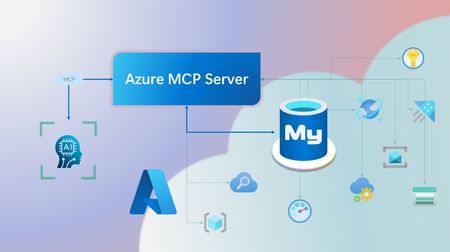
Step into a new era of data-driven intelligence with the fusion of Azure MCP Server and Azure Database for MySQL, where your MySQL data is no longer just stored, but instantly conversational, intelligent and action-ready. By harnessing the open-standard Model Context Protocol (MCP), your AI agents can now query, analyze and automate in natural language, accessing tables, surfacing insights and acting on your MySQL-driven business logic as easily as chatting with a colleague. It’s like giving your data a voice and your applications a brain, all within Azure’s trusted cloud platform. We are excited to announce that we have added support for Azure Database for MySQL in Azure MCP Server. The Azure MCP Server leverages the Model Context Protocol (MCP) to allow AI agents to seamlessly interact with various Azure services to perform context-aware operations such as querying databases and managing cloud resources. Building on this foundation, the Azure MCP Server now offers a set of tools that AI agents and apps can invoke to interact with Azure Database for MySQL - enabling them to list and query databases, retrieve schema details of tables, and access server configurations and parameters. These capabilities are delivered through the same standardized interface used for other Azure services, making it easier to the adopt the MCP standard for leveraging AI to work with your business data and operations across the Azure ecosystem. Before we delve into these new tools and explore how to get started with them, let’s take a moment to refresh our understanding of MCP and the Azure MCP Server - what they are, how they work, and why they matter. MCP architecture and key components The Model Context Protocol (MCP) is an emerging open protocol designed to integrate AI models with external data sources and services in a scalable, standardized, and secure manner. MCP dictates a client-server architecture with four key components: MCP Host, MCP Client, MCP Server and external data sources, services and APIs that provide the data context required to enhance AI models. To explain briefly, an MCP Host (AI apps and agents) includes an MCP client component that connects to one or more MCP Servers. These servers are lightweight programs that securely interface with external data sources, services and APIs and exposes them to MCP clients in the form of standardized capabilities called tools, resources and prompts. Learn more: MCP Documentation What is Azure MCP Server? Azure offers a multitude of cloud services that help developers build robust applications and AI solutions to address business needs. The Azure MCP Server aims to expose these powerful services for agentic usage, allowing AI systems to perform operations that are context-aware of your Azure resources and your business data within them, while ensuring adherence to the Model Context Protocol. It supports a wide range of Azure services and tools including Azure AI Search, Azure Cosmos DB, Azure Storage, Azure Monitor, Azure CLI and Developer CLI extensions. This means that you can empower AI agents, apps and tools to: Explore your Azure resources, such as listing and retrieving details on your Azure subscriptions, resource groups, services, databases, and tables. Search, query and analyze your data and logs. Execute CLI and Azure Developer CLI commands directly, and more! Learn more: Azure MCP Server GitHub Repository Introducing new Azure MCP Server tools to interact with Azure Database for MySQL The Azure MCP Server now includes the following tools that allow AI agents to interact with Azure Database for MySQL and your valuable business data residing in these servers, in accordance with the MCP standard: Tool Description Example Prompts azmcp_mysql_server_list List all MySQL servers in a subscription & resource group "List MySQL servers in resource group 'prod-rg'." "Show MySQL servers in region 'eastus'." azmcp_mysql_server_config_get Retrieve the configuration of a MySQL server "What is the backup retention period for server 'my-mysql-server'?" "Show storage allocation for server 'my-mysql-server'." azmcp_mysql_server_param_get Retrieve a specific parameter of a MySQL server "Is slow_query_log enabled on server my-mysql-server?" "Get innodb_buffer_pool_size for server my-mysql-server." azmcp_mysql_server_param_set Set a specific parameter of a MySQL server to a specific value "Set max_connections to 500 on server my-mysql-server." "Set wait_timeout to 300 on server my-mysql-server." azmcp_mysql_table_list List all tables in a MySQL database "List tables starting with 'tmp_' in database 'appdb'." "How many tables are in database 'analytics'?" azmcp_mysql_table_schema_get Get the schema of a specific table in a MySQL database "Show indexes for table 'transactions' in database 'billing'." "What is the primary key for table 'users' in database 'auth'?" azmcp_mysql_database_query Executes a SELECT query on a MySQL Database. The query must start with SELECT and cannot contain any destructive SQL operations for security reasons. “How many orders were placed in the last 30 days in the salesdb.orders table?” “Show the number of new users signed up in the last week in appdb.users grouped by day.” These interactions are secured using Microsoft Entra authentication, which enables seamless, identity-based access to Azure Database for MySQL - eliminating the need for password storage and enhancing overall security. How are these new tools in the Azure MCP Server different from the standalone MCP Server for Azure Database for MySQL? We have integrated the key capabilities of the Azure Database for MySQL MCP server into the Azure MCP Server, making it easier to connect your agentic apps not only to Azure Database for MySQL but also to other Azure services through one unified and secure interface! How to get started Installing and running the Azure MCP Server is quick and easy! Use GitHub Copilot in Visual Studio Code to gain meaningful insights from your business data in Azure Database for MySQL. Pre-requisites Install Visual Studio Code. Install GitHub Copilot and GitHub Copilot Chat extensions. An Azure Database for MySQL with Microsoft Entra authentication enabled. Ensure that the MCP Server is installed on a system with network connectivity and credentials to connect to Azure Database for MySQL. Installation and Testing Please use this guide for installation: Azure MCP Server Installation Guide Try the following prompts with your Azure Database for MySQL: Azure Database for MySQL tools for Azure MCP Server Try it out and share your feedback! Start using Azure MCP Server with the MySQL tools today and let our cloud services become your AI agent’s most powerful ally. We’re counting on your feedback - every comment, suggestion, or bug-report helps us build better tools together. Stay tuned: more features and capabilities are on the horizon! Feel free to comment below or write to us with your feedback and queries at AskAzureDBforMySQL@service.microsoft.com.587Views3likes0CommentsUsing Microsoft Sentinel MCP Server with GitHub Copilot for AI-Powered Threat Hunting
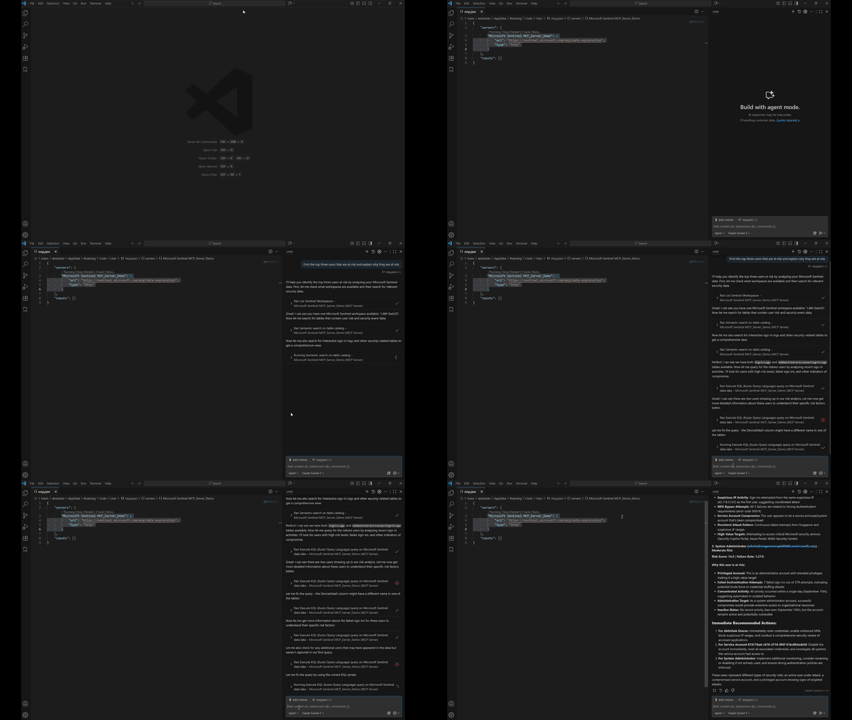
Introduction This post walks through how to get started with the Microsoft Sentinel MCP Server and showcases a hands-on demo integrating with Visual Studio Code and GitHub Copilot. Using the MCP server, you can run natural language queries against Microsoft Sentinel’s security data lake, enabling faster investigations and simplified threat hunting using tools you already know. This blog includes a real-world prompt you can use in your own environment and highlights the power of AI-assisted security workflows. What is the Microsoft Sentinel MCP Server? The Model Context Protocol (MCP) allows AI models to access structured security data in a standard, context-aware way. The Sentinel MCP server connects to your Microsoft Sentinel data lake and enables tools like GitHub Copilot or Security Copilot to: Search security data using natural language Summarize findings and explain risks Build intelligent agents for security operations Prerequisites Make sure you have the following in place: Onboarded to Microsoft Sentinel Data Lake Assigned the Security Reader role Installed: Visual Studio Code GitHub Copilot extension (Optional) Security Copilot plugin if building agents Setting Up MCP Server in VS Code Step 1: Add the MCP Server In VS Code, press Ctrl + Shift + P Search for: MCP: Add Server Choose HTTP or Server-Sent Events Enter one of the following MCP endpoints: Use Case Endpoint Data Exploration https://sentinel.microsoft.com/mcp/data-exploration Agent Creation https://sentinel.microsoft.com/mcp/security-copilot-agent-creation Give the server a friendly name (e.g., Sentinel MCP Server) Choose whether to apply it to all workspaces or just the current one When prompted, Allow authentication using an account with Security Reader access Verify the Connection Open Chat: View > Chat or Ctrl + Alt + I Switch to Agent Mode Click the Configure Tools icon to ensure MCP tools are active Using GitHub Copilot + Sentinel MCP Once connected, you can use natural language prompts to pull insights from your Sentinel data lake without writing any KQL. Demo Prompt: 🔍 “Find the top three users that are at risk and explain why they are at risk.” This prompt is designed to: Identify the highest-risk users in your environment Explain the reasoning behind each user's risk status Help prioritize investigation and response efforts You can enter this prompt in either: VS Code Chat window (Agent Mode) Copilot inline prompt area Expected Behavior The MCP server will: Query multiple Microsoft Sentinel sources (Identity Protection, Defender for Identity, Sign-in logs) Correlate risk events (e.g., risky sign-ins, alerts, anomalies) Return a structured response with top users and risk explanation Sample Output from My Tenant Results Found: User 1: 233 risk score - 53 failed attempts from suspicious IPs User 2: 100% failure rate indicating service account compromise User 3: Admin account under targeted brute force attack This demo shows how the integration of Microsoft Sentinel MCP Server with GitHub Copilot and VS Code transforms complex security investigations into simple, conversational workflows. By leveraging natural language and AI-driven context, we can surface high-risk users, understand the underlying threats, and take action — all within a familiar development environment, and without writing a single line of KQL. More details here: What is Microsoft Sentinel’s support for MCP? (preview) - Microsoft Security | Microsoft Learn Get started with Microsoft Sentinel MCP server - Microsoft Security | Microsoft Learn Data exploration tool collection in Microsoft Sentinel MCP server - Microsoft Security | Microsoft Learn