location
25 TopicsLet us Choose Download Location For each File Type separately in Edge insider browser
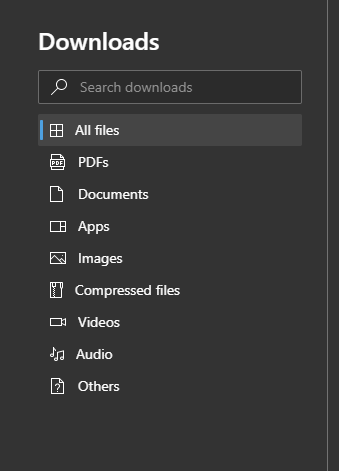
Here are the file types Edge insider browser currently recognizes in downloads My suggestion is to let us choose a separate Download location for each file type. Because: I usually download games or movies (compressed files for games and video files for movies/series) that are big (>10GB) and in multiple parts. I want them to be saved on somewhere else other than C drive, such as my HDD drive for archieve. I want PDF files to be automatically saved in Documents folder/PDF. I want downloaded Image file be saved in my OneDrive/Pictures folder so they get automatically synced and uploaded to my OneDrive cloud space. I want Audio files be saved in a Different folder where my music player program and Spotify watch those folders for music files (MP3, AAC etc). I want unknown files (files with extensions other than those mentioned above) to be saved in the default download location so I can decide what to do with them later. I want .exe files (programs) to be automatically saved in a different partition where the rest of my programs are. And so on. there is currently one global download location having to choose a download location and browse for a folder for each of them every time is not convenient, so, Please Let us Choose Download Location For each File Type separately in Edge insider browser. also let Edge insider Sync these download location settings with cloud so Users won't have to apply all of these modifications Again after reinstalling browser or OS change, etc. Thanks6.9KViews16likes5Comments
Geolocation wrong (really wrong) in Edge but correct in Chrome
This is probably a Windows 10 API problem not an Edge issue, but geolocation is wrong - usually really, really wrong - in Edge... while Chrome gets my location dead-on. On the same computer. At the same time. Before we get into any 101 fixes - I deal with location tech in my job, and I know W10 well enough to know how to correctly configure my country, and clear my location. This is a problem that exists on fresh installs of W10 and Edge. I can send some screenshots to engineers who may be lurking. The distance off is around 500 miles or so. It is locating me in a place that I've never visited. This has been a problem for years and a few (Google) searches shows that it pops up in the Feedback Hub, the user forums and other places every now and then, with no fix. I really want to use Edge. But correct geolocation is so fundamental to everything associated with search-based services today, and it gets old getting recommendations to walk down the street to a store that is 500 miles away.36KViews4likes16CommentsAzure Maps: Understanding View vs. Routing Coordinates
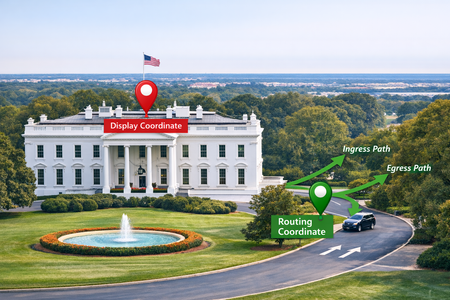
When you work with Azure Maps long enough, you will eventually run into a subtle but important detail: the platform returns two different types of coordinates for the same address. And while they may look interchangeable, they behave very differently once you start routing, calculating travel times, or dropping pins on a map. Let’s break down what each represents and how to use them correctly when building location‑intelligent applications. Why Azure Maps Has More Than One Coordinate for a Place Geocoders, including Azure Maps, are designed to satisfy two competing needs: Show the place in the visually “accurate” spot on a map. Get people or goods to a real, accessible point on the road network. The coordinate that satisfies the first need is rarely the same answer for the second, in fact it can be wildly off. If you have ever visited a National Park or other large location where the entrance is far from where you would display the center of the park, you will note that the difference between these coordinates can be many miles apart and often you can't drive to the exact center, so we would say the View coordinate is not Routable. So Azure Maps provides them separately; one to power the visual map experience, the other to power the routing engine. The View Coordinate: Your Visual Anchor Point Think of the Azure Maps view coordinate as “the place where the map pin should sit.” It may come from an address parcel, a building footprint centroid, or a point-of-interest geometry. Azure Maps will provide whatever option that produces the most natural visual representation of the feature on the map. This is the important part for our topic: a view coordinate is not guaranteed to land on a road or even near one. It might be in the center of a large warehouse, deep inside a shopping mall footprint, or somewhere else that makes sense visually but is effectively unreachable from the road network. View coordinates are great for anything that involves visual context such as placing a point on the map, centering the map on a search result, running spatial clustering on data values, or doing proximity lookups. They’re simply not intended for navigation. The Routing Coordinate: Your Navigable Access Point Routing coordinates serve a very different purpose. Azure Maps generates them to represent an access point. The point where a vehicle, pedestrian, or cyclist can legally and realistically approach or leave the location from the road network. This usually means: The point is snapped to the closest routable road segment. It’s positioned where a driver or pedestrian can actually arrive (e.g., the driveway, street entrance, or legal access point). It includes the orientation and topology needed for the routing engine to produce correct ETAs, distance calculations, and directions. When you're calling Azure Maps Routing APIs—calculateRoute, routeRange, distance matrices, isochrones, multi‑itinerary optimization—you should always feed the routing coordinate into the engine. Feeding a view coordinate instead may cause the service to snap to the wrong part of the network, or worse, find no viable route at all. How Azure Maps Exposes These Coordinates Azure Maps surfaces routing coordinates and view coordinates through structured fields in its search and geocoding responses. The naming varies by API, but you will often see: "usageTypes": [ "Display" ] denotes position or displayPosition → View coordinate "usageTypes": [ "Route" ] denotes routePosition, accessPoint, or entryPoints → Routing coordinate Azure Maps provides both and should your scenario involve travel movement (even indirectly), the routing coordinate is the authoritative choice. What Goes Wrong When You Swap Them If you use a view coordinate for routing, you can be asking for routes that terminate inside a building footprint, on the wrong side of the street, or at an incorrect driveway. You might also see unexpected route endpoints because the routing engine is forced to snap the point to whichever road segment it thinks is closest, which might not be the correct one. On the other hand, if you use a routing coordinate for display, your pins may look "off" because the access point for an address could be far from the building’s center. This is why the distinction matters: one is about realism, the other about navigability. The Upside: Using Them Correctly in Your Applications When building an end‑to‑end Azure Maps experience, a good mental model is: Map UI? Use the view coordinate. Anything involving routing logic? Use the routing coordinate. That includes distance calculations, service‑area modeling, route planning, delivery optimization, pickup/drop-off flows, fleet operations, and anything else where “how the user gets there” matters just as much as “where it is.” With this separation of geocode results, you can trust Azure Maps to keep your visual experience clean while ensuring the routing engine has the precision it needs to get users where they actually need to go. To find out more about Azure Maps Geocoding and our new Azure Maps AutoComplete experience, check out Search for a location using Azure Maps Search services | Microsoft Learn434Views1like0Comments
Introducing the Azure Maps Geocode Autocomplete API
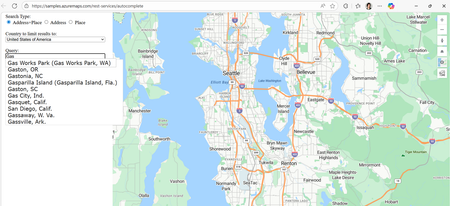
We’re thrilled to unveil the public preview of Azure Maps Geocode Autocomplete API, a powerful REST service designed to modernize and elevate autocomplete capabilities across Microsoft’s mapping platforms. If you’ve ever started typing an address into a search bar and immediately seen a list of relevant suggestions—whether it’s for a landmark, or your own home—you’ve already experienced the convenience of autocomplete. What’s less obvious is just how complex it is to deliver those suggestions quickly, accurately, and in a format that modern applications can use. That’s exactly the challenge this new API is designed to solve. Why Autocomplete Matters More Than Ever The Azure Maps Geocode Autocomplete API is the natural successor to the Bing Maps Autosuggest REST API, designed to meet the growing demand for intelligent, real-time location suggestions across a wide range of applications. It’s an ideal solution for developers who need reliable and scalable autocomplete functionality—whether for small business websites or large-scale enterprise systems. Key use cases include: Store locators: When a customer starts typing “New Yo…” into store locator, autocomplete instantly suggests “New York, N.Y.” With just a click, the map centers on the right location—making it fast and effortless to find the nearest branch. Rideshare or dispatching platforms: A rideshare driver needs to pick up a passenger at “One Microsoft Way.” Instead of typing out the full address, the driver starts entering “One Micro…” and the app instantly offers the correct road segment in Redmond, Washington. Delivery services: A delivery app can limit suggestions to postal codes within a specific region, ensuring the addresses customers choose are deliverable and reducing the risk of failed shipments Any Web UIs requiring location input: From real estate search to form autofill, autocomplete enhances the user experience wherever accurate location entry is needed. What the API Can Do The Geocode Autocomplete API is designed to deliver fast, relevant, and structured suggestions as users type. Key capabilities include: Entity Suggestions: Supports both Place (e.g., administrative districts, populated places, landmarks, postal codes) and Address (e.g., roads, point addresses) entities. Ranking: Results can be ranked based on entity popularity, user location (coordinates), and bounding box (bbox). Structured Output: Returns suggestions with structured address formats, making integration seamless. Multilingual Support: Set up query language preferences via the Accept-Language parameter. Flexible Filtering: You can filter suggestions by specifying a country or region using countryRegion, or by targeting a specific entity subtype using resultType. This allows you to extract entities with precise categorization—for example, you can filter results to return only postal codes to match the needs of a location-based selection input in your web application. How It Works The Geocode Autocomplete API is accessed via the following endpoint: https://atlas.microsoft.com/geocode:autocomplete?api-version=2025-06-01-preview This endpoint provides autocomplete-style suggestions for addresses and places. With just a few parameters, like your Azure Maps subscription key, a query string, and optionally user coordinates or a bounding box, you can start returning structured suggestions instantly. Developers can further issue geocode service with the selected/ideal entity as query to locate the entity on map, which is a common scenario for producing interactive mapping experiences. Let’s look at below examples: Example 1: Place Entity Autocomplete GET https://atlas.microsoft.com/geocode:autocomplete?api-version=2025-06-01-preview &subscription-key={YourAzureMapsKey} &coordinates={coordinates} &query=new yo &top=3 A user starts typing “new yo.” The API quickly returns results like “New York City” and “New York State,” each complete with structured metadata you can plug directly into your app. { "type": "FeatureCollection", "features": [ { "type": "Feature", "properties": { "typeGroup": "Place", "type": "PopulatedPlace", "geometry": null, "address": { "locality": "New York", "adminDistricts": [ { "name": "New York", "shortName": "N.Y." } ], "countryRegions": { "ISO": "US", "name": "United States" }, "formattedAddress": "New York, N.Y." } } }, { "type": "Feature", "properties": { "typeGroup": "Place", "type": "AdminDivision1", "geometry": null, "address": { "locality": "", "adminDistricts": [ { "name": "New York", "shortName": "N.Y." } ], "countryRegions": { "ISO": "US", "name": "United States" }, "formattedAddress": "New York" } } }, { "type": "Feature", "properties": { "typeGroup": "Place", "type": "AdminDivision2", "geometry": null, "address": { "locality": "", "adminDistricts": [ { "name": "New York", "shortName": "N.Y." }, { "name": "New York County" } ], "countryRegions": { "ISO": "US", "name": "United States" }, "formattedAddress": "New York County" } } } ] } Example 2: Address Entity Autocomplete GET https://atlas.microsoft.com/geocode:autocomplete?api-version=2025-06-01-preview &subscription-key={YourAzureMapsKey} &bbox={bbox} &query=One Micro &top=3 &countryRegion=US A query for “One Micro” scoped to the U.S. yields “NE One Microsoft Way, Redmond, WA 98052, United States.” That’s a complete, structured address ready to be mapped, dispatched, or stored. { "type": "FeatureCollection", "features": [ { "type": "Feature", "properties": { "typeGroup": "Address", "type": "RoadBlock", "geometry": null, "address": { "locality": "Redmond", "adminDistricts": [ { "name": "Washington", "shortName": "WA" }, { "name": "King County" } ], "countryRegions": { "ISO": "US", "name": "United States" }, "postalCode": "98052", "streetName": "NE One Microsoft Way", "addressLine": "", "formattedAddress": "NE One Microsoft Way, Redmond, WA 98052, United States" } } } ] } Example 3: Integration with Web Application Below sample shows user enter query and autocomplete service provide a series of suggestions based on user query and location. Pricing and Billing The Geocode Autocomplete API uses the same metering model as the Azure Maps Search service. For billing purposes, every 10 Geocode Autocomplete API requests are counted as one billable transaction. This approach keeps usage and costs consistent with what developers are already familiar with in Azure Maps. Ready to Build Smarter Location Experiences? Whether you're powering a store locator, enhancing address entry, or building a dynamic dispatch system, the new Geocode Autocomplete API gives you the precision, flexibility, and performance needed to deliver seamless location intelligence. With real-world use cases already proving its value, now is the perfect time to integrate this service into your applications and unlock richer, more interactive mapping experiences. Let’s build what’s next—faster, smarter, and more intuitive. Resources to Get Started Geocode Autocomplete REST API Documentation Geocode Autocomplete Samples Migrate from Bing Maps to Azure Maps How to use Azure Maps APIs3.9KViews1like1CommentUsing Location Data to Gain Insights with Azure Maps
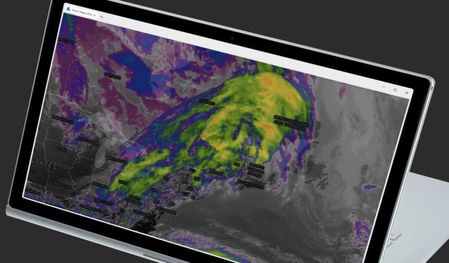
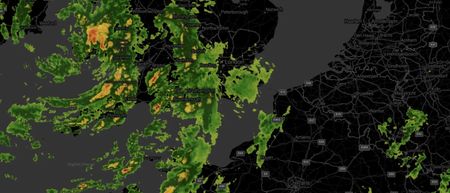
Azure Maps provides current and historical data to help you build your applications and create new insights. Support business decisions, enable planning, and power predictions with GIS data management. Combine Azure Maps with data in your Azure account to do even more. Smart decisions and plans, powered by data. Whether you’re finding the best possible place for a new business outlet or optimizing routing for multiple agents, every successful decision starts with better data. Azure Maps APIs’ delivers the geospatial data that thousands of businesses around the world depend on. Find out how Azure Maps APIs’ global coverage and high-accuracy geospatial data can transform organization outcomes. Rich geospatial data Access a vast repository of high-quality geospatial data curated from diverse sources worldwide, and leverage powerful analytics tools to extract actionable insights from spatial data provided within the Azure environment, uncovering hidden patterns, trends, and correlations that drive strategic initiatives Boundless flexibility Benefit from Azure's robust and scalable infrastructure. Process and analyze large volumes of spatial data efficiently and cost-effectively. Visualize spatial data in a way that suits your needs with customizable maps, location data management tools, and dashboards that facilitate clear communication and decision-making. Industry-specific compliance Ensure compliance with regulatory requirements by accessing geospatial data management tools that meet the highest standards of accuracy, privacy, and security with spatial analytics solutions tailored to your industry's unique compliance criteria, whether you're in retail, logistics, real estate, or urban planning. . GIS data management, simplified Azure Maps makes it easy to use and integrate our accurate geospatial data into your applications to unlock new insights. Whether you’re a seasoned developer or new to building mapping applications, you’ll find it easy to work with these robust and intuitive mapping APIs. Azure Maps API provides everything you need to thrive with your next app, from generating accurate time zone data, leveraging live or predictive traffic to high-resolution weather information. Timezone API The timezone API allows developers to query the timezone for any latitude/longitude. The timezone service can return past, current, and future timezones, localized time zones in UTC, or daylight savings in various formats. Explore Timezone API Get Started With Timezones Traffic Data The traffic service provides data on traffic flow and incidents for a given area or route and presents this information as a map overlay using the Traffic REST API. This location data management feature provides insights and critical awareness of flow and incidents along a route that could affect routes, distance, and travel time between locations. Explore Traffic API Demo: Traffic Data Get Started with Traffic Data in Your Application Weather Data Our weather service provides daily, historical, normal, and actuals for any latitude/longitude while also providing temperature, air quality, and storm information using the Weather API. This REST API provides valuable data to inform prediction and modeling based on current and forecasted data, helping developers create weather-informed applications. Explore Weather API Demo: Adding Weather Data Get Started With Weather Data Explore the Azure Maps Platform Large-scale geospatial applications require innovative tools and effective optimization to balance data efficiency and usability. We have only introduced three of these Data rich options, but Azure Maps has a whole lot more to offer. Explore Azure Maps’ capabilities and leverage Azure Maps rich Data APIs today for gaining deeper insights and building better geospatial solutions.509Views1like1CommentAdvanced Route Tracking for Transportation Services
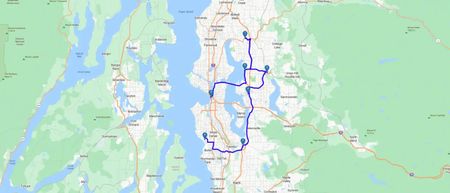
Azure Maps routing services can help ensure that the right professionals use the best route to reach their destination on time. The services can also factor-in variables such as vehicle data, traffic information, weather events, and more to find the best route for a call, while scaling this across an entire department.589Views1like0CommentsCreating Custom Map Visualizations with Azure Maps
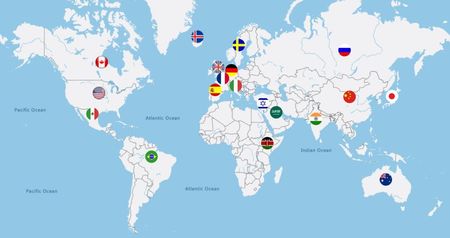
Azure Maps empowers businesses and developers by making it easy to create custom maps and interactive visualizations. Whether you’re using Power BI or integrating APIs directly into applications, Azure Maps simplifies each step—from data preparation to advanced customization. Its robust features, scalability, and superior support set it apart, enabling you to unlock deeper insights through the visualization of geospatial data6.2KViews1like0Comments