licensing
444 Topics
Windows 11 not activating after mainboard replacement, troubleshooter doesn't run, can't get support
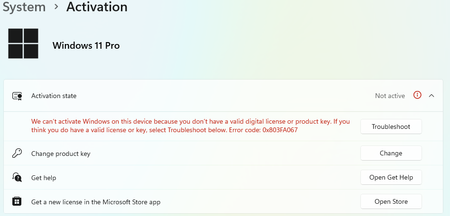
I work from home with my PC running Windows 11 Pro 25H2. My Windows license has a long lineage, starting with a retail Windows 8 DVD, which was successively updated for free to Windows 8.1, 10, and 11, activating it with a digital license automatically issued by Microsoft at every update and renewed without issue at every Windows reinstall. So, I don't have a Windows 11 product key, and since the original retail purchase was over a decade ago, I don't have the Windows 8 DVD or its key anymore either (not that I think that it would work anyway). During all those years, my PC had several hardware changes that affected the activation, but back in those days you could easily talk to a Microsoft support representative, and they always solved my problem. Now, however, Microsoft has made that extremely difficult. More about this later on. My mainboard just died a few days ago, and I was forced to replace it. I did not reinstall Windows, I'm still using the same old boot drive with the same Windows install. I knew I would lose the Windows activation, but I counted on that being easy to resolve, as it was the previous times. Was I wrong! I searched what I should do and found that I had to run the activation troubleshooter on the Settings -> System -> Activation window and inform that my hardware had changed. However, when I click on the Troubleshoot button, nothing happens, other than the mouse cursor briefly blinking. THE TROUBLESHOOTER WINDOW DOES NOT APPEAR AND IT DOES NOT RUN. I ran sfc /scannow, rebooted, and tried again. Nothing changed. I tried to contact Microsoft's support, but after walking in circles through a lot of knowledge base articles that the site force-fed me and that obviously didn't help, I finally found an actual contact link. It asked me for the type of issue, and I selected "Windows activation". After another truckload of useless KB articles, it asked me to inform my installation ID (not the product key), which, according to that page, should appear on the Activation window. The window does not show the installation ID. I searched again and found that I could obtain the installation ID with the command slmgr /dtl. Indeed, it showed the ID — in a separate pop-up window that doesn't allow copying the text. It's a very long sequence of digits (63, I think) that I had to manually and carefully type into the form. I had a few false starts (it's easy to mistype when it's 63 seemingly random digits), but the form warned me that the ID was invalid and I retyped it until I got it right. Then I got a response that said that my installation could not be validated and I could close the window. No contact link, nothing more. Dead end. Microsoft refused to even hear me! So, the recommended solution doesn't work and Microsoft won't even let me contact them and explain my problem. I don't want to buy a new Windows license, not only because of the expense, but also because it wouldn't be fair. After all, until a few days ago I was a legitimate user with a fully licensed and activated Windows install, according to Microsoft's own terms. In the meantime, I'm writing this with that ugly watermark on my monitor... What can I do? Thank you very much in advance for any help.Solved503Views0likes5Comments
Wasted money on Windows Licenses
Exact same issue as Windows License Will Not Transfer to New Motherboard | Microsoft Community Hub https://techcommunity.microsoft.com/discussions/windows11/windows-license-will-not-transfer-to-new-motherboard/4554117 Purchased Windows 11 Home and Windows 11 Pro Installed home on amd and pro on intel pc. Month or so later did a wipe and re installed on the pcs but wanted pro on the amd pc and put home on the intel. WILL NOT ACTIVATE! Yes I have tried ALL the trouble shoots and online "so called support" and hit all the same dead ends the op in the thread posted above it. Troubleshoot shows no devices linked and says cant activate, Change product keys says can't activate. Wasted my money on legit full retail license when I should have just bought a $20 key from one of those websites. Microsoft does not give a rats about customers and I swear every time I build a new PC over the years there is always something crap about the install process or activation.9Views0likes0Comments
Windows License Will Not Transfer to New Motherboard
I've gone in circles for 2 days now with AI support bots, trouble shooters, and agonizing search engine queries. In my old PC setup, I had Windows 11 Pro; under the activation tab in settings, it shows it is linked to my Microsoft account. Great, should be a piece of cake. I install a new mobo and fresh install windows 11 pro after migrating the M.2 to the new mobo, and I am met with this screen when I try to input the same, old Windows key: Whatever, I'll follow the troubleshooter: Fantastic, I'll follow both of those links because SURELY that is all I have to do to resolve this: It doesn't list any devices, which is complete BS because I can see everything in my Microsoft devices: It doesn't list any of my other devices, despite being logged in to the new PC with my MS account? The red note for my old Mobo is referencing that I unassembled my current PC, reassembled it with the old hardware, reformatted and fresh installed windows - and could see that it Windows 11 Pro was activated and tied to my MS account in settings. Cool cool, time to contact support through 'Get Help'. Reactivating Windows 11 after hardware change > No > yes > on this PC > No > Contact support It seems that it knows my key is correct, however it dumps me into a deadend: Man, this feels awesome! I guess I will continue down the rabbit hole and """"contact support"""": I followed the prompts, entered in my 63digit cmd.exe > "slmgr /dti" from my current PC (AND MY OLD PC AFTER SPENDING HOURS REHOOKING MY OLD MOBO ****BACK UP**** TO CONFIRM I HAVE DONE EVERYTHING CORRECTLY, AND GRABBING THAT ID TOO) and I'm ultimately met with a dead end. So after "contacting support", I decided to use the support bot feature on microsoft's site, where I still cannot reach a real person. I'm beyond livid and exhausted at this point; somehow, spending 30-45 minutes to write up this post seems like the best way to "Get Help", ironically. it refuses to connect me to someone real, and the above 'activate-by-ID' doesn't work for my new (or old) PC setup IDs. Any help is appreciated. I read online that if I get in contact with an agent, they can help swap the license over - I just can't connect to anyone.426Views0likes11Comments
What is the best PC backup software for Windows 11/10?
Hi everyone, hope to tap into the collective wisdom here. I've put off a proper backup solution for my Windows 11 machine, and I know I play with fire. Every "top 10" list feels like an ad, and I just want real-user opinions. I’m not a pro, so something reliable and user-friendly is key. I look for something that can handle both a solid system image (for a full disaster recovery) and regular file backups. Free is great, but I’m willing to pay a reasonable one-time fee for a "set it and forget it" tool that just works. What is the best PC backup software for Windows in 2026? Any horror stories to avoid? Major thanks for any help you can offer.13KViews4likes9Comments
Reinstalling the Microsoft Gaming Overlay
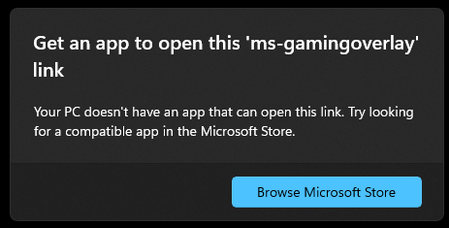
Hi! Some time ago, I uninstalled the Microsoft Gaming Overlay - I think it was the overlay used by the Xbox Game Bar (win+G to bring it up). I am trying to reinstall it, but I can't figure it out. Is there a powershell command I can use to reinstall it? Every time I launch a game, I get the following popup a few times: Any ideas? Thanks!228KViews3likes44Comments
Which license for private Windows 11 Pro VM running on KVM/QEMU on Homelab
Hello, I have a question about the license terms for Windows 11 Pro. I have an Ubuntu server at home that's always running. I’m setting up a Windows 11 Pro VM on it using KVM/QEMU to run Ableton Live. My laptop isn’t powerful enough for music production, so I’d like to use the server’s processing power and access the VM remotely from my own PC or laptop. Both devices already have a valid Windows 11 Pro license. The VM on the server would be an additional installation and would be used exclusively by me for personal purposes. My question is: Is an additional Windows 11 Pro retail license sufficient for this scenario, including use within the VM and remote access from my own devices? Or do I need a different license for this? I specifically want to clarify the licensing rights, not the technical activation process. I've already asked several Microsoft support bots about this, but haven't received a clear answer.31Views0likes0CommentsHow do I free up storage space on my Windows 11 PC?
Hi everyone, I have an legacy PC that was recently upgraded to Windows 11, and now I am running low on storage space. The computer has a 256GB SSD, and there is only about 20GB of free space left. I am worried that this may affect performance or cause problems with updates. I am not very tech-savvy, so I would really appreciate simple and safe advice. What are the best ways to free up storage space on Windows 11 PC without deleting anything important? I would like to know what I should check first, which files are usually safe to remove, and whether Windows 11 has any built-in tools that can help. Thanks in advance for any help.4.1KViews1like11Comments
Windows 11 Enterprise Evaluation 26H2 — Is offline activation supported?
Hello, I'm seeking clarification from Microsoft regarding offline activation of Windows 11 Enterprise Evaluation 26H2. Environment: Windows 11 Enterprise Evaluation 26H2 Build: 26300.9457 Hyper-V virtual machine used for isolated software testing Licensing channel: Retail:TB:Eval Product: EnterpriseEval Current licensing status: Notification Notification reason: 0xC004F009 Grace period remaining: 0 The VM was installed offline and deliberately has no network adapters connected. An Installation ID is available through slmgr /dlv. No activation attempt, licence reset, rearm or product-key modification has been performed. My question: Microsoft documents an offline activation process using an Installation ID and Confirmation ID. Does this procedure support the specific Retail:TB:Eval licence used by Windows 11 Enterprise Evaluation 26H2? Can a Confirmation ID be obtained through Microsoft's Product Activation Portal using a separate Internet-connected device, allowing the VM to remain completely offline? If this evaluation edition does not support offline activation, is initial online activation mandatory? Is there official Microsoft documentation confirming the applicable activation requirements? I'm specifically asking about the 90-day Enterprise Evaluation, not a standard retail, volume or perpetual Windows licence. I'd appreciate confirmation from a Microsoft representative or a reference to authoritative evaluation-specific licensing documentation. Thank you.38Views0likes0Comments
Win11 Night light turns off automatically after waking from sleep
When the Night Light feature is enabled and the computer enters sleep mode, the Night Light feature will automatically turn off even after the system is woken up, although its scheduled tasks and manual on/off functions will remain enabled. The screen will revert to the default color temperature until the Night Light feature is turned off and then turned back on again.39Views0likes0Comments
Win 11 Pro - Unable to log in with MS 365 Business Basic account
Good day, I have a couple of new build Win11Pro 26H2 units that have been setup with a local admin account. When I go to SETTINGS, ACCOUNTS, OTHER USERS, ADD ACOUNT it comes up with a message stating "Looks like this isn't a Microsoft account." I know that this is a valid account as this is my MS365 Admin Center account. Is there something that I am missing on how to add an account? I had read that it had to be WinPro, so upgraded from Home to Pro. Thanks for any support that you can provide. Bill WilsonSolved115Views0likes2Comments