learning
58 Topics
Defender streaming setup and integration with private event hub
Hey team, Do we know Defeneder supports private endpoint only event hubs to ingest data - I think only public is supported Configure Azure Event Hubs for Microsoft Defender XDR event ingestion - Microsoft Defender XDR | Microsoft Learn Could anyone please clarify?254Views0likes1CommentIntune device compliance status not evaluated
Has anyone encountered devices taking absolutely forever to evaluate overall compliance after user enrollment ESP? (pre-provisioned devices). They just sit there in "not evaluated" and get blocked by CA policy. Most come good eventually, but some literally are taking employees offline for the whole day. These are all Win11 AAD-joined. Microsoft has only offered me the standard "may take up to 8 hours, goodbye" response but I am pulling my hair out trying to figure out if this is just an Intune thing, or is there a trick I am missing? Some of them take so long that I give up and swap out the device so they can start working. The individual policies are evaluating just fine, but the overall status is way behind. I'd even prefer them to be non-compliant because at least then the grace period would kick in. I have had very limited success with rebooting and kicking off all the syncs / check access buttons, but I have a feeling those buttons have just been a placebo. It happens very sporadically too on about half of devices the user doesn't even notice it's that quick. Thanks for any advice10KViews0likes6Comments
Is "Endpoint Security Policies" available to us? (error getting Intune policies)
Question We'd like to use Defender \ Endpoint Security Policies. Is that possible for my tenant's environment? Getting below error on "Defender \ Endpoint Security Policies" page "There seems to be an issue getting your Intune policies" Details of our environment Purpose of defender To protect our server fleet that's running outside of Azure Tenant GCC - Moderate Scoped Region Commercial Azure East US 2 Subscription Microsoft Defender for Servers Plan 1 (No other subscription, etc.) Defender Client OS Windows 2016, 2019, 2022 RHEL8, 9 (No desktops\laptops) Agents installed on each Windows and Linux server Defender is onboarded Arc is onboarded Configured Settings and Errors Defender \ Settings \ Configuration management \ Enforcement scope https://security.microsoft.com/securitysettings/endpoints/configuration_management2 Error at top of page "Intune is not configured to allow Microsoft Defender for Endpoint to manage security configuration settings." Use MDE to enforce security configuration settings from Intune Set to ON Enable configuration management Windows Server devices On tagged devices Windows Server Domain Controller devices On tagged devices Linux devices On tagged devices Security settings management for Microsoft Defender for Cloud onboarded devices. Set to ON Manage Security settings using Configuration Manager Set to OFF Defender \ Settings \ Configuration management \ Intune Permissions https://security.microsoft.com/securitysettings/endpoints/intune_permissions Getting error "Access needed You don't have the right permissions in AAD to view this information (in addition to those you already have in MDE). To adjust your permissions, go to the AAD portal." Defender \ Endpoint Security Policies https://security.microsoft.com/policy-inventory On main page, getting below error There seems to be an issue getting your Intune policies If I try to make a new policy There seems to be an issue loading the policy authoring wizard. Intune \ Endpoint security https://intune.microsoft.com/#view/Microsoft_Intune_Workflows/SecurityManagementMenu Getting Error You don't have access Intune roles | My permissions https://intune.microsoft.com/#view/Microsoft_Intune_DeviceSettings/RolesLandingMenuBlade/~/myPermissions You're an administrator with full permissions to all Microsoft Intune resources. Intune roles | Administrator Licensing https://intune.microsoft.com/#view/Microsoft_Intune_DeviceSettings/RolesLandingMenuBlade/~/administratorLicensing Allow admins without an Intune license to access Intune. Their scope of access is determined by the Intune roles you've assigned them. I've clicked the box "Allow access to unlicensed admins" Alternatives If Defender \ Endpoint Security Policies isn't available, as alternatives, I guess we could use SCCM Antimalware policies to manage Windows servers Deploying a central mdatp_managed.json to manage Linux servers However, it would be greatly preferred to use the Defender \ Endpoint Security Policies feature for Windows and Linux690Views0likes4Comments
Pending Approval/Provisioning for Microsoft Defender XDR Lab/Trial Environment
Hello Microsoft Community Team, On June 26, 2026, our organization applied for a Microsoft 365 Developer Environment / Free Trial to support evaluation of the Microsoft Defender XDR Lab environment. To date, the environment has not been provisioned, and we have not received any status updates or confirmation. Impact: Current Status: We are currently utilizing our production environment to test project capabilities, which poses risks and limitations. Future Intent: Our organization plans to transition to a full, paid Business/Enterprise purchase immediately upon proving the platform’s benefits. Urgency: This delay is stalling our evaluation phase. We urgently need this environment onboarded and activated so we can proceed with deployment tests and subsequent procurement. Request: Please review the status of our registration and expedite the onboarding/provisioning of this developer environment. Thank you for your prompt assistance.458Views0likes1CommentAsk Microsoft Anything: Attack Disruption with Microsoft Defender on July 14
Hey Defender enthusiasts! Just wanted to remind you all that we are holding an AMA next week at 9AM PST on July 14 with the Attack Disruption team. Come learn about Attack Disruption—Microsoft Defender’s built‑in, AI-powered capability that stops in‑progress attacks at machine speed by analyzing attacker intent, identifying compromised assets, and containing threats before they spread. Bring your questions and hear directly from product experts on real‑world scenarios and best practices. Hope to see you there! Event Link: Ask Microsoft Anything: Microsoft Defender Attack Disruption | Microsoft Community Hub136Views0likes0CommentsMicrosoft Sentinel MCP Entity Analyzer: Explainable risk analysis for URLs and identities
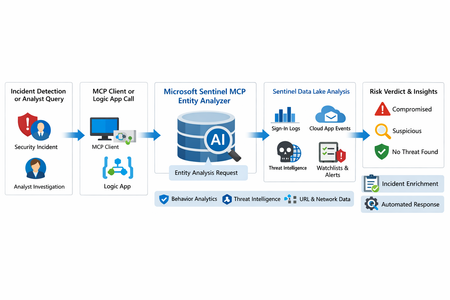
What makes this release important is not just that it adds another AI feature to Sentinel. It changes the implementation model for enrichment and triage. Instead of building and maintaining a chain of custom playbooks, KQL lookups, threat intel checks, and entity correlation logic, SOC teams can call a single analyzer that returns a reasoned verdict and supporting evidence. Microsoft positions the analyzer as available through Sentinel MCP server connections for agent platforms and through Logic Apps for SOAR workflows, which makes it useful both for interactive investigations and for automated response pipelines. Why this matters First, it formalizes Entity Analyzer as a production feature rather than a preview experiment. Second, it introduces a real cost model, which means organizations now need to govern usage instead of treating it as a free enrichment helper. Third, Microsoft’s documentation is now detailed enough to support repeatable implementation patterns, including prerequisites, limits, required tables, Logic Apps deployment, and cost behavior. From a SOC engineering perspective, Entity Analyzer is interesting because it focuses on explainability. Microsoft describes the feature as generating clear, explainable verdicts for URLs and user identities by analyzing multiple modalities, including threat intelligence, prevalence, and organizational context. That is a much stronger operational model than simple point-enrichment because it aims to return an assessment that analysts can act on, not just more raw evidence What Entity Analyzer actually does The Entity Analyzer tools are described as AI-powered tools that analyze data in the Microsoft Sentinel data lake and provide a verdict plus detailed insights on URLs, domains, and user entities. Microsoft explicitly says these tools help eliminate the need for manual data collection and complex integrations usually required for investigation and enrichment hat positioning is important. In practice, many SOC teams have built enrichment playbooks that fetch sign-in history, query TI feeds, inspect click data, read watchlists, and collect relevant alerts. Those workflows work, but they create maintenance overhead and produce inconsistent analyst experiences. Entity Analyzer centralizes that reasoning layer. For user entities, Microsoft’s preview architecture explains that the analyzer retrieves sign-in logs, security alerts, behavior analytics, cloud app events, identity information, and Microsoft Threat Intelligence, then correlates those signals and applies AI-based reasoning to produce a verdict. Microsoft lists verdict examples such as Compromised, Suspicious activity found, and No evidence of compromise, and also warns that AI-generated content may be incorrect and should be checked for accuracy. That warning matters. The right way to think about Entity Analyzer is not “automatic truth,” but “high-value, explainable triage acceleration.” It should reduce analyst effort and improve consistency, while still fitting into human review and response policy. Under the hood: the implementation model Technically, Entity Analyzer is delivered through the Microsoft Sentinel MCP data exploration tool collection. Microsoft documents that entity analysis is asynchronous: you start analysis, receive an identifier, and then poll for results. The docs note that analysis may take a few minutes and that the retrieval step may need to be run more than once if the internal timeout is not enough for long operations. That design has two immediate implications for implementers. First, this is not a lightweight synchronous enrichment call you should drop carelessly into every automation branch. Second, any production workflow should include retry logic, timeouts, and concurrency controls. If you ignore that, you will create fragile playbooks and unnecessary SCU burn. The supported access path for the data exploration collection requires Microsoft Sentinel data lake and one of the supported MCP-capable platforms. Microsoft also states that access to the tools is supported for identities with at least Security Administrator, Security Operator, or Security Reader. The data exploration collection is hosted at the Sentinel MCP endpoint, and the same documentation notes additional Entity Analyzer roles related to Security Copilot usage. The prerequisite many teams will miss The most important prerequisite is easy to overlook: Microsoft Sentinel data lake is required. This is more than a licensing footnote. It directly affects data quality, analyzer usefulness, and rollout success. If your organization has not onboarded the right tables into the data lake, Entity Analyzer will either fail or return reduced-confidence output. For user analysis, the following tables are required to ensure accuracy: AlertEvidence, SigninLogs, CloudAppEvents, and IdentityInfo. also notes that IdentityInfo depends on Defender for Identity, Defender for Cloud Apps, or Defender for Endpoint P2 licensing. The analyzer works best with AADNonInteractiveUserSignInLogs and BehaviorAnalytics as well. For URL analysis, the analyzer works best with EmailUrlInfo, UrlClickEvents, ThreatIntelIndicators, Watchlist, and DeviceNetworkEvents. If those tables are missing, the analyzer returns a disclaimer identifying the missing sources A practical architecture view An incident, hunting workflow, or analyst identifies a high-interest URL or user. A Sentinel MCP client or Logic App calls Entity Analyzer. Entity Analyzer queries relevant Sentinel data lake sources and correlates the findings. AI reasoning produces a verdict, evidence narrative, and recommendations. The result is returned to the analyst, incident record, or automation workflow for next-step action. This model is especially valuable because it collapses a multi-query, multi-tool investigation pattern into a single explainable decisioning step. Where it fits in real Sentinel operations Entity Analyzer is not a replacement for analytics rules, UEBA, or threat intelligence. It is a force multiplier for them. For identity triage, it fits naturally after incidents triggered by sign-in anomaly detections, UEBA signals, or Defender alerts because it already consumes sign-in logs, cloud app events, and behavior analytics as core evidence sources. For URL triage, it complements phishing and click-investigation workflows because it uses TI, URL activity, watchlists, and device/network context. Implementation path 1: MCP clients and security agents Microsoft states that Entity Analyzer integrates with agents through Sentinel MCP server connections to first-party and third-party AI runtime platforms. In practice, this makes it attractive for analyst copilots, engineering-side investigation agents, and guided triage experiences The benefit of this model is speed. A security engineer or analyst can invoke the analyzer directly from an MCP-capable client without building a custom orchestration layer. The tradeoff is governance: once you make the tool widely accessible, you need a clear policy for who can run it, when it should be used, and how results are validated before action is taken. Implementation path 2: Logic Apps and SOAR playbooks For SOC teams, Logic Apps is likely the most immediately useful deployment model. Microsoft documents an entity analyzer action inside the Microsoft Sentinel MCP tools connector and provides the required parameters for adding it to an existing logic app. These include: Workspace ID Look Back Days Properties payload for either URL or User The documented payloads are straightforward: { "entityType": "Url", "url": "[URL]" } And { "entityType": "User", "userId": "[Microsoft Entra object ID or User Principal Name]" } Also states that the connector supports Microsoft Entra ID, service principals, and managed identities, and that the Logic App identity requires Security Reader to operate. This makes playbook integration a strong pattern for incident enrichment. A high-severity incident can trigger a playbook, extract entities, invoke Entity Analyzer, and post the verdict back to the incident as a comment or decision artifact. The concurrency lesson most people will learn the hard way Unusually direct guidance on concurrency: to avoid timeouts and threshold issues, turn on Concurrency control in Logic Apps loops and start with a degree of parallelism of . The data exploration doc repeats the same guidance, stating that running multiple instances at once can increase latency and recommending starting with a maximum of five concurrent analyses. This is a strong indicator that the correct implementation pattern is selective analysis, not blanket analysis. Do not analyze every entity in every incident. Analyze the entities that matter most: external URLs in phishing or delivery chains accounts tied to high-confidence alerts entities associated with high-severity or high-impact incidents suspicious users with multiple correlated signals That keeps latency, quota pressure, and SCU consumption under control. KQL still matters Entity Analyzer does not eliminate KQL. It changes where KQL adds value. Before running the analyzer, KQL is still useful for scoping and selecting the right entities. After the analyzer returns, KQL is useful for validation, deeper hunting, and building custom evidence views around the analyzer’s verdict. For example, a simple sign-in baseline for a target user: let TargetUpn = "email address removed for privacy reasons"; SigninLogs | where TimeGenerated between (ago(7d) .. now()) | where UserPrincipalName == TargetUpn | summarize Total=count(), Failures=countif(ResultType != "0"), Successes=countif(ResultType == "0"), DistinctIPs=dcount(IPAddress), Apps=make_set(AppDisplayName, 20) by bin(TimeGenerated, 1d) | order by TimeGenerated desc And a lightweight URL prevalence check: let TargetUrl = "omicron-obl.com"; UrlClickEvents | where TimeGenerated between (ago(7d) .. now()) | search TargetUrl | take 50 Cost, billing, and governance GA is where technical excitement meets budget reality. Microsoft’s Sentinel billing documentation says there is no extra cost for the MCP server interface itself. However, for Entity Analyzer, customers are charged for the SCUs used for AI reasoning and also for the KQL queries executed against the Microsoft Sentinel data lake. Microsoft further states that existing Security Copilot entitlements apply The April 2026 “What’s new” entry also explicitly says that starting April 1, 2026, customers are charged for the SCUs required when using Entity Analyzer. That means every rollout should include a governance plan: define who can invoke the analyzer decide when playbooks are allowed to call it monitor SCU consumption limit unnecessary repeat runs preserve results in incident records so you do not rerun the same analysis within a short period Microsoft’s MCP billing documentation also defines service limits: 200 total runs per hour, 500 total runs per day, and around 15 concurrent runs every five minutes, with analysis results available for one hour. Those are not just product limits. They are design requirements. Limitations you should state clearly The analyze_user_entity supports a maximum time window of seven days and only works for users with a Microsoft Entra object ID. On-premises Active Directory-only users are not supported for user analysis. Microsoft also says Entity Analyzer results expire after one hour and that the tool collection currently supports English prompts only. Recommended rollout pattern If I were implementing this in a production SOC, I would phase it like this: Start with a narrow set of high-value use cases, such as suspicious user identities and phishing-related URLs. Confirm that the required tables are present in the data lake. Deploy a Logic App enrichment pattern for incident-triggered analysis. Add concurrency control and retry logic. Persist returned verdicts into incident comments or case notes. Then review SCU usage and analyst value before expanding coverage.1.4KViews8likes0Comments
Custom data collection in MDE - what is default?
So you just announced the preview of "Custom data collection in Microsoft Defender for Endpoint (Preview)" which lets me ingest custom data to sentinel. Is there also an overview of what is default and what I can add? e.g. we want to examine repeating disconnects from AzureVPN clients (yes, it's most likely just Microsoft's fault, as the app ratings show 'everyone' is having them) How do I know which data I can add to DeviceCustomNetworkEvents which isnt already in DeviceNetworkEvents?Solved228Views1like1CommentWhat’s New in Microsoft Sentinel and XDR: AI Automation, Data Lake Innovation, and Unified SecOps
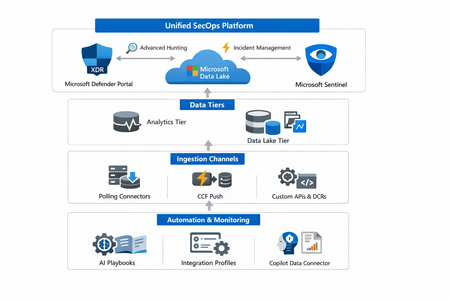
The most consequential “new” Microsoft Sentinel / Defender XDR narrative for a deeply technical Microsoft Tech Community article is the operational and engineering shift to unified security operations in the Microsoft Defender portal, including an explicit Azure portal retirement/sunset timeline and concrete migration implications (data tiering, correlation engine changes, schema differences, and automation behavior changes). Official sources now align on March 31, 2027 as the sunset date for managing Microsoft Sentinel in the Azure portal, with customers being redirected to the Defender portal after that date. The “headline” feature announcements to anchor your article around (because they create new engineering patterns, not just UI changes) are: AI playbook generator (preview): Natural-language-driven authoring of Python playbooks in an embedded VS Code environment (Cline), using Integration Profiles for dynamic API calls and an Enhanced Alert Trigger for broader automation triggering across Microsoft Sentinel, Defender, and XDR alert sources. CCF Push (public preview): A push-based connector model built on the Azure Monitor Logs Ingestion API, where deploying via Content Hub can automate provisioning of the typical plumbing (DCR/DCE/app registration/RBAC), enabling near-real-time ingestion plus ingestion-time transformations and (per announcement) direct delivery into certain system tables. Data lake tier ingestion for Advanced Hunting tables (GA): Direct ingestion of specific Microsoft XDR Advanced Hunting tables into the Microsoft Sentinel data lake without requiring analytics-tier ingestion—explicitly positioned for long-retention, cost-effective storage and retrospective investigations at scale. Microsoft 365 Copilot data connector (public preview): Ingests Copilot-related audit/activity events via the Purview Unified Audit Log feed into a dedicated table (CopilotActivity) with explicit admin-role requirements and cost notes. Multi-tenant content distribution expansion: Adds support for distributing analytics rules, automation rules, workbooks, and built-in alert tuning rules across tenants via distribution profiles, with stated limitations (for example, automation rules that trigger a playbook cannot currently be distributed). Alert schema differences for “standalone vs XDR connector”: A must-cite engineering artifact documenting breaking/behavioral differences (CompromisedEntity semantics, field mapping changes, alert filtering differences) when moving to the consolidated Defender XDR connector path. What’s new and when Feature and release matrix The table below consolidates officially documented Sentinel and Defender XDR features that are relevant to a “new announcements” technical article. If a source does not explicitly state GA/preview or a specific date, it is marked “unspecified.” Feature Concise description Status (official) Announcement / release date Azure portal Sentinel retirement / redirection Sentinel management experience shifts to Defender portal; sunset date extended; post-sunset redirection expected Date explicitly stated Mar 31, 2027 sunset (date stated) extension published Jan 29, 2026 Sentinel in Defender portal (core GA) Sentinel is GA in Defender portal, including for customers without Defender XDR/E5; unified SecOps surface GA Doc updated Sep 30, 2025; retirement note reiterated 2026 AI playbook generator Natural language → Python playbook, documentation, and a visual flow diagram; VS Code + Cline experience Preview Feb 23, 2026 Integration Profiles (playbook generator) Centralized configuration objects (base URL, auth method, credentials) used by generated playbooks to call external APIs dynamically Preview feature component Feb 23, 2026 Enhanced Alert Trigger (generated playbooks) Tenant-level trigger designed to target alerts across Sentinel + Defender + XDR sources and apply granular conditions Preview feature component Feb 23, 2026 CCF Push Push-based ingestion model that reduces setup friction (DCR/DCE/app reg/RBAC), built on Logs Ingestion API; supports transformations and high-throughput ingestion Public preview Feb 12–13, 2026 Legacy custom data collection API retirement Retirement of legacy custom data collection API noted as part of connector modernization Retirement date stated Sep 2026 (retirement) Data lake tier ingestion for Microsoft XDR Advanced Hunting tables Ingest selected Advanced Hunting tables from MDE/MDO/MDA directly into Sentinel data lake; supports long retention and lake-first analytics GA Feb 10, 2026 Microsoft 365 Copilot data connector Ingests Copilot activities/audit logs; data lands in CopilotActivity; requires specific tenant roles to enable; costs apply Public preview Feb 3, 2026 Multi-tenant content distribution: expanded content types Adds support for analytics rules, automation rules, workbooks, and built-in alert tuning rules; includes limitations and prerequisites Stated as “supported”; feature described as part of public preview experience in monthly update Jan 29, 2026 GKE dedicated connector Dedicated connector built on CCF; ingests GKE cluster activity/workload/security events into GKEAudit; supports DCR transformations and lake-only ingestion GA Mar 4, 2026 UEBA behaviors layer “Who did what to whom” behavior abstraction from raw logs; newer sources state GA; other page sections still label Preview GA and Preview labels appear in official sources (inconsistent) Feb 2026 (GA statement) UEBA widget in Defender portal home Home-page widget to surface anomalous user behavior and accelerate workflows Preview Jan 2026 Alert schema differences: standalone vs XDR connector Documents field mapping differences, CompromisedEntity behavior changes, and alert filtering/scoping differences Doc (behavioral/change reference) Feb 4, 2026 (last updated) Defender incident investigation: Blast radius analysis Graph visualization built on Sentinel data lake + graph for propagation path analysis Preview (per Defender XDR release notes) Sep 2025 (release notes section) Advanced hunting: Hunting graph Graph rendering of predefined threat scenarios in advanced hunting Preview (per Defender XDR release notes) Sep 2025 (release notes section) Sentinel repositories API version retirement “Call to action” to update API versions: older versions retired June 1, 2026; enforcement June 15, 2026 for actions Dates explicitly stated March 2026 (noticed); Jun 1 / Jun 15, 2026 (deadline/enforcement) Technical architecture and integrations Unified reference architecture Microsoft’s official integration documentation describes two “centers of gravity” depending on how you operate: In Defender portal mode, Sentinel data is ingested alongside organizational data into the Defender portal, enabling SOC teams to analyze and respond from a unified surface. In Azure portal mode, Defender XDR incidents/alerts flow via Sentinel connectors and analysts work across both experiences. Integration model: Defender suite and third-party security tools The Defender XDR integration doc is explicit about: Supported Defender components whose alerts appear through the integration (Defender for Endpoint, Identity, Office 365, Cloud Apps), plus other services such as Purview DLP and Entra ID Protection. Behavior when onboarding Sentinel to the Defender portal with Defender XDR licensing: the Defender XDR connector is automatically set up and component alert-provider connectors are disconnected. Expected latency: Defender XDR incidents typically appear in Sentinel UI/API within ~5 minutes, with additional lag before securityIncident ingestion is complete. Cost model: Defender XDR alerts and incidents that populate SecurityAlert / SecurityIncident are synchronized at no charge, while other data types (for example, Advanced Hunting tables) are charged. For third-party tools, Microsoft’s monthly “What’s new” explicitly calls out new GA out-of-the-box connectors/solutions (examples include Mimecast audit logs, Vectra AI XDR, and Proofpoint POD email security) as part of an expanding connector ecosystem intended to unify visibility across cloud, SaaS, and on-premises environments. Telemetry, schemas, analytics, automation, and APIs Data flows and ingestion engineering CCF Push and the “push connector” ingestion path Microsoft’s CCF Push announcement frames the “old” model as predominantly polling-based (Sentinel periodically fetching from partner/customer APIs) and introduces push-based connectors where partners/customers send data directly to a Sentinel workspace, emphasizing that “Deploy” can auto-provision the typical prerequisites: DCE, DCR, Entra app registration + secrets, and RBAC assignments. Microsoft also states that CCF Push is built on the Logs Ingestion API, with benefits including throughput, ingestion-time transformation, and system-table targeting. A precise engineering description of the underlying Logs Ingestion API components (useful for your article even if your readers never build a connector) is documented in Azure Monitor: Sender app authenticates via an app registration that has access to a DCR. Sender sends JSON matching the DCR’s expected structure to a DCR endpoint or a DCE (DCE required for Private Link scenarios). The DCR can apply a transformation to map/filter/enrich before writing to the target table. DCR transformation (KQL) Microsoft documents “transformations in Azure Monitor” and provides concrete sample KQL snippets for common needs such as cost reduction and enrichment. // Keep only Critical events source | where severity == "Critical" // Drop a noisy/unneeded column source | project-away RawData // Enrich with a simple internal/external IP classification (example) source | extend IpLocation = iff(split(ClientIp,".")[0] in ("10","192"), "Internal", "External") These are direct examples from Microsoft’s sample transformations guidance; they are especially relevant because ingestion-time filtering is one of the primary levers for both performance and cost management in Sentinel pipelines. A Sentinel-specific nuance: Microsoft states that Sentinel-enabled Log Analytics workspaces are not subject to Azure Monitor’s filtering ingestion charge, regardless of how much data a transformation filters (while other Azure Monitor transformation cost rules still exist in general). Telemetry schemas and key tables you should call out A “new announcements” article aimed at detection engineers should explicitly name the tables that are impacted by new features: Copilot connector → CopilotActivity table, with a published list of record types (for example, CopilotInteraction and related plugin/workspace/prompt-book operations) and explicit role requirements to enable (Global Administrator or Security Administrator). Defender XDR incident/alert sync → SecurityAlert and SecurityIncident populated at no charge; other Defender data types (Advanced Hunting event tables such as DeviceInfo/EmailEvents) are charged. Sentinel onboarding to Defender advanced hunting: Sentinel alerts tied to incidents are ingested into AlertInfo and accessible in Advanced hunting; SecurityAlert is queryable even if not shown in the schema list in Defender (notable for KQL portability). UEBA “core” tables (engineering relevance: query joins and tuning): IdentityInfo, BehaviorAnalytics, UserPeerAnalytics, Anomalies. UEBA behaviors layer tables (new behavior abstraction): SentinelBehaviorInfo and SentinelBehaviorEntities, created only if behaviors layer is enabled. Microsoft XDR Advanced Hunting lake tier ingestion GA: explicit supported tables from MDE/MDO/MDA (for example DeviceProcessEvents, DeviceNetworkEvents, EmailEvents, UrlClickEvents, CloudAppEvents) and an explicit note that MDI support will follow. Detection and analytics: UEBA and graph UEBA operating model and scoring Microsoft’s UEBA documentation gives you citeable technical detail: UEBA uses machine learning to build behavioral profiles and detect anomalies versus baselines, incorporating peer group analysis and “blast radius evaluation” concepts. Risk scoring is described with two different scoring models: BehaviorAnalytics.InvestigationPriority (0–10) vs Anomalies.AnomalyScore (0–1), with different processing characteristics (near-real-time/event-level vs batch/behavior-level). UEBA Essentials is positioned as a maintained pack of prebuilt queries (including multi-cloud anomaly detection), and Microsoft’s February 2026 update adds detail about expanded anomaly detection across Azure/AWS/GCP/Okta and the anomalies-table-powered queries. Sentinel data lake and graph as the new “analytics substrate” Microsoft’s data lake overview frames a two-tier model: Analytics tier: high-performance, real-time analytics supporting alerting/incident management. Data lake tier: centralized long-term storage for querying and Python-based analytics, designed for retention up to 12 years, with “single-copy” mirroring (data in analytics tier mirrored to lake tier). Microsoft’s graph documentation states that if you already have Sentinel data lake, the required graph is auto-provisioned when you sign into the Defender portal, enabling experiences like hunting graph and blast radius. Microsoft also notes that while the experiences are included in existing licensing, enabling data sources can incur ingestion/processing/storage costs. Automation: AI playbook generator details that matter technically The playbook generator doc contains unusually concrete engineering constraints and required setup. Key technical points to carry into your article: Prerequisites: Security Copilot must be enabled with SCUs available (Microsoft states SCUs aren’t billed for playbook generation but are required), and the Sentinel workspace must be onboarded to Defender. Roles: Sentinel Contributor is required for authoring Automation Rules, and a Detection tuning role in Entra is required to use the generator; permissions may take up to two hours to take effect. Integration Profiles: explicitly defined as Base URL + auth method + required credentials; cannot change API URL/auth method after creation; supports multiple auth methods including OAuth2 client credentials, API key, AWS auth, Bearer/JWT, etc. Enhanced Alert Trigger: designed for broader coverage across Sentinel, Defender, and XDR alerts and tenant-level automation consistency. Limitations: Python only, alerts as the sole input type, no external libraries, max 100 playbooks/tenant, 10-minute runtime, line limits, and separation of enhanced trigger rules from standard alert trigger rules (no automatic migration). APIs and code/CLI (official) Create/update a DCR with Azure CLI (official) Microsoft documents an az monitor data-collection rule create workflow to create/update a DCR from a JSON file, which is directly relevant if your readers build their own “push ingestion” paths outside of CCF Push or need transformations not supported via a guided connector UI. az monitor data-collection rule create \ --location 'eastus' \ --resource-group 'my-resource-group' \ --name 'my-dcr' \ --rule-file 'C:\MyNewDCR.json' \ --description 'This is my new DCR' Send logs via Azure Monitor Ingestion client (Python) (official) Microsoft’s Azure SDK documentation provides a straightforward LogsIngestionClient pattern (and the repo samples document the required environment variables such as DCE, rule immutable ID, and stream name). import os from azure.identity import DefaultAzureCredential from azure.monitor.ingestion import LogsIngestionClient endpoint = os.environ["DATA_COLLECTION_ENDPOINT"] rule_id = os.environ["LOGS_DCR_RULE_ID"] # DCR immutable ID stream_name = os.environ["LOGS_DCR_STREAM_NAME"] # stream name in DCR credential = DefaultAzureCredential() client = LogsIngestionClient(endpoint=endpoint, credential=credential) body = [ {"Time": "2026-03-18T00:00:00Z", "Computer": "host1", "AdditionalContext": "example"} ] # Actual upload method name/details depend on SDK version and sample specifics. # Refer to official ingestion samples and README for the exact call. The repo sample and README explicitly define the environment variables and the use of LogsIngestionClient + DefaultAzureCredential. Sentinel repositories API version retirement (engineering risk) Microsoft’s Sentinel release notes contain an explicit “call to action” that older REST API versions used for Sentinel Repositories will be retired (June 1, 2026) and that Source Control actions using older versions will stop being supported (starting June 15, 2026), recommending migration to specific versions. This is critical for “content-as-code” SOC engineering pipelines. Migration and implementation guidance Prerequisites and planning gates A technically rigorous migration section should treat this as a set of gating checks. Microsoft’s transition guidance highlights several that can materially block or change behavior: Portal transition has no extra cost: Microsoft explicitly states transitioning to the Defender portal has no extra cost (billing remains Sentinel consumption). Data storage and privacy policies change: after onboarding, Defender XDR policies apply even when working with Sentinel data (data retention/sharing differences). Customer-managed keys constraint for data lake: CMK is not supported for data stored in Sentinel data lake; even broader, Sentinel data lake onboarding doc warns that CMK-enabled workspaces aren’t accessible via data lake experiences and that data ingested into the lake is encrypted with Microsoft-managed keys. Region and data residency implications: data lake is provisioned in the primary workspace’s region and onboarding may require consent to ingest Microsoft 365 data into that region if it differs. Data appearance lag when switching tiers: enabling ingestion for the first time or switching between tiers can take 90–120 minutes for data to appear in tables. Step-by-step configuration tasks for the most “new” capabilities Enable lake-tier ingestion for Advanced Hunting tables (GA) Microsoft’s GA announcement provides direct UI steps in the Defender portal: Defender portal → Microsoft Sentinel → Configuration → Tables Select an Advanced Hunting table (from the supported list) Data Retention Settings → choose “Data lake tier” + set retention + save Microsoft states that this allows Defender data to remain accessible in the Advanced Hunting table for 30 days while a copy is sent to Sentinel data lake for long-term retention (up to 12 years) and graph/MCP-related scenarios. Deploy the Microsoft 365 Copilot data connector (public preview) Microsoft’s connector post provides the operational steps and requirements: Install via Content Hub in the Defender portal (search “Copilot”, install solution, open connector page). Enablement requires tenant-level Global Administrator or Security Administrator roles. Data lands in CopilotActivity. Ingestion costs apply based on Sentinel workspace settings or Sentinel data lake tier pricing. Configure multi-tenant content distribution (expanded content types) Microsoft documents: Navigate to “Content Distribution” in Defender multi-tenant management portal. Create/select a distribution profile; choose content types; select content; choose up to 100 workspaces per tenant; save and monitor sync results. Limitations: automation rules that trigger a playbook cannot currently be distributed; alert tuning rules limited to built-in rules (for now). Prerequisites: access to more than one tenant via delegated access; subscription to Microsoft 365 E5 or Office E5. Prepare for Defender XDR connector–driven changes Microsoft explicitly warns that incident creation rules are turned off for Defender XDR–integrated products to avoid duplicates and suggests compensating controls using Defender portal alert tuning or automation rules. It also warns that incident titles will be governed by Defender XDR correlation and recommends avoiding “incident name” conditions in automation rules (tags recommended). Common pitfalls and “what breaks” A strong engineering article should include a “what breaks” section, grounded in Microsoft’s own lists: Schema and field semantics drift: The “standalone vs XDR connector” schema differences doc calls out CompromisedEntity behavior differences, field mapping changes, and alert filtering differences (for example, Defender for Cloud informational alerts not ingested; Entra ID below High not ingested by default). Automation delays and unsupported actions post-onboarding: Transition guidance states automation rules might run up to 10 minutes after alert/incident changes due to forwarding, and that some playbook actions (like adding/removing alerts from incidents) are not supported after onboarding—breaking certain playbook patterns. Incident synchronization boundaries: incidents created in Sentinel via API/Logic App playbook/manual Azure portal aren’t synchronized to Defender portal (per transition doc). Advanced hunting differences after data lake enablement: auxiliary log tables are no longer available in Defender Advanced hunting once data lake is enabled; they must be accessed via data lake exploration KQL experiences. CI/CD failures from API retirement: repository connection create/manage tooling that calls older API versions must migrate by June 1, 2026 to avoid action failures. Performance and cost considerations Microsoft’s cost model is now best explained using tiering and retention: Sentinel data lake tier is designed for cost-effective long retention up to 12 years, with analytics-tier data mirrored to the lake tier as a single copy. For Defender XDR threat hunting data, Microsoft states it is available in analytics tier for 30 days by default; retaining beyond that and moving beyond free windows drives ingestion and/or storage costs depending on whether you extend analytics retention or store longer in lake tier. Ingesting data directly to data lake tier incurs ingestion, storage, and processing costs; retaining in lake beyond analytics retention incurs storage costs. Ingestion-time transformations are a first-class cost lever, and Microsoft explicitly frames filtering as a way to reduce ingestion costs in Log Analytics. Sample deployment checklist Phase Task Acceptance criteria (engineering) Governance Confirm target portal strategy and dates Internal cutover plan aligns with March 31, 2027 retirement; CI/CD deadlines tracked Identity/RBAC Validate roles for onboarding + automation Required Entra roles + Sentinel roles assigned; propagation delays accounted for Data lake readiness Decide whether to onboard to Sentinel data lake CMK policy alignment confirmed; billing subscription owner identified; region implications reviewed Defender XDR integration Choose integration mode and test incident sync Incidents visible within expected latency; bi-directional sync fields behave as expected Schema regression Validate queries/rules against XDR connector schema KQL regression tests pass; CompromisedEntity and filtering changes handled Connector modernization Inventory connectors; plan CCF / CCF Push transitions Function-based connectors migration plan; legacy custom data collection API retirement addressed Automation Pilot AI playbook generator + enhanced triggers Integration Profiles created; generated playbooks reviewed; enhanced trigger scopes correct Multi-tenant operations Configure content distribution if needed Distribution profiles sync reliably; limitations documented; rollback/override plan exists Outage-proofing Update Sentinel repos tooling for API retirement All source-control actions use recommended API versions before June 1, 2026 Use cases and customer impact Detection and response scenarios that map to the new announcements Copilot governance and misuse detection The Copilot connector’s published record types enable detections for scenarios such as unauthorized plugin/workspace/prompt-book operations and anomalous Copilot interactions. Data is explicitly positioned for analytic rules, workbooks, automation, and threat hunting within Sentinel and Sentinel data lake. Long-retention hunting on high-volume Defender telemetry (lake-first approach) Lake-tier ingestion for Advanced Hunting tables (GA) is explicitly framed around scale, cost containment, and retrospective investigations beyond “near-real-time” windows, while keeping 30-day availability in the Advanced Hunting tables themselves. Faster automation authoring and customization (SOAR engineering productivity) Microsoft positions the playbook generator as eliminating rigid templates and enabling dynamic API calls across Microsoft and third-party tools via Integration Profiles, with preview-customer feedback claiming faster automation development (vendor-stated). Multi-tenant SOC standardization (MSSP / large enterprise) Multi-tenant content distribution is explicitly designed to replicate detections, automation, and dashboards across tenants, reducing drift and accelerating onboarding, while keeping execution local to target tenants. Measurable benefit dimensions (how to discuss rigorously) Most Microsoft sources in this announcement set are descriptive (not benchmark studies). A rigorous article should therefore describe what you can measure, and label any numeric claims as vendor-stated. Recommended measurable dimensions grounded in the features as documented: Time-to-detect / time-to-ingest: CCF Push is positioned as real-time, event-driven delivery vs polling-based ingestion. Time-to-triage / time-to-investigate: UEBA layers (Anomalies + Behaviors) are designed to summarize and prioritize activity, with explicit scoring models and tables for query enrichment. Incident queue pressure: Defender XDR grouping/enrichment is explicitly described as reducing SOC queue size and time to resolve. Cost-per-retained-GB and query cost: tiering rules and retention windows define cost tradeoffs; ingestion-time transformations reduce cost by dropping unneeded rows/columns. Vendor-stated metrics: Microsoft’s March 2026 “What’s new” roundup references an external buyer’s guide and reports “44% reduction in total cost of ownership” and “93% faster deployment times” as outcomes for organizations using Sentinel (treat as vendor marketing unless corroborated by an independent study in your environment). Comparison of old vs new Microsoft capabilities and competitor XDR positioning Old vs new (Microsoft) Capability “Older” operating model (common patterns implied by docs) “New” model emphasized in announcements/release notes Primary SOC console Split experience (Azure portal Sentinel + Defender portal XDR) Defender portal as the primary unified SecOps surface; Azure portal sunset Incident correlation engine Sentinel correlation features (e.g., Fusion in Azure portal) Defender XDR correlation engine replaces Fusion for incident creation after onboarding; incident provider always “Microsoft XDR” in Defender portal mode Automation authoring Logic Apps playbooks + automation rules Adds AI playbook generator (Python) + Enhanced Alert Trigger, with explicit constraints/limits Custom ingestion Data Collector API legacy patterns + manual DCR/DCE plumbing CCF Push built on Logs Ingestion API; emphasizes automated provisioning and transformation support Long retention Primarily analytics-tier retention strategies Data lake tier supports up to 12 years; lake-tier ingestion for AH tables GA; explicit tier/cost model Graph-driven investigations Basic incident graphs Blast radius analysis + hunting graph experiences built on Sentinel data lake + graph Competitor XDR offerings (high-level, vendor pages) The table below is intentionally “high-level” and marks details as unspecified unless explicitly stated on the cited vendor pages. Vendor Positioning claims (from official vendor pages) Notes / unspecified items CrowdStrike Falcon Insight XDR is positioned as “AI-native XDR” for “endpoint and beyond,” emphasizing detection/response and threat intelligence. Data lake architecture, ingestion transformation model, and multi-tenant content distribution specifics are unspecified in cited sources. Palo Alto Networks Cortex XDR is positioned as integrated endpoint security with AI-driven operations and broader visibility; vendor site highlights outcome metrics in customer stories and “AI-driven endpoint security.” Lake/graph primitives, connector framework model, and schema parity details are unspecified in cited sources. SentinelOne Singularity XDR is positioned as AI-powered response with automated workflows across the environment; emphasizes machine-speed incident response. Specific SIEM-style retention tiering and documented ingestion-time transformations are unspecified in cited sources.2.3KViews10likes0Comments
Integrate Defender for Cloud Apps w/ Azure Firewall or VPN Gateway
Hello, Recently I have been tasked with securing our openAI implementation. I would like to marry the Defender for Cloud Apps with the sanctioning feature and the Blocking unsanctioned traffic like the Defender for Endpoint capability. To do this, I was only able to come up with: creating a windows 2019/2022 server, with RRAS, and two interfaces in Azure, one Public, and one private. Then I add Defender for Endpoint, Optimized to act as a traffic moderator, integrated the solution with Defender for cloud apps, with BLOCK integration enabled. I can then sanction each of the desired applications, closing my environment and only allowing sanctioned traffic to sanctioned locations. This solution seemed : difficult to create, not the best performer, and the solution didn't really take into account the ability of the router to differentiate what solution was originating the traffic, which would allow for selective profiles depending on the originating source. Are there any plans on having similar solutions available in the future from: VPN gateway (integration with Defender for Cloud Apps), or Azure Firewall -> with advanced profile. The Compliance interface with the sanctioning traffic feature seems very straight forward .377Views0likes1Comment