event
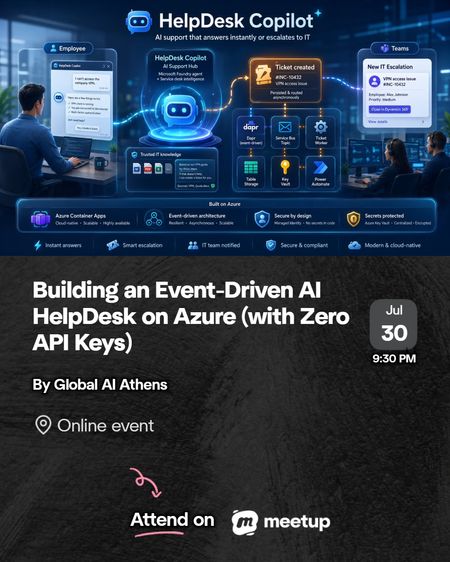
177 TopicsBuilding an Event-Driven AI HelpDesk on Azure (with Zero API Keys)
Building AI agents is one thing, but deploying them securely at enterprise scale is another challenge. If you’re still relying on hardcoded API keys to connect your AI services, it’s time to move on. Join a live, in-depth demo of HelpDesk Copilot—an open-source, event-driven AI service desk built entirely on Azure with zero API keys. This session will cover the foundry-ticketing architecture, showing how to orchestrate autonomous AI agents using cloud-native patterns, combining Microsoft Foundry Agents’ conversational intelligence with Dapr’s event-routing, all running on Azure Container Apps. You’ll also learn about the “Zero API Key” security model using Managed Identities and Azure RBAC, and pick up best practices for serverless, scale-to-zero cloud deployments. Perfect for Cloud Architects, AI/DevOps Engineers, and Backend Developers aiming to build secure, scalable, event-driven AI apps on the Microsoft stack.78Views0likes0CommentsEvent Recap - TechCon Chicago 2026
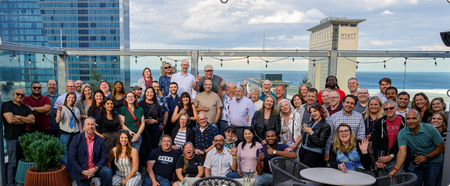
TechCon 365 Chicago is part of the TechCon series of regional Microsoft 365, Power Platform, and Azure data conferences — one of the most widely attended community-run Microsoft conference series in North America. For FY26, the Chicago edition was focused on Microsoft 365, Collaboration, Microsoft 365 Copilot and Power Platform. Dates: June 15–19, 2026 Venue: McCormick Place South, 2301 S. King Drive, Chicago, IL 60616 Reach: 650+ attendees | 43 US states | 14 countries Event website: Home - Microsoft TechCon365 Chicago - A Microsoft 365 Conference & Copilot Conference In a Nutshell TechCon 365 Chicago 2026 delivered: A full-stage, 90-minute keynote anchored by Microsoft leaders, using a baseball playbook metaphor to frame the AI + Microsoft 365 transformation story 20+ Microsoft-led and 100+ Community-led sessions spanning Copilot adoption, AI in SharePoint, Power Platform, governance, and community engagement A dedicated Microsoft Community Zone (Expo Hall) for face-to-face engagement, demos, and community resource sign-ups Multiple Ask the Experts slots giving attendees direct access to product experts The Women in Tech and Allies Discussion, building on the MGCI community inclusion agenda Microsoft / Team Involvement Microsoft was a principal sponsor of TechCon 365 Chicago 2026, with the SCALE Microsoft Community Team leading the Microsoft engagement from planning through execution. Microsoft Production Team Heather Cook, Principal PM, SCALE Team — Production Lead & Keynote/Session Speaker Bryan Wofford, Principal PM, SCALE Team — Production PM & Session Speaker, MVP Lead Jonathan Jones – Program Manager, SCALE Team - Booth & Community Emily Hove — Event Logistics, SCALE Team Event Producers (TechCon side) David Wilhelm Sharon Toler Ashley Wilhelm Liz Sundet Key Content & Highlights Keynote “Stepping Up to the Plate: Winning Strategies to Empower Your Team” | Wed, June 17 | 8:30–9:40 AM | Stage S105bcd The 90-minute keynote used a baseball lens to map the Microsoft 365 + AI + Power Platform transformation journey, organizing the message into four “bases”: First Base: AI in Action – From Promise to Real Work (Copilot as leadoff hitter) Second Base: The Foundation Matters – Governance, Security, and Readiness Third Base: Adoption Is the Hard Part – coaching, culture, and confidence Home Plate: Building the Platform – Extensibility and What's Next with Power Platform The keynote brought together Microsoft and community voices on the same stage, reinforcing the message that AI transformation is a team sport. Speakers included Heather Cook, Bryan Wofford, Charles Lakes II, Liam Clearly, Julie Turner, Shannon Lindsay, and Mark Kashman. We may have had a seventh inning stretch to sing "Take Me Out To The Ballgame". Named Microsoft Sessions 20+ Microsoft-led sessions were delivered across the five days, spanning beginner to advanced levels. Microsoft Led Breakout Sessions (Times are in Central Time (CT)) Building Enterprise AI Agents: From Low‑Code Copilot Studio to GitHub Copilot Integration with Minhaj Sahibzada (Wednesday 11:30 AM to 12:40 PM) Backstage event production with Microsoft 365 Copilot with Heather Cook and Bryan Wofford (Wednesday 11:30 AM to 12:40 PM) Secure and Govern AI and Agents with Microsoft & Agent 365 with Craig Jahnke and Sophie Ke (Wednesday 11:30 AM to 12:40 PM) Driving productivity with Power BI and M365 with Lada Hill and Lauren Faber (Wednesday 1:40 PM to 2:50 PM) Engage Everywhere: Communities, Events, and Storylines in Teams, Powered by AI with Steve Nguyen (Wednesday 1:40pm - 2:50 pm) How to Get What You Want: The Art of Prompt Engineering for Copilot with Michelle Gilbert (Wednesday 1:40pm - 2:50 pm) Avoiding the “Go-Live Hangover”: Battle-Tested Best Practices for Contact Center Implementations with Vinoth Balasubramanian (Wednesday 3:30 PM to 4:40 PM) Setup M365 for Education: Copilot. Teams & More with Max Fritz (Wednesday 3:30 PM to 4:40 PM) Beyond Compliance: How Accessibility Improves Productivity in Microsoft 365 with Max Fritz (Thursday 9:00 AM to 10:10 AM) From Hocus Pocus to Focus: Contextualize Your Power BI Data with Stephanie Bruno and Shannon Lindsay (Thursday 9:00 AM to 10:10 AM) Introduction to Vibing with the M365 Tools Frontier Agents and Power Platform with Ralph Rivas and Craig Jahnke (Thursday 9:00 AM to 10:10 AM) Work Smarter with OneDrive: AI-Enhanced Productivity Across Microsoft 365 with Vishal Lodha (Thursday 9:00 AM to 10:10 AM) The Next Generation of Community Storytelling: Powered by AI with Jonathan Jones (Thursday 9:00 AM to 10:10 AM) AI Ready - An Evolutive Approach with Juan Carlos Chipi (Thursday 10:40 AM to 11:50 PM) Accessibility by Design: Building Inclusive Experiences with Microsoft 365 and Copilot with Darryl Rowe and Laurie Allen (Thursday 10:40 AM to 11:50 PM) Engage, Learn, Lead: Maximizing Impact with the Microsoft Tech Community with Josh Leporati (Thursday 12:50 PM to 2:00 PM) The Rise of AI Agents: Designing the Platforms That Power Enterprise AI with Marco Salas Robles and Kevin Leal (Thursday 12:50 PM to 2:00 PM) Voice Bots That Work: Designing AI Conversations Customers Don’t Hang Up On with Vinoth Balasubramanian (Thursday 2:10 PM to 3:20 PM) From Data Chaos to Copilot Confidence: Building a Secure Foundation with Purview & SAM with Bryan Wofford (Thursday 4:00 PM to 5:10 PM) Extending Copilot with Connectors: Powering Intelligent Agents with Your Data with AJ Goldie (Thursday 4:00 PM to 5:10 PM) Why Power BI Copilot Works (and When It Doesn’t) with Sanjay Raut and Dan English (Thursday 4:00 PM to 5:10 PM) Your Copilot Adoption Playbook: Getting Started with Microsoft Adoption Resources with Gina Hoffman and Bryan Wofford (MCAG) (Friday 9:00 AM to10:10 AM) What’s New in the Microsoft 365 Copilot App: Your AI Command Center for Work with Michael Goad (Friday 9:00 AM to 10:10 AM) AI in SharePoint in Action with Bryan Wofford (Friday 10:20 AM to 11:30 AM) Building Smarter Agents: What’s New in Agent Builder and What’s Coming Next with AJ Goldie (Friday 12:30 PM to 1:40 PM) For all community sessions and the overall agenda from this show: https://aka.ms/TechCon365/2026/Sessions Thank you to all the Microsoft speakers who gave terrific sessions and staffed our Microsoft Community Lounge: AJ Goldie, Allison Michels, April Delsing, Bryan Wofford, Carrie White, Craig Jahnke, Dan English, Darryl Rowe, Gina Hoffman, Jonathan Jones, Juan Carlos Chipi, Lada Hill, Lauren Faber, Marco Salas Robles, Max Fritz, Michael Goad, Michelle Gilbert, Minhaj Sahibzada, Nisaini Rexach, Sanjay Raut, Sophie Ke, Steve Nguyen, Vinoth Balasubramanian, Vishal Lodha. Thank you to all community speakers for bringing your awesomeness to this show, so many repeat speakers bringing their A game and welcome to all of the first timers!! You Rock! Ask the Experts Microsoft experts participated in open drop-in Ask the Experts sessions in the Expo Hall / South Concourse Lobby, giving attendees direct access for one-on-one Q&A and guidance. Microsoft Community Zone (Expo Hall) The Microsoft Community Zone served as the hub for community engagement throughout the event — featuring branded resources, QR code sign-up stations for MGCI and Microsoft Tech Community, and staffed meet-and-greet hours with Microsoft speakers and experts. Microsoft MVPs at TechCon A big thank you to all the Microsoft MVPs who spoke and staffed the event: Andrew Hess, Anna Bordioug, Antonio Maio, Asif Rehmani, Brian Alderman, Cathy Dew, Charles Lakes II, Chris McNulty, Christian Buckley, David Drever, Derek Cash-Peterson, Don Kirkham, Drew Madelung, Galen Keene, Geetha Sivasailam, Gokan Ozcifci, Heidi Jordan, Jared Matfess, John Kerski, John White, Joy Apple, Julie Turner, Karinne Bessette, Lindsay Shelton, Luc Labelle, Marc D Anderson, Mark Kashman, Mark Rackley, Mike Maadarani, Norm Young, Paul Papanek Stork, Prashant G Bhoyar, Ralph Rivas, Ryan Schouten, Samir Makwana, Sarah Haase, Scott Shearer, Shari Oswald, Stephanie Bruno, Susan Hanley, Tiffany Songvilay, Treb Gatte, Vlad Catrinescu, Wes Preston, and William Huneycutt. Women in Tech and Allies Discussion Heather Cook led a collaborative discussion alongside Nisaini Rexach, April Delsing, Carrie White all from Microsoft and Kelly Fernandez, Executive Director of TedXChicago bringing together women in tech and allies to share perspectives, experiences, and inspiration. The session is part of Microsoft's ongoing Women in M365 community initiative. Sponsors A big thank you to all the sponsors What Attendees Valued Most When asked what they valued most, attendees consistently cited five themes: Networking — the #1 answer: meeting peers with shared challenges and forming lasting connections Workshops & hands-on demos — live, participatory sessions cited as highlights by both new and returning attendees Direct access to MVPs & experts — one-on-one conversations with speakers and subject matter experts Copilot & AI sessions — practical, applicable Copilot and AI implementation content Overall session quality — well-paced sessions with actionable takeaways and strong speaker insight Wrap-Up Summary TechCon 365 Chicago 2026 was a clear success and a strong validation of Microsoft's investment in community-run, practitioner-focused technical events. A Big THANK YOU to the TechCon producers David Wilhelm, Sharon Toler, Ashley Wilhelm, Liz Sundet and the entire team for an outstanding event.158Views1like0CommentsPartner Blog | MCAPS Start for Partners is almost here: Your final readiness checklist
On Wednesday, July 22, Microsoft partners will come together for a no-cost, digital-only event designed to provide a clear view of Microsoft FY27 priorities, investment focus, and go-to-market direction. This is more than a moment to hear what is ahead. It is an opportunity to prepare your organization for the customer conversations, capability decisions, and execution priorities that will shape the year. The partners who will receive the most value from MCAPS Start for Partners will be the ones who tune in ready to listen, align, and act. Don’t miss out—there’s still time to register for the event. Why this moment matters The pace of AI adoption is moving quickly. Customers have moved beyond experimentation and are now focused on measurable business outcomes, return on AI investments, and trusted systems that protect their data, intellectual property, and competitive advantage. The start of the Microsoft fiscal year is an important planning moment for the partner ecosystem. It is when Microsoft priorities become clearer, investment areas come into focus, and partners can assess how to align business plans, customer motions, and internal readiness for the year ahead. MCAPS Start for Partners is designed to provide that early clarity. It gives partner leaders and teams a shared view of where Microsoft is focused, how customer demand is evolving, and what actions partners can take to build capability, go to market, and align with Microsoft sellers. Whether your business serves small and medium-sized business customers, enterprise customers, or both, your team can use the insights from MCAPS Start for Partners to start FY27 with a stronger operating rhythm and clearer alignment across your sales, technical, marketing, delivery, operations, and alliance teams. Continue reading blog here143Views2likes0CommentsEvent Recap - Microsoft at the Digital Workplace Conference Australia 2026
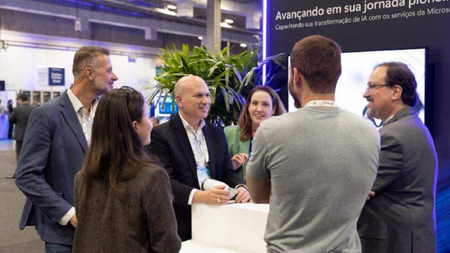
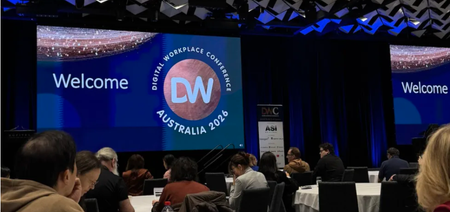
The Digital Workplace Conference 2026 (DWC AU) proved to be an unforgettable two days at the Sofitel Melbourne on Collins from 28–29 May 2026. Australia's premier in-person event for Microsoft 365 professionals brought together power users, business leaders, IT pros, and adoption and change managers from across the region under this year's theme — One Change. Big Impact. With deep focus on Microsoft 365, AI and Copilot, SharePoint, governance, and real-world adoption, attendees were treated to a packed programme of community-led learning, customer stories, and the kind of practical, take-home guidance that makes DWC such a standout on the Australian tech calendar. DWC in a nutshell 30+ speakers from 5 countries 247+ years of combined digital workplace experience represented on stage 3 parallel tracks across 2 days — Productivity, AI & Copilot, and Customer Journeys Microsoft as a sponsor, with our team on the keynote stage and on the floor Post-event attendee survey across roles, industries, states, and countries captured (full breakdown in the Attendee Insights section below) Give a read to the DW Results recap as well: Digital Workplace Conference Australia: What We Learned About AI, Governance, and Why People Still Matter - DW Results Opening Keynote From AI Hype to Everyday Impact Thursday 28 May, 9:00 AM, Grand Ballroom (90 minutes) Panelists: Heather Cook (Microsoft), Debbie Ireland (DWR), and Brett Gilbertson (ASI Solutions). The opening keynote set the tone for the two days — cutting through AI hype and grounding the conversation in what is actually working inside Australian organisations today. The panel landed honest stories about where Copilot is delivering value, where adoption is getting stuck, and how the right single change — well chosen and well executed — really can have an outsized impact. The energy carried straight into the first round of breakouts and shaped the customer conversations that followed across both days. Breakout Sessions Overview DWC 2026 ran three parallel tracks across two days, anchored on the official conference themes: Productivity Sessions in this track focused on getting more ROI from the Microsoft 365 tools customers already own — practical patterns to work smarter, not harder, and the unlocks people did not know they had. AI and Copilot This was the dominant theme — sessions ran the full lifecycle from governance and security through implementation to adoption, with a strong focus on moving teams from novice to nimble with Copilot prompts, agents, and Copilot Studio. Customer Journeys Real-world case studies from organisations who have shipped — the trials, the tribulations, and the lessons. Customer Journeys remains the track attendees consistently rate as the most valuable. Featured sessions and speakers Build Your Own M365 Copilot Reporting Dashboard — Loryan Strant (Avanade, Microsoft MVP) Adoption & Change Management for AI: The People Side — Troy Waller (ASI Solutions) From SharePoint Foundations to AI Agents: The Blackmores Journey — Sujith Sukumaran and Liza Tinker (Blackmores) Data Security Considerations for M365 Copilot and Agents — Andrew O'Young (Microsoft MVP) Not Just Slop: How AI Agents Run Our Managed Services Helpdesk — Mark Rhodes (Rapid Circle) Novice to Nimble: Mastering Microsoft 365 Copilot Prompts — Kirsty McGrath (OnPoint Solutions) (Microsoft MVP) Side by Side with Copilot Cowork: Reimagining Collaboration with AI — Lisa Crosbie (Akkodis, Microsoft MVP) The Copilot Mirror: Why AI Isn't the Problem, Your Governance is — Alpesh Nakar (EDUC4TE) and James Milne (FrontRow Technologies) Making AI, SharePoint and Intranets work well together — Natalie Ryan (Step Two) Keepin' it real: Lessons from the trenches — Debbie Ireland (DWR) (Microsoft RD) and Shannon Donovan (DWR) Gone but not forgotten: Lifecycle and retention — Jenn Jones (Datacom) Reaching Every Employee: Strategic Decisions Behind High Impact Employee Platforms— Benoit Rabreaud (LumApps ANZ) and Carolyn Coon Unshackled: Forge Your AI Personalised AI-Powered Digital Workplace — Emily Hughes (Circle T) The PowerPoint hacks every M365 user should know — Sharon Connolly (Microsoft MVP) Deliver more, govern better: Practical M365 governance — Peter Varitimidis, Connor Martin (Orchestry), and Louie Newlove (Rapid Circle) From Copilot Pilots to Business Impact: Turning AI Hype into Measurable Workplace Value — Daniel Brown (Archon Gnosis) (Microsoft MVP) You Have No Idea What Copilot Can Do Now — Daniel Anderson (Microsoft MVP) The Future of Intranets: AI Meets SharePoint — Steve Knutson, Stratos Technology Partners (Microsoft RD & MVP) Who Am I Now? Evolving Roles in the Modern Digital Workplace — Megan Strant, Kirsty McGrath, Bec Gallen, Jacob Laurence and Mathew Gilbertson Microsoft on the agenda Beyond the opening keynote, our Microsoft team carried sessions across both days. The Microsoft-led sessions at DWC 2026: From AI Hype to Everyday Impact (Opening Keynote panel) — Heather Cook, with Debbie Ireland (DWR) and Brett Gilbertson (ASI Solutions) — Thursday 28 May, Grand Ballroom Cultivating Trust and Leadership Excellence: Strategies for Respect and Empathy in the Workplace — Heather Cook — Friday 29 May, 9:00 AM, Sydney Room Why do my services keep breaking? — Elaine van Bergen, Principal Site Reliability Engineer, Azure Reliability — Friday 29 May, 9:00 AM, Brisbane Room Agent 365 — the why, what and how? — Jian Sun, Principal Program Manager — Friday 29 May, 12:45 PM, Brisbane Room Microsoft MVPs and Regional Directors Microsoft MVPs and Regional Directors were a huge part of the DWC programme this year — across SharePoint, Microsoft 365 Apps, Business Applications, AI Platform, and Copilot. The MVPs and RD on stage and in the community spaces at DWC 2026: Andrew O'Young Daniel Anderson Daniel Brown Debbie Ireland Kirsty McGrath Lisa Crosbie Liza Tinker Loryan Strant Matthew Gilbertson Brett Gilbertson Megan Strant Sharon Connolly Steve Knutson Their contributions, alongside customers, partner consultants, and DWR community leaders, reinforced exactly what makes DWC valuable — the community in this room shines, and they came ready to share what works and their experiences. Community Highlights DWC has always been a community-first event, and 2026 was no different. A few moments that stood out: The opening keynote panel — a packed Grand Ballroom and a lively Q&A that ran right up to the morning tea bell Thursday Networking Drinks in the Exhibition Area — two hours of unstructured time where the best conversations of the conference happened Customer-led case study sessions that drew standing-room-only crowds Recognition for Debbie Ireland and the DWR team for 35+ events across Australia, New Zealand, and Southeast Asia since 2009 Exhibition Area and the Microsoft booth The Exhibition Area was the centre of gravity for both days — morning tea, lunch, afternoon tea, and Thursday's networking drinks all happened in the same space, which meant the Microsoft booth had a steady stream of attendees and a constant flow of conversations across both days. Microsoft on-site: Ana Maria Suarez — Cloud Solution Architect Ashish Trivedi – Sr Program Manager, FastTrack Eddie Chua — Sr Program Manager Elaine van Bergen — Principal Site Reliability Engineer, Azure Reliability Garrett White — Biz Apps STU Heather Cook — Principal PM, M365 Customer Advocacy Group Jian Sun — Principal Program Manager, Microsoft Corporation Paul Mineo – Sr Solution Engineer Conversations at the Microsoft booth ran throughout the two days alongside sponsor and partner check-ins — see the attendee insights and themes sections below for what came out of those conversations. Who Was in the Room — Attendee Insights DWR shared post-event demographics from their attendee survey (approximately 64 responses). The room was a genuine cross-section of the Australian and New Zealand digital workplace community: Geography: Attendees came from across Australian states and territories — Victoria, New South Wales, Queensland, Western Australia, South Australia, and beyond — plus international guests from New Zealand and further afield Roles: Business Analysts, Change Managers, Developers, Information Architects, IT Management, Knowledge Managers, and Site Administrators and Power Users Industries: Banking and Finance, Government, Education, Health, Professional Services, Technology, Energy, NFP, Defence, Manufacturing, Retail, Transport, and more What attendees told us — four themes from DWR's post-event feedback The pace of AI is real — but no one has it fully figured out. People spoke openly about how hard it is to stay on top of how fast things are moving. There was genuine relief in hearing that even experts are working through it in real time. Foundations matter more than ever. One of the strongest signals: AI isn't the starting point. Good data, clear ownership, and solid governance still underpin everything — without that, even the most advanced tools struggle to deliver value. The biggest challenge is helping people change how they work. Even in a conference heavily focused on AI, the strongest recurring message wasn't about tools — it was about people. Supporting teams through change is still the hardest and most important part. Learning happens faster when we do it together. Again and again, attendees called out the value of being in the room — the informal conversations between sessions, shared experiences, and honest exchanges that are impossible to replicate online. Customer Conversations at the Microsoft Booth Customer conversations at the Microsoft booth throughout DWC 2026 were highly productive. These weren't formal meetings — they were the organic, drop-by conversations that happen when you're in the room — and they clustered around adoption, governance, and what's next for AI in the Australian enterprise. Top themes surfaced Microsoft 365 Copilot — adoption, ROI measurement, governance, agent extensibility, and moving teams from "I tried it once" to embedded daily use Copilot Studio and Agents — where to start, who should build, how to govern citizen-built agents, and how to keep them healthy in production SharePoint as the knowledge platform — search accuracy, information architecture, archive and retention, and getting the foundations right so Copilot actually returns useful answers Data security and Purview for AI — label rollout, sensitivity handling, and what "governance done right" looks like before scaling Copilot organisation-wide Adoption and change management — the people side keeps being named as the gap that determines whether AI investment pays off Intranet modernisation and employee experience — practical stories from customers building production-grade intranets quickly, with AI features layered on top Australian customers consistently asked for sharper guidance on moving Copilot beyond basic tasks toward creative, workflow-specific use cases — and reinforced that internal champions, structured adoption stages, and embedded security and compliance are critical to success. Public sector and federal government attendees raised human-centred digital practice and Australian-specific compliance considerations as recurring themes. Thank You A huge thank you to every attendee, speaker, sponsor, and volunteer who helped bring DWC 2026 to life. Your passion, curiosity, and commitment made this year's event genuinely exceptional. DW Results and Debbie Ireland Special thanks to event founder and producer Debbie Ireland and the entire team at Digital Workplace Results. DWR has delivered 35+ events across Australia, New Zealand, and Southeast Asia since 2009 — and the welcoming home you create for this industry each year is a big part of why Microsoft is proud to sponsor and show up the way we do. Microsoft MVPs, customers, and community speakers Thank you to the MVPs, Regional Director, customers, partners, and community speakers who carried the bulk of this year's programme. The full DWC 2026 speaker roster: Alpesh Nakar, Andrew O'Young, Andrew Pope, Annabel Hay, Benoit Rabreaud, Brett Gilbertson, Cairo Walker, Carolyn Coon, Connor Martin, Daniel Anderson, Daniel Brown, David Mitchell, Debbie Ireland, Elaine van Bergen, Emily Hughes, James Milne, Jan Krist, Jemma Hirst, Jenn Jones, Kirsty McGrath, Jian Sun, Lisa Crosbie, Liza Tinker, Loryan Strant, Louie Newlove, Mark Rhodes, Mathew Gilbertson, Megan Strant, Mel Finnigan, Mia Tait, Natalie Ryan, Peter Varitimidis, Shannon Donovan, Sharon Connolly, Shelley Van Hoos, Steve Knutson, Sujith Sukumaran, Sutter Schumacher, and Troy Waller. The community in this region keeps showing up with sharp, practical content — thank you for the time, the prep, and the generosity of sharing what you've learned. Sponsors Microsoft is proud to be part of the DWC 2026 sponsor community. Thank you to: Platinum: ASI Solutions Gold: Rapid Circle, Orchestry, Ideagen Silver: Athentra, LumApps, EDUC4TE, Audio Visual Distributors / Barco ClickShare, Microsoft, Datacom, Circle T, DW Results Bronze: Step Two, Technomancy Whether it was your first DWC or you've been with us since the early years, your presence helped create an inspiring and unforgettable experience. What's Next? The journey continues. Watch the dwcau.com.au and DWR channels for the 2027 dates and venue announcement — and in the meantime, keep the momentum going on the customer follow-ups and adoption commitments that came out of this week's conversations. Until then, let's keep the energy alive. Continue exploring, innovating, and collaborating with this community. The Australian M365 ecosystem is one of the strongest and most generous in the world, and DWC 2026 was a reminder of exactly why. #DWCAU | One Change. Big Impact187Views0likes0CommentsPartner Blog | From Microsoft Build to AI implementation: Build the skills to lead Frontier Transformation
Microsoft Build showcased the next phase of AI transformation. Across AI platforms, agents, and secure development, one message came through: customers are moving from AI exploration to implementation. For partners, that shift creates a practical opportunity. Customers are looking for guidance on ways to design, deploy, manage, secure, and scale AI-powered solutions that create measurable business value. That takes skilled teams, repeatable delivery capabilities, and a clear path from learning to implementation. This month’s skilling updates focus on turning Build momentum into action. New Frontier Transformation Engineering resources, on-demand Frontier Transformation Summit content, upcoming certification preparation, Microskilling, and go-to-market assets give partners multiple ways to strengthen AI implementation capabilities and show customers they are ready to lead. Build Frontier Transformation Engineering capability Frontier Transformation describes the shift from AI pilots to embedded, governed operating models. It requires technical depth across agents, Copilot, Microsoft Foundry, Microsoft IQ, security, governance, and business process transformation. The Frontier Transformation Engineer Badge is designed for technical professionals building this capability. It validates the skills needed to design and deliver AI agents across Copilot Studio, Microsoft Foundry, and the broader Frontier stack. For partners, the badge signals readiness to move from AI vision to execution. To support that journey, all of the Frontier Transformation Engineer Summit sessions are now available on demand, giving your teams a chance to revisit key content or catch up on sessions they missed. Use the recordings to continue progressing toward badge attainment and prepare your teams for the AI implementation work customers are prioritizing now. Continue reading here105Views1like0CommentsAbility Summit 2026: Accessibility-first innovation and your next partner opportunity
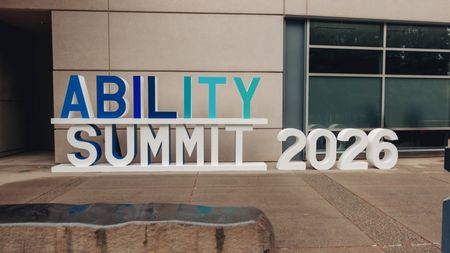
Accessibility is increasingly both a business imperative and a meaningful commercial opportunity for partners. At this year’s Microsoft Ability Summit, leaders across technology, education, and advocacy reinforced a clear point: accessibility-first innovation is creating new demand across AI, collaboration, learning, and customer experience. For partners, accessibility represents a clear opportunity to grow customer value. Accessibility-first innovation is becoming a mainstream expectation, opening opportunities to build differentiated services and solutions across AI, collaboration, learning, compliance, and customer experience. Organizations are increasingly viewing accessibility as part of a broader shift in how they approach AI, employee experience, and customer engagement. For partners, that shift creates an opportunity to lead higher-value conversations around innovation, trust, and long-term business impact. I encourage you to read Microsoft Chief Accessibility Officer Neil Barnett’s full recap of this year’s announcements and stories from the summit, including updates across AI, developer tools, Windows, devices, learning, Xbox, and inclusive packaging design. Why accessiblity matters for partners now Accessibility is becoming part of how customers evaluate experience quality, employee productivity, compliance expectations, and technology trust. Organizations are looking for technology that works consistently across real-world scenarios, roles, abilities, and environments. That expectation is accelerating as AI adoption grows. Accessibility is increasingly becoming part of how customers evaluate transformation readiness, technology trust, and the quality of the experiences they deliver across their organizations. A 2026 Forrester Consulting study commissioned by Microsoft found that assistive technology is already part of everyday work and life. Consumers reported using assistive features across at least six activities in the past month, on average. The same study found that 63% of respondents reported some level of difficulty with daily tasks related to vision, hearing, learning and cognition, mobility, and/or mental health. It also found that 71% of respondents would use assistive tools more often if enhanced with AI capabilities, and 55% said they feel a stronger commitment to employers when companies prioritize assistive tools and features. For partners, this points to a broader opportunity. Accessibility-first design can expand participation, strengthen employee and customer experiences, and build greater trust in technology, making it an increasingly important part of long-term transformation strategy. Where partners can lead The opportunity for partners is to bring accessibility into the conversations that are already shaping customer priorities, including AI transformation and adoption, modern work, application innovation, employee experience, customer engagement, and compliance. As accessibility becomes more central to business and technology strategy, partners can differentiate by making it part of the broader value they bring to customers. Partners that bring accessibility-first innovation into these conversations can deepen trust, expand strategic relevance, and create more differentiated value over time. This opportunity spans organizations of every size. Across both SMB and enterprise customers, accessibility is increasingly part of how leaders think about growth, workforce experience, customer connection, and technology modernization, and the Microsoft partner ecosystem is well positioned to meet that need. Partner opportunities in Microsoft Marketplace Microsoft Marketplace offers a useful view into how partners are translating accessibility-first innovation into practical customer value. The examples below illustrate how that opportunity is taking shape across different business and technology scenarios. Level Access makes digital accessibility a streamlined, scalable part of everyday operations The Level Access platform supports a continuous approach to accessibility, embedded into design, development, governance, and training workflows. Unlike point tools or episodic audits, this integrated solution helps organizations accelerate remediation, reduce risk, and demonstrate progress over time. Organizations can extend the power of the Level Access platform through private offers with capabilities such as LevelDocs for accessible content creation and remediation in Microsoft Word, Excel, and PowerPoint; LevelCI for automated web accessibility testing within CI/CD pipelines; and Mobile Testing for native iOS and Android accessibility across physical and virtual devices. Retain Connector by Inclusively Many organizations have invested heavily in benefits, workplace accommodations, mental health resources, and employee support programs. But employees, especially those navigating disabilities or workplace barriers, often don't know what is available or how to access it. Retain Connector by Inclusively closes that gap directly inside the tools employees already use. Deployed within Microsoft Teams, SharePoint, Outlook, and Microsoft 365 with no heavy integrations required, Retain acts as a workforce intelligence layer that lets employees describe their needs in plain language and get routed to the right benefits and resources through Inclusively's Success Enabler framework without needing to know what to search for or where to look. For employees who may feel hesitant to disclose a need or navigate a fragmented benefits landscape, the anonymous, conversational experience lowers the barrier to getting support. For HR and people leaders, Retain surfaces something equally valuable: real-time, aggregated insights into the benefits and barriers employees are actually experiencing. That intelligence helps organizations understand unmet demand, allocate benefits investments more effectively, and demonstrate a genuine commitment to inclusion not just in policy, but in practice. Creating differentiated value through accessibility offerings Taken together, these examples reinforce a broader point: accessibility is becoming an increasingly important part of how partners create differentiated value across both employee and customer experiences. Marketplace solutions can strengthen how partners bring accessibility-first innovation into customer conversations and platform experiences. The Microsoft Accessibility Partner Onboarding Guide also provides a useful foundation for partners looking to expand their accessibility focus on Microsoft platforms. The opportunity ahead for partners Accessibility is becoming an increasingly important part of the conversations customers are having around AI, modern work, security, application development, and industry transformation. The opportunity is not to treat accessibility as a separate conversation. It is to make accessibility part of how customers modernize, adopt AI, and build more trusted digital experiences. Ability Summit 2026 reinforced that accessibility-first innovation is shaping the future of AI, productivity, learning, collaboration, and end-customer experience. For partners, the opportunity is to turn that innovation into real customer impact. It is about building AI-powered experiences that are more trusted, more inclusive, and more effective for the people they serve. As Frontier Transformation accelerates AI adoption, partners are uniquely positioned to turn accessibility-first innovation into lasting business impact deepening customer relationships, expanding strategic relevance, and building stronger momentum as accessibility-first expectations continue to rise for our customers. Additional resources Read the Ability Summit 2026 blog by Neil Barnett, Chief Accessibility Officer at Microsoft. Explore the Forrester Consulting thought leadership paper commissioned by Microsoft, May 2026. Visit the Unique Unites Us accessibility hub. Watch for Ability Summit sessions to be available on demand in the coming weeks.116Views1like0Comments
Add Location to a Webinar
Hello! I appreciate Webinars are designed to be online - but does anyone know if it's possible to be able to add the Location field to Webinars? We often have hybrid meetings and it would be great to include Location. I have tried to add Location within Outlook after it's published, but this location does not then transfer down to those who register for the webinar. If I created a custom template (which I know requires Teams Premium) can I include Location on a custom template?132Views0likes2CommentsPartner Blog | Make the most of MCAPS Start for Partners: Sessions to prioritize
MCAPS Start for Partners is a no-cost, digital-only event taking place Wednesday, July 22, 2026, starting at 7:00 AM Pacific Time. This year’s event is designed to give partners a fast start to FY27, with guidance on Microsoft priorities, innovation, investments, and go-to-market motions. As customers move from AI experimentation to scaled execution, partners play a critical role in turning Frontier Transformation into measurable business outcomes. MCAPS Start for Partners is designed to give you a clear view of where Microsoft is focusing in FY27 and how those priorities translate into partner opportunity across sales planning, technical readiness, Microsoft Marketplace strategy, co-sell motion, security practice growth, and customer transformation. This event is designed for the teams responsible for FY27 execution, including alliance leaders, sales, presales, technical and practice leaders, marketing, Microsoft Marketplace, customer success, and business decision-makers. Whether your organization serves small and medium-sized businesses, enterprise customers, or both, MCAPS Start for Partners can give your teams the guidance they need to align early, reduce rework, and move faster into the year ahead. FY27 starts here, together. Hear from Microsoft leaders and partner voices about where we are investing, what is changing, and how to activate AI-led opportunities to drive growth this year. Featured sessions at MCAPS Start for Partners This year’s sessions span AI Business Solutions, Cloud & AI Platforms, Security, the Microsoft AI Cloud Partner Program, co-sell, Microsoft Marketplace, and partner investments. Whether your organization is building solutions, expanding services, scaling through Marketplace, or aligning with Microsoft sellers, these sessions are designed to accelerate turning FY27 priorities into execution. Keynote: Powering Frontier Transformation AI is moving into broad, scaled deployment, and partners are essential to turning that momentum into customer outcomes. This session will frame the FY27 opportunity across build, go to market, and growth while showing how Microsoft is simplifying the way partners capture that opportunity. Continue reading blog here141Views1like0Comments