developer
2 TopicsExtend Microsoft Purview data protection to AWS Bedrock agents for cross-cloud AI governance
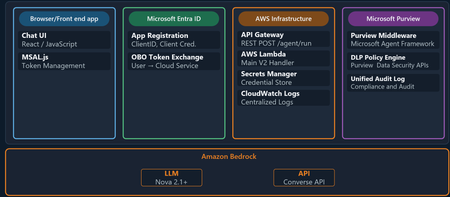
Organizations are moving fast with AI, and many of those AI workloads are not staying in one cloud. A team might use Microsoft 365 and Microsoft Purview for governance and in addition to Microsoft Foundry they may still choose to run an AI agent on AWS Bedrock or on the Google Cloud Platform. The technical challenge is straightforward: how do you keep one consistent set of data security, governance, and compliance controls when the agent itself runs outside Microsoft Azure? This is where Microsoft Purview becomes the central policy engine for your data estate. In this post, we show why that matters and then walk through a practical example: an expense approval agent running on Amazon Bedrock, protected by Microsoft Purview Data Loss Prevention (DLP) policies. ExpenseApprovalAgent" details of the Agent blade Why Purview should be the central policy engine Most organizations do not want separate policy stacks for every cloud, every model endpoint, and every app team. That leads to duplicated controls, inconsistent enforcement, and audit gaps. The better model is to separate where workloads run from where policy decisions are made. That is the value proposition for Microsoft Purview in cross-cloud AI scenarios. Purview gives you: A consistent policy layer for sensitive information types such as credit card numbers, Social Security numbers, financial data, and other regulated content. A governance plane that can extend beyond Microsoft-hosted workloads into multi-cloud environments. A compliance framework with auditability, policy traceability, and a familiar operational model for security and compliance teams. A way to apply data-aware controls to AI interactions, not just to storage locations. In practical terms, that means the same organization that already trusts Purview to govern Exchange, SharePoint, Teams, and Copilot can use Purview to govern prompts and responses in a Bedrock-based agent as well. The key architectural shift is this: your app does not need to invent its own data policy engine. It can call Purview at the points where risk exists. What this Bedrock agent demonstrates The sample solution in this blog is a cross-cloud AI pattern: The frontend is a single-page browser-based chat app. Users authenticate with Microsoft Entra ID via MSAL. The backend runs in AWS Lambda. The model is Amazon Bedrock using Nova 2 Lite. Microsoft Purview evaluates prompts and model responses for DLP policy violations. This matters because it proves a broader point: Microsoft Purview can govern AI interactions even when the model and compute are not running in Azure. The core architecture As shown above the end-to-end flow follows this pattern: A user signs in through Microsoft Entra ID from the frontend. The frontend sends the user's access token and prompt to an API endpoint in AWS. The Lambda function exchanges that token using the On-Behalf-Of flow so Purview can evaluate under the signed-in user's identity. Purview scans the full prompt for sensitive information before the model is called. If the prompt is allowed, the Lambda function sends the request to Amazon Bedrock. Purview scans the model response before it is returned to the user. The frontend shows the result along with a Purview evaluation badge. That gives you two strong governance controls: In-line data loss prevention enforcement, which can block risky requests before they ever reach the model. Response-time enforcement, which can stop sensitive data from being returned even if a model generates it. The implementation also uses the user's identity for policy evaluation. That is important because governance decisions should reflect who is asking, not just what application is running. Why this pattern is useful for security, governance, and compliance teams There are three reasons this pattern is worth paying attention to. First, it aligns policy with risk rather than with hosting location. The compute might run in Lambda and the model might be in Bedrock, but Purview still remains the policy decision point. Second, it improves operational clarity. Security teams do not have to learn a different governance toolchain for each AI stack. They can keep using Purview concepts, policy models, and audit workflows. Third, it supports real-world adoption. Most large enterprises are hybrid and multi-cloud already. A governance pattern that only works for one vendor's runtime is not enough. Policy definition in Purview Two polices are needed to enforce DLP-a collection policy for Enterprise AI Apps and a DLP policy Collection policy 2. DLP policy Follow the steps outlined here to create the DLP policy for Enterprise AI Apps. Sample provided: purview-api-samples/DLPforCustomAIApps at main · microsoft/purview-api-samples To replicate this scenario, follow this link to the official GitHub repo: purview-api-samples/AWSBedrock at main · microsoft/purview-api-samples Once deployed, you will have: An AWS Lambda function that calls Amazon Bedrock. A browser frontend that authenticates with Microsoft Entra ID. Microsoft Purview evaluating both prompts and responses. A demo flow where safe prompts succeed and sensitive prompts are blocked. With the App and agent deployed, now comes the moment when the architectural value becomes clear. The model runtime is AWS Bedrock, but the policy decision is still coming from Microsoft Purview. Below screenshot shows the prompt containing sensitive information being blocked based on the policy evaluation by Purview. Minimal code integration requirements using the SDK Below is the code needed to perform the integration between Purview and Bedrock to perform the in and outbound inspection of content destined to and from the Bedrock model. Results of Purview’s verdict presented to user in the App UI Review governance evidence in Purview Data Security Posture Management Summary The bigger story here is not just that Microsoft Purview can protect an Amazon Bedrock agent. It is that organizations can centralize data security, governance, and compliance policy even while their AI architecture becomes more distributed across multiple clouds. That is the operational win. Developers keep the freedom to choose the best runtime and model platform. Security and compliance teams keep a central policy engine they already understand and trust. AI applications can be multi-cloud, but your data protection model does not have to be fragmented. Additional resources Configure Microsoft Purview - purview-sdk | Microsoft Learn Microsoft Purview Developer Platform Documentation - purview-sdk | Microsoft Learn1.1KViews1like1CommentAI Security Ideogram: Practical Controls and Accelerated Response with Microsoft
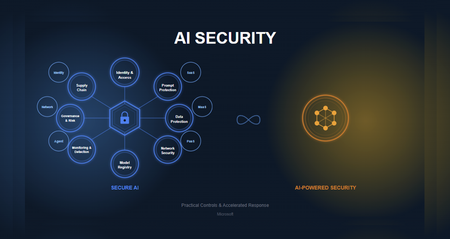
Overview As organizations scale generative AI, two motions must advance in lockstep: hardening the AI stack (“Security for AI”) and using AI to supercharge SecOps (“AI for Security”). This post is a practical map—covering assets, common attacks, scope, solutions, SKUs, and ownership—to help you ship AI safely and investigate faster. Why both motions matter, at the same time Security for AI (hereafter ‘ Secure AI’ ) guards prompts, models, apps, data, identities, keys, and networks; it adds governance and monitoring around GenAI workloads (including indirect prompt injection from retrieved documents and tools). Agents add complexity because one prompt can trigger multiple actions, increasing the blast radius if not constrained. AI for Security uses Security Copilot with Defender XDR, Microsoft Sentinel, Purview, Entra, and threat intelligence to summarize incidents, generate KQL, correlate signals, and recommend fixtures and betterments. Promptbooks make automations easier, while plugins provide the opportunity to use out of the box as well as custom integrations. SKU: Security Compute Units (SCU). Responsibility: Shared (customer uses; Microsoft operates). The intent of this blog is to cover Secure AI stack and approaches through matrices and mind map. This blog is not intended to cover AI for Security in detail. For AI for Security, refer Microsoft Security Copilot. The Secure AI stack at a glance At a high level, the controls align to the following three layers: AI Usage (SaaS Copilots & prompts) — Purview sensitivity labels/DLP for Copilot and Zero Trust access hardening prevent oversharing and inadvertent data leakage when users interact with GenAI. AI Application (GenAI apps, tools, connectors) — Azure AI Content Safety (Prompt Shields, cross prompt injection detection), policy mediation via API Management, and Defender for Cloud’s AI alerts reduce jailbreaks, XPIA/UPIA, and tool based exfiltration. This layer also includes GenAI agents. AI Platform & Model (foundation models, data, MLOps) — Private Link, Key Vault/Managed HSM, RBAC controlled workspaces and registries (Azure AI Foundry/AML), GitHub Advanced Security, and platform guardrails (Firewall/WAF/DDoS) harden data paths and the software supply chain end-to-end. Let’s understand the potential attacks, vulnerabilities and threats at each layer in more detail: 1) Prompt/Model protection (jailbreak, UPIA/system prompt override, leakage) Scope: GenAI applications (LLM, apps, data) → Azure AI Content Safety (Prompt Shields, content filters), grounded-ness detection, safety evaluations in Azure AI Foundry, and Defender for Cloud AI threat protection. Responsibility: Shared (Customer/Microsoft). SKU: Content Safety & Azure OpenAI consumption; Defender for Cloud – AI Threat Protection. 2) Cross-prompt Injection (XPIA) via documents & tools Strict allow-lists for tools/connectors, Content Safety XPIA detection, API Management policies, and Defender for Cloud contextual alerts reduce indirect prompt injection and data exfiltration. Responsibility: Customer (config) & Microsoft (platform signals). SKU: Content Safety, API Management, Defender for Cloud – AI Threat Protection. 3) Sensitive data loss prevention for Copilots (M365) Use Microsoft Purview (sensitivity labels, auto-labeling, DLP for Copilot) with enterprise data protection and Zero Trust access hardening to prevent PII/IP exfiltration via prompts or Graph grounding. Responsibility: Customer. SKU: M365 E5 Compliance (Purview), Copilot for Microsoft 365. 4) Identity & access for AI services Entra Conditional Access (MFA/device), ID Protection, PIM, managed identities, role based access to Azure AI Foundry/AML, and access reviews mitigate over privilege, token replay, and unauthorized finetuning. Responsibility: Customer. SKU: Entra ID P2. 5) Secrets & keys Protect against key leakage and secrets in code using Azure Key Vault/Managed HSM, rotation policies, Defender for DevOps and GitHub Advanced Security secret scanning. Responsibility: Customer. SKU: Key Vault (Std/Premium), Defender for Cloud – Defender for DevOps, GitHub Advanced Security. 6) Network isolation & egress control Use Private Link for Azure OpenAI and data stores, Azure Firewall Premium (TLS inspection, FQDN allow-lists), WAF, and DDoS Protection to prevent endpoint enumeration, SSRF via plugins, and exfiltration. Responsibility: Customer. SKU: Private Link, Firewall Premium, WAF, DDoS Protection. 7) Training data pipeline hardening Combine Purview classification/lineage, private storage endpoints & encryption, human-in-the-loop review, dataset validation, and safety evaluations pre/post finetuning. Responsibility: Customer. SKU: Purview (E5 Compliance / Purview), Azure Storage (consumption). 8) Model registry & artifacts Use Azure AI Foundry/AML workspaces with RBAC, approval gates, versioning, private registries, and signed inferencing images to prevent tampering and unauthorized promotion. Responsibility: Customer. SKU: AML; Azure AI Foundry (consumption). 9) Supply chain & CI/CD for AI apps GitHub Advanced Security (CodeQL, Dependabot, secret scanning), Defender for DevOps, branch protection, environment approvals, and policy-as-code guardrails protect pipelines and prompt flows. Responsibility: Customer. SKU: GitHub Advanced Security; Defender for Cloud – Defender for DevOps. 10) Governance & risk management Microsoft Purview AI Hub, Compliance Manager assessments, Purview DSPM for AI, usage discovery and policy enforcement govern “shadow AI” and ensure compliant data use. Responsibility: Customer. SKU: Purview (E5 Compliance/addons); Compliance Manager. 11) Monitoring, detection & incident Defender for Cloud ingests Content Safety signals for AI alerts; Defender XDR and Microsoft Sentinel consolidate incidents and enable KQL hunting and automation. Responsibility: Shared. SKU: Defender for Cloud; Sentinel (consumption); Defender XDR (E5/E5 Security). 12) Existing landing zone baseline Adopt Azure Landing Zones with AI-ready design, Microsoft Cloud Security Benchmark policies, Azure Policy guardrails, and platform automation. Responsibility: Customer (with Microsoft guidance). SKU: Guidance + Azure Policy (included); Defender for Cloud CSPM. Mapping attacks to controls This heatmap ties common attack themes (prompt injection, cross-prompt injection, sensitive data loss, identity & keys, network egress, training data, registries, supply chain, governance, monitoring, and landing zone) to the primary Microsoft controls you’ll deploy. Use it to drive backlog prioritization. Quick decision table (assets → attacks → scope → solution) Use this as a guide during design reviews and backlog planning. The rows below are a condensed extract of the broader map in your workbook. Asset Class Possible Attack Scope Solution Data Sensitive info disclosure / Risky AI usage Microsoft AI Purview DSPM for AI; Purview DSPM for AI + IRM Unknown interactions for enterprise AI apps Microsoft AI Purview DSPM for AI Unethical behavior in AI apps Microsoft AI Purview DSPM for AI + Comms Compliance Sensitive info disclosure / Risky AI usage Non-Microsoft AI Purview DSPM for AI + IRM Unknown interactions for enterprise AI apps Non-Microsoft AI Purview DSPM for AI Unethical behavior in AI apps Non-Microsoft AI Purview DSPM for AI + Comms Compliance Models (MaaS) Supply-chain attacks (ML registry / DevOps of AI) OpenAI LLM OOTB built-in; Azure AI Foundry – Content Safety / Prompt Shield; Defender for AI – Run-time Secure registries/workspaces compromise OpenAI LLM OOTB built-in Secure models running inside containers OpenAI LLM OOTB built-in Training data poisoning OpenAI LLM OOTB built-in Model theft OpenAI LLM OOTB built-in Prompt injection (XPIA) OpenAI LLM OOTB built-in; Azure AI Foundry – Content Safety / Prompt Shield Crescendo OpenAI LLM OOTB built-in Jailbreak OpenAI LLM OOTB built-in Supply-chain attacks (ML registry / DevOps of AI) Non-OpenAI LLM Azure AI Foundry – Content Safety / Prompt Shield; Defender for AI – Run-time Secure registries/workspaces compromise Non-OpenAI LLM Azure AI Foundry – Content Safety / Prompt Shield; Defender for AI – Run-time Secure models running inside containers Non-OpenAI LLM Azure AI Foundry – Content Safety / Prompt Shield; Defender for AI – Run-time Training data poisoning Non-OpenAI LLM Azure AI Foundry – Content Safety / Prompt Shield; Defender for AI – Run-time Model theft Non-OpenAI LLM Azure AI Foundry – Content Safety / Prompt Shield; Defender for AI – Run-time Prompt injection (XPIA) Non-OpenAI LLM Azure AI Foundry – Content Safety / Prompt Shield; Defender for AI – Run-time Crescendo Non-OpenAI LLM Azure AI Foundry – Content Safety / Prompt Shield; Defender for AI – Run-time Jailbreak Non-OpenAI LLM Azure AI Foundry – Content Safety / Prompt Shield; Defender for AI – Run-time GenAI Applications (SaaS) Jailbreak Microsoft Copilot SaaS OOTB built-in Prompt injection (XPIA) Microsoft Copilot SaaS OOTB built-in Wallet abuse Microsoft Copilot SaaS OOTB built-in Credential theft Microsoft Copilot SaaS OOTB built-in Data leak / exfiltration Microsoft Copilot SaaS OOTB built-in Insecure plugin design Microsoft Copilot SaaS Responsibility: Provider/Creator Example 1: Microsoft plugin: responsibility to secure lies with Microsoft Example 2: 3rd party custom plugin: responsibility to secure lies with the 3rd party provider. Example 3: customer-created plugin: responsibility to secure lies with the plugin creator. Shadow AI Microsoft Copilot SaaS or non-Microsoft SaaS gen AI APPS: Purview DSPM for AI (endpoints where browser extension is installed) + Defender for Cloud Apps AGENTS: Entra agent ID (preview) + Purview DSPM for AI Jailbreak Non-Microsoft GenAI SaaS SaaS provider Prompt injection (XPIA) Non-Microsoft GenAI SaaS SaaS provider Wallet abuse Non-Microsoft GenAI SaaS SaaS provider Credential theft Non-Microsoft GenAI SaaS SaaS provider Data leak / exfiltration Non-Microsoft GenAI SaaS Purview DSPM for AI Insecure plugin design Non-Microsoft GenAI SaaS SaaS provider Shadow AI Microsoft Copilot SaaS or non-Microsoft SaaS GenAI APPS: Purview DSPM for AI (endpoints where browser extension is installed) + Defender for Cloud Apps AGENTS: Entra agent ID (preview) + Purview DSPM for AI Agents (Memory) Memory injection Microsoft PaaS (Azure AI Foundry) agents Defender for AI – Run-time* Memory exfiltration Microsoft PaaS (Azure AI Foundry) agents Defender for AI – Run-time* Memory injection Microsoft Copilot Studio agents Defender for AI – Run-time* Memory exfiltration Microsoft Copilot Studio agents Defender for AI – Run-time* Memory injection Non-Microsoft PaaS agents Defender for AI – Run-time* Memory exfiltration Non-Microsoft PaaS agents Defender for AI – Run-time* Identity Tool misuse / Privilege escalation Enterprise Entra for AI / Entra Agent ID – GSA Gateway Token theft & replay attacks Enterprise Entra for AI / Entra Agent ID – GSA Gateway Agent sprawl & orphaned agents Enterprise Entra for AI / Entra Agent ID – GSA Gateway AI agent autonomy Enterprise Entra for AI / Entra Agent ID – GSA Gateway Credential exposure Enterprise Entra for AI / Entra Agent ID – GSA Gateway PaaS General AI platform attacks Azure AI Foundry (Private Preview) Defender for AI General AI platform attacks Amazon Bedrock Defender for AI* (AI-SPM GA, Workload protection is on roadmap) General AI platform attacks Google Vertex AI Defender for AI* (AI-SPM GA, Workload protection is on roadmap) Network / Protocols (MCP) Protocol-level exploits (unspecified) Custom / Enterprise Defender for AI * *roadmap OOTB = Out of the box (built-in) This table consolidates the mind map into a concise reference showing each asset class, the threats/attacks, whether they are scoped to Microsoft or non-Microsoft ecosystems, and the recommended solutions mentioned in the diagram. Here is a mind map corresponding to the table above, for easier visualization: Mind map as of 30 Sep 2025 (to be updated in case there are technology enhancements or changes by Microsoft) OWASP-style risks in SaaS & custom GenAI apps—what’s covered Your map calls out seven high frequency risks in LLM apps (e.g., jailbreaks, cross prompt injection, wallet abuse, credential theft, data exfiltration, insecure plugin design, and shadow LLM apps/plugins). For Security Copilot (SaaS), mitigations are built-in/OOTB; for non-Microsoft AI apps, pair Azure AI Foundry (Content Safety, Prompt Shields) with Defender for AI (runtime), AISPM via MDCSPM (build-time), and Defender for Cloud Apps to govern unsanctioned use. What to deploy first (a pragmatic order of operations) Land the platform: Existing landing zone with Private Link to models/data, Azure Policy guardrails, and Defender for Cloud CSPM. Lock down identity & secrets: Entra Conditional Access/PIM and Key Vault + secret scanning in code and pipelines. Protect usage: Purview labels/DLP for Copilot; Content Safety shields and XPIA detection for custom apps; APIM policy mediation. Govern & monitor: Purview AI Hub and Compliance Manager assessments; Defender for Cloud AI alerts into Defender XDR/Sentinel with KQL hunting & playbooks. Scale SecOps with AI: Light up Copilot for Security across XDR/Sentinel workflows and Threat Intelligence/EASM. The below table shows the different AI Apps and the respective pricing SKU. There exists a calculator to estimate costs for your different AI Apps, Pricing - Microsoft Purview | Microsoft Azure. Contact your respective Microsoft Account teams to understand the mapping of the above SKUs to dollar value. Conclusion: Microsoft’s two-pronged strategy—Security for AI and AI for Security—empowers organizations to safely scale generative AI while strengthening incident response and governance across the stack. By deploying layered controls and leveraging integrated solutions, enterprises can confidently innovate with AI while minimizing risk and ensuring compliance.2.2KViews5likes1Comment