developer platform
9 Topics
Purview SDK
I've been spending quite a bit of time working with Purview APIs, The APIs themselves are fine, but after a while I realized I was writing the same authentication, pagination and relationship handling code over and over again. So instead of construction the same code from project to project, I turned it into a python package, and now it's available on PyPI pip install purview-unified-sdk Right now, the SDK supports most of the common operations, such as creating, retrieving, updating and deleting business domains, data products, glossary terms, objectives, key results and etc., It also make it much easier to work with relationships, add group id as a owner, navigate resources and retrieve metadata across the unified catalog. https://niki9001.github.io/purview-unified-sdk/ https://github.com/purview-unified-sdk Feel free to fork the project, submit a pull request or open an issue if you have ideas or suggestions171Views0likes0CommentsExtend Microsoft Purview data protection to AWS Bedrock agents for cross-cloud AI governance
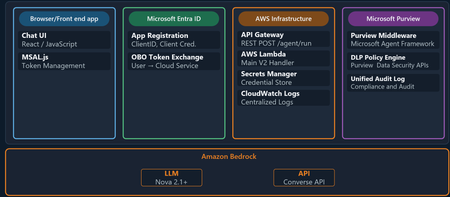
Organizations are moving fast with AI, and many of those AI workloads are not staying in one cloud. A team might use Microsoft 365 and Microsoft Purview for governance and in addition to Microsoft Foundry they may still choose to run an AI agent on AWS Bedrock or on the Google Cloud Platform. The technical challenge is straightforward: how do you keep one consistent set of data security, governance, and compliance controls when the agent itself runs outside Microsoft Azure? This is where Microsoft Purview becomes the central policy engine for your data estate. In this post, we show why that matters and then walk through a practical example: an expense approval agent running on Amazon Bedrock, protected by Microsoft Purview Data Loss Prevention (DLP) policies. ExpenseApprovalAgent" details of the Agent blade Why Purview should be the central policy engine Most organizations do not want separate policy stacks for every cloud, every model endpoint, and every app team. That leads to duplicated controls, inconsistent enforcement, and audit gaps. The better model is to separate where workloads run from where policy decisions are made. That is the value proposition for Microsoft Purview in cross-cloud AI scenarios. Purview gives you: A consistent policy layer for sensitive information types such as credit card numbers, Social Security numbers, financial data, and other regulated content. A governance plane that can extend beyond Microsoft-hosted workloads into multi-cloud environments. A compliance framework with auditability, policy traceability, and a familiar operational model for security and compliance teams. A way to apply data-aware controls to AI interactions, not just to storage locations. In practical terms, that means the same organization that already trusts Purview to govern Exchange, SharePoint, Teams, and Copilot can use Purview to govern prompts and responses in a Bedrock-based agent as well. The key architectural shift is this: your app does not need to invent its own data policy engine. It can call Purview at the points where risk exists. What this Bedrock agent demonstrates The sample solution in this blog is a cross-cloud AI pattern: The frontend is a single-page browser-based chat app. Users authenticate with Microsoft Entra ID via MSAL. The backend runs in AWS Lambda. The model is Amazon Bedrock using Nova 2 Lite. Microsoft Purview evaluates prompts and model responses for DLP policy violations. This matters because it proves a broader point: Microsoft Purview can govern AI interactions even when the model and compute are not running in Azure. The core architecture As shown above the end-to-end flow follows this pattern: A user signs in through Microsoft Entra ID from the frontend. The frontend sends the user's access token and prompt to an API endpoint in AWS. The Lambda function exchanges that token using the On-Behalf-Of flow so Purview can evaluate under the signed-in user's identity. Purview scans the full prompt for sensitive information before the model is called. If the prompt is allowed, the Lambda function sends the request to Amazon Bedrock. Purview scans the model response before it is returned to the user. The frontend shows the result along with a Purview evaluation badge. That gives you two strong governance controls: In-line data loss prevention enforcement, which can block risky requests before they ever reach the model. Response-time enforcement, which can stop sensitive data from being returned even if a model generates it. The implementation also uses the user's identity for policy evaluation. That is important because governance decisions should reflect who is asking, not just what application is running. Why this pattern is useful for security, governance, and compliance teams There are three reasons this pattern is worth paying attention to. First, it aligns policy with risk rather than with hosting location. The compute might run in Lambda and the model might be in Bedrock, but Purview still remains the policy decision point. Second, it improves operational clarity. Security teams do not have to learn a different governance toolchain for each AI stack. They can keep using Purview concepts, policy models, and audit workflows. Third, it supports real-world adoption. Most large enterprises are hybrid and multi-cloud already. A governance pattern that only works for one vendor's runtime is not enough. Policy definition in Purview Two polices are needed to enforce DLP-a collection policy for Enterprise AI Apps and a DLP policy Collection policy 2. DLP policy Follow the steps outlined here to create the DLP policy for Enterprise AI Apps. Sample provided: purview-api-samples/DLPforCustomAIApps at main · microsoft/purview-api-samples To replicate this scenario, follow this link to the official GitHub repo: purview-api-samples/AWSBedrock at main · microsoft/purview-api-samples Once deployed, you will have: An AWS Lambda function that calls Amazon Bedrock. A browser frontend that authenticates with Microsoft Entra ID. Microsoft Purview evaluating both prompts and responses. A demo flow where safe prompts succeed and sensitive prompts are blocked. With the App and agent deployed, now comes the moment when the architectural value becomes clear. The model runtime is AWS Bedrock, but the policy decision is still coming from Microsoft Purview. Below screenshot shows the prompt containing sensitive information being blocked based on the policy evaluation by Purview. Minimal code integration requirements using the SDK Below is the code needed to perform the integration between Purview and Bedrock to perform the in and outbound inspection of content destined to and from the Bedrock model. Results of Purview’s verdict presented to user in the App UI Review governance evidence in Purview Data Security Posture Management Summary The bigger story here is not just that Microsoft Purview can protect an Amazon Bedrock agent. It is that organizations can centralize data security, governance, and compliance policy even while their AI architecture becomes more distributed across multiple clouds. That is the operational win. Developers keep the freedom to choose the best runtime and model platform. Security and compliance teams keep a central policy engine they already understand and trust. AI applications can be multi-cloud, but your data protection model does not have to be fragmented. Additional resources Configure Microsoft Purview - purview-sdk | Microsoft Learn Microsoft Purview Developer Platform Documentation - purview-sdk | Microsoft Learn1.2KViews1like1Comment
Unable to use MS Graph DLP Api's to use with my Entra Registered App
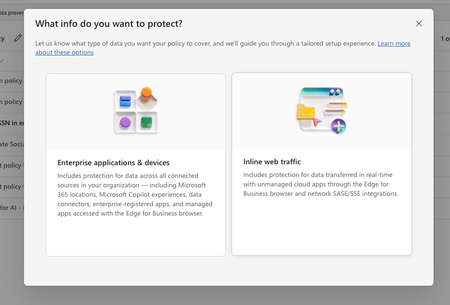
In purview, I have set of policies in DLP, where I have registered to block the US SSN in the text contents and I have created different policies in all of them I have selected the available locations: Exchange email - All accounts SharePoint sites OneDrive accounts - All accounts Teams chat and channel messages - All accounts Devices - All accounts Microsoft Defender for Cloud Apps On-premises repositories And selected action as block all, in all of them for the rule and enabled the rule (not in simulation mode) Now, I have the app registered in Entra and I try to use the following API's https://learn.microsoft.com/en-us/graph/api/userprotectionscopecontainer-compute?view=graph-rest-1.0 https://learn.microsoft.com/en-us/graph/api/userdatasecurityandgovernance-processcontent?view=graph-rest-1.0&tabs=http But whenever I use the compute api I can see i'm only getting curl -X POST https://graph.microsoft.com/v1.0/users/5fd51e08-c5f1-4298-b79b-a357eaa414ff/dataSecurityAndGovernance/protectionScopes/compute\ -H 'Authorization: Bearer <ACCESS_TOKEN>'\ -H 'Content-Type: application/json' -d '{ "activities": "uploadText,downloadText" }' { "@odata.context": "https://graph.microsoft.com/v1.0/$metadata#Collection(microsoft.graph.policyUserScope)", "value": [ { "activities": "uploadText,downloadText", "executionMode": "evaluateOffline", "locations": [ { "@odata.type": "#microsoft.graph.policyLocationApplication", "value": "b48106d9-1cdb-4d90-9485-fe2b6ee78acf" } ], "policyActions": [] } ] } My sample App's Id is showing up but always with `evaluateOffline` I don't know why it always gives 'evaluteOffline' and policyActions is always empty array Also, I can see my Entra registered app is showing up here in the value of the locations And when I use the processContent api , I always get modified in the response and nothing else like below: curl -XPOST https://graph.microsoft.com/v1.0/users/5fd51e08-c5f1-4298-b79b-a357eaa414ff/dataSecurityAndGovernance/processContent \ -H 'Authorization: <ACCESS TOKEN>'\ -H 'Content-Type: application/json' -d '{ "contentToProcess": { "contentEntries": [ { "@odata.type": "microsoft.graph.processConversationMetadata", "identifier": "07785517-9081-4fe7-a9dc-85bcdf5e9075", "content": { "@odata.type": "microsoft.graph.textContent", "data": "Please process this application for John VSmith, his SSN is 121-98-1437 and credit card number is 4532667785213500" }, "name": "Postman message", "correlationId": "d63eafd2-e3a9-4c1a-b726-a2e9b9d9580d", "sequenceNumber": 0, "isTruncated": false, "createdDateTime": "2026-04-06T00:23:20", "modifiedDateTime": "2026-04-06T00:23:20" } ], "activityMetadata": { "activity": "uploadText" }, "deviceMetadata": { "operatingSystemSpecifications": { "operatingSystemPlatform": "Windows 11", "operatingSystemVersion": "10.0.26100.0" }, "ipAddress": "127.0.0.1" }, "protectedAppMetadata": { "name": "Postman", "version": "1.0", "applicationLocation": { "@odata.type": "microsoft.graph.policyLocationApplication", "value": "b48106d9-1cdb-4d90-9485-fe2b6ee78acf" } }, "integratedAppMetadata": { "name": "Postman", "version": "1.0" } } }' In the above request I have mentioned some sample US Security SSN, but the response I get is { "@odata.context": "https://graph.microsoft.com/v1.0/$metadata#microsoft.graph.processContentResponse", "protectionScopeState": "notModified", "policyActions": [], "processingErrors": [] } But Ideally I want to see whether I can get the content is valid or not, for example in the above request, it has SSN, so ideally I should get restrictAction or something right? Or is that evaluateInline is not available or something? Note that I have purchased E5 and assigned to the user who is trying this Also, whenever I choose to create a Policy in DLP , I got two options And Lets say I choose "Enterprise applications & devices", what happens is in the Locations, I'm seeing only these as the options: And If I choose the "Inline Traffic", i'm seeing only these options In Unmanaged, I'm seeing the following And in the Enforcement Options, I have the following : And in the "Advanced DLP rules" I'm seeing only these So, can you tell me the exact steps in the Purview suite, I couldn't where to mention the Entra registered App, I searched and I couldn't find one But in the compute endpoint, https://learn.microsoft.com/en-us/graph/api/userprotectionscopecontainer-compute?view=graph-rest-1.0 I'm getting my app but only with "evaluateOffline" and with that ETag, If I use the processContent Api, its not giving anything except as I mentioned above in the postSolved185Views0likes1Comment
Unified Catalog Self-Serve Analytics - Data products and other elements do not sync
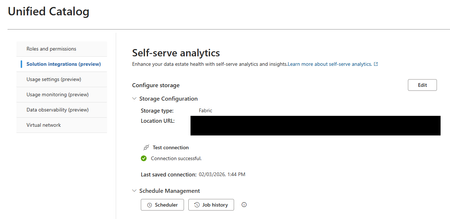
Dears, I intend to create a custom interface through a PowerBI report in Fabric to distribute Purview Unified Catalog browser. I use the feature "Unified Catalog Self-Serve Analytics" to deliver the Unified Data Catalog content in a Fabric Lakehouse. However, from the 44 data products created, only 22 are delivered to the lakehouse, in the data product table I have tried in different lakehouse, same result. I would love some advice to help me configure this properly. Do you face the same issue ? Best, Antoine192Views0likes2CommentsHow to cancel a Norton subscription Allow Uniqueness of Glossary Terms across Governance Domains
When glossary terms are created and published, there is no check for the same term name in another governance domain. Some organizations do want to enforce term uniqueness across all domains. Would it be feasible to provide an optional switch in Unified Catalog settings to turn this on?115Views0likes1Comment
Data Quality Error (Internal Service Error)
I am facing an issue while running the DQ scan, when i tried doing manual scan and scheduled scans both time i faced Internal Service Error. ( DataQualityInternalError Internal service error occurred .Please retry or contact Microsoft support ) Data Profiling is running successfully but for none of the asset, DQ is working. After the lineage patch which MS had fixed, they had introduced Custom SQL option to create a rule, and after that only i am facing this issue. Is anyone else also facing the same? I tried with different data sources (ADLS, and Synapse) its same for both. If anyone has an idea, do share it here, it will be helpful.257Views0likes1Comment
C# MIP SDK v1.17.x - AccessViolationException on creation of MIPContext in 64-bit console app
I first logged this on https://stackoverflow.com/questions/79746967/accessviolationexception-when-creating-mipcontext-after-upgrade-to-v1-17 and the responses there have indicated I should raise with Microsoft a a likely bug, but I don't see a clear route to reporting other than here so any response would be appreciated, even if just to direct me to the appropriate reporting location. I've built a simple console app that demonstrates this issue that I'm happy to provide but we're seeing an issue with the 1.17.x version of the C# MIP SDK where an AccessViolationException is being thrown when trying to create an MIP context object. This is for a .Net Framework 4.8 console app built in 64-bit configuration, deployed to a Windows Server 2016 with the latest VC++ redistributable (14.44.35211) installed (both x86 and x64 versions), though we've seen the same on Windows Server 2019 and 2022. When the same app is built in 32-bit and deployed to the same environment the exception doesn't occur. The following code is what I've used to repro the issue: MIP.Initialize(MipComponent.File); var appInfo = new ApplicationInfo { ApplicationId = string.Empty, ApplicationName = string.Empty, ApplicationVersion = string.Empty }; var diagnosticConfiguration = new DiagnosticConfiguration { IsMinimalTelemetryEnabled = true }; var mipConfiguration = new MipConfiguration(appInfo, "mip_data", LogLevel.Info, false, CacheStorageType.InMemory) { DiagnosticOverride = diagnosticConfiguration }; //Expect BadInputException here due to empty properties of appInfo //When built as part of a 64-bit console app this causes AccessViolationException instead MIP.CreateMipContext(mipConfiguration); The AccessViolationException crashes the console app, with the following logged in the Windows Event Log: Framework Version: v4.0.30319 Description: The process was terminated due to an unhandled exception. Exception Info: System.AccessViolationException at Microsoft.InformationProtection.Internal.SdkWrapperPINVOKE.MipContext_Create__SWIG_1(System.Runtime.InteropServices.HandleRef) at Microsoft.InformationProtection.Internal.MipContext.Create(Microsoft.InformationProtection.Internal.MipConfiguration) at Microsoft.InformationProtection.Utils.MIPHelper.CreateMipContext(Microsoft.InformationProtection.MipConfiguration) The issue doesn't occur with the latest 1.16 version (1.16.149) of the SDK but does appear to be in all versions of the 1.17 release. Library: C# MIP SDK v1.17.x Target App: .Net Framework 4.8 console app Deployed OS: Windows Server 2016, 2019 and 2022 (With .Net Framework 4.8 and latest VC++ redist installed)403Views0likes1Comment
Java MIP SDK 1.17.154: commitAsync() TemplateNotFoundError (C# OK; Java fails Win & Ubuntu)
TL;DR Java SDK 1.17.154: calling setLabel() then commitAsync() fails with TemplateNotFoundError (TemplateId=2ea3c830-...). Same label/code works on Java 1.16.x and C# 1.17.154. Policy cache cleared, templates/labels verified, token/tenant checked—issue persists. Environment SDK (Java): 1.16.x (OK), 1.17.154 (FAIL) SDK (C#): 1.17.154 (OK) OS (Java): Windows 10/11 (win32 build), Ubuntu 20.04 / 22.04 / 24.04 Java: OpenJDK 17.0.16 (x64) Service/Tenant: Microsoft Purview Information Protection Auth: (e.g., user delegated token / app-only token) Code Snippet (Java) // Label apply options LabelingOptions labelingOptions = new LabelingOptions(); labelingOptions.setAssignmentMethod(AssignmentMethod.PRIVILEGED); labelingOptions.setDowngradeJustified(true); labelingOptions.setJustificationMessage("Label Apply"); // Get label Label label = fileEngine.getLabelById(labelId); // Apply label (no explicit template handling) fileHandler.setLabel(label, labelingOptions, new ProtectionSettings()); // Commit File workFile = new File(domainFolder, UidUtil.makeUid()); CompletableFuture<Boolean> commitFuture = fileHandler.commitAsync(workFile.getAbsolutePath()); commitFuture.get(); // <-- Throws TemplateNotFoundError on 1.17.154 Stack trace excerpt: Caused by: com.microsoft.informationprotection.internal.gen.Error: TemplateNotFoundError: Could not find template with id: 2ea3c830-5a0e-4eea-b48b-c72186d453c0, BadInputError.Code=General, CorrelationId=42ffaad4-3a0f-4986-ba9d-b5a79c5fd076 (ProtectionEngine), CorrelationId=16819f70-e419-473f-9895-c756f3dd5e4b (FileHandler) at com.microsoft.informationprotection.internal.gen.SdkWrapperJNI.SwigDirector_FileHandler_Observer_OnCommitFailure(SdkWrapperJNI.java:2688) Expected Behavior setLabel() should apply the label (and its protection) and commit successfully, as it does in Java 1.16 and C# 1.17.154. Actual Behavior commitAsync() fails with TemplateNotFoundError for the GUID referenced by the label’s ApplyProtectionAction. What I’ve Tried Policy/cache refresh: Deleted %LOCALAPPDATA%\Microsoft\MSIP\ / ~/.mip/, reloaded engine. Template/label verification: Confirmed existence and publish scope in Purview portal & via PowerShell/Graph. Label actions check: policyEngine.getLabelActions(labelId) shows an ApplyProtectionAction with that GUID. Token/tenant sanity check: Correct scopes and same tenant. Rollback test: Java 1.16 works; C# 1.17.154 works. Questions Any breaking change in Java 1.17 regarding how protection templates are resolved during setLabel()? Is this a known issue specific to Java SDK 1.17.154 (win32 & Ubuntu 20/22/24 builds)? Should we now explicitly use ProtectionDescriptor / SetProtection() in Java? Can someone review the service logs using the CorrelationIds above? Happy to provide additional logs, PowerShell/Graph queries, or action dumps if needed. Thanks!257Views0likes2CommentsFabric Warehouse is not extracting metadata like tables and its columns in Purview
Hello Team, Good Evening..! We noticed that the metadata in Datawarehouse is not extracting Schema(Tab) which contains Tables and its columns We scanned Lakehouse using Service prinicple where metadata extraction is done as expected but it is not the same in Data Warehouse after the scan completes. Are there any other options to get that metadata extracted under warehouse ? Please guide us the best possible methods to handle this situation. Regards, Naresh Inaganti235Views0likes2Comments