data warehouse
117 Topics
SQL Server issue but don't know what - please help!
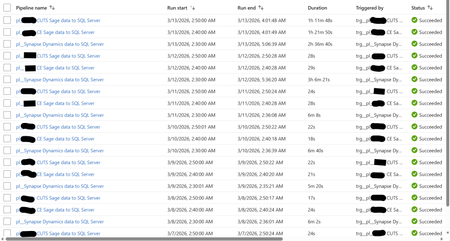
Hi, I'm facing a SQL Server focused issue that I don't understand why it's occurring and would like your help to identify and resolve, please. I will provide an in-depth breakdown of the scenario. Two years ago, I created a Azure Data Factory (ADF) Pipeline to take data from Azure Synapse to Azure SQL Server, and two other Pipelines to take data from an On-Premises Sage server to the same Azure SQL Server. These Pipelines were working perfectly up until two days ago (11/03/26) when the Pipelines still always complete successfully but the duration have increased greatly. The below screenshot shows the log of these three Pipeline for the past week. Note how prior to the 12/03/26 the Synapse Pipeline took about 6 minutes to complete and the two Sage Pipelines took around 25 seconds. Also note how on the 12/03/26 the Synapse Pipeline took over 3 hours but the two Sage Pipelines continued with their normal 25 seconds. Notice today (13/03/26) the Synapse Pipeline was still slow but now the two Sage Pipelines are taking over an hour. I'll note here that the Pipelines still complete successfully (so the config must be correct as it has been for two years). Each Pipeline contains a single (for Sage) or several (for Synapse) 'Copy data' objects. The objects have their source configuration to simply extract from the source (so either Synapse or Sage) and then the sink configuration has a 'Pre-Copy script' which simply Truncates the target SQL Server table, before loading to the SQL Server table. The screenshot below is one example - each Pre-Copy script is populated the same but just with the tables being different. When I look at the log for the Pipelines, I see a common theme for each and that is the 'Pre-Copy script' (the Truncate) is consuming 99% of the time. The screenshot below shows this common theme. So at this point, I ask the question why, after two years of all working well and completing very quickly, are the Pipelines taking so long to complete? This also seems to be an intermittent problem as I have performed several manual executions which will take a long while, then revert back to the quick several minutes again (so good), then revert once more to taking a long while again. It is intermittent. See the screenshot below. Notice how the same Pipeline have different durations. It's intermittent. The reason why I think it is a SQL Server focused issue for the following reasons: 1) Synapse - Performing simple commands (Select Top) returns data within seconds. 2) SQL Server - Performing simple commands (Select Top) usually takes seconds but during the past two days is often taking half hour. 3) SQL Server - When amending a SQL View it would take a split second to complete. During the past two days, it goes over ten minutes and still doesn't complete (I was amending the View for testing purposes). 4) SQL Server - When looking at the Views node under a database, during the past two days, it intermittently doesn't show the View. Sometimes, it will work if I log out and then back into SQL Server. 5) Power BI - Refreshing a Power BI report, whether from the Power BI Service or Desktop, call SQL Server Views. These SQL Server Views read from several SQL Server tables. These report refreshes are failing due to an IDbCommand interface error. These Power BI report data refreshes simply read from a SQL Server table via a SQL View. They don't reference or consider at all the any ADF Pipelines. The Pipelines execute between 2am and 3am each morning. The Power BI report refresh their data around 12pm to 5pm. As SQL Server seems to be problematic at the point of the 'Pre-Copy script', which is one of the end to end process, and then problematic at the very other end where Power BI reports consumes SQL Views - leads me to believe the issue is with SQL Server. I am a report developer and not an ADF expert. I've built the ADF process on the side. I haven't changed any development/configuration/etc... between this all working and failing. Our I.T. department have advised they have made no changes to contribute to this issue. Please can someone advise on what's happening here and why this issue has arose when for two years all was fine? Thanks.142Views0likes0Comments
SQL Timestamp Incremental Load Issue
An incremental load is implemented based on timestamp, using a view to update a fact table. • The fact table contains multiple KPIs coming from different source tables. • Two main KPI tables are included directly in the view and drive the incremental logic (their timestamps change). • Additional KPIs come from other source tables, which are LEFT JOINed to the view. During an incremental run: • Main source tables are updated → timestamp changes • Other source tables are NOT updated → timestamp unchanged • Because of the LEFT JOIN, missing values from these tables are returned as NULL • These NULLs overwrite existing values in the fact table Example Fact table (before load) id app_number score 1 333 5 Source tables • source1, source2 → timestamps updated (drive incremental load) • source3 → timestamp unchanged Stored procedure logic MERGE fact_table tgt USING ( SELECT app_number, ISNULL(score, 0) AS score FROM vw_main_kpis v LEFT JOIN source3 s3 ON v.app_number = s3.app_number ) src ON tgt.app_number = src.app_number WHEN MATCHED THEN UPDATE SET tgt.score = src.score; Result (incorrect) id app_number score 1 333 0 Existing data is lost.431Views0likes2Comments“8152 String or binary data would be truncated” error while running select query on a view
I have a complex view (it’s organisational so i cannot paste it here) that joins multiple tables, uses CTEs, performs logical calculations and then provides for multiple columns over which we can select. This view is based on top of multiple master tables and a transactional table. It was performing fine until today morning. But then it started throwing 8152 error. I’m assuming it’s started happening only after certain values got written to the transactional table. The funny thing is, that the view is still executing fine if I remove just one column from the select query. If i include that one column in the select query, it throws 8152 error. I spent my entire day trying to troubleshoot, but couldn’t. Unable to understand how the view is running fine but the including a column in the select query causes it to malfunction. Any insights would be much appreciated.Solved423Views0likes1CommentSQL Server 2017 – CLR was loaded in an unsupported manner (All SSIS jobs failed)
Hi, We are facing a critical issue in our SQL Server 2017 instance. When trying to use a built-in CLR function or running SSIS-related jobs, we are getting the below error: The Common Language Runtime (CLR) was loaded in an unsupported manner. This can occur if an extended stored procedure or OLE Automation object running in SQL Server calls into managed code before the CLR integration runtime host loads the CLR. You need to restart SQL Server to use CLR integration features. Steps tried so far: Restarted SQL Server service Restarted the entire Windows Server Verified .NET Framework version (4.7.03062 installed) Confirmed CLR integration is enabled (sp_configure 'clr enabled', 1) All SSIS jobs are failing due to this issue. Any suggestions, please?217Views0likes0Comments
Pet project on SQL Server 2022 platform
Hello, world! I would like to share my pet project on SQL Server 2022 platform. I have created a DWH solution that includes many MS's best practices and interesting features such us: ETL process with data cleansing and MDM that easy expand Documentation CI/CD Functional ETL test Ready analytical templates Time intelligence New & returning customers Cluster customers based on spending volume Product ABC classification Basket analysis Events in progress https://dev.azure.com/zinykov/NorthwindBI Unfortunately in SQL Server 2025 will be no DQS & MDS...153Views0likes0Comments
Insert & Update both implemented wrong semantically
Insert means to introduce something, adding/entering something new Update means to change something, change and existing value. Semantically and logically speaking, Insert should only be used to enter data into an empty or partially empty record/table. Update should only be used to change existing values within a record/table. Using a 5 column table as an example where column 1 is an email address Example1 INSERT INTO table (Column1,Column2,Column3) VALUES (value1,value2,value3) Or Example2 INSERT INTO table VALUES (value1,value2,value3,value4,value5) With example 1, 2 columns are left empty Semantically, insert should be used to populate columns for the first time INSERT INTO table (column4, column5) VALUES (value4,value5) where column1 = "EmailAddress" Then for example, UPDATE table SET COLUMN2 = "newValue" WHERE COLUMN1 = "EmailAddress" Updating (setting) an empty column should cause an error, cannot update an empty column SQL, a great idea, pity its implementation is tainted by bad design. SQL works, but its design/implementation of Insert & Update is semantically wrong. IMO As the saying goes, if it isn't broken, don't fix it. Who cares about semantics or logic.304Views0likes1CommentSQL Server does not reduce the size of MDF and LDF
I am a SQL Server 2017 user, I deleted a table that had too many records, but after the delete process, the size of the MDF and LDF files did not decrease, but increased. I have shrunk the file but the file size remains the same. What should I do to change the file size?618Views0likes2Comments
Having difficulties to paste data to excel ?
Hi, I need to provide data in excel format. One of the field is having varchar - I am using CAST(AP.IDINVC AS VARCHAR) as [INVOICE_ID] But I am missing the leading zero's when I copy the data from MS SQL Server Result to excel file. No of rows is 147474. How to keep the leading zeros when copying the Invoice ID from MS SQL Server result to Excel.355Views0likes1CommentHow can I optimize this query for better performance
Hi , I have this query and it is taking a long time. If there are more than 10k rows, it takes more than 5 minutes. Is there another way to speed up the process? SELECT ROW_NUMBER() OVER (ORDER BY CreationDate DESC) AS RowId, Id [Id], transactionsId [TransactionsId], amount [Amount], AccountId [AccountId], dbo.Account_FirstBalance(CreationDate, AccountId, 161, CompanyId) [FirstBalance] FROM p_Ledger WHERE CreationDate >= '2024-11-01' AND CreationDate <= '2025-02-11' AND CompanyId = 117 AND branchId = 161 ALTER FUNCTION [dbo].[Account_FirstBalance]( @TransactionsDate DATETIME, @AccountId BIGINT, @BranchId INT, @CompanyId BIGINT ) RETURNS FLOAT AS BEGIN DECLARE @credit FLOAT; SELECT @credit = SUM(CASE WHEN T.transactionStatusId = 1 THEN T.amount ELSE -T.amount END) FROM dbo.Transactions T WHERE T.Approval = 1 AND T.CompanyId = @CompanyId AND T.AccountsId = @AccountId AND T.IsDeleted = 0 AND T.transactionsDate < @TransactionsDate AND (@BranchId = 0 OR T.branchId = @BranchId); RETURN ROUND(COALESCE(@credit, 0), 2); END;399Views0likes2Comments