copilot studio
9 TopicsAgent Builder, Copilot Studio, or Azure AI Foundry: How We Decide for Every Client
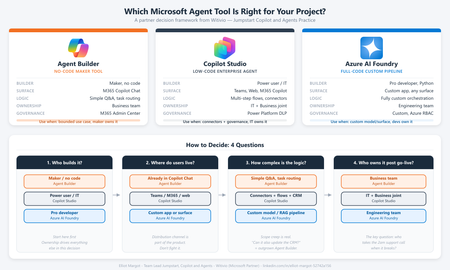
Every client conversation starts the same way. Someone has seen a demo, attended an Ignite session, or read a press release. They want to build an agent. Then comes the question that derails more projects than any technical challenge: "Which tool should we use?" After deploying agents for clients across industries - insurance, professional services, manufacturing, public sector - we have developed a repeatable framework for answering that question. It is not based on which tool is newest or which has the best marketing. It is based on where projects actually succeed or fail in production. The three tools are not competitors The first mistake most teams make is treating Agent Builder, Copilot Studio, and Azure AI Foundry as a hierarchy - basic, intermediate, advanced. That framing leads to bad decisions. They are not a ladder. They are three distinct tools built for three distinct contexts. The right question is not "which tool is most powerful?" It is "which tool fits this project's constraints?" The framework: 4 questions We evaluate every project against four dimensions before recommending a tool: Who is building it? Where do users live? How complex is the logic? Who owns it after go-live? Agent Builder Copilot Studio Azure AI Foundry Builder profile Maker, no code Developer / power user Pro developer, Python User surface M365 Copilot Chat Teams, web, M365 Copilot Custom app, any surface Logic complexity Simple Q&A, task routing Multi-step flows, connectors Fully custom orchestration Post-go-live ownership Business team IT + Business joint Engineering team Governance M365 Admin Center Power Platform DLP Custom, Azure RBAC When we recommend Agent Builder Agent Builder is the right call when the business team wants to own the agent end-to-end, the use case is bounded, and the users already live inside M365 Copilot Chat. The key advantage is distribution - an Agent Builder agent surfaces natively inside Copilot Chat with zero additional deployment work. No IT ticket, no app registration, no Teams app package. The ceiling is real. Agent Builder does not support complex branching logic, external API calls, or dynamic prompt injection. The moment a client asks "can it also update a record in our CRM?" the answer is usually no. Use it when: The maker owns it, the use case is narrow, and M365 Copilot is already the user's primary surface. When we recommend Copilot Studio Copilot Studio is our default recommendation for the majority of enterprise agent projects. It covers the wide middle ground between no-code simplicity and full-code flexibility - within the Microsoft governance perimeter most enterprise IT teams already control. Power Platform connectors - 1,000+ out-of-the-box connectors means most enterprise data sources are reachable without custom API development M365 Copilot channel - surface a Copilot Studio agent directly inside M365 Copilot Chat, Agent Builder-level distribution with enterprise-grade logic underneath Topic-level governance - fallback behaviors, confidence thresholds, escalation paths configurable without code DLP policy enforcement - the agent operates within the same data loss prevention perimeter as the rest of the Power Platform tenant The most common mistake: under-investing in the knowledge layer. The agent authoring is the easy part. Getting SharePoint content structured, metadata consistent, and documents deduplicated is where most projects hit delays. Budget for it. Use it when: The use case requires connectors, dynamic responses, or M365 Copilot integration - and you want IT to own governance without requiring a developer team. When we recommend Azure AI Foundry Foundry is the right call when you need to bring your own model, build a fully custom orchestration pipeline, or integrate into a surface that has nothing to do with Microsoft 365. In practice, this means one of three scenarios: The client has a model fine-tuned on proprietary data that must be used The agent is embedded inside a custom-built web or mobile application The logic requires Python-level control - complex reasoning chains, multi-agent coordination, custom evaluation loops Foundry projects require a professional developer, take longer, and produce something the business team cannot maintain without engineering support. That is not a reason to avoid it - it is a reason to be honest with the client upfront. Use it when: You need full control of the model, the orchestration, or the surface - and you have a developer team to own it. The question that resolves most debates When a client is torn between Copilot Studio and Foundry, we ask one question: "Who is answering the 2am support call when this breaks in production?" If the answer is a developer, Foundry is viable. If the answer is the IT admin or the business owner, Copilot Studio is the right call. Not because Foundry is unreliable, but because the operational model has to match the tool. More projects fail from ownership mismatch than from technical limitations. What we see go wrong Reaching for Foundry too early. Developers often want full control and reach for Foundry before validating the use case. We have rebuilt several Foundry POCs in Copilot Studio when the production constraints called for it - faster to ship and cheaper to run. Under-scoping Agent Builder. Business teams choose Agent Builder because it looks simple, then hit the ceiling at month two. The re-platform cost is higher than building in Copilot Studio from the start. Ignoring the M365 Copilot channel. Many Copilot Studio projects are deployed as standalone Teams apps when they could surface directly inside M365 Copilot Chat. The distribution advantage is significant and underused. The short version Agent Builder - maker-owned, bounded use case, M365 Copilot surface, fast Copilot Studio - IT + business joint ownership, connectors, production governance, M365 Copilot integration Azure AI Foundry - developer-owned, custom model or surface, full control, higher cost Start with the ownership model. Everything else follows. Elliot Margot - Team Lead Jumpstart, Copilot and Agents at Witivio (Microsoft Partner). Connect on https://www.linkedin.com/in/elliot-margot-52742a156/.318Views3likes1CommentCopilot Studio User Group • About Microsoft Copilot Studio
What Is Microsoft Copilot Studio? According To serinf Microsoft Copilot Studio Is The Platform That Enables You To Create Conversational AI Agents Using An Low Code Interface How To Access Copilot Studio? The: " `Resources` Tab Has Details On How To Access Copilot Studio30Views0likes0CommentsGetting Started with Copilot Studio: Your PAA & FAQ Guide
What is Microsoft Copilot Studio? Microsoft Copilot Studio is a low-code, graphical tool within the Power Platform used for building and conversational bots. It empowers users, even those without extensive technical backgrounds, to create sophisticated logic and connect to various data sources and services using prebuilt or custom plugins. Is Copilot Studio easy to use for beginners? Yes Copilot Studio is designed to be easy for beginners. You only need to describe the agent you want in plain language to start creating it. The platform uses a graphical, low-code interface that streamlines the process of defining instructions, knowledge sources (like documents), and conversation triggers, making it accessible to most users. What is the difference between Microsoft 365 Copilot and Copilot Studio? Microsoft 365 Copilot is an AI assistant that integrates across Microsoft 365 apps (Word, Excel, Teams, etc.) to enhance productivity. Copilot Studio, conversely, is a development platform used to build customised AI agents that are tailored to specific business goals or data sources. Copilot is the agent you use; Copilot Studio is the tool you use to build or extend agents. Do end-users need a specific license to use a Copilot I create? Yes, licensing for end-users depends on how and where the custom copilot is deployed. While development often requires a Power Platform or Azure subscription deploying the bot across an organization may require specific Copilot licenses for the end-users accessing the agent. Check the official Microsoft licensing documentation for your specific scenario. How can I add SharePoint data as a knowledge source for my Copilot? You can connect your Copilot agent to SharePoint data using the generative answers feature in Copilot Studio. The agent can search documents stored in a SharePoint document library. Be aware that there can sometimes be nuances with how attachments versus core document libraries are indexed, which the community is actively discussing in the forums. We hope this formatted FAQ helps you quickly find the information you need! If you have more questions, please use the discussion board to connect with the community.523Views0likes2CommentsWho’s Allowed To Join The Copilot Studio User Group?
This Post Is About Who Is Allowed To Join The Copilot Studio User Group It Is Not An Official Copilot Studio User Group Policy Or An Copilot Studio User Group Guideline Who’s Allowed To Join The Copilot Studio User Group? Who’s Allowed To Join The Copilot Studio User Group? User Group Privacy Type Anyone On The Microsoft Tech Community That Is Interested In Microsoft Copilot Studio May Join The Copilot User Group Public User Group77Views0likes0CommentsWho Can Start Discussions On The Copilot Studio User Group?
This Post Is About Who Can Post On The Copilot Studio User Group It Is For Members That Want To Know Who Can Start Discussions On The Copilot Studio User Group Who Can Start Discussions On The Copilot Studio User Group? Group Members That Have Joined The Copilot Studio User Group Can Post About Copilot Studio & Ask Questions About Copilot Studio & Even Discuss About Copilot Studio52Views0likes0Comments
Problem Exporting Copilot with Custom Connection
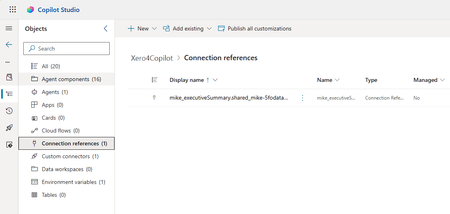
I have a clean environment in which I have created a single solution, "Xero4Copilot", that contains a single agent "Executive Summary". This agent uses a Custom Connector "Odatalink_report", which is created from a tested Swagger file. The Agent uses two endpoints from the connector as tools. The Agent is using the tools well, with no configuration errors. I wanted to clarify the problem before calling for help, hence the clean install and intro. When I export the solution, I get a failure, the GUI gives the same answer, this is the output from PAC CLI: PS C:\Users\mike\Downloads> pac solution export -n Xero4Copilot Connected as email address removed for privacy reasons Connected to... Xero4CopilotDev Starting Solution Export... Microsoft PowerPlatform CLI Version: 1.50.1+gabb74d2 (.NET Framework 4.8.9221.0) Online documentation: https://aka.ms/PowerPlatformCLI Feedback, Suggestions, Issues: https://github.com/microsoft/powerplatform-build-tools/discussions Error: Exporting connection reference mike_executiveSummary.shared_mike-5fodatalink-5freport-5f24577e437a5ff0b6.a4cd806a-ef0b-4680-acf3-34e5b779930f for a custom connector requires the custom connector to be added to a dataverse solution. Please add connector shared_mike-5fodatalink-5freport-5f24577e437a5ff0b6 to a solution and retry. I've tried various adds of components, but this does not really seem to be the problem. I have reduced the problem to a single area of interest: I was wondering if I need to register that Custom Connector or add some metadata. Any thoughts on how to resolve this problem? I've decided to call it a problem and see if it is an issue, haha! TIA MikeSolved578Views0likes7CommentsWelcome to the Copilot Studio User Group!
🚀 About This Community The Copilot Studio User Group is a virtual community where members share knowledge, experiences, and ideas about using and building with Microsoft Copilot Studio. Our goal is to make Copilot Studio more accessible, collaborative, and fun for everyone — whether you’re experimenting with AI copilots or running automation in your organization. 💡What We’ll Be Doing Here’s what you can expect from our group: 💬 Virtual Chat Events: Join topics-based sessions where members discuss Copilot Studio best practices. 🧩 Community Projects: Collaborate on creative experiments and prototypes. 📢Feature Updates: Stay informed on the latest Microsoft Copilot news. 🤝Member Spotlights: Learn from other community builders and share your own work. 🌍 Why Join Our Events Each virtual event is designed to be interactive you’ll be able to: Ask questions live in chat. Exchange use cases and demos. Network with fellow makers and technologists. Get inspired by what others are building! 🧰 Resources & Tools Here are some links to help you get started: Microsoft Copilot Studio Official Site Copilot Documentation Join The Microsoft Tech Community 💬 Get Involved We’d love your participation! Here’s how to engage: Comment on posts and share your insights. Participate in our chat-based virtual sessions. Share your own tutorials, blog posts, or project ideas with the group. 🌟 Our Commitment This user group follows all Microsoft Tech Community Standards, and Terms Of Use. Our focus is collaboration, inclusion, and respectful discussion. 🙌 Final Note Whether you’re new to Copilot Studio or a seasoned pro, you belong here. let’s build the future of AI collaboration — together.407Views0likes0Comments