copilot studio
73 TopicsNew Microsoft Applied Skill Alert – Create Agents in Microsoft Copilot Studio (APL-7008)
Hi Friends👋 If you’ve been demoing Copilot Studio in your classes, here’s a quick way to validate and showcase those agent-building skills—without sitting a full certification exam. Why grab this micro-credential? Hands-on, half-day lab — prove you can build, publish & govern generative-AI agents end-to-end. Instant résumé boost — digital badge drops into Credly the moment you pass. Perfect add-on to PL-300/PL-400/PL-700 prep or any Power Platform course you teach. Lab tasks you’ll master Design the agent persona & generative AI instructions Build topics, variables & rich dialogues (Adaptive Cards included!) Call Dataverse data with Power Automate flows Publish to Microsoft Teams & the web, then secure with content moderation Prep in three steps Run the free learning path: Create agents in Microsoft Copilot Studio (9 bite-size modules). Skim the official study guide checklist (APL-7008). Spin up a trial tenant for learners and let them practice before the live lab. Ready? 👉 Copilot Studio Applied Skill Let’s keep empowering our students (and ourselves) to build the next generation of AI agents inside Microsoft 365. If you earn the badge, drop it below—would love to celebrate your win! 🏆 #CopilotStudio #AppliedSkills #PowerPlatform #GenerativeAI4.9KViews3likes3Comments
Copilot Studio agent not visible in M365 mobile app without desktop access
Hi, I'm having an issue with a Copilot Studio agent not being discoverable in the Microsoft 365 mobile app for users without desktop access. **Setup:** - Agent created in Copilot Studio, published and shared with specific users - All users have the same Microsoft 365 Copilot license - Target channel is the Microsoft 365 app (not Teams) - The agent has been published to both the Teams and Microsoft 365 channels in Copilot Studio **The problem:** Users who have access to a desktop/browser can open the agent via a direct link, add it, and after that it appears correctly in the M365 mobile app. However, users who only have access to the M365 mobile app cannot find the agent there — even though it has been shared with them. **What I've tried:** - Verified the agent is published and shared directly with the affected users in Copilot Studio - Confirmed all users have the same license - Published the agent to both Teams and Microsoft 365 channels - Sending a direct link to the agent — works on desktop/browser but not actionable in the mobile app in a way that adds the agent - Logging out and back in to the M365 mobile app **What I'm looking for:** Is there a way for users to discover and add a shared Copilot Studio agent directly from the M365 mobile app, without needing desktop or browser access first? Any help or workarounds are appreciated!Solved130Views0likes4CommentsThe Employee Self-Service agent - how to find it
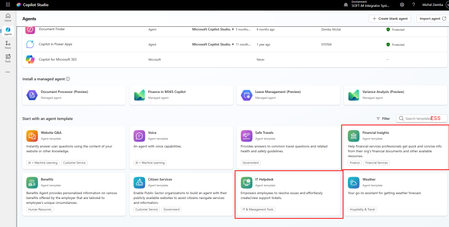
I see that Microsoft has put a lot of efforts to marketing the Copilot Employee Self-Service Agent but it seems it is not available for every tenant. I have already checked on several small and mid ones (5-2k users) and cannot find it in templates. As I understand from what I already red and saw, this is a template that should be available to you when you start building agents. Unfortunately when I enter Copilot Studio and enter in the search ESS (abbreviation from Employee Self-Service) I got only those two agents marked red filtered (see screenshot below). When I installed IT Helpdesk agent, I do not see topics related to HRSD in ServiceNow which I need. I found the Employee-Self-Service-Agent-Developer-Kit that contains same examples of the ServiceNow HRSD topics, but when I copy the YAML code of those topics to my agent I got some references to topics that I do not exists in my agents. Anyone has struggled with the same? Or maybe you have access to the Employee Self-Service agent and can share the basic solution/topics with me? Michal73Views0likes1CommentCopilot studio Agents published on Sharepoint
Hi everyone, I'm hoping someone can confirm or correct my understanding of a limitation we're experiencing. We have a Copilot Studio agent published to a SharePoint site. When users interact with the agent, they are unable to see their previous chat history — unlike the built-in SharePoint AI agents (e.g. SharePoint Agents / Copilot for SharePoint), which do appear to retain and display conversation history. Is it correct that Copilot Studio agents published to SharePoint do NOT support persistent chat history visible to the end user, while native/built-in SharePoint AI agents do support this out of the box?42Views0likes1Comment
New workflow designer accessing environment variables
Hi, I really enjoy using the new workflow designer. I've a triggered workflow (Email arrives) that I added into a solution. I'd like to use environment variables from within the workflow. The variables and the workflow are in the same solution. Unfortunatly the environment variables are not visible like they were in the old designer. How can I access them ? Thanks in advance10Views0likes0Comments
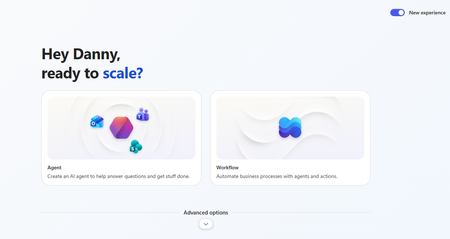
New Agent experience - how to add Fabric data agent
When using the new (Agent) experience in Copilot studio how can you add Fabric Data agent as connected agent ? There does not seem to be an option. Also should adding it as an MCP server be supported (under Tools) ? https://learn.microsoft.com/en-us/fabric/data-science/data-agent-mcp-server says the following: Currently, you can use the Fabric data agent MCP server only in VS Code. If you're using your own MCP client, it can also work, as long as you set up authentication Has anyone tried this? If yes, by using with authentication? OAuth2? Thanks75Views1like2CommentsMicrosoft Power Platform community call - June 2026
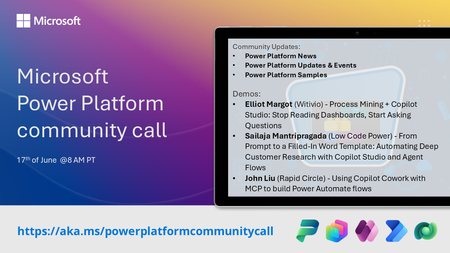
💡 Power Platform monthly community call focuses on different extensibility options for builders, makers and developers within the Power Platform. Typically demos are from our awesome community members who showcase the art of possible within the Power Platform capabilities. 👏 Looking to catch up on the latest news and updates, including cool community demos, this call is for you! 📅 On 17th of June we'll have following agenda: Power Platform Updates & Events Latest on Power Platform samples Elliot Margot (Witivio) - Process Mining + Copilot Studio: Stop Reading Dashboards, Start Asking Questions Sailaja Mantripragada (Low Code Power) - From Prompt to a Filled-In Word Template: Automating Deep Customer Research with Copilot Studio and Agent Flows John Liu (Rapid Circle) - Using Copilot Cowork with MCP to build Power Automate flows 📅 Download recurrent invite from https://aka.ms/powerplatformcommunitycall 📞 & 📺 Join the Microsoft Teams meeting live at https://aka.ms/PowerPlatformMonthlyCall 💡 Building something cool for Microsoft 365 or Power Platform (Copilot, SharePoint, Power Apps, etc)? We are always looking for presenters - Volunteer for a community call demo at https://aka.ms/community/request/demo 👋 See you in the call! 📖 Resources: Previous community call recordings and demos from the Microsoft 365 & Power Platform community YouTube channel at https://aka.ms/community/videos Microsoft 365 & Power Platform samples from Microsoft and community - https://aka.ms/community/samples Microsoft 365 & Power Platform community details - https://aka.ms/community/home122Views0likes1Comment
Why Your Copilot Studio Agent Fails in Production (And How to Fix It)
Most Copilot Studio tutorials show you how to build a chatbot. This post is about something harder: building agents that actually work in production. I architect enterprise agents at a hospitality company — handling customer email triage, HR workflows, helpdesk automation, and reporting pipelines across multiple systems. One of those agents reduced human handling time per customer email from ~12 minutes to under 2 minutes (88% reduction) by orchestrating sentiment analysis, CRM lookups, SOP research via child agents, and response drafting — all before a human agent ever opens the email. Here is what I've learned building at that scale. The Four Layers Every Enterprise Agent Needs Most teams design only the top layer and treat everything else as "we'll figure it out later." By the time the other layers become urgent — usually after an incident — they're too expensive to retrofit. Layer Component Conversation Topics · Entities · Adaptive Cards · NLU Orchestration Agent routing · Context passing · State Integration Connectors · Power Automate · Azure Functions Governance DLP · Auth · ALM · Monitoring · Logging Build the governance layer first. Design the conversation layer last. The demo will be slightly less impressive. The production deployment will be significantly more stable. The Three Mistakes I See Most Often 1. Slot-filling designed for the happy path The default Copilot Studio pattern collects parameters one by one. It breaks the moment your flow has conditional branches — which every real enterprise workflow does. Use intent-first routing instead: identify what the user wants before collecting any parameters, then branch to a sub-flow that collects only what that variant needs. 2. Multi-agent context that gets dropped When you delegate from a router agent to a capability agent, the receiving agent needs to know who the user is and what conversation state to preserve. Native session variables don't cross agent boundaries. Build an explicit context envelope — a JSON object passed at delegation time — that carries user identity, security scope, origin topic, and return context. Your agents become stateless with respect to each other. Context travels with the conversation. 3. No async pattern for slow integrations A synchronous request that works for a REST API returning in 200ms will silently fail for a legacy system query that takes 45 seconds. Design async from day one: submit to an Azure Service Bus queue, return a correlation ID, acknowledge the user, and use proactive messaging to deliver the result when it's ready. This is the single biggest gap between demos and production deployments. A Note on Authentication — Chatbots vs. Autonomous Agents This is a distinction most articles get wrong, so it's worth being explicit. Chatbots have a human on the other end of the conversation. Authentication options here include Entra ID SSO (works in Teams and SharePoint channels where the user's identity is delegated to the agent) or client ID + secret (validates against AD but without user delegation — the agent authenticates as itself, not as the user). Autonomous agents are different in a fundamental way: there is no human in the authentication loop. The agent authenticates using the identity of the account that owns and runs it. There is no SSO because there is no interactive user session. This distinction matters because the security model shifts entirely — you are no longer protecting a user session, you are protecting a service identity. This gets more interesting when your autonomous agent connects to non-Microsoft systems. There is no universal pattern here — it depends entirely on what the external system supports: - API Key / Secret — the most common pattern for SaaS integrations. The external system issues a scoped key specifically for this integration. Store it in Azure Key Vault or encrypted Power Platform environment variables, never hardcoded in a flow. The scoping question is critical: is this a full-admin key or a least-privilege key issued only for what this agent needs? - OAuth 2.0 Client Credentials (machine-to-machine) — the agent authenticates as itself using client ID + secret against the external system's auth server and receives a bearer token. No user involved, fully automated. - Basic Auth on legacy systems — still common in enterprise environments. Credentials must live in Key Vault, not in flow variables or connector configuration in plain text. - Custom connector with encrypted connection — Power Platform manages the auth at the connector level; credentials are stored encrypted and scoped to the environment. The governing principle across all of these: the identity the agent uses to call an external system should be issued specifically for that integration, scoped to only the permissions that agent needs, stored securely (Key Vault or encrypted environment variables), and auditable — meaning the external system's logs show the agent's calls as a distinct identity, not a shared admin account that 12 other things also use. Before You Go to Production — Quick Checklist [ ] Autonomous agent's owning account/service principal is scoped to least-privilege — access only to systems the agent needs, nothing broader [ ] Non-Microsoft system credentials stored in Azure Key Vault or encrypted environment variables — never hardcoded in flows [ ] Each external system integration uses a dedicated, scoped credential — not a shared admin account [ ] External system audit logs show the agent as a distinct, identifiable caller [ ] DLP policies configured per environment — production is strict, dev is permissive [ ] Dataverse schema finalized before topic design begins [ ] Error handling designed for every integration point with user-readable failure messages [ ] Async pattern in place for any integration that may take > 10 seconds [ ] ALM pipeline configured: Dev → Test → UAT → Prod with automated solution checker [ ] Application Insights connected with custom events for key agent actions [ ] Escalation rate baseline established with alert threshold configured The One Question to Ask Before Building Anything "What does success look like in six months, and what data does the agent need access to in order to achieve it?" That answer determines your Dataverse schema, your integration architecture, your authentication model, and your DLP policy — before a single topic is created. Agents designed from that question forward are maintainable and trusted by the business. Agents designed from the conversation layer down spend their first year in retrofitting mode. Happy to go deeper on any of these layers in the comments — particularly multi-agent context passing and the async pattern, which I find generate the most questions in enterprise deployments.Copilot Studio + SharePoint: Markdown (.md) Files in Doc Libraries Supported as Knowledge Sources?
Hi all, We’ve been doing some deeper testing with Copilot Studio agents grounded in SharePoint knowledge sources, and I’m hoping to clarify whether what we’re seeing is a known limitation or an undocumented gap. Scenario A Copilot Studio agent uses SharePoint document libraries as a knowledge source The library contains Markdown (.md) files that are intentionally used as canonical design references The same .md files: ✅ Work well when uploaded directly to the agent ❌ Are not retrievable or citable when stored in a SharePoint library and added as a SharePoint knowledge source To help with grounding, we created modern SharePoint index pages that: Explain what the markdown collections are (Patterns, ADRs, Guardrails) Link directly to the canonical folders and files Explicitly state that the .md files are the source of truth The agent can: Discover and summarize the index pages correctly Understand that .md artifacts exist and where they live But it cannot: Read the content of the individual .md files Apply a specific pattern or ADR from those files in a design conversation Cite them as sources, even when permissions and search indexing are confirmed What We’ve Checked Permissions (agent user has access) Folder depth (kept shallow) Search results (markdown files appear in SharePoint search) SharePoint indexing status Work IQ enabled Same content works when attached directly to the agent This behavior also seems consistent with what others have reported here: Markdown works when uploaded directly Markdown retrieval degrades when hosted in SharePoint libraries Questions for the Product Team / Community Are Markdown (.md) files in SharePoint document libraries officially supported as Copilot Studio knowledge sources today? If yes, are there specific constraints (file size, rendering, parsing, indexing) that differ from Word/PDF? If no (or “not yet”), is this a known limitation on the roadmap? Is the recommended pattern to: Convert important markdown files into .aspx pages, or Use thin “index / summary” pages and keep markdown canonical until retrieval improves? We’re happy to adapt our information architecture — just trying to align with the intended platform direction rather than work against it. Thanks in advance for any guidance or clarification. This capability is extremely powerful, and clearer expectations here would help a lot of teams make the right design tradeoffs.985Views7likes3Comments