content
48 Topics
The Sentinel migration mental model question: what's actually retiring vs what isn't?
Something I keep seeing come up in conversations with other Sentinel operators lately, and I think it's worth surfacing here as a proper discussion. There's a consistent gap in how the migration to the Defender portal is being understood, and I think it's causing some teams to either over-scope their effort or under-prepare. The gap is this: the Microsoft comms have consistently told us *what* is happening (Azure portal experience retires March 31, 2027), but the question that actually drives migration planning, what is architecturally changing versus what is just moving to a different screen, doesn't have a clean answer anywhere in the community right now. The framing I've been working with, which I'd genuinely like to get other practitioners to poke holes in: What's retiring: The Azure portal UI experience for Sentinel operations. Incident management, analytics rule configuration, hunting, automation management: all of that moves to the Defender portal. What isn't changing: The Log Analytics workspace, all ingested data, your KQL rules, connectors, retention config, billing. None of that moves. The Defender XDR data lake is a separate Microsoft-managed layer, not a replacement for your workspace. Where it gets genuinely complex: MSSP/multi-tenant setups, teams with meaningful SOAR investments, and anyone who's built tooling against the SecurityInsights API for incident management (which now needs to shift to Microsoft Graph for unified incidents). The deadline extension from July 2026 to March 2027 tells its own story. Microsoft acknowledged that scale operators needed more time and capabilities. If you're in that camp, that extra runway is for proper planning, not deferral. A few questions I'd genuinely love to hear about from people who've started the migration or are actively scoping it: For those who've done the onboarding already: what was the thing that caught you most off guard that isn't well-documented? For anyone running Sentinel across multiple tenants: how are you approaching the GDAP gap while Microsoft completes that capability? Are you using B2B authentication as the interim path, or Azure Lighthouse for cross-workspace querying? I've been writing up a more detailed breakdown of this, covering the RBAC transition, automation review, and the MSSP-specific path, and the community discussion here is genuinely useful for making sure the practitioner perspective covers the right edge cases. Happy to share more context on anything above if useful.Solved666Views2likes7Comments
[DevOps] dps.sentinel.azure.com no longer responds
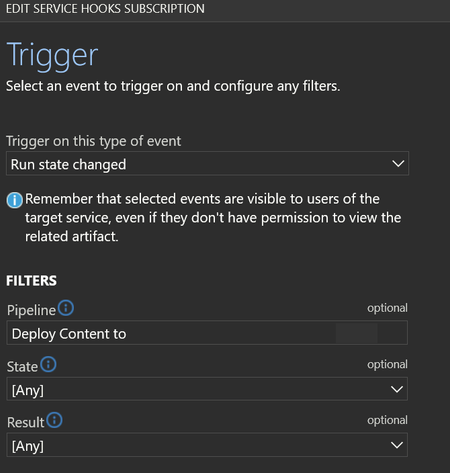
Hello, Ive been using Repository connections in sentinel to a central DevOps for almost two years now. Today i got my first automated email on error for a webhook related to my last commit from the central repo to my Sentinel intances. Its a webhook that is automticly created in connections that are made the last year (the once from 2 years ago dont have this webhook automaticly created). The hook is found in devops -> service hooks -> webhooks "run state change" for each connected sentinel However, after todays run (which was successfull, all content deployed) this hook generates alerts. It says it cant reach: (EU in my case) eu.prod.dps.sentinel.azure.com full url: https://eu.prod.dps.sentinel.azure.com/webhooks/ado/workspaces/[REDACTED]/sourceControls/[REDACTED] So, what happened to this domain? why is it no longer responding and when was it going offline? I THINK this is the hook that sets the status under Sentinel -> Repositories in the GUI. this success status in screenshoot is from 2025/02/06, no new success has been registered in the receiving Sentinel instance. For the Sentinel that is 2 year old and dont have a hook in my DevOps that last deployment status says "Unknown" - so im fairly sure thats what the webhook is doing. So a second question would be, how can i set up a new webhook ? (it want ID and password of the "Azure Sentinel Content Deployment App" - i will never know that password....) so i cant manually add ieather (if the URL ever comes back online or if a new one exists?). please let me know.332Views2likes3CommentsASIM built-in functions in Sentinel, are they updated automatically?
Are the ASIM built-in functions in Sentinel automatically updated? For example, the built-in parsers such for DNS, NetworkSession, and WebSession. Do the built-in ones receive automatic updates or will the workspace-deployed versions of these parsers be the most up-to-date? And if true, would it be recommended to use workspace-deployed version of parsers that already come built-in?747Views2likes1Comment
Sentinel Data Connector: Google Workspace (G Suite) (using Azure Functions)
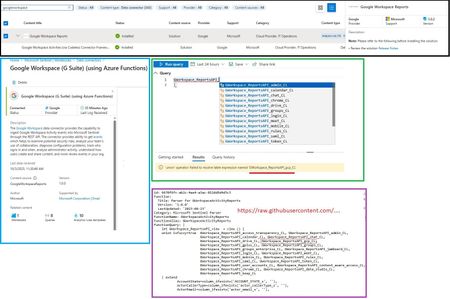
I'm encountering a problem when attempting to run the GWorkspace_Report workbook in Azure Sentinel. The query is throwing this error related to the union operator: 'union' operator: Failed to resolve table expression named 'GWorkspace_ReportsAPI_gcp_CL' I've double-checked, and the GoogleWorkspaceReports connector is installed and updated to version 3.0.2. Has anyone seen this or know what might be causing the table GWorkspace_ReportsAPI_gcp_CL to be unresolved? Thanks!471Views1like2Comments
Trend Micro Vision One Connector Not working
Hi All, Before I get nuked in the comments to raise an issue on the Sentinel Repo. Here me out 😇 Around a month ago, the logs stopped ingesting. A quick snoop around revealed the reason. But I'm not sure if I should raise an issue, or try to fix the issue, risking voiding any future support I can get, since the connector and the app that comes with it are market solutions. Function app was not running due to a dependency issue. Spotted this on the diagnostic logs, under the "exceptions" table. "module named _cffi_backend not found" a python package google tells me, thats used to interact with C code. So logically, I need to find the requirement.txt and make sure the dependency is there. Also make sure the python version on the runtime and Azure matches, The logs were initially flowing as usual . I had completed integrating Trend Micro using Azure Functions based connector around 7 months ago. Worked like a toyota helix until now. So once again, would like to know the community's thoughts on it. Thxx376Views1like1CommentUpdate content package Metadata
Hello Sentinel community and Microsoft. Ive been working on a script where i use this command: https://learn.microsoft.com/en-us/rest/api/securityinsights/content-package/install?view=rest-securityinsights-2024-09-01&tabs=HTTP Ive managed to successfully create everything from retrieving whats installed, uninstalling, reinstalling and lastly updating (updating needed to be "list, delete, install" however :'), there was no flag for "update available"). However, now to my issue. As this work like a charm through powershell, the metadata and hyperlinking is not being deployed - at all. So i have my 40 content packages successfully installed through the REST-api, but then i have to visit the content hub in sentinel in the GUI, filter for "installed" and mark them all, then press "install". When i do this the metadata and hyperlinking is created. (Its most noticeable that the analytic rules for the content hubs are not available under analytic rules -> Rule templates after installing through the rest api). But once you press install button in the GUI, they appear. So i looked in to the request that is made when pressing the button. It uses another API version, fine, i can add that to my script. But it also uses 2 variables that are not documented and encrypted-data. they are called c and t: Im also located in EU and it makes a request to SentinelUS. im OK with that, also as mentioned, another API version (2020-06-01) while the REST APi to install content packages above has 2024-09-01. NP. But i can not simulate this last request as the variables are encrypted and not available through the install rest api. They are also not possible to simulate. it ONLY works in the GUI when pressing install. Lastly i get another API version back when it successfully ran through install in GUI, so in total its 3 api versions. Here is my code snippet i tried (it is basically a mimic of the post request in the network tab of the browser then pressing "install" on the package in content hub, after i successfully installed it through the official rest api). function Refresh-WorkspaceMetadata { param ( [Parameter(Mandatory = $true)] [string]$SubscriptionId, [Parameter(Mandatory = $true)] [string]$ResourceGroup, [Parameter(Mandatory = $true)] [string]$WorkspaceName, [Parameter(Mandatory = $true)] [string]$AccessToken ) # Use the API version from the portal sample $apiVeri = "?api-version=" $RefreshapiVersion = "2020-06-01" # Build the batch endpoint URL with the query string on the batch URI $batchUri = "https://management.azure.com/\$batch$apiVeri$RefreshapiVersion" # Construct a relative URL for the workspace resource. # Append dummy t and c parameters to mimic the portal's request. $workspaceUrl = "/subscriptions/$SubscriptionId/resourceGroups/$ResourceGroup/providers/Microsoft.OperationalInsights/workspaces/$WorkspaceName$apiVeri$RefreshapiVersion&t=123456789&c=dummy" # Create a batch payload with several GET requests $requests = @() for ($i = 0; $i -lt 5; $i++) { $requests += @{ httpMethod = "GET" name = [guid]::NewGuid().ToString() requestHeaderDetails = @{ commandName = "Microsoft_Azure_SentinelUS.ContenthubWorkspaceClient/get" } url = $workspaceUrl } } $body = @{ requests = $requests } | ConvertTo-Json -Depth 5 try { $response = Invoke-RestMethod -Uri $batchUri -Method Post -Headers @{ "Authorization" = "Bearer $AccessToken" "Content-Type" = "application/json" } -Body $body Write-Host "[+] Workspace metadata refresh triggered successfully." -ForegroundColor Green } catch { Write-Host "[!] Failed to trigger workspace metadata refresh. Error: $_" -ForegroundColor Red } } Refresh-WorkspaceMetadata -SubscriptionId $subscriptionId -ResourceGroup $resourceGroup -WorkspaceName $workspaceName -AccessToken $accessToken (note: i have variables higher up in my script for subscriptionid, resourcegroup, workspacename and token etc). Ive tried with and without mimicing the T and C variable. none works. So for me, currently, installing content hub packages for sentinel is always: Install through script to get all 40 packages Visit webpage, filter for 'Installed', mark them and press 'Install' You now have all metadata and hyperlinking available to you in your Sentinel (such as hunting rules, analytic rules, workbooks, playbooks -templates). Anyone else manage to get around this or is it "GUI" gated ? Greatly appreciated.Solved722Views1like6Comments
Microsoft Defender Vulnerability Management Data in Sentinel
Anyone know when Microsoft Defender Vulnerability Management data will be available in Microsoft Defender XDR connector in Sentinel? If it won't be available soon, what is the best way to collect Vulnerability Management data to Sentinel? Thanks577Views1like1CommentIssue while deploying Sentienl Rules
I know that when deleting a Sentinel rule, you need to wait a specific amount of time before it can be redeployed. However, in this tenant, we've been waiting for almost a month and are still getting the same deployment error ('was recently deleted. You need to allow some time before re-using the same ID. Please try again later. Click here for details'). I still want to use the same ID ect. Does anyone have any idea or similar issue why it's still not possible after waiting for about a month?814Views1like4CommentsSentinel Solution Deployment via GitHub
Over the past couple years I have been working exclusively with LogRhythm and while I have deployed Sentinel a few times in the past, I have never attempted to do so using GitHub Actions. I seem to be relatively close to getting it deployed but have been struggling for the last couple days and have been unable to find (or overlooked) documentation to guide me in the right direction, so I thought I'd reach out to find out if anyone can help me out. Goals Central management of Sentinel across multiple tenants using Lighthouse Content such as Analytic Rules, Hunting Queries, Playbooks, Workbooks.. must be centrally managed across each tenant. I will have limited access to tenants and need a simple templated deployment process to handle the majority of the Sentinel deployment in tenants, ideally, I will provide the client with a deployment template and once deployed, it will have the the same content as the central management tenant. I have not yet decided whether to use Workspace manager, however, I will need to protect intellectual property so this will likely be a requirement (MSSP) I have been trying out the GitHub deployment and have mostly been running into issues with the solution deployment since the ARM Templates I have been creating don't seem to work. I get "Failed to check valid resource type." errors followed by "The file contains resources for content that was not selected for deployment. Please add content type to connection if you want this file to be deployed." warnings for most content. I have been able to get some working, specifically the Analytic Rules and Playbooks, and have not spent time on the Hunting Queries or Workbooks yet since I have rather been focused on the Solutions and while I make a bit of progress each day, I still feel like I am missing something simple, most likely related to the deployment script which Sentinel generates when connected to GitHub? Perhaps I am not deploying the required resources in the correct order? Now I am in the very early stages of planning and may very well not need to deploy solutions via GitHub if using the workspace manager (still to be verified), but it is killing me because I have not been able to figure it out in the last couple days! Does anyone know of a document that explains the process for those of us that don't spend a considerable amount of time using GitHub/DevOps?774Views1like1Comment