community
18 Topics
Azure Logic Apps Workflow Templates (Preview): Issues with Updates, Expressions, and Designer UI.
Hi Azure Logic Apps team, if someone from the team is monitoring this community, I would like to report a few issues I have encountered with the Logic Apps Workflow Templates (Preview) feature. These issues are impacting the user experience and require attention. Workflow Template name update issue I created a workflow template that was working correctly. However, when I try to edit the template and change its name, the update either fails or the new name is not saved. Other changes appear to work, but renaming the template is consistently problematic. Expression update issue with Base64 output When using the expression: base64(body('Create_CSV_table')) each time the email action is updated, the expression automatically changes back to: body('Create_CSV_table') This causes an Internal Server Error and requires manually fixing the expression every time the workflow is updated. This becomes very frustrating when managing multiple workflows. Logic Apps designer responsiveness issue The Logic Apps designer page is not fully responsive across different screen sizes. On my laptop screen, the Add Expression option disappears and is only visible when using a larger monitor. The designer should support different screen resolutions and provide a consistent user experience. Thank you for looking into these issues. Logic Apps Workflow Templates is a very useful feature, and addressing these problems would greatly improve usability for developers and users.Solved48Views0likes1Comment
Azure communication services not working
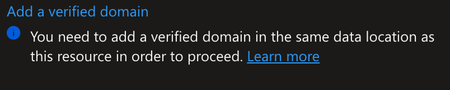
Hi, We are about to launch communication services to be able to recieve and send email from our website. But the problem is that i cannot choose my custom domains under email. I get this error: I have the services in the same data location and i have tried add multiple domains, and they are all verified.... please help.400Views0likes4Comments
Azure Billing Credit - No Explanation
Hello, I have a customer who received a larger credit on their February bill without any explanation. The customer is seeking clarification on the reason behind this credit. We compared the Azure billing and Azure portal cost management and noticed discrepancies in charges for compute and some PaaS services. Unfortunately, support has not been able to provide any answers or assistance. Could you please suggest a way to identify the source of this credit and the reason for it? Is there a specific team or group that might be able to assist us in resolving this issue? Thank you in advance for your help! Terru216Views0likes2CommentsHow to build a RAG system using AzureOpenAI and AzureAISearch.
I want to build a RAG system using AzureOpenAI and AzureAISearch. I am currently struggling with the on your data feature of AzureOpenAI to adjust the field composition of the uploaded files. The uploaded file has two fields, a question field and a content field, but the field structure of the index created summarizes all the information about the contents of the file in the content field. Therefore, when a particular question is asked from AzureOpenAI, multiple questions and answers are output, summarized in the content field. This is not the expected result. The expected result is that a specific question should return one answer to a specific question. Perhaps to do this I need to edit the json in the index field, but I am having difficulty understanding how to do this. If anyone has any knowledge of this, please let me know. Thank you.538Views0likes1CommentBest practices to manage long custom policies ?
Hi Team, I am trying to create custom policies in Azure B2C that need to be supported in more than 50 languages (including the OOB languages supported by MS). I need to understand what is best practice to store these translation. Should all translations should be stored in single xml file (e.g.) TrustFrameworkLocalization.xml or as there can be a way to have in multiple files so that one file have translation for only one language. Also what best practices says that all user journeys and technical profiles should be defined in single xml (TrustFrameworkExtensions.xml) or we should have one file for each user journey.922Views0likes2CommentsIs Redis Vector Database available in Azure, how to store embeddings in Redis Vector Database
I've read about Azure Cache for Redis and Redis Enterprise. But I'm not sure if they're referring to Redis Vector Database. Is Redis Vector Database available in Azure? If yes, please share some procedure and links about how to store OpenAI embeddings in Redis Vector Database in Azure.4KViews0likes4Comments
Azure Front Door
Hello Folks !! After a long time , I am back with a new topic explaining Azure's latest (but not so ) service to you ie Azure Front Door service. Let's go with it !! It is a global, scalable entry-point that uses the global edge network to create fast, secure, and widely used web applications. Basically it is a cloud Content Delivery Network (CDN) that provides fast, reliable, and secure access between you and your applications’ web content across the globe. It works at layer 7 using anycast protocol with split TCP and Microsoft’s global network to improve global connectivity. You can use your routing method to ensure that Front Door will route your client requests to the fastest and most available application backend. Now let's coming to "why we should use Azure front door " -- Azure Front Door enables internet-facing application to: Helps us to operate the architecture that have dynamic, high-quality digital experiences with highly automated, secure, and reliable platforms. To accelerate your application and scale to your users wherever they're creating opportunities for you to compete, weather change, and quickly adapt to new demand and markets. To secure your application against known and new threats with intelligent security that embrace a trustable framework What are the key benefits of using Azure Front End door -- To scale out and improve performance of your applications and content using Microsoft’s global Cloud CDN and WAN. It can improve your latency for apps by up to 3 times. Accelerating application performance by using Front Door’s anycast network and split TCP connections. Terminating SSL offload at the edge and use integrated certificate management . Natively support end-to-end IPv6 connectivity and the HTTP/2 protocol. Helps in delivering the modern architecture Modernize your internet first applications on Azure with Cloud Native experiences It integrates with you various azure functionalities and provided Azure IAC tools like - Azure Bicep, ARM templates, CLI and PowerShell. Provides the facility to define your own custom domain with flexible domain validation. Load balance and route traffic across origins and use intelligent health probe monitoring across apps or content hosted in Azure or anywhere. Integrate with other Azure services such as DNS, Web Apps, Storage and many more for domain and origin management. Log each Front Door request and failed health probes. It basically provides the ui for seeing the health checks of our application. Simple and cost-effective Unified static and dynamic delivery offered in a single tier to accelerate and scale your application . Free, autorotation managed SSL certificates that save time and quickly secure apps and content. Low entry fee and a simplified cost model that reduces billing complexity by having fewer meters needed to plan for. Azure to Front Door integrated egress pricing that removes the separate egress charge from Azure regions to Azure Front Door. Intelligent secure internet perimeter Secure applications with built-in layer 3-4 DDoS protection, seamlessly attached Web Application Firewall (WAF) , and Azure DNS to protect your domains . Protect your apps from malicious actors with Bot manager rules . Privately connect to your backend behind Azure Front Door with Private Link and embrace a zero-trust access model. Provide a centralized security experience for your application via Azure Policy and Azure Advisor . It also provides a rich set of advanced capabilities that enhance the DevOps experience, security posture, and cost-effectiveness for enterprise customers migrating and/or deploying high-performance, scalable, and secure applications on Azure or anywhere. Now what will happen to existing azure cdn services .. The existing Azure Front Door and Azure CDN from Microsoft will now be known as Azure Front Door (classic) and Azure CDN from Microsoft (classic) moving forward. Azure Front Door (classic), as well as Azure CDN from Microsoft (classic), will continue to be fully supported and you can continue to use them. There will be no big change as such , but there will be a slight modification in using Azure front door service as CDN .In the coming time , Azure zero downtime migrations from Azure Front Door (classic) and Azure CDN from Microsoft (classic) to Azure Front Door Standard and Premium. To summarise it up - Azure Front Door offers dynamic site acceleration (DSA ) as well as global load balancing with near real-time failover. For enterprises that have a global reach, the performance of their web applications is greatly impacted by the proximity of the consumer. For a better and more consistent experience, enterprises may use content delivery networks (CDNs ) with several distribution points and deliver content to consumers rapidly because of optimized connections and proximity. Azure Front Door leverages the anycast protocol that goes beyond providing traditional CDN capabilities and offers advanced security capabilities including DDoS attack prevention. The infrastructure for this globally distributed multi-tenant service is shared across all its customers.2KViews0likes1CommentQuestions about VNET and 2 different App Service Plans
Hello Community, i have some questions and maybe i don't understand something about vnetting in Azure. I have 1 VNET in my resource group with 2 subnets. I have also a App Service Plan S1 with windows (There is running a app service) for the frontend and a second App Service Plan S1 with Linux with 3 Function Apps for the Backend. For the Frontend (Windows App Service Plan) i have added in the networking section an IP restriction for my IP so the public internet access is disabled. The 3 Function Apps should only be able to communicate with the Frontend AppService and the ServiceTag AzureDevOps. Right now the 3 function apps are public in the internet. (Security issues!) How can i configure the VNET? I've already tried to: Windows Frontend App Service --> Outbound Traffic VNET to SubNet1 Linux Plan Function Apps --> Inbound Traffic Allow to SubNet1, Outbound Traffic VNET to SubNet2 (SubNet1 is greyed out so i have to choose the second subnet. But it should not be the problem because every subnet in the same vnet can talk to each other right?!) After i configured this i get some CORS Errors when i open the frontend app like this: (Without the networking config i get no errors because function apps are public then) .... has been blocked by CORS policy: Response to preflight request doesn't pass access control check: No 'Access-Control-Allow-Origin' header is present on the requested resource. What i have to do?1.1KViews0likes1CommentCreate Client ID and ANd Client Secret in azure
We have created a SharePoint provider-hosted app and the Web App of the app is hosted in the Local IIS. We are also using the App only permission with the Tenant's Full control as follows: <AppPermissionRequests AllowAppOnlyPolicy="true"> <AppPermissionRequest Scope="http://sharepoint/content/tenant" Right="FullControl" /> </AppPermissionRequests> Now, one of our clients is looking to Generate a Client ID and client secret in Azure and wants to use them in the SharePoint provider-hosted app. Is that possible to generate without hosting the Provider hosted app in azure using the app service?1.9KViews0likes1Comment