cm current branch
56 Topics
Latest ODBC Driver 18 for SQL (18.7.1.1) breaks SCCM Site Server > SQL connectivity
We have an automated update configured for ODBC Driver 18 for SQL which kicked in last night and took our install on the site server from 18.6.2.1 to 18.7.1.1 which seems to have completely broken Site Server -> SQL server connectivity. Rolling back to 18.6.2.1 and restarting the Site Server is the fix (for now) but I'm sure our Information Security team will be asking to get patched again soon. For info, the hman.log shows some threads stopping and then just goes dead when the update is applied and the Application event log is filled with "Complus" errors all related to the msodbcsql18.dll... The system has called a custom component and that component has failed and generated an exception. This indicates a problem with the custom component. Notify the developer of this component that a failure has occurred and provide them with the information below. Component Prog ID: 0[ODBC][C:\Windows\system32\msodbcsql18.dll] Method Name: IDispenserDriver::CreateResource Process Name: sitecomp.exe Exception: c0000005 Address: 0X00007FFA85FD2C10 How do we raise this with Microsoft? Has anyone else seen the same? Site Server is on Server 2019 (patched monthly). Our SCCM site is version 2603. Site Server and SQL DB on two different servers. Running E-HTTP mode. I note that something similar happened not too long ago... https://learn.microsoft.com/en-us/troubleshoot/mem/configmgr/setup-migrate-backup-recovery/update-odbc-18611-causes-issues-configmgr Thanks Stuart5KViews10likes12Comments
Upgrade task sequence skipping locations and failing
Upgrade task sequence using Operating System upgrade skipping http(s) paths Hi All SCCM Experts, I have an Upgrade to Windows 11 25H2 Task sequence which was working fine until lately. Now all devices on other networks outside my IT network. When it reaches the upgrade operating system step fails and does not download the content. Everything is fine with iis, and package is distributed successfully. The TS was working fine 3 weeks ago. I had success with a collection of devices. Boundary groups are still the same fine too. CAS log is fine no issues either. There is lots of disk space and the cache max size is good too. 1 primary site server which is the DP. *Has anybody encountered this happening with an in place upgrade ts before? If so what was the fix? It should not be skipping and the content should start to download because it does resolve and see the OS Upgrade Image package. The message in smsts.log is as follows: Package location: \_SMSTSCM100465, ://\*\*\*\*\*\*/sms\_dp\_smspkg$/cm100465,https://\*\*\*\*\*/ccmtokenauth\_sms\_dp\_smspkg$/cm100465 OSDUpgradeWindows 01/10/2026 09:06:18 28116 (0x6DD4) Skipping http(s) path: :/\*\*\*\*\*\*/sms\_dp\_smspkg$/cm100465 OSDUpgradeWindows 01/10/2026 09:06:18 28116 (0x6DD4) Skipping http(s) path: ://\*\*\*\*\*\*\*/ccmtokenauth\_sms\_dp\_smspkg$/cm100465 OSDUpgradeWindows 01/10/2026 09:06:18 28116 (0x6DD4)148Views0likes5Comments
MCM V2609 - Release Date?
Everything seems to have gone quiet about Version 2609. It was due for release this month and the month is almost over. Just wondering if any info on when it might be making an appearance? Just finishing up our migration to W11, so finally have time to upgrade from the old version we are running, so would like to get it on ASAP.204Views1like1CommentWinPE network adapter only works after manual drvload, despite driver present in SCCM boot image
Below are three sanitised versions suitable for an SCCM community forum. They retain the technical evidence needed for troubleshooting without disclosing internal server names, domains, IP addresses, MAC addresses, package IDs, or the organisation’s identity. Hi, I am building an SCCM OSD environment and have encountered an issue where the wired network adapter is not initialised automatically after WinPE loads. Environment Microsoft Configuration Manager Current Branch 2603 Current Windows ADK and WinPE add-on x64 WinPE boot image PXE-enabled Distribution Point Lenovo ThinkBook 14-IIL, Type 20SL Realtek PCIe GbE network adapter Realtek driver: rt640x64.inf Driver version: 10.43.723.2020 Symptoms The device successfully: Contacts the correct PXE server Downloads the x64 boot image Starts WinPE Reaches the Configuration Manager screen However, the Task Sequence Wizard does not continue. The task-sequence log shows that WinPE repeatedly fails to download the PXE variable file from the PXE server: Unable to download PXE variable file. Exit code=14. Failed to download PXE variable file after 6 retries. PxeGetPxeData failed with 0x8004016c. Running ipconfig at this point shows no active Ethernet adapter. Troubleshooting completed I have: Imported the Realtek PCIe GbE driver into SCCM Added the driver to the x64 boot image Confirmed the driver is listed under the boot image’s Drivers tab Reloaded the boot image using the current Windows ADK Updated the Distribution Point Confirmed the boot image is distributed successfully Confirmed the PXE copy of the WIM has a current timestamp Mounted the distributed WIM and confirmed the driver is present: Driver: oem5.inf OriginalFileName: rt640x64.inf ProviderName: Realtek ClassName: Net Version: 10.43.723.2020 The driver does not appear to bind or initialise automatically during WinPE startup. Manual workaround If I copy the complete Realtek driver folder to a USB drive and run: drvload "D:\LAN_V02\rt640x64.inf" wpeutil InitializeNetwork`` The driver loads successfully, the device receives a valid DHCP address, and it can reach the SCCM server. The task sequence then proceeds successfully if the driver is loaded before the PXE variable-file retries expire. Question Why would a network driver work correctly when loaded manually with drvload, but not initialise automatically when the same driver is confirmed as present in the distributed WinPE boot image? Is there a recommended way to make this driver load automatically that will scale across multiple laptop and desktop models? I would prefer to avoid: A model-specific prestart command Manually loading drivers from USB Adding complete model driver packs to the boot image Any advice on WinPE driver ranking, Plug and Play initialisation, driver versions, or recommended SCCM boot-image practices would be appreciated.164Views0likes1CommentSCCM Application Model: Which WMI Properties and Classes Correspond to Software Center Tab Fields?
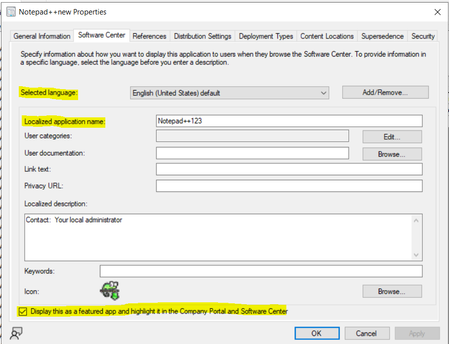
Service: Microsoft Configuration Manager (SCCM / MECM) Scenario: I am working with the Application Model and need to identify the underlying SCCM/WMI property names and associated class names for several fields displayed on the Software Center tab of an Application. Specifically, I am looking for the properties and classes corresponding to the following fields: Selected Language Localized Application Name Display this as a featured app and highlight it in the Company Portal and Software Center Environment: Microsoft Configuration Manager (Current Branch) Application Model What I am looking for: The SCCM/WMI property name associated with each field. The SCCM class name (SMS Provider class) where each property is stored. If applicable, the related SDK object path or SQL view that exposes these values. Troubleshooting Performed: I reviewed the Configuration Manager SDK documentation and application-related classes but could not determine the exact property-to-UI mapping for these Software Center settings. Supporting Material: A screenshot of the Software Center tab highlighting the fields is attached. Could someone help identify the corresponding WMI properties and classes for these settings?148Views0likes0CommentsConfiguration Manager manifest synchronization failing since 8 July 2026
Has anyone else experienced Configuration Manager Updates and Servicing synchronization failures since 8 July 2026? We have three independent Microsoft Configuration Manager hierarchies: Test environment Production T0 environment Production T1 environment All three started showing the same SMS_DMP_DOWNLOADER error during the last three days. The affected request is sent to: https://sccm.manage.microsoft.com/SCCMConnectedService.svc/Manifest Configuration Manager builds a hierarchy-specific request containing the Tenant, Version, Ring, and Branch parameters. However, the endpoint now returns only: OK The resulting file is: ConfigMgr.Update.Manifest.cab Size: 2 bytes Hex: 4F 4B Content: OK Because this is not a valid signed CAB file, dmpdownloader.log records: manifest.cab (http response) size is 2 Error in verifying the trust of file ConfigMgr.Update.Manifest.cab' WARNING: Failed to call IsFileTrusted WARNING: Failed to download and verify the manifest.cab. We cant get info in Updates and Servicing mode.373Views0likes2CommentsExisting required application deployments policy is not sent to devices
I have couple hundred applications in SCCM/MCM that are set to required and whenever there is a new device is built, all these required applications automatically get installed. I am on 2503 and 5 days ago i started seeing this issue. But if modify that deployment with current date and time then the application gets deployed right away if i run Application Deployment evaluation cycle. I also tested by deleting the existing deployment and created a new required deployment and run Application Deployment evaluation cycle then the application installs right away. The problem seems like the Primary server is not sending the policy to the client for existing deployments. The application compliance that we see for every deployment under Monitoring for all the devices moved to Error with Success. Not sure why this is happening. All these changes i noticed in the last one week. A week ago all these Already Compliant and Success status device count is under Success tab. Let me know if you have any suggestions.948Views0likes6Comments
Updates Not Installing by Install Deadline
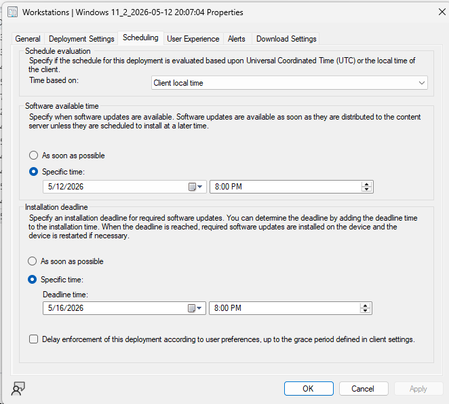
Hello all! We have an organization with about 12,000 Windows 11 Workstations. I'm noticing that even though install deadline is set, and updates are allowed to be installed before install deadline hits, we are noticing in Software Center that updates say "will install after _____" (deadline date). How can I change this? I want updates to install during the maintenance window as well as a reboot. What am I missing? Connor365Views0likes2Comments
SCCM PXE Boot Deep Dive – Backend Flow & DP Migration
SCCM PXE Boot Deep Dive – Backend Flow & DP Migration I recently worked on a Distribution Point migration and noticed PXE requests were still routing to the old DP due to DHCP/IP helper configuration. I put together a deep dive explaining: PXE flow (DHCP and TFTP sequence) Role of Distribution Points What changes during DP migration Common failure points One key takeaway: PXE issues are almost always network and routing related, not SCCM itself. Curious how others are handling PXE in large environments. Are you standardizing on IP helpers or still using DHCP options? Full article: http://SCCM%20PXE%20Boot%20Deep%20Dive%20–%20Backend%20Flow%20&%20DP%20Migration414Views0likes1CommentMECM OSD TS Application Installations fail randomly to download content.
We are experiencing a persistent and well-documented issue with MECM OSD Task Sequences where Applications randomly fail to install after the MECM client has been installed. This behavior seems to affect many environments and has been an ongoing problem for years, yet a definitive solution remains elusive. In our case, we have over 30 Applications included in the OSD Task Sequence. Despite implementing all commonly recommended mitigations—such as inserting an additional restart after the MECM client installation and including a two-minute delay before the Application install task group begins—we still encounter random failures. The issue is not limited to any specific Application; it can be any one of the 30+ Apps, and the failure to download appears to occur entirely at random. Occasionally, most of the Applications install successfully, and only one will fail, which subsequently causes the entire Task Sequence to fail with the same error. Importantly, all of these Applications install without any issues post-OSD, further confirming that the problem lies not with the Applications themselves but with the process during the Task Sequence. The randomness of which App fails also suggests an underlying process, feature, or timing issue—not an App configuration problem. We have thoroughly validated all related infrastructure settings: Boundaries and boundary groups have been triple-checked. No boundary is assigned to multiple groups. Site system assignments are correct. We are using PKI certificates and HTTPS, and the client authentication certificate is present on the device at the time of failure. The issue has been replicated across both Windows 10 and Windows 11, ruling out any specific cumulative updates or OS version anomalies. No additional language packs are being installed—only language fallback is applied via the "Apply Windows Settings" step. One suspicious observation is the lack of any reference to our local Distribution Point in the LocationServices or CAS logs during failure events. Initially, this pointed to a possible boundary misconfiguration, but after multiple checks, no issues have been identified. Unfortunately, we are unable to use the common workaround of converting Applications to Packages, due to internal policies and deployment requirements. Therefore, we need to resolve this while continuing to use Applications in the Task Sequence. Given the number of years this issue has persisted across customer environments, it's surprising there isn’t more formal guidance or documentation available to help isolate the root cause. If anyone has encountered a similar scenario or has any advanced troubleshooting tips, we would greatly appreciate your insight.628Views0likes2Comments