azure openai
97 TopicsAzure OpenAI GPT model to review Pull Requests for Azure DevOps
In recent months, the use of Generative Pre-trained Transformer (GPT) models for natural language processing (NLP) has gained significant traction. GPT models, which are based on the Transformer architecture, can generate text from arbitrary sources of input data and can be trained to identify errors and detect anomalies in text. As such, GPT models are increasingly being used for a variety of applications, ranging from natural language understanding to text summarization and question-answering. In the software development world, developers use pull requests to submit proposed changes to a codebase. However, reviews by other developers can sometimes take a long time and not accurate, and in some cases, these reviews can introduce new bugs and issues. In order to reduce this risk, During my research I found the integration of GPT models is possible and we can add Azure OpenAI service as pull request reviewers for Azure Pipelines service. The GPT models are trained on developer codebases and are able to detect potential coding issues such as typos, syntax errors, style inconsistencies and code smells. In addition, they can also assess code structure and suggest improvements to the overall code quality. Once the GPT models have been trained, they can be integrated into the Azure Pipelines service so that they can automatically review pull requests and provide feedback. This helps to reduce the time taken for code reviews, as well as reduce the likelihood of introducing bugs and issues.49KViews4likes13CommentsTeach ChatGPT to Answer Questions: Using Azure AI Search & Azure OpenAI (Lang Chain)
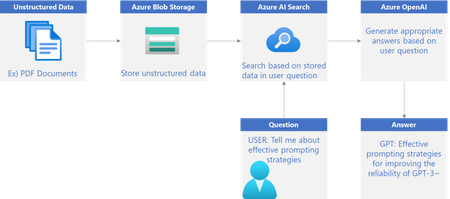
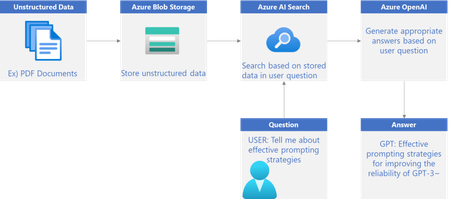
In this two-part series, we will explore how to build intelligent service using Azure. In Series 1, we'll use Azure AI Search to extract keywords from unstructured data stored in Azure Blob Storage. In Series 2, we'll Create a feature to answer questions based on PDF documents using Azure OpenAI.44KViews4likes9CommentsAzure Data Explorer for Vector Similarity Search
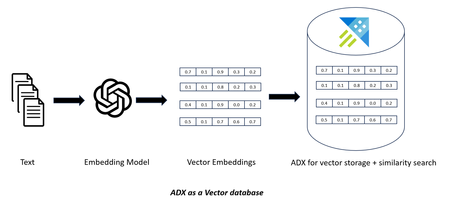
https://learn.microsoft.com/en-us/azure/data-explorer/kusto/query/series-cosine-similarity-function In the world of AI & data analytics, vector databases are emerging as a powerful tool for managing complex and high-dimensional data. In this article, we will explore the concept of vector databases, the need for vector databases in data analytics, and how Azure Data Explorer (ADX) aka Kusto can be used as a vector database.33KViews13likes5CommentsTeach ChatGPT to Answer Questions: Using Azure AI Search & Azure OpenAI (Semantic Kernel)
In this two-part series, we will explore how to build intelligent service using Azure. In Series 1, we'll use Azure AI Search to extract keywords from unstructured data stored in Azure Blob Storage. In Series 2, we'll Create a feature to answer questions based on PDF documents using Azure OpenAI26KViews4likes3CommentsNew Azure Open AI models bring fast, expressive, and real‑time AI experiences in Microsoft Foundry
Modern AI applications, whether voice‑first experiences or building large software systems, rarely fit into a single prompt. Real work unfolds over time: maintaining context, following instructions, invoking tools, and adapting as requirements evolve. When these foundations break down through latency spikes, instruction drift, or unreliable tool calls, both user conversations and developer workflows are impacted. OpenAI’s latest models address this shared challenge by prioritizing continuity and reliability across real‑time interaction and long‑running engineering tasks. Starting today, GPT-Realtime-1.5, GPT-Audio-1.5, and GPT-5.3-Codex are rolling out into Microsoft Foundry. Together, these models reflect the growing needs of the modern developer and push the needle from short, stateless interactions toward AI systems that can reason, act, and collaborate over time. GPT-5.3-Codex at a glance GPT‑5.3‑Codex brings together advanced coding capability with broader reasoning and professional problem solving in a single model built for real engineering work. It unifies the frontier coding performance of GPT-5.2-Codex with the reasoning and professional knowledge capabilities of GPT5.2 in one system. This shifts the experience from optimizing isolated outputs to supporting longer running development efforts; where repositories are large, changes span multiple steps, and requirements aren’t always fully specified at the start. What’s improved Model experiences 25% faster execution time, according to Open AI, than its predecessors so developers can accelerate development of new applications. Built for long-running tasks that involve research, tool use, and complex, multi‑step execution while maintaining context. Midtask steerability and frequent updates allow developers to redirect and collaborate with the model as it works without losing context. Stronger computer-use capabilities allow developers to execute across the full spectrum of technical work. Common use cases Developers and teams can apply GPT‑5.3‑Codex across a wide range of scenarios, including: Refactoring and modernizing large or legacy applications Performing multi‑step migrations or upgrades Running agentic developer workflows that span analysis, implementation, testing, and remediation Automating code reviews, test generation, and defect detection Supporting development in security‑sensitive or regulated environments Pricing Model Input Price/1M Tokens Cached Input Price/1M Tokens Output Price/1M Tokens GPT-5.3-Codex $1.75 $0.175 $14.00 GPT-Realtime-1.5 and GPT-Audio-1.5 at a glance The models deliver measurable gains in reasoning and speech understanding for real‑time voice interactions on Microsoft Foundry. In OpenAI’s evaluations, it shows a +5% lift on Big Bench Audio (reasoning), a +10.23% improvement in alphanumeric transcription, and a +7% gain in instruction following, while maintaining low‑latency performance. Key improvements include: What's improved More natural‑sounding speech: Audio output is smoother and more conversational, with improved pacing and prosody. Higher audio quality: Clearer, more consistent audio output across supported voices. Improved instruction following: Better alignment with developer‑provided system and user instructions during live interactions. Function calling support: Enables structured, tool‑driven interactions within real‑time audio flows. Common use cases Developers are using GPT-Realtime-1.5 and GPT-Audio-1.5 for scenarios where low‑latency voice interaction is essential, including: Conversational voice agents for customer support or internal help desks Voice‑enabled assistants embedded in applications or devices Live voice interfaces for kiosks, demos, and interactive experiences Hands‑free workflows where audio input and output replace keyboard interaction Pricing Model Text Audio Image Input Cached Input Output Input Cached Input Output Input Cached Input Output GPT-Realtime-1.5 $4.00 $0.04 $16.0 $32.0 $0.40 $64.00 $4.00 $0.04 $16.0 GPT-Audio-1.5 $2.50 n/a $10.0 $32.00 n/a $64.00 $2.50 n/a $10.0 Getting started in Microsoft Foundry Start building in Microsoft Foundry, evaluate performance, and explore Azure Open AI models today. Foundry brings evaluation, deployment, and governance into a single workflow, helping teams progress from experiments to scalable applications while maintaining security and operational controls.20KViews1like0CommentsAnnouncing GPT‑5.2‑Codex in Microsoft Foundry: Enterprise‑Grade AI for Secure Software Engineering
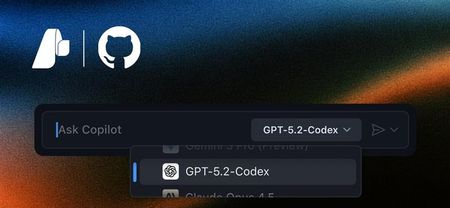
Enterprise developers know the grind: wrestling with legacy code, navigating complex dependency challenges, and waiting on security reviews that stall releases. OpenAI’s GPT‑5.2‑Codex flips that equation and helps engineers ship faster without cutting corners. It’s not just autocomplete; it’s a reasoning engine for real-world software engineering. Generally available starting today through Azure OpenAI in Microsoft Foundry Models, GPT‑5.2‑Codex is built for the realities of enterprise codebases, large repos, evolving requirements, and security constraints that can’t be overlooked. As OpenAI’s most advanced agentic coding model, it brings sustained reasoning, and security-aware assistance directly into the workflows enterprise developers already rely on with Microsoft’s secure and reliable infrastructure. GPT-5.2-Codex at a Glance GPT‑5.2‑Codex is designed for how software gets built in enterprise teams. You start with imperfect inputs including legacy code, partial docs, screenshots, diagrams, and work through multi‑step changes, reviews, and fixes. The model helps keep context, intent, and standards intact across that entire lifecycle, so teams can move faster without sacrificing quality or security. What it enables Work across code and artifacts: Reason over source code alongside screenshots, architecture diagrams, and UI mocks — so implementation stays aligned with design intent. Stay productive in long‑running tasks: Maintain context across migrations, refactors, and investigations, even as requirements evolve. Build and review with security in mind: Get practical support for secure coding patterns, remediation, reviews, and vulnerability analysis — where correctness matters as much as speed. Feature Specs (quick reference) Context window: 400K tokens (approximately 100K lines of code) Supported languages: 50+ including Python, JavaScript/TypeScript, C#, Java, Go, Rust Multimodal inputs: Code, images (UI mocks, diagrams), and natural language API compatibility: Drop-in replacement for existing Codex API calls Use cases where it really pops Legacy modernization with guardrails: Safely migrate and refactor “untouchable” systems by preserving behavior, improving structure, and minimizing regression risk. Large‑scale refactors that don’t lose intent: Execute cross‑module updates and consistency improvements without the typical “one step forward, two steps back” churn. AI‑assisted code review that raises the floor: Catch risky patterns, propose safer alternatives, and improve consistency, especially across large teams and long‑lived codebases. Defensive security workflows at scale: Accelerate vulnerability triage, dependency/path analysis, and remediation when speed matters, but precision matters more. Lower cognitive load in long, multi‑step builds: Keep momentum across multi‑hour sessions: planning, implementing, validating, and iterating with context intact. Pricing Model Input Price/1M Tokens Cached Input Price/1M Tokens Output Price/1M Tokens GPT-5.2-Codex $1.75 $0.175 $14.00 Security Aware by Design, not as an Afterthought For many organizations, AI adoption hinges on one nonnegotiable question: Can this be trusted in security sensitive workflows? GPT-5.2-Codex meaningfully advances the Codex lineage in this area. As models grow more capable, we’ve seen that general reasoning improvements naturally translate into stronger performance in specialized domains — including defensive cybersecurity. With GPT‑5.2‑Codex, this shows up in practical ways: Improved ability to analyze unfamiliar code paths and dependencies Stronger assistance with secure coding patterns and remediation More dependable support during code reviews, vulnerability investigations, and incident response At the same time, Microsoft continues to deploy these capabilities thoughtfully balancing access, safeguards, and platform level controls so enterprises can adopt AI responsibly as capabilities evolve. Why Run GPT-5.2-Codex on Microsoft Foundry? Powerful models matter — but where and how they run matters just as much for enterprise. Organizations choose Microsoft Foundry because it combines Foundry frontier AI with Azure enterprise grade fundamentals: Integrated security, compliance, and governance Deploy GPT-5.2-Codex within existing Azure security boundaries, identity systems, and compliance frameworks — without reinventing controls. Enterprise ready orchestration and tooling Build, evaluate, monitor, and scale AI powered developer experiences using the same platform teams already rely on for production workloads. A unified path from experimentation to scale Foundry makes it easier to move from proof of concept to real deployment —without changing platforms, vendors, or operating assumptions. Trust at the platform level For teams working in regulated or security critical environments, Foundry and Azure provide assurances that go beyond the model itself. Together with GitHub Copilot, Microsoft Foundry provides a unified developer experience — from in‑IDE assistance to production‑grade AI workflows — backed by Azure’s security, compliance, and global scale. This is where GPT-5.2-Codex becomes not just impressive but adoptable. Get Started Today Explore GPT‑5.2‑Codex in Microsoft today. Start where you already work: Try GPT‑5.2‑Codex in GitHub Copilot for everyday coding and scale the same model to larger workflows using Azure OpenAI in Microsoft Foundry. Let’s build what’s next with speed and security.18KViews3likes1CommentStop Drawing Architecture Diagrams Manually: Meet the Open-Source AI Architecture Review Agents
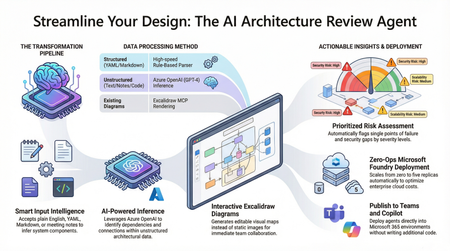
Designing and documenting software architecture is often a battle against static diagrams that become outdated the moment they are drawn. The Architecture Review Agent changes that by turning your design process into a dynamic, AI-powered workflow. In this post, we explore how to leverage Microsoft Foundry Hosted Agents, Azure OpenAI, and Excalidraw to build an open-source tool that instantly converts messy text descriptions, YAML, or README files into editable architecture diagrams. Beyond just drawing boxes, the agent acts as a technical co-pilot, delivering prioritized risk assessments, highlighting single points of failure, and mapping component dependencies. Discover how to eliminate manual diagramming, catch security flaws early, and deploy your own enterprise-grade agent with zero infrastructure overhead.18KViews7likes5CommentsIntroducing OpenAI's GPT-image-2 in Microsoft Foundry
Take a small design team running a global social campaign. They have the creative vision to produce localized imagery for every market, but not the resources to reshoot, reformat, or outsource that scale. Every asset needs to fit a different platform, a different dimension, a different cultural context, and they all need to ship at the same time. This is where flexible image generation comes in handy. OpenAI's GPT-image-2 is now generally available and rolling out today to Microsoft Foundry, introducing a step change in image generation. Developers and designers now get more control over image output, so a small team can execute with the reach and flexibility of a much larger one. What is new in GPT-image-2? GPT-image-2 brings real world intelligence, multilingual understanding, improved instruction following, increased resolution support, and an intelligent routing layer giving developers the tools to scale image generation for production workflows. Real world intelligence GPT-image-2 has a knowledge cut off of December 2025, meaning that it is able to give you more contextually relevant and accurate outputs. The model also comes with enhanced thinking capabilities that allow it to search the web, check its own outputs, and create multiple images from just one prompt. These enhancements shift image generation models away from being simple tools and runs them into creative sidekicks. Multilingual understanding GPT-image-2 includes increased language support across Japanese, Korean, Chinese, Hindi, and Bengali, as well as new thinking capabilities. This means the model can create images and render text that feels localized. Increased resolution support GPT-image-2 introduces 4K resolution support, giving developers the ability to generate rich, detailed, and photorealistic images at custom dimensions. Resolution guidelines to keep in mind: Constraint Detail Total pixel budget Maximum pixels in final image cannot exceed 8,294,400 Minimum pixels in final image cannot be less than 655,360 Requests exceeding this are automatically resized to fit. Resolutions 4K, 1024x1024, 1536x1024, and 1024x1536 Dimension alignment Each dimension must be a multiple of 16 Note: If your requested resolution exceeds the pixel budget, the service will automatically resize it down. Intelligent routing layer GPT-image-2 also includes an expanded routing layer with two distinct modes, allowing the service to intelligently select the right generation configuration for a request without requiring an explicitly set size value. Mode 1 — Legacy size selection In Mode 1, the routing layer selects one of the three legacy size tiers to use for generation: Size tier Description smimage Small image output image Standard image output xlimage Large image output This mode is useful for teams already familiar with the legacy size tiers who want to benefit from automatic selection without making any manual changes. Mode 2 — Token size bucket selection In Mode 2, the routing layer selects from six token size buckets — 16, 24, 36, 48, 64, 96 — which map roughly to the legacy size tiers: Token bucket Approximate legacy size 16, 24 smimage 36, 48 image 64, 96 xlimage This approach can allow for more flexibility in the number of tokens generated, which in turn helps to better optimize output quality and efficiency for a given prompt. See it in action GPT-image-2 shows improved image fidelity across visual styles, generating more detailed and refined images. But, don’t just take our word for it, let's see the model in action with a few prompts and edits. Here is the example we used: Prompt: Interior of an empty subway car (no people). Wide-angle view looking down the aisle. Clean, modern subway car with seats, poles, route map strip, and ad frames above the windows. Realistic lighting with a slight cool fluorescent tone, realistic materials (metal poles, vinyl seats, textured floor). As you can see, when using the same base prompt, the image quality and realism improved with each model. Now let’s take a look at adding incremental changes to the same image: Prompt: Populate the ad frames with a cohesive ad campaign for “Zava Flower Delivery” and use an array of flower types. And our subway is now full of ads for the new ZAVA flower delivery service. Let's ask for another small change: Prompt: In all Zava Flower Delivery advertisements, change the flowers shown to roses (red and pink roses). And in three simple prompts, we've created a mockup of a flower delivery ad. From marketing material to website creation to UX design, GPT-image-2 now allows developers to deliver production-grade assets for real business use cases. Image generation across industries These new capabilities open the door to richer, more production-ready image generation workflows across a range of enterprise scenarios: Retail & e-commerce: Generate product imagery at exact platform-required dimensions, from square thumbnails to wide banners, without post-processing. Marketing: Produce crisp, rich in color campaign visuals and social assets localized to different markets. Media & entertainment: Generate storyboard panels and scene at resolutions suited to production pipelines. Education & training: Create visual learning aids and course materials formatted to exact display requirements across devices. UI/UX design: Accelerate mockup and prototype workflows by generating interface assets at the precise dimensions your design system requires. Trust and safety At Microsoft, our mission to empower people and organizations remains constant. As part of this commitment, models made available through Foundry undergo internal reviews and are deployed with safeguards designed to support responsible use at scale. Learn more about responsible AI at Microsoft. For GPT-image-2, Microsoft applied an in-depth safety approach that addresses disallowed content and misuse while maintaining human oversight. The deployment combines OpenAI’s image generation safety mitigations with Azure AI Content Safety, including filters and classifiers for sensitive content. Pricing Model Offer type Pricing - Image Pricing - Text GPT-image-2 Standard Global Input Tokens: $8 Cached Input Tokens: $2 Output Tokens: $30 Input Tokens: $5 Cached Input Tokens: $1.25 Note: All prices are per 1M token. There is no billing for output tokens for the GPT-image-2 model. Getting started Whether you’re building a personalized retail experience, automating visual content pipelines or accelerating design workflows. GPT-image-2 gives your team the resolution control and intelligent routing to generate images that fit your exact needs. Try the GPT-image-2 in Microsoft Foundry today! Deploy the model in Microsoft Foundry Experiment with the model in the Image playground Read the documentation to learn more18KViews3likes3CommentsIntroducing OpenAI’s GPT-5.4 mini and GPT-5.4 nano for low-latency AI
Imagine you’re a developer building a research assistant agent on top of GPT‑5.4. The agent retrieves documents, summarizes findings, and answers follow‑up questions across multiple turns. In early testing, the reasoning quality is strong, but as the agent chains together retrieval, tool calls, and generation, latency starts to add up. For interactive experiences, those delays matter—so many teams adopt a multi‑model approach, using a larger model to plan and smaller models to execute subtasks quickly at scale. This is where GPT‑5.4 mini and GPT‑5.4 nano come in. These smaller variants of GPT-5.4 are optimized for developer workloads where latency, cost savings, and agentic design are top of mind. GPT-5.4 mini and GPT-5.4 nano will be rolling out today in Microsoft Foundry, so you can evaluate them in the model catalog and deploy the right option for each workload. GPT-5.4 mini: efficient reasoning for production workflows GPT-5.4 mini distills GPT-5.4’s strengths into a smaller, more efficient model for developer workloads where responsiveness matters. It significantly improves over GPT-5 mini across coding, reasoning, multimodal understanding, and tool use while running about 2X faster. Text and image inputs: build multimodal experiences that combine prompts with screenshots or other images. Tool use and function calling: reliably invoke tools and APIs for agentic workflows. Web search and file search: ground responses in external or enterprise content as part of multi-step tasks. Computer use: support software-interaction loops where the model interprets UI state and takes well-scoped actions. Where GPT-5.4 mini thrives Developer copilots and coding assistants: latency-sensitive coding help, code review suggestions, and fast iteration loops where turnaround time matters. Multimodal developer workflows: applications that interpret screenshots, understand UI state, or process images as part of coding and debugging loops. Computer-use sub-agents: fast executors that take well-scoped actions in software (for example, navigating UIs or completing repetitive steps) within a larger agent loop coordinated by a planner model. GPT-5.4 nano: ultra-low latency automation at scale GPT-5.4 nano is the smallest and fastest model in the lineup, designed for low-latency and low-cost API usage at high throughput. It’s optimized for short-turn tasks like classification, extraction, and ranking, plus lightweight sub-agent work where speed and cost are the priority and extended multi-step reasoning isn’t required. Strong instruction following: consistent adherence to developer intent across short, well-defined interactions. Function and tool calling: dependable invocation of tools and APIs for lightweight agent and automation scenarios. Coding support: optimized performance for common coding tasks where fast turnaround is required. Image understanding: multimodal image input support for basic image interpretation alongside text. Low-latency, low-cost execution: designed to deliver responses quickly and efficiently at scale. Where GPT-5.4 nano thrives GPT-5.4 nano is a strong fit when you need predictable behavior at very high throughput and the task can be expressed as short, well-scoped instructions. Classification and intent detection: fast labeling and routing decisions for high-volume requests. Extraction and normalization: pull structured fields from text, validate formats, and standardize outputs. Ranking and triage: reorder candidates, prioritize tickets/leads, and select best-next actions under tight latency budgets. Guardrails and policy checks: lightweight safety and policy classification, prompt gating, and enforcement decisions before dispatching to tools or larger models. High-volume text processing pipelines: batch transformation, cleanup, deduping, and normalization steps where unit cost and throughput dominate. Routing and prioritization at the edge: select the right downstream workflow (template, queue, or model) for each request under tight latency budgets. Choosing the right GPT-5.4 model Microsoft Foundry makes it possible to deploy multiple GPT-5.4 variants side by side, so teams can route requests to the model that best fits each task. Here’s a practical way to think about the lineup: Model Best suited for Typical workloads GPT-5.4 Sustained, multi-step reasoning with reliable follow-through Agentic workflows, research assistants, document analysis, complex internal tools GPT-5.4 Pro Deeper, higher-reliability reasoning for complex production scenarios High-stakes agentic workflows, long-form analysis and synthesis, complex planning, advanced internal copilots GPT-5.4 mini Balanced reasoning with lower latency for interactive systems Real-time agents, developer tools, retrieval-augmented applications GPT-5.4 nano Ultra-low latency and high throughput High-volume request routing, real-time chat, lightweight automation Responsible AI in Microsoft Foundry At Microsoft, our mission to empower people and organizations remains constant. In the age of AI, trust is foundational to adoption, and earning that trust requires a commitment to transparency, safety, and accountability. Microsoft Foundry provides governance controls, monitoring, and evaluation capabilities to help organizations deploy GPT-5.4 models responsibly in production environments, aligned with Microsoft's Responsible AI principles. Pricing Model Deployment Input (USD $/M tokens) Cached input (USD $/M tokens) Output (USD $/M tokens) GPT-5.4 mini Standard Global $0.75 $0.075 $4.5 GPT-5.4 nano Standard Global $0.20 $0.02 $1.25 The models are also available in Data Zone US. It is rolling out to Data Zone EU. Getting started Explore the models in Microsoft Foundry. Sign in to the Foundry portal and browse the model catalog to evaluate GPT-5.4 mini and GPT-5.4 nano alongside other options, then deploy the right model for each workload.15KViews0likes1Comment