azure key vault
31 Topics
Azure Key Vault Replication: Why Paired Regions Alone Don’t Guarantee Business Continuity
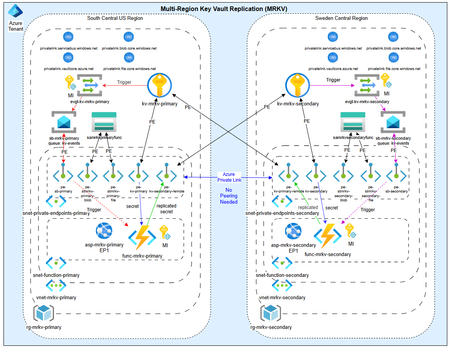
As customers modernize toward multi‑region architectures in Azure, one question comes up repeatedly: “If my region goes down, will Azure Key Vault continue to work without disruption?” The short answer: it depends on what you mean by “work.” Azure Key Vault provides strong durability and availability guarantees, but those guarantees are often misunderstood—especially when customers assume paired‑region replication equals full disaster recovery. In reality, Azure Key Vault replication is designed for survivability, not uninterrupted write access or customer‑controlled failover. This post explains: How Azure Key Vault replication actually works (per Microsoft Learn) Why paired‑region failover does not equal business continuity Two reference architectures that implement true multi‑region Key Vault availability, with Terraform How Azure Key Vault Replication Works (Per Microsoft Learn) Azure Key Vault includes multiple layers of Microsoft‑managed redundancy. In‑Region and Zone Resiliency Vault contents are replicated within the region. In regions that support availability zones, Key Vault is zone‑resilient by default. This protects against localized hardware or zone failures. Paired‑Region Replication If a Key Vault is deployed in a region with an Azure‑defined paired region, its contents are asynchronously replicated to that paired region. This replication is automatic and cannot be configured, observed, or tested by customers. Microsoft‑Managed Regional Failover If Microsoft declares a full regional outage, requests are automatically routed to the paired region. After failover, the vault operates in read‑only mode: ✅ Read secrets, keys, and certificates ✅ Perform cryptographic operations ❌ Create, update, rotate, or delete secrets, keys, or certificates This is a critical distinction. Paired‑region replication preserves access — not operational continuity. Why Paired‑Region Replication Is Not Business Continuity From a reliability and DR perspective, several limitations matter: Failover is Microsoft‑initiated, not customer‑controlled No write operations during regional failover No secret rotation or certificate renewal No way to test DR Accidental deletions replicate No point‑in‑time recovery without backups Microsoft Learn explicitly states that critical workloads may require custom multi‑region strategies beyond built‑in replication. For many customers, this means Azure Key Vault becomes a single‑region dependency in an otherwise multi‑region application design. The Multi‑Region Key Vault Pattern The two GitHub repositories below implement a common architectural shift: Multiple independent Key Vaults deployed in separate regions, with customer‑controlled replication and failover. Instead of relying on invisible platform replication, the vaults become first‑class, region‑scoped resources, aligned with application failover. Solution 1: Private, Locked‑Down Multi‑Region Key Vault Replication Repository: 👉 https://github.com/jclem2000/KeyVault-MultiRegion-Replication-Private Architecture Highlights Independent Key Vault per region Private Endpoints only No public network exposure Terraform‑based deployment Controlled replication using Event Based synchronization What This Enables ✅ Full read/write access during regional outages ✅ Continued secret rotation and certificate renewal ✅ Customer‑defined failover and RTO ✅ DR testing and validation ✅ Strong alignment with zero‑trust and regulated environments Trade‑offs Higher operational complexity Requires automation and application awareness of multiple vaults Solution 2: Low‑Cost Public Multi‑Region Key Vault Replication Repository: 👉 https://github.com/jclem2000/KeyVault-MultiRegion-Replication-Public Architecture Highlights Independent Key Vault per region Public endpoints Minimal networking dependencies Terraform‑based Controlled replication using Event Based synchronization Optimized for simplicity and cost What This Enables ✅ Full read/write availability in any region ✅ Clear and testable DR posture ✅ Lower cost than private endpoint designs ✅ Suitable for many non‑regulated workloads Trade‑offs Public exposure (mitigated via firewall rules, RBAC, and conditional access) Not appropriate for all compliance requirements Requires automation and application awareness of multiple vaults Azure Native Replication vs Customer‑Managed Multi‑Region Vaults Capability Azure Paired Region Multi‑Region Vaults Read access during outage ✅ ✅ Write access during outage ❌ ✅ Secret rotation during outage ❌ ✅ Customer‑controlled failover ❌ ✅ DR testing ❌ ✅ Isolation from accidental deletion ❌ ✅ Predictable RTO ❌ ✅ Azure Key Vault’s native replication optimizes for platform durability. The multi‑region pattern optimizes for application continuity. When to Use Each Approach Paired‑Region Replication Is Often Enough When: Secrets are mostly static Read‑only access during outages is acceptable RTO is flexible You prefer Microsoft‑managed recovery Multi‑Region Vaults Are Recommended When: Secrets or certificates rotate frequently Applications must remain writable during outages Deterministic failover is required DR testing is mandatory Regulatory or operational isolation is needed Closing Thoughts Azure Key Vault behaves exactly as documented on Microsoft Learn—but it’s important to be clear about what those guarantees mean. Paired‑region replication protects your data, not your ability to operate. If your application is designed to survive a regional outage, Key Vault must follow the same multi‑region design principles as the application itself. The reference architectures above show how to extend Azure’s native durability model into true operational resilience, without waiting for a platform‑level failover decision.1KViews0likes1Comment
Azure Cloud HSM: Secure, Compliant & Ready for Enterprise Migration
Azure Cloud HSM is Microsoft’s single-tenant, FIPS 140-3 Level 3 validated hardware security module service, designed for organizations that need full administrative control over cryptographic keys in the cloud. It’s ideal for migration scenarios, especially when moving on-premises HSM workloads to Azure with minimal application changes. Onboarding & Availability No Registration or Allowlist Needed: Azure Cloud HSM is accessible to all customers no special onboarding or monetary policy required. Regional Availability: Private Preview: UK West Public Preview (March 2025): East US, West US, West Europe, North Europe, UK West General Availability (June 2025): All public, US Gov, and AGC regions where Azure Managed HSM is available Choosing the Right Azure HSM Solution Azure offers several key management options: Azure Key Vault (Standard/Premium) Azure Managed HSM Azure Payment HSM Azure Cloud HSM Cloud HSM is best for: Migrating existing on-premises HSM workloads to Azure Applications running in Azure VMs or Web Apps that require direct HSM integration Shrink-wrapped software in IaaS models supporting HSM key stores Common Use Cases: ADCS (Active Directory Certificate Services) SSL/TLS offload for Nginx and Apache Document and code signing Java apps needing JCE provider SQL Server TDE (IaaS) via EKM Oracle TDE Deployment Best Practices 1. Resource Group Strategy Deploy the Cloud HSM resource in a dedicated resource group (e.g., CHSM-SERVER-RG). Deploy client resources (VM, VNET, Private DNS Zone, Private Endpoint) in a separate group (e.g., CHSM-CLIENT-RG) 2. Domain Name Reuse Policy Each Cloud HSM requires a unique domain name, constructed from the resource name and a deterministic hash. Four reuse types: Tenant, Subscription, ResourceGroup, and NoReuse choose based on your naming and recovery needs. 3. Step-by-Step Deployment Provision Cloud HSM: Use Azure Portal, PowerShell, or CLI. Provisioning takes ~10 minutes. Register Resource Provider: (Register-AzResourceProvider -ProviderNamespace Microsoft.HardwareSecurityModules) Create VNET & Private DNS Zone: Set up networking in the client resource group. Create Private Endpoint: Connect the HSM to your VNET for secure, private access. Deploy Admin VM: Use a supported OS (Windows Server, Ubuntu, RHEL, CBL Mariner) and download the Azure Cloud HSM SDK from GitHub. Initialize and Configure Edit azcloudhsm_resource.cfg: Set the hostname to the private link FQDN for hsm1 (found in the Private Endpoint DNS config). Initialize Cluster: Use the management utility (azcloudhsm_mgmt_util) to connect to server 0 and complete initialization. Partition Owner Key Management: Generate the PO key securely (preferably offline). Store PO.key on encrypted USB in a physical safe. Sign the partition cert and upload it to the HSM. Promote Roles: Promote Precrypto Officer (PRECO) to Crypto Officer (CO) and set strong password Security, Compliance, and Operations Single-Tenant Isolation: Only your organization has admin access to your HSM cluster. No Microsoft Access: Microsoft cannot access your keys or credentials. FIPS 140-3 Level 3 Compliance: All hardware and firmware are validated and maintained by Microsoft and the HSM vendor. Tamper Protection: Physical and logical tamper events trigger key zeroization. No Free Tier: Billing starts upon provisioning and includes all three HSM nodes in the cluster. No Key Sharing with Azure Services: Cloud HSM is not integrated with other Azure services for key usage. Operational Tips Credential Management: Store PO.key offline; use environment variables or Azure Key Vault for operational credentials. Rotate credentials regularly and document all procedures. Backup & Recovery: Backups are automatic and encrypted; always confirm backup/restore after initialization. Support: All support is through Microsoft open a support request for any issues. Azure Cloud HSM vs. Azure Managed HSM Feature / Aspect Azure Cloud HSM Azure Managed HSM Deployment Model Single-tenant, dedicated HSM cluster (Marvell LiquidSecurity hardware) Multi-tenant, fully managed HSM service FIPS Certification FIPS 140-3 Level 3 FIPS 140-2 Level 3 Administrative Control Full admin control (Partition Owner, Crypto Officer, Crypto User roles) Azure manages HSM lifecycle; customers manage keys and RBAC Key Management Customer-managed keys and partitions; direct HSM access Azure-managed HSM; customer-managed keys via Azure APIs Integration PKCS#11, OpenSSL, JCE, KSP/CNG, direct SDK access Azure REST APIs, Azure CLI, PowerShell, Key Vault SDKs Use Cases Migration from on-prem HSMs, legacy apps, custom PKI, direct cryptographic ops Cloud-native apps, SaaS, PaaS, Azure-integrated workloads Network Access Private VNET only; not accessible by other Azure services Accessible by Azure services (e.g., Storage, SQL, Disk Encryption) Key Usage by Azure Services Not supported (no integration with Azure services) Supported (can be used for disk, storage, SQL encryption, etc.) BYOK/Key Import Supported (with key wrap methods) Supported (with Azure Key Vault import tools) Key Export Supported (if enabled at key creation) Supported (with exportable keys) Billing Hourly fee per cluster (3 HSMs per cluster); always-on Consumption-based (per operation, per key, per hour) Availability High availability via 3-node cluster; automatic failover and backup Geo-redundant, managed by Azure Firmware Management Microsoft manages firmware; customer cannot update Fully managed by Azure Compliance Meets strictest compliance (FIPS 140-3 Level 3, single-tenant isolation) Meets broad compliance (FIPS 140-2 Level 3, multi-tenant isolation) Best For Enterprises migrating on-prem HSM workloads, custom/legacy integration needs Cloud-native workloads, Azure service integration, simplified management When to Choose Each? Azure Cloud HSM is ideal if you: Need full administrative control and single-tenant isolation. Are migrating existing on-premises HSM workloads to Azure. Require direct HSM access for legacy or custom applications. Need to meet the highest compliance standards (FIPS 140-3 Level 3). Azure Managed HSM is best if you: Want a fully managed, cloud-native HSM experience. Need seamless integration with Azure services (Storage, SQL, Disk Encryption, etc.). Prefer simplified key management with Azure RBAC and APIs. Are building new applications or SaaS/PaaS solutions in Azure. Scenario Recommended Solution Migrating on-prem HSM to Azure Azure Cloud HSM Cloud-native app needing Azure service keys Azure Managed HSM Custom PKI or direct cryptographic operations Azure Cloud HSM SaaS/PaaS with Azure integration Azure Managed HSM Highest compliance, single-tenant isolation Azure Cloud HSM Simplified management, multi-tenant Azure Managed HSM Azure Cloud HSM is the go-to solution for organizations migrating HSM-backed workloads to Azure, offering robust security, compliance, and operational flexibility. By following best practices for onboarding, deployment, and credential management, you can ensure a smooth and secure transition to the cloud.
Can I create an Azure Key Vault from a Teams app in the customer’s tenant?
Hi everyone, I’m building a Teams app and want to support this flow: A customer admin opens the app and sees a setup dialog. They enter subscription/resource group details. The app then creates a new Azure Key Vault in the customer’s tenant. My questions: Is it feasible for a Teams app to create a Key Vault in the customer’s tenant? What is the recommended way to request the necessary permissions? (e.g., Azure AD OAuth2 consent for ARM API access?) Or is best practice for the customer to create the Key Vault themselves and just grant my app access? Thanks!251Views0likes2Comments
I can't delete my Azure Key Vault Connection in Azure AI Foundry
I have deleted all project under my Azure AI Foundry, but I still can't delete the Azure Key Vault Connection. Error: Azure Key Vault connection [Azure Key Vault Name] cannot be deleted, all credentials will be lost. Why is this happening?216Views0likes1CommentIs it possible for a Teams app to automatically create an Azure Key Vault during installation?
Hi everyone, I’m developing a custom Teams app that needs access to Azure Key Vault. Right now, users must manually provide: Key Vault URL Tenant ID Client ID Client Secret Instead, I’d like the app to automatically create a Key Vault in the user’s tenant during installation. Is this possible? If so, what permissions/consent are required from the admin? If not, what’s the best practice to simplify this setup? Thanks!Solved269Views0likes3CommentsAZ-500: Microsoft Azure Security Technologies Study Guide
The AZ-500 certification provides professionals with the skills and knowledge needed to secure Azure infrastructure, services, and data. The exam covers identity and access management, data protection, platform security, and governance in Azure. Learners can prepare for the exam with Microsoft's self-paced curriculum, instructor-led course, and documentation. The certification measures the learner’s knowledge of managing, monitoring, and implementing security for resources in Azure, multi-cloud, and hybrid environments. Azure Firewall, Key Vault, and Azure Active Directory are some of the topics covered in the exam.23KViews4likes3CommentsUpgrade performance, availability and security with new features in Azure Database for PostgreSQL
At Microsoft Build 2025 the Postgres on Azure team is announcing an exciting set of improvements and features for Azure Database for PostgreSQL. One area we are always focused on is the enterprise. This week we are delighted to announce improvements across the enterprise pillars of Performance, Availability and Security. In addition, we're improving Integration of Postgres workloads with services like ADF and Fabric. Here's a quick tour of the enterprise enhancements to Azure Database for PostgreSQL being announced this week. Performance and scale SSD v2 with HA support - Public Preview The public preview of zone-redundant high availability (HA) support for the Premium SSD v2 storage tier with Azure Database for PostgreSQL flexible server is now available. You can now enable High Availability with zone redundancy using Azure Premium SSD v2 when deploying flexible server, helping you achieve a Recovery Point Objective (RPO) of zero for mission-critical workloads. Premium SSD v2 offers sub-millisecond latency and outstanding performance at a low cost, making it ideal for IO-intensive, enterprise-grade workloads. With this update, you can significantly boost the price-performance of your PostgreSQL deployments on Azure and improve availability with reduced downtime during HA failover. The key benefits of SSD v2 include: Flexible disk sizing from 1 GiB to 64 TiB, with 1-GiB increment support Independent performance configuration: scale up to 80,000 IOPS and 1,200 MBps throughput without needing to provision larger disks To learn more about how to upgrade and best practices, visit: Premium SSDv2 PostgreSQL 17 Major Version Upgrade – Public Preview PostgreSQL version 17 brings a host of performance improvements, including a more efficient VACUUM process, faster sequential scans via streaming IO, and optimized query execution. Now, with the public preview of in-place major version upgrades to PostgreSQL 17 there is an easier path to v17 for your existing flexible server workloads. With this release, you can upgrade from earlier versions (14, 15, or 16) to PostgreSQL 17 without the need to migrate data or change server endpoints, simplifying the upgrade process and minimizing downtime. Azure’s in-place upgrade capability offers a native, low-disruption upgrade path directly from the Azure Portal or CLI. For upgrade steps and best practices, check out our detailed blog post. Availability Long-Term Backup (LTR) for Azure Database for PostgreSQL flexible server - Generally Available Long-term backups are essential for organizations with regulatory, compliance, and audit-driven requirements, especially in industries like finance and healthcare. Certifications such as HIPAA often mandate data retention periods up to 10 years, far exceeding the default 35-day retention limit provided by point-in-time restore (PITR) capabilities. Long-term backup for Azure Database for PostgreSQL flexible server, powered by Azure Backup is now generally available. With this release, you can now benefit from: Policy-driven, one-click enablement of long-term backups Resilient data retention across Azure Storage tiers Consumption-based pricing with no egress charges Support for restoring backups well beyond community-supported PostgreSQL versions This LTR capability uses a logical backup approach based on pg_dump and pg_restore, offering a flexible, open-source format that enhances portability and ensures your data can be restored across a variety of environments including Azure VMs, on-premises, or even other cloud providers. Learn more about long term retention: Backup and restore - Azure Database for PostgreSQL flexible server Azure Databases for PostgreSQL flexible server Resiliency Solution accelerator When it comes to ensuring business continuity, your database infrastructure is the most critical component. In addition to product documentation, it is important to have access to opinionated solution architecture, industry-proven recommended practices, and deployable infra-as-code that you can learn and customize to ensure an automated production-ready resilient infrastructure for your data. The Azure Database for PostgreSQL Resiliency Solution Accelerator is now available, providing a set of deployable architectures to ensure business continuity, minimize downtime, and protect data integrity during planned and unplanned events. In additional to architecture and recommended practices, a customizable Terraform deployment workflow is provided. Learn more: Azure Database for PostgreSQL Resiliency Solution Accelerator Security Automatic Customer Managed Key (CMK) version updates - Generally Available Azure Database for PostgreSQL flexible server data is fully encrypted, supporting both Service Managed and Customer Managed encryption keys (CMK). Automatic version updates for CMK (also known as “versionless keys”) is now generally available. This change simplifies the key lifecycle management by allowing PostgreSQL to automatically adopt new keys without needing manual updates. Combined with Azure Key Vault's auto-rotation feature this significantly reduces the management overhead of encryption key maintenance. Learn more about automatic CMK version updates. Azure confidential computing SKUs for flexible server - Public Preview Azure confidential computing enables secure sensitive and regulated data, preventing unwanted access of data in-use, by cloud providers, administrators, or external users. With the public preview of Azure confidential SKUs for Azure Database for PostgreSQL flexible server you can now select from a range of Confidential Computing VM sizes to run your PostgreSQL workloads in a hardware-based trusted execution environment (TEE). Azure confidential computing encrypts data in TEE, processing data in a verified environment, enabling you to securely process workloads while meeting compliance and regulatory demands. Learn more about confidential computing with the Azure Database for flexible server. Integration Entra Authentication for Azure Data Factory & Azure Synapse - Generally Available In an era of bring-your-own-device and cloud-enabled apps it is increasingly important for enterprises to maintain central control an identity-based security perimeter. With integrated Entra ID support, Azure Database for PostgreSQL flexible server allows you to bring your database workloads within this perimeter. But how do you securely connect to other services? Entra ID authentication is now supported in the Azure Data Factory and Azure Synapse connectors for Azure Database for PostgreSQL. This feature enables seamless, secure connectivity using Service Principal (key or certificate) and both User-Assigned and System-Assigned Managed Identities, streamlining access to your data pipelines and analytics workloads. Learn more about How to Connect from Azure Data Factory and Synapse Analytics to Azure Database for PostgreSQL. Fabric Data Factory – Upsert Method & Script Activity - Generally Available The Microsoft Fabric has become to go-to data analytics platform with services and tools for every data lifecycle state. To improve customization and fine-grained control over processing of PostgreSQL data, the Upsert Method and custom Script Activity are now generally available in Fabric Data Factory when using Azure Database for PostgreSQL as a source or sink. Upsert Method enables intelligent insert-or-update logic for PostgreSQL, making it easier to handle incremental data loads and change data capture (CDC) scenarios without complex workarounds. Script Activity allows you to embed and execute your own SQL scripts directly within pipelines—ideal for advanced transformations, procedural logic, and fine-grained control over data operations. These capabilities offer enhanced flexibility for building robust, enterprise-grade data workflows, simplifying your ETL processes. Connect to VS Code from the Azure Portal - Public Preview With the exciting announcement of a revamped VS Code PostgreSQL extension preview this week, we're adding a new connection option to the Azure Portal to connect to your flexible server with VS Code, creating a more unified and efficient developer experience. Here's why it matters: One Click Connectivity: No manual connection strings or configuration needed. Faster Onboarding: Go from provisioning a database in Azure to exploring and managing it in VS Code within seconds. Integrated Workflow: Manage infrastructure and development from a single, cohesive environment. Productivity: Connect directly from the Portal to leverage VS Code extension features like query editing, result views, and schema browsing. Where to learn more The Build 2025 announcements this week are just the latest in a compelling set of features delivered by the Azure Database for PostgreSQL team and build on our latest set of monthly feature updates (see: April 2025 Recap: Azure Database for PostgreSQL Flexible Server). Follow the Azure Database for PostgreSQL Blog where you'll see many of the latest updates from Build, including What's New with PostgreSQL @Build, and New Generative AI Features in Azure Database for PostgreSQL.745Views4likes0Comments
Utilizing Azure Key vault with Private link in DevOps
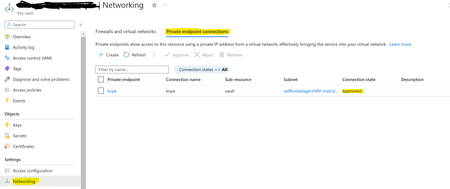
Azure Key Vault is a cloud service that provides secure storage and access to secrets such as API keys, passwords, certificates, or cryptographic keys. To enhance security and disable public access, Azure Key Vault can be integrated with Private Endpoint powered by Azure Private Link. This private endpoint uses a private IP address from your VNet and brings the service into your VNet, effectively eliminating exposure from the public Internet by traversing traffic between your virtual network and the service over the Microsoft backbone network.Active Directory Certificate Services with Azure Key Vault Virtual HSM
Hi all (an I hope also Microsoft folk in the security and AD CS arenas), With Azure adoption etc and the GA a while ago of Azure Key Vault virtual HSM it seems to me that it would make a significant enhancement of AD CS security to use Azure Key Vault virtual HSM to host the AD CS server certificate keys. Most third party (virtual) HSMs come with instructions, agents, custom key service providers etc to enable the external hosting and access from the windows host to the certificate key. I can only find (quite old) information for SQL which adds a custom KSP to SQL seemingly rather than to the OS. Has anyone else had a go at or implemented this yet?4.8KViews0likes3Comments