azure event hubs
77 Topics
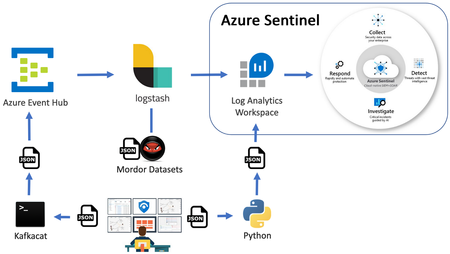
Azure Sentinel To-Go (Part1): A Lab w/ Prerecorded Data 😈 & a Custom Logs Pipe via ARM Templates 🚀
In this post, I show you how to use ARM templates to deploy an Azure Sentinel solution and ingest pre-recorded datasets via a python script, Azure Event Hubs and a Logstash pipeline.69KViews20likes25CommentsJSON Structure: A JSON schema language you'll love
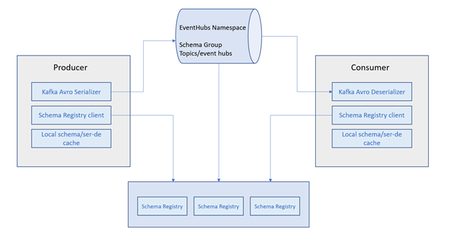
We talk to many customers moving structured data through queues and event streams and topics, and we see a strong desire to create more efficient and less brittle communication paths governed by rich data definitions well understood by all parties. The way those definitions are often shared are schema documents. While there is great need, the available schema options and related tool chains are often not great. JSON Schema is popular for its relative simplicity in trivial cases, but quickly becomes unmanageable as users employ more complex constructs. The industry has largely settled on "Draft 7," with subsequent releases seeing weak adoption. There's substantial frustration among developers who try to use JSON Schema for code generation or database mapping—scenarios it was never designed for. JSON Schema is a powerful document validation tool, but it is not a data definition language. We believe it's effectively un-toolable for anything beyond pure validation; practically all available code-generation tools agree by failing at various degrees of complexity. Avro and Protobuf schemas are better for code generation, but tightly coupled to their respective serialization frameworks. For our own work in Microsoft Fabric, we're initially leaning on an Avro-compatible schema with a small set of modifications, but we ultimately need a richer type definition language that ideally builds on people's familiarity with JSON Schema. This isn't just a Microsoft problem. It's an industry-wide gap. That's why we've submitted JSON Structure as a set of Internet Drafts to the IETF, aiming for formal standardization as an RFC. We want a vendor-neutral, standards-track schema language that the entire industry can adopt. What Is JSON Structure? JSON Structure is a modern, strictly typed data definition language that describes JSON-encoded data such that mapping to and from programming languages and databases becomes straightforward. It looks familiar—if you've written "type": "object", "properties": {...} before, you'll feel right at home. But there's a key difference: JSON Structure is designed for code generation and data interchange first, with validation as an optional layer rather than the core concern. This means you get: Precise numeric types: int32 , int64 , decimal with precision and scale, float , double Rich date/time support: date , time , datetime , duration —all with clear semantics Extended compound types: Beyond objects and arrays, you get set , map , tuple , and choice (discriminated unions) Namespaces and modular imports: Organize your schemas like code Currency and unit annotations: Mark a decimal as USD or a double as kilograms Here's a compact example that showcases these features. We start with the schema header and the object definition: { "$schema": "https://json-structure.org/meta/extended/v0/#", "$id": "https://example.com/schemas/OrderEvent.json", "name": "OrderEvent", "type": "object", "properties": { Objects require a name for clean code generation. The $schema points to the JSON Structure meta-schema, and the $id provides a unique identifier for the schema itself. Now let's define the first few properties—identifiers and a timestamp: "orderId": { "type": "uuid" }, "customerId": { "type": "uuid" }, "timestamp": { "type": "datetime" }, The native uuid type maps directly to Guid in .NET, UUID in Java, and uuid in Python. The datetime type uses RFC3339 encoding and becomes DateTimeOffset in .NET, datetime in Python, or Date in JavaScript. No format strings, no guessing. Next comes the order status, modeled as a discriminated union: "status": { "type": "choice", "choices": { "pending": { "type": "null" }, "shipped": { "type": "object", "name": "ShippedInfo", "properties": { "carrier": { "type": "string" }, "trackingId": { "type": "string" } } }, "delivered": { "type": "object", "name": "DeliveredInfo", "properties": { "signedBy": { "type": "string" } } } } }, The choice type is a discriminated union with typed payloads per case. Each variant can carry its own structured data— shipped includes carrier and tracking information, delivered captures who signed for the package, and pending carries no payload at all. This maps to enums with associated values in Swift, sealed classes in Kotlin, or tagged unions in Rust. For monetary values, we use precise decimals: "total": { "type": "decimal", "precision": 12, "scale": 2 }, "currency": { "type": "string", "maxLength": 3 }, The decimal type with explicit precision and scale ensures exact monetary math—no floating-point surprises. A precision of 12 with scale 2 gives you up to 10 digits before the decimal point and exactly 2 after. Line items use an array of tuples for compact, positional data: "items": { "type": "array", "items": { "type": "tuple", "properties": { "sku": { "type": "string" }, "quantity": { "type": "int32" }, "unitPrice": { "type": "decimal", "precision": 10, "scale": 2 } }, "tuple": ["sku", "quantity", "unitPrice"], "required": ["sku", "quantity", "unitPrice"] } }, Tuples are fixed-length typed sequences—ideal for time-series data or line items where position matters. The tuple array specifies the exact order: SKU at position 0, quantity at 1, unit price at 2. The int32 type maps to int in all mainstream languages. Finally, we add extensible metadata using set and map types: "tags": { "type": "set", "items": { "type": "string" } }, "metadata": { "type": "map", "values": { "type": "string" } } }, "required": ["orderId", "customerId", "timestamp", "status", "total", "currency", "items"] } The set type represents unordered, unique elements—perfect for tags. The map type provides string keys with typed values, ideal for extensible key-value metadata without polluting the main schema. Here's what a valid instance of this schema looks like: { "orderId": "f47ac10b-58cc-4372-a567-0e02b2c3d479", "customerId": "7c9e6679-7425-40de-944b-e07fc1f90ae7", "timestamp": "2025-01-15T14:30:00Z", "status": { "shipped": { "carrier": "Litware", "trackingId": "794644790323" } }, "total": "129.97", "currency": "USD", "items": [ ["SKU-1234", 2, "49.99"], ["SKU-5678", 1, "29.99"] ], "tags": ["priority", "gift-wrap"], "metadata": { "source": "web", "campaign": "summer-sale" } } Notice how the choice is encoded as an object with a single key indicating the active case— {"shipped": {...}} —making it easy to parse and route. Tuples serialize as JSON arrays in the declared order. Decimals are encoded as strings to preserve precision across all platforms. Why Does This Matter for Messaging? When you're pushing events through Service Bus, Event Hubs, or Event Grid, schema clarity is everything. Your producers and consumers often live in different codebases, different languages, different teams. A schema that generates clean C# classes, clean Python dataclasses, and clean TypeScript interfaces—from the same source—is not a luxury. It's a requirement. JSON Structure's type system was designed with this polyglot reality in mind. The extended primitive types map directly to what languages actually have. A datetime is a DateTimeOffset in .NET, a datetime in Python, a Date in JavaScript. No more guessing whether that "string with format date-time" will parse correctly on the other side. SDKs Available Now We've built SDKs for the languages you're using today: TypeScript, Python, .NET, Java, Go, Rust, Ruby, Perl, PHP, Swift, and C. All SDKs validate both schemas and instances against schemas. A VS Code extension provides IntelliSense and inline diagnostics. Code and Schema Generation with Structurize Beyond validation, you often need to generate code or database schemas from your type definitions. The Structurize tool converts JSON Structure schemas into SQL DDL for various database dialects, as well as self-serializing classes for multiple programming languages. It can also convert between JSON Structure and other schema formats like Avro, Protobuf, and JSON Schema. Here's a simple example: a postal address schema on the left, and the SQL Server table definition generated by running structurize struct2sql postaladdress.json --dialect sqlserver on the right: JSON Structure Schema Generated SQL Server DDL { "$schema": "https://json-structure.org/meta/extended/v0/#", "$id": "https://example.com/schemas/PostalAddress.json", "name": "PostalAddress", "description": "A postal address for shipping or billing", "type": "object", "properties": { "id": { "type": "uuid", "description": "Unique identifier for the address" }, "street": { "type": "string", "description": "Street address with house number" }, "city": { "type": "string", "description": "City or municipality" }, "state": { "type": "string", "description": "State, province, or region" }, "postalCode": { "type": "string", "description": "ZIP or postal code" }, "country": { "type": "string", "description": "ISO 3166-1 alpha-2 country code" }, "createdAt": { "type": "datetime", "description": "When the address was created" } }, "required": ["id", "street", "city", "postalCode", "country"] } CREATE TABLE [PostalAddress] ( [id] UNIQUEIDENTIFIER, [street] NVARCHAR(200), [city] NVARCHAR(100), [state] NVARCHAR(50), [postalCode] NVARCHAR(20), [country] NVARCHAR(2), [createdAt] DATETIME2, PRIMARY KEY ([id], [street], [city], [postalCode], [country]) ); EXEC sp_addextendedproperty 'MS_Description', 'A postal address for shipping or billing', 'SCHEMA', 'dbo', 'TABLE', 'PostalAddress'; EXEC sp_addextendedproperty 'MS_Description', 'Unique identifier for the address', 'SCHEMA', 'dbo', 'TABLE', 'PostalAddress', 'COLUMN', 'id'; EXEC sp_addextendedproperty 'MS_Description', 'Street address with house number', 'SCHEMA', 'dbo', 'TABLE', 'PostalAddress', 'COLUMN', 'street'; -- ... additional column descriptions The uuid type maps to UNIQUEIDENTIFIER , datetime becomes DATETIME2 , and the schema's description fields are preserved as SQL Server extended properties. The tool supports PostgreSQL, MySQL, SQLite, and other dialects as well. Mind that all this code is provided "as-is" and is in a "draft" state just like the specification set. Feel encouraged to provide feedback and ideas in the GitHub repos for the specifications and SDKs at https://github.com/json-structure/ Learn More We've submitted JSON Structure as a set of Internet Drafts to the IETF, aiming for formal standardization as an RFC. This is an industry-wide issue, and we believe the solution needs to be a vendor-neutral standard. You can track the drafts at the IETF Datatracker. Main site: json-structure.org Primer: JSON Structure Primer Core specification: JSON Structure Core Extensions: Import | Validation | Alternate Names | Units | Composition IETF Drafts: IETF Datatracker GitHub: github.com/json-structure7.7KViews8likes1CommentStream data in real time from Azure Database for MySQL - Flexible Server to Power BI
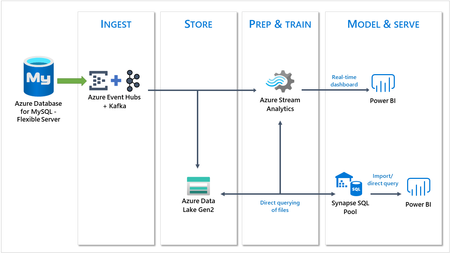
Debezium, Kafka Connect, Azure Event Hubs, Azure Data Lake Storage, Azure Stream Analytics, Synapse SQL Serverless, and Power BI can work together to create a comprehensive data pipeline that captures data changes from relational databases, stores them in Azure Data Lake Storage, performs real-time analytics on the data stream using Azure Stream Analytics, and provides insights through Power BI.10KViews5likes0CommentsAzure Event Hubs update – Q4 2022
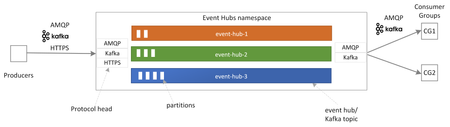
Azure Event Hubs enables you to stream millions of events per second from any source using Kafka, AMQP or HTTPS protocols and build end-to-end event streaming pipelines. We are excited to announce the availability of several new features and major enhancements in Azure Event Hubs, which will be available in Q4 of calendar year 2022.10KViews5likes2CommentsAnnouncing self-serve experience for Azure Event Hubs Clusters
For businesses today, data is indispensable. Innovative ideas in manufacturing, health care, transportation, and financial industries are often the result of capturing and correlating data from multiple sources. Now more than ever, the ability to reliably ingest and respond to large volumes of data in real time is the key to gaining competitive advantage for consumer and commercial businesses alike. To meet these big data challenges, Azure Event Hubs offers a fully managed and massively scalable distributed streaming platform designed for a plethora of use cases from telemetry processing to fraud detection. Event Hubs has been immensely popular with Azure’s largest customers and now even more so with the recent release of Event Hubs for Apache Kafka. With this powerful new capability, customers can stream events from Kafka applications seamlessly into Event Hubs without having to run Zookeeper or manage Kafka clusters, all while benefitting from a fully managed platform-as-a-service (PaaS) with features like auto-inflate and geo-disaster recover. As the front door to Azure’s data pipeline, customers can also automatically Capture streaming events into Azure Storage or Azure Data Lake, or natively perform real-time analysis on data streams using Azure Stream Analytics. For customers with the most demanding streaming needs, Event Hubs clusters in our Dedicated tier provide a single-tenant offering that guarantees the capacity to ingest millions of events per second while boasting a 99.99% SLA. Clusters are used by the Xbox One Halo team, as well as powers both Microsoft Teams and Microsoft Office client application telemetry pipelines. Azure portal experience for Event Hubs clusters Today, we are excited to announce that Azure Event Hubs clusters can be easily created through the Azure portal or through Azure Resource Manager as a self-serve experience (preview), and is instantly available with no further setup. Within your cluster, you can subsequently create and manage namespaces and event hubs per usual and ingest events with no throttling. Creating a cluster to contain your event hubs offers the following benefits: Single tenant hosting for better performance with guaranteed capacity at full scale, enabling ingress of gigabytes of streaming data at millions of events per second while maintaining fully durable storage and sub-second latency. Capture feature included at no additional cost, which allows you to effortlessly batch and deliver your events to Azure Storage or Azure Data Lake. Significant savings on your Event Hubs cloud costs with fixed hourly billing while scaling your infrastructure with Dedicated Event Hubs. No maintenance since we take care of load balancing, security patching, and OS updates. You can spend less time on infrastructure maintenance and more time building client-side features. Exclusive access to upcoming features like bring your own key (BYOK). In the self-serve experience (preview), you can create 1 CU clusters in the following strategic regions through the Azure portal: North Europe West Europe US Central East US East US 2 West US West US 2 North US South Central US South East Asia UK South Larger clusters of up to 20 CUs or clusters in regions not listed above will also be available upon direct request to the Event Hubs team. Data is key to staying competitive in this fast moving world and Azure Event Hubs can help your organization gain the competitive edge. With so many possibilities, it’s time to get started. Learn more about Event Hubs clusters in our Dedicated offering. Get started with an Event Hubs cluster on the Azure portal. Quickstart: Data streaming with Event Hubs using the Kafka protocol4.1KViews4likes0CommentsAzure Event Hubs Dedicated Self-Serve Scalable Clusters GA for Mission-Critical Streaming Workloads
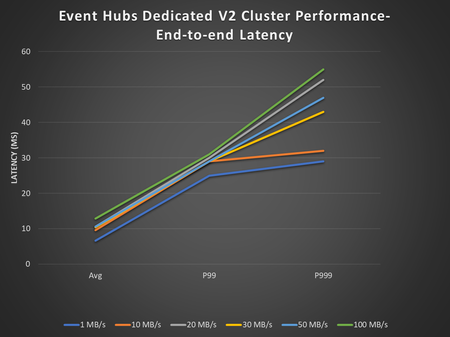
Today, we are announcing the general availability of Azure Event Dedicated Self-Serve clusters which are designed for mission-critical Kafka and AMQP workloads that require low-latency and high-volume data streaming with dynamic scaling.8.7KViews4likes0CommentsGeo-Replication is Here! Now generally available for Event Hubs Premium & Dedicated
Today, we are thrilled to announce the General Availability of the Geo-replication feature for Azure Event Hubs, now available in both Premium and Dedicated tiers. This milestone marks a significant enhancement in our service, providing our customers with robust business continuity and disaster recovery capabilities – ensuring high availability for their mission-critical applications. The Geo-replication feature allows you to replicate your Event Hubs data across multiple regions either synchronously or asynchronously, ensuring that your data remains accessible in the event of maintenance activities, regional degradation, or a regional outage. With Geo-replication, you can seamlessly promote a secondary region to a primary, minimizing downtime and ensuring business continuity. Before failover (promotion of secondary to primary) After failover (promotion of secondary to primary) With general availability, we are excited to announce that the Geo-replication feature now supports all the features that are generally available in the service today. This includes private networking, customer-managed key encryption, Event Hubs Capture, and many more. These enhancements ensure that you can leverage the full capabilities of Event Hubs while benefiting from the added reliability of Geo-replication. We have also increased visibility into the health and metrics of your replicas. This means you can now monitor the status of your replicas more effectively and know exactly when it is appropriate to promote your secondary to primary. This added visibility ensures that you can make informed decisions and maintain the high availability of your applications. Since the announcement of public preview, we’ve had several customers try out the Geo-replication feature and appreciate the enhanced reliability and peace of mind that comes with having a robust disaster recovery solution in place. Learn more Learn more about geo-replication concepts and the pricing model and try out this quickstart to learn how to setup geo-replication for your premium and dedicated tier namespaces. We encourage our customers to try out the Geo-replication feature and experience the benefits of turnkey business continuity and disaster recovery features firsthand. Your feedback is invaluable to us, and we look forward to hearing about your experiences.1.1KViews3likes0CommentsAnnouncing the Event Hubs Data Explorer: a handy tool for getting started and debugging
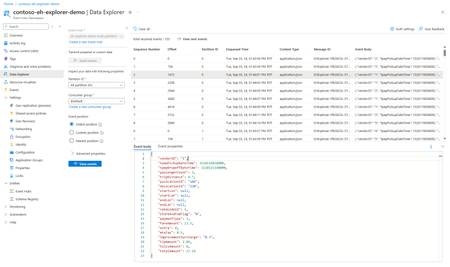
Transform your event-driven architectures with the new Event Hubs Data Explorer! Whether you're debugging, optimizing, or just getting started, this tool offers a unified interface for producing and consuming event data, providing invaluable insights. Explore the endless possibilities with Event Hubs Data Explorer!3KViews3likes3Comments