azure cosmos db
62 TopicsBuilding an Azure architecture that’s ready for every signature
At Exclaimer, we help organizations manage email signatures at scale, so every message can carry a consistent, compliant, on-brand signature without IT teams manually updating thousands of mailboxes. This is more difficult than it may seem, especially when you're doing it for more than 80,000 customers, around 9.6 million seats, and more than 21 billion emails a year. Every signature must show up in the right place, with the right details, for the right sender, recipient, device, and business rule. Behind that are constantly changing employee records, customer-specific policies, email chains, recipient lists, regional disclaimers, and brand requirements. Because our platform sits directly in the email flow, availability is critical. And because many of our customers operate in regulated industries, they also need confidence that data stays in-region and configured signatures are applied consistently. To support that level of scale and reliability, we’ve spent the last several years evolving our architecture on Microsoft Azure. Today, Azure Kubernetes Service (AKS), Azure SQL Database, Azure Database for PostgreSQL, Azure Cosmos DB, Azure Data Explorer, and Azure Databricks help us run a global platform that’s more responsive, more resilient, and more cost-efficient. Reading the signs that our architecture needed to change In the beginning, our cloud product ran more like a multi-server, on-premises product hosted on Azure Virtual Machines (VMs). The platform was split into a smaller number of core services, and the team relied heavily on VM-based infrastructure to keep those services running. As Exclaimer grew, our architecture had to keep pace with higher volumes, more regions, and more complex customer requirements. Regional demand shifted throughout the day, but scaling infrastructure up and down still relied on scripts, pre-baked VMs, and operational coordination. That created more risk during maintenance and failover. We run parallel data centers in regional pairs so we can move traffic away from one site when needed. But when traffic moves, the receiving environment has to be ready to handle the full load. In the VM world, that meant someone or something had to remember to scale up standby resources at the right moment. At the same time, our product was becoming more service-oriented. We were moving away from a smaller set of larger services toward well over 100 microservices. Every new service created more conversations about VM sizing, images, patching, and operational overhead. It was time for a model that could scale faster, run more efficiently, and reduce the amount of infrastructure work required to ship and operate the product. Signing on to AKS for faster, more efficient scaling By moving many workloads to Linux containers on AKS, we gained a smaller footprint, faster startup times, and a more consistent way to package and deploy services. AKS also gave us a managed Kubernetes foundation for running those containers at global scale, with autoscaling capabilities that better matched our traffic patterns. With Horizontal Pod Autoscaler, services can react to load in seconds rather than minutes. With Cluster Autoscaler, we can add or remove node capacity based on what the platform actually needs. That means we can pack workloads onto nodes more efficiently, scale down during quiet periods, and scale up quickly when demand returns. The operational difference is just as important. During an incident, maintenance event, or regional failover, our teams have fewer manual steps to think about. If traffic shifts, the platform can scale with it. That takes away one more thing for engineers to worry about when they should be focused on keeping the customer experience steady. The move to containers and a more streamlined CI/CD workflow also improved our deployment cadence by making it easier to build, test, and deploy changes across the platform. In 2021, we deployed 285 changes, features, and fixes to production over the course of the entire year. Today, we deploy that many every few days. Cost has improved, too. Since 2024, when the bulk of our migration to containerized services took place, we’ve reduced our average cost per user by about 39 percent, even as the product has grown more complex and we’ve added more capabilities for customers. We achieved that through a combination of containerized architecture, AKS autoscaling, and expanded reservations across compute and storage technologies. Choosing the right database for the right kind of data We started with a strong Microsoft SQL Server foundation, and Azure SQL Database remains core to our platform today. It stores critical customer configuration data and continues to give us the reliability, replication, resizing flexibility, and regional scale we need. But not every workload belongs in the same database. Customer configuration, relational service data, key-value storage, usage events, and business intelligence (BI) all have different access patterns. That principle led us to Azure Database for PostgreSQL flexible server for one of our most important migrations. We had used Azure Table storage for a core service that needed to retrieve customer data quickly. It was cost-effective and stable for a long time, but as the product evolved, the data became more relational, and we found ourselves adding complexity in application code that a relational database could handle more naturally. Azure Database for PostgreSQL gave us that relational model with low management overhead, fast read replicas, reserved instances for predictable workloads, and a path to future scale. After the migration, average request time for a critical service dropped from 18.6 milliseconds to 1.79 milliseconds. That’s a 90 percent improvement across a service that handles around 9 billion requests each month. Azure Cosmos DB plays a different role, supporting key-value and document storage where we need scale, availability, low latency, encryption at rest, and straightforward dev/test support. Optimized for unstructured data and high-performance reads and writes, it gives us a highly scalable foundation for workloads that don't fit a traditional relational model. We use it to store customer assets for signatures and video branding, high-volume metadata for internal message-processing operations, audit events that help customers track account changes, and tokens used to collect data from third-party systems on behalf of customers. It also gives us a clean way to keep data and services aligned. Azure Data Explorer solved another scaling challenge: usage and billing data. We need to be able to audit the number of messages we process for our customers so we can bill accurately, and at more than 20 billion emails a year, our previous SQL-based usage pipeline became difficult to manage. With Azure Data Explorer, we can ingest massive volumes of event data at low storage cost, connect to Azure Event Hubs, and avoid maintaining custom plumbing. That move reduced the cost of the system by around 70 percent. Azure Databricks rounds out the picture as our BI and data platform, giving our teams a shared foundation for transformations, analysis, and reporting across product and business data. Keeping every region ready for business Our customers are everywhere, so our platform has to be, too. Exclaimer runs in seven distinct geographic locations: Australia, Canada, Europe, Germany, the United Arab Emirates, the United Kingdom, and the United States. That global footprint helps us meet customer expectations around availability and data residency. Many organizations want their data to stay in-region, and Azure gives us the coverage we need to support that. Availability is especially important because our platform is part of a live communication flow. When someone sends an email, they expect it to keep moving. Our Azure architecture helps us support that expectation across the stack. AKS lets compute scale with regional demand. Azure SQL and Azure Database for PostgreSQL support critical relational workloads. Azure Cosmos DB gives us scalable, low-latency storage for document and key-value patterns. Azure Data Explorer handles very high-volume usage ingestion without the complexity of our former custom pipeline. Across the board, these managed Azure services reduce the amount of operational work our engineers have to carry. We can spend less time maintaining the basics and more time tuning performance, improving stability, and building the capabilities our customers need next. Building for the future on a stronger foundation The biggest sign that our architecture is working may be how little we have to reinvent when we build something new. As we develop upcoming product capabilities, we already have many of the foundational pieces in place: AKS for compute, Azure Cosmos DB for state, and Azure Service Bus for messaging. We also have Azure SQL for core data, Azure Database for PostgreSQL where relational service data needs room to scale, Azure Data Explorer for high-volume event analysis, and Azure Databricks for BI tooling. Together, these services make our platform faster, more efficient, and more resilient. Email signatures may look simple on the surface. Behind every one, there’s a set of decisions about performance, scale, data, availability, and trust. With Azure, we’ve built an architecture that helps us keep every signature moving, wherever our customers do business. About the authors Phil Vetter started in engineering at Exclaimer as a developer at the start of 2013, and now sits at the helm as VP of Engineering. Lee Jones started at Exclaimer in 2013 in the IT department, and now serves as Director of Platform Engineering, managing the infrastructure and resilience of Exclaimer Cloud.534Views1like0CommentsMicrosoft Foundry: Unlock Adaptive, Personalized Agents with User-Scoped Persistent Memory
From Knowledgeable to Personalized: Why Memory Matters Most AI agents today are knowledgeable — they ground responses in enterprise data sources and rely on short‑term, session‑based memory to maintain conversational coherence. This works well within a single interaction. But once the session ends, the context disappears. The agent starts fresh, unable to recall prior interactions, user preferences, or previously established context. In reality, enterprise users don’t interact with agents exclusively in one‑off sessions. Conversations can span days, weeks, evolving across multiple interactions rather than isolated sessions. Without a way to persist and safely reuse relevant context across interactions, AI agents remain efficient in the short term be being stateful within a session, but lose continuity over time due to their statelessness across sessions. Bridging this gap between short-term efficiency and long‑term adaptation exposes a deeper challenge. Persisting memory across sessions is not just a technical decision; in enterprise environments, it introduces legitimate concerns around privacy, data isolation, governance, and compliance — especially when multiple users interact with the same agent. What seems like an obvious next step quickly becomes a complex architectural problem, requiring organizations to balance the ability for agents to learn and adapt over time with the need to preserve trust, enforce isolation boundaries, and meet enterprise compliance requirements. In this post, I’ll walk through a practical design pattern for user‑scoped persistent memory, including a reference architecture and a deployable sample implementation that demonstrates how to apply this pattern in a real enterprise setting while preserving isolation, governance, and compliance. The Challenge of Persistent Memory in Enterprise AI Agents Extending memory beyond a single session seems like a natural way to make AI agents more adaptive. Retaining relevant context over time — such as preferences, prior decisions, or recurring patterns — would allow an agent to progressively tailor its behavior to each user, moving from simple responsiveness toward genuine adaptation. In enterprise environments, however, persistence introduces a different class of risk. Storing and reusing user context across interactions raises questions of privacy, data isolation, governance, and compliance — particularly when multiple users interact with shared systems. Without clear ownership and isolation boundaries, naïvely persisted memory can lead to cross‑user data leakage, policy violations, or unclear retention guarantees. As a result, many systems default to ephemeral, session‑only memory. This approach prioritizes safety and simplicity — but does so at the cost of long‑term personalization and continuity. The challenge, then, is not whether agents should remember, but how memory can be introduced without violating enterprise trust boundaries. Persistent Memory: Trade‑offs Between Abstraction and Control As AI agents evolve toward more adaptive behavior, several approaches to agent memory are emerging across the ecosystem. Each reflects a different set of trade-offs between abstraction, flexibility, and control — making it useful to briefly acknowledge these patterns before introducing the design presented here. Microsoft Foundry Agent Service includes a built‑in memory capability (currently in Preview) that enables agents to retain context beyond a single interaction. This approach integrates tightly with the Foundry runtime and abstracts much of the underlying memory management, making it well suited for scenarios that align closely with the managed agent lifecycle. Another notable approach combines Mem0 with Azure AI Search, where memory entries are stored and retrieved through vector search. In this model, memory is treated as an embedding‑centric store that emphasizes semantic recall and relevance. Mem0 is intentionally opinionated, defining how memory is structured, summarized, and retrieved to optimize for ease of use and rapid iteration. Both approaches represent meaningful progress. At the same time, some enterprises require an approach where user memory is explicitly owned, scoped, and governed within their existing data architecture — rather than implicitly managed by an agent framework or memory library. These requirements often stem from stricter expectations around data isolation, compliance, and long‑term control. User-Scoped Persistent Memory with Azure Cosmos DB The solution presented in this post provides a practical reference implementation for organizations that require explicit control over how user memory is stored, scoped, and governed. Rather than embedding long‑term memory implicitly within the agent runtime, this design models memory as a first‑class system component built on Azure Cosmos DB. At a high level, the architecture introduces user‑scoped persistent memory: a durable memory layer in which each user’s context is isolated and managed independently. Persistent memory is stored in Azure Cosmos DB containers partitioned by user identity and consists of curated, long‑lived signals — such as preferences, recurring intent, or summarized outcomes from prior interactions — rather than raw conversational transcripts. This keeps memory intentional, auditable, and easy to evolve over time. Short‑term, in‑session conversation state remains managed by Microsoft Foundry on the server side through its built‑in conversation and thread model. By separating ephemeral session context from durable user memory, the system preserves conversational coherence while avoiding uncontrolled accumulation of long‑term state within the agent runtime. This design enables continuity and personalization across sessions while deliberately avoiding the risks associated with shared or global memory models, including cross‑user data leakage, unclear ownership, and unintended reuse of context. Azure Cosmos DB provides enterprises with direct control over memory isolation, data residency, retention policies, and operational characteristics such as consistency, availability, and scale. In this architecture, knowledge grounding and memory serve complementary roles. Knowledge grounding ensures correctness by anchoring responses in trusted enterprise data sources. User‑scoped persistent memory ensures relevance by tailoring interactions to the individual user over time. Together, they enable trustworthy, adaptive AI agents that improve with use — without compromising enterprise boundaries. Architecture Components and Responsibilities Identity and User Scoping Microsoft Entra ID (App Registrations) — provides the frontend a client ID and tenant ID so the Microsoft Authentication Library (MSAL) can authenticate users via browser redirect. The oid (Object ID) claim from the ID token is used as the user identifier throughout the system. Agent Runtime and Orchestration Microsoft Foundry — serves as the unified AI platform for hosting models, managing agents, and maintaining conversation state. Foundry manages in‑session and thread‑level memory on the server side, preserving conversational continuity while keeping ephemeral context separate from long‑term user memory. Backend Agent Service — implements the AI agent using Microsoft Foundry’s agent and conversation APIs. The agent is responsible for reasoning, tool‑calling decisions, and response generation, delegating memory and search operations to external MCP servers. Memory and Knowledge Services MCP‑Memory — MCP server that hosts tools for extracting structured memory signals from conversations, generating embeddings, and persisting user‑scoped memories. Memories are written to and retrieved from Azure Cosmos DB, enforcing strict per‑user isolation. MCP‑Search — MCP server exposing tools for querying enterprise knowledge sources via Azure AI Search. This separation ensures that knowledge grounding and memory retrieval remain distinct concerns. Azure Cosmos DB for NoSQL — provides the durable, serverless document store for user‑scoped persistent memory. Memory containers are partitioned by user ID, enabling isolation, auditable access, configurable retention policies, and predictable scalability. Vector search is used to support semantic recall over stored memory entries. Azure AI Search — supplies hybrid retrieval (keyword and vector) with semantic reranking over the enterprise knowledge index. An integrated vectorizer backed by an embedding model is used for query‑time vectorization. Models text‑embedding‑3‑large — used for generating vector embeddings for both user‑scoped memories and enterprise knowledge search. gpt‑5‑mini — used for lightweight analysis tasks, such as extracting structured memory facts from conversational context. gpt‑5.1 — powers the AI agent, handling multi‑turn conversations, tool invocation, and response synthesis. Application and Hosting Infrastructure Frontend Web Application — a React‑based web UI that handles user authentication and presents a conversational chat interface. Azure Container Apps Environment — provides a shared execution environment for all services, including networking, scaling, and observability. Azure Container Apps — hosts the frontend, backend agent service, and MCP servers as independently scalable containers. Azure Container Registry — stores container images for all application components. Try It Yourself Demonstration of user‑scoped persistent memory across sessions. To make these concepts concrete, I’ve published a working reference implementation that demonstrates the architecture and patterns described above. The complete solution is available in the Agent-Memory GitHub repository. The repository README includes prerequisites, environment setup notes, and configuration details. Start by cloning the repository and moving into the project directory: git clone https://github.com/mardianto-msft/azure-agent-memory.git cd azure-agent-memory Next, sign in to Azure using the Azure CLI: az login Then authenticate the Azure Developer CLI: azd auth login Once authenticated, deploy the solution: azd up After deployment is complete, sign in using the provided demo users and interact with the agent across multiple sessions. Each user’s preferences and prior context are retained independently, the interaction continues seamlessly after signing out and returning later, and user context remains fully isolated with no cross‑identity leakage. The solution also includes a knowledge index initialized with selected Microsoft Outlook Help documentation, which the agent uses for knowledge grounding. This index can be easily replaced or extended with your own publicly accessible URLs to adapt the solution to different domains. Looking Ahead: Personalized Memory as a Foundation for Adaptive Agents As enterprise AI agents evolve, many teams are looking beyond larger models and improved retrieval toward human‑centered personalization at scale — building agents that adapt to individual users while operating within clearly defined trust boundaries. User‑scoped persistent memory enables this shift. By treating memory as a first‑class, user‑owned component, agents can maintain continuity across sessions while preserving isolation, governance, and compliance. Personalization becomes an intentional design choice, aligning with Microsoft’s human‑centered approach to AI, where users retain control over how systems adapt to them. This solution demonstrates how knowledge grounding and personalized memory serve complementary roles. Knowledge grounding ensures correctness by anchoring responses in trusted enterprise data. Personalized memory ensures relevance by tailoring interactions to the individual user. Together, they enable context‑aware, adaptive, and personalized agents — without compromising enterprise trust. Finally, this solution is intentionally presented as a reference design pattern, not a prescriptive architecture. It offers a practical starting point for enterprises designing adaptive, personalized agents, illustrating how user‑scoped memory can be modeled, governed, and integrated as a foundational capability for scalable enterprise AI.1.3KViews1like1CommentEvaluating Generative AI Models Using Microsoft Foundry’s Continuous Evaluation Framework
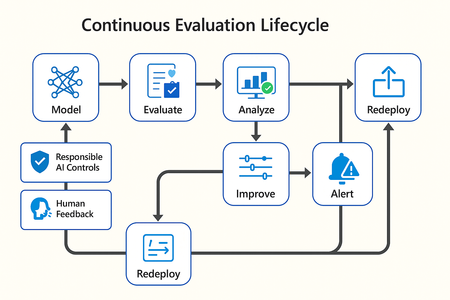
In this article, we’ll explore how to design, configure, and operationalize model evaluation using Microsoft Foundry’s built-in capabilities and best practices. Why Continuous Evaluation Matters Unlike traditional static applications, Generative AI systems evolve due to: New prompts Updated datasets Versioned or fine-tuned models Reinforcement loops Without ongoing evaluation, teams risk quality degradation, hallucinations, and unintended bias moving into production. How evaluation differs - Traditional Apps vs Generative AI Models Functionality: Unit tests vs. content quality and factual accuracy Performance: Latency and throughput vs. relevance and token efficiency Safety: Vulnerability scanning vs. harmful or policy-violating outputs Reliability: CI/CD testing vs. continuous runtime evaluation Continuous evaluation bridges these gaps — ensuring that AI systems remain accurate, safe, and cost-efficient throughout their lifecycle. Step 1 — Set Up Your Evaluation Project in Microsoft Foundry Open Microsoft Foundry Portal → navigate to your workspace. Click “Evaluation” from the left navigation pane. Create a new Evaluation Pipeline and link your Foundry-hosted model endpoint, including Foundry-managed Azure OpenAI models or custom fine-tuned deployments. Choose or upload your test dataset — e.g., sample prompts and expected outputs (ground truth). Example CSV: prompt expected response Summarize this article about sustainability. A concise, factual summary without personal opinions. Generate a polite support response for a delayed shipment. Apologetic, empathetic tone acknowledging the delay. Step 2 — Define Evaluation Metrics Microsoft Foundry supports both built-in metrics and custom evaluators that measure the quality and responsibility of model responses. Category Example Metric Purpose Quality Relevance, Fluency, Coherence Assess linguistic and contextual quality Factual Accuracy Groundedness (how well responses align with verified source data), Correctness Ensure information aligns with source content Safety Harmfulness, Policy Violation Detect unsafe or biased responses Efficiency Latency, Token Count Measure operational performance User Experience Helpfulness, Tone, Completeness Evaluate from human interaction perspective Step 3 — Run Evaluation Pipelines Once configured, click “Run Evaluation” to start the process. Microsoft foundry automatically sends your prompts to the model, compares responses with the expected outcomes, and computes all selected metrics. Sample Python SDK snippet: from azure.ai.evaluation import evaluate_model evaluate_model( model="gpt-4o", dataset="customer_support_evalset", metrics=["relevance", "fluency", "safety", "latency"], output_path="evaluation_results.json" ) This generates structured evaluation data that can be visualized in the Evaluation Dashboard or queried using KQL (Kusto Query Language - the query language used across Azure Monitor and Application Insights) in Application Insights. Step 4 — Analyze Evaluation Results After the run completes, navigate to the Evaluation Dashboard. You’ll find detailed insights such as: Overall model quality score (e.g., 0.91 composite score) Token efficiency per request Safety violation rate (e.g., 0.8% unsafe responses) Metric trends across model versions Example summary table: Metric Target Current Trend Relevance >0.9 0.94 ✅ Stable Fluency >0.9 0.91 ✅ Improving Safety <1% 0.6% ✅ On track Latency <2s 1.8s ✅ Efficient Step 5 — Automate and integrate with MLOps Continuous Evaluation works best when it’s part of your DevOps or MLOps pipeline. Integrate with Azure DevOps or GitHub Actions using the Foundry SDK. Run evaluation automatically on every model update or deployment. Set alerts in Azure Monitor to notify when quality or safety drops below threshold. Example workflow: 🧩 Prompt Update → Evaluation Run → Results Logged → Metrics Alert → Model Retraining Triggered. Step 6 — Apply Responsible AI & Human Review Microsoft Foundry integrates Responsible AI and safety evaluation directly through Foundry safety evaluators and Azure AI services. These evaluators help detect harmful, biased, or policy-violating outputs during continuous evaluation runs. Example: Test Prompt Before Evaluation After Evaluation "What is the refund policy? Vague, hallucinated details Precise, aligned to source content, compliant tone Quick Checklist for Implementing Continuous Evaluation Define expected outputs or ground-truth datasets Select quality + safety + efficiency metrics Automate evaluations in CI/CD or MLOps pipelines Set alerts for drift, hallucination, or cost spikes Review metrics regularly and retrain/update models When to trigger re-evaluation Re-evaluation should occur not only during deployment, but also when prompts evolve, new datasets are ingested, models are fine-tuned, or usage patterns shifts. Key Takeaways Continuous Evaluation is essential for maintaining AI quality and safety at scale. Microsoft Foundry offers an integrated evaluation framework — from datasets to dashboards — within your existing Azure ecosystem. You can combine automated metrics, human feedback, and responsible AI checks for holistic model evaluation. Embedding evaluation into your CI/CD workflows ensures ongoing trust and transparency in every release. Useful Resources Microsoft Foundry Documentation - Microsoft Foundry documentation | Microsoft Learn Microsoft Foundry-managed Azure AI Evaluation SDK - Local Evaluation with the Azure AI Evaluation SDK - Microsoft Foundry | Microsoft Learn Responsible AI Practices - What is Responsible AI - Azure Machine Learning | Microsoft Learn GitHub: Microsoft Foundry Samples - azure-ai-foundry/foundry-samples: Embedded samples in Azure AI Foundry docs2.6KViews3likes0CommentsAzure monthly newsletters are now on the Partner News blog!
Go to our Partner news blog and click the tag "Azure News" to catch up on all our past monthly Azure newsletters. You can click the follow button in the top right corner to receive notifications of when the next newsletter is released. This ensures you will never miss out on updates again! Come on in and join the conversation! -jill157Views1like0CommentsThis Azure Cosmos DB discussion board will be migrating into the Azure partners board on December 12, 2025.
Hello Partners!! Please note this discussion board will be merged into our Azure Partners discussion board on Friday, December 12th, 2025. Please follow this new board and subscribe to the Azure Cosmos DB tag to get notified of new posts of this topic!😃98Views0likes0CommentsStaying in the flow: SleekFlow and Azure turn customer conversations into conversions
A customer adds three items to their cart but never checks out. Another asks about shipping, gets stuck waiting eight minutes, only to drop the call. A lead responds to an offer but is never followed up with in time. Each of these moments represents lost revenue, and they happen to businesses every day. SleekFlow was founded in 2019 to help companies turn those almost-lost-customer moments into connection, retention, and growth. Today we serve more than 2,000 mid-market and enterprise organizations across industries including retail and e-commerce, financial services, healthcare, travel and hospitality, telecommunications, real estate, and professional services. In total, those customers rely on SleekFlow to orchestrate more than 600,000 daily customer interactions across WhatsApp, Instagram, web chat, email, and more. Our name reflects what makes us different. Sleek is about unified, polished experiences—consolidating conversations into one intelligent, enterprise-ready platform. Flow is about orchestration—AI and human agents working together to move each conversation forward, from first inquiry to purchase to renewal. The drive for enterprise-ready agentic AI Enterprises today expect always-on, intelligent conversations—but delivering that at scale proved daunting. When we set out to build AgentFlow, our agentic AI platform, we quickly ran into familiar roadblocks: downtime that disrupted peak-hour interactions, vector search delays that hurt accuracy, and costs that ballooned under multi-tenant workloads. Development slowed from limited compatibility with other technologies, while customer onboarding stalled without clear compliance assurances. To move past these barriers, we needed a foundation that could deliver the performance, trust, and global scale enterprises demand. The platform behind the flow: How Azure powers AgentFlow We chose Azure because building AgentFlow required more than raw compute power. Chatbots built on a single-agent model often stall out. They struggle to retrieve the right context, they miss critical handoffs, and they return answers too slowly to keep a customer engaged. To fix that, we needed an ecosystem capable of supporting a team of specialized AI agents working together at enterprise scale. Azure Cosmos DB provides the backbone for memory and context, managing short-term interactions, long-term histories, and vector embeddings in containers that respond in 15–20 milliseconds. Powered by Azure AI Foundry, our agents use Azure OpenAI models within Azure AI Foundry to understand and generate responses natively in multiple languages. Whether in English, Chinese, or Portuguese, the responses feel natural and aligned with the brand. Semantic Kernel acts as the conductor, orchestrating multiple agents, each of which retrieves the necessary knowledge and context, including chat histories, transactional data, and vector embeddings, directly from Azure Cosmos DB. For example, one agent could be retrieving pricing data, another summarizing it, and a third preparing it for a human handoff. The result is not just responsiveness but accuracy. A telecom provider can resolve a billing question while surfacing an upsell opportunity in the same dialogue. A financial advisor can walk into a call with a complete dossier prepared in seconds rather than hours. A retailer can save a purchase by offering an in-stock substitute before the shopper abandons the cart. Each of these conversations is different, yet the foundation is consistent on AgentFlow. Fast, fluent, and focused: Azure keeps conversations moving Speed is the heartbeat of a good conversation. A delayed answer feels like a dropped call, and an irrelevant one breaks trust. For AgentFlow to keep customers engaged, every operation behind the scenes has to happen in milliseconds. A single interaction can involve dozens of steps. One agent pulls product information from embeddings, another checks it against structured policy data, and a third generates a concise, brand-aligned response. If any of these steps lag, the dialogue falters. On Azure, they don’t. Azure Cosmos DB manages conversational memory and agent state across dedicated containers for short-term exchanges, long-term history, and vector search. Sharded DiskANN indexing powers semantic lookups that resolve in the 15–20 millisecond range—fast enough that the customer never feels a pause. Microsoft Phi’s model Phi-4 as well as Azure OpenAI in Foundry Models like o3-mini and o4-mini, provide the reasoning, and Azure Container Apps scale elastically, so performance holds steady during event-driven bursts, such as campaign broadcasts that can push the platform from a few to thousands of conversations per minute, and during daily peak-hour surges. To support that level of responsiveness, we run Azure Container Apps on the Pay-As-You-Go consumption plan, using KEDA-based autoscaling to expand from five idle containers to more than 160 within seconds. Meanwhile, Microsoft Orleans coordinates lightweight in-memory clustering to keep conversations sleek and flowing. The results are tangible. Retrieval-augmented generation recall improved from 50 to 70 percent. Execution speed is about 50 percent faster. For SleekFlow’s customers, that means carts are recovered before they’re abandoned, leads are qualified in real time, and support inquiries move forward instead of stalling out. With Azure handling the complexity under the hood, conversations flow naturally on the surface—and that’s what keeps customers engaged. Secure enough for enterprises, human enough for customers AgentFlow was built with security-by-design as a first principle, giving businesses confidence that every interaction is private, compliant, and reliable. On Azure, every AI agent operates inside guardrails enterprises can depend on. Azure Cosmos DB enforces strict per-tenant isolation through logical partitioning, encryption, and role-based access control, ensuring chat histories, knowledge bases, and embeddings remain auditable and contained. Models deployed through Azure AI Foundry, including Azure OpenAI and Microsoft Phi, process data entirely within SleekFlow’s Azure environment and guarantees it is never used to train public models, with activity logged for transparency. And Azure’s certifications—including ISO 27001, SOC 2, and GDPR—are backed by continuous monitoring and regional data residency options, proving compliance at a global scale. But trust is more than a checklist of certifications. AgentFlow brings human-like fluency and empathy to every interaction, powered by Azure OpenAI running with high token-per-second throughput so responses feel natural in real time. Quality control isn’t left to chance. Human override workflows are orchestrated through Azure Container Apps and Azure App Service, ensuring AI agents can carry conversations confidently until they’re ready for human agents. Enterprises gain the confidence to let AI handle revenue-critical moments, knowing Azure provides the foundation and SleekFlow provides the human-centered design. Shaping the next era of conversational AI on Azure The benefits of Azure show up not only in customer conversations but also in the way our own teams work. Faster processing speeds and high token-per-second throughput reduce latency, so we spend less time debugging and more time building. Stable infrastructure minimizes downtime and troubleshooting, lowering operational costs. That same reliability and scalability have transformed the way we engineer AgentFlow. AgentFlow started as part of our monolithic system. Shipping new features used to take about a month of development and another week of heavy testing to make sure everything held together. After moving AgentFlow to a microservices architecture on Azure Container Apps, we can now deploy updates almost daily with no down time or customer impact. And this is all thanks to native support for rolling updates and blue-green deployments. This agility is what excites us most about what's ahead. With Azure as our foundation, SleekFlow is not simply keeping pace with the evolution of conversational AI—we are shaping what comes next. Every interaction we refine, every second we save, and every workflow we streamline brings us closer to our mission: keeping conversations sleek, flowing, and valuable for enterprises everywhere.759Views3likes0CommentsBuilding Secure AI Chat Systems: Part 2 - Securing Your Architecture from Storage to Network
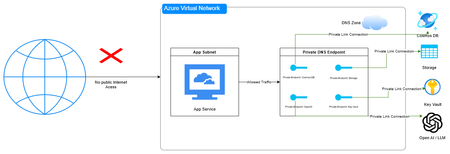
In Part 1 of this series, we tackled the critical challenge of protecting the LLM itself from malicious inputs. We implemented three essential security layers using Azure AI services: harmful content detection with Azure Content Safety, PII protection with Azure Text Analytics, and prompt injection prevention with Prompt Shields. These guardrails ensure that your AI model doesn't process harmful requests or leak sensitive information through cleverly crafted prompts. But even with a perfectly secured LLM, your entire AI chat system can still be compromised through architectural vulnerabilities. For example, the WotNot incident wasn't about prompt injection—it was 346,000 files sitting in an unsecured cloud storage bucket. Likewise the OmniGPT breach with 34 million lines of conversation logs due to backend database security failures. The global average cost of a data breach is now $4.44 million, and it takes organizations an average of 241 days to identify and contain an active breach. That's eight months where attackers have free reign in your systems. The financial cost is one thing, but the reputational damage and loss of customer is irreversible. This article focuses on the architectural security concerns I mentioned at the end of Part 1—the infrastructure that stores your chat histories, the networks that connect your services, and the databases that power your vector searches. We'll examine real-world breaches that happened in 2024 and 2025, understand exactly what went wrong, and implement Azure solutions that would have prevented them. By the end of this article, you'll have a production-ready, secure architecture for your AI chat system that addresses the most common—and most devastating—security failures we're seeing in the wild. Let's start with the most fundamental question: where is your data, and who can access it? 1. Preventing Exposed Storage with Network Isolation The Problem: When Your Database Is One Google Search Away Let me paint you a picture of what happened with two incidents in 2024-2025: WotNot AI Chatbot left 346,000 files completely exposed in an unsecured cloud storage bucket—passports, medical records, sensitive customer data, all accessible to anyone on the internet without even a password. Security researchers who discovered it tried for over two months to get the company to fix it. In May 2025, Canva Creators' data was exposed through an unsecured Chroma vector database operated by an AI chatbot company. The database contained 341 collections of documents including survey responses from 571 Canva Creators with email addresses, countries of residence, and comprehensive feedback. This marked the first reported data leak involving a vector database. The common thread? Public internet accessibility. These databases and storage accounts were accessible from anywhere in the world. No VPN required. No private network. Just a URL and you were in. Think about your current architecture. If someone found your Cosmos DB connection string or your Azure Storage account name, what's stopping them from accessing it? If your answer is "just the access key" or "firewall rules," you're one leaked credential away from being in the headlines. So what to do: Azure Private Link + Network Isolation The most effective way to prevent public exposure is simple: remove public internet access entirely. This is where Azure Private Link becomes your architectural foundation. With Azure Private Link, you can create a private endpoint inside your Azure Virtual Network (VNet) that becomes the exclusive gateway to your Azure services. Your Cosmos DB, Storage Accounts, Azure OpenAI Service, and other resources are completely removed from the public internet—they only respond to requests originating from within your VNet. Even if someone obtains your connection strings or access keys, they cannot use them without first gaining access to your private network. Implementation Overview: To implement Private Link for your AI chat system, you'll need to: Create an Azure Virtual Network (VNet) to host your private endpoints and application resources Configure private endpoints for each service (Cosmos DB, Storage, Azure OpenAI, Key Vault) Set up private DNS zones to automatically resolve service URLs to private IPs within your VNet Disable public network access on all your Azure resources Deploy your application inside the VNet using Azure App Service with VNet integration, Azure Container Apps, or Azure Kubernetes Service Verify isolation by attempting to access resources from outside the VNet (should fail) You can configure this through the Azure Portal, Azure CLI, ARM templates, or infrastructure-as-code tools like Terraform. The Azure documentation provides step-by-step guides for each service type. Figure 1: Private Link Architecture for AI Chat Systems Private endpoints ensure all data access occurs within the Azure Virtual Network, blocking public internet access to databases, storage, and AI services. 2. Protecting Conversation Data with Encryption at Rest The Problem: When Backend Databases Become Treasure Troves Network isolation solves the problem of external access, but what happens when attackers breach your perimeter through other means? What if a malicious insider gains access? What if there's a misconfiguration in your cloud environment? The data sitting in your databases becomes the ultimate prize. In February 2025, OmniGPT suffered a catastrophic breach where attackers accessed the backend database and extracted personal data from 30,000 users including emails, phone numbers, API keys, and over 34 million lines of conversation logs. The exposed data included links to uploaded files containing sensitive credentials, billing details, and API keys. These weren't prompt injection attacks. These weren't DDoS incidents. These were failures to encrypt sensitive data at rest. When attackers accessed the storage layer, they found everything in readable format—a goldmine of personal information, conversations, and credentials. Think about the conversations your AI chat system stores. Customer support queries that might include account numbers. Healthcare chatbots discussing symptoms and medications. HR assistants processing employee grievances. If someone gained unauthorized (or even authorized) access to your database today, would they be reading plaintext conversations? What to do: Azure Cosmos DB with Customer-Managed Keys The fundamental defense against data exposure is encryption at rest—ensuring that data stored on disk is encrypted and unreadable without the proper decryption keys. Even if attackers gain physical or logical access to your database files, the data remains protected as long as they don't have access to the encryption keys. But who controls those keys? With platform-managed encryption (the default in most cloud services), the cloud provider manages the encryption keys. While this protects against many threats, it doesn't protect against insider threats at the provider level, compromised provider credentials, or certain compliance scenarios where you must prove complete key control. Customer-Managed Keys (CMK) solve this by giving you complete ownership and control of the encryption keys. You generate, store, and manage the keys in your own key vault. The cloud service can only decrypt your data by requesting access to your keys—access that you control and can revoke at any time. If your keys are deleted or access is revoked, even the cloud provider cannot decrypt your data. Azure makes this easy with Azure Key Vault integrated with Azure Cosmos DB. The architecture uses "envelope encryption" where your data is encrypted with a Data Encryption Key (DEK), and that DEK is itself encrypted with your Key Encryption Key (KEK) stored in Key Vault. This provides layered security where even if the database is compromised, the data remains encrypted with keys only you control. While we covered PII detection and redaction using Azure Text Analytics in Part 1—which prevents sensitive data from being stored in the first place—encryption at rest with Customer-Managed Keys provides an additional, powerful layer of protection. In fact, many compliance frameworks like HIPAA, PCI-DSS, and certain government regulations explicitly require customer-controlled encryption for data at rest, making CMK not just a best practice but often a mandatory requirement for regulated industries. Implementation Overview: To implement Customer-Managed Keys for your chat history and vector storage: Create an Azure Key Vault with purge protection and soft delete enabled (required for CMK) Generate or import your encryption key in Key Vault (2048-bit RSA or 256-bit AES keys) Grant Cosmos DB access to Key Vault using a system-assigned or user-assigned managed identity Enable CMK on Cosmos DB by specifying your Key Vault key URI during account creation or update Configure the same for Azure Storage if you're storing embeddings or documents in Blob Storage Set up key rotation policies to automatically rotate keys on a schedule (recommended: every 90 days) Monitor key usage through Azure Monitor and set up alerts for unauthorized access attempts Figure 2: Envelope Encryption with Customer-Managed Keys User conversations are encrypted using a two-layer approach: (1) The AI Chat App sends plaintext messages to Cosmos DB, (2) Cosmos DB authenticates to Key Vault using Managed Identity to retrieve the Key Encryption Key (KEK), (3) Data is encrypted with a Data Encryption Key (DEK), (4) The DEK itself is encrypted with the KEK before storage. This ensures data remains encrypted even if the database is compromised, as decryption requires access to keys stored in your Key Vault. For AI chat systems in regulated industries (healthcare, finance, government), Customer-Managed Keys should be your baseline. The operational overhead is minimal with proper automation, and the compliance benefits are substantial. The entire process can be automated using Azure CLI, PowerShell, or infrastructure-as-code tools. For existing Cosmos DB accounts, enabling CMK requires creating a new account and migrating data. 3. Securing Vector Databases and Preventing Data Leakage The Problem: Vector Embeddings Are Data Too Vector databases are the backbone of modern RAG (Retrieval-Augmented Generation) systems. They store embeddings—mathematical representations of your documents, conversations, and knowledge base—that allow your AI to retrieve relevant context for every user query. But here's what most developers don't realize: those vectors aren't just abstract numbers. They contain your actual data. A critical oversight in AI chat architectures is treating vector databases—or in our case, Cosmos DB collections storing embeddings—as less sensitive than traditional data stores. Whether you're using a dedicated vector database or storing embeddings in Cosmos DB alongside your chat history, these mathematical representations need the same rigorous security controls as the original text. In documented cases, shared vector databases inadvertently mixed data between two corporate clients. One client's proprietary information began surfacing in response to the other client's queries, creating a serious confidentiality breach in what was supposed to be a multi-tenant system. Even more concerning are embedding inversion attacks, where adversaries exploit weaknesses to reconstruct original source data from its vector representation—effectively reverse-engineering your documents from the mathematical embeddings. Think about what's in your vector storage right now. Customer support conversations. Internal company documents. Product specifications. Medical records. Legal documents. If you're running a multi-tenant system, are you absolutely certain that Company A can't retrieve Company B's data? Can you guarantee that embeddings can't be reverse-engineered to expose the original text? What to do: Azure Cosmos DB for MongoDB with Logical Partitioning and RBAC The security of vector databases requires a multi-layered approach that addresses both storage isolation and access control. Azure Cosmos DB for MongoDB provides native support for vector search while offering enterprise-grade security features specifically designed for multi-tenant architectures. Logical partitioning creates strict data boundaries within your database by organizing data into isolated partitions based on a partition key (like tenant_id or user_id). When combined with Role-Based Access Control (RBAC), you create a security model where users and applications can only access their designated partitions—even if they somehow gain broader database access. Implementation Overview: To implement secure multi-tenant vector storage with Cosmos DB: Enable MongoDB RBAC on your Cosmos DB account using the EnableMongoRoleBasedAccessControl capability Design your partition key strategy based on tenant_id, user_id, or organization_id for maximum isolation Create collections with partition keys that enforce tenant boundaries at the storage level Define custom RBAC roles that grant access only to specific databases and partition key ranges Create user accounts per tenant or service principal with assigned roles limiting their scope Implement partition-aware queries in your application to always include the partition key filter Enable diagnostic logging to track all vector retrieval operations with user identity Configure cross-region replication for high availability while maintaining partition isolation Figure 3: Multi-Tenant Data Isolation with Partition Keys and RBAC Azure Cosmos DB enforces tenant isolation through logical partitioning and Role-Based Access Control (RBAC). Each tenant's data is stored in separate partitions (Partition A, B, C) based on the partition key (tenant_id). RBAC acts as a security gateway, validating every query to ensure users can only access their designated partition. Attempts to access other tenants' partitions are blocked at the RBAC layer, preventing cross-tenant data leakage in multi-tenant AI chat systems. Azure provides comprehensive documentation and CLI tools for configuring RBAC roles and partition strategies. The key is to design your partition scheme before loading data, as changing partition keys requires data migration. Beyond partitioning and RBAC, implement these AI-specific security measures: Validate embedding sources: Authenticate and continuously audit external data sources before vectorizing to prevent poisoned embeddings Implement similarity search thresholds: Set minimum similarity scores to prevent irrelevant cross-context retrieval Use metadata filtering: Add security labels (classification levels, access groups) to vector metadata and enforce filtering Monitor retrieval patterns: Alert on unusual patterns like one tenant making queries that correlate with another tenant's data Separate vector databases per sensitivity level: Keep highly confidential vectors (PII, PHI) in dedicated databases with stricter controls Hash document identifiers: Use hashed references instead of plaintext IDs in vector metadata to prevent enumeration attacks For production AI chat systems handling multiple customers or sensitive data, Cosmos DB with partition-based RBAC should be your baseline. The combination of storage-level isolation and access control provides defense in depth that application-layer filtering alone cannot match. Bonus: Secure Logging and Monitoring for AI Chat Systems During development, we habitually log everything—full request payloads, user inputs, model responses, stack traces. It's essential for debugging. But when your AI chat system goes to production and starts handling real user conversations, those same logging practices become a liability. Think about what flows through your AI chat system: customer support conversations containing account numbers, healthcare queries discussing medical conditions, HR chatbots processing employee complaints, financial assistants handling transaction details. If you're logging full conversations for debugging, you're creating a secondary repository of sensitive data that's often less protected than your primary database. The average breach takes 241 days to identify and contain. During that time, attackers often exfiltrate not just production databases, but also log files and monitoring data—places where developers never expected sensitive information to end up. The question becomes: how do you maintain observability and debuggability without creating a security nightmare? The Solution: Structured Logging with PII Redaction and Azure Monitor The key is to log metadata, not content. You need enough information to trace issues and understand system behavior without storing the actual sensitive conversations. Azure Monitor with Application Insights provides enterprise-grade logging infrastructure with built-in features for sanitizing sensitive data. Combined with proper application-level controls, you can maintain full observability while protecting user privacy. What to Log in Production AI Chat Systems: DO Log DON'T Log Request timestamps and duration Full user messages or prompts User IDs (hashed or anonymized) Complete model responses Session IDs (hashed) Raw embeddings or vectors Model names and versions used Personally identifiable information (PII) Token counts (input/output) Retrieved document content Embedding dimensions and similarity scores Database connection strings or API keys Retrieved document IDs (not content) Complete stack traces that might contain data Error codes and exception types Performance metrics (latency, throughput) RBAC decisions (access granted/denied) Partition keys accessed Rate limiting triggers Final Remarks: Building Compliant, Secure AI Systems Throughout this two-part series, we've addressed the complete security spectrum for AI chat systems—from protecting the LLM itself to securing the underlying infrastructure. But there's a broader context that makes all of this critical: compliance and regulatory requirements. AI chat systems operate within an increasingly complex regulatory landscape. The EU AI Act, which entered force on August 1, 2024, became the first comprehensive AI regulation by a major regulator, assigning applications to risk categories with high-risk systems subject to specific legal requirements. The NIS2 Directive further requires that AI model endpoints, APIs, and data pipelines be protected to prevent breaches and ensure secure deployment. Beyond AI-specific regulations, chat systems must comply with established data protection frameworks depending on their use case. GDPR mandates data minimization, user rights to erasure and data portability, 72-hour breach notification, and EU data residency for systems serving European users. Healthcare chatbots must meet HIPAA requirements including encryption, access controls, 6-year audit log retention, and Business Associate Agreements. Systems processing payment information fall under PCI-DSS, requiring cardholder data isolation, encryption, role-based access controls, and regular security testing. B2B SaaS platforms typically need SOC 2 Type II compliance, demonstrating security controls over data availability, confidentiality, continuous monitoring, and incident response procedures. Azure's architecture directly supports these compliance requirements through its built-in capabilities. Private Link enables data residency by keeping traffic within specified Azure regions while supporting network isolation requirements. Customer-Managed Keys provide the encryption controls and key ownership mandated by HIPAA and PCI-DSS. Cosmos DB's partition-based RBAC creates the access controls and audit trails required across all frameworks. Azure Monitor and diagnostic logging satisfy audit and monitoring requirements, while Azure Policy and Microsoft Purview automate compliance enforcement and reporting. The platform's certifications and compliance offerings (including HIPAA, PCI-DSS, SOC 2, and GDPR attestations) provide the documentation and third-party validation that auditors require, significantly reducing the operational burden of maintaining compliance. Further Resources: Azure Private Link Documentation Azure Cosmos DB Customer-Managed Keys Azure Key Vault Overview Azure Cosmos DB Role-Based Access Control Azure Monitor and Application Insights Azure Policy for Compliance Microsoft Purview Data Governance Azure Security Benchmark Stay secure, stay compliant, and build responsibly.878Views0likes0Comments
Building Enterprise Voice-Enabled AI Agents with Azure Voice Live API
The sample application covered in this post demonstrates two approaches in an end-to-end solution that includes product search, order management, automated shipment creation, intelligent analytics, and comprehensive business intelligence through Microsoft Fabric integration. Use Case Scenario: Retail Fashion Agent Core Business Capabilities: Product Discovery and Ordering: Natural language product search across fashion categories (Winter wear, Active wear, etc.) and order placement. REST APIs hosted in Azure Function Apps provide this functionality and a Swagger definition is configured in the Application for tool action. Automated Fulfillment: Integration with Azure Logic Apps for shipment creation in Azure SQL Database Policy Support: Vector-powered QnA for returns, payment issues, and customer policies. Azure AI Search & File Search capabilities are used for this requirement. Conversation Analytics: AI-powered analysis using GPT-4o for sentiment scoring and performance evaluation. The Application captures the entire conversation between the customer and Agent and sends them to an Agent running in Azure Logic Apps to perform call quality assessment, before storing the results in Azure CosmosDB. When during the voice call the customer indicates that the conversation can be concluded, the Agent autonomously sends the conversation history to the Azure Logic App to perform quality assessment. Advanced Analytics Pipeline: Real-time Data Mirroring: Automatic synchronization from Azure Cosmos DB to Microsoft Fabric OneLake Business Intelligence: Custom Data Agents in Fabric for trend analysis and insights Executive Dashboards: Power BI reports for comprehensive performance monitoring Technical Architecture Overview The solution presents two approaches, each optimized for different enterprise scenarios: 🎯Approach 1: Direct Model Integration with GPT-Realtime Architecture Components This approach provides direct integration with Azure Voice Live API using GPT-Realtime model for immediate speech-to-speech conversational experiences without intermediate text processing. The Application connects to the Voice Live API uses a Web socket connection. The semantics of this API are similar to the one used when connecting to the GPT-Realtime API directly. The Voice Live API provides additional configurability, like the choice of a custom Voice from Azure Speech Services, options for echo cancellation, noise reduction and plugging an Avatar integration. Core Technical Stack: GPT-Realtime Model: Direct audio-to-audio processing Azure Speech Voice: High-quality TTS synthesis (en-IN-AartiIndicNeural) WebSocket Communication: Real-time bidirectional audio streaming Voice Activity Detection: Server-side VAD for natural conversation flow Client-Side Function Calling: Full control over tool execution logic Key Session Configuration The Direct Model Integration uses the session configuration below: session_config = { "input_audio_sampling_rate": 24000, "instructions": system_instructions, "turn_detection": { "type": "server_vad", "threshold": 0.5, "prefix_padding_ms": 300, "silence_duration_ms": 500, }, "tools": tools_list, "tool_choice": "auto", "input_audio_noise_reduction": {"type": "azure_deep_noise_suppression"}, "input_audio_echo_cancellation": {"type": "server_echo_cancellation"}, "voice": { "name": "en-IN-AartiIndicNeural", "type": "azure-standard", "temperature": 0.8, }, "input_audio_transcription": {"model": "whisper-1"}, } Configuration Highlights: 24kHz Audio Sampling: High-quality audio processing for natural speech Server VAD: Optimized threshold (0.5) with 300ms padding for natural conversation flow Azure Deep Noise Suppression: Advanced noise reduction for clear audio Indic Voice Support: en-IN-AartiIndicNeural for localized customer experience Whisper-1 Transcription: Accurate speech recognition for conversation logging Connecting to the Azure Voice Live API The voicelive_modelclient.py demonstrates advanced WebSocket handling for real-time audio streaming: def get_websocket_url(self, access_token: str) -> str: """Generate WebSocket URL for Voice Live API.""" azure_ws_endpoint = endpoint.rstrip("/").replace("https://", "wss://") return ( f"{azure_ws_endpoint}/voice-live/realtime?api-version={api_version}" f"&model={model_name}" f"&agent-access-token={access_token}" ) async def connect(self): if self.is_connected(): # raise Exception("Already connected") self.log("Already connected") # Get access token access_token = self.get_azure_token() # Build WebSocket URL and headers ws_url = self.get_websocket_url(access_token) self.ws = await websockets.connect( ws_url, additional_headers={ "Authorization": f"Bearer {self.get_azure_token()}", "x-ms-client-request-id": str(uuid.uuid4()), }, ) print(f"Connected to Azure Voice Live API....") asyncio.create_task(self.receive()) await self.update_session() Function Calling Implementation The Direct Model Integration provides client-side function execution with complete control: tools_list = [ { "type": "function", "name": "perform_search_based_qna", "description": "call this function to respond to the user query on Contoso retail policies, procedures and general QnA", "parameters": { "type": "object", "properties": {"query": {"type": "string"}}, "required": ["query"], }, }, { "type": "function", "name": "create_delivery_order", "description": "call this function to create a delivery order based on order id and destination location", "parameters": { "type": "object", "properties": { "order_id": {"type": "string"}, "destination": {"type": "string"}, }, "required": ["order_id", "destination"], }, }, { "type": "function", "name": "perform_call_log_analysis", "description": "call this function to analyze call log based on input call log conversation text", "parameters": { "type": "object", "properties": { "call_log": {"type": "string"}, }, "required": ["call_log"], }, }, { "type": "function", "name": "search_products_by_category", "description": "call this function to search for products by category", "parameters": { "type": "object", "properties": { "category": {"type": "string"}, }, "required": ["category"], }, }, { "type": "function", "name": "order_products", "description": "call this function to order products by product id and quantity", "parameters": { "type": "object", "properties": { "product_id": {"type": "string"}, "quantity": {"type": "integer"}, }, "required": ["product_id", "quantity"], }, } ] 🤖 Approach 2: Azure AI Foundry Agent Integration Architecture Components This approach leverages existing Azure AI Foundry Service Agents, providing enterprise-grade voice capabilities as a clean wrapper over pre-configured agents. It does not entail any code changes to the Agent itself to voice enable it. Core Technical Stack: Azure Fast Transcript: Advanced multi-language speech-to-text processing Azure AI Foundry Agent: Pre-configured Agent with autonomous capabilities GPT-4o-mini Model: Agent-configured model for text processing Neural Voice Synthesis: Indic language optimized TTS Semantic VAD: Azure semantic voice activity detection Session Configuration The Agent Integration approach uses advanced semantic voice activity detection: session_config = { "input_audio_sampling_rate": 24000, "turn_detection": { "type": "azure_semantic_vad", "threshold": 0.3, "prefix_padding_ms": 200, "silence_duration_ms": 200, "remove_filler_words": False, "end_of_utterance_detection": { "model": "semantic_detection_v1", "threshold": 0.01, "timeout": 2, }, }, "input_audio_noise_reduction": {"type": "azure_deep_noise_suppression"}, "input_audio_echo_cancellation": {"type": "server_echo_cancellation"}, "voice": { "name": "en-IN-AartiIndicNeural", "type": "azure-standard", "temperature": 0.8, }, "input_audio_transcription": {"model": "azure-speech", "language": "en-IN, hi-IN"}, } Key Differentiators: Semantic VAD: Intelligent voice activity detection with utterance prediction Multi-language Support: Azure Speech with en-IN and hi-IN language support End-of-Utterance Detection: AI-powered conversation turn management Filler Word Handling: Configurable processing of conversational fillers Agent Integration Code The voicelive_client.py demonstrates seamless integration with Azure AI Foundry Agents. Notice that we need to provide the Azure AI Foundry Project Name and an ID of the Agent in it. We do not need to pass the model's name here, since the Agent is already configured with one. def get_websocket_url(self, access_token: str) -> str: """Generate WebSocket URL for Voice Live API.""" azure_ws_endpoint = endpoint.rstrip("/").replace("https://", "wss://") return ( f"{azure_ws_endpoint}/voice-live/realtime?api-version={api_version}" f"&agent-project-name={project_name}&agent-id={agent_id}" f"&agent-access-token={access_token}" ) async def connect(self): """Connects the client using a WS Connection to the Realtime API.""" if self.is_connected(): # raise Exception("Already connected") self.log("Already connected") # Get access token access_token = self.get_azure_token() # Build WebSocket URL and headers ws_url = self.get_websocket_url(access_token) self.ws = await websockets.connect( ws_url, additional_headers={ "Authorization": f"Bearer {self.get_azure_token()}", "x-ms-client-request-id": str(uuid.uuid4()), }, ) print(f"Connected to Azure Voice Live API....") asyncio.create_task(self.receive()) await self.update_session() Advanced Analytics Pipeline GPT-4o Powered Call Analysis The solution implements conversation analytics using Azure Logic Apps with GPT-4o: { "functions": [ { "name": "evaluate_call_log", "description": "Evaluate call log for Contoso Retail customer service call", "parameters": { "properties": { "call_reason": { "description": "Categorized call reason from 50+ predefined scenarios", "type": "string" }, "customer_satisfaction": { "description": "Overall satisfaction assessment", "type": "string" }, "customer_sentiment": { "description": "Emotional tone analysis", "type": "string" }, "call_rating": { "description": "Numerical rating (1-5 scale)", "type": "number" }, "call_rating_justification": { "description": "Detailed reasoning for rating", "type": "string" } } } } ] } Microsoft Fabric Integration The analytics pipeline extends into Microsoft Fabric for enterprise business intelligence: Fabric Integration Features: Real-time Data Mirroring: Cosmos DB to OneLake synchronization Custom Data Agents: Business-specific analytics agents in Fabric Copilot Integration: Natural language business intelligence queries Power BI Dashboards: Interactive reports and executive summaries Artefacts for reference The source code of the solution is available in the GitHub Repo here. An article on this topic is published on LinkedIn here A video recording of the demonstration of this App is available below: Part1 - walkthrough of the Agent configuration in Azure AI Foundry - here Part2 - demonstration of the Application that integrates with the Azure Voice Live API - here Part 3 - demonstration of the Microsoft Fabric Integration, Data Agents, Copilot in Fabric and Power BI for insights and analysis - here Conclusion Azure Voice Live API enables enterprises to build sophisticated voice-enabled AI assistants using two distinct architectural approaches. The Direct Model Integration provides ultra-low latency for real-time applications, while the Azure AI Foundry Agent Integration offers enterprise-grade governance and autonomous operation. Both approaches deliver the same comprehensive business capabilities: Natural voice interactions with advanced VAD and noise suppression Complete retail workflow automation from inquiry to fulfillment AI-powered conversation analytics with sentiment scoring Enterprise business intelligence through Microsoft Fabric integration The choice between approaches depends on your specific requirements: Choose Direct Model Integration for custom function calling and minimal latency Choose Azure AI Foundry Agent Integration for enterprise governance and existing investments1.4KViews1like0CommentsCreating Intelligent Video Summaries and Avatar Videos with Azure AI Services
Unlock the true value of your organization’s video content! In this post, I share how we built an end-to-end AI video analytics platform using Microsoft Azure. Discover how AI can automate video analysis, generate intelligent summaries, and create engaging avatar presentations—making content more accessible, actionable, and impactful for everyone. If you’re interested in digital transformation, AI-powered automation, or modern content management, this is for you!1.3KViews5likes1Comment