azure bots
26 TopicsApplying DevOps Principles on Lean Infrastructure. Lessons From Scaling to 102K Users.
Hi Azure Community, I'm a Microsoft Certified DevOps Engineer, and I want to share an unusual journey. I have been applying DevOps principles on traditional VPS infrastructure to scale to 102,000 users with 99.2% uptime. Why am I posting this in an Azure community? Because I'm planning migration to Azure in 2026, and I want to understand: What mistakes am I already making that will bite me during migration? THE CURRENT SETUP Platform: Social commerce (West Africa) Users: 102,000 active Monthly events: 2 million Uptime: 99.2% Infrastructure: Single VPS Stack: PHP/Laravel, MySQL, Redis Yes - one VPS. No cloud. No Kubernetes. No microservices. WHY I HAVEN'T USED AZURE YET Honest answer: Budget constraints in emerging market startup ecosystem. At our current scale, fully managed Azure services would significantly increase monthly burn before product-market expansion. The funding we raised needs to last through growth milestones. The trade: I manually optimize what Azure would auto-scale. I debug what Application Insights would catch. I do by hand what Azure Functions would automate. DEVOPS PRACTICES THAT KEPT US RUNNING Even on single-server infrastructure, core DevOps principles still apply: CI/CD Pipeline (GitHub Actions) • 3-5 deployments weekly • Zero-downtime deploys • Automated rollback on health check failures • Feature flags for gradual rollouts Monitoring & Observability • Custom monitoring (would love Application Insights) • Real-time alerting • Performance tracking and slow query detection • Resource usage monitoring Automation • Automated backups • Automated database optimization • Automated image compression • Automated security updates Infrastructure as Code • Configs in Git • Deployment scripts • Environment variables • Documented procedures Testing & Quality • Automated test suite • Pre-deployment health checks • Staging environment • Post-deployment verification KEY OPTIMIZATIONS Async Job Processing • Upload endpoint: 8 seconds → 340ms • 4x capacity increase Database Optimization • Feed loading: 6.4 seconds → 280ms • Strategic caching • Batch processing Image Compression • 3-8MB → 180KB (94% reduction) • Critical for mobile users Caching Strategy • Redis for hot data • Query result caching • Smart invalidation Progressive Enhancement • Server-rendered pages • 2-3 second loads on 4G WHAT I'M WORRIED ABOUT FOR AZURE MIGRATION This is where I need your help: Architecture Decisions • App Service vs Functions + managed services? • MySQL vs Azure SQL? • When does cost/benefit flip for managed services? Cost Management • How do startups manage Azure costs during growth? • Reserved instances vs pay-as-you-go? • Which Azure services are worth the premium? Migration Strategy • Lift-and-shift first, or re-architect immediately? • Zero-downtime migration with 102K active users? • Validation approach before full cutover? Monitoring & DevOps • Application Insights - worth it from day one? • Azure DevOps vs GitHub Actions for Azure deployments? • Operational burden reduction with managed services? Development Workflow • Local development against Azure services? • Cost-effective staging environments? • Testing Azure features without constant bills? MY PLANNED MIGRATION PATH Phase 1: Hybrid (Q1 2026) • Azure CDN for static assets • Azure Blob Storage for images • Application Insights trial • Keep compute on VPS Phase 2: Compute Migration (Q2 2026) • App Service for API • Azure Database for MySQL • Azure Cache for Redis • VPS for background jobs Phase 3: Full Azure (Q3 2026) • Azure Functions for processing • Full managed services • Retire VPS QUESTIONS FOR THIS COMMUNITY Question 1: Am I making migration harder by waiting? Should I have started with Azure at higher cost to avoid technical debt? Question 2: What will break when I migrate? What works on VPS but fails in cloud? What assumptions won't hold? Question 3: How do I validate before cutting over? Parallel infrastructure? Gradual traffic shift? Safe patterns? Question 4: Cost optimization from day one? What to optimize immediately vs later? Common cost mistakes? Question 5: DevOps practices that transfer? What stays the same? What needs rethinking for cloud-native? THE BIGGER QUESTION Have you migrated from self-hosted to Azure? What surprised you? I know my setup isn't best practice by Azure standards. But it's working, and I've learned optimization, monitoring, and DevOps fundamentals in practice. Will those lessons transfer? Or am I building habits that cloud will expose as problematic? Looking forward to insights from folks who've made similar migrations. --- About the Author: Microsoft Certified DevOps Engineer and Azure Developer. CTO at social commerce platform scaling in West Africa. Preparing for phased Azure migration in 2026. P.S. I got the Azure certifications to prepare for this migration. Now I need real-world wisdom from people who've actually done it!411Views0likes1Comment
Pipeline Intelligence is live and open-source real-time Azure DevOps monitoring powered by AI .
Every DevOps team I've worked with had the same problem: Slow pipelines. Zero visibility. No idea where to start. So I stopped complaining and built the solution. So I built something about it. ⚡ Pipeline Intelligence is a full-stack Azure DevOps monitoring dashboard that: ✅ Connects to your real Azure DevOps organization via REST API ✅ Detects bottlenecks across all your pipelines automatically ✅ Calculates exactly how much time your team is wasting per month ✅ Uses Gemini AI to generate prioritized fixes with ready-to-paste YAML solutions ✅ JWT-secured, Docker-ready, and fully open-source Tech Stack: → React 18 + Vite + Tailwind CSS → Node.js + Express + Azure DevOps API v7 → Google Gemini 1.5 Flash → JWT Authentication + Docker 𝗪𝗵𝗮𝘁 𝗺𝗮𝗸𝗲𝘀 𝗶𝘁 𝗱𝗶𝗳𝗳𝗲𝗿𝗲𝗻𝘁? Most tools show you generic estimates. Pipeline Intelligence reads your actual cluster config, node count, and pipeline structure and gives you recommendations specific to your infrastructure. 🎯 This year, I set myself a personal challenge: Build and open-source a series of production-grade tools exclusively focused on Azure services tools that solve real problems for real DevOps teams. This project represents weeks of research, architecture decisions, and late-night debugging sessions. I'm sharing it with the community because I believe great tooling should be accessible to everyone not locked behind enterprise paywalls. If this resonates with you, I have one simple ask: 👉 A like, a comment, or a share takes 3 seconds but it helps this reach the DevOps engineers who need it most. Your support is what keeps me building. ❤️ GitHub: https://github.com/HlaliMedAmine/pipeline-intelligence367Views0likes1CommentExcited to share my latest open-source project: KubeCost Guardian
After seeing how many DevOps teams struggle with Kubernetes cost visibility on Azure, I built a full-stack cost optimization platform from scratch. 𝗪𝗵𝗮𝘁 𝗶𝘁 𝗱𝗼𝗲𝘀: ✅ Real-time AKS cluster monitoring via Azure SDK ✅ Cost breakdown per namespace, node, and pod ✅ AI-powered recommendations generated from actual cluster state ✅ One-click optimization actions ✅ JWT-secured dashboard with full REST API 𝗧𝗲𝗰𝗵 𝗦𝘁𝗮𝗰𝗸: - React 18 + TypeScript + Vite - Tailwind CSS + shadcn/ui + Recharts - Node.js + Express + TypeScript - Azure SDK (@azure/arm-containerservice) - JWT Authentication + Azure Service Principal 𝗪𝗵𝗮𝘁 𝗺𝗮𝗸𝗲𝘀 𝗶𝘁 𝗱𝗶𝗳𝗳𝗲𝗿𝗲𝗻𝘁: Most cost tools show you generic estimates. KubeCost Guardian reads your actual VM size, node count, and cluster configuration to generate recommendations that are specific to your infrastructure not averages. For example, if your cluster has only 2 nodes with no autoscaler enabled, it immediately flags the HA risk and calculates exactly how much you'd save by switching to Spot instances based on your actual VM size. This project is fully open-source and built for the DevOps community. ⭐ GitHub: https://github.com/HlaliMedAmine/kubecost-guardian This project represents hours of hard work, and passion. I decided to make it open-source so everyone can benefit from it 🤝 ,If you find it useful, I’d really appreciate your support . Your support motivates me to keep building and sharing more powerful projects 👌. More exciting ideas are coming soon… stay tuned! 🔥.350Views0likes1Comment
Scaling Smart with Azure: Architecture That Works
Hi Tech Community! I’m Zainab, currently based in Abu Dhabi and serving as Vice President of Finance & HR at Hoddz Trends LLC a global tech solutions company headquartered in Arkansas, USA. While I lead on strategy, people, and financials, I also roll up my sleeves when it comes to tech innovation. In this discussion, I want to explore the real-world challenges of scaling systems with Microsoft Azure. From choosing the right architecture to optimizing performance and cost, I’ll be sharing insights drawn from experience and I’d love to hear yours too. Whether you're building from scratch, migrating legacy systems, or refining deployments, let’s talk about what actually works.415Views0likes1Comment
"Invalid JWT Error When Sending Messages from Azure Bot to Skype User
I'm encountering an "Invalid JWT" error when trying to send a non-reply message from an Azure Bot to a Skype user, despite using what appears to be a valid token. Here's a breakdown of my setup: I successfully generate an access token using OAuth client credentials for the Microsoft Bot Framework. I create a conversation ID successfully, but when I attempt to send a message using this ID, I receive a 401 error with "Invalid JWT." Here is the relevant part of my code: import requests # Setup for token generation service_url = "https://smba.trafficmanager.net/apis token_url = f'https://login.microsoftonline.com/{tenantId}/oauth2/v2.0/token token_headers = {'Content-Type': 'application/x-www-form-urlencoded'} token_payload = { 'grant_type': 'client_credentials', 'client_id': app_id, 'client_secret': app_password, 'scope': 'https://api.botframework.com/.default } # Token request token_response = requests.post(token_url, headers=token_headers, data=token_payload) token = token_response.json()['access_token'] # Setup for creating a conversation conversation_headers = {'Authorization': f'Bearer {token}', 'Content-Type': 'application/json'} conversation_url = f"{service_url}/v3/conversations" conversation_payload = { "bot": {"id": f"28:{app_id}", "name": "botname"}, "isGroup": False, "members": [{"id": skype_id, "name": "Milkiyas Gebru"}], "topicName": "New Conversation" } conversation_response = requests.post(conversation_url, headers=conversation_headers, json=conversation_payload) conversation_id = conversation_response.json()["id"] # Setup for sending a message message_url = f"{service_url}/v3/conversations/{conversation_id}/activities" message_headers = {'Authorization': f'Bearer {token}', 'Content-Type': 'application/json'} message_payload = {"type": "message", "text": "My bots reply"} message_response = requests.post(message_url, headers=message_headers, json=message_payload) print("Create Message Response: ", message_response.json(), message_response.status_code) The response I get indicates an authorization error: Create Message Response: {'error': {'code': 'AuthorizationError', 'message': 'Invalid JWT.'}} 401 Has anyone experienced this issue before, or does anyone know what might be causing the JWT to be considered invalid? Any insights or suggestions would be greatly appreciated!763Views0likes1CommentComparision on Azure Cloud Sync and Traditional Entra connect Sync.
Introduction In the evolving landscape of identity management, organizations face a critical decision when integrating their on-premises Active Directory (AD) with Microsoft Entra ID (formerly Azure AD). Two primary tools are available for this synchronization: Traditional Entra Connect Sync (formerly Azure AD Connect) Azure Cloud Sync While both serve the same fundamental purpose, bridging on-prem AD with cloud identity, they differ significantly in architecture, capabilities, and ideal use cases. Architecture & Setup Entra Connect Sync is a heavyweight solution. It installs a full synchronization engine on a Windows Server, often backed by SQL Server. This setup gives administrators deep control over sync rules, attribute flows, and filtering. Azure Cloud Sync, on the other hand, is lightweight. It uses a cloud-managed agent installed on-premises, removing the need for SQL Server or complex infrastructure. The agent communicates with Microsoft Entra ID, and most configurations are handled in the cloud portal. For organizations with complex hybrid setups (e.g., Exchange hybrid, device management), is Cloud Sync too limited?1.3KViews1like2Comments
Error creating Azure BOT: Failed to store new BOT
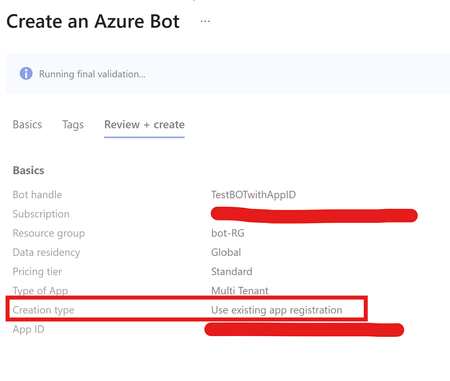
SCENARIO You are trying to create Azure BOT where you are already provided with an existing App registration. After adding relevant details, validation is passed however, the BOT fails to create with Internal Server error. CAUSE This error usually comes up if we are using the same APP ID which is already registered with another Azure BOT resource. { "status": "Failed", "error": { "code": "UnknownError", "message": "Failed to store new bot." } } RESOLUTION Azure BOT requires one to one mapping with the app registration. You can only have one BOT mapped to one App ID. Hence recommendation is to use single app registration for every BOT resource we create.832Views1like1Comment
Help with Deploying AI Agents to Microsoft Teams Chats
Hello, I need help with deploying AI Agents (bots) to Microsoft Teams chats. Here's my current setup: - I have a REST API endpoint that processes user queries and provides LLM-based responses. - Users on my platform can create custom AI assistants. What I need assistance with is: - How to deploy these AI bots into Microsoft Teams chats, allowing end users to create and integrate their assistants directly into Teams. - Any resources or step-by-step guidance on bot registration, deployment, or integrating custom bots would be appreciated. Thank you for your help!1.4KViews0likes4Comments
Send Messages using Bot/Change Notification in MS Teams
Hi I have some questions regarding bot functionality within Microsoft Teams. I'm developing an app/plug-in to monitor and analyze all incoming messages in chats and channels. The goal is to intercept these messages, check them for specific flagged (e.g., inappropriate) content, and instantly send a notification back to the respective chat or channel if flagged content is detected. I need to achieve this in real time. Currently, I’ve implemented the first half of this functionality using Microsoft Graph’s change notifications API, allowing me to intercept and read messages as they arrive. However, I’m facing a limitation: since my app doesn’t have permissions to post messages, I can't use the Graph API’s send capabilities to notify users within the channels or chats. To work around this, I’m considering utilizing a bot. My approach is to have a bot send these notifications to the appropriate chats and channels, using identifiers such as tenant ID, team ID, channel ID, message ID, and chat ID—information I retrieve through the change notifications API. So here are my main questions: Can I use a bot to send messages to various chats and channels on demand, leveraging the IDs obtained from the change notifications API? This would allow my app to handle message interception while the bot takes over in sending the flagged notifications. In my current setup, is there a way to reply to chats or channels directly using the Graph API's 'send' functionality through the app itself? It is related to Application/Delegation Permissions. Thanks712Views0likes5Comments
Former Employer Abuse
My former employer, Albert Williams, president of American Security Force Inc., keeps adding my outlook accounts, computers and mobile devices to the company's azure cloud even though I left the company more than a year ago. What can I do to remove myself from his grip? Does Microsoft have a solution against abusive employers?174Views0likes0Comments