ai workforce
10 TopicsLand Your Offer - Anatomy of Revenue Generating Partner Offer - Part 1 - Copilot in 30
Copilot in 30: A Ready-Made Marketplace Offer to Grow Your SMB Practice Thirty days. Twenty-five users. One repeatable offer that turns AI curiosity into a long-term customer relationship. Small and medium businesses know AI matters. What they lack is a trusted guide and a low-risk way to start. Copilot in 30 gives you both: a $0, 25-user, 30-day Microsoft 365 Copilot Business trial from Microsoft, wrapped in a structured journey that only a partner can deliver. Package it as a Microsoft Marketplace offer and you have a scalable on-ramp to every SMB customer in your base — and to the managed services that follow. Start Here: Why Publishing on Microsoft Marketplace Matters Microsoft Marketplace is Microsoft's partner-focused business platform, designed to help you reach more customers and simplify how you sell. A published offer gives your practice a permanent, discoverable storefront in the place customers already look for Copilot help. More importantly, an offer turns your expertise into something repeatable. Instead of scoping every engagement from scratch, you define the journey once — activities, timeline, deliverables — and run it across dozens of customers. Professional service and managed service offer types are available in Partner Center, so the same offer can carry both the 30-day journey and what comes after it. The SMB Opportunity Hiding in Plain Sight SMB customer segment is still early in their AI journey. These are organisations with 300 or fewer users on Microsoft 365 Business Basic, Standard or Premium — typically without an in-house AI team. That combination is exactly where partners win: high demand, limited internal capacity, and a customer base large enough that a well-designed, repeatable offer scales far beyond what bespoke projects can. Why Copilot Is the Right First AI Step for SMBs Microsoft 365 Copilot Business is the cost-effective Copilot add-on built for SMB customers, delivering the same capabilities as Microsoft 365 Copilot inside the apps their people already use — Outlook, Teams, Word, Excel and PowerPoint. No platform overhaul, minimal training, immediate relevance. Copilot is also the on-ramp. Once a team works confidently with Copilot, the natural next steps are agents, automated workflows and Copilot Cowork — each one deepening the customer's dependence on the partner who guided them there. Meet Copilot in 30: 25 Users, 30 Days, $0 Copilot in 30 is a limited-time, CSP partner-led Microsoft 365 Copilot Business trial for SMB customers with fewer than 300 employees. The essentials: What the customer gets: 25 Microsoft 365 Copilot Business seats for 30 days at $0, transacted through CSP New Commerce (Product ID CFQ7TTC0MM8R · SKU 006Z) Who qualifies: Customers on Microsoft 365 Business Basic, Standard or Premium with no paid Microsoft 365 Copilot today — one trial per customer How long it runs: Available to transact until 31 December 2026 What happens at Day 30: The trial auto-converts to a paid subscription unless renewal settings are changed, with a 7-day cancellation window What Microsoft provides: A launch kit, campaign materials, setup guidance, the Copilot Success Planner and conversion guidance Microsoft supplies the licences and the assets. The offer — and the customer relationship — is yours. Your Role: The Guide Who Turns a Trial Into a Habit A trial alone rarely changes behaviour. A guided trial does. Your job across the 30 days is to make sure 25 people experience real value in real work, and that the sponsor can see it. Before Day 0 — pick the right customers, become "Customer Zero" by using Copilot in your own business, secure a named sponsor and Copilot admin, and build a 30-day success plan with agreed measures. Day 0 — transact the trial, set the paid renewal quantity and term, complete admin setup, assign all 25 licences and run the kick-off with starter prompts. Days 1–28 — lead a weekly scenario (Outlook, Teams, Apps, Agents), review Copilot Analytics, re-engage low-activity users and capture proof points in the customer's own words. Days 29–30 — run the outcome and ROI review, confirm the paid offer and open the expansion and consumption conversation. Every touchpoint is partner expertise the customer cannot get from a licence alone — and every one moves the decision at Day 30 from "should we?" to "how much more?" Inside the Offer: Activities, Timeline and Deliverables Below is the full activity plan behind the offer, ready to drop into your own offer description or statement of work. ID Stage Activity Trial day (of 30) Key deliverables — Pre-req Customer eligibility (Copilot Business trial) Before Day 0 Active M365 Business base licence; no paid M365 Copilot; one $0 trial per customer; CSP New Commerce transactable; offer open to 31 Dec 2026 I1 Identify Build the prioritised target list Pre-trial Tier A/B target list from ASPX and Cloud Ascent; 50–300 eligible seats I2 Identify Confirm eligibility and trial fit Pre-trial Eligibility check: M365 Business base licence, no paid Copilot, one trial I3 Identify Launch the acquisition campaign Pre-trial Campaign email sent; briefing delivered; responses triaged into pipeline I4 Identify Be Customer Zero: complete microskilling Pre-trial Microskilling complete; internal Copilot experience; team briefed P1 Plan Confirm sponsor and success measures Pre-trial Named sponsor and admin; 25 trial users; agreed success measures P2 Plan Build the 30-day success plan Pre-trial Personalised Success Planner output; weekly scenarios; admin and user views P3 Plan Confirm technical and compliance readiness Pre-trial Minimum requirements verified; data and compliance review; blocker log A1 Activate Transact the trial in CSP New Commerce Day 0 25-seat, 30-day, $0 trial ordered (CFQ7TTC0MM8R · SKU 006Z) A2 Activate Configure the paid renewal settings Day 0 Renewal quantity, term and billing set; Cowork usage-based billing if in scope A3 Activate Complete admin setup and assign licences Day 0 Recommended settings on; 25 licences assigned (starts the clock) A4 Activate Run the kick-off and share starter prompts Day 0 Kick-off email; starter prompts; four-week prompt series scheduled X1 Experience Week 1 · Outlook — catch up and communicate Days 1–7 Week 1 prompts landed; first-week activation rate reviewed X2 Experience Week 2 · Teams — meetings that run themselves Days 8–14 Copilot Analytics checkpoint; recaps adopted; low-activity users re-engaged X3 Experience Week 3 · Apps — create in minutes Days 15–21 App scenarios and proof points; week 3 training gate before day 30 X4 Experience Week 4 · Agents — unlock the next level Days 22–28 Role-built agents trialled; 30-day usage trends from the admin centre C1 Convert Outcome review, paid offer and expansion plan Days 29–30 ROI review; 50-seat offer confirmed in 7 days; wave 2 plan; consumption conversation opened Land Your Offer: What One Customer Is Worth The table below is the revenue anatomy of one Copilot in 30 engagement — and it shows that the money is not in the trial, but in what the trial sets up. Item Value Detail Offer duration 30 days Trial clock runs Days 1–30; identify, plan and Day 0 setup precede it Trial offer 25 seats M365 Copilot Business · 30 days · $0 · one per customer · to 31 Dec 2026 CSP incentive — 25 seats (K) $0.32K 5.0% direct bill (2.5% M365 CSP Core + 2.5% Strategic Product Accelerator Tier 1) on 25 M365 Copilot Business seats x $21/mo† ≈ $6.3K/yr; indirect reseller 2.5% ≈ $0.16K Conversion target 50 seats Lead with 50 paid seats at conversion; sets up the wave 2 expansion plan CSP incentive — 50 seats (K) $0.63K 5.0% direct bill (Core + SPA Tier 1) on 50 M365 Copilot Business seats x $21/mo† ≈ $12.6K/yr; indirect reseller 2.5% ≈ $0.32K Frontier Accelerate deployment funding (K) $2.5K Microsoft Commercial Incentives funding for the Copilot deployment engagement when the conversion lands with 50 paid seats†; funds the deployment and adoption work that leads into managed services † Illustrative estimates from the offer plan. Confirm current incentive rates, funding and eligibility in Partner Center. Three streams stack on top of each other: CSP incentive — earned on every paid Copilot Business seat from the moment the trial converts, and growing again when the customer expands from 25 to 50 seats. Frontier Accelerate deployment funding — $2,500 available when you lead the conversion with 50 paid seats, paying for the deployment work that makes the expansion stick. Managed services — the recurring engagement described in Day 31 and Beyond, which is where the largest and most durable share of revenue lives. Now multiply. Everything above is the anatomy of a single customer. Landing the offer means running it across every eligible customer in your base — and you don't need to guess who they are. Partner Center's growth insights reporting, available through the AI Business Solutions & Security Insights (ASPX) dashboard, gives you account-level Copilot eligibility, seat whitespace, free Copilot Chat usage and adoption signals for the customers you already manage. To turn that export into a ranked target list, my colleague Brian O'Shea has built a Copilot for 30 Power BI dashboard that sits over your ASPX data and scores each customer on a 0–100 priority scale from eligible seats, whitespace, free-to-paid potential and opportunity signals — so your first cohort is the ten customers most likely to convert, not the first ten who reply. How the Offer Fits Together: From Trial Inputs to Proof of Value The offer runs left to right in three layers: Trial inputs — 25 users, 30 days, $0 CSP trial SKU; an SMB with 50–300 eligible Microsoft 365 seats; no paid Copilot today; a Business Basic, Standard or Premium base; one trial per customer to 31 Dec 2026; a named sponsor and Copilot admin; auto-conversion to paid unless changed. Five stages — Identify (I1–I4), Plan (P1–P3), Activate (A1–A4), Experience (X1–X4) and Convert (C1, T1, T2, W2). Each stage produces a concrete output the sponsor can see. Proof of value — a prioritised list and campaign responses; agreed use cases and success measures; a provisioned trial with 25 licences assigned; weekly usage from the Microsoft 365 admin centre; adoption proof points in the customer's words; paid conversion confirmed in Partner Center — and a named wave 2 expansion beyond the first 25. The highlighted activities — admin setup (A3), Week 4 agents (X4), 25→50 paid seats (T1), Frontier Accelerate funding (T2) and the wave 2 expansion plan (W2) — are where the engagement stops being a project and starts becoming an ongoing relationship: managed services, agent build-out, Copilot Studio and Copilot Cowork follow-on once the trial converts. Day 31 and Beyond: Managed Services That Keep Delivering The end of the trial is the start of the real engagement. Package these as standing services in your offer: Copilot adoption management — monthly Copilot Analytics business reviews, prompt and scenario refreshes, champion programme and onboarding for each new wave of users Licence and expansion management — take the customer from 25 to 50 paid seats and on to wave 2, aligning renewals, terms and billing as the footprint grows Agent build-out — design, build and maintain role-based agents with Copilot Studio for sales, service, finance and operations scenarios surfaced in Week 4 Copilot Cowork enablement and governance — introduce consumption-based Cowork scenarios, set budgets and cost controls, and report on usage each month Security, compliance and readiness — keep data protection, permissions and governance in step with expanding AI use, including a path to Microsoft 365 Business Premium Quarterly value reviews — refresh success measures, capture new proof points and agree the next expansion plan with the sponsor Each of these is a recurring, outcome-based service rather than a one-off project — and each keeps you positioned as the customer's AI partner as their needs grow. Ready to Build Your Copilot in 30 Offer? Download the Copilot in 30 launch kit and Microsoft 365 Copilot Partner FAQ from the Microsoft AI Cloud Partner Program. Be Customer Zero — run Copilot and the microskilling series inside your own business first. Publish your offer in Partner Center as a professional service (the 30-day journey) with a managed service follow-on (Day 31 and beyond). Pick your first cohort — customers with 50–300 seats on a Microsoft 365 Business plan and no paid Copilot today. Transact your first trial through CSP New Commerce (Product ID CFQ7TTC0MM8R · SKU 006Z) and set the paid renewal on Day 0. Book the Day 30 review before Day 1 — so the conversion and expansion conversation is already on the calendar. The window closes on 31 December 2026. The customers are already in your base. Publish the offer and start the clock. Resources From AI curiosity to Copilot adoption in 30 days — Microsoft Partner Blog Copilot in 30 Launch Kit — partner GTM playbook, customer trial guide, invitation and weekly prompt emails, admin setup guidance Build Your 30-Day Copilot Success Plan Copilot Success Planner Walkthrough video Partner Skilling Hub | Microskilling for Copilot in 30 Power BI Dashboard that integrates with your ASPXi Partner Data · By Brian O'Shea Create compelling customer business cases455Views2likes1CommentWhen AI Stops Waiting for Instructions
Microsoft’s Autopilots mark a shift from AI that responds to prompts to persistent agents with identity, initiative and standing responsibilities. As AI begins to hold a “job,” the enterprise challenge moves beyond deploying agents to defining what they should own, how far their autonomy should extend, and where human accountability must remain.234Views1like0CommentsScaling Seller Impact with ASPX Insights: From Data Access to AI-Driven Execution
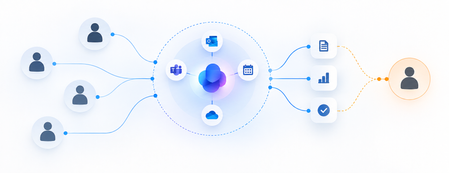
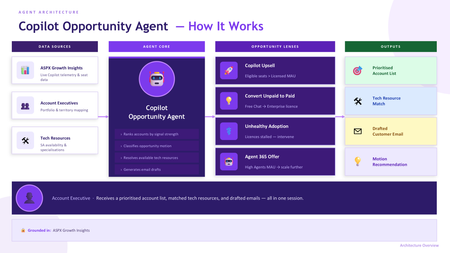
ASPX Insights in Partner Center Most sellers are not constrained by opportunity; they are constrained by time and signal. With up to 70% of effort spent on administrative work, portfolio coverage continues to expand while insight quality declines. Sellers are forced to manually interpret fragmented telemetry across multiple systems, slowing decision-making and reducing precision in where they focus. The result is missed revenue signals, delayed interventions, and inconsistent execution at scale. Productivity is not just about efficiency, it is about enabling every seller to consistently identify and act on the highest-value opportunity, in real time. To drive consistent, data-led growth across Security and AI Business Solutions, partners should connect to ASPX Insights within Partner Center. This provides direct access to adoption propensity models, customer telemetry, and actionable account-level insights across Microsoft 365 Copilot, E7, and Agent 365 scenarios. Access to ASPX Insights is only the starting point. The real value comes from how you operationalise that data and surface it directly to sellers in the flow of work. The most effective pattern is to build a lightweight “opportunity agent” that connects to ASPX data via API and translates telemetry into clear actions. This ensures your sales teams have the right conversation with the right customer at the right time - Conversations that are backed by intelligent insights to help guide your customer's on their AI and security journey. The Architecture ASPX Insights is powered by Partner Center data and exposes rich telemetry and propensity signals that can be accessed programmatically. This allows partners to move beyond dashboards and embed insights directly into seller workflows. As demonstrated in internal adoption patterns, partners can connect to ASPX via API and pull Customer-level adoption and usage telemetry Copilot, Security, and Agent usage signals Propensity scores for expansion, adoption, and conversion Licensing, whitespace, and engagement indicators The M365 Partner API – AI Business Solutions & Security Insights allows partners to ground an agent in real, actionable data rather than static pipeline assumptions. By pulling live telemetry and seat-level signals directly into the agent, the solution continuously reflects actual customer usage patterns - who is adopting, who is stalled, and where there is untapped potential. This means opportunity identification is no longer based on periodic reporting or manual interpretation, but on near real-time behavioural insight. As a result, account prioritisation, upsell motions, and intervention strategies are driven by evidence rather than instinct, enabling account teams to act with precision and focus on the highest-impact opportunities across their portfolio. The agent should act as a translation layer between raw telemetry and seller action. The goal is not to expose more data, but to remove ambiguity and tell the seller exactly where to focus. A simple architecture looks like this: Data layer Ingest ASPX Insights data via API on a daily or scheduled basis. Optionally store monthly snapshots to track trends and smooth out variability. This creates both real-time signal and historical context. With the data layer you have a couple of options. You can integrate directly into Partner Centre ASPX Insights by using the API. This is technically complex and may have a longer lead time to see results. Alternatively, to see results with less complexity, you can simply download snapshots of the data monthly from ASPX Insights in Partner Centre. This is manual but easy to achieve and offers a shorter time to value for your agent. Scoring layer Use ASPX propensity outputs directly or combine them with your own logic to rank accounts across a small set of opportunity lenses Expansion ready (Copilot scale) Conversion ready (free to paid) At risk (low adoption vs paid licenses) Transformation ready (Agent 365 and advanced AI scenarios) These align directly with the machine learning models and signals already surfaced in ASPX. Action layer Translate scores into next best actions Who to engage Why now What motion to run (sell, enable, expand, govern) This is where agents create value. Sellers should not see raw dashboards. They should see prioritised accounts and recommended actions. Internal Adoption Path The key design principle is simple: bring insight into the tools sellers already use. CRM integration Push ranked accounts and recommendations directly into CRM as opportunities, tasks, or account insights. This ensures data becomes part of pipeline management, not a separate activity. Copilot / Agent interface Expose the agent through Microsoft 365 Copilot or a custom chat interface where sellers can ask Which customers should I prioritise this week Which accounts are ready for Copilot or E7 expansion Where are my adoption risks The agent queries the ASPX-backed dataset and returns structured recommendations in seconds. Proactive notifications Trigger alerts based on signal changes Spikes in Copilot usage Drops in adoption for paid tenants New high-propensity accounts entering threshold This shifts sellers from reactive to proactive engagement. Portfolio dashboards (secondary) Maintain dashboards for leadership and planning, but not as the primary interaction model for sellers. Dashboards support strategy, agents drive execution. Extending into E7 and Agent 365 scenarios Once the agent is connected to ASPX, partners can extend the same model across broader solution plays E7 opportunities Use signals such as usage depth, licensing posture, and workload adoption to identify customers progressing toward advanced security and compliance requirements. The agent can flag these accounts as ready for E7-led conversations. Agent 365 opportunities Combine Copilot maturity with agent usage signals to identify customers moving beyond productivity into process automation. These are high-value transformation plays where partners should proactively engage. This ensures sellers are not operating in silos but are guided toward the next logical workload based on real behavior, not assumptions. Where to Next If you lead a partner sales team, connect to ASPX Insights and see how these insights can empower your sales teams to achieve more. Check out our ready made ASPX Insights agent in Github.1KViews3likes5CommentsSizing Copilot Credits for Cowork? Let Your Users Use Cowork Investment Advisor Agent.
Right, let's talk about a headache. If you're helping a customer allocate Copilot Credits for M365 Copilot Cowork, you have to size it all up first — and doing that by hand is a fiddly, time-consuming job. Here's the problem, and a much easier way to solve it. Start with the Cowork Estimator Here's the good news: you don't have to start from scratch. Microsoft has published the Customer Cowork Estimator — a handy tool that turns personas, prompt complexity and expected usage into an estimated credit number. It's the perfect place to begin, and it does the core maths for you. To get the most out of it, you just need to feed it good inputs — and that's where a little groundwork comes in. For each part of the business, you'll want to: Work out who's who. There are four types of user — corporate knowledge workers, management and senior leaders, customer-facing folks, and technical staff. Count how many of each. Quick for a small team, a bit more involved for a big one. Pin down what they'd genuinely use Cowork for. The real multi-step workflows that hop across apps and actually do things — not just a quick chat or a summary. Judge how heavy each workflow is. Light, Medium or Heavy — since each level uses a different number of credits per run. Estimate how often it runs. Daily adds up to a lot of runs a month; weekly is far fewer. The estimator handles the sums beautifully once those inputs are in. Gathering the inputs themselves — persona by persona, workflow by workflow, across a few thousand people — is simply the part that takes time. And that's exactly where this agent lends a hand: it builds on the estimator by automating the groundwork that feeds it. How this agent helps This agent takes on that groundwork for you. Instead of sizing everyone from the outside, the admin simply switches the agent on for every user. Each person then sizes their own needs — and the agent does the clever bits for them, ready to drop into the estimator. Here's what it does behind the scenes: Spots the right persona. It works out which of the four personas each user fits. Finds the real workflows. It looks at the top Cowork scenarios the user would actually run. Keeps it honest. It checks each one is a genuine Cowork job — several steps, more than one app, real actions and a bit of decision-making — not something a Scheduled Prompt or plain Copilot Chat could do just as well. Grounds it in evidence. It reads the signals from recent work — emails, meetings, documents and Teams chats — so the estimate is based on what people actually do, not thin air. Does the sums. It maps each workflow's complexity to credits per run and totals it up — giving you numbers that line up neatly with the estimator. Shows the value. It gives a view of pay-as-you-go versus a pre-purchase plan, and a sense of the return on the spend. Stays transparent. It states its assumptions, flags how confident it is, and sticks to permitted data and the usual privacy and compliance rules. And here's the kind of report it hands back — persona, the top workflows, complexity, credits, cost and a clear recommendation, all in one place: Why this approach works better So why hand it to the users? A few good reasons: More accurate. The numbers come from each person's real workload, not a top-down guess. Consistent by design. Everyone follows the same method — same personas, same complexity bands, same maths — so the results line up and roll into one clean figure. No over-buying. Because it weeds out the workflows that don't really need Cowork, your customer only pays for credits they'll genuinely use. A proper business case. You get cost clarity and a feel for the return, so you're handing over more than just a number. It scales. Ten users or ten thousand — the effort on your side stays much the same. It saves you hours. You swap manual sizing for gathering and rolling up. Your time goes on advising, not tallying. Not ready to roll it out? Other ways in If an admin isn't quite ready to switch the agent on for everyone, that's OK— there's no need to. This agent is an M365 Copilot agent, and it has free access to Work IQ — the same engine that will eventually power Cowork. Because that access is free, the agent can read how people really work and take the guesswork right out of sizing. And there's more than one way to get at it: Build it with Agent Builder. Ready-made instructions, a description and a starter prompt are all sitting in the GitHub repo. Anyone with access to M365 Copilot can pop them into Agent Builder and stand the agent up in minutes. Prefer not to build an agent? Just use the prompt. There's a comprehensive prompt you can drop straight into the M365 Copilot Chat experience. Same sizing, same evidence — no agent to create. Ready to give it a go? Whichever route suits you best, getting started is dead simple. If you're rolling the agent out to your users: Have a quick word with your customer's admin about switching the agent on for their users. Let each person size their own Cowork needs. Gather it all up and roll it into a single estimate. Prefer to keep it in your own hands? Build the agent from the GitHub repo with Agent Builder, or drop the comprehensive prompt into M365 Copilot Chat — you'll get to the same place with even less setup. THE BOTTOM LINE That's the heavy lifting done for you. You'll save yourself hours, spare yourself the guesswork, and hand your customer a credit plan they can genuinely trust — with the numbers and the business case sitting right behind it. Give it a spin on your next engagement and see how much quicker it gets you there. Resources Everything you need is in one place: Customer Cowork Estimator — https://aka.ms/CustomerCoworkEstimator GitHub repo — agent instructions, description, starter prompt and the full Copilot Chat prompt: Cowork Investment Assessment1.4KViews1like0CommentsPitch Maker Agent: Turn Copilot Chat Signals into Microsoft 365 Copilot Deals
Executive Summary Customers are already using free Copilot Chat at scale, but adoption is often ungoverned and disconnected from the Microsoft 365 workloads where measurable productivity and risk controls live. The Pitch Maker Agent (BETA) helps partners convert Partner Center Copilot growth opportunity signals into customer-ready narratives—reducing pitch preparation from days to minutes and improving consistency across stakeholders (replace with your measured baseline). What it enables (partner outcomes) Turn raw usage signals into an executive business case with clear opportunity, risk, and next steps. Standardize value conversations across IT and business buyers while keeping customer context specific. Accelerate conversion from exploration to governed deployment by anchoring on Microsoft 365 workloads. Why it’s different Evidence-led: uses Partner Center Copilot growth opportunities (ASPX) signals rather than generic prompts. Buyer-ready: outputs a structured narrative (not a feature list) designed for executive alignment and action. Inputs required Partner Center Copilot growth opportunities export (all columns) for the target customer. The Opportunity: From AI Exploration to Enterprise Direction The move from free Copilot Chat to Microsoft 365 Copilot is a timing advantage: customers have intent and familiarity, but need a governed path that ties AI to real work in Teams, Outlook, Excel, and beyond. Advisory gap: translate usage metrics into business insight executives can fund. Governance gap: balance opportunity with security, compliance, and lifecycle controls. Workflow gap: connect AI usage to measurable outcomes inside Microsoft 365 workloads. How the Agent Works (BETA) The Agent follows a simple, repeatable flow to generate an executive-ready pitch narrative from Partner Center Copilot growth opportunity signals. See the agent in action below. In three steps Upload the Partner Center Copilot growth opportunities export (all columns). Run the Agent to translate usage signals into a customer-specific executive narrative. Use the generated business case, recommendations, and next steps in the customer conversation. What the Output Enables Translate Partner Center signals into a fundable business case, faster. Improve executive alignment by presenting opportunity, risk, and plan in one narrative. Increase repeatability across accounts with a consistent structure and messaging. The figure below illustrates how the Agent turns usage signals into a concise, executive-ready pitch narrative and action plan. Figure 1. From Copilot Chat signals to an executive pitch narrative and next-step plan. For customers, the conversation shifts from features to outcomes—clear productivity impact, role-based change, and risk-aware governance. Deployment and Execution The Agent is delivered as a solution package and deployed through Copilot Studio with a straightforward publish-and-run flow. Prepare Partner Center ASPX export (all columns) and validate sensitivity labels. Import the solution package into Copilot Studio. Verify dependencies, publish the Agent, and enable access in Microsoft 365 Copilot and Teams. Run the guided pitch flow by uploading customer data and capturing the narrative output. The run guide provides step-by-step visuals for data preparation, import, publication, and how to use the output in customer conversations. Why This Matters for Partner Practices The Pitch Maker Agent (BETA) supports a repeatable value motion: identify opportunity, align stakeholders, and move customers from experimentation to governed Microsoft 365 Copilot adoption. Higher conversion: clearer executive rationale anchored in evidence and outcomes. Lower effort: less time drafting, more time on discovery and delivery. Better governance: built-in prompts to address risk, readiness, and controls early. Call to Action This week: 15-minute start Locate the solution package and run guide in the Agent folder. Deploy the Agent in Copilot Studio and publish to Microsoft 365 Copilot/Teams. Export Partner Center Copilot growth opportunities data and validate sensitivity labels. Upload the dataset and generate a customer-specific executive pitch narrative. Resources Helpful links to learn more and access supporting materials: Partner Center Copilot growth opportunities data GitHub repository Overview: Run guide977Views0likes0CommentsAzure Native Integrations: Public Preview of Napster Companion API on Azure
What is Napster Companion API? Napster Companion API is Napster's platform for building Omniagents: persistent, multi-channel AI agents with one identity, one memory, and one set of tools that show up across every channel an end user touches. The same Omniagent meets the customer on the website, in the mobile app, on video, and on the phone line with the same face, the same voice, and the same memory of the last conversation. The Omniagent as a digital worker The clearest way to think about an Omniagent is as a digital worker: It has a role (customer support specialist, sales advisor, internal IT assistant). It carries the memory of past shifts and prior conversations. It has the tools it needs to do the job which include APIs, knowledge bases, ticketing systems, CRMs. It shows up across every surface the end user touches, like a human worker who answers the door, the phone, and the inbox. When something is outside its scope, it hands off to a human colleague with the context already attached and picks the thread back up when the human is done. Use cases for the Companion API Teams are already exploring the Companion API across a wide range of scenarios: Agentic commerce. Agents that guide end users through discovery, recommendations, purchase, and post-sales support all in one continuous conversation across channels. Customer service. Agents that resolve issues end to end, escalate to humans with full context attached, and pick the thread back up across sessions. Internal operations and digital coworkers. Agents that orchestrate workflows, retrieve knowledge, and automate repetitive tasks for the workforce. Capabilities introduced by Napster Companion API The Companion API public preview brings the following capabilities to Azure customers: Persistent multi-channel agents that maintain identity, memory, and context across web, mobile, voice, video, and telephony. Real-time multimodal interactions across voice, video, and text for natural back-and-forth conversation. Tool and API orchestration that lets agents take real actions like opening tickets, updating records, retrieving documents, and triggering workflows. Persona-driven agents with configurable behavior, conversational style, and avatar-based interaction. Knowledge bases and deterministic question-and-answer pairs for grounded, accurate responses on topics where exactness matters. Developer SDKs and a no-code Dashboard for building, testing, deploying, and iterating on agents. Better together: Napster and Microsoft This integration is the result of a long-term Azure-native partnership between Napster and Microsoft. It is not an external service layered onto Azure infrastructure but it is a co-engineered offering designed to help enterprises operationalize persistent AI agents at scale. In practice, the Azure Native integration delivers: Benefit What it means for you Seamless development experience Provision and manage Companion API resources directly from the Azure portal, alongside your other Azure services. Build and operate Omniagents in the Napster Dashboard, reached through single sign-on. Bring your own model or use Napster Hosted Connect your Azure OpenAI realtime deployment on Microsoft Foundry so inference runs in your tenant. Or use the Napster Hosted tier where Napster manages the model for you. Simplified billing Manage Companion API spend through Azure Marketplace, on the same invoice as the rest of your Azure consumption which means no separate procurement, no separate billing relationship. Single sign-on with Microsoft Entra Switch between Azure resources and the Companion API Dashboard without re-entering credentials. Enterprise-ready foundation Built on Azure's compliance, security, and global infrastructure footprint. How it works?    If the player doesn’t load, open the video in a new window: Open video Get started in minutes Provisioning Napster Companion API on Azure takes just a few clicks: Open the Azure portal and search for *Napster Companion API*. Create a new resource and choose your subscription, resource group, region, and pricing tier. Link your Napster organization (or create one as part of resource provisioning). Launch the Companion API Dashboard from the resource overview page using single sign-on, and start building your first Omniagent in the Napster portal. Full step-by-step guidance is available in the Napster Companion API documentation on Microsoft Learn Resources Product documentation: Napster Companion API on Microsoft Learn Quickstart: Create a Napster Companion API resource Azure Marketplace listing: Napster Companion API Napster for partners: napster.com/partners Azure Native Integrations overview: Azure partner solutions What's next This public preview is the first milestone on a broader roadmap. We are eager to hear from early adopters. Try the public preview, build your first Omniagent, and let us know what you think as your feedback will shape what ships next. Get started today by searching for Napster Companion API in the Azure portal.1.8KViews1like1CommentAgent Builder, Copilot Studio, or Azure AI Foundry: How We Decide for Every Client
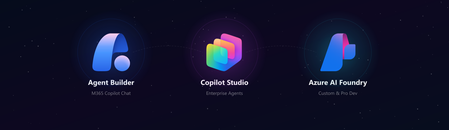
Every client conversation starts the same way. Someone has seen a demo, attended an Ignite session, or read a press release. They want to build an agent. Then comes the question that derails more projects than any technical challenge: "Which tool should we use?" After deploying agents for clients across industries - insurance, professional services, manufacturing, public sector - we have developed a repeatable framework for answering that question. It is not based on which tool is newest or which has the best marketing. It is based on where projects actually succeed or fail in production. The three tools are not competitors The first mistake most teams make is treating Agent Builder, Copilot Studio, and Azure AI Foundry as a hierarchy - basic, intermediate, advanced. That framing leads to bad decisions. They are not a ladder. They are three distinct tools built for three distinct contexts. The right question is not "which tool is most powerful?" It is "which tool fits this project's constraints?" The framework: 4 questions We evaluate every project against four dimensions before recommending a tool: Who is building it? Where do users live? How complex is the logic? Who owns it after go-live? Agent Builder Copilot Studio Azure AI Foundry Builder profile Maker, no code Developer / power user Pro developer, Python User surface M365 Copilot Chat Teams, web, M365 Copilot Custom app, any surface Logic complexity Simple Q&A, task routing Multi-step flows, connectors Fully custom orchestration Post-go-live ownership Business team IT + Business joint Engineering team Governance M365 Admin Center Power Platform DLP Custom, Azure RBAC When we recommend Agent Builder Agent Builder is the right call when the business team wants to own the agent end-to-end, the use case is bounded, and the users already live inside M365 Copilot Chat. The key advantage is distribution - an Agent Builder agent surfaces natively inside Copilot Chat with zero additional deployment work. No IT ticket, no app registration, no Teams app package. The ceiling is real. Agent Builder does not support complex branching logic, external API calls, or dynamic prompt injection. The moment a client asks "can it also update a record in our CRM?" the answer is usually no. Use it when: The maker owns it, the use case is narrow, and M365 Copilot is already the user's primary surface. When we recommend Copilot Studio Copilot Studio is our default recommendation for the majority of enterprise agent projects. It covers the wide middle ground between no-code simplicity and full-code flexibility - within the Microsoft governance perimeter most enterprise IT teams already control. Power Platform connectors - 1,000+ out-of-the-box connectors means most enterprise data sources are reachable without custom API development M365 Copilot channel - surface a Copilot Studio agent directly inside M365 Copilot Chat, Agent Builder-level distribution with enterprise-grade logic underneath Topic-level governance - fallback behaviors, confidence thresholds, escalation paths configurable without code DLP policy enforcement - the agent operates within the same data loss prevention perimeter as the rest of the Power Platform tenant The most common mistake: under-investing in the knowledge layer. The agent authoring is the easy part. Getting SharePoint content structured, metadata consistent, and documents deduplicated is where most projects hit delays. Budget for it. Use it when: The use case requires connectors, dynamic responses, or M365 Copilot integration - and you want IT to own governance without requiring a developer team. When we recommend Azure AI Foundry Foundry is the right call when you need to bring your own model, build a fully custom orchestration pipeline, or integrate into a surface that has nothing to do with Microsoft 365. In practice, this means one of three scenarios: The client has a model fine-tuned on proprietary data that must be used The agent is embedded inside a custom-built web or mobile application The logic requires Python-level control - complex reasoning chains, multi-agent coordination, custom evaluation loops Foundry projects require a professional developer, take longer, and produce something the business team cannot maintain without engineering support. That is not a reason to avoid it - it is a reason to be honest with the client upfront. Use it when: You need full control of the model, the orchestration, or the surface - and you have a developer team to own it. The question that resolves most debates When a client is torn between Copilot Studio and Foundry, we ask one question: "Who is answering the 2am support call when this breaks in production?" If the answer is a developer, Foundry is viable. If the answer is the IT admin or the business owner, Copilot Studio is the right call. Not because Foundry is unreliable, but because the operational model has to match the tool. More projects fail from ownership mismatch than from technical limitations. What we see go wrong Reaching for Foundry too early. Developers often want full control and reach for Foundry before validating the use case. We have rebuilt several Foundry POCs in Copilot Studio when the production constraints called for it - faster to ship and cheaper to run. Under-scoping Agent Builder. Business teams choose Agent Builder because it looks simple, then hit the ceiling at month two. The re-platform cost is higher than building in Copilot Studio from the start. Ignoring the M365 Copilot channel. Many Copilot Studio projects are deployed as standalone Teams apps when they could surface directly inside M365 Copilot Chat. The distribution advantage is significant and underused. The short version Agent Builder - maker-owned, bounded use case, M365 Copilot surface, fast Copilot Studio - IT + business joint ownership, connectors, production governance, M365 Copilot integration Azure AI Foundry - developer-owned, custom model or surface, full control, higher cost Start with the ownership model. Everything else follows. Elliot Margot - Team Lead Jumpstart, Copilot and Agents at Witivio (Microsoft Partner). Connect on https://www.linkedin.com/in/elliot-margot-52742a156/.2KViews1like0CommentsThree Tiers, One Platform: Building Agents Together with the Build-Along Series
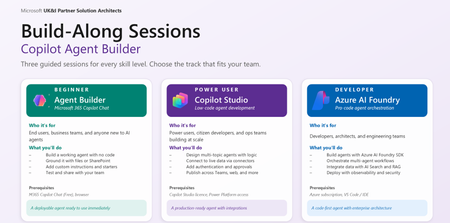
The Agentic Opportunity Every partner has agent ambition, but a single workshop format cannot serve every builder. Business makers want a fast win without writing code. Citizen developers want to orchestrate real processes across enterprise systems. Pro developers want a code-first surface with evaluations, tracing, and managed identity. Run the wrong session for the wrong audience, and engagement collapses - too abstract for one group, too constrained for another. The Agent Build-Along Series solves that by meeting builders exactly where they are, across three tiers of the Microsoft platform stack. Behind the series sits a self-serve GitHub repository - a curated library of build-along sessions with easy-to-follow, step-by-step instructions, scoped to specific industry scenarios and business functions. Partners pick the scenario that fits the room, clone the assets, and run the session. No bespoke content build, no facilitator guesswork. A Self-Serve Repository for Build-Along Sessions Diagram illustrating three tiers of agent building The repo at Agent Build-Along Github is a self-serve catalog of ready-to-run workshops. Every session is curated for a specific industry and business function, with easy-to-follow instructions a facilitator can pick up and deliver. Pick the combination that matches the room and run the session - the content, scenario, and assets are already there. Sessions are organised across three axes so partners can find the right fit fast: Industry - Financial Services, Healthcare, Retail, Manufacturing, Public Sector, Energy, Professional Services Business function - Sales, Marketing, Finance, HR, Operations, IT, Customer Service Workload - Agent Builder, Copilot Studio and Azure AI Foundry Each session in the repo includes a real-world scenario, step-by-step build instructions, sample data, prompts and configuration, and a facilitator narrative. Clone, brief the room, build the agent - that is the loop. Three Tiers - Meet Builders Where They Are The pyramid is intentional. Builders start where their skills are today and move up as confidence grows. The tier defines platform, audience, duration, and approach - content stays consistent. Tier Platform Audience Duration Approach 1 - Foundation Microsoft 365 Copilot Agent Builder Business makers, end users, departmental teams 60 min No-code 2 - Extend Copilot Studio Citizen developers, power users, ops teams 90 min Low-code 3 - Pro-Code Azure AI Foundry Pro developers, architects, AI engineers 180+ min Code-first Tier 1 - M365 Copilot Agent Builder Author your first agent - no code required. Microsoft 365 Copilot Agent Builder virtual workshop overview, What your customers will build A custom agent scoped to a real workplace scenario Grounded with knowledge sources (SharePoint sites, files, web URLs) Configured with custom instructions and conversation starters Tested in the preview pane and shared with a team Session flow Define → Ground → Refine → Test & Share Prerequisites Microsoft 365 Copilot licence (or Copilot Chat free) Modern browser (Edge / Chrome) A workplace scenario in mind, or use our template Outcome Attendees leave with a working agent they can use immediately, plus a repeatable pattern for future use cases. This is the right entry point for departmental teams who want to operationalise Copilot without engineering involvement. Tier 2 - Copilot Studio Orchestrate multi-step agents across enterprise systems. Microsoft Copilot Studio virtual workshop overview What your customers will build A copilot with generative answers and authored topics Custom actions that call APIs and Power Platform connectors Knowledge sources spanning SharePoint, Dataverse, public web, and enterprise data Channel deployment to Microsoft Teams and a public web embed Session flow Design → Connect → Author → Publish Prerequisites M365 Copilot license with access to Copilot Studio Familiarity with Power Platform helpful, not required A multi-step workflow or process in mind Outcome Attendees leave with a published copilot running in Teams or on the web, plus a pattern for connecting copilots to enterprise systems. This is where citizen developers and ops teams turn manual processes into orchestrated, agent-driven workflows. Tier 3 - Azure AI Foundry Ship a code-first agent with evaluations and observability. What your customers will build A code-first agent with custom tools and function calling Grounding via Azure AI Search and the customer's own data Model selection from the Foundry catalog, with optional fine-tuning Evaluations, tracing, and managed-identity deployment Session flow Provision → Build → Evaluate → Deploy Prerequisites Azure subscription with Azure AI Foundry access VS Code, plus Python or .NET familiarity Sample data or a use case ready to ground on Outcome Attendees leave with a deployed agent - code, evaluations, and tracing in place - plus reusable SDK templates. This is the right tier for architects and AI engineers shipping agents into production with the governance bar enterprise customers expect. How the Repository Works The repo removes the heaviest lift in running these workshops: content creation. Every session is curated against the same three axes - industry, business function, tier - and shipped with step-by-step instructions a facilitator can follow with minimum prep. Industry/Business Function × Tier → Ready-to-run Build-Along Each session in the repo ships with: A real-world scenario grounded in the chosen industry and business function Step-by-step build instructions tuned to the selected tier Sample data the agent can ground against Prompts, conversation starters, and configuration snippets Facilitator narrative so anyone can run the session Need an enterprise agent that can handle integrate with CRM data? There is a curated Copilot Studio session with a deal-desk scenario and sample CRM data. Need a pro-code health care agent? Choose the Foundry session with a patient-flow scenario and a grounded dataset. Same repo, different curated paths - at the right depth for the room. What Attendees Walk Away With Agent-Builder - A working agent in Microsoft 365 Copilot, ready to share with colleagues. Copilot Studio - A published copilot running in Teams or on the web, connected to enterprise systems. Foundry - A deployed Foundry agent with evaluations, tracing, and SDK templates for the next build. In all cases attendees leave with assets - not slides - and the confidence to build the next one without facilitation. Next Steps - Host a Build-Along Pick your tier - Start where your skills are today. Move up the pyramid as confidence grows. Drive Registration – Socialise your Build-Along session to maximise attendance. Show up and build. Bring a real scenario. Customers leave with a working agent to share. Where to Next Browse the self-serve repository of Build-Along sessions - curated by industry and business function, with step-by-step instructions ready to run: Agent Build Along.1.4KViews0likes1CommentMicrosoft Partners: Accelerate Your AI Journey at AgentCon 2026 (Free Community Event)
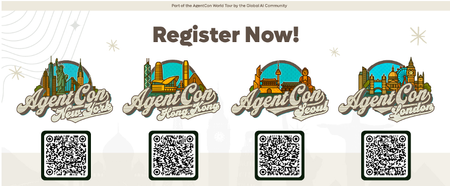
Recently, a customer asked me a question many Microsoft partners are hearing right now: “We have Copilot — how do we actually use AI to change the way we work?” That question captures where we are in the AI journey today. Organizations have moved past curiosity. Now they’re looking for trusted partners who can turn AI into real business outcomes. That’s why events like AgentCon 2026 matter. A free, community-led event built by practicioners AgentCon is not a traditional conference. It’s a free, community-driven global event organized by the Global AI Community together with Microsoft partners and ecosystem leaders. Simply put: it’s for the community, by the community. Across cities worldwide, developers, consultants, architects, and Microsoft partners come together to share practical experiences building with AI agents, Copilot, and the Microsoft platform. The focus isn’t theory — it’s implementation: What worked What didn’t What partners can apply immediately with customers This peer learning model reflects how many of us actually grow in the Microsoft ecosystem: by learning from other partners solving real problems. Why this matters for Microsoft partners The opportunity for partners is evolving quickly. Customers aren’t just asking about AI tools — they’re asking how to redesign processes, automate work, and unlock productivity using AI-powered solutions. The Microsoft AI Cloud Partner Program emphasizes partner skilling and helping customers realize value from AI investments. Community events like AgentCon accelerate that learning by bringing partners together to exchange proven approaches and practical insights. When partners upskill faster, customers succeed faster. Why attend AgentCon is designed to help partners move from AI awareness to AI delivery. As an attendee, you can expect: Practical sessions and demos from practitioners Real-world AI and agent scenarios Direct conversations with builders and peers New collaboration and co-sell opportunities You’ll leave with ideas and approaches you can bring directly into customer engagements. Why speak AgentCon thrives because partners share openly with one another. If you’ve implemented Copilot, explored AI agents, or learned lessons from customer deployments, your experience can help others accelerate their journey. Speaking at AgentCon allows you to: Share your expertise with the global partner community Build credibility within the Microsoft ecosystem Create new partnerships and opportunities Contribute to collective partner success You don’t need a perfect story — just an honest one others can learn from. Join the global AgentCon community AgentCon 2026 events takes place around the world including these upcoming events: March 9 - New York: https://aka.ms/AgentconNYC2026 April 11 - Hong Kong: https://aka.ms/AgentconHongKong2026 April 16 - Seoul: https://aka.ms/agentconLondon2026 April 22 - London: https://aka.ms/agentconSeoul2026 Each event is locally organized, community-led, and free to attend. Help shape the next phase of AI adoption AI transformation is happening now — and Microsoft partners play a critical role in guiding customers forward. AgentCon is an opportunity to learn together, share experiences, and strengthen the partner ecosystem driving AI innovation. 👉 Register or apply to speak: https://aka.ms/agentcon2026 We hope you’ll join us — and be part of the community helping customers turn AI potential into real impact.632Views0likes0CommentsLearn to maximize your productivity at the proMX Project Operations + AI Summit 2026
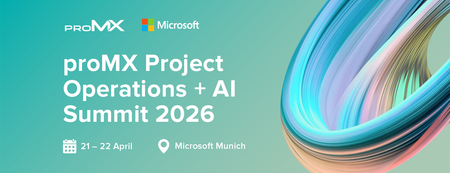
As organizations accelerate AI adoption across business applications, mastering how Microsoft Dynamics 365 solutions, Copilot, and agents work together is becoming a strategic priority. Fortunately, businesses no longer need to rely on speculation — they can gain practical insights with fellow industry professionals during a unique two-day event: On April 21-22, 2026, Microsoft and proMX will jointly host the fourth edition of proMX Project Operations Summit at the Microsoft office in Munich, but this time with an AI edge. The summit brings together Dynamics 365 customers and Microsoft and proMX experts to explore how AI is reshaping project delivery, resource management, and operational decision‑making across industries. On day one, participants will discover how Dynamics 365 Project Operations, Copilot, Project Online, proMX 365 PPM, and Contact Center can strategically transform business processes and drive organizational growth. On day two, they can explore the technical side of these solutions. Secure your spot! What to expect from the summit Expert-led, actionable insights Join interactive sessions led by Microsoft and proMX experts to learn practical AI and Dynamics 365 skills you can use right away. Inspiring keynotes Gain future-focused perspectives on Dynamics 365, Copilot, and AI to prepare your organization for what’s next. In between our special guests we have Microsoft's Rupa Mantravadi, Chief Product Officer, Dynamics 365 Project Operations, Rob Nehrbas, Head of AI Business Solutions, Archana Prasad, Worldwide FastTrack Leader for Project Operations, and Mathias Klaas, Partner Development Manager. Hands-on AI workshops Take part in workshops where Sebastian Sieber, Global Technology Director (proMX) and Microsoft MVP will show the newest AI features in Dynamics 365, giving you real-world experience with innovative tools. Connect with industry leaders Engage with experts through Q&A sessions, round tables, and personalized Connect Meetings for tailored guidance on your business needs. Real customer success stories Hear case studies from proMX customers who are already using Dynamics 365 solutions and learn proven strategies for successful digital transformation. Who should attend? This summit is tailored for business and IT decision-makers that are using Dynamics 365 solutions and want to drive more business impact with AI, but also for those who might be planning to move away from other project management solutions such as Project Online and need practical guidance grounded in real-life implementations. Date: Apr 21 & 22, 2026 | 2 -Days event Location: Microsoft Munich, Walter-Gropius Straße 5, Munich, Bavaria, DE, 80807 Ready to maximize your productivity? Register here.271Views1like0Comments