ai agents
3 TopicsFrom fragmented data to trusted intelligence: Microsoft at TM Forum Innovate Americas 2026
AI is reshaping telecom, but moving from isolated pilots to AI-native operations requires more than capable models and agents. It requires trusted data, shared operational context, and governance that enables AI to act safely across network, customer, and business workflows. At TM Forum Innovate Americas 2026, Microsoft will join industry leaders to explore how operators can build that foundation and turn intelligence into measurable outcomes at scale The next phase of telecom AI begins with the foundation The telecommunications industry is entering a new phase of AI adoption. The question is no longer whether AI can improve a particular task, workflow, or customer interaction. Operators are now asking how to move beyond isolated pilots and embed intelligence across network operations, customer experiences, business processes, and partner ecosystems—while maintaining the security, governance, reliability, and control that carrier-grade environments demand. That transition will require more than capable models or a growing collection of AI agents. Agents need timely access to operational information, but they must also understand what that information means: how customers, services, network resources, incidents, and business commitments relate; which sources are authoritative; what policies apply; and what actions they are permitted to take. As AI moves from observing and recommending toward acting inside operational workflows, trusted context becomes as important as the underlying data. These challenges will be at the center of TM Forum Innovate Americas 2026, taking place October 6–7 in Allen, Texas. Under the theme AI-native networks. Built to scale, faster, the event will bring together operators and industry partners to explore practical approaches to network autonomy, trusted AI and data, business and IT modernization, and the production-ready foundations needed to scale innovation. TM Forum expects more than 1,000 attendees, including over 350 CSP participants, alongside more than 130 speakers and 50 exhibitors and partners. Microsoft will contribute to this discussion through two complementary sessions. As part of the broader The data product challenge — Feeding AI with trusted, industrial-scale data session, Microsoft will participate in the panel Fix the data layer or fail at AI: What needs to change now? The panel will examine what makes data trustworthy enough for AI to act on, where fragmentation prevents cross-domain orchestration, who should be accountable for data quality and meaning, and what changes when operators begin managing data as reusable products rather than static enterprise assets. Microsoft will also contribute to the masterclass Reinvent Business & IT for autonomy: Building AI-Native Customer, Business and Ecosystem Growth Platforms. This discussion will expand the conversation from the data foundation to the broader business, technology, operating-model, and ecosystem changes required to turn AI capabilities into repeatable customer and operational outcomes. Together, the two sessions reflect a common premise: the next phase of telecom AI will not be defined by how many agents an operator deploys. It will be defined by whether those agents can reason from trusted business and operational context, act within clearly governed boundaries, and deliver outcomes that can be measured, proven, and scaled. The foundation matters because the path to AI-native operations begins not with more isolated automation, but with a shared intelligence layer that can connect data, meaning, decisions, and action. Fix the data layer or fail at AI: What needs to change now? 📅October 6, 2026 🕛14:00-15:40 📍Impact Stage The panel Fix the data layer or fail at AI: What needs to change now? features leaders from Microsoft, Verizon, AT&T, and NumoData to examine whether operators’ data foundations are ready not only to inform people, but also to support AI agents making and executing operational decisions. Operators have invested significantly in lakes, warehouses, analytics, APIs, telemetry systems, and operational platforms. Yet data remains distributed across network domains, OSS/BSS, customer care, billing, and field operations—with inconsistent definitions, unclear ownership, and limited shared context. The problem is therefore not simply fragmented data. It is fragmented context. From data access to shared context Consider a broadband failure. It may appear internally as a network alarm, customer complaint, field-service work order, and billing adjustment. The customer experiences one problem, but the operator’s systems may see several unrelated events. An AI agent needs more than access to those records. It must understand that they relate to the same customer, service, resource, and operational condition. It must also know which information is authoritative, what commitments and policies apply, and which actions it may take. For an agent to act reliably, the data’s meaning, provenance, freshness, ownership, permissions, and quality must be understood. Put simply: If the data is good enough to observe but not trustworthy enough to act on, it is not agent-ready. The foundation must answer three questions: Can the agent access the information? Does it understand what the information means? And is it authorized to act on that understanding? An upcoming operator whitepaper developed by Omdia in collaboration with Microsoft reinforces this challenge. 48% of respondents reported using a combined real-time intelligence layer for network telemetry, while 26% still use separate domain telemetry and 21% rely on centralized but non-real-time data lakes. Connecting real-time signals is important, but agents also need the business and operational context required to interpret them. Making data products genuinely reusable A curated dataset does not become a data product simply because it is relabeled. A meaningful data product needs a defined consumer and purpose, stable semantics and interfaces, an accountable owner, measurable quality and freshness expectations, governance policies, discoverability, and lifecycle management. Its strategic value comes from reuse. Operators should not rebuild integration, definitions, security, and governance for every AI project. This becomes increasingly urgent as operators deploy agents across multiple functions. Omdia’s research found respondents evaluating or deploying agents across an average of 4.2 domains, led by IT operations and network operations, followed by software development, BSS/OSS, and customer care. Establishing ownership and governed authority The technology platform can be centralized, while accountability for data meaning and fitness for purpose remains with the operational domains that create and use it. Central teams can provide governance, security, access, and interoperability; domain teams determine whether a network alarm, service relationship, or customer record is suitable for a specific decision. For agentic AI, accountability must extend through the full chain: Data → Context → Decision → Action → Outcome Operators must define authoritative sources, agent permissions, priority rules, approval requirements, and escalation paths. In Omdia’s research, 49% of respondents expected to resolve competing agent actions through a central AI supervisor with priority rules, while 35% anticipated human intervention for policy conflicts. Data governance and agent governance must therefore evolve together. Giving agents shared meaning Semantic models and ontologies help close the gap between data access and operational understanding. They can define how customers, accounts, services, network resources, incidents, policies, and actions relate, giving people and agents a more consistent understanding across network and business domains. Operator sentiment is strong: 58% of respondents described a standardized telecom ontology as important to their AI strategy and 34% described it as critical. In a related question, 86% agreed that a standardized telco ontology is vital for scaling automation and AI. These findings suggest that semantics are no longer merely a data-hygiene concern. They are becoming an operational requirement for agents expected to interpret information and coordinate decisions across domains. Building autonomy on evidence The Omdia research also shows that operators are prioritizing measurable outcomes. Cost reduction was the leading AI-agent success metric at 39%, followed by risk reduction at 36%, service-delivery speed at 35%, customer satisfaction or NPS at 34%, and revenue growth at 32%. Leading use cases include fraud prevention, network diagnostics and remediation, cross-domain analytics, and customer-care assistance. The message is clear: the next stage of telecom autonomy will not come from adding more isolated agents. It will come from giving agents trusted real-time context, shared semantic meaning, and clearly governed authority to act. Operators do not need to repair their entire data estate before beginning. They can select one valuable cross-domain journey, define its outcome and control boundaries, establish the minimum trusted context it requires, and measure the complete result. Agents can progress from observing and recommending to approval-gated actions and, once reliability has been demonstrated, bounded autonomy. The objective is not a perfect data estate or the largest collection of agents. It is a repeatable foundation that allows intelligence to move safely from observation to understanding, decision, and measurable action. Join the Microsoft in Telecom LinkedIn Group to connect with industry peers, follow the latest telecom AI insights, and be among the first to access the upcoming Omdia whitepaper on AI and Agent Driven Unified Data and Semantic Layer when it is published. Source: AI and Agent Driven Unified Data and Semantic Layer White Paper – Omdia GTM Telecom – October 2026 Reinventing business and IT for AI-native growth 📅October 6, 2026 🕛16:00-17:30 📍Twilight Microsoft’s second contribution at Innovate Americas will be part of the masterclass Reinvent Business & IT for autonomy: Building AI-Native Customer, Business and Ecosystem Growth Platforms. Microsoft will bring the perspective of AI4CX—AI for Customer Experience, a TM Forum workstream focused on translating AI-enabled business and IT modernization into measurable improvements across end-to-end customer journeys. AI4CX recognizes that transforming customer experience requires more than adding a chatbot or copilot to an existing process. Operators need to connect customer interactions with trusted knowledge, service information, network conditions, billing data, and operational workflows. The contact center can then evolve from an isolated support function into an intelligent experience hub where people and agents work together across self-service, employee assistance, service operations, and journey orchestration. A key element is the AI4CC—or AI for Contact Center—workstream, which applies an AI-native, decoupled architecture across applications, platform capabilities, and carrier-grade infrastructure. Agentic interfaces and TM Forum Open APIs can connect customer-facing virtual agents, employee copilots, knowledge-management capabilities, and operational systems while preserving modularity and interoperability. This creates a path from today’s assisted experiences toward increasingly proactive and autonomous customer-care journeys. The broader lesson extends beyond customer care. Operators need common platforms through which customer, network, and business agents can share trusted data, business context, identity, governance, and integration patterns. Microsoft’s AI4CX contribution will explore how these foundations can help operators move from disconnected AI use cases to reusable growth platforms—improving customer outcomes while creating capabilities that can be extended across business functions and ecosystem partners. Turning operator data into reusable intelligence with Microsoft Fabric The latest Microsoft Fabric announcements reinforce the central theme of Innovate Americas: scaling AI requires more than connecting models to data. Organizations need governed data, shared business definitions, real-time operational knowledge, and the guardrails that allow agents to act reliably. Microsoft Fabric provides an open foundation for connecting data across sources, while Fabric IQ adds a shared intelligence layer that brings together unified data from OneLake, trusted metrics from Power BI semantic models, and operational context from ontologies and real-time intelligence. This gives people, applications, and agents a more consistent understanding of the business. For telecom operators, Fabric IQ can help establish shared meaning across customers, services, network resources, incidents, and operational events. Microsoft announced a new agentic experience for creating and governing ontologies from semantic models, OneLake data, and other context documents. Organizations can define rules in natural language, connect them to ontology entities and relationships, and reuse established Power BI measures. This directly addresses the need to make telecom domain knowledge machine-readable and reusable across customer, network, and business workflows. OneLake also helps operators connect distributed data without requiring every source to be moved into a single physical repository. Mirroring and shortcuts can connect data across applications, platforms, and clouds, while IQ sharing, now in preview, is designed to share governed data and business context—including tables, files, agent instructions, and RDF ontologies—across teams and ecosystem partners. For multi-vendor telecom environments, this creates a path to reusable data products and shared intelligence without imposing a closed or monolithic architecture. Operational use cases also depend on understanding events as they happen. New Copilot capabilities in Fabric Real-Time Intelligence help teams create dashboards and manage live operational data using natural language, while operations agents support root-cause investigation and actionable recommendations. Fabric data agents can use ontologies, semantic models, glossaries, documentation, and data dictionaries to produce richer, more explainable answers grounded in established business concepts and relationships. Together, these capabilities help move the conversation from data access to reusable intelligence. Operators can connect existing data estates, establish shared context, ground agents in consistent definitions, and carry that intelligence into analytics, applications, copilots, and operational workflows. Fabric does not require operators to replace every existing data platform; its strategic role is to help turn distributed, governed data into an intelligence foundation that can be reused as AI expands across the telecom business and network. Start with one outcome—and build a foundation that can be reused Operators do not need to resolve every data challenge or transform their entire technology estate before generating value from AI. A more practical path is to begin with one high-value journey where better intelligence and automation can produce a measurable customer or operational outcome. This could include reducing service-restoration time, improving first-contact resolution, preventing repeat incidents, or accelerating network diagnosis. For that journey, operators should identify the minimum trusted context required for a reliable decision: the relevant customers, services, network resources, events, telemetry, policies, and relationships. That context should be managed as a reusable product, with clear ownership, stable meaning, quality and freshness expectations, governed access, and interfaces that allow other applications and agents to consume it. An agent’s authority should then expand progressively. It may begin by observing and recommending, move to actions performed with human approval, and ultimately receive bounded authority for defined actions once its performance, safety, and controls have been demonstrated. Success should be measured across the complete workflow—from detection and diagnosis through decision, execution, and verification—not simply by counting agent interactions or automated tasks. As additional journeys are introduced, operators can reuse the data products, ontologies, governance controls, evaluation practices, and workflow patterns established through the first deployment. The objective is not to create the largest agent estate or pursue autonomy as an abstract target. It is to build a repeatable operating capability that turns trusted intelligence into safe, measurable action—and compounds in value with every new use case. Join Microsoft at Innovate Americas TM Forum Innovate Americas 2026 will bring together the region’s telecom leaders on October 6–7 in Allen, Texas, to explore how the industry can move from AI experimentation to scalable, production-ready capabilities. Microsoft looks forward to contributing to this conversation and collaborating with operators and partners working to turn trusted data, operational knowledge, and AI into measurable outcomes. The path to AI-native telecom will not be defined by who deploys the most agents. It will be defined by who can turn unique data and operational knowledge into trusted intelligence—and move that intelligence safely from insight to action. Reach out to your account executive if you’d like to meet with Microsoft while at the event. We look forward to seeing you and continuing the conversation with customers, partners, and industry leaders at Innovate Americas!
The bottleneck isn't AI. It's transformation capacity.
AI everywhere, except at scale Ask almost any operator where they are with AI and the answer sounds impressive. Hundreds of potential use cases. Dozens of pilots in play. Multiple foundation models, thousands of agents, several data platforms, and a meaningful share of infrastructure already running in the cloud. Then ask how many of those use cases are in production at scale, with a measurable business result attached, and the room goes quiet. The usual explanations arrive quickly. The models aren't ready. The data is a mess. We can't hire the talent. Microsoft's view is that it is none of those things. As Kevin Shatzkamer, the Corporate Vice President leading the Telco and Media Engineering Studio at Microsoft Frontier Company, put it on a recent episode the Telco in 20 Podcast, the bottleneck is no longer the AI model. It isn't cloud, it isn't data, and at this point it probably isn't even engineering capacity. The bottleneck is transformation capacity: how fast an organization can move from idea to production to measurable outcome to scaled capability. “The distance between what AI can do and what enterprise can actually operationalize has just become too large.” Kevin Shatzkamer, Corporate Vice President, Microsoft Frontier Company AI doesn't break in the demo. It breaks at the seams. There is no shortage of good telco AI demos, and that is precisely the problem. AI rarely breaks down in the demo. It breaks down at the seams of the operational environment, where a model that performs beautifully in isolation meets business context it doesn't have, permissions it wasn't granted, observability nobody built, and an escalation path that was never designed to carry it. Telcos carry a particular version of this problem. They have extraordinary technical depth. They also have fragmented data, decades of accumulated systems, regulatory obligation, and workflows that run cross-domain across network, care, field service, security, and commercial operations. An agent that automates one step of that chain still has to earn the trust of the five organizations that own the rest of it. What has changed is how operators describe the problem to themselves. For the first time, they are looking at this and saying it is structural capability they need to build, not a set of tools to procure. The industry is converging on an AI-native operating model thesis, and Kevin is openly optimistic that telecoms capture this one. This is the single biggest transformation the industry will ever go through. Three phases, and why the third one is hard Kevin frames the industry's arc in three phases. The encouraging part of his read is that a lot of the foundational capability for the third phase already exists. The hard part is what the second phase quietly left behind. Phase What it connected What it produced One People and things The network as the product Two Businesses, experiences, and ecosystems A digitized business built on edge computing, digital identity, cybersecurity, and IoT Three Intelligence itself: infrastructure that senses, decides, acts, and continuously optimizes The AI-native telco, and the phase operators are entering now Phase two consumed the last decade. Operators digitized the business because they recognized it as an imperative, and they built a genuine platform in the process. What it did not do was simplify the telco operating model. What it produced instead was a digital services conglomerate running on top of the network. Every new capability arrived as another platform, another vendor, another API, another integration point, another data silo, another product, another lifecycle journey for the customer. The cumulative result is technical debt at industry scale. Operators need to do two hard things simultaneously: burn down that technical debt while capturing the AI-native opportunity. Kevin's shorthand for it is the tightest summary of the decade ahead I have heard. “What we used to think about in the cloud world as migrate and modernize has become migrate, modernize, agentify.” Kevin Shatzkamer, Corporate Vice President, Microsoft Frontier Company In practice, phase three looks like the network becoming intelligent, customer service becoming intelligent, and products becoming intelligent. Instead of bundles of services, products become software plus AI plus connectivity plus data, sold with outcomes attached. It also looks like the employee becoming augmented, which is not a matter of handing everyone a copilot. It is redesigning work itself around human and agent teams. The proof points are already growing across business functions, from AI customer care and AI coding to autonomous procurement and zero-touch network operations. What embedded engineers actually do Microsoft Frontier Company is not a product. It is engineers embedded directly inside customer environments, building and running AI alongside the people who own the work. The operating thesis is that forward deployed engineering is largely the right model, and that the real value sits in co-design, co-deployment, and continuous improvement of AI systems at scale. Every system is outcome-driven by design, because at this point a system that cannot deliver a measurable business result is not worth deploying. Kevin describes what he asks of his own team in a single line. “Fall in love with our customer's problems and not our products.” Kevin Shatzkamer, Corporate Vice President, Microsoft Frontier Company In practice, the engagement runs in four beats. Start with an outcome, not a model. What business or operational result do you actually want to change? What is the baseline? Who owns it? Which constraints are non-negotiable? Those questions sound simple and are not, and most organizations discover they cannot yet answer them. Observe the work as it actually runs, not as it is documented. Where are people compensating for missing context? Where do approvals stall? Where do exceptions accumulate? Where does risk enter the system? Identify the smallest production workflow that proves the new operating model, then run it for real. A prototype is very good at telling you where something can work. It does not tell you where it fails, and it does not tell you whether an organization can trust it. Close the learning loops, for quality, exceptions, adoption, business outcomes, and human-in-the-loop. The objective was never a clever agent. It is a repeatable agentic harness that lets the customer build, govern, observe, and improve many agents over time. The part most likely to feel foreign inside a telco is the cadence. Transformation in this industry has meant heavyweight programs that last years and are tracked by milestone. The discipline Frontier is trying to instill is capability-driven rather than milestone-driven, and it snaps to what engineering cadence actually looks like today: two-week sprints. That forces capability transfer and change management to become continuous as well, rather than a training event bolted on at the end. Fewer meetings about AI, and more AI in production. A partnership with a deliberate boundary The obvious question follows quickly. Do Microsoft's engineers train telco teams to eventually take over the work, or does Microsoft simply become the operator's AI department? Kevin calls that a false choice, and he answers both halves of it. If Microsoft becomes a customer's permanent AI department, we have not built a durable operating model for the industry, and industry-level transformation is the actual goal. At the same time, pretending that every enterprise should independently recreate a hyperscaler, or stumble through problems that already have solutions, is not productive either. This is explicitly not about taking over telco operations. The industry ran that experiment, and most operators have since re-insourced. The model is build-with from the beginning: shared architecture, shared decisions, shared governance, and deliberate transfer of knowledge. Teams embed for a period of time, and when they leave, they leave a structural capability behind. The interlock between the two sides is unusually clean. Microsoft brings The telco contributes what we can't manufacture Platform depth Network context Engineering patterns Customer context Product knowledge Regulatory judgment Shared learnings across other operating environments Operational excellence and accountability for the business outcome “My team is not successful when we've delivered. We're successful when the outcome that we intended to create for the telco is realized.” Kevin Shatzkamer, Corporate Vice President, Microsoft Frontier Company The question to ask your team this week The operators who capture this cycle will not be the ones with the most pilots or the biggest AI budget. They will be the ones that rewire how change gets done: sprints measured in days rather than two-year programs, shipping in weeks rather than quarters. So, there is one diagnostic worth running. Ask your team what your cycle time is from idea to production. If the answer comes back in months or quarters, the constraint is not the model, the cloud, or the data. It is transformation capacity, and unlike the other three, it is entirely within your control to change. Kevin closed the conversation with the advice he is giving his own kids as they head into an AI-shaped workforce, and it holds up just as well against operating models as it does against careers. Do not try to predict which jobs AI will replace, because the work inside just about every job is going to change. Build judgment instead. Learn how to frame a problem, ask a better question, think about system dynamics, test an answer, and take accountability for outcomes. Before the internet there was value in holding and retaining knowledge. In this next world it is not just knowledge but task execution that sits at your fingertips, and the advantage belongs less to the person who has every answer than to the person who can frame the right problem. That is as good a description of transformation capacity as any.
Inside Orchestrated Media Intelligence: The Technology Behind Connected Media Workflows
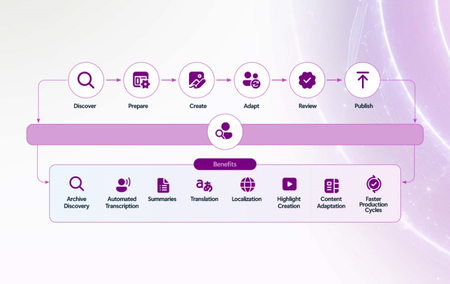
What orchestration changes Media workflows are already distributed across specialized creative, content, rights, archive, delivery, audience, and business systems. The technical challenge is not to replace those systems with one monolithic platform. It is to create an orchestration layer that can carry context, policy, and learning across them. In practice, orchestrated media intelligence connects four foundations: trusted data and metadata, specialized AI models and agents, scalable cloud infrastructure, and governance that follows every interaction. Agents can monitor state, retrieve context, recommend or initiate actions, and keep people informed. Human approval remains explicit for decisions involving creative intent, rights, brand, privacy, security, or material business impact. A reference pattern for connected media workflows Define the outcome and measurement model. Orchestration should begin with a specific business outcome, not a technology deployment. Teams should establish the workflow result they want to improve and the baseline against which progress will be measured. Telemetry should connect agent activity to outcomes such as time to market, localization cost, service reliability, incident response, inventory yield, engagement, and rights protection. The data, model, agent, and governance choices that follow are only valuable if they help achieve that result. Unify and enrich the data layer. Content assets, production metadata, rights information, operational telemetry, audience signals, and commercial data need consistent identity, access, lineage, and quality controls. Enrichment services can make archives searchable, connect live and historical context, and ground AI in enterprise knowledge. Coordinate models and agents. Different tasks require different capabilities, from language and vision models to media processing, speech, forecasting, optimization, and observability. An agent layer coordinates those capabilities, passes context between systems, and invokes workflows under defined permissions rather than treating each model as an isolated assistant. A practical example comes from Southworks, which developed an AI-powered quality control pipeline on Microsoft Azure. The solution combines deterministic media analysis with Azure AI Speech and Azure OpenAI so signal processing measures what happened, AI interprets whether a finding is meaningful, and an operator makes the final decision. This division of responsibility helps automate the first review while preserving human accountability. Embed security and governance. Identity, least-privilege access, rights enforcement, content provenance, privacy, policy, monitoring, and human review must be architectural components. Governance should travel with the data and action so an automated recommendation cannot bypass the controls that would apply to a person. How the pattern appears across the media lifecycle Creation and production: Galleri5’s AI Studio, powered by Microsoft Foundry, unifies multimodal capabilities across video generation, visual effects, 3D world building, storyboarding, asset generation, shot tracking, and post-production. Adobe extends this connected approach across creative and content supply chain workflows, while NVIDIA accelerated computing on Microsoft Azure provides the performance required for demanding generation, rendering, and visual-effects workloads. Together, these technologies connect creative tools with rights, approvals, brand controls, storage, and downstream production requirements. That connected workflow can also extend from production into rapid evaluation at scale. After rebuilding its LINK AI creative effectiveness platform on Azure, Kantar reduced ad-scoring time from as long as an hour to just a few minutes and enabled tens of thousands of ads to be evaluated within hours. Delivery and operations: Sanoma combined GPT-4o in Azure OpenAI, Finnish Meteorological Institute data, and Custom Neural Voice in Azure AI Speech to automate forecasts for 26 regions. Skyline Communications uses DataMiner and Microsoft Azure to provide a unified operational view across fragmented media systems, surface service insights, recommend actions, and optimize workflows in real time. NAGRAVISION adds an intelligence-led security layer: NAGRA Venturi turns multi-source piracy data into prioritized action so teams can focus on threats with the greatest business impact. Audience and content intelligence: The Premier League Companion demonstrates how Azure and Microsoft Foundry can connect archives, statistics, live match data, and audience context. Separately, MediaKind and Microsoft are connecting live production, delivery, and audience signals so personalized experiences remain responsive during live events. Protiviti’s Sport Performance Intelligent Platform uses Azure AI technologies to unify disparate sources and expose real-time insights through a conversational experience. Design principles for technical teams Start with a bounded, high-value workflow and a measurable business outcome. Design for composability, especially where high-value technology is evolving rapidly. Use published interfaces so components can be connected, adapted, or replaced as requirements change. Keep people in control of high-impact creative, rights, security, and commercial decisions. Make identity, policy, observability, and auditability consistent across agents and systems. Design context to move across lifecycle stages without exposing data beyond its permitted use. Test for reliability, quality, latency, cost, and safe failure, not only model performance. Moving from pilot to production A practical path begins by defining the outcome, establishing a baseline, and mapping the workflow, systems, decisions, data, and controls already in place. Teams can then identify one orchestration point where shared context removes a meaningful bottleneck and introduce agents behind explicit guardrails. As the workflow proves measurable value, the same trusted data, identity, governance, and observability foundation can support additional use cases. This is the technical promise of orchestrated media intelligence: not a single model or product, but a governed, composable system that helps specialized tools work together, allows people to retain accountability, and turns intelligence from isolated task assistance into a capability that improves across the media lifecycle. For the executive perspective and the three frontier use cases, read Silvia Candiani’s companion industry blog, Orchestrating Media Intelligence: Turning AI Potential into Business Value.