query
45 Topics
Access Query Problem
Good afternoon. I have been trying to track down a very strange error that my database has thrown for the first time ever... the query performs a complex math equation based on temperature, chlorine residual and pH time to compute the amount of time required to meet disinfection. This month the temerpature of the water has been historically high and the time required historically low. See the screenshot below. The math is evaluating the time required is greater than the time achieved (which it is not). The query is pasted below. I have recreated the math in excel and cannot duplicate this error. It seems exclusive to Access. When the formula evaluates as 10.0 the results are “YES” if the formula evaluates as 9.9 the result becomes “NO” but should be yes… Any advice would be greatly appreciated. Also, this post keeps getting flagged as SPAM... This is attempt number 5.. Fingers crossed.Solved299Views0likes5CommentsRun web queries
Hi, I am trying to import data from web but I have problems to use it. I am using an Excel version of Microsoft 365 on Mac. I have tried doing this without success: 1 st) Pate the url of the website from which I need the data on a word new document, leaving a few spaces. 2) I saved it as a .txt file and .txt file with the .ipy at the end of the name of the document. I saved it as MS or OS default (I've tried both). I saved it in the queries folder. (In there, are 2 .iqy documents that I didn't create it). 3) I opened a new excel file. I went to the data toolbar > Get external data > Run web query. It opened the Queries folder where appeared the file that I had created and these 2 files that I hadn't save it that I mentioned in 2. Here comes the problem: I can't select the files that I created. They are over there but they're impossible to select. Though I can select these 2 files and enter the data that are in it in my excel. But with my files, I just can't. Can someone help me with this?5.1KViews0likes3CommentsUnlocking AI-Driven Data Access: Azure Database for MySQL Support via the Azure MCP Server
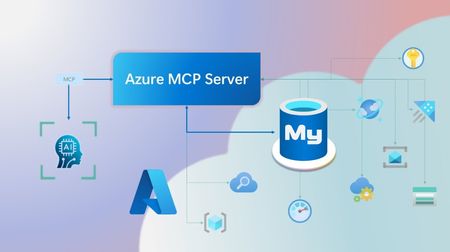
Step into a new era of data-driven intelligence with the fusion of Azure MCP Server and Azure Database for MySQL, where your MySQL data is no longer just stored, but instantly conversational, intelligent and action-ready. By harnessing the open-standard Model Context Protocol (MCP), your AI agents can now query, analyze and automate in natural language, accessing tables, surfacing insights and acting on your MySQL-driven business logic as easily as chatting with a colleague. It’s like giving your data a voice and your applications a brain, all within Azure’s trusted cloud platform. We are excited to announce that we have added support for Azure Database for MySQL in Azure MCP Server. The Azure MCP Server leverages the Model Context Protocol (MCP) to allow AI agents to seamlessly interact with various Azure services to perform context-aware operations such as querying databases and managing cloud resources. Building on this foundation, the Azure MCP Server now offers a set of tools that AI agents and apps can invoke to interact with Azure Database for MySQL - enabling them to list and query databases, retrieve schema details of tables, and access server configurations and parameters. These capabilities are delivered through the same standardized interface used for other Azure services, making it easier to the adopt the MCP standard for leveraging AI to work with your business data and operations across the Azure ecosystem. Before we delve into these new tools and explore how to get started with them, let’s take a moment to refresh our understanding of MCP and the Azure MCP Server - what they are, how they work, and why they matter. MCP architecture and key components The Model Context Protocol (MCP) is an emerging open protocol designed to integrate AI models with external data sources and services in a scalable, standardized, and secure manner. MCP dictates a client-server architecture with four key components: MCP Host, MCP Client, MCP Server and external data sources, services and APIs that provide the data context required to enhance AI models. To explain briefly, an MCP Host (AI apps and agents) includes an MCP client component that connects to one or more MCP Servers. These servers are lightweight programs that securely interface with external data sources, services and APIs and exposes them to MCP clients in the form of standardized capabilities called tools, resources and prompts. Learn more: MCP Documentation What is Azure MCP Server? Azure offers a multitude of cloud services that help developers build robust applications and AI solutions to address business needs. The Azure MCP Server aims to expose these powerful services for agentic usage, allowing AI systems to perform operations that are context-aware of your Azure resources and your business data within them, while ensuring adherence to the Model Context Protocol. It supports a wide range of Azure services and tools including Azure AI Search, Azure Cosmos DB, Azure Storage, Azure Monitor, Azure CLI and Developer CLI extensions. This means that you can empower AI agents, apps and tools to: Explore your Azure resources, such as listing and retrieving details on your Azure subscriptions, resource groups, services, databases, and tables. Search, query and analyze your data and logs. Execute CLI and Azure Developer CLI commands directly, and more! Learn more: Azure MCP Server GitHub Repository Introducing new Azure MCP Server tools to interact with Azure Database for MySQL The Azure MCP Server now includes the following tools that allow AI agents to interact with Azure Database for MySQL and your valuable business data residing in these servers, in accordance with the MCP standard: Tool Description Example Prompts azmcp_mysql_server_list List all MySQL servers in a subscription & resource group "List MySQL servers in resource group 'prod-rg'." "Show MySQL servers in region 'eastus'." azmcp_mysql_server_config_get Retrieve the configuration of a MySQL server "What is the backup retention period for server 'my-mysql-server'?" "Show storage allocation for server 'my-mysql-server'." azmcp_mysql_server_param_get Retrieve a specific parameter of a MySQL server "Is slow_query_log enabled on server my-mysql-server?" "Get innodb_buffer_pool_size for server my-mysql-server." azmcp_mysql_server_param_set Set a specific parameter of a MySQL server to a specific value "Set max_connections to 500 on server my-mysql-server." "Set wait_timeout to 300 on server my-mysql-server." azmcp_mysql_table_list List all tables in a MySQL database "List tables starting with 'tmp_' in database 'appdb'." "How many tables are in database 'analytics'?" azmcp_mysql_table_schema_get Get the schema of a specific table in a MySQL database "Show indexes for table 'transactions' in database 'billing'." "What is the primary key for table 'users' in database 'auth'?" azmcp_mysql_database_query Executes a SELECT query on a MySQL Database. The query must start with SELECT and cannot contain any destructive SQL operations for security reasons. “How many orders were placed in the last 30 days in the salesdb.orders table?” “Show the number of new users signed up in the last week in appdb.users grouped by day.” These interactions are secured using Microsoft Entra authentication, which enables seamless, identity-based access to Azure Database for MySQL - eliminating the need for password storage and enhancing overall security. How are these new tools in the Azure MCP Server different from the standalone MCP Server for Azure Database for MySQL? We have integrated the key capabilities of the Azure Database for MySQL MCP server into the Azure MCP Server, making it easier to connect your agentic apps not only to Azure Database for MySQL but also to other Azure services through one unified and secure interface! How to get started Installing and running the Azure MCP Server is quick and easy! Use GitHub Copilot in Visual Studio Code to gain meaningful insights from your business data in Azure Database for MySQL. Pre-requisites Install Visual Studio Code. Install GitHub Copilot and GitHub Copilot Chat extensions. An Azure Database for MySQL with Microsoft Entra authentication enabled. Ensure that the MCP Server is installed on a system with network connectivity and credentials to connect to Azure Database for MySQL. Installation and Testing Please use this guide for installation: Azure MCP Server Installation Guide Try the following prompts with your Azure Database for MySQL: Azure Database for MySQL tools for Azure MCP Server Try it out and share your feedback! Start using Azure MCP Server with the MySQL tools today and let our cloud services become your AI agent’s most powerful ally. We’re counting on your feedback - every comment, suggestion, or bug-report helps us build better tools together. Stay tuned: more features and capabilities are on the horizon! Feel free to comment below or write to us with your feedback and queries at AskAzureDBforMySQL@service.microsoft.com.535Views3likes0Comments
Sort in Query not Displaying
I have no clue how to word this. Basically, in a form I have a field called Members. This field is a drop down menu that lists all of the Members for a meeting via check boxes. I can then tick the checkboxes for the people who attended the meeting, click 'ok', and then when when I run the report, their names will appear. I don't need this information saved; just to display on the report so I can print it. Here's my problem. Not all of the members can vote, so I want the members who can vote listed first, and the rest of the members listed next. I've put in my custom sort formula in the Members query. When I open my Members dropdown box, they are listed exactly the way I want. However, as soon as I tick on the names and then click 'ok,' it's displayed in order of the primary key. When I run the report, the names are still sorted by the primary key. I've gone to every query and table I can find to create my custom sort, but it keeps defaulting to sorting by the primary key. It's driving me INSANE. Any idea why it's doing this? I've dug through google and haven't had luck finding an answer that works. Thanks in advance!Solved763Views0likes16Comments
Query error 3141
Yesterday I started my Microsoft 365 free trial. I created a database and made a query, when i tried to save the query i got error 3141"The SELECT statement includes a reserved word or an argument name that is misspelled or missing, or the punctuation is incorrect" but the spelling was correct. So i tried a new database and got the same error again when saving a query. This error happens with multiple different types of queries across multiple databases and when i download a database with a query already in it and copy the code from the already made query into a new query it still gives the error 3141 even though it works in an already made query. I assume this has something to do with my Microsoft Access. this is the query i made: SELECT * FROM ttblTraits;364Views0likes2CommentsI would like help writing a query to determine when people should follow up on a late shipment
Basically, I have a table that is a log for when issues of different magazines are received. Here are the fields: Title of the magazine Frequency (Monthly, bimonthly, annual, etc) Issue date (the date printed on the magazine) Received Date (The date the item was received) Expected Next Issue Date (Calculated field that figures out when the next issue should come in based on the Received Date and the Frequency) I want a query that, for each title, returns the record for the last issue that was received, but ONLY if it is after the "Expected Next Issue Date" for that record. For example, Time is Biweekly. So If they receive it January 1, and it is now January 15 and the next issue was not received, I want the query to return the record for the issue that was received on January 1, but not any of the issues that were returned before that (so not any issues that were received in December of the previous year). Right now I have a query that does that, but it requires the user to check off old issues as they receive things, which is not ideal. Any ideas on how to write a query that will do what I want?283Views0likes3Comments
KQL help Exchange Online
Hello, I need help in buildinga KQL Query as I'm fairly new to this. I have a set of 2 keyword list like Set 1 = "A","B","C" Set 2 = "1","2","3" I want a KQL Query that matches any combinations those 2 sets match. I have tried ("A" OR "B" OR "C") AND ("1" OR "2" OR "3") but that does not seem to work. Many Greetings Erik525Views0likes1CommentUsing KQL functions to speed up analysis in Azure Sentinel
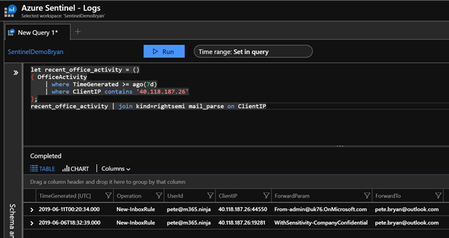
Security Operations can often be a very repetitive role. As a security analyst, you will often find yourself conducting the same actions and tasks as you work through an investigation. KQL functions in Azure Sentinel provide a way in which analysts can build up a collection of investigation tools to call upon quickly and simply.36KViews3likes4CommentsAccess Query Expressions not working: Replace, InStr
I am trying to run a relatively simple query and receive a compile error. The two fields involved are both text fields. SELECT Spouse, Replace(Spouse, Last, "") AS Result FROM SimplifiedTable; What this query should do is look at a text Spouse field, and, if the last name is present in it, replace it with blanks. Ideally, I would add an RTrim to the thing to just get the first name of the spouse. I have tried the same query with brackets around the fields, with tableName.fieldname, etcetera. No joy: Compile error. in query expression 'Replace(Spouse, Last, ""'. (It also errors if I try using single quotes -- is there an escape I should be using?) Additionally, I enlisted the assistance of AI and tried to do the same thing using InStr -- Here's a sample of other approaches attempted: SELECT Spouse, IIf(Spouse Like "*" & [Last] & "*", Left(Spouse, InStr(Spouse, [Last]) - 1), Spouse) AS Result FROM SimplifiedTable; SELECT Spouse, IIf(Spouse Like "*" & [Last] & "*", Left(Spouse, Len(Spouse) - Len([Last]) + 1), Spouse) AS Result FROM SimplifiedTable; Each of these queries received the same error message (the quoted text the only differentiator). If I run a select query on just the fields, or concatenate them, no problem. Thanks!1.2KViews0likes4Comments