pipelines
6 Topics
🎉 Announcing General Availability of AI & RAG Connectors in Logic Apps (Standard)
We’re excited to share that a comprehensive set of AI and Retrieval-Augmented Generation (RAG) capabilities is now Generally Available in Azure Logic Apps (Standard). This release brings native support for document processing, semantic retrieval, embeddings, and grounded reasoning directly into the Logic Apps workflow engine. 🔌 Available AI Connectors in Logic Apps Standard Logic Apps (Standard) had previously previewed four AI-focused connectors that open the door for a new generation of intelligent automation across the enterprise. Whether you're processing large volumes of documents, enriching operational data with intelligence, or enabling employees to interact with systems using natural language, these connectors provide the foundation for building solutions that are smarter, faster, and more adaptable to business needs. These are now in GA. They allow teams to move from routine workflow automation to AI-assisted decisioning, contextual responses, and multi-step orchestration that reflects real business intent. Below is the full set of built-in connectors and their actions as they appear in the designer. 1. Azure OpenAI Actions Get an embedding Get chat completions Get chat completions using Prompt Template Get completion Get multiple chat completions Get multiple embeddings What this unlocks Bring natural language reasoning and structured AI responses directly into workflows. Common scenarios include guided decisioning, user-facing assistants, classification and routing, or preparing embeddings for semantic search and RAG workflows. 2. Azure AI Search Actions Delete a document Delete multiple documents Get agentic retrieval output (Preview) Index a document Index multiple documents Merge document Search vectors Search vectors with natural language What this unlocks Add vector, hybrid semantic, and natural language search directly to workflow logic. Ideal for retrieving relevant content from enterprise data, powering search-driven workflows, and grounding AI responses with context from your own documents. 3. Azure AI Document Intelligence Action Analyze document What this unlocks Document Intelligence serves as the entry point for document-heavy scenarios. It extracts structured information from PDFs, images, and forms, allowing workflows to validate documents, trigger downstream processes, or feed high-quality data into search and embeddings pipelines. 4. AI Operations Actions Chunk text with metadata Parse document with metadata What this unlocks Transform unstructured files into enriched, structured content. Enables token-aware chunking, page-level metadata, and clean preparation of content for embeddings and semantic search at scale. 🤖 Advanced AI & Agentic Workflows with AgentLoop Logic Apps (Standard) also supports AgentLoop (also Generally Available), allowing AI models to use workflow actions as tools and iterate until the task is complete. Combined with chunking, embeddings, and natural language search, this opens the door to advanced agentic scenarios such as document intelligence agents, RAG-based assistants, and iterative evaluators. Conclusion With these capabilities now built into Logic Apps Standard, teams can bring AI directly into their integration workflows without additional infrastructure or complexity. Whether you’re streamlining document-heavy processes, enabling richer search experiences, or exploring more advanced agentic patterns, these capabilities provide a strong foundation to start building today.
Deploy Logic App Standard to storage account with private endpoints using Terraform
This blog provides examples on how to use Terraform and Azure DevOps to create standard Logic App to a storage account within private network. Here are the resources that will be created: VNET and subnets for Logic App and storage account Storage account and fileshare Private endpoints for storage file, blob, table and queue and the private DNS zones App service plan Application insight Standard Logic App with VNET intigration Private endpoint for Logic App and private DNS zone5.5KViews3likes1Comment
Deploy Logic App Standard with Application Routing Feature Based on Terraform and Azure Pipeline
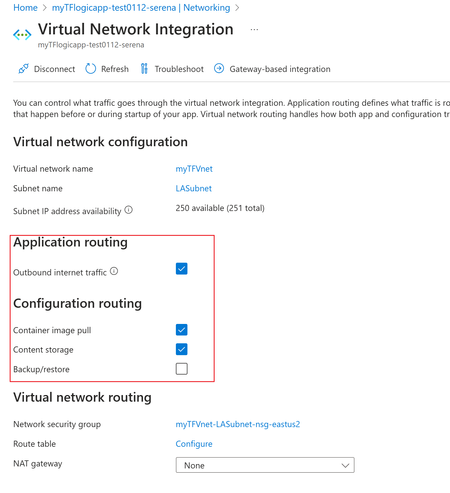
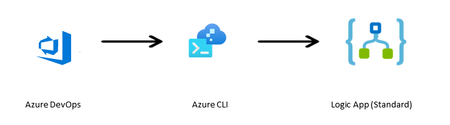
Due to Terraform's cross-cloud compatibility, automation, and efficient execution, among many other advantages, more and more customers use it to deploy integration solutions based on Azure Logic App standard. However, despite the extensive contributions from the community and individual contributors providing Terraform templates and supporting VNET integration solutions for Logic App standards, there are still very few terraform templates covering the "Application routing" and "Configuration routing" settings: This article shared a mature plan to deploy logic app standard then set the mentioned routing features automatically. It's based on Terraform template and Azure DevOps Pipeline. Code Reference: https://github.com/serenaliqing/LAStandardTerraformDeployment/tree/main/Terraform-Deployment-Demo About Terraform Template: Please kindly find the the template in directory Terraform/LAStandard.tf, it includes the terraform definitions for logic app standard, the backend storage account, application insights, virtual network and VNET integration settings. About VNET Routing Configuration Because there is no terraform examples available for VNET routing, we add VNET Settings by invoking "Patch" request to ARM RESTful API endpoint for interacting with logic app standard site: https://management.azure.com/subscriptions/<Your subscription id>/resourceGroups/$(deployRG)/providers/Microsoft.Web/sites/$(deployLA)?api-version=2022-03-01 We figured out the required request body in network trace as the following format: { "properties": { "vnetContentShareEnabled": false, "vnetImagePullEnabled": true, "vnetRouteAllEnabled": false, "vnetBackupRestoreEnabled": false } } Please find the YAML file in TerraformPipeline/logicappstandard-terraform.yml. Within the Yaml file , the "AzureCLI@2" task is used to send the request by Azure CLI command. task to send the patch request. Special Tips: To use the terraform task during Azure pipeline run, it's required to install terraform extension (which you can find in the following link): https://marketplace.visualstudio.com/items?itemName=ms-devlabs.custom-terraform-tasks Terraform tasks: Reference: Deploy Logic App Standard with Terraform and Azure DevOps pipelines https://registry.terraform.io/providers/hashicorp/azurerm/latest/docs/resources/app_service https://azure.microsoft.com/en-us/products/devops/pipelines496Views2likes0Comments
Deploy Workflows to Logic App Standard using AZ CLI Task in DevOps Pipeline with Append Option
The zipDeploy method used for Deploying Logic Apps Standard overwrites all/any existing files in the wwwroot folder. Set up DevOps for Standard logic apps - Azure Logic Apps | Microsoft Learn This tutorial is for using an Azure CLI task instead of the zipDeploy task, to give you flexibility on whether to overwrite the files/folder or not.3.8KViews2likes1Comment