excel on mac
2722 Topics
unpivot data and handle merged cells without using Power Query (Unpivot_Toolkit)
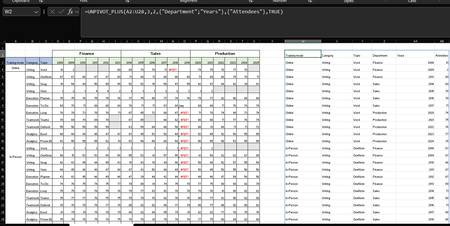
Hey, guys!! I’ve been working on a set of functional Excel Lambdas to solve a common headache: transforming "Wide" human-readable data into "Long" database formats without having to open Power Query every time. =UNPIVOT_PLUS(table, [no_of_cols], [no_of_headers], [attribute_names], [value_name], [remove_errors], [remove_blanks],[pad_blanks_with],[pad_errors_with]) Don’t worry about the full list, most use cases only require 5 arguments. I've included a table of default values at the end. Merged Cell Support: Automatically handles fill-down/fill-right logic for merged headers/columns. Bonus Helper: SPLIT_INJECT =SPLIT_INJECT(array, target_indices, delimiter, [ignore_empty], [match_mode], [pad_with]) It targets specific columns, splits them by a delimiter (like TEXTSPLIT), and expands the entire table horizontally while keeping all other columns perfectly stable. Optional arguments match TEXTSPLIT defaults. Feel free to tear this apart or adapt it for your own edge cases. I’d love to hear how you end up using it! You can grab both functions from my GitHub Gist https://gist.github.com/Medohh2120/f8553c149684e39bb499249e39f01017. File with use cases https://1drv.ms/x/c/6c310c8fd1669a94/IQCscpo3yh7jR5XdGZe2AQGyAf4-vCd8K6BvLZQgrP2V8Oo?e=gPdbOd Argument Description Default Behavior table The array or range of data to unpivot. Required argument (no default) [no_of_cols] Fixed left columns to keep as identifiers. 1 [no_of_headers] Top rows used as headers, handling merged cells. 1 [attribute_names] Header name for the unpivoted attributes . "Attribute" [value_name] Header name for the unpivoted values. "Value" [remove_errors] Excludes grid rows with formula errors. FALSE [remove_blanks] Removes grid empty cells and empty strings. TRUE [pad_blanks_with] Value to substitute for empty cells. Leaves cell blank [pad_errors_with] Value to substitute for errors. Leaves error as-is378Views2likes4CommentsExcel file problem
When I download an Excel file from iCloud (on my Mac laptop), I get a message saying: "We found a problem with some content in the file. Do you want us to try to recover as much as possible? Click "yes" if you trust the source of this workbook." I click yes, but the file then opens in a corrupted or unusable state. How can I retrieve the original file as it was before? Please recommend a solution.47Views0likes1Comment
Excel workbooks keep breaking
Hi All, Sorry if this is not the right place to ask, I'm new here. Since a couple of days, my Excel workbooks keep breaking. When opening specific files, Excel states the file needs to be repaired. Everytime certain formulas are being deleted and the values are just pasted as is. I haven't had any issues with these files in the past. Previously I used a license which I bought online via a third party. It seems the issues started after an update. I switched to a license which I bought directly from Microsoft. I did a clean installation, removed all the previous versions files but the issue still exists. For a couple of days I can open the files without problems. And then yesterday excel showed an update was available and excel had to be reopened. After doing so, the issues came up again. I have a Office Home 2024 License, Excel version 16.106.1, on macOS Tahoe 26.2. T.I.A102Views1like2Comments
File always corrupt
Anyone have the same problem with me? I use microsoft excel 365 on my mac. At the beginning everything alright, until i use formula and then save the file. When i want to re-open the file, the messagebox showed up "we found something wrong in your content...". It gives 2 option, yes and no. If i click no, the file wont open. If i click yes, the file open, the excel do the recovery, the file open but end up with all the formulas is gone, deleted by excel and just left the value. What should i do? Do the file can still be fixed?164Views0likes4Comments
Excel giving incorrect answer to simple multiplication
This is undoubtedly due to some quirk of Excel, but I was using Excel to illustrate how fast doubling increases things. I was using the old story about the person who would work for $ .01 for the first day, .02 for the second, .04 for the third, etc. My formula is essentially A2=A1*2 carried through 64 cells. The cells are all formatted as currency with two decimal points. The calculations are all correct until day 51. Day 49 = 5,629,499,534,213.12. Day 50 should end with $xxxxxxxx.24. Instead it ends with .20. Day 51 (should end with .48) ends with .50 and so on through the rest of the spreadsheet. This probably has something to do with floating-point calculations, but there should be a way for it to just work with the actual number.164Views0likes3Comments
No stocks button/option
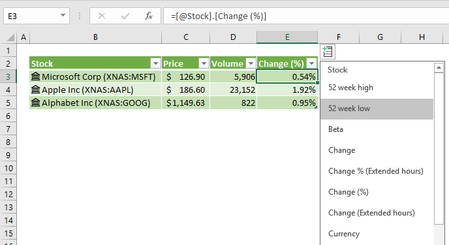
I have an active Microsoft 365 subscription through my Apple ID. But the Stocks button is completely missing from the Data tab. This issue occurs in both the Excel for Mac app (version 16.105.3) and Excel Online. My privacy settings for "Connected Experiences" are all enabled. I've already run the Office License Removal Tool and logged in again, but to no avail. Since the feature is also missing in the web version, it appears to be an issue with my Microsoft account configuration itself. Microsoft support can't see my settings and refers me to this forum. Does anyone have any ideas?124Views0likes2CommentsExcel for mac - Stocks data doesnt work
I was never able to get the Share Price or any other fields auto fill in Excel for Mac. It works fine on Windows or Cloud based Excel but not on a macbook. None of the options like Price, Volume... work. I tried to copy paste the formula for those fields from Office 365 to Mac but they never worked. Any ideas?11KViews0likes6Comments