excel on mac
2727 Topics
File always corrupt
Anyone have the same problem with me? I use microsoft excel 365 on my mac. At the beginning everything alright, until i use formula and then save the file. When i want to re-open the file, the messagebox showed up "we found something wrong in your content...". It gives 2 option, yes and no. If i click no, the file wont open. If i click yes, the file open, the excel do the recovery, the file open but end up with all the formulas is gone, deleted by excel and just left the value. What should i do? Do the file can still be fixed?214Views0likes5Comments
Excel repair strips all formulas from large .xlsm after March 2026 security update (KB5002849)
Hi everyone, I'm a master's student at Karolinska Institutet in Stockholm. My thesis is a health economic cost-effectiveness model built entirely in Excel — a gender-neutral static Markov cohort model with 34 worksheets. The file has become completely unusable after what I believe is the March 2026 security update, and I'm running out of options. The file: - .xlsm, ~46.5 MB compressed, ~370 MB uncompressed XML - 34 worksheets, four of which are 73–92 MB each (Markov trace sheets) - ~65,000 formulas, ~33,500 shared formulas - Heavy use of LET, LAMBDA, XLOOKUP, XMATCH, CHOOSECOLS, TAKE, MAP, SWITCH - 771 defined names including ~147 hidden _xlpm.* LET/LAMBDA variable placeholders - Stored on OneDrive via KI SharePoint, 34,000+ AutoSave revisions - Contains VBA (vbaProject.bin) The problem: Every time I open the file — on Excel for Mac or Excel Online — the repair engine triggers and strips ALL formulas from every sheet, replacing them with cached values. The file shrinks from ~46.5 MB to ~26 MB. Clicking "No" on the repair dialog just closes the file. There is no way to bypass the repair. What I've verified: - Extracted the .xlsm as a ZIP and confirmed all formulas (<f> tags) are fully intact in the raw XML - Libr€Office Calc can read the formulas but cannot execute them (Err:508 — no LET/LAMBDA support) - Removed 158 broken named ranges (#REF! and #NAME? entries) from workbook.xml and rebuilt the archive — repair engine still strips all formulas - The issue reproduces on every OneDrive version history copy (up until I largely used LET formulas in my sheets - but there is still 1,5months of changes lost) - The issue reproduces on both Excel for Mac and Excel Online Suspected cause: The March 10, 2026 security update (KB5002849) patched CVE-2026-26108, a heap overflow in Excel's file parsing during loading. The same patch was applied to Office Online Server (KB5002846). I believe the tightened parsing now rejects or flags my file's large XML structures as potentially malicious, triggering the repair engine to strip all formulas. This is consistent with: - The known _xlfn. namespace bug on Excel for Mac (reported by multiple users on Microsoft Q&A since late 2024) - The timing - the file was working before this update flawlessly up until March 16th - The fact that Excel Online is also affected (same server-side patch) My questions to the community: 1. Has anyone else experienced formula stripping on large workbooks after the March 2026 update? 2. Is there a way to bypass the repair engine on Mac, or roll back the specific security patch without downgrading all of Office? 3. Would opening this file on Windows Excel (pre-patch or current) preserve the formulas? If anyone with a Windows PC would be willing to try opening and re-saving this file, I would be incredibly grateful. 4. Is there now effectively a size/complexity ceiling for Excel workbooks that makes models like this unviable? If so - should I be migrating this to another environment (R, Python, etc.) going forward? This file represents six months of thesis work. The formulas are all there in the XML. I just need Excel to stop destroying them on open. Any help, pointers, or similar experiences would be hugely appreciated. Thank you, Florian Boschek6Views0likes0Comments
Excel says two numbers are not equal
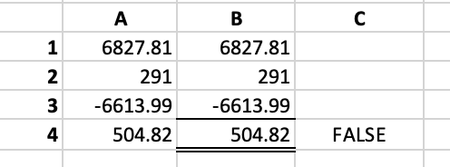
Column A are numbers typed into the cells. Column B, the numbers in B1 to B3 are also typed in. Cell B4 is SUM(b1:b3) C4 is =B4=A4 Can someone please explain why excel is saying the two numbers in A4 & B4 are not equal. I understand about using rounding or truncation with large calculations but I've never seen anything like this on such a simple calculation. I've tried this on a new spreadsheet and the results are the same. I am using Excel Version 16.109 (26033013) on a Mac. Thank you for your help.62Views0likes1Comment
How to keep the result of the formula from appearing down the column before a number is added
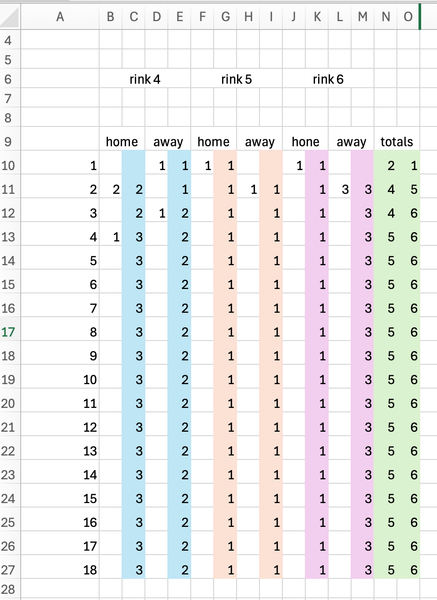
I wish to produce a Teams running score sheet for lawn bowls. When each team (rink) has finished their end the score for either the H or A team is entered. When the next end is finished again the score is entered for the winning team. I am using an IF function in each of the coloured cells: =IF(B13="",C12,B13+C12) This works well, however the result of C?? runs down the entire column as cells in column B are blank waiting for the scores to be added. How can I fix this so the scores show for the rows only and not the entire column. Formula for the TOTALS column is =C10+G10+K1069Views0likes3Comments
Payroll Spreadsheet
I need to create a payroll spreadsheet that I can organize by day of the week, Thursday thru Wednesday with each employees name listed under each day, the column would be how many hours they worked that day, and I would need the column to automatically multiply the number of hours by the hourly rate that each individual employee earns, I'm new to excel, please help. I have attached the very basic version that I've been having to use in word, excel doing the calculations would be much faster and more accurate. Thanks so much !!!Solved1.6KViews0likes3Commentsmac Excel: can't select form Group Box
Hi, I'm using Excel 16.107 on a Mac. I have Developer mode enabled and placed form elements, including group boxes. What I've found is if I delete the text label for a group box, the group box then becomes impossible to select -- there's nothing to click on with my pointer. See attached. Any attempt merely selects the cell, not the group box. How can I select group boxes like this, so that I can delete it or edit its properties?Solved90Views0likes2Commentsunpivot data and handle merged cells without using Power Query (Unpivot_Toolkit)
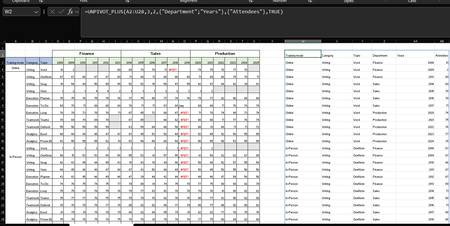
Hey, guys!! I’ve been working on a set of functional Excel Lambdas to solve a common headache: transforming "Wide" human-readable data into "Long" database formats without having to open Power Query every time. =UNPIVOT_PLUS(table, [no_of_cols], [no_of_headers], [attribute_names], [value_name], [remove_errors], [remove_blanks],[pad_blanks_with],[pad_errors_with]) Don’t worry about the full list, most use cases only require 5 arguments. I've included a table of default values at the end. Merged Cell Support: Automatically handles fill-down/fill-right logic for merged headers/columns. Bonus Helper: SPLIT_INJECT =SPLIT_INJECT(array, target_indices, delimiter, [ignore_empty], [match_mode], [pad_with]) It targets specific columns, splits them by a delimiter (like TEXTSPLIT), and expands the entire table horizontally while keeping all other columns perfectly stable. Optional arguments match TEXTSPLIT defaults. Feel free to tear this apart or adapt it for your own edge cases. I’d love to hear how you end up using it! You can grab both functions from my GitHub Gist https://gist.github.com/Medohh2120/f8553c149684e39bb499249e39f01017 File with use cases https://1drv.ms/x/c/6c310c8fd1669a94/IQCscpo3yh7jR5XdGZe2AQGyAf4-vCd8K6BvLZQgrP2V8Oo?e=gPdbOd Argument Description Default Behavior table The array or range of data to unpivot. Required argument (no default) [no_of_cols] Fixed left columns to keep as identifiers. 1 [no_of_headers] Top rows used as headers, handling merged cells. 1 [attribute_names] Header name for the unpivoted attributes . "Attribute" [value_name] Header name for the unpivoted values. "Value" [remove_errors] Excludes grid rows with formula errors. FALSE [remove_blanks] Removes grid empty cells and empty strings. TRUE [pad_blanks_with] Value to substitute for empty cells. Leaves cell blank [pad_errors_with] Value to substitute for errors. Leaves error as-is489Views2likes5CommentsXLOOKUP disappeared
I have Excel for Mac version 16.80 (23121017) under Microsoft 365 Subscription, license provided by my university. I remember using XLOOKUP before, but it's been a few months since I've opened an excel file. Now it seems to be gone (had `_xlfn` prefix in a file with it, removing it results in NAME ERROR, and XLOOKUP is not suggested in the formula dropdown list). Where did it go? Shouldn't it be available to me on this Excel version? P.S. Same with SEQUENCE now I see. P.P.S. These function are shown in the Excel Help window, making this even more annoying somehow.2.2KViews1like2Comments