endpoint manager
26 TopicsImplementing Intune RBAC and Scope Tags for Zero Trust and Least Privilege
If you’re rolling out Microsoft Intune at scale, the hardest part usually isn’t creating policies—it’s making sure the right people can manage the right things, without turning every admin account into a “keys to the kingdom” risk. In this guide, you’ll learn how to use Intune RBAC and Scope Tags to enforce least privilege, build clear management boundaries by region/agency/environment, and pair device compliance with Entra Conditional Access to strengthen a Zero Trust posture—plus a practical RACI approach so ownership stays clear as your environment grows. TL;DR Use Intune RBAC to align admin permissions to job responsibilities, reducing standing privilege and limiting who can change policies, apps, and security settings. Use Scope Tags to create visibility/management boundaries (region, agency, environment) so admins only see and manage what they own. Pair Intune compliance + Entra Conditional Access to enforce “access only from compliant devices / protected apps,” which supports a Zero Trust posture. Establish a RACI model so ownership is explicit across Endpoint, Identity, Security, Apps, AD, Help Desk, and Compliance teams. Track outcomes (compliance rates, blocked risky sign-ins, RBAC audit events, scope boundary effectiveness, GPO migration progress) and review on a regular cadence. Zero Trust and Least Privilege in Modern Endpoint Management Zero Trust is an approach to security that treats every access attempt as untrusted until it is proven otherwise. Rather than relying on “inside the network = safe,” organizations evaluate each request using signals such as user identity, device health, location, and risk, and they re-check those signals over time. In an endpoint program, Microsoft Intune supports this model by establishing device compliance, applying app protection where appropriate, and working with Conditional Access so that access decisions can depend on verified user and device posture. A practical way to describe Zero Trust is through three recurring themes: (1) make access decisions using explicit verification (strong authentication plus context and risk signals), (2) minimize privilege by granting only the access needed and reducing standing admin rights where possible, and (3) design for compromise by limiting lateral movement and reducing the impact of any single breach. These concepts align with Microsoft’s published Zero Trust guidance. Role-Based Access Control (RBAC) in Intune allows organizations to delegate administrative permissions based on roles, responsibilities, and scope. For modern endpoint environments, RBAC ensures that only authorized personnel can manage devices, deploy configurations, or access sensitive data, which is a foundational control in a Zero Trust model where access is granted based on least privilege and verified identity. By combining Intune's RBAC capabilities with Scope Tags, organizations can create visibility boundaries that align with their organizational structure, whether by region, department, business unit, or function. This prevents over-allowing permissions by assigning only the rights needed for each role, supports Zero Trust by enforcing least privilege and role-based access, and improves operational security by limiting who can manage devices and policies. Understanding Intune RBAC Roles and Permissions Microsoft Intune provides nine built-in RBAC roles designed to address common administrative scenarios. Each role has predefined permissions that determine what actions users can perform within the Intune environment, helping organizations delegate administrative tasks while maintaining control over access to sensitive information. The built-in roles include Intune Administrator with full access to all Intune features and settings (This role should not be used for every day management tasks and should be limited to only a few individuals who would be responsible for performing more elevated tasks in the Intune Portal), Policy and Profile Manager who manages device configuration profiles and compliance policies, Application Manager who manages mobile and managed applications, Endpoint Security Manager who manages security and compliance features, Help Desk Operator who performs remote tasks on users and devices, Read-Only Operator with view-only access, School Administrator for Windows 10 devices in Intune for Education, Intune Role Administrator who manages custom roles and assignments, and Cloud PC roles for managing Cloud PC features and Windows Autopatch roles for managing updates. Built-in Role Primary Permissions Use Case Application Manager Manages mobile and managed applications, app configuration policies, and app protection policies Teams responsible for deploying and managing organizational apps across devices Policy and Profile Manager Manages device configuration profiles, compliance policies, and conditional access policies IT administrators configuring device settings and ensuring compliance across the organization Endpoint Security Manager Manages security baselines, endpoint detection and response, and BitLocker policies Security teams focused on device protection and threat mitigation Help Desk Operator Performs remote tasks including device restart, password reset, and remote lock First-line support staff assisting end users with device issues Read-Only Operator View-only access to all Intune data and reports without modification rights Auditors and stakeholders needing visibility without administrative capabilities Beyond built-in roles, Intune supports custom roles that allow administrators to define specific permissions for users or groups based on their responsibilities. Custom roles enable fine-grained access control by selecting granular permissions for each role, ensuring users have access only to the features and data they require. For example, a custom role could grant only the 'Rotate local administrator password' permission to a specific Helpdesk Managers group, demonstrating the principle of least privilege in action. Create Custom Roles Login to the Intune Admin Portal with the Intune Administrator Role and navigate to Tenant Administration> Roles > All Roles > Create then select the type of role you want to create. I will select “Intune Role” Give your Custom Role a Name and a brief description. Scroll through the list of permissions as they will all be set to no by default and select the permissions relevant to the responsibility of the custom role. If you have already created your Scope Tag add it here, then review and select create Once the role is created you can select the new role and create an assignment. Give it a name and description, then select the admin group to be assigned to the role. Add the groups that the role will be managing. Add your relevant Scope Tags then select create. To take things one step further I would recommend leveraging Privileged Identity Management (PIM) for groups so that you can leverage Just-in-Time Assignments for the Intune roles. One last note on custom roles if you do not want to start from scratch with the permission sets, you can also duplicate a built-in role and modify the permissions as needed. Just select the 3 dots to the right of the role and select Duplicate Implementing Scope Tags for Distributed IT Management Scope Tags are labels that help control what different admins can see and manage in Microsoft Intune. By adding scope tags to Intune items like configuration profiles, apps, policies, or device groups and assigning the same labels to admins, organizations create clear boundaries, so each admin only sees the devices and settings they are responsible for. This capability is essential for distributed IT environments where different teams manage different locations, departments, or business units. Every Intune tenant includes a default scope tag that is automatically applied to all objects and admins, ensuring everything continues working smoothly even without custom tags configured. The key benefits of using scope tags include enabling distributed IT management by allowing regional or departmental admins to manage their specific resources, controlling access by limiting admin visibility to specific resources, enhancing security by preventing unauthorized access, improving organization by grouping resources by scope, and providing flexibility to support multiple administrative models. Scope tags work together with RBAC role assignments through three components: the role defining what actions admins can perform, scope tags determining which objects admins can see, and scope groups limiting which users and devices they can affect. Common use cases for scope tags include managed service providers limiting access to specific customer resources, regional IT administrators ensuring teams only manage and see objects relevant to their region, separating testing versus production environments when a dedicated test tenant is not available, and separating Azure Virtual Desktop resources for AVD administrators. Creating Scope Tags While still under Tenant Administration> Roles select Scope Tags Then Create. Give it a name and description. Assign the proper groups then select create. If this is all implemented properly, the admin will only be able to see items and devices that have the Scope tag that has been assigned to their role. Here are views of the apps in my tenant when signed in as a Intune Administrator (which Scope tags do not apply t And here are the same views when logged in with an admin with the iOS admin role that we created. Establishing a RACI Model for Intune Management While establishing a RACI model is not something done in the Intune portal, it is crucial in my opinion for enterprise customers since Intune covers such a vast number of capabilities that should not all be done by one team if we are practicing least privilege and zero trust. A RACI matrix is a powerful tool for defining organizational roles and responsibilities, identifying who is Responsible, Accountable, Consulted, and Informed for each activity. In Microsoft Intune management, implementing a RACI model eliminates ambiguity about which teams handle security policies, application management, patch compliance, Conditional Access, and GPO migration. The RACI framework defines four key roles: Responsible individuals execute the task or deliverable, Accountable is the single person ultimately answerable for correct completion and decision-making authority, Consulted are experts or stakeholders whose feedback is sought during the task, and Informed are those kept up to date on progress or decisions without actively contributing. For Intune environments, a well-designed RACI matrix promotes organizational alignment by mapping all key stakeholders across central IT and individual agencies or departments, clarifies decision rights by defining who approves, who executes, and who provides input for each Intune activity, ensures accountability by assigning a single accountable party for each deliverable to prevent diffusion of responsibility, and improves communication by identifying upfront who needs to be consulted and kept informed. Based on internal implementation experience and with Microsoft Federal customers, organizations should list deliverables not just activities, define roles not individual names to ensure the matrix remains relevant as people change positions, enforce exactly one Accountable person per task, assign Responsible, Consulted, and Informed roles thoughtfully, validate in a short review session, publish where work happens, and evolve the matrix as the project evolves. RACI Matrix for Security Policies and Compliance The following are just generic examples of some of the workloads and how they could be managed with a RACI matrix. Security policies and compliance management in Intune require clear ownership across multiple teams. Organizations must define who creates compliance policies requiring device encryption and minimum OS versions, who deploy security baselines like the Microsoft Defender for Endpoint Security Baseline, who manages Conditional Access policies that require device compliance, and who responds to non-compliant devices. A typical RACI model for security policies assigns the Cloud Security Team as Accountable for overall security policy strategy and compliance requirements, the Endpoint Team as Responsible for creating and deploying compliance policies and security baselines in Intune, the Application Team as Consulted for application-specific security requirements, the Help Desk as Informed about policy changes that may affect device compliance status, and the Compliance Team as Consulted to ensure policies meet regulatory requirements and as Informed about compliance status reports. For patch management and application compliance, the RACI model shifts slightly with the Endpoint Team becoming Accountable for patch deployment strategy and timing, the Application Team becoming Responsible for testing application compatibility with updates, the Help Desk becoming Responsible for addressing user-reported issues after patches, and the Cloud Security Team becoming Consulted for security update prioritization. Organizations implementing Windows Autopatch benefit from Microsoft managing problematic quality and feature update deployment cancellations using telemetry, automatically splitting devices into rings based on percentage of total devices, and managing patching behavior for Windows, Microsoft 365 Apps, Edge, Teams, and Drivers. This shifts some Accountable and Responsible designations to Microsoft while keeping internal teams Informed and Consulted. Intune Activity Accountable Responsible Consulted Informed Security Policy Creation Cloud Security Team Endpoint Team Application Team, Compliance Team Help Desk Compliance Policy Deployment Cloud Security Team Endpoint Team Compliance Team Help Desk, Application Team Security Baseline Management Cloud Security Team Endpoint Team Application Team Help Desk, Compliance Team Patch Management Strategy Endpoint Team Application Team Cloud Security Team Help Desk, Compliance Team Non-Compliance Response Cloud Security Team Endpoint Team, Help Desk Compliance Team Application Team Application and Conditional Access Management Responsibilities Application management and Conditional Access in Intune span multiple organizational functions requiring coordinated responsibility. For application lifecycle management, the Application Team is both Accountable and Responsible for deployment strategy, app protection policies, creating and testing app packages and configurations. The Endpoint Team is Consulted for deployment targeting and device compatibility, while the Help Desk is Informed about new applications and support procedures. For Conditional Access policy management, multiple teams coordinate their expertise. The Cloud Security Team is Accountable for overall Conditional Access strategy and Zero Trust implementation. The Endpoint Team is Responsible for ensuring device compliance status feeds correctly into Conditional Access decisions. The Identity Team is Responsible for configuring Conditional Access policies in Microsoft Entra ID. The Application Team is Consulted about application-specific access requirements, and the Help Desk is both Informed about access restrictions and Responsible for assisting users blocked by Conditional Access policies. Conditional Access integration with Intune creates a powerful Zero Trust security model where Intune evaluates device compliance based on compliance policies, compliance status is reported to Microsoft Entra ID, Conditional Access policies check device compliance status, and access is granted or blocked based on compliance status. For mobile application management, the Application Team is both Accountable and Responsible for app protection policies including data protection settings, access requirements like PIN and biometric authentication, and integration with Conditional Access. The Cloud Security Team is Consulted for security requirements, and the Endpoint Team is Informed about app-level controls that complement device-level policies. GPO Migration to Intune: Roles and Responsibilities Migrating Group Policy Objects from on-premises Active Directory to Microsoft Intune represents a critical transformation requiring clear ownership and phased execution. The migration process uses Group Policy Analytics, a built-in tool in Intune that analyzes on-premises GPOs by importing them as XML exports and translating them against the Settings Catalog to determine which policies are supported, deprecated, or unsupported in Intune. Organizations export GPOs from the Group Policy Management Console by right clicking the GPO, selecting Save Report, and saving as XML format. After importing to Intune via Devices > Group Policy Analytics, the tool generates a percentage-based report showing exactly how many settings have a direct 1:1 mapping to modern Intune settings. The Group Policy Analytics tool categorizes settings into three distinct types: Supported settings that have a direct counterpart in Intune and can be migrated via Settings Catalog policies, Deprecated settings no longer applicable to modern Windows versions, and Not Supported settings that do not currently have a CSP mapping and often require alternative management methods like PowerShell scripts or Proactive Remediations. Approximately 45% of GPOs can be successfully migrated to Settings Catalog, 30% require alternative approaches via PowerShell remediations, and 25% can be deprecated and retired based on typical migration outcomes. RACI Model for GPO Migration For the RACI model, the Endpoint Team is Accountable for the overall GPO migration strategy and timeline, the Active Directory Team is Responsible for exporting GPOs and documenting current policy structures, the Application Team is Consulted to validate that application-specific GPOs migrate correctly and that applications continue functioning, the Cloud Security Team is Consulted to ensure migrated policies maintain security posture, and the Help Desk is Informed about changes to device configurations and becomes Responsible for user communication about policy transitions. Integrating Conditional Access with Device Compliance Conditional Access integration with Intune device compliance creates an additional layer of security by enforcing access controls based on device compliance status and app protection policies. This integration ensures that only compliant devices and protected apps can access organizational resources, forming a cornerstone of Zero Trust architecture. Device-Based Conditional Access Implementation Device-based Conditional Access uses device compliance status from Intune to control access to organizational resources through a four-step process: Intune evaluates device compliance based on compliance policies Compliance status is reported to Microsoft Entra ID Conditional Access policies check device compliance status Access is granted or blocked based on compliance status To implement device compliance Conditional Access, organizations first create and assign device compliance policies in Intune requiring elements like BitLocker encryption, Microsoft Defender antivirus enabled, Windows Firewall enabled, and minimum OS version requirements. Then in the Microsoft Entra Admin Center under Security > Conditional Access, administrators create policies specifying: Users as target groups like Corporate Users Cloud apps as All cloud apps or selected Microsoft 365 apps Device platform as Windows or other platforms Access control requiring device to be marked as compliant Measuring Success and Continuous Improvement Organizations implementing Intune RBAC and Scope Tags should establish metrics to measure success and identify areas for continuous improvement. Key performance indicators include percentage of devices compliant with security policies, time to resolve non-compliance issues, number of unauthorized access attempts blocked by Conditional Access, percentage of GPOs successfully migrated to Intune Settings Catalog, and administrative efficiency measured by reduction in time spent on routine management tasks. Compliance reporting in Intune provides visibility into device compliance status across the organization, with reports showing compliant versus non-compliant devices, specific compliance policy violations, and trends over time. Organizations typically see compliance rates improve from a 65% baseline to 95% or higher within 12 months of implementing proper RBAC roles and Scope Tags. This improvement results from clearer ownership, faster policy deployment, and more focused administrative oversight. Conditional Access sign-in logs in Microsoft Entra ID reveal which access attempts are granted or blocked, the reasons for access decisions, and patterns of risky sign-ins that may indicate compromised credentials or devices. For RBAC effectiveness, organizations should monitor audit logs to track which administrators are performing which actions, identify any privilege escalation attempts or suspicious administrative activity, and ensure separation of duties is maintained. Scope tag effectiveness can be measured by confirming that administrators only see resources within their designated scope, tracking incidents where admins requested access outside their scope, and validating that regional or departmental segregation is working as intended. Organizations should establish a regular review cadence with monthly compliance and security posture reviews, quarterly RBAC and Scope Tag access reviews, bi-annual GPO migration progress assessments, and annual Zero Trust maturity assessments. Disclaimer All screenshots are from a non-production lab environment and can/will vary per environment. All processes and directions are of my own opinion and not of Microsoft and are from my years of experience with the Intune product in multiple customer environments References Role-based access control (RBAC) with Microsoft Intune - Microsoft Intune | Microsoft Learn Use role-based access control (RBAC) and scope tags for distributed IT - Microsoft Intune | Microsoft Learn Aligning responsibilities across teams - Cloud Adoption Framework | Microsoft Learn How to Require Device Compliance with Conditional Access - Microsoft Entra ID | Microsoft Learn Configuring Microsoft Intune just-in-time admin access with Azure AD PIM for Groups | Microsoft Community Hub
Microsoft Store-App (Legacy) - Url for Endpoint Manager
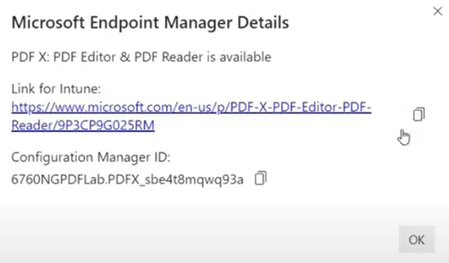
Hello Everyone, can anybody tell me, where i can find the "Appstore-Url" for every app within the MS App Store. In the past you were able to find it under the headliner "Developer and IT" --> Endpoint Manager. The link should look something like this: I want to deploy some apps via Microsoft Store-App (legacy) Thanks a lot!5.3KViews0likes4Comments
Intune Device Kiosk
Hi, I'm fairly new to using Intune and Autopilot, my company have several old laptops that we want to utilise as training laptops across multiple business units, We currently use M365 with Intune/ Endpoint manager. I am looking to set these up as kiosk devices so they are restricted to 1 or 2 applications and want to have everything managed through Intune. However I can't seem to find how to best set this up. Would it be best to purchase a licence for 1 user and then log that user onto multiple devices or is possible to have multiple devices using 1 Intune device licence. Thanks686Views0likes2CommentsMicrosoft Intune in GCC and GCC High Overview + CMMC Applications
Organizations can meet CMMC compliance for specific practices across several different domains using Microsoft Intune in GCC or GCC High in combination with configuration settings and policies in Azure Government and Microsoft Defender for Endpoint.16KViews2likes3CommentsIntune Fresh start Windows not loading
Hello everyone, One of our company devices is currently unable to load Windows. I'm looking to perform a fresh start via Intune, but due to Windows failing to load, this isn't feasible at the moment. As we're operating remotely, I attempted to guide my colleague through a Windows recovery process. We tried a local recovery, but unfortunately, it was unsuccessful. Cloud recovery isn't an option either because she lacks a LAN cable and can't connect to the internet. Is our only viable solution to manually reinstall Windows?1.6KViews0likes1Comment
Endpoint Fraud / Stalking
Hi everyone Im not a developer however I have a complicated crazy situation where all my devices were auto enrolled in an MDM without my consent which I believe someone I used to know did to stalk me , for the past 6 months Ive tried to figure it out as It makes me have very little privlidges and it auto deploys on brand new devices , It also refuses to ping back to anything but still under full control , I believe its controlled via azure and a server domain I tried to see if I had an azure account even though I never made one and I somehow have one but everything says unknown and a bunch of errors on everything I try to access does anyone have any advice for how to go about this ? Also note I never was a part of an enterprise of any kind1.6KViews0likes2Comments
Move Hybrid Azure AD Devices to Intune
Hello, we have already a lot of devices on our azure active directory (AD) registered. We want move them to Intune / Autopilot without generating hardware hashes. Is it possible? To move existing Azure AD Devices to the Microsoft Intune Center? And how we can solve this problem? Thanks a lot Best Regards NY1.8KViews0likes2Comments
Ability to enrol Win 10 Enterprise multisession to Intune?
Hi all, We've got an AVD Win 10 Enterprise Multisession machine that's joined to Azure AD but we want enrolled to Intune/Endpoint manager. I can't figure out how we can do this on this OS. Any help appreciated - thanks!1.1KViews0likes1Comment
Shared Device / Encryption and Admin
I am deploying a few machines as shared devices as described here: https://learn.microsoft.com/en-us/mem/intune/configuration/shared-user-device-settings Can anyone help me clarify if I can deploy a Bitlocker configuration profile to these devices, as they will only be operated by standard users? I'm also wondering what the best practice is for local admin rights. For just a couple of machines I have software that won't deploy nicely so was wondering how to do a local install on the machines? I also have something that needs elevated rights when run as a standard user. This is not my field of expertise and I'm struggling to find answers online, so perhaps I'm asking the wrong questions! Grateful for any guidance!923Views0likes0CommentsIntune 403 error - When accessing InTune Portal
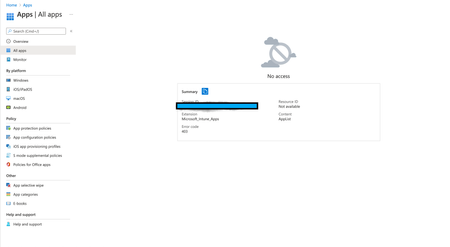
Hi Intune Community, I have two users who I have given them the Application Manager role with full access, under Tenant Admin --> MEM roles but they are receiving following access error when they try to reach Intune/Endpoint Manager: I read https://techcommunity.microsoft.com/t5/microsoft-intune/401-and-403-error-when-logging-into-endpoint-admin-center/m-p/1713817#M5226 link, which does not apply to our environment. As we already have the MDM set-up and running. Any thoughts/help appreciated.Solved66KViews0likes8Comments