DevOps
174 Topics
Azure File copy task v4 and later causes 403 error
I've configured a release pipeline in ADO which copies some files to a Storage Account. Using Azure File copy task version 6 consistently fails with a 403 error. RESPONSE Status: 403 This request is not authorized to perform this operation using this permission. After much wasted time checking IP restrictions, checking access and recreating service connections I tried using an earlier version of the task that some other pipelines which do the same thing were using. I found that using version 4 or later of the file copy task causes the issue. Setting the task version to 3 works. Are there any known issues around this?Solved48Views0likes1CommentApplying DevOps Principles on Lean Infrastructure. Lessons From Scaling to 102K Users.
Hi Azure Community, I'm a Microsoft Certified DevOps Engineer, and I want to share an unusual journey. I have been applying DevOps principles on traditional VPS infrastructure to scale to 102,000 users with 99.2% uptime. Why am I posting this in an Azure community? Because I'm planning migration to Azure in 2026, and I want to understand: What mistakes am I already making that will bite me during migration? THE CURRENT SETUP Platform: Social commerce (West Africa) Users: 102,000 active Monthly events: 2 million Uptime: 99.2% Infrastructure: Single VPS Stack: PHP/Laravel, MySQL, Redis Yes - one VPS. No cloud. No Kubernetes. No microservices. WHY I HAVEN'T USED AZURE YET Honest answer: Budget constraints in emerging market startup ecosystem. At our current scale, fully managed Azure services would significantly increase monthly burn before product-market expansion. The funding we raised needs to last through growth milestones. The trade: I manually optimize what Azure would auto-scale. I debug what Application Insights would catch. I do by hand what Azure Functions would automate. DEVOPS PRACTICES THAT KEPT US RUNNING Even on single-server infrastructure, core DevOps principles still apply: CI/CD Pipeline (GitHub Actions) • 3-5 deployments weekly • Zero-downtime deploys • Automated rollback on health check failures • Feature flags for gradual rollouts Monitoring & Observability • Custom monitoring (would love Application Insights) • Real-time alerting • Performance tracking and slow query detection • Resource usage monitoring Automation • Automated backups • Automated database optimization • Automated image compression • Automated security updates Infrastructure as Code • Configs in Git • Deployment scripts • Environment variables • Documented procedures Testing & Quality • Automated test suite • Pre-deployment health checks • Staging environment • Post-deployment verification KEY OPTIMIZATIONS Async Job Processing • Upload endpoint: 8 seconds → 340ms • 4x capacity increase Database Optimization • Feed loading: 6.4 seconds → 280ms • Strategic caching • Batch processing Image Compression • 3-8MB → 180KB (94% reduction) • Critical for mobile users Caching Strategy • Redis for hot data • Query result caching • Smart invalidation Progressive Enhancement • Server-rendered pages • 2-3 second loads on 4G WHAT I'M WORRIED ABOUT FOR AZURE MIGRATION This is where I need your help: Architecture Decisions • App Service vs Functions + managed services? • MySQL vs Azure SQL? • When does cost/benefit flip for managed services? Cost Management • How do startups manage Azure costs during growth? • Reserved instances vs pay-as-you-go? • Which Azure services are worth the premium? Migration Strategy • Lift-and-shift first, or re-architect immediately? • Zero-downtime migration with 102K active users? • Validation approach before full cutover? Monitoring & DevOps • Application Insights - worth it from day one? • Azure DevOps vs GitHub Actions for Azure deployments? • Operational burden reduction with managed services? Development Workflow • Local development against Azure services? • Cost-effective staging environments? • Testing Azure features without constant bills? MY PLANNED MIGRATION PATH Phase 1: Hybrid (Q1 2026) • Azure CDN for static assets • Azure Blob Storage for images • Application Insights trial • Keep compute on VPS Phase 2: Compute Migration (Q2 2026) • App Service for API • Azure Database for MySQL • Azure Cache for Redis • VPS for background jobs Phase 3: Full Azure (Q3 2026) • Azure Functions for processing • Full managed services • Retire VPS QUESTIONS FOR THIS COMMUNITY Question 1: Am I making migration harder by waiting? Should I have started with Azure at higher cost to avoid technical debt? Question 2: What will break when I migrate? What works on VPS but fails in cloud? What assumptions won't hold? Question 3: How do I validate before cutting over? Parallel infrastructure? Gradual traffic shift? Safe patterns? Question 4: Cost optimization from day one? What to optimize immediately vs later? Common cost mistakes? Question 5: DevOps practices that transfer? What stays the same? What needs rethinking for cloud-native? THE BIGGER QUESTION Have you migrated from self-hosted to Azure? What surprised you? I know my setup isn't best practice by Azure standards. But it's working, and I've learned optimization, monitoring, and DevOps fundamentals in practice. Will those lessons transfer? Or am I building habits that cloud will expose as problematic? Looking forward to insights from folks who've made similar migrations. --- About the Author: Microsoft Certified DevOps Engineer and Azure Developer. CTO at social commerce platform scaling in West Africa. Preparing for phased Azure migration in 2026. P.S. I got the Azure certifications to prepare for this migration. Now I need real-world wisdom from people who've actually done it!54Views0likes0Comments
Has anyone here integrated JIRA with Azure DevOps
We are currently using Azure Pipelines for our deployment process and Azure Boards to track issues and tickets. However, our company recently decided to move the ticketing system to JIRA, and I have been tasked with integrating JIRA with Azure DevOps. If you have done something similar, I will appreciate any guidance, best practices, or things to watch out for.320Views0likes4CommentsHow to deploy n8n on Azure App Service and leverage the benefits provided by Azure.
Lately, n8n has been gaining serious traction in the automation world—and it’s easy to see why. With its open-source core, visual workflow builder, and endless integration capabilities, it has become a favorite for developers and tech teams looking to automate processes without being locked into a single vendor. Given all the buzz, I thought it would be the perfect time to share a practical way to run n8n on Microsoft Azure using App Service. Why? Because Azure offers a solid, scalable, and secure platform that makes deployment easy, while still giving you full control over your container and configurations. Whether you're building a quick demo or setting up a production-ready instance, Azure App Service brings a lot of advantages to the table—like simplified scaling, integrated monitoring, built-in security features, and seamless CI/CD support. In this post, I’ll walk you through how to get your own n8n instance up and running on Azure—from creating the resource group to setting up environment variables and deploying the container. If you're into low-code automation and cloud-native solutions, this is a great way to combine both worlds. The first step is to create our Resource Group (RG); in my case, I will name it "n8n-rg". Now we proceed to create the App Service. At this point, it's important to select the appropriate configuration depending on your needs—for example, whether or not you want to include a database. If you choose to include one, Azure will handle the connections for you, and you can select from various types. In my case, I will proceed without a database. Proceed to configure the instance details. First, select the instance name, the 'Publish' option, and the 'Operating System'. In this case, it is important to choose 'Publish: Container', set the operating system to Linux, and most importantly select the region closest to you or your clients. Service Plan configuration. Here, you should select the plan based on your specific needs. Keep in mind that we are using a PaaS offering, which means that underlying compute resources like CPU and RAM are still being utilized. Depending on the expected workload, you can choose the most appropriate plan. Secondly—and very importantly—consider the features offered by each tier, such as redundancy, backup, autoscaling, custom domains, etc. In my case, I will use the Basic B1 plan. In the Database section, we do not select any option. Remember that this will depend on your specific requirements. In the Container section, under 'Image Source', select 'Other container registries'. For production environments, I recommend using Azure Container Registry (ACR) and pulling the n8n image from there. Now we will configure the Docker Hub options. This step is related to the previous one, as the available options vary depending on the image source. In our case, we will use the public n8n image from Docker Hub, so we select 'Public' and proceed to fill in the required fields: the first being the server, and the second the image name. This step is very important—use the exact same values to avoid issues. In the Networking section, we will select the values as shown in the image. This configuration will depend on your specific use case—particularly whether to enable Virtual Network (VNet) integration or not. VNet integration is typically used when the App Service needs to securely communicate with private resources (such as databases, APIs, or services) that reside within an Azure Virtual Network. Since this is a demo environment, we will leave the default settings without enabling VNet integration. In the 'Monitoring and Security' section, it is essential to enable these features to ensure traceability, observability, and additional security layers. This is considered a minimum requirement in production environments. At the very least, make sure to enable Application Insights by selecting 'Yes'. Finally, click on 'Create' and wait for the deployment process to complete. Now we will 'stop' our Web App, as we need to make some preliminary modifications. To do this, go to the main overview page of the Web App and click on 'Stop'. In the same Web App overview page, navigate through the left-hand panel to the 'Settings' section. Once there, click on it and select 'Environment Variables'. Environment variables are key-value pairs used to configure the behavior of your application without changing the source code. In the case of n8n, they are essential for defining authentication, webhook behavior, port configuration, timezone settings, and more. Environment variables within Azure specifically in Web Apps function the same way as they do outside of Azure. They allow you to configure your application's behavior without modifying the source code. In this case, we will add the following variables required for n8n to operate properly. Note: The variable APP_SERVICE_STORAGE should only be modified by setting it to true. Once the environment variables have been added, proceed to save them by clicking 'Apply' and confirming the changes. A confirmation dialog will appear to finalize the operation. Restart the Web App. This second startup may take longer than usual, typically around 5 to 7 minutes, as the environment initializes with the new configuration. Now, as we can see, the application has loaded successfully, and we can start using our own n8n server hosted on Azure. As you can observe, it references the host configured in the App Service. I hope you found this guide helpful and that it serves as a useful resource for deploying n8n on Azure App Service. If you have any questions or need further clarification, feel free to reach out—I'd be happy to help.5.7KViews4likes8CommentsKickstart Conditional Access in Microsoft Entra: Free Starter Pack with Policies & Automation
Introduction Conditional Access (CA) is the backbone of Zero Trust in Microsoft Entra ID. It helps you enforce security without compromising productivity. But rolling out CA can feel risky what if you lock out admins or break apps? To make this easier, I’ve created a free starter pack with: Ready-to-use policy templates (JSON) PowerShell scripts for deployment via Microsoft Graph GitHub Actions workflow for automation Safe rollout strategy using report-only mode Why This Matters Block legacy authentication to reduce attack surface. Require MFA for admins to protect privileged accounts. Handle high-risk sign-ins with compliant device + MFA. Validate impact before enforcing using report-only mode. What’s Inside the Starter Pack ✔ Policies Block legacy authentication Require MFA for admin roles High-risk sign-ins → compliant device + MFA Safety-net report-only baseline ✔ Scripts Deploy policies (deploy-conditional-access.ps1) Export existing policies Toggle report-only mode ✔ Automation GitHub Actions workflow for CI/CD deployment ✔ Docs Usage guide Safe rollout checklist How to Use It Download the repo: GitHub Repo: https://github.com/soaeb7007/entra-ca-starter-pack Install Microsoft Graph PowerShell SDK: Install-Module Microsoft.Graph -Scope CurrentUser Connect-MgGraph -Scopes 'Policy.ReadWrite.ConditionalAccess','Directory.Read.All' Select-MgProfile -Name beta Deploy policies in report-only mode: ./scripts/deploy-conditional-access.ps1 -PolicyPath ./policies -ReportOnly Validate impact in Sign-in logs before enforcing. Safe Rollout Checklist Exclude break-glass accounts, Start with report-only, Validate for 48–72 hours, Roll out to pilot group before org-wide Next Steps Enable report-only mode for new policies. Explore Conditional Access templates in Entra portal. Watch for my next post: “Optimizing Conditional Access for Performance and Security.” What’s your biggest challenge with Conditional Access? Drop it in the comments, I’ll cover the top 3 in my next post.84Views0likes0Comments
[ADO] Work Items custom states
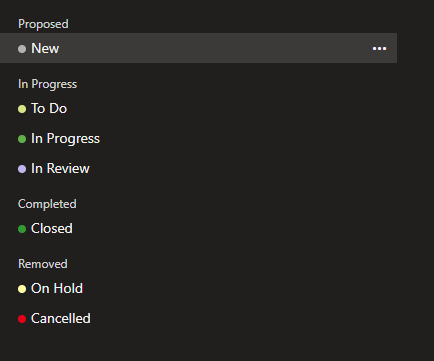
Hello. Wer shifting to ADO as a project management tool (not for software development and delivery, not directly). I'm creating our own custome process (inheriting from Agile) and was wondering if there is any way for us (my team) to have custom workflow states to be created by default instead of havig to do it manually for each work item type we create. This is what we would like to have and has we have some several WI types to create would make our lives easier and possibly future proof it in case we need to make changes (add or edit - through delete+add - more WI). Thank you.293Views0likes1Comment
Azure DevOps sometimes doesn't trigger build for GitHub PRs
Hello Community, I have an Azure Pipelines plugin installed on my application's GitHub repo. We should have a CI build trigger for each PR and when those PR merged into specific branches. The issue is that sometimes the build is getting triggered for the PR commits, but when merging this PR to the branch, the build is not triggered, and I have to run it manually.295Views0likes1Comment
Built a Real-Time Azure AI + AKS + DevOps Project – Looking for Feedback
Hi everyone, I recently completed a real-time project using Microsoft Azure services to build a cloud-native healthcare monitoring system. The key services used include: Azure AI (Cognitive Services, OpenAI) Azure Kubernetes Service (AKS) Azure DevOps and GitHub Actions Azure Monitor, Key Vault, API Management, and others The project focuses on real-time health risk prediction using simulated sensor data. It's built with containerized microservices, infrastructure as code, and end-to-end automation. GitHub link (with source code and documentation): https://github.com/kavin3021/AI-Driven-Predictive-Healthcare-Ecosystem I would really appreciate your feedback or suggestions to improve the solution. Thank you!148Views0likes2CommentsScaling Smart with Azure: Architecture That Works
Hi Tech Community! I’m Zainab, currently based in Abu Dhabi and serving as Vice President of Finance & HR at Hoddz Trends LLC a global tech solutions company headquartered in Arkansas, USA. While I lead on strategy, people, and financials, I also roll up my sleeves when it comes to tech innovation. In this discussion, I want to explore the real-world challenges of scaling systems with Microsoft Azure. From choosing the right architecture to optimizing performance and cost, I’ll be sharing insights drawn from experience and I’d love to hear yours too. Whether you're building from scratch, migrating legacy systems, or refining deployments, let’s talk about what actually works.163Views0likes1CommentIn Azure Devops, How to view all child work items for a dependent feature ?
I have a Epic with few features. In one of the feature, I have a user story that has a related link to other features. Is it possible to see all the features. its child user stories, tasks, bugs that are open for all the associated features ? Epic -> Feature 1 -> User stories -> Tasks, Bugs Epic -> Feature 2 -> User stories -> Tasks, Bugs Epic -> Feature 3 -> User stories -> Tasks, Bugs Epic -> Feature 4 -> Special User story (with relation to Feature 1, 2) -> Tasks, Bugs In the view I want to see all the features (that are associated to Special User story) and its childs Epic -> Feature 1 -> User stories, Tasks, Bugs Epic -> Feature 2 -> User stories, Tasks, Bugs894Views0likes2Comments