bi & data analysis
2466 Topics
Power Query - How Do I Count a Number of Entries Based on Another Column?
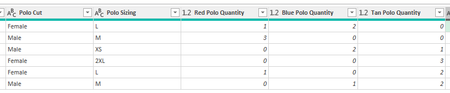
Hello! The title might be a little confusing. Here's the situation. I manage uniforms for my team. I am making a SharePoint list and form that an employee will use to request the uniforms. Then, to give me a digestible table that shows me exactly what I need, I have an Excel Power Query pulling the list in. On the form, instead of having a different entry for each polo in each color, each size, and each cut, I have it separated so that you pick cut, sizing, and color separately. Is there a way to have Power Query pull it to show me, for the screenshot example: Female L Red Polo: 2 Female L Blue Polo: 2 Male M Red Polo: 3 Male M Blue Polo: 1 Male M Tan Polo: 2 So on, and so forth. Is this possible? Thank you!259Views0likes3Comments
Help needed with IF and COUNTIFS Formulas
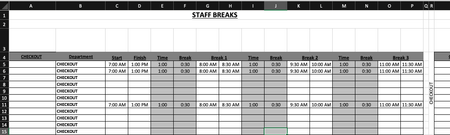
Is anyone able to advise the following formula: =COUNTIFS($B$5:$B$15,$R$4,$C5:$C15,"<=" & V3,$D5:$D15, ">" & V3)-COUNTIFS($B$5:$B$15,"="&$R$4,$G5:$G15,"<=" & V3,$H5:$H15, ">" & V3)-COUNTIFS($B$5:$B$15,"="&$R$4,$K5:$K15,"<=" & V3,$L5:$L15, ">" & V3)-COUNTIFS($B$5:$B$15,"="&$R$4,$O5:$O15,"<=" & V3,$P5:$P15, ">" & V3) Is there a way to simplify this? Is there a way to make this more accurate? Cells in column G & H, I & J, O & P are using the following format: =IF(C6="","",C6+E6) Cells in U4:CC4 are using the following format: =COUNTIFS($B$5:$B$15,$R$4,$C5:$C15,"<=" & U3,$D5:$D15, ">" & U3)-COUNTIFS($B$5:$B$15,"="&$R$4,$G5:$G15,"<=" & U3,$H5:$H15, ">" & U3)-COUNTIFS($B$5:$B$15,"="&$R$4,$K5:$K15,"<=" & U3,$L5:$L15, ">" & U3)-COUNTIFS($B$5:$B$15,"="&$R$4,$O5:$O15,"<=" & U3,$P5:$P15, ">" & U3) Cells in U5:CC15 are using the following format: =IF(U$4>=$T5,1,"") My issue is is when I put in the three break times, the mid break comes out at a shorter time. My other issue is is that when I put in the times in row 5,6and 11, the data is coming up as a combined data in rows 5, 6 and seven on the page two. Just for reference, "page two" is the same spreadsheet. What I need to happen is that I enter in the shift start time and finish time. This then populates through to Break 1, 2 and 3. The Time entry is the time the break starts. ie: 1 hour after start of shift, 1 hour after coming back from break, etc. The break entry is the duration of the break taken. ie: 30 minutes. Once all the info is put in, the relevant "Time Block" on "Page 2" shows a 1. What is happening at the moment is that when I enter all the time data, the time blocks are not populating correctly in accordance to the entry. Basically, If I have numerous people on shiftI need the time blocks to show where I have shortfalls in shift cover and not having too many people on break at the same time. IE: Link to Live Copy: https://www.dropbox.com/scl/fi/eur1j526htu1j8a4d4290/Staff-Breaks.xlsx?rlkey=r4tm9xts4tonofpa2th2cusfw&st=nueyk0d7&dl=0 Any ideas would be greatly appreciated.191Views0likes4CommentsFormula result not showing in cell
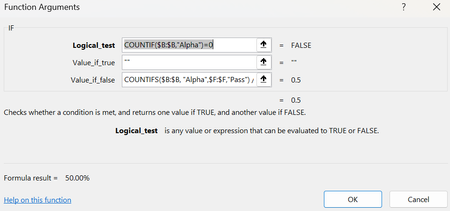
Attached is my code and the formula result showing 50%. But in the cell where the formula is located, it displays a 0%. I have tried formatting the cell to be a number, percentage, and everything else, yet it still does not put the formula result in properly. Am I missing something?Solved165Views0likes5Comments
Excel Power Query / data query on Microsoft Surface Laptop 7
Not sure why I am here, micorsoft said I needed to come here for technical support from microsoft??? I cannot get power query in excel to work (or create any query to external data) in excel. The mashup works fine in power BI, but doesn't work in excel. How do I get this addressed?24Views0likes0CommentsExcel Challenge - Pivoting poorly structured data
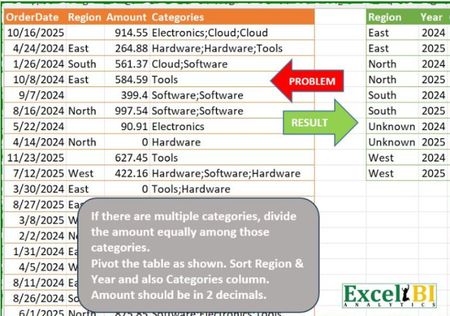
This is from an ExcelBI challenge. I thought it may be worth while posting my solution here as a demonstration of modern Excel methods. Challenge Like many of such challenges, the natural solution approach is to use BYROW but that creates the usual 'array of arrays' error. Solution: Gradually I am moving to a point at which I have no formulas showing in the workbook other than calls to Lambda functions. In this case, the worksheet formuloa is = PIVOTBYCATEGORYλ(OrderTbl) The function works row by row apportioning the amounts against the listed categories PIVOTBYCATEGORYλ // Groups and pivots table by category = LAMBDA(table, LET( normalised, BYROWλ(table, APPORTIONλ), // Identify fields from normalised table dimension, TAKE(DROP(normalised,,1),,2), category, TAKE(normalised,,1), partCost, TAKE(normalised,,-1), // Pivot by category return, PIVOTBY(dimension, category, partCost, SUM,,0,,0), return ) ); The function APPORTIONλ divides the amount between categories so each record within the source data returns a number of rows APPORTIONλ // Splits by category and assigns costs = LAMBDA(record, LET( category, TOCOL(REGEXEXTRACT(INDEX(record,4),"\w+",1)), amount, INDEX(record,3) / COUNTA(category), year, YEAR(INDEX(record,1)), region, IF(LEN(INDEX(record, 2)), INDEX(record, 2), "Unknown"), broadcast, B∕CASTλ(HSTACK(region, year, amount), category), return, HSTACK(category, broadcast), return ) ); /* FUNCTION NAME: B∕CASTλ DESCRIPTION: Broadcasts the terms of a vector over the shape of a second array */ B∕CASTλ = LAMBDA(vector, array, IF({1}, vector, array)); The key to making the formula work is the function BYROWλ that I wrote to generalise the inbuilt but over-restrictive BYROW function. The PIVOTBY function returned the required crosstab from the normalised data arraySolved434Views2likes7Comments
Variable "Connecting to Datasource" Load times
Hello, I am running into a strange issue that I am not sure how to solve. I am using Power Query to link to external Excel data files/Sheets and then I process the data within Power Query and also have some Macros that run after the data is refreshed. I am seeing a drastic difference in the amount of time it takes separate users to open/refresh this file (the users have the same internet connection, use the same link to the file on a Shared Drive on our servers, same Excel settings, and have the same hardware). Some users can load and run all Macros in < 15 seconds, while the others take > 10 minutes. I have exhausted all possible causes/reasons that I can think of and am looking for some guidance. Any and all suggestions are appreciated! Thanks, Skywalker_78Views0likes2CommentsHow to create a multi-tiered percentage-based bar chart?
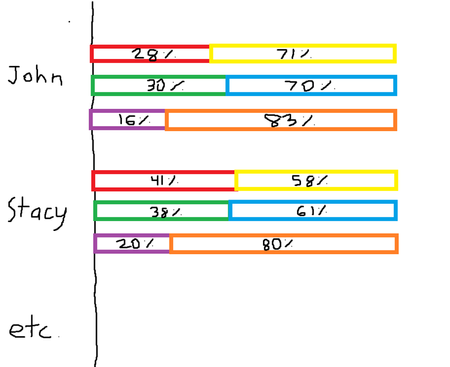
Hello, I would like to create a multi-tiered percentage-based bar chart based on the data found below (test data evidently). Column B and C add up to 100%, Column D and E add up to 100%, and lastly column F and G add up to 100%. I would like each set of variables to equate to 100% on the graph, as the source data is percentage based anyways, but all be organized in their own separate row on the graph underneath the employee name. I have included a diagram drawn in MS paint to portray the desired output (with an accompanying legend). Thanks in advance! Employee Name Number of Sales Made % Number of Sales Made from Other Competitors % Number of Calls Made % Number of Calls Made from Other Competitors % Number of Individual Employees % (always is 1) Number of competitor employees % John 28.57% 71.43% 30.00% 70.00% 16.67% 83.33% Stacy 41.67% 58.33% 38.71% 61.29% 20.00% 80.00% Richard 47.06% 52.94% 47.06% 52.94% 14.29% 85.71% Andy 42.31% 57.69% 40.48% 59.52% 10.00% 90.00%254Views0likes6CommentsCalculate overlapping hours
Hello, I need to report how many hours a staff member supervised one or more volunteers. For a very simplified example, Volunteer Name Date Start Time End Time Supervisor Fred 1/1/26 1:00pm 3:00pm Lucy Ethel 1/1/26 2:30pm 4:30pm Lucy Here 4 volunteer hours were served, but because there was a 30 minute overlap, Lucy only supervised for 3.5 hours. Is there a way to get Excel to calculate that? To say: look at all the entries with matching date and matching supervisor, and add up non-overlapping time. I'm not expecting this to be possible, but I thought I'd ask. Thanks!Solved537Views1like14Comments