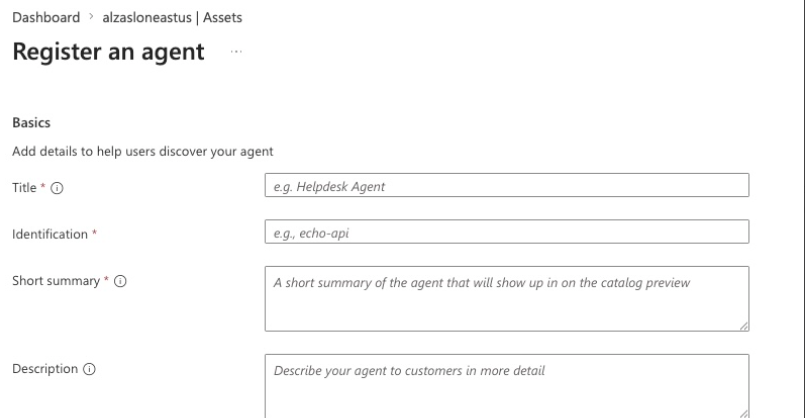
Azure API Center enables teams to register new agents directly into the enterprise catalog, automatically ingest and synchronize agents from Git repositories and assess agent quality before catalog registration that scores agents across safety, reliability, and behavioral completeness
What's new
Three capabilities are now generally available:
| Capability | What it does |
|---|---|
| Agent registration | Register agents directly into the enterprise catalog for cross-team discovery and reuse. |
| Agent assessment | LLM-as-a-Judge framework scores agents across 6 criteria before catalog registration. |
| Git synchronization | Connect a repo and keep agent definitions automatically in sync with source control. |
Agent assessment — six weighted criteria, automatically enforced
When assessment is enabled, every agent is scored on creation or update. Up to 8 criteria are supported; weights are fully configurable by platform teams.
| Criterion | Weight | What it evaluates |
|---|---|---|
| capability-transparency | 0.15 | Documents tools, delegated capabilities, external systems, access levels, and capability boundaries. |
| composition-resource-discipline | 0.15 | Named skill/sub-agent references, invoke guidance, no inline duplication, resource/token constraints. |
| operational-protocol-quality | 0.25 | Structured workflow with named steps, decision points, failure modes, recovery paths, and pre-flight checks. |
| output-contract | 0.10 | Specifies output format, mandatory sections, evidence requirements, confidence semantics, and dead-end handling. |
| purpose-scope-clarity | 0.15 | Clear role identity, type (specialist/orchestrator), activation triggers, anti-triggers, and refusal behavior. |
| safety-consent-architecture | 0.20 | Classifies risk, distinguishes idempotent vs approval-required actions, enumerates NEVER/ALWAYS rules, documents failure-mode safety. |
Git-based synchronization — connect once, stay in sync automatically
Integrating a Git repository creates an environment in API Center representing the repo as an asset source. API Center polls for changes and reflects them in Inventory > Assets — linked assets display a provenance icon.
Agent definitions live in source control and evolve continuously — yet keeping a catalog manually in sync with a codebase is slow, error-prone work that no platform team should have to do. Git-based synchronization connects Azure API Center directly to your repository, polling for changes and reflecting them in the inventory automatically so the catalog always represents the current state of your agents. Linked assets carry a provenance icon that traces them back to their source repository, giving developers immediate visibility into where an agent comes from and whether it is actively maintained. Because assessment gates run before any version is promoted from the repo into the catalog, only agents that meet your organization's quality criteria ever reach developers — enforcing governance at the point of commit, not as an afterthought. A single integration supports multiple asset types through configurable file patterns, so teams can sync agents, skills, and APIs from one repository with per-type control and no duplication.
A2A agent sync from Azure API Management — publish once, discover everywhere
Azure API Management → continuous sync → Azure API Center One-way · updates within minutes · includes API definitions, environments & deployments
As teams publish more A2A agents through Azure API Management, manually registering each one into a discovery catalog creates friction that slows developer productivity and risks catalog staleness. Azure API Center now automatically synchronizes A2A agents — alongside APIs and MCP servers — published in an API Management instance, so every agent that reaches runtime is immediately visible in the centralized catalog without any additional registration step. The sync is continuous and one-way: when agents are created, updated, versioned, or deleted in API Management, those changes propagate to API Center within minutes, keeping the inventory accurate at all times. Each synchronized agent gets an associated environment and deployment record, giving developers the runtime context they need to discover and integrate the right agent with confidence. This closes the loop between runtime publishing and centralized governance, helping organizations operationalize agent ecosystems at scale without burdening platform teams with manual catalog maintenance.
Why it matters
By bringing agents into Azure API Center alongside APIs, plugins, skills, and MCP tools, organizations gain a single pane of glass for everything their AI applications depend on. Teams reduce duplication, improve reuse, and accelerate development — while maintaining the governance standards enterprise deployments require.
Get started

 Microsoft