This retirement has been extremely disruptive for organisations that rely on simple, user-driven notifications.
The suggested alternatives (Power Automate and SharePoint Rules) are not parity replacements for SharePoint Alerts. Power Automate is significantly more complex, requires additional governance, and in many cases requires technical expertise that end users simply do not have. Alerts are far from parity with Rules.
For example, users attempted to replicate a basic “notify me when a file is added” alert using the Microsoft-recommended approach. The resulting notification did not even include the file name, file location, or a direct link to the document. That is a substantial regression in usability compared to legacy SharePoint Alerts.
To provide equivalent functionality for a single document library (Critical Incident Reports), I had to design and build a Power Automate solution in a controlled Dev-to-Prod deployment model. The solution required:
- A SharePoint list to manage subscribers
- A flow that checks that list
- Conditional logic
- Custom email formatting
- Inclusion of author details
- File name
- Full file path
- Direct document link
- Direct folder link
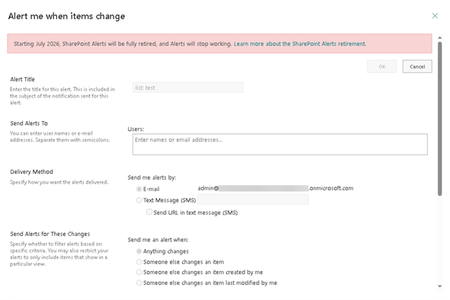
This was a non-trivial amount of engineering effort to replace what was previously achievable by end users in a few clicks, with no administrative overhead.
This change shifts workload from users to IT, increases governance complexity, and introduces long-term maintenance overhead, all to replace a feature that worked reliably for years.
It is difficult to see how customers are “better served” by removing a simple, functional capability and replacing it with a platform-level automation tool that was never designed as a like-for-like substitute.
If SharePoint Alerts must be retired, there should be a lightweight, built-in modern notification mechanism that:
- Includes file name and path by default
- Includes direct links
- Allows users to self-manage subscriptions
- Does not require flow development or admin involvement
The current replacement strategy does not meet the usability or operational simplicity of the feature being retired.

 Microsoft
