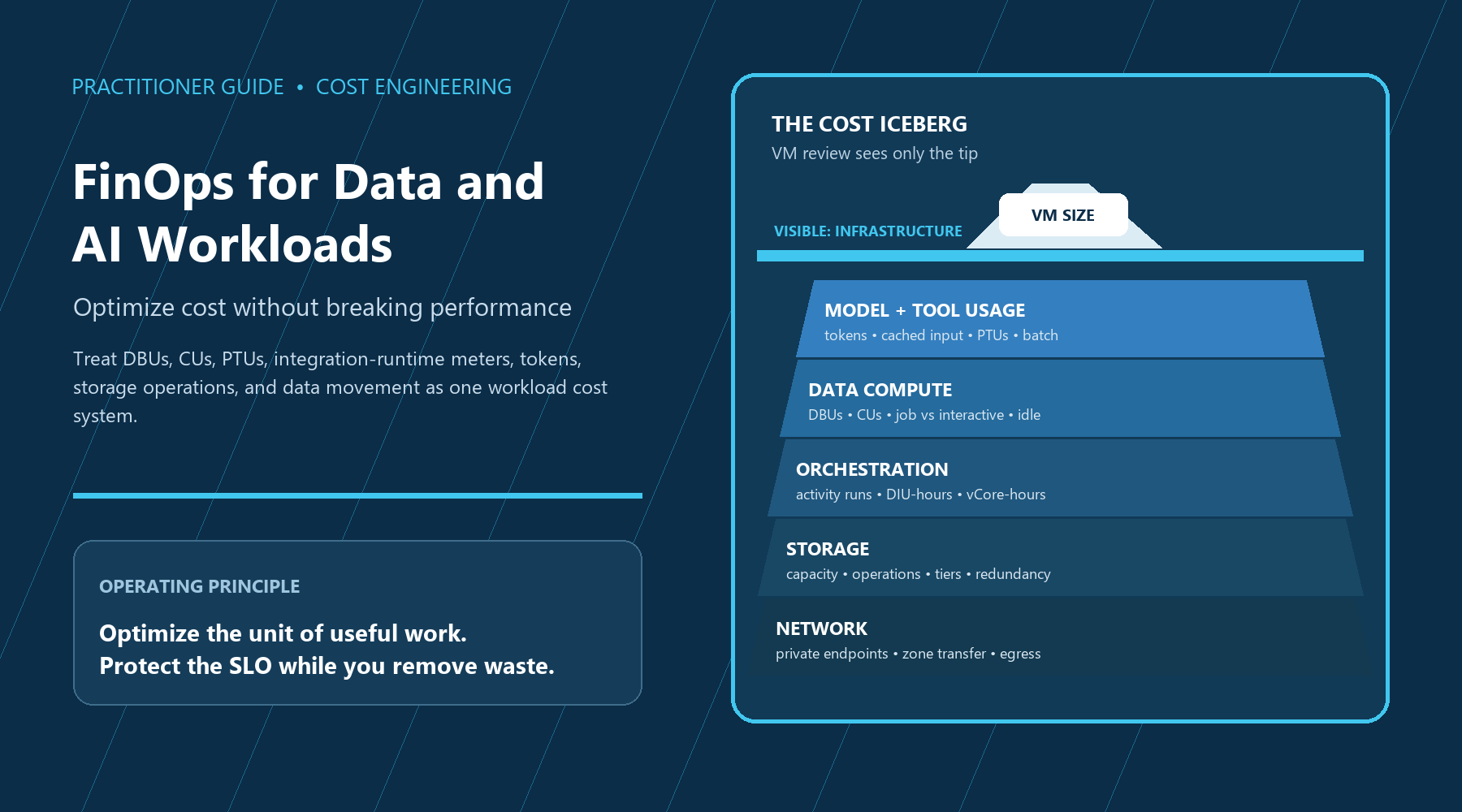
Optimize cost without breaking performance
A VM-only review misses the unit economics of managed data and AI services. A useful review asks what it cost to produce one reliable outcome, then includes DBUs, capacity units, activity runs, integration-runtime compute, tokens, storage operations, data movement, and shared platform cost. Make spend attributable first; remove idle demand and unnecessary work; protect the service-level objective (SLO); and buy commitments only against a stable, measured baseline. FinOps is a continuous engineering loop, not a one-time savings exercise.
Measure the complete workload
Choose a denominator that reflects value: cost per successful pipeline run, terabyte promoted through a quality gate, business refresh, million events, or 1,000 accepted AI outcomes. Keep failed work, retries, and shared-cost allocation in the numerator. A lower hourly rate is a false saving if runtime doubles, freshness slips, quality falls, or spend moves to another team.
Tag workload, owner, environment, product, region, and SLO class. Allocate shared Fabric capacity, Databricks compute, integration runtimes, monitoring, and networking directly when reliable telemetry exists; otherwise publish a transparent proxy and retain an unallocated bucket. Budgets notify rather than stop services, and cost data can lag, so pair budgets and anomaly alerts with operational telemetry and an owned triage process.
Each workload layer has an independent meter and performance guardrail.
Match the execution contract to demand
For Azure Databricks, keep interactive exploration separate from scheduled jobs. Enforce auto-termination, tested VM families, practical autoscaling ranges, and required allocation tags. Compute policies are GA but require the Premium plan; lowering a policy limit does not retroactively terminate existing resources. Benchmark Photon, pools, spot capacity, and serverless on real workloads. Small files and poor clustering turn storage design into compute spend; predictive optimization is GA for eligible Unity Catalog managed tables, while VACUUM LITE remains Public Preview and needs an explicit preview exception.
Azure Data Factory meters orchestration, copy DIU-hours, data-flow execution and debug, and integration-runtime choices. Fabric Data Factory is GA and consumes capacity units, with OneLake storage considered separately. Prefer incremental movement, stop debug sessions, consolidate tiny activities only when retry and ownership boundaries remain clear, and count retry cost per successful run.
For ADLS Gen2, model capacity, read/write/list operations, tier transitions, retrieval, redundancy, retention penalties, and transfer. Cool, cold, and archive economics include minimum residence periods; archive is offline and rehydration can take hours. A lifecycle rule is not valid until restore, legal-hold, retention, and recovery objectives still pass.
Right-size shared capacity and AI requests
Fabric capacity must be managed at the timepoint and workspace level. Bursting and smoothing can consume future capacity, so monthly averages can hide interactive delays and throttling. Use the Capacity Metrics app with workload telemetry; isolate incompatible demand and pause nonproduction F capacity only after checking queued work and smoothed usage. Spark Autoscale Billing is a separate pay-as-you-go behavior, not part of bursting and smoothing.
For Foundry model deployments, compare Standard, priority processing, provisioned throughput, and Global Batch against the request shape. Provisioned throughput and Global Batch are GA where supported, but PTU quota does not guarantee capacity, and model, region, minimum, and reservation constraints apply. Use the smallest model that passes task-specific quality and safety tests; cap output and retries; batch asynchronous work; and meter search, storage, code, functions, and observability separately from tokens.
Protect performance with controlled experiments
State the expected meter reduction and freeze the comparison boundary: demand, data volume, model or runtime version, region, quality checks, and SLO. Record baseline cost, latency, freshness, failures, retries, and allocation. Change one major lever where practical, canary it, observe a representative peak and business cycle, and accept or roll back using both cost and SLO evidence. Map the actual network path; private endpoints improve isolation but add DNS, topology, and processing considerations and do not make every cross-region transfer free.
Operate on a regular rhythm: triage material anomalies daily, review idle and unallocated spend weekly, assess unit-cost and SLO evidence monthly, and revisit lifecycle, recovery, and commitments quarterly. Re-baseline after a model, runtime, capacity, region, retention, redundancy, or architecture change. This prevents an optimization that was valid for yesterday’s workload from becoming today’s reliability defect.
Production decision checklist
Commitments come last. Recheck current prices, status, region, quota, networking, and reservation terms at implementation time; none should be copied as a timeless constant.
|
Gate |
Required evidence |
|
Ownership |
Workload, owner, denominator, SLO, and at least 95% allocation coverage |
|
Demand |
Idle time, retries, execution mode, file/request shape, and peak behavior measured |
|
Guardrail |
Quality, p95 latency, freshness, recovery, and rollback thresholds pass |
|
Status |
GA/Preview, plan, region, quota, capacity, and fallback recorded |
|
Commitment |
Only the post-optimization stable floor is reserved; renewal owner named |
Conclusion
Durable FinOps joins the meter, owner, useful outcome, and SLO in one evidence chain. Start with visibility and allocation, choose the right execution model, remove waste, improve data and request shape, and right-size from peaks rather than averages. Apply rate optimization only afterward, then repeat whenever demand, architecture, model, region, or service behavior changes.

 Microsoft