apps & infra
7 Topics
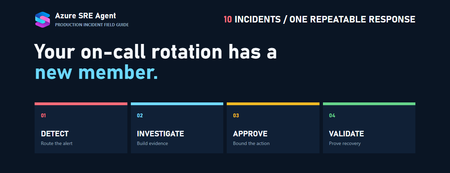
Your on-call rotation has a new member: 10 production incidents, end to end, with Azure SRE Agent
What this post is. A hands-on, reproducible walkthrough of ten real production failure modes — App Service, AKS, Azure SQL, Cosmos DB, VMs, VM Scale Sets, Application Gateway, and Service Bus — each one driven end to end by Azure SRE Agent: detection, hypothesis-driven investigation, ITSM ticketing, bounded remediation, recovery validation, and follow-up records. What this post is not. A claim that you install SRE Agent and all of this happens on day one. Every workflow below needs telemetry, scoped RBAC, a response plan, an approved action surface, and an ITSM integration. I'll be explicit about which parts are documented product behavior and which parts you have to wire yourself — because that distinction is the difference between a demo that works on stage and one that works at 3 AM. TL;DR The pattern Alert → agent investigates read-only → agent opens/updates the ticket with evidence → agent proposes a bounded action → human approves → agent executes → agent validates recovery → agent files the follow-up record The unlock Not "AI fixes prod." The unlock is that investigation — the 20 minutes of tab-switching between Azure Monitor, App Insights, deployment history, and Activity Log — is fully automated and consistent, and the fix arrives pre-justified with an evidence chain The guardrail Read-only automatic. Ticketing automatic. Production writes in Review mode. Guest-OS work through fixed-purpose runbooks, never a shell prompt The reality check SRE Agent hard-blocks delete / remove and all az keyvault commands, respects Azure management locks, and only one incident platform can be active at a time. Several patterns in this post need a custom tool or MCP server to complete the loop Time to first value One resource group, one alert rule, one response plan. You can reproduce use case #1 in an afternoon 1. Why the "investigation" half is the real prize Every conversation about AI in operations goes straight to remediation. "Will it restart my app?" That's the least interesting question, and it's the one with the most downside risk. Think about what actually consumes the minutes during a Sev1. The alert fires. Someone acknowledges. Then: Open Azure Monitor, confirm the metric is real and not a probe artifact Open Application Insights, find the dominant exception Open the deployment pipeline, find what shipped and when Open Activity Log, check whether someone changed configuration Open Resource Health, rule out a platform incident Open the other environment, confirm the previous version is healthy Assemble all of that into a sentence a human can act on That's twenty minutes of context assembly performed by a tired human, differently every time, with quality that depends entirely on who happens to be on call. It is the single most automatable part of incident response and the part nobody automates, because scripts can't reason about which of six hypotheses fits the evidence. This is exactly what root cause analysis in SRE Agent is designed for. The agent doesn't grep logs — it forms hypotheses and invalidates them: HYPOTHESIS 1: Recent deployment broke something ├─ Checked: Last deployment was 3 days ago ├─ Evidence: Error rate stable until 30 minutes ago └─ Result: INVALIDATED HYPOTHESIS 2: Database overloaded ├─ Checked: Azure SQL metrics (CPU, DTU, connections) ├─ Evidence: DTU at 98%, query duration 4x normal ├─ Traced: SELECT * FROM orders WHERE... taking 8.2s └─ Result: VALIDATED ROOT CAUSE: Orders table missing index on customer_id column. Query plan shows full table scan on 2.1M rows. RECOMMENDED ACTION: Add index on orders.customer_id Similar fix applied in INC-2341 (3 weeks ago) That last line — recalling a similar incident from three weeks ago — is the compounding part. Every thread produces a session insight: symptoms observed, steps that worked, root cause, and pitfalls to avoid. Thirty minutes after a thread goes quiet, the agent indexes those learnings. Next time the same resource misbehaves, that history surfaces first. So the framing for the rest of this post: remediation is the punchline, but investigation is the product. Every one of the ten use cases below has a large read-only phase you can turn on tomorrow with zero write permissions, and a small write phase you should gate behind approval for a long time. 2. What Azure SRE Agent actually does Before the use cases, here is the honest capability map, drawn from the product documentation rather than from a keynote. The three primary use cases Use case What it means Automate incidents Alert fires → agent queries monitoring tools, correlates signals across systems, identifies probable root cause, proposes mitigations Automate scheduled workflows Proactive health checks, compliance sweeps, and routine tasks on a schedule, with results routed to your incident platform or notification channel Investigate and advise Natural-language questions — "what changed in the last hour?" — answered with grounded citations The five extension primitives Everything you customize sits in one of five buckets: Primitive What it is When you reach for it Skills Procedural guidance ( SKILL.md ) plus optional attached tools; auto-loaded when relevant Team troubleshooting runbooks that should also execute Subagents / custom agents Purpose-built specialists invoked via /agent or routed to by a response plan A DatabaseExpert that owns every SQL incident Python tools Custom logic, transformations, API calls Anything that needs code, e.g. writing to the ServiceNow Table API MCP servers 40+ managed connectors (Datadog, New Relic, Splunk, Elastic, Dynatrace…) plus any custom MCP tool Bringing your non-Azure telemetry and your ITSM write surface into the loop Agent hooks Event-triggered automations at Stop and PostToolUse Policy enforcement, audit emission, blocking risky commands Six generic subagents ship built in — Explore, Plan, CodeReview, Bash, Verification, GeneralPurpose — and the agent can parallelize investigation, planning, review, shell, and verification work across them. A permission gate sits in front of all five primitives and evaluates every proposed tool call before it runs. Integrations you can assume Category Supported Monitoring Azure Monitor (metrics, logs, alerts, workbooks), Application Insights, Log Analytics, Grafana Incident platforms Azure Monitor Alerts, PagerDuty, ServiceNow — only one active at a time Source control / CI GitHub (repos, issues), Azure DevOps (repos, work items) Data Azure Data Explorer (Kusto), MCP servers Comms Slack, Microsoft Teams ⚠️ Design constraint worth internalizing early. Only one incident platform can be active at a time, and switching disconnects the current one. If your org runs PagerDuty for paging and ServiceNow for records of truth, you must pick which one the agent is bound to and reach the other through a connector or custom tool. Every use case below assumes ServiceNow is the bound platform. Skills vs. custom agents vs. knowledge files The three are constantly confused. This table settles it: Skills Custom agents Knowledge files Access Automatic when relevant Explicit ( /agent ) or routed by response plan Automatic search Tools Can attach Has its own None Context Uses thread context Shares thread context (no clean slate) Reference only Best for Team procedures with execution Domain specialists Runbooks, architecture docs Practical limits: a maximum of five concurrent active skills (oldest auto-unloads), knowledge base uploads up to 16 MB per file, and custom agent knowledge bases up to 1,000 files. 3. Anatomy of an agent-run incident Every use case in section 6 is an instance of this one shape. Learn it once. [[INCIDENT_FLOW_IMAGE]] Five properties make this shape safe, and they're worth stating as rules: The read phase has no blast radius. Turn it on everywhere, immediately, with Reader . One action per incident. Not "roll back and scale and restart." One bounded, reversible step, then re-measure. The proposed action is always the smallest reversible one. Swap a slot, don't redeploy. Bump one service tier, don't resize the cluster. Validation is a first-class phase, not a vibe. Define the metric, the threshold, and the duration before you approve. Technical recovery ≠ business recovery. Use case #10 makes this painfully clear. 4. Build the demo lab Everything below runs in a single throwaway resource group. Nothing here should touch a subscription you care about. 🧪 Lab hygiene. Create it, demo it, delete it. az group delete -n rg-sre-agent-demo --yes --no-wait when you're done. Several of these use cases deliberately break things. 4.1 Resource group and agent LOC=eastus2 RG=rg-sre-agent-demo az group create -n $RG -l $LOC Create the SRE Agent from the Azure portal and point it at $RG . Three things are created for you automatically: an Application Insights instance (this is where your audit trail lands), a Log Analytics workspace, a user-assigned managed identity (UAMI) — the identity every action runs as. 4.2 Choose a permission level deliberately At creation you pick one of two levels: Level Grants Use it when Reader Core monitoring roles + resource-type reader roles. Prompts for temporary elevation via on-behalf-of when it needs to act Start here. Production. Weeks 1–4 of any pilot Privileged Core monitoring roles + resource-type contributor roles Non-production, or after a proven pilot Regardless of level, these are always assigned: Role Scope Why Reader Resource group See resources and properties Log Analytics Reader Resource group Query logs and workspaces Monitoring Reader Resource group Read metrics Monitoring Contributor Subscription Acknowledge and close Azure Monitor alerts Grant additional access explicitly and narrowly: SUB=$(az account show --query id -o tsv) AGENT_MI=<agent-managed-identity-principal-id> # Read everywhere you want visibility az role assignment create \ --assignee $AGENT_MI \ --role "Reader" \ --scope "/subscriptions/$SUB" # Write ONLY where you intend the agent to act az role assignment create \ --assignee $AGENT_MI \ --role "Website Contributor" \ --scope "/subscriptions/$SUB/resourceGroups/$RG/providers/Microsoft.Web/sites/app-checkout-demo"</agent-managed-identity-principal-id> 📌 A sharp edge. You can't remove individual permissions from an agent — only entire resource groups. Removing a resource group from the agent's scope revokes all access to it. Plan your resource group boundaries as your blast-radius boundaries, because that's exactly what they are. 4.3 Connect ServiceNow Use a dedicated, least-privileged integration user — not a shared admin account. Method When What you need Basic auth Quick setup, PDI, testing Username + password, itil or admin role OAuth 2.0 Production ServiceNow OAuth app (client ID + secret); register redirect https://logic-apis-{region}.consent.azure-apim.net/redirect Scope the connection so you don't drown: Assignment group — essential on a shared enterprise instance Priority — Critical through Planning Category Scanner defaults worth knowing: Setting Value Scan interval 1 minute Incidents per page 20 Max incidents per cycle 220 (11 pages) Initial lookback 30 days Setup performs a real connectivity check by fetching an actual incident, so credential and endpoint mistakes surface immediately instead of six hours later when nothing syncs. 🚨 Delete the quickstart plan. Connecting an incident platform auto-creates a quickstart_handler response plan that runs in fully autonomous mode across all impacted services. If you then build your own plans, incidents get routed twice or to the wrong agent. Go to Builder → Incident response plans → Table view and delete it before you do anything else. 4.4 Connect deployment correlation Half the use cases below hinge on "what shipped three minutes before the spike." That correlation requires a source control connector: GitHub — repositories and issues Azure DevOps — repos and work items Connect one. Without it, the agent can still read Azure Activity Log and deployment history, but it can't reach commits, PRs, or work items. 4.5 Create the demo resources # 1 · App Service with a staging slot (use cases 1) az appservice plan create -g $RG -n plan-demo --sku P1V3 --is-linux az webapp create -g $RG -p plan-demo -n app-checkout-demo --runtime "DOTNETCORE:8.0" az webapp deployment slot create -g $RG -n app-checkout-demo --slot previous # 2 · AKS (use case 2) az aks create -g $RG -n aks-demo --node-count 3 --generate-ssh-keys --enable-addons monitoring # 3 · Azure SQL (use case 3) az sql server create -g $RG -n sqlsrv-sre-demo -u sqladmin -p "<use-a-generated-password>" az sql db create -g $RG -s sqlsrv-sre-demo -n db-customer --service-objective S1 # 4 · Cosmos DB (use case 4) az cosmosdb create -g $RG -n cosmos-sre-demo az cosmosdb sql database create -g $RG -a cosmos-sre-demo -n catalog az cosmosdb sql container create -g $RG -a cosmos-sre-demo -d catalog \ -n products --partition-key-path /category --throughput 400 # 5–7 · VMs (use cases 5, 6, 7) az vm create -g $RG -n vm-payments-linux --image Ubuntu2204 --size Standard_B2s --generate-ssh-keys az vm create -g $RG -n vm-claims-win --image Win2022Datacenter --size Standard_B2ms \ --admin-username azureadmin --admin-password "<use-a-generated-password>" # 8 · VM Scale Set (use case 8) az vmss create -g $RG -n vmss-api-demo --image Ubuntu2204 --instance-count 12 \ --upgrade-policy-mode automatic --generate-ssh-keys # 10 · Service Bus (use case 10) az servicebus namespace create -g $RG -n sb-sre-demo --sku Standard az servicebus queue create -g $RG --namespace-name sb-sre-demo -n order-events \ --enable-dead-lettering-on-message-expiration true</use-a-generated-password></use-a-generated-password> Install the Azure Monitor Agent on the VMs and associate a data collection rule — without guest telemetry, use cases 5, 6, and 7 have nothing to detect. 4.6 One custom agent per domain Don't build a single mega-agent. Build specialists and let response plans route to them: Custom agent Owns Attached tools DeploymentAnalyzer App Service, AKS, anything release-correlated RunAzCliReadCommands , GitHub connector, Kusto DatabaseExpert Azure SQL, Cosmos DB RunAzCliReadCommands , Kusto, read-only SQL diagnostics tool GuestOSResponder VM / VMSS / IIS RunAzCliReadCommands , fixed-purpose runbook tools only NetworkPathExpert Application Gateway, NSG, DNS, TLS RunAzCliReadCommands IntegrationExpert Service Bus, Event Hubs RunAzCliReadCommands , Kusto A custom agent definition is small: name: database_expert system_prompt: | You are a database specialist for this estate. Analyze query performance, diagnose connection and saturation issues, and recommend the smallest reversible mitigation. Never propose schema changes, index changes, plan forcing, or session termination — those are DBA-owned and require a change record. handoff_description: Handles Azure SQL and Cosmos DB troubleshooting tools: - execute_kusto_query - RunAzCliReadCommands allowed_skills: - azure-sql-saturation-runbook - cosmos-throughput-runbook Note what that system_prompt is really doing: it is narrowing the action space. Half of production safety with an agent is telling it, in plain English, which categories of fix are off the table. 4.7 Response plans Create one plan per domain, all starting in Review: Plan Filter Custom agent Mode appsvc-p1 Priority 1 + 2, service checkout DeploymentAnalyzer Review aks-p1 Priority 1, service orders-api DeploymentAnalyzer Review db-critical Priority 1 + 2, service customer-api DatabaseExpert Review vm-guest Priority 1 + 2, title contains disk , memory , CPU GuestOSResponder Review network-p1 Priority 1, title contains 502 , backend NetworkPathExpert Review integration-p1 Priority 1, service fulfillment IntegrationExpert Review Filters available: severity/priority (multiselect), impacted service, incident type, and title contains. Plans can be turned off without deleting them, which is exactly what you want during maintenance windows. 5. Set your guardrails before your first incident If you read only one section of this post, read this one. The guardrails are not paperwork; they are the reason this is deployable. 5.1 Run modes Mode Behavior Default Review Agent proposes; you approve or deny Agent-level default Autonomous Agent executes immediately and reports Per-plan and per-task default Two subtleties that bite people: Run modes are set per response plan and per scheduled task, not globally. The agent-level setting is only a fallback. And per-plan the default is Autonomous — so if you don't set it, you get autonomy. Review mode shows Approve/Deny only for Azure infrastructure operations (Azure CLI, ARM writes). Sending an email, posting to Teams, or querying an external source proceeds based on the agent's reasoning. To gate those, you need hooks or tool access policies. Only users holding the SRE Agent Administrator role can approve. Standard users cannot, and personal Microsoft accounts can't authorize on-behalf-of at all — it requires a work or school (Entra ID) account. 5.2 What the product blocks for you These are enforced at the command level, independent of your RBAC: Guardrail Behavior Delete operations The agent never runs delete or remove commands. It returns an error pointing you at the portal Key Vault All az keyvault commands are blocked, to prevent credential exposure Management locks Resources with ReadOnly locks can't be modified, regardless of permissions or run mode Subscription validation Subscription IDs are validated as well-formed GUIDs before execution 💡 Use the delete block architecturally. Put a ReadOnly management lock on anything that must never change during an incident — your Key Vaults, your production databases, your golden images. That lock is respected before every modification, which gives you a control that survives RBAC drift and misconfigured response plans. 5.3 Hooks: the guardrail you write yourself Two events are supported — Stop (agent about to return a final response) and PostToolUse (a tool finished). Hooks run as an LLM prompt or a sandboxed command script. Here is the single most useful hook for this entire post — a deterministic policy gate on shell execution: hooks: PostToolUse: - type: command matcher: "Bash|ExecuteShellCommand" timeout: 30 failMode: block script: | #!/usr/bin/env python3 import sys, json, re context = json.load(sys.stdin) command = context.get('tool_input', {}).get('command', '') dangerous = [ r'\brm\s+-rf\b', r'\bsudo\b', r'\bchmod\s+777\b', r'\bmkfs\b', r'\bdd\s+if=', r'\btruncate\b', r'\bDROP\s+TABLE\b', ] for pattern in dangerous: if re.search(pattern, command, re.IGNORECASE): print(json.dumps({"decision": "block", "reason": f"Blocked by policy: {pattern}"})) sys.exit(0) print(json.dumps({"decision": "allow"})) And a Stop hook that refuses to let the agent declare victory without evidence: hooks: Stop: - type: prompt model: ReasoningFast timeout: 30 prompt: | Review the agent's final response. $ARGUMENTS It is only acceptable if it contains ALL of: 1. The specific resource acted upon (full name or resource ID) 2. Metric values BEFORE and AFTER the action 3. The observation window over which recovery was confirmed 4. Who approved the action and at what UTC timestamp Respond with: {"ok": true} {"ok": false, "reason": "<what is="" missing="">"}</what> Hook mechanics you'll want on hand: Setting Default Range / notes timeout 30s 1–300s failMode allow allow or block maxRejections 3 1–25; prompt-type Stop hooks only matcher — Regex, anchored ^(pattern)$ , case-sensitive; * matches all Script size — 64 KB max Shebangs — #!/bin/bash , #!/usr/bin/env python3 ⚠️ The footgun: for Stop hooks, a rejection without a reason field is treated as approval. Always populate reason . Agent-level hooks and custom-agent-level hooks both run when both match; agent-level fires first. 5.4 The recommended production policy This is the policy I'd put in front of a change board: Allow read-only investigation automatically, everywhere. Allow automatic incident creation and work-note updates — after sanitization. Use Review mode for all production remediation. Require human approval for every production write. Use fixed-purpose runbooks instead of unrestricted VM shell access. Require separate approval for destructive or data-affecting actions. Initially require human confirmation before resolving an incident. 6. The ten use cases Each use case follows the same seven-part structure so you can skim to the one you're firefighting: What happened → How Azure Monitor detected it → How the agent found the cause → Agent action table → Recovery note → Try it yourself → Guardrails In the action tables, Type is one of: Type Meaning Read No blast radius. Safe to run automatically Decision Agent reasoning or an approval gate. No resource change Write (ITSM) Ticket create/update. Sanitized Write (Azure) Azure control-plane change. Approval required in production Write (Guest OS) Inside the VM, via a fixed-purpose runbook. Approval required Write (K8s/DevOps) Cluster or pipeline change. Approval required Validation Post-action measurement against defined thresholds Use case #1 — App Service: HTTP 500 after deployment The one you should build first. Clean trigger, bounded action, unambiguous validation. What happened Release 2026.03.12.4 was deployed to a production checkout App Service. The new code referenced an application setting that was never defined in the production slot. The application started fine — which is what makes this class of failure nasty — but every checkout operation that touched that setting returned HTTP 500. How Azure Monitor detected it Azure Monitor and Application Insights fired on a composite condition, not a single metric: HTTP 5xx rate above the operational threshold Failed availability tests Increased application exceptions Increased dependency failures Request latency above baseline P1 – Checkout App Service returning elevated HTTP 500 responses How the agent found the cause Identified the affected App Service and slot. Queried HTTP response and latency metrics. Queried Application Insights failed requests and exceptions. Identified the missing-setting exception as the dominant failure. Reviewed deployment history and Azure Activity Log. Correlated the error increase with release 2026.03.12.4 . Compared production against the previous deployment slot. Confirmed the previous slot remained healthy. Confirmed no matching Azure platform incident. Agent finding: HTTP 500 responses increased from 0.4% to 18% within three minutes of release 2026.03.12.4. Most failures reference a missing application setting. The previous deployment slot passes availability and dependency checks. Notice the shape of that sentence: a delta, a time correlation, and a known-good comparison. That's what makes it actionable rather than merely true. Agent action table # Action Type Detail 1 Investigate alert Read Reads HTTP 5xx rate, failed requests, latency, availability-test results 2 Analyze exceptions Read Identifies missing-configuration exception as dominant failure 3 Correlate deployment Read Finds release 2026.03.12.4 deployed three minutes before the spike 4 Compare slots Read Confirms previous slot healthy while production is failing 5 Rule out platform issue Read Checks Azure Resource Health and dependency health 6 Assess blast radius Read Determines checkout affected, unrelated services healthy 7 Create SNOW INC Write (ITSM) P1 against the Checkout CI, assigned to Application Operations 8 Update INC evidence Write (ITSM) Adds exceptions, deployment correlation, resource links, affected operations 9 Classify response Decision Classifies as deployment-caused; selects rollback 10 Pause release Write (DevOps) Pauses the failed release pipeline 11 Request approval Decision Requests approval to swap the previous healthy slot into production 12 Swap slot Write (Azure) Performs the approved swap only on the named App Service 13 Validate recovery Validation Confirms 5xx, latency, exceptions, dependencies, availability recover 14 Update/resolve INC Write (ITSM) Records approval, rollback, timestamps, recovery evidence 15 Create SNOW PRB Write (ITSM) Problem record for configuration-validation improvements Recovery note Production was reverted to the previous healthy deployment slot at 14:26 UTC. HTTP 500 responses declined from 18% to below 1%, and availability tests passed for 15 consecutive minutes. Preliminary cause: missing production configuration in release 2026.03.12.4. Try it yourself Break it: # Put a healthy build in the 'previous' slot first, then break production # by deploying code that reads an app setting which only exists in staging. az webapp config appsettings delete -g $RG -n app-checkout-demo \ --setting-names Checkout__PaymentProviderKey az webapp restart -g $RG -n app-checkout-demo Alert it: az monitor metrics alert create -g $RG -n "alert-checkout-5xx" \ --scopes "/subscriptions/$SUB/resourceGroups/$RG/providers/Microsoft.Web/sites/app-checkout-demo" \ --condition "total Http5xx > 20" \ --window-size 5m --evaluation-frequency 1m --severity 1 \ --description "P1 – Checkout App Service returning elevated HTTP 500 responses" Ask it (before the alert, to see the read phase in isolation): app-checkout-demo is returning HTTP 500s. Do not change anything. Investigate and tell me: 1. the dominant exception and its share of total failures 2. what deployed in the 30 minutes before the error rate changed 3. whether the 'previous' slot is healthy right now 4. whether Azure Resource Health shows a platform issue Give me the evidence chain and the smallest reversible mitigation. Expect it to propose: Proposed action: Swap slot 'previous' into production on app-checkout-demo Risk: brief connection drain (~10s). Fully reversible by swapping back. Validation: Http5xx < 1% and availability test passing for 15 minutes. [Approve] [Deny] Verify it: requests | where timestamp > ago(1h) | summarize failed = countif(success == false), total = count() by bin(timestamp, 1m) | extend failureRate = 100.0 * failed / total | render timechart 🎬 Best thing to record for a demo: the moment the Approve button appears with the evidence already attached. That single screen is the whole value proposition. Guardrails Scope write permissions to the named App Service, not the resource group. Verify the previous slot is healthy before swapping — a swap into a broken slot doubles the outage. Require human approval for production slot swaps. Preserve the failed deployment for analysis; don't let the pipeline overwrite it. Never grant subscription-level Contributor or Owner. Use case #2 — AKS: pods in CrashLoopBackOff What happened Image orders-api:4.18.0 referenced a configuration key that didn't exist in the production namespace. Eight of ten pods entered CrashLoopBackOff . The two survivors couldn't carry production traffic, producing latency and ingress 5xx. How Azure Monitor detected it Managed Prometheus / Container Insights detected: Unavailable replicas Increasing container restart count CrashLoopBackOff pod state Failed readiness and liveness checks Elevated ingress HTTP 5xx Reduced successful-request rate P1 – Orders API unavailable replicas in production AKS How the agent found the cause Identified the cluster, namespace, and deployment. Reviewed deployment availability and pod states. Examined logs from failing containers. Reviewed Kubernetes warning events. Compared current and previous ReplicaSets. Correlated the failure with revision 42. Identified the missing configuration key. Confirmed revision 41 was previously healthy. Checked node CPU, memory, storage, networking, status. Determined AKS infrastructure was healthy. Agent finding: Eight of ten Orders API pods entered CrashLoopBackOff during rollout of revision 42. Container logs show a missing configuration key. Revision 41, using image 4.17.6, was healthy. Step 10 is the one people skip. "Rule out the infrastructure" is what stops you from spending an hour on a node pool that was never the problem. Agent action table # Action Type Detail 1 Investigate workload Read Deployment status, unavailable replicas, readiness, restart counts 2 Analyze pod logs Read Startup failure from a missing configuration key 3 Analyze events Read Image pulls, mounts, scheduling, probes, container events 4 Correlate rollout Read Revision 42 deployed immediately before failure 5 Compare ReplicaSets Read Revision 41 was the previous healthy workload 6 Rule out infrastructure Read Nodes, memory, CPU, networking, storage healthy 7 Assess blast radius Read Eight of ten replicas unavailable 8 Create SNOW INC Write (ITSM) P1 against the Orders API CI 9 Update INC evidence Write (ITSM) Namespace, image, revision, errors, rollout correlation 10 Classify response Decision Application/configuration-caused 11 Request approval Decision Approval to pause and roll back revision 42 12 Pause failed rollout Write (K8s/DevOps) Prevents the release progressing or being reapplied 13 Roll back deployment Write (K8s) Rolls back only the named deployment to revision 41 14 Validate replicas Validation All expected replicas ready and stable 15 Validate application Validation Ingress errors decline; synthetic orders succeed 16 Update/resolve INC Write (ITSM) Revision, approval, rollback, recovery evidence 17 Create defect/task Write (ITSM) Add configuration validation to CI/CD Recovery note Orders API was rolled back from revision 42 to revision 41. All ten replicas are ready, restart counts have stabilized, ingress HTTP 5xx responses are below threshold, and synthetic order transactions are succeeding. Try it yourself Break it: az aks get-credentials -g $RG -n aks-demo kubectl create namespace orders kubectl create deployment orders-api -n orders --image=nginx:1.25 --replicas=10 kubectl rollout status deployment/orders-api -n orders # revision 41 equivalent, healthy # Now break it: point at an image whose entrypoint requires a missing env var kubectl set image deployment/orders-api -n orders orders-api=busybox:1.36 kubectl patch deployment orders-api -n orders --type=json -p='[ {"op":"add","path":"/spec/template/spec/containers/0/command", "value":["sh","-c","test -n \"$ORDERS_CONFIG_KEY\" || (echo \"FATAL: missing ORDERS_CONFIG_KEY\" >&2; exit 1); sleep 3600"]} ]' Watch it break: kubectl get pods -n orders -w kubectl rollout history deployment/orders-api -n orders Ask it: Pods in namespace 'orders' on aks-demo are crash looping. Read-only. Tell me: which revision introduced it, the exact container error, whether the node pool is healthy, and how many replicas are actually serving. Then tell me the last known-good revision and why you believe it was healthy. Expect it to propose: kubectl rollout undo deployment/orders-api -n orders --to-revision= scoped to that single deployment. Verify it: kubectl get deployment orders-api -n orders \ -o jsonpath='{.status.readyReplicas}/{.status.replicas}{"\n"}' kubectl get pods -n orders --no-headers | awk '{print $4}' | sort | uniq -c Guardrails Restrict access to the required cluster, namespace, and deployment. Do not grant cluster-admin . Require approval for rollback. Coordinate with GitOps reconciliation. If Flux or Argo owns that deployment, a kubectl rollout undo gets reverted within minutes and you've created a flapping outage. Either pause reconciliation first or roll back through Git. Do not permit namespace, persistent-volume, or cluster deletion. Use case #3 — Azure SQL Database: CPU saturation and timeouts The use case where the agent's job is to buy time, not to fix the problem. What happened A query execution plan changed after an application release. The new plan consumed substantially more CPU and workers. The database saturated, producing SQL dependency timeouts and failed customer requests. How Azure Monitor detected it Sustained CPU saturation Worker or session pressure Increased connection failures SQL dependency timeouts Query-duration deviation from baseline Degraded customer API success rate P1 – Customer API database saturation causing request timeouts How the agent found the cause Reviewed database CPU, workers, sessions, connections. Reviewed application SQL dependency failures. Checked for blocking and deadlocks. Ran approved read-only Query Store diagnostics. Identified the primary CPU-consuming query. Detected a recent execution-plan change. Correlated with an application release. Ruled out Azure service health and storage issues. Determined a temporary scale operation could restore service. Left permanent query remediation to the DBA team. Agent finding: Database CPU has remained saturated for 17 minutes. One query accounts for most recent CPU consumption and changed execution plan shortly before the incident. Application SQL dependency timeout rate is 23%. Step 10 is the design decision that makes this safe. The agent correctly diagnoses a plan regression and then deliberately does not fix it, because forcing a plan or dropping an index is a permanent, DBA-owned, change-controlled action. It buys capacity instead. Agent action table # Action Type Detail 1 Investigate database Read CPU, workers, sessions, connections, storage, availability 2 Analyze app impact Read SQL dependency latency, failures, affected API operations 3 Check blocking Read Approved diagnostics for blocking, deadlocks, connection growth 4 Analyze Query Store Read Highest-impact query and recent plan change 5 Correlate changes Read Recent application and database deployments 6 Rule out platform issue Read Service health, storage, database availability 7 Assess blast radius Read Affected applications; other databases healthy 8 Create SNOW INC Write (ITSM) P1 against the production database CI 9 Update INC evidence Write (ITSM) Utilization, query ID, timeouts, change correlation 10 Classify response Decision Scaling is mitigation; query changes remain DBA-owned 11 Calculate bounded scale Read Selects the smallest pre-approved capacity increase 12 Request approval Decision Database owner or incident commander 13 Scale database Write (Azure) Increases the affected database by one approved service step 14 Validate recovery Validation CPU, workers, timeouts, application success recover 15 Update INC Write (ITSM) Previous/new capacity, approval, timing, results 16 Create SNOW PRB Write (ITSM) Permanent query-remediation work 17 Create scale-down task Write (ITSM) Task/change to restore normal capacity after stability Recovery note Azure SQL capacity was temporarily increased by one approved service step. CPU declined from sustained saturation to 54%, and SQL dependency timeouts returned to baseline. Query Store indicates a probable execution-plan regression requiring permanent DBA remediation. Try it yourself Break it — generate a saturating workload against db-customer (an unindexed LIKE '%...%' scan in a tight loop from a container in the same region works fine on an S1). Alert it: az monitor metrics alert create -g $RG -n "alert-sql-cpu" \ --scopes "/subscriptions/$SUB/resourceGroups/$RG/providers/Microsoft.Sql/servers/sqlsrv-sre-demo/databases/db-customer" \ --condition "avg cpu_percent > 90" \ --window-size 5m --evaluation-frequency 1m --severity 1 \ --description "P1 – Customer API database saturation causing request timeouts" Ask it: db-customer is saturated. Read-only investigation. Identify the top CPU-consuming query, whether its plan changed recently, and what application release correlates. Do NOT propose index, schema, plan-forcing, or session-kill actions. Propose only the smallest temporary capacity step that restores service, and tell me what it costs per day and when we should scale back down. Read-only Query Store diagnostics the agent should run: SELECT TOP 10 qsq.query_id, qsp.plan_id, qsp.last_execution_time, SUM(qsrs.count_executions) AS executions, SUM(qsrs.avg_cpu_time * qsrs.count_executions) AS total_cpu_us FROM sys.query_store_query AS qsq JOIN sys.query_store_plan AS qsp ON qsp.query_id = qsq.query_id JOIN sys.query_store_runtime_stats AS qsrs ON qsrs.plan_id = qsp.plan_id JOIN sys.query_store_runtime_stats_interval AS qsrsi ON qsrsi.runtime_stats_interval_id = qsrs.runtime_stats_interval_id WHERE qsrsi.start_time > DATEADD(hour, -2, GETUTCDATE()) GROUP BY qsq.query_id, qsp.plan_id, qsp.last_execution_time ORDER BY total_cpu_us DESC; Expect it to propose: az sql db update -g $RG -s sqlsrv-sre-demo -n db-customer --service-objective S2 — exactly one step, on exactly that database. Guardrails Restrict scaling to the named database. Define minimum and maximum capacity. Require approval for scale-up and scale-down. Time-limit temporary capacity — an un-reversed emergency scale-up is how a P1 becomes a budget incident. Do not autonomously force plans, terminate sessions, modify indexes, or change schema. Track the temporary cost impact with an Azure Cost Management alert. Use case #4 — Azure Cosmos DB: HTTP 429 throttling The one where the correct root cause is "we're succeeding." What happened A marketing campaign increased Product Catalog traffic by roughly 40%. The Cosmos DB container hit its provisioned throughput ceiling. HTTP 429s increased, and client retries amplified application latency. How Azure Monitor detected it High normalized RU consumption Increased HTTP 429 responses Elevated server-side latency Application dependency failures Sustained operation near the throughput limit P2 – Cosmos DB throttling affecting Product Catalog requests How the agent found the cause Reviewed normalized RU consumption and throttled requests. Identified the affected database and container. Reviewed regional and partition behavior. Checked for hot-partition evidence. Reviewed application retry telemetry. Compared current traffic with the historical baseline. Correlated demand with the marketing campaign. Checked recent application deployments. Checked Azure service health. Determined the primary cause was legitimate demand. Agent finding: The Product Catalog container is at its configured throughput ceiling, and 21% of requests are being throttled. Traffic increased by approximately 40% following a campaign launch. No deployment or regional platform issue correlates with the event. Step 4 is the fork in the road. If consumption is uneven across partitions, more RU/s is money set on fire — the correct answer is an architecture change, not a scale-up. The agent has to check before it recommends. Agent action table # Action Type Detail 1 Investigate throttling Read RU consumption, 429 rate, latency, requests, availability 2 Identify scope Read Account, database, container, operations, regions 3 Analyze demand Read Compares traffic and RU consumption with historical patterns 4 Check partitions Read Looks for uneven partition consumption where telemetry permits 5 Analyze retries Read Determines whether client retries are amplifying the incident 6 Correlate events Read Links demand to campaign traffic; excludes release/platform issues 7 Assess blast radius Read Affected catalog operations; unaffected containers 8 Create SNOW INC Write (ITSM) P2 against the Product Catalog CI 9 Update INC evidence Write (ITSM) RU, throttling, latency, traffic, partition evidence 10 Classify response Decision Demand-driven unless hot-partition evidence exists 11 Calculate throughput Read Smallest increase within the cost ceiling 12 Request approval Decision Approval for a temporary throughput increase 13 Increase throughput Write (Azure) Raises throughput only to the approved maximum 14 Validate recovery Validation 429 rate and latency recover 15 Update/resolve INC Write (ITSM) Throughput, approval, cost implication, recovery 16 Create capacity task Write (ITSM) Work to return throughput to normal 17 Create SNOW PRB Write (ITSM) Partition or retry improvements, if required Recovery note Provisioned throughput was increased within the approved production limit. HTTP 429 responses declined from 21% to below 1%, and Product Catalog latency returned to baseline. The increase is temporary and will be reviewed after campaign traffic subsides. Try it yourself Break it: the container was created at 400 RU/s. Drive a few hundred reads per second at it and you'll be throttled within seconds. Alert it: az monitor metrics alert create -g $RG -n "alert-cosmos-429" \ --scopes "/subscriptions/$SUB/resourceGroups/$RG/providers/Microsoft.DocumentDB/databaseAccounts/cosmos-sre-demo" \ --condition "total TotalRequests where StatusCode == 429 > 100" \ --window-size 5m --evaluation-frequency 1m --severity 2 \ --description "P2 – Cosmos DB throttling affecting Product Catalog requests" Ask it: cosmos-sre-demo container 'products' is throttling. Read-only. Before recommending anything, tell me whether RU consumption is EVEN across physical partitions or concentrated. If it is concentrated, do not recommend a throughput increase — recommend an architecture problem record instead. If it is even, tell me the smallest RU/s that clears throttling and the daily cost delta. That prompt is the whole use case. Getting the agent to refuse the easy answer under a stated condition is the skill. Verify it: AzureDiagnostics | where ResourceProvider == "MICROSOFT.DOCUMENTDB" | where Category == "DataPlaneRequests" | summarize throttled = countif(statusCode_s == "429"), total = count() by bin(TimeGenerated, 1m) | extend throttleRate = 100.0 * throttled / total | render timechart Guardrails Define a maximum throughput ceiling the agent may not exceed. Restrict changes to the named container. Require approval for increases and reductions. Do not permit deletion, consistency-level changes, or region changes. Create cost alerts for prolonged increased throughput. Treat persistent hot partitions as an architecture issue, never as a scaling issue. Use case #5 — Azure VM: OS/root disk full The most operationally dangerous use case in this post, and the one with the most interesting guardrail design. What happened A legacy payment application generated excessive trace logs. Log rotation stopped working and the root filesystem filled. The VM stayed available at the Azure platform layer — heartbeat green, Resource Health fine — but the application stopped, because it could no longer write to disk. This is the classic "green dashboard, dead service" failure. Platform-layer monitoring alone will never catch it. How Azure Monitor detected it Azure Monitor Agent and guest telemetry detected: Critically low filesystem free space Rapid filesystem consumption Application process stopped Failed availability tests Elevated HTTP 5xx Healthy VM heartbeat but unhealthy application P1 – Legacy payment application unavailable due to full VM OS disk How the agent found the cause Confirmed the VM was online. Confirmed Azure Monitor Agent heartbeat. Identified the affected root/OS filesystem. Reviewed the free-space trend. Correlated application failure with disk exhaustion. Found 86 GB of growth in the application trace directory. Reviewed recent deployments and logging changes. Checked log-rotation status. Confirmed the files matched the approved cleanup policy. Excluded customer data, database files, audit logs, and system files. Agent finding: The VM is healthy at the Azure platform layer, but the OS volume has less than 1% free space. The approved application trace directory grew by 86 GB in six hours. The payment service stopped when it could no longer write to disk. Agent action table # Action Type Detail 1 Investigate VM Read VM, agent heartbeat, Azure platform health 2 Analyze filesystem Read Root volume and free-space trend 3 Correlate app failure Read Service stopped after disk exhaustion 4 Identify disk consumer Read Abnormal growth in an approved trace directory 5 Check changes Read Deployments, logging changes, rotation, scheduled tasks 6 Validate cleanup scope Read Candidate files meet approved path, type, and age rules 7 Protect data Decision Excludes databases, customer data, security logs, unknown files 8 Create SNOW INC Write (ITSM) P1 against the payment VM/application CI 9 Update INC evidence Write (ITSM) Disk usage, growth timeline, service impact, cleanup scope 10 Request approval Decision Approval for the restricted recovery runbook 11 Archive logs Write (Guest OS) Archives eligible files to protected Azure Storage 12 Remove eligible files Write (Guest OS) Removes only successfully archived, allowlisted files 13 Run log rotation Write (Guest OS) Executes the approved rotation operation 14 Restart service Write (Guest OS) Restarts only the named payment service if necessary 15 Validate recovery Validation Disk, application, archive, availability, growth stabilization 16 Update/resolve INC Write (ITSM) Bytes processed, exclusions, approval, results 17 Create SNOW PRB Write (ITSM) Permanent logging and rotation remediation Recovery note The approved recovery runbook archived and removed 82 GB of eligible application trace files. OS-volume free space is now 31%. The payment service was restarted and has passed health checks for 15 minutes. No database, customer, security, or system files were modified. That last sentence is not decoration. It is the sentence your auditor will read. Try it yourself Break it (lab VM only — this fills the root disk): az vm run-command invoke -g $RG -n vm-payments-linux \ --command-id RunShellScript --scripts " mkdir -p /var/log/payments/trace fallocate -l 24G /var/log/payments/trace/trace-$(date +%s).log df -h / " Ask it: vm-payments-linux root filesystem is nearly full and the payment service is down. Read-only first. Tell me: - exactly which directory grew, by how much, over what window - whether log rotation is configured and when it last ran - what changed in the last 24 hours that would explain it Then tell me which files are inside the approved cleanup allowlist (/var/log/payments/trace/*.log, older than 2h) and which are NOT, and confirm no database, audit, or customer data files are in scope. Do not delete anything. The critical design point. SRE Agent blocks delete and remove commands outright. You cannot have it rm those files through its Azure CLI surface, and you should be glad. The correct implementation is a fixed-purpose, version-controlled runbook that the agent invokes with tightly bounded parameters: # What the agent is allowed to call — one runbook, allowlisted parameters, nothing else az automation runbook start \ -g $RG --automation-account-name aa-sre-runbooks \ -n "Reclaim-TraceDiskSpace" \ --parameters vmName=vm-payments-linux \ allowedPath=/var/log/payments/trace \ pattern='*.log' \ minAgeHours=2 \ maxBytes=90000000000 \ archiveToContainer=payments-trace-archive \ requireArchiveBeforeDelete=true \ dryRun=false The runbook — not the agent — owns the destructive logic, and it enforces: path allowlist (refuse anything outside allowedPath ) filename pattern allowlist minimum file age maximum total bytes per execution successful archive verified before any deletion hard-refuse if any candidate file is unknown, or matches a protected pattern ( *.mdf , *.bak , /var/log/audit/* , *.key , *.pem ) a cooldown that prevents re-execution within N hours Verify it: az vm run-command invoke -g $RG -n vm-payments-linux \ --command-id RunShellScript \ --scripts "df -h /; systemctl is-active payments.service; ls -la /var/log/payments/trace | head" Guardrails Do not give SRE Agent unrestricted SSH or shell access. Ever. This is the single highest-leverage rule in this post. Use a version-controlled, fixed-purpose runbook. Allowlist paths, patterns, file ages, and maximum cleanup size. Stop if the responsible files are unknown. A disk filled by something you can't identify is a security event until proven otherwise. Require successful archival before deletion. Prevent repeated execution with a cooldown. Treat cleanup as temporary mitigation — the problem record is the fix. Use case #6 — Linux VM: anomalous CPU saturation Where "anomalous" is doing all the work. What happened Release 7.3.1 introduced an immediate retry loop when an inventory dependency failed. The application retried continuously without backoff, consuming nearly all VM CPU and causing request timeouts. How Azure Monitor detected it The alert deliberately combined conditions rather than firing on a threshold: CPU significantly outside the historical baseline Persistent saturation over multiple evaluations Increased request latency Increased dependency failures No approved maintenance or batch workload active P1 – Production order-processing Linux VM experiencing anomalous CPU saturation A static "CPU > 90%" rule on a batch-processing VM is a pager that everyone learns to ignore. The composite condition is what makes the alert worth waking someone — or an agent — for. How the agent found the cause Confirmed the VM was online. Compared current CPU with historical behavior. Identified the order-processing service as the main CPU consumer. Reviewed application request latency. Reviewed downstream dependency failures. Analyzed application retry logs. Correlated CPU growth with release 7.3.1. Excluded expected batch jobs. Excluded Azure maintenance or platform issues. Confirmed other application instances had sufficient capacity. Agent finding: CPU increased from a normal range of 35–50% to 98% four minutes after deployment 7.3.1. The order-processing service is repeatedly calling a failed dependency without backoff. No expected batch job or platform maintenance is active. Agent action table # Action Type Detail 1 Confirm anomaly Read Compares current CPU with the historical baseline 2 Analyze impact Read Latency, timeouts, availability, dependencies 3 Identify process Read Named order service is the primary CPU consumer 4 Correlate deployment Read Release 7.3.1, four minutes before saturation 5 Analyze logs Read Dependency retry loop without backoff 6 Rule out expected work Read Excludes batch, backup, maintenance, scheduled processing 7 Assess blast radius Read Traffic and available capacity on other instances 8 Create SNOW INC Write (ITSM) P1 against the Order Processing CI 9 Update INC evidence Write (ITSM) CPU, process, dependency, release, customer impact 10 Classify response Decision Rollback, not VM resize or arbitrary process termination 11 Request approval Decision Approval to drain, roll back, restart the service 12 Drain VM Write (Azure) Removes the VM from load-balancer rotation 13 Restore prior release Write (Guest OS/DevOps) Restores known-good version or configuration 14 Restart named service Write (Guest OS) Restarts only orders-service 15 Validate recovery Validation CPU, retries, latency, dependencies, health recover 16 Return to rotation Write (Azure) Restores traffic only after successful validation 17 Update/resolve INC Write (ITSM) Drain, rollback, restart, approval, results 18 Create defect Write (ITSM) Retry, backoff, and circuit-breaker remediation Steps 12 and 16 are the pattern to steal: drain before you touch, restore traffic only after validation passes. Most homegrown automation restarts a service while it's still taking traffic and turns a degradation into an outage. Recovery note Release 7.3.1 introduced a retry loop when the inventory dependency failed. After approval, the VM was drained, the previous release was restored, and orders-service was restarted. CPU declined from 98% to 43%, and application latency returned to baseline. Try it yourself Break it: az vm run-command invoke -g $RG -n vm-payments-linux \ --command-id RunShellScript --scripts " nohup bash -c 'while true; do curl -s -m 1 http://127.0.0.1:9/inventory >/dev/null 2>&1; done' & nohup bash -c 'while true; do :; done' & echo started " Ask it: CPU on vm-payments-linux is at 98%. Read-only. First: is this actually anomalous, or is it consistent with this VM's historical pattern for this hour and day of week? Show me the baseline. If anomalous: which process, which dependency is it calling, at what rate, and what deployed immediately before? Do NOT propose killing the top process or resizing the VM. Expect it to propose a drain → restore → restart sequence, with the drain step as a separate approval from the restart. Guardrails Do not automatically terminate the highest-CPU process. It is very often a legitimate workload, and occasionally it's a security incident you just destroyed the evidence for. Allow operations only for named services. Drain before service restart where possible. Escalate unknown or suspicious processes to security rather than remediating them. Limit restart attempts. Do not permanently resize the VM when the evidence points to faulty code. Resizing to survive a retry storm is buying hardware to host a bug. Use case #7 — Windows VM with IIS: memory leak What happened Release ClaimsPortal 5.9.0 introduced a memory leak in the Claims IIS application pool. Memory consumption climbed over several hours, paging began, request queues grew, and IIS returned HTTP 503. How Azure Monitor detected it Azure Monitor Agent collected available memory, committed bytes, paging activity, process working set, IIS request queues, HTTP 500/503 responses, and availability-test results. The alert required sustained abnormal growth, not a brief spike. P1 – Memory exhaustion affecting production IIS application How the agent found the cause Confirmed the VM and monitoring agent were healthy. Compared memory behavior with the historical baseline. Identified the relevant w3wp.exe process. Mapped it to the Claims application pool. Reviewed paging and request queues. Correlated HTTP 503 errors with low available memory. Reviewed Windows Event Logs. Correlated the growth with release 5.9.0. Excluded antivirus and scheduled-reporting activity. Confirmed another instance could carry traffic. Agent finding: Available memory declined from 42% to 4% over three hours. The Claims application pool grew from 1.8 GB to 11.6 GB without releasing memory after traffic normalized. Paging and HTTP 503 errors followed. The pattern began after release 5.9.0. "Without releasing memory after traffic normalized" is the sentence that distinguishes a leak from load. Cache growth under load is normal; failure to return afterwards is not. Agent action table # Action Type Detail 1 Confirm anomaly Read Memory, committed bytes, paging vs. baseline 2 Identify process Read Maps growing w3wp.exe to the Claims pool 3 Analyze IIS health Read Pools, queues, HTTP errors, availability 4 Correlate release Read Links sustained growth to release 5.9.0 5 Rule out other causes Read Excludes scheduled jobs, antivirus, maintenance 6 Assess capacity Read Confirms another instance can serve traffic 7 Create SNOW INC Write (ITSM) P1 against the Claims Portal CI 8 Update INC evidence Write (ITSM) Memory, paging, pool, release, HTTP impact 9 Classify response Decision Targeted recycling, not a full VM restart 10 Request approval Decision Approval to drain and recycle the named pool 11 Drain VM Write (Azure) Removes VM from load-balancer rotation 12 Capture diagnostics Write (Guest OS) Captures approved diagnostics to a protected location 13 Recycle app pool Write (Guest OS) Recycles only the Claims application pool 14 Validate recovery Validation Memory, paging, queues, HTTP errors, availability recover 15 Return to rotation Write (Azure) Restores traffic after health checks pass 16 Update/resolve INC Write (ITSM) Memory before/after, approval, stability 17 Create SNOW PRB Write (ITSM) Memory-leak remediation Step 12 before step 13 matters: recycling the pool destroys the evidence. Capture first. Recovery note Abnormal memory growth was isolated to the Claims application pool following release 5.9.0. The VM was drained, the approved application pool was recycled, and health checks passed before traffic was restored. Available memory increased from 4% to 61%, and HTTP 503 responses stopped. Try it yourself Break it (lab VM only): az vm run-command invoke -g $RG -n vm-claims-win ` --command-id RunPowerShellScript --scripts " Install-WindowsFeature Web-Server -IncludeManagementTools New-WebAppPool -Name 'ClaimsPool' # Simulate the leak \$leak = New-Object System.Collections.ArrayList 1..40 | ForEach-Object { [void]\$leak.Add((New-Object byte[] 100MB)) ; Start-Sleep -Milliseconds 200 } " Ask it: vm-claims-win available memory is at 4%. Read-only. Map the growing process to an IIS application pool. Show me the memory curve for the last 6 hours and tell me whether memory was released after traffic dropped. Correlate with deployment history. Then propose the most targeted possible mitigation — I do not want a VM restart. Expect it to propose: Restart-WebAppPool -Name "ClaimsPool" …and nothing else on that machine. Guardrails Recycle only the named application pool. Avoid full VM restart as the first response — it's a bigger hammer with a longer outage and it destroys the leak evidence. Do not copy memory dumps into ServiceNow. They contain credentials, tokens, and customer data. Store diagnostics in a secured location; put the link in the ticket. Prevent repeated automatic recycling — a pool that needs recycling every 40 minutes is an incident, not a routine. Escalate if the leak returns during the observation period. Use case #8 — Virtual Machine Scale Set: unhealthy instance The most autonomy-ready use case in the list, and the reason is stateless workloads. What happened A configuration extension failed while VMSS instance 17 was being provisioned. The VM was running but its application service never started. The instance failed application health probes and caused intermittent errors. How Azure Monitor detected it Reduced healthy backend count Application Health extension failure Backend health-probe failure VM extension provisioning failure Instance-specific errors Elevated intermittent HTTP 5xx P2 – Unhealthy VM Scale Set instance causing intermittent API failures How the agent found the cause Reviewed the VMSS healthy-instance count. Identified instance 17 as the only unhealthy instance. Reviewed backend health. Compared instance 17 with healthy instances. Checked the image and VMSS model. Reviewed VM extension state. Found the configuration extension failure. Reviewed boot and application diagnostics. Confirmed the workload was stateless. Confirmed eleven instances could carry production traffic. Agent finding: Instance 17 is the only unhealthy member of the 12-instance scale set. Its application health probe has failed since 09:18 UTC. The configuration extension failed during provisioning, and the application service never started. Eleven healthy instances can maintain service. Agent action table # Action Type Detail 1 Investigate VMSS Read Instance health, provisioning state, healthy count 2 Identify instance Read Instance 17 is the only unhealthy member 3 Analyze backend health Read Confirms the instance fails application probes 4 Compare instances Read Image, model, extensions, configuration 5 Find extension failure Read Locates the failed configuration extension 6 Review diagnostics Read Boot, extension, and application diagnostics 7 Assess safe capacity Read Eleven instances can carry traffic 8 Confirm statelessness Decision Replacement won't destroy required local state 9 Create SNOW INC Write (ITSM) P2 against the VMSS/application CI 10 Update INC evidence Write (ITSM) Instance, extension error, health, capacity evidence 11 Classify response Decision Replacement or reimage per approved procedure 12 Request approval Decision Approval to isolate and replace instance 17 13 Isolate instance Write (Azure) Ensures the instance receives no production traffic 14 Preserve evidence Read/Write Stores approved diagnostic evidence securely 15 Replace instance Write (Azure) Reimages or replaces only instance 17 16 Validate provisioning Validation Image, model, and extensions deploy successfully 17 Validate service Validation Backend health, capacity, customer errors recover 18 Update/resolve INC Write (ITSM) Replacement, approval, diagnostics, recovery 19 Create SNOW PRB Write (ITSM) Extension and image-validation improvement work Steps 8 and 7 are the gate. Replacing a stateless instance with eleven healthy peers is genuinely low risk. Replacing a stateful instance, or replacing one when you're already at minimum capacity, is an outage. Both must be confirmed, not assumed. Recovery note VMSS instance 17 was isolated after its configuration extension failed and the application service did not start. Diagnostic evidence was captured, and the instance was replaced after approval. The replacement passed extension, application, and backend health checks. The scale set has returned to 12 healthy instances. Try it yourself Break it: INSTANCE_ID=$(az vmss list-instances -g $RG -n vmss-api-demo \ --query "[5].instanceId" -o tsv) az vmss extension set -g $RG --vmss-name vmss-api-demo \ --name CustomScript --publisher Microsoft.Azure.Extensions \ --settings '{"commandToExecute":"exit 1"}' Ask it: vmss-api-demo has an unhealthy instance. Read-only. Identify which instance, since when, and the specific extension error. Confirm for me: (a) the workload is stateless, (b) how many healthy instances remain, and (c) whether remaining capacity can carry current traffic with 20% headroom. Only if all three are satisfied, propose a reimage of that single instance. Capture diagnostics before proposing anything. Expect it to propose: az vmss reimage -g $RG -n vmss-api-demo --instance-id $INSTANCE_ID Verify it: az vmss get-instance-view -g $RG -n vmss-api-demo --instance-id $INSTANCE_ID \ --query "vmHealth.status.code" az vmss list-instances -g $RG -n vmss-api-demo -o table Guardrails Confirm the workload is stateless before any replacement. Confirm sufficient healthy capacity first. Preserve diagnostic evidence before replacement — the instance is your only copy of the failure. Restrict permissions to the named VMSS. Limit simultaneous replacements. One at a time. An agent that reimages six instances because six probes failed has just caused the outage it was investigating. Do not permit deletion of the entire scale set. Use case #9 — Application Gateway: HTTP 502 from unhealthy backends The cross-component change nobody coordinated. What happened Customer Portal release 9.2 changed the backend listener from port 443 to 8443. Application Gateway remained configured to connect on 443. All backend probes failed and customers received HTTP 502. How Azure Monitor detected it Increased Application Gateway HTTP 502 responses Increased failed requests Four unhealthy backends Reduced healthy-host count Failed synthetic availability tests P1 – Application Gateway returning HTTP 502 due to unhealthy backends How the agent found the cause Reviewed Application Gateway metrics. Retrieved backend health. Identified the affected pool. Reviewed probe path, protocol, host header, and port. Reviewed backend settings. Confirmed the application responded on 8443. Confirmed the gateway used 443. Correlated the mismatch with release 9.2. Reviewed NSG, route, DNS, certificate, and WAF changes. Excluded networking, certificate, and platform-health issues. Agent finding: HTTP 502 responses began at 16:07 UTC. All four Customer Portal backends are unhealthy. Release 9.2 changed the backend listener to port 8443, while Application Gateway continues to use port 443. No NSG, routing, or certificate issue correlates with the incident. Step 9 is what separates a real investigation from a lucky guess. A 502 has at least six plausible causes — NSG, UDR, DNS, expired cert, WAF rule, backend down. The agent has to exclude them, in writing, before you trust the conclusion. Agent action table # Action Type Detail 1 Investigate gateway Read HTTP 502, failed requests, latency, backend counts 2 Inspect backend health Read Identifies four unhealthy Customer Portal backends 3 Review configuration Read Settings, probes, protocol, port, TLS, routing 4 Test backend state Read App responds on 8443 while gateway uses 443 5 Correlate changes Read Links mismatch to Customer Portal release 9.2 6 Rule out networking Read NSGs, routes, DNS, TLS, WAF, platform health 7 Assess blast radius Read Confirms the Customer Portal pool is unavailable 8 Create SNOW INC Write (ITSM) P1 against the portal/gateway CI 9 Update INC evidence Write (ITSM) 502s, backend, port, deployment, known-good configuration 10 Classify response Decision Restore the known-good backend listener 11 Request approval Decision Approval to restore source-controlled configuration 12 Restore listener Write (Application) Restores the application listener to approved port 443 13 Validate backend health Validation All four backends become healthy 14 Validate application Validation HTTP 502 declines; synthetic transactions pass 15 Verify controls Read Confirms no WAF, TLS, routing, or NSG control was weakened 16 Update/resolve INC Write (ITSM) Cause, restoration, approval, recovery 17 Create SNOW CHG Write (ITSM) Coordinated change for the intended port migration 18 Create SNOW PRB Write (ITSM) Cross-component deployment-validation work Step 12 is a genuinely important choice. There were two ways to fix this: change the application back to 443, or change the gateway to 8443. The agent restores the application to the known-good, source-controlled state rather than mutating the gateway to match an unapproved change. One of those is a rollback; the other is ratifying an unreviewed change during an outage. Then step 17 files a proper change record for the migration the team clearly intended to do. Step 15 exists because the fastest way to make a 502 disappear is to disable TLS validation. The agent must prove it didn't take the fast way. Recovery note Customer Portal release 9.2 changed the backend listener from port 443 to 8443 without a coordinated gateway change. The application listener was restored to the previous configuration. All four backends are healthy, HTTP 502 responses returned to baseline, and synthetic login tests passed for 15 minutes. Try it yourself Ask it: appgw-portal is returning 502s and all backends are unhealthy. Read-only. Walk me through the exclusion, explicitly, for each of: NSG, UDR/route table, DNS resolution, backend TLS certificate, WAF rule blocking, backend process down, and probe configuration mismatch. State which you ruled out and the evidence for each. Then tell me the known-good configuration and where it is source-controlled. Verify it: az network application-gateway show-backend-health \ -g $RG -n appgw-portal \ --query "backendAddressPools[].backendHttpSettingsCollection[].servers[].{addr:address,health:health}" -o table Guardrails Do not disable TLS validation. Not to test, not temporarily, not "just to confirm." Do not weaken NSGs or WAF policies as a mitigation. Use source-controlled configuration as the definition of "known-good." Restore a known-good state during the incident; migrate through a change record afterwards. Require approval for gateway or backend changes. Validate full application transactions, not just health probes. A probe returning 200 on /health proves very little. Use case #10 — Azure Service Bus: queue and dead-letter backlog The one that teaches the most important lesson in the entire post. What happened Release fulfillment-worker:6.4.0 couldn't deserialize messages containing a new deliveryWindow field. Consumer throughput dropped by 92%. The active backlog grew rapidly, and incompatible messages entered the dead-letter queue. How Azure Monitor detected it Increasing active-message count Increasing oldest-message age Dead-letter growth Reduced completed-message rate Consumer application errors Delayed downstream business processing P1 – Production order-event backlog delaying fulfillment How the agent found the cause Reviewed active, incoming, outgoing, and dead-letter counts. Calculated message arrival and completion rates. Confirmed the backlog was growing. Reviewed consumer instance health. Reviewed consumer errors and restarts. Checked downstream dependency health. Checked Service Bus authentication and authorization. Correlated the throughput decline with release 6.4.0. Found deserialization errors for the new field. Determined scaling more broken consumers would amplify failures. Agent finding: The order-events queue grew from 3,000 to 185,000 active messages in 35 minutes. Consumer throughput dropped by 92% immediately after release fulfillment-worker:6.4.0. Application logs show deserialization failures involving the new deliveryWindow field. Step 10 is the whole reason to use a reasoning agent instead of an autoscale rule. Every metric here screams "scale out the consumers." An HPA would have done exactly that, and every new replica would have dead-lettered messages faster. Agent action table # Action Type Detail 1 Investigate queue Read Active, incoming, outgoing, scheduled, DLQ counts 2 Calculate flow rates Read Confirms arrival exceeds completion; backlog growing 3 Inspect consumers Read Health, instance count, scaling, errors, dependencies 4 Analyze failures Read Deserialization exceptions involving the new field 5 Correlate release Read Links the 92% throughput reduction to release 6.4.0 6 Rule out Service Bus Read Health, authorization, throttling, networking, service status 7 Assess blast radius Read Backlog age and fulfillment impact 8 Protect message data Decision Prevents payloads or personal data entering ServiceNow 9 Create SNOW INC Write (ITSM) P1 against the fulfillment integration CI 10 Update INC evidence Write (ITSM) Backlog, age, flow, exception, release, business impact 11 Classify response Decision Rollback, not scaling broken consumers 12 Request approval Decision Approval to restore consumer 6.3.7 13 Roll back consumer Write (Azure/K8s) Rolls back through the approved deployment platform 14 Restore capacity Write (Azure/K8s) Restores approved consumer instance count 15 Validate processing Validation Consumer and downstream health 16 Validate backlog Validation Completion exceeds arrival; DLQ growth stops 17 Update INC Write (ITSM) Rollback, rates, estimated drain time, approval 18 Maintain incident Decision Keeps the incident open until backlog age meets the objective 19 Create SNOW CHG Write (ITSM) Separate controlled change for DLQ replay 20 Create SNOW PRB Write (ITSM) Message-contract compatibility remediation Recovery note Consumer release 6.4.0 could not deserialize messages containing the new deliveryWindow field. The fulfillment worker was rolled back to 6.3.7. Consumer throughput recovered, new dead-letter growth stopped, and the active backlog is draining at approximately 7,500 messages per minute. Dead-letter replay requires a separately approved procedure. The lesson: technical recovery is not business recovery Step 18 is the most important row in this entire post. At the moment of rollback, every technical signal is green. Consumers are healthy. Throughput has recovered. The DLQ has stopped growing. An agent optimizing for metrics would resolve the incident right there and go back to sleep. But there are still 185,000 unshipped orders and a dead-letter queue full of messages that need a separately approved replay procedure. Customers are still affected. The incident stays open until backlog age meets the business objective, not until the graphs look nice. Encode this in the response plan explicitly: Do not resolve this incident when consumer health recovers. Resolution criteria: 1. Completion rate exceeds arrival rate for 15 consecutive minutes, AND 2. Oldest active message age is under 5 minutes, AND 3. Dead-letter count has not increased for 30 minutes. DLQ replay is out of scope for this incident. File a separate change record. Try it yourself Break it: # Flood the queue while no consumer is running for i in $(seq 1 5000); do az servicebus queue message send -g $RG --namespace-name sb-sre-demo \ -q order-events --body "{\"orderId\":$i,\"deliveryWindow\":\"2026-08-09T10:00Z\"}" 2>/dev/null done az servicebus queue show -g $RG --namespace-name sb-sre-demo -n order-events \ --query "countDetails" -o json Ask it: order-events on sb-sre-demo has a growing backlog. Read-only. Give me: arrival rate, completion rate, current active count, oldest message age, DLQ count and DLQ growth rate, and the projected drain time at current rates. Then tell me why scaling out consumers is or is not the correct action here. Do not include any message payloads or customer data in your answer. That last line is not optional. Message bodies routinely contain names, addresses, and payment references — and everything the agent writes goes into a ticket. Verify it: az servicebus queue show -g $RG --namespace-name sb-sre-demo -n order-events \ --query "{active:countDetails.activeMessageCount, dlq:countDetails.deadLetterMessageCount}" -o json Guardrails Never automatically purge queues. Do not automatically replay dead-letter messages. Replay without idempotency guarantees means duplicate charges and duplicate shipments. Do not place message payloads in ServiceNow. Confirm idempotency before replay. Scale consumers only when the processing path is healthy. Require separate approval for replay or queue configuration changes. Keep the incident open until business recovery is confirmed. 7. The ITSM integration model Recommended incident fields Field Example Short description Production Orders API pods failing after deployment Configuration item prod-aks-orders-api Assignment group Container Platform Operations Impact High Urgency High Environment Production Azure resource ID Full affected Azure resource ID Azure alert ID Azure Monitor alert correlation identifier SRE investigation Link to the SRE Agent investigation thread Current impact Eight of ten replicas unavailable Probable cause Missing configuration in latest release Confidence High Proposed action Roll back to revision 41 Approval Approver and UTC timestamp Validation Ten replicas ready and synthetic tests passing Resolution Service restored through rollback The Confidence field earns its place. An agent that says "probable cause: missing configuration (confidence: low)" is far more useful than one that always sounds certain, because it tells the human how much to verify before approving. Fields the agent can set directly (preview): assignment_group , category , subcategory , impact , urgency , priority , short_description , and any custom u_* field. It cannot change incident state through field updates — acknowledge and resolve are separate, dedicated tools. Recommended agent-generated timeline Every work note should carry: Element Example Timestamp 2026-03-18 14:26 UTC Observation HTTP 500 rate increased to 18% Evidence Link to the Application Insights query Change correlation Incident started three minutes after deployment Probable cause Missing production application setting Confidence High Proposed action Swap to previous healthy slot Risk Temporary deployment rollback Approval Incident commander and timestamp Execution Slot-swap operation and result Validation 5xx below 1% for 15 minutes Follow-up Problem record for configuration validation Note that Evidence is a link, not a paste. This is a deliberate data-protection pattern: the ticket carries a pointer to the query, and the query results stay in the system that already has the right access controls. Deduplication strategy Do not create one incident per alert, pod, queue, or VMSS instance. Correlate on: application/business service + Azure resource ID + environment (production) + alert-rule family + active incident time window Related alerts attach to the existing incident as evidence or child alerts. Azure Monitor already merges recurring alerts into a single thread when it's the bound platform; for ServiceNow, this correlation key is yours to implement. Get this wrong and your first AKS incident produces eight incidents, eight investigations, and eight rollback proposals for the same deployment. Record responsibilities Record Purpose Example Incident (INC) Restore service quickly and safely App Service HTTP 500 outage Problem (PRB) Identify and remove the underlying cause Missing deployment configuration validation Change (CHG) Govern permanent or higher-risk production changes Coordinated Application Gateway port migration Engineering defect/task Correct application or automation behavior Add retry backoff to the Linux application The agent must clearly distinguish temporary mitigation from permanent correction. Every single use case above ends with a follow-up record, and that's not bureaucratic theatre — an agent that mitigates flawlessly and never files a problem record is an agent that lets the same outage recur forever while making the metrics look great. 8. Reality check: where you have to build This is the section that will save you a month. The PDF this post is built from is explicit that these are target response patterns, not guaranteed zero-configuration behavior. Having now checked each pattern against the product documentation, here is exactly where the gaps are and what fills them. # The pattern assumes What's actually documented What you must build 1 Agent creates a ServiceNow INC ServiceNow is an inbound platform. Documented writes: post discussion entries, acknowledge, resolve, plus field updates (preview) Incidents should originate in ServiceNow (via its own Azure Monitor integration) and flow in. If you truly need agent-initiated creation, add a Python tool or MCP server against the ServiceNow Table API 2 Agent creates PRB / CHG / defect records Not a documented first-class ServiceNow action Same: a custom tool against /api/now/table/problem and /change_request . This is ~30 lines of Python and worth doing properly, with a least-privileged integration user 3 ServiceNow and PagerDuty both connected Only one incident platform active at a time; switching disconnects the other Bind the agent to your system of record (ServiceNow). Reach the pager through a connector, Teams/Slack, or a webhook 4 Agent runs guest-OS cleanup ( rm , rotate, restart) delete and remove commands are blocked outright. az keyvault blocked. Management locks respected Wrap all guest-OS work in fixed-purpose Azure Automation runbooks or a constrained az vm run-command script, invoked with allowlisted parameters. See use case #5 5 Agent "pauses the release pipeline" Requires the GitHub or Azure DevOps connector, plus permissions on that pipeline Connect source control; grant pipeline permissions explicitly; test the pause path before you need it 6 Approval gate on every action Review mode shows Approve/Deny only for Azure infrastructure operations. Emails, Teams posts, and external queries proceed on the agent's reasoning Use hooks or tool access policies to gate non-Azure actions 7 Agent resolves incidents Supported — but during a pilot you don't want it Require human confirmation before resolve. Encode it in the response plan and enforce it with a Stop hook 8 One agent handles everything Response plans route to custom agents; skills cap at five concurrent active Build domain specialists (§4.6). A single mega-agent thrashes its skill budget 9 Autonomous mode by default is fine Per-plan default is Autonomous, and connecting a platform auto-creates an autonomous quickstart_handler Delete the quickstart plan. Set every plan to Review explicitly 10 Agent has broad subscription rights You can't remove individual permissions — only whole resource groups Design resource groups as blast-radius boundaries before onboarding None of these are blockers. All of them are a week of work you'd rather discover now than during your pilot readout. 9. Approval and autonomy policy The policy I would actually ship: Action category Recommended initial policy Read metrics, logs, traces, resource health Automatic Correlate deployments and configuration changes Automatic Create a ServiceNow incident Automatic after deduplication Add sanitized work notes Automatic Prepare a remediation plan Automatic Create a draft ServiceNow change Automatic, but not approve it Modify an Azure production resource Human approval required Execute a VM guest runbook Human approval required Roll back an application Human approval required Delete or replace a stateless VMSS instance Human approval required Resolve a ServiceNow incident Human confirmation during the pilot Delete data, purge queues, replay DLQ messages Separate explicit approval Autonomous remediation Only after a proven, bounded pilot Two notes on making this real: Start in Review and stay there longer than feels necessary. The documented recommendation is to observe for two to four weeks and then promote specific triggers you consistently approve. Not the agent — the triggers. Promotion should be per-response-plan and evidence-based: "we approved this exact rollback proposal eleven times without modification" is a reason to go autonomous. "It seems good" is not. Autonomy should be earned per action type, not per environment. "Autonomous in staging" is a fine starting rule, but the durable version is "autonomous for VMSS single-instance reimage where the workload is stateless and healthy capacity exceeds 80%" — a narrow, well-characterized action with a mechanical precondition. 10. Cross-cutting security controls Use a dedicated managed identity for SRE Agent. Scope Azure roles to selected resources or resource groups. Avoid broad Contributor and Owner assignments. Use fixed-purpose Automation runbooks for guest operations. Do not provide unrestricted SSH, shell, or PowerShell execution. Use a dedicated least-privileged ServiceNow integration identity. Prefer OAuth or a managed connector over stored credentials. Store required secrets in Key Vault — never in prompts. (The agent blocks az keyvault commands entirely, which helps.) Sanitize logs before posting them into ServiceNow. Do not post tokens, personal data, SQL text, message payloads, or memory dumps. Record every approval and production action. Define remediation cooldowns and maximum retry counts. Require post-action application validation. Retain existing manual runbooks as fallback. Use Azure Cost Management alerts for temporary scaling actions. What the platform gives you for free Worth knowing so you don't rebuild it: Layer Isolation model Compute Dedicated sandbox (micro VM) per agent; tool execution separate from the reasoning loop Database Separate database per agent Blob storage Separate blob storage per agent Network Per-agent proxy instance validating every outbound request Credentials Identity sidecar issues short-lived, per-call tokens; credentials never enter the reasoning context Token lifetimes: managed identity ~1 hour (auto-refreshed), OAuth refreshed 20 minutes before expiry, per-tool-call action tokens are single-use, blob SAS 1 hour refreshed at 45 minutes. Each tool invocation launches a fresh process whose entire tree terminates on completion — there are no persistent process pools, so one tool call cannot see another's environment. The audit trail Every az command is logged to your Application Insights as an AgentAzCliExecution custom event. This is your evidence for change management: customEvents | where name == "AgentAzCliExecution" | where timestamp > ago(30d) | project timestamp, command = tostring(customDimensions.command), resource = tostring(customDimensions.resourceId), succeeded = tostring(customDimensions.success), thread = tostring(customDimensions.threadId) | order by timestamp desc Run that query in front of your auditor once and most of the "but can we prove what it did" conversation ends. 11. A 30/60/90 pilot that survives contact with your CAB Phase Enabled capability 1 Detect Azure Monitor alerts 2 Create or correlate ServiceNow incidents 3 Perform read-only investigation 4 Add sanitized findings to ServiceNow 5 Recommend remediation without execution 6 Execute bounded actions after approval in Review mode 7 Validate technical and business recovery 8 Prepare incident resolution and follow-up records 9 Consider autonomy only for proven low-risk actions Phases 1–5 have zero production write risk and deliver most of the MTTR reduction. Do not rush past them to get to the demo-friendly part. The best first five candidates App Service deployment-slot rollback — clean trigger, reversible action, unambiguous validation AKS deployment rollback — same shape, one GitOps caveat VMSS unhealthy-instance replacement — stateless, bounded, easy precondition check Restricted VM disk-recovery runbook — high toil, high value, forces you to build the runbook pattern properly Automatic ServiceNow incident creation and timeline updates — the compounding one; every incident from here on is better documented than any incident before it These five share the properties you want: clear triggers, tightly bounded actions, measurable validation criteria, and practical escalation paths. What to measure in week one Before you enable a single write action, capture your baseline: Median time from alert to first accurate human diagnosis Percentage of incidents where the first hypothesis was wrong Median time from diagnosis to mitigation Percentage of incidents with a complete timeline in the ticket Percentage of incidents that produced a follow-up problem record The read-only phase moves the first, second, and fourth of those immediately. If it doesn't, your telemetry is the problem, not the agent — and that's a genuinely useful thing to discover in week one rather than week twelve. 12. Measuring whether it's actually working Under Monitor → Incident metrics: Metric What it shows Incidents reviewed Total incidents the agent processes Mitigated by agent Resolved autonomously Assisted by agent Agent helped; a human completed it Mitigated by user Human resolved using agent-provided information Pending user action Waiting on a human The counter-intuitive read: "Assisted by agent" and "Mitigated by user" are the healthy numbers during a pilot. A high "Mitigated by agent" count in month one means someone left autonomy on. Watch Pending user action closely. A growing queue there means either your approval routing is broken or the agent is proposing things nobody is comfortable approving — both are important signals, and both are invisible without this dashboard. Also check Monitor → Session insights periodically. Each insight card links back to the thread that generated it, so you can trace any learned pattern to its origin. If the agent has learned something wrong, this is where you find it — and #forget is how you fix it. 13. Resources Core documentation Overview of Azure SRE Agent Security and trust model Agent permissions Run modes Incident response Incident management platforms Incident response plans ServiceNow incident indexing Root cause analysis Execute mitigations Extensibility Custom agents Skills Agent hooks Scheduled tasks Memory and knowledge Closing The framing that makes this work isn't "AI runs my production." It's this: Your agent is the most junior person on the rotation — and the most thorough. It will never skip the Resource Health check. It will never forget to compare against the previous slot. It will never write "restarted it, seems fine" in a work note at 4 AM. And it will never, ever be allowed to rm -rf anything. Every guardrail in this post exists to keep it in that role. Scope the identity to resource groups. Keep production writes in Review. Wrap guest-OS work in runbooks with allowlists. Never let it purge a queue or replay a dead-letter message on its own. Keep the incident open until customers are actually served, not until the graphs look nice. Do that, and the ten workflows above stop being a slide deck and start being your Tuesday. Start with use case #1. One App Service, one slot, one alert rule, one response plan in Review mode. Watch it assemble an evidence chain you'd have spent twenty minutes building by hand, and then decide how much further you want to go. The ten scenarios in this post are target response patterns. Each one requires appropriate telemetry, scoped Azure RBAC, response-plan instructions, approved remediation tooling, and ITSM integration. Confirm current Azure SRE Agent and ServiceNow connector capabilities against Microsoft documentation before implementing — the product is moving quickly, and several capabilities referenced here are in preview.591Views1like0CommentsEnterprise Security Assessment: A Strategic Lens for Mission Critical Environments
Understanding Enterprise Security at Scale Understanding security posture at scale requires more than isolated control reviews or point‑in‑time assessments. The Enterprise Security Assessment (ESA) helps organizations understand their security posture across Azure, Microsoft 365, and hybrid environments from a true enterprise perspective. Instead of assessing individual services or workloads in isolation, ESA provides a single, enterprise‑wide view of security. By examining identity, data security, endpoints, threat protection, and cloud infrastructure together, ESA helps uncover gaps that often span multiple teams and platforms. This broader perspective enables clearer prioritization, stronger alignment across security teams, and a more resilient foundation for long‑term security improvement. ESA complements other Microsoft assessments, such as workload‑specific reviews, by connecting the bigger picture - to align security priorities across teams and platforms, fostering a more cohesive and resilient security approach. From Standard Engagement to Strategic Partnership An Enterprise Security Assessment is typically delivered as a focused engagement designed to establish an enterprise‑wide view of security posture. At Microsoft, we begin by reviewing Secure Score insights, analyzing a defined set of core security datasets, and correlating those signals across Azure and Microsoft 365. For many organizations, this approach works well. Collecting and evaluating these datasets provides a high‑level understanding of security posture, highlights common gaps, and identifies priority improvement areas. In standard enterprise environments, ESA delivers actionable insights with minimal disruption and sets a solid foundation for security improvements. How ESA Evolves in Mission‑Critical Environments In large or mission‑critical environments, security is often distributed across multiple teams and tools. Operational constraints, regulatory requirements, and business dependencies introduce complexity that standard assessments cannot fully capture. For mission‑critical customers, ESA goes beyond a baseline review and becomes more consultative. This typically includes: 📝 Structured discovery sessions across multiple security domains 🤝 Deep‑dive workshops with specialized teams 🎯 Validation of findings against real‑world operating models 🔄 Iterative analysis to validate findings against real operational conditions This ensures recommendations reflect how security is actually managed, not just how it is documented. Why Going Deeper Matters to Customers For organizations operating at scale, this consultative ESA approach delivers significantly more than a standard readout: A realistic, enterprise‑wide understanding of security posture, grounded in actual configurations and operating models Clear visibility into cross‑team dependencies and systemic risks Prioritized recommendations aligned to existing licenses, third‑party tools, and regulatory requirements A realistic, phased security roadmap focused on adoption, not theory The result is a clear starting point for security improvements that teams can execute with confidence. A Continuous Improvement Model ESA is not a one‑time exercise. For most customers, it becomes the foundation for ongoing security maturity. Once a baseline is established, future ESAs are faster and more efficient, allowing organizations to track progress, validate improvements, and maintain alignment as environments evolve. Over time, ESA functions as an annual enterprise security health check, supported by follow‑up reviews and continuous improvement. In mission‑critical environments, this means: The first ESA requires deeper engagement investment Building cross-team alignment takes time Future assessments become smoother and more efficient once a baseline is established Over time, ESA functions as an enterprise security health check that supports continuous improvement. It works best when treated as a starting point for continuous improvement, and Enterprise Security Alignment. What Customers Gain from an Enterprise Security Assessment A true enterprise view Visibility across identity, data, devices, cloud workloads, and threat signals - without losing sight of critical details. A customized security roadmap Recommendations aligned to existing licenses, third‑party tools, hybrid footprints, and regulatory requirements - making adoption realistic, not aspirational. Momentum and measurability Many organizations track progress using dashboards or scorecards to measure improvement and sustain focus over time. Repeatability Once a baseline is established, future ESAs become easier and more efficient - serving as a regular health check rather than a brand‑new effort. A consultative model ESA delivers far more value than a one‑time assessment by fostering collaboration, shared understanding, and long‑term alignment. A Foundation for Continuous Improvement Enterprise security is complex, especially at scale. In mission‑critical environments, security success depends on embracing complexity, aligning teams, and moving beyond a standard assessment playbook. An Enterprise Security Assessment is more than a snapshot. It’s an opportunity to build alignment, inform strategy, and create a resilient security foundation that evolves with the organization.1.3KViews3likes0CommentsAzure AI Foundry vs. Azure Databricks – A Unified Approach to Enterprise Intelligence
Key Insights into Azure AI Foundry and Azure Databricks Complementary Powerhouses: Azure AI Foundry is purpose-built for generative AI application and agent development, focusing on model orchestration and rapid prototyping, while Azure Databricks excels in large-scale data engineering, analytics, and traditional machine learning, forming the data intelligence backbone. Seamless Integration for End-to-End AI: A critical native connector allows AI agents developed in Foundry to access real-time, governed data from Databricks, enabling contextual and data-grounded AI solutions. This integration facilitates a comprehensive AI lifecycle from data preparation to intelligent application deployment. Specialized Roles for Optimal Performance: Enterprises leverage Databricks for its robust data processing, lakehouse architecture, and ML model training capabilities, and then utilize AI Foundry for deploying sophisticated generative AI applications, agents, and managing their lifecycle, ensuring responsible AI practices and scalability. In the rapidly evolving landscape of artificial intelligence, organizations seek robust platforms that can not only handle vast amounts of data but also enable the creation and deployment of intelligent applications. Microsoft Azure offers two powerful, yet distinct, services in this domain: Azure AI Foundry and Azure Databricks. While both contribute to an organization's AI capabilities, they serve different primary functions and are designed to complement each other in building comprehensive, enterprise-grade AI solutions. Decoding the Core Purpose: Foundry for Generative AI, Databricks for Data Intelligence At its heart, the distinction between Azure AI Foundry and Azure Databricks lies in their core objectives and the types of workloads they are optimized for. Understanding these fundamental differences is crucial for strategic deployment and maximizing their combined potential. Azure AI Foundry: The Epicenter for Generative AI and Agents Azure AI Foundry emerges as Microsoft's unified platform specifically engineered for the development, deployment, and management of generative AI applications and AI agents. It represents a consolidation of capabilities from what were formerly Azure AI Studio and Azure OpenAI Studio. Its primary focus is on accelerating the entire lifecycle of generative AI, from initial prototyping to large-scale production deployments. Key Characteristics of Azure AI Foundry: Generative AI Focus: Foundry streamlines the development of large language models (LLMs) and customized generative AI applications, including chatbots and conversational AI. It emphasizes prompt engineering, Retrieval-Augmented Generation (RAG), and agent orchestration. Extensive Model Catalog: It provides access to a vast catalog of over 11,000 foundation models from various publishers, including OpenAI, Meta (Llama 4), Mistral, and others. These models can be deployed via managed compute or serverless API deployments, offering flexibility and choice. Agentic Development: A significant strength of Foundry is its support for building sophisticated AI agents. This includes tools for grounding agents with knowledge, tool calling, comprehensive evaluations, tracing, monitoring, and guardrails to ensure responsible AI practices. Foundry Local further extends this by allowing offline and on-device development. Unified Development Environment: It offers a single management grouping for agents, models, and tools, promoting efficient development and consistent governance across AI projects. Enterprise Readiness: Built-in capabilities such as Role-Based Access Control (RBAC), observability, content safety, and project isolation ensure that AI applications are secure, compliant, and scalable for enterprise use. Figure 1: Conceptual Architecture of Azure AI Foundry illustrating its various components for AI development and deployment. Azure Databricks: The Powerhouse for Data Engineering, Analytics, and Machine Learning Azure Databricks, on the other hand, is an Apache Spark-based data intelligence platform optimized for large-scale data engineering, analytics, and traditional machine learning workloads. It acts as a collaborative workspace for data scientists, data engineers, and ML engineers to process, analyze, and transform massive datasets, and to build and deploy diverse ML models. Key Characteristics of Azure Databricks: Unified Data Analytics Platform: Central to Databricks is its lakehouse architecture, built on Delta Lake, which unifies data warehousing and data lakes. This provides a single platform for data engineering, SQL analytics, and machine learning. Big Data Processing: Excelling in distributed computing, Databricks is ideal for processing large datasets, performing ETL (Extract, Transform, Load) operations, and real-time analytics at scale. Comprehensive ML and AI Workflows: It offers a specialized environment for the full ML lifecycle, including data preparation, feature engineering, model training (both classic and deep learning), and model serving. Tools like MLflow are integrated for tracking, evaluating, and monitoring ML models. Data Intelligence Features: Databricks includes AI-assistive features such as Databricks Assistant and Databricks AI/BI Genie, which enable users to interact with their data using natural language queries to derive insights. Unified Governance with Unity Catalog: Unity Catalog provides a centralized governance solution for all data and AI assets within the lakehouse, ensuring data security, lineage tracking, and access control. Figure 2: The Databricks Data Intelligence Platform with its unified approach to data, analytics, and AI. The Symbiotic Relationship: Integration and Complementary Use Cases While distinct in their primary functions, Azure AI Foundry and Azure Databricks are explicitly designed to work together, forming a powerful, integrated ecosystem for end-to-end AI development and deployment. This synergy is key to building advanced, data-driven AI solutions in the enterprise. Seamless Integration for Enhanced AI Capabilities The integration between the two platforms is a cornerstone of Microsoft's AI strategy, enabling AI agents and generative applications to be grounded in high-quality, governed enterprise data. Key Integration Points: Native Databricks Connector in AI Foundry: A significant development in 2025 is the public preview of a native connector that allows AI agents built in Azure AI Foundry to directly query real-time, governed data from Azure Databricks. This means Foundry agents can leverage Databricks AI/BI Genie to surface data insights and even trigger Databricks Jobs, providing highly contextual and domain-aware responses. Data Grounding for AI Agents: This integration enables AI agents to access structured and unstructured data processed and stored in Databricks, providing the necessary context and knowledge base for more accurate and relevant generative AI outputs. All interactions are auditable within Databricks, maintaining governance and security. Model Crossover and Availability: Foundation models, such as the Llama 4 family, are made available across both platforms. Databricks DBRX models can also appear in the Foundry model catalog, allowing flexibility in where models are trained, deployed, and consumed. Unified Identity and Governance: Both platforms leverage Azure Entra ID for authentication and access control, and Unity Catalog provides unified governance for data and AI assets managed by Databricks, which can then be respected by Foundry agents. Here's a breakdown of how a typical flow might look: Mindmap 1: Illustrates the complementary roles and integration points between Azure Databricks and Azure AI Foundry within an end-to-end AI solution. When to Use Which (and When to Use Both) Choosing between Azure AI Foundry and Azure Databricks, or deciding when to combine them, depends on the specific requirements of your AI project: Choose Azure AI Foundry When You Need To: Build and deploy production-grade generative AI applications and multi-agent systems. Access, evaluate, and benchmark a wide array of foundation models from various providers. Develop AI agents with sophisticated capabilities like tool calling, RAG, and contextual understanding. Implement enterprise-grade guardrails, tracing, monitoring, and content safety for AI applications. Rapidly prototype and iterate on generative AI solutions, including chatbots and copilots. Integrate AI agents deeply with Microsoft 365 and Copilot Studio. Choose Azure Databricks When You Need To: Perform large-scale data engineering, ETL, and data warehousing on a unified lakehouse. Build and train traditional machine learning models (supervised, unsupervised learning, deep learning) at scale. Manage and govern all data and AI assets centrally with Unity Catalog, ensuring data quality and lineage. Conduct complex data analytics, business intelligence (BI), and real-time data processing. Leverage AI-assistive tools like Databricks AI/BI Genie for natural language interaction with data. Require high-performance compute and auto-scaling for data-intensive workloads. Use Both for Comprehensive AI Solutions: The most powerful approach for many enterprises is to leverage both platforms. Azure Databricks can serve as the robust data backbone, handling data ingestion, processing, governance, and traditional ML model training. Azure AI Foundry then sits atop this foundation, consuming the prepared and governed data to build, deploy, and manage intelligent generative AI agents and applications. This allows for: Domain-Aware AI: Foundry agents are grounded in enterprise-specific data from Databricks, leading to more accurate, relevant, and trustworthy AI responses. End-to-End AI Lifecycle: Databricks manages the "data intelligence" part, and Foundry handles the "generative AI application" part, covering the entire spectrum from raw data to intelligent user experience. Optimized Resource Utilization: Each platform focuses on what it does best, leading to more efficient resource allocation and specialized toolsets for different stages of the AI journey. Comparative Analysis: Features and Capabilities To further illustrate their distinct yet complementary nature, let's examine a detailed comparison of their features, capabilities, and typical user bases. Radar Chart 1: This chart visually compares Azure AI Foundry and Azure Databricks across several key dimensions, illustrating their specialized strengths. Azure AI Foundry excels in generative AI and agent orchestration, while Azure Databricks dominates in data engineering, unified data governance, and traditional ML workflows. A Detailed Feature Comparison Feature Category Azure AI Foundry Azure Databricks Primary Focus Generative AI application & agent development, model orchestration Large-scale data engineering, analytics, traditional ML, and AI workflows Data Handling Connects to diverse data sources (e.g., Databricks, Azure AI Search) for grounding AI agents. Not a primary data storage/processing platform. Native data lakehouse architecture (Delta Lake), optimized for big data processing, storage, and real-time analytics. AI/ML Capabilities Foundation models (LLMs), prompt engineering, RAG, agent orchestration, model evaluation, content safety, responsible AI tooling. Traditional ML (supervised/unsupervised), deep learning, feature engineering, MLflow for lifecycle management, Databricks AI/BI Genie. Development Style Low-code agent building, prompt flows, unified SDK/API, templates. Code-first (Python, SQL, Scala, R), notebooks, IDE integrations. Model Access & Deployment Extensive model catalog (11,000+ models), serverless API, managed compute deployments, model benchmarking. Training and serving custom ML models, including deep learning. Models available for deployment through MLflow. Governance & Security Azure-based security & compliance, RBAC, project isolation, content safety guardrails, tracing, evaluations. Unity Catalog for unified data & AI governance, lineage tracking, access control, Entra ID integration. Key Users AI developers, business analysts, citizen developers, AI app builders. Data scientists, data engineers, ML engineers, data analysts. Integration Points Native connector to Databricks AI/BI Genie, Azure AI Search, Microsoft 365, Copilot Studio, Power Platform. Microsoft Fabric, Power BI, Azure AI Foundry, Azure Purview, Azure Monitor, Azure Key Vault. Table 1: A comparative overview of the distinct features and functionalities of Azure AI Foundry and Azure Databricks Concluding Thoughts In essence, Azure AI Foundry and Azure Databricks are not competing platforms but rather essential components of a unified, comprehensive AI strategy within the Azure ecosystem. Azure Databricks provides the robust, scalable foundation for all data engineering, analytics, and traditional machine learning workloads, acting as the "data intelligence platform." Azure AI Foundry then leverages this foundation to specialize in the rapid development, deployment, and operationalization of generative AI applications and intelligent agents. Together, they enable enterprises to unlock the full potential of AI, transforming raw data into powerful, domain-aware, and governed intelligent solutions. Frequently Asked Questions (FAQ) What is the main difference between Azure AI Foundry and Azure Databricks? Azure AI Foundry is specialized for building, deploying, and managing generative AI applications and AI agents, focusing on model orchestration and prompt engineering. Azure Databricks is a data intelligence platform for large-scale data engineering, analytics, and traditional machine learning, built on a Lakehouse architecture. Can Azure AI Foundry and Azure Databricks be used together? Yes, they are designed to work synergistically. Azure AI Foundry can leverage a native connector to access real-time, governed data from Azure Databricks, allowing AI agents to be grounded in enterprise data for more accurate and contextual responses. Which platform should I choose for training large machine learning models? For training large-scale, traditional machine learning, and deep learning models, Azure Databricks is generally the preferred choice due to its robust capabilities for data processing, feature engineering, and ML lifecycle management (MLflow). Azure AI Foundry focuses more on the deployment and orchestration of pre-trained foundation models and generative AI applications. Does Azure AI Foundry replace Azure Machine Learning or Databricks? No, Azure AI Foundry complements these services. It provides a specialized environment for generative AI and agent development, often integrating with data and models managed by Azure Databricks or Azure Machine Learning for comprehensive AI solutions. How do these platforms handle data governance? Azure Databricks utilizes Unity Catalog for unified data and AI governance, providing centralized control over data access and lineage. Azure AI Foundry integrates with Azure-based security and compliance features, ensuring responsible AI practices and data privacy within its generative AI applications.5.3KViews1like3CommentsPreparing for Azure PostgreSQL Certificate Authority Rotation: A Comprehensive Operational Guide
The Challenge It started with a standard notification in the Azure Portal: Tracking-ID YK3N-7RZ. A routine Certificate Authority (CA) rotation for Azure Database for PostgreSQL. As Cloud Solution Architects, we’ve seen this scenario play out many times. The moment “certificate rotation” is mentioned, a wave of unease ripples through engineering teams. Let’s be honest: for many of us—ourselves included—certificates represent the edge of our technical “comfort zone.” We know they are critical for security, but the complexity of PKI chains, trust stores, and SSL handshakes can be intimidating. There is a silent fear: “If we touch this, will we break production?” We realized we had a choice. We could treat this as an opportunity, and we could leave that comfort zone. We approached our customer with a proactive proposal: Let’s use this event to stop fearing certificates and start mastering them. Instead of just patching the immediate issue, we used this rotation as a catalyst to review and upgrade the security posture of their database connections. We wanted to move from “hoping it works” to “knowing it’s secure.” The response was overwhelmingly positive. The teams didn’t just want a quick fix; they wanted “help for self-help.” They wanted to understand the mechanics behind sslmode and build the confidence to manage trust stores proactively. This guide is the result of that journey. It is designed to help you navigate the upcoming rotation not with anxiety, but with competence—turning a mandatory maintenance window into a permanent security improvement. Two Levels of Analysis A certificate rotation affects your environment on two distinct levels, requiring different expertise and actions: Level Responsibility Key Questions Actions Platform Level Cloud/Platform Teams Which clusters, services, and namespaces are affected? How do we detect at scale? Azure Service Health monitoring, AKS scanning, infrastructure-wide assessment Application Level Application/Dev Teams What SSL mode? Which trust store? How to update connection strings? Code changes, dependency updates, trust store management This article addresses both levels - providing platform-wide detection strategies (Section 5) and application-specific remediation guidance (Platform-Specific Remediation). Business Impact: In production environments, certificate validation failures cause complete database connection outages. A single missed certificate rotation has caused hours of downtime for enterprise customers, impacting revenue and customer trust. Who’s Affected: DevOps engineers, SREs, database administrators, and platform engineers managing Azure PostgreSQL instances - especially those using: - Java applications with custom JRE cacerts - Containerized workloads with baked-in trust stores - Strict SSL modes (sslmode=verify-full, verify-ca) The Solution What we’ll cover: 🛡️ Reliability: How to prevent database connection outages through proactive certificate management 🔄 Resiliency: Automation strategies that ensure your trust stores stay current 🔒 Security: Maintaining TLS security posture while rotating certificates safely Key Takeaway: This rotation is a client trust topic, not a server change. Applications trusting root CAs (DigiCert Global Root G2, Microsoft RSA Root CA 2017) without intermediate pinning are unaffected. Risk concentrates where strict validation meets custom trust stores. 📦 Platform-Specific Implementation: Detailed remediation guides for Java, .NET, Python, Node.js, and Kubernetes are available in our GitHub Repository. Note: The GitHub Repository. contains community-contributed content provided as-is. Test all scripts in non-production environments before use. 1. Understanding Certificate Authority Rotation What Changes During CA Rotation? Azure Database for PostgreSQL uses TLS/SSL to encrypt client-server connections. The database server presents a certificate chain during the TLS handshake: Certificate Chain Structure: Figure: Certificate chain structure showing the rotation from old intermediate (red, deprecated) to new intermediate (blue, active after rotation). Client applications must trust the root certificates (green) to validate the chain. 📝 Diagram Source: The Mermaid source code for this diagram is available in certificate-chain-diagram.mmd. Why Root Trust Matters Key Principle: If your application trusts the root certificate and allows the chain to be validated dynamically, you are not affected. The risk occurs when: Custom trust stores contain only the old intermediate certificate (not the root) Certificate pinning is implemented at the intermediate level Strict validation is enabled (sslmode=verify-full in PostgreSQL connection strings) 2. Who Is Affected and Why Risk Assessment Matrix Application Type Trust Store SSL Mode Risk Level Action Required Cloud-native app (Azure SDK) OS Trust Store require 🟢 Low None - Azure SDK handles automatically Java app (default JRE) System cacerts verify-ca 🟡 Medium Verify JRE version (11.0.16+, 17.0.4+, 8u381+) Java app (custom cacerts) Custom JKS file verify-full 🔴 High Update custom trust store with new intermediate .NET app (Windows) Windows Cert Store require 🟢 Low None - automatic via Windows Update Python app (certifi) certifi bundle verify-ca 🟡 Medium Update certifi package (pip install --upgrade certifi) Node.js app (default) Built-in CAs verify-ca 🟢 Low None - Node.js 16+, 18+, 20+ auto-updated Container (Alpine) /etc/ssl/certs verify-full 🔴 High Update base image or install ca-certificates-bundle Container (custom) Baked-in certs verify-full 🔴 High Rebuild image with updated trust store How to Read This Matrix Use the above matrix to quickly assess whether your applications are affected by CA rotation. Here is an overview, how you read the matrix: Column Meaning Application Type What kind of application do you have? (e.g., Java, .NET, Container) Trust Store Where does the application store its trusted certificates? SSL Mode How strictly does the application validate the server certificate? Risk Level 🟢 Low / 🟡 Medium / 🔴 High - How likely is a connection failure? Action Required What specific action do you need to take? Risk Level Logic: Risk Level Why? 🟢 Low Automatic updates (OS/Azure SDK) or no certificate validation 🟡 Medium Manual update required but straightforward (e.g., pip install --upgrade certifi) 🔴 High Custom trust store must be manually updated - highest outage risk SSL Mode Security Posture Understanding SSL modes is critical because they determine both security posture AND rotation impact. This creates a dual consideration: SSL Mode Certificate Validation Rotation Impact Security Level Recommendation disable ❌ None ✅ No impact 🔴 INSECURE Never use in production allow ❌ None ✅ No impact 🟠 WEAK Not recommended prefer ❌ Optional ✅ Minimal 🟡 WEAK Not recommended require ❌ No (Npgsql 6.0+) ✅ No impact 🟡 WEAK Upgrade to verify-full verify-ca ✅ Chain only 🔴 Critical 🔵 MODERATE Update trust stores verify-full ✅ Chain + hostname 🔴 Critical 🟢 SECURE Recommended - Update trust stores Key Insight: Applications using weak SSL modes (everything below verify-ca) are technically unaffected by CA rotation but represent security vulnerabilities. The safest path is verify-full with current trust stores. ⚖️ The Security vs. Resilience Trade-off The Paradox: Secure applications (verify-full) have the highest rotation risk 🔴, while insecure applications (require) are unaffected but have security gaps. Teams discovering weak SSL modes during rotation preparation face a critical decision: Option Approach Rotation Impact Security Impact Recommended For 🚀 Quick Fix Keep weak SSL mode (require) ✅ No action needed ⚠️ Security debt remains Emergency situations only 🛡️ Proper Fix Upgrade to verify-full 🔴 Requires trust store updates ✅ Improved security posture All production systems Our Recommendation: Use CA rotation events as an opportunity to improve your security posture. The effort to update trust stores is a one-time investment that pays off in long-term security. Common Scenarios Scenario 1: Enterprise Java Application Problem: Custom trust store created 2+ years ago for PCI compliance Risk: High - contains only old intermediate certificates Solution: Export new intermediate from Azure, import to custom cacerts Scenario 2: Kubernetes Microservices Problem: Init container copies trust store from ConfigMap at startup Risk: High - ConfigMap never updated since initial deployment Solution: Update ConfigMap, redeploy pods with new trust store Scenario 3: Legacy .NET Application Problem: .NET Framework 4.6 on Windows Server 2016 (no Windows Update) Risk: Medium - depends on manual certificate store updates Solution: Import new intermediate to Windows Certificate Store manually 3. Trust Store Overview A trust store is the collection of root and intermediate CA certificates that your application uses to validate server certificates during TLS handshakes. Understanding where your application’s trust store is located determines how you’ll update it for CA rotations. Trust Store Locations by Platform Category Platform Trust Store Location Update Method Auto-Updated? OS Level Windows Cert:\LocalMachine\Root Windows Update ✅ Yes Debian/Ubuntu /etc/ssl/certs/ca-certificates.crt apt upgrade ca-certificates ✅ Yes (with updates) Red Hat/CentOS /etc/pki/tls/certs/ca-bundle.crt yum update ca-certificates ✅ Yes (with updates) Runtime Level Java JRE $JAVA_HOME/lib/security/cacerts Java security updates ✅ With JRE updates Python (certifi) site-packages/certifi/cacert.pem pip install --upgrade certifi ❌ Manual Node.js Bundled with runtime Node.js version upgrade ✅ With Node.js updates Custom Custom JKS Application-specific path keytool -importcert ❌ Manual Container image /etc/ssl/certs (baked-in) Rebuild container image ❌ Manual ConfigMap mount Kubernetes ConfigMap Update ConfigMap, redeploy ❌ Manual Why This Matters for CA Rotation Applications using auto-updated trust stores (OS-managed, current runtime versions) generally handle CA rotations automatically. The risk concentrates in: Custom trust stores created for compliance requirements (PCI-DSS, SOC 2) that are rarely updated Baked-in container certificates from images built months or years ago Outdated runtimes (old JRE versions, frozen Python environments) that haven’t received security updates Air-gapped environments where automatic updates are disabled When planning for CA rotation, focus your assessment efforts on applications in the “Manual” update category. 4. Platform-Specific Remediation 📦 Detailed implementation guides are available in our GitHub repository: azure-certificate-rotation-guide Quick Reference: Remediation by Platform Platform Trust Store Location Update Method Guide Java $JAVA_HOME/lib/security/cacerts Update JRE or manual keytool import java-cacerts.md .NET (Windows) Windows Certificate Store Windows Update (automatic) dotnet-windows.md Python certifi package pip install --upgrade certifi python-certifi.md Node.js Built-in CA bundle Update Node.js version nodejs.md Containers Base image /etc/ssl/certs Rebuild image or ConfigMap containers-kubernetes.md Scripts & Automation Script Purpose Download State Scan-AKS-TrustStores.ps1 Scan all pods in AKS for trust store configurations PowerShell tested validate-connection.sh Test PostgreSQL connection with SSL validation Bash not tested update-cacerts.sh Update Java cacerts with new intermediate Bash not tested 5. Proactive Detection Strategies Database-Level Discovery: Identifying Connected Clients One starting point for impact assessment is querying the PostgreSQL database itself to identify which applications are connecting. We developed a SQL query that joins pg_stat_ssl with pg_stat_activity to reveal active TLS connections, their SSL version, and cipher suites. 🔍 Get the SQL Query: Download the complete detection script from our GitHub repository: detect-clients.sql Important Limitations This query has significant constraints that you must understand before relying on it for CA rotation planning: Limitation Impact Mitigation Point-in-time snapshot Only shows currently connected clients Run query repeatedly over days/weeks to capture periodic jobs and batch processes No certificate details Cannot identify which CA certificate the client is using Requires client-side investigation (trust store analysis) Connection pooling May show pooler instead of actual application Use application_name in connection strings to identify true source Idle connections Long-running connections may be dormant Cross-reference with application activity logs Recommended approach: Use this query to create an initial inventory, then investigate each unique application_name and client_addr combination to determine their trust store configuration and SSL mode. Proactive Monitoring with Azure Monitor To detect certificate-related issues before and after CA rotation, configure Azure Monitor alerts. This enables early warning when SSL handshakes start failing. Why this matters: After CA rotation, applications with outdated trust stores will fail to connect. An alert allows you to detect affected applications quickly rather than waiting for user reports. Official Documentation: For complete guidance on creating and managing alerts, see Azure Monitor Alerts Overview and Create a Log Search Alert. Here is a short example of an Azure Monitor Alert definition as a starting point. { "alertRule": { "name": "PostgreSQL SSL Connection Failures", "severity": 2, "condition": { "query": "AzureDiagnostics | where ResourceType == 'SERVERS' and Category == 'PostgreSQLLogs' and Message contains 'SSL error' | summarize count() by bin(TimeGenerated, 5m)", "threshold": 5, "timeAggregation": "Total", "windowSize": "PT5M" } } } Alert Configuration Notes: Setting Recommended Value Rationale Severity 2 (Warning) Allows investigation without triggering critical incident response Threshold 5 failures/5min Filters noise while catching genuine issues Evaluation Period 5 minutes Balances responsiveness with alert fatigue Action Group Platform Team Ensures quick triage and coordination 6. Production Validation Pre-Rotation Validation Checklist Inventory all applications connecting to Azure PostgreSQL Identify trust store locations for each application Verify root certificate presence in trust stores Test connection with new intermediate in non-production environment Update monitoring alerts for SSL connection failures Prepare rollback plan if issues occur Schedule maintenance window (if required) Notify stakeholders of potential impact Testing Procedure We established a systematic 3-step validation process to ensure zero downtime. This approach moves from isolated testing to gradual production rollout. 🧪 Technical Validation Guide: For the complete list of psql commands, connection string examples for Windows/Linux, and automated testing scripts, please refer to our Validation Guide in the GitHub repository. Connection Testing Strategy The core of our validation strategy was testing connections with explicit sslmode settings. We used the psql command-line tool to simulate different client behaviors. Test Scenario Purpose Expected Result Encryption only (sslmode=require) Verify basic connectivity Connection succeeds even with unknown CA CA validation (sslmode=verify-ca) Verify trust store integrity Connection succeeds only if CA chain is valid Full validation (sslmode=verify-full) Verify strict security compliance Connection succeeds only if CA chain AND hostname match Pro Tip: Test with verify-full and an explicit root CA file containing the new Microsoft/DigiCert root certificates before the rotation date. This validates that your trust stores will work after the intermediate certificate changes. Step 1: Test in Non-Production Validate connections against a test server using the new intermediate certificate (Azure provides test endpoints during the rotation window). Step 2: Canary Deployment Deploy the updated trust store to a single “canary” instance or pod. Monitor: - Connection success rate - Error logs - Response times Step 3: Gradual Rollout Once the canary is stable, proceed with a phased rollout: 1. Update 10% of pods 2. Monitor for 1 hour 3. Update 50% of pods 4. Monitor for 1 hour 5. Complete rollout 7. Best Practices and Lessons Learned Certificate Management Best Practices Practice Guidance Example Trust Root CAs, Not Intermediates Configure trust stores with root CA certificates only. This provides resilience against intermediate certificate rotations. Trust Microsoft TLS RSA Root G2 and DigiCert Global Root G2 instead of specific intermediates Automate Trust Store Updates Use OS-provided trust stores when possible (automatically updated). For custom trust stores, implement CI/CD pipelines. Schedule bi-annual trust store audits Use SSL Mode Appropriately Choose SSL mode based on security requirements. verify-ca is recommended for most scenarios. See Security Posture Matrix in Section 2 Maintain Container Images Rebuild container images monthly to include latest CA certificates. Use init containers for runtime updates. Multi-stage builds with CA certificate update step Avoid Certificate Pinning Never pin intermediate certificates. If pinning is required for compliance, implement automated update processes. Pin only root CA certificates if absolutely necessary SSL Mode Decision Guide SSL Mode Security Level Resilience When to Use require Medium High Encrypted traffic without certificate validation. Use when CA rotation resilience is more important than MITM protection. verify-ca High Medium Validates certificate chain. Recommended for most production scenarios. verify-full Highest Low Strictest validation with hostname matching. Use only when compliance requires it. Organizational Communication Model Effective certificate rotation requires structured communication across multiple layers: Layer Responsibility Key Action Azure Service Health Microsoft publishes announcements to affected subscriptions Monitor Azure Service Health proactively Platform/Cloud Team Receives Azure announcements, triages criticality Follow ITSM processes, assess impact Application Teams Execute application-level changes Update trust stores, validate connections Security Teams Define certificate validation policies Set compliance requirements Ownership and Responsibility Matrix Team Responsibility Deliverable Platform/Cloud Team Monitor Azure Service Health, coordinate response Impact assessment, team notifications Application Teams Application-level changes (connection strings, trust stores) Updated configurations, validation results Security Teams Define certificate policies, compliance requirements Policy documentation, audit reports All Teams (Shared) Certificate lifecycle collaboration Playbooks, escalation paths, training Certificate Rotation Playbook Components Organizations should establish documented playbooks including: Component Recommended Frequency Purpose Trust Store Audits Bi-annual (every 6 months) Ensure certificates are current Certificate Inventory Quarterly review Know what certificates exist where Playbook Updates Annual or after incidents Keep procedures current Team Training Annual Build knowledge and confidence Field Observations: Common Configuration Patterns Pattern Observation Risk Implicit SSL Mode Teams don’t explicitly set sslmode, relying on framework defaults Unexpected behavior during CA rotation Copy-Paste Configurations Connection strings copied without understanding options Works until certificate changes expose gaps Framework-Specific Defaults Java uses JRE trust store, .NET uses Windows Certificate Store, Python depends on certifi package Some require manual updates, some are automatic Framework Trust Store Defaults Framework Default Trust Store Update Method Risk Level Java/Quarkus JRE cacerts Manual or JRE update Medium - requires awareness .NET Windows Certificate Store Windows Update Low - automatic Node.js Bundled certificates Node.js version update Low - automatic Python certifi package pip install --upgrade certifi High - manual intervention required Knowledge and Confidence Challenges Challenge Impact Mitigation Limited certificate knowledge Creates uncertainty and risk-averse behavior Proactive education, hands-on workshops Topic intimidation “Certificates” can seem complex, leading to avoidance Reality: Implementation is straightforward once understood Previous negative experiences Leadership concerns based on past incidents Document successes, share lessons learned Visibility gaps Lack of visibility into application dependencies Maintain certificate inventory, use discovery tools Monitoring Strategy (Recommended for Post-Rotation): While pre-rotation monitoring focuses on inventory, post-rotation monitoring should track: Key Metrics: - Connection failure rates (group by application, SSL error types) - SSL handshake duration (detect performance degradation) - Certificate validation errors (track which certificates fail) - Application error logs (filter for “SSL”, “certificate”, “trust”) Recommended Alerts: - Threshold: >5 SSL connection failures in 5 minutes - Anomaly detection: Connection failure rate increases >50% - Certificate expiry warnings: 30, 14, 7 days before expiration Dashboard Components: - Connection success rate by application - SSL error distribution (validation failures, expired certificates, etc.) - Certificate inventory with expiry dates - Trust store update status across infrastructure These metrics, alerts and thresholds are only starting points and need to be adjusted based on your environment and needs. Post-Rotation Validation and Telemetry Note: This article focuses on preparation for upcoming certificate rotations. Post-rotation metrics and incident data will be collected after the rotation completes and can inform future iterations of this guidance. Recommended Post-Rotation Activities: Here are some thoughts on post-rotation activities that could create more insights on the effectiveness of the preparation. Incident Tracking: After rotation completes, organizations should track: - Production incidents related to SSL/TLS connection failures - Services affected and their business criticality - Mean Time to Detection (MTTD) for certificate-related issues - Mean Time to Resolution (MTTR) from detection to fix Success Metrics to Measure Pre-Rotation Validation: - Number of services inventoried and assessed - Percentage of services requiring trust store updates - Testing coverage (dev, staging, production) Post-Rotation Outcomes: - Zero-downtime success rate (percentage of services with no impact) - Applications requiring emergency patching - Time from rotation to full validation Impact Assessment Telemetry to Collect: - Total connection attempts vs. failures (before and after rotation) - Duration of any service degradation or outages - ustomer-facing impact (user-reported issues, support tickets) - Geographic or subscription-specific patterns Continuous Improvement Post-Rotation Review: - What worked well in the preparation phase? - Which teams or applications were unprepared? - What gaps exist in monitoring or alerting? - How can communication be improved for future rotations? Documentation Updates: - Update playbooks with lessons learned - Refine monitoring queries based on observed patterns - Enhance team training materials - Share anonymized case studies across the organization 8. Engagement & Next Steps Discussion Questions We’d love to hear from the community: What’s your experience with certificate rotations? Have you encountered unexpected connection failures during CA rotation events? Which trust store update method works best for your environment? OS-managed, runtime-bundled, or custom trust stores? How do you handle certificate management in air-gapped environments? What strategies have worked for your organization? Share Your Experience If you’ve implemented proactive certificate management strategies or have lessons learned from CA rotation incidents, we encourage you to: Comment below with your experiences and tips Contribute to the GitHub repository with additional platform guides or scripts Connect with us on LinkedIn to continue the conversation Call to Action Take these steps now to prepare for the CA rotation: Assess your applications - Use the Risk Assessment Matrix (Section 2) to identify which applications use sslmode=verify-ca or verify-full with custom trust stores Import root CA certificates - Add DigiCert Global Root G2 and Microsoft RSA Root CA 2017 to your trust stores Upgrade SSL mode - Change your connection strings to at least sslmode=verify-ca (recommended: verify-full) for improved security Document your changes - Record which applications were updated, what trust stores were modified, and the validation results Automate for the future - Implement proactive certificate management so future CA rotations are handled automatically (OS-managed trust stores, CI/CD pipelines for container images, scheduled trust store audits) 9. Resources Official Documentation Azure PostgreSQL: Azure PostgreSQL SSL/TLS Concepts Azure PostgreSQL - Connect with TLS/SSL PostgreSQL & libpq: PostgreSQL libpq SSL Support - SSL mode options and environment variables PostgreSQL psql Reference - Command-line tool documentation PostgreSQL Server SSL/TLS Configuration Certificate Authorities: DigiCert Root Certificates Microsoft PKI Repository Microsoft Trusted Root Program Community Resources Let’s Encrypt Root Expiration (2021 Incident) NIST SP 800-57: Key Management Guidelines OWASP Certificate Pinning Cheat Sheet Neon Blog: PostgreSQL Connection Security Defaults Tools and Scripts PowerShell AKS Trust Store Scanner (see Platform-Specific Remediation) PostgreSQL Interactive Terminal (psql) PostgreSQL JDBC SSL Documentation Industry Context Certificate rotation challenges are not unique to Azure PostgreSQL. Similar incidents have occurred across the industry: Historical Incidents: - Let’s Encrypt Root Expiration (2021): Widespread impact when DST Root CA X3 expired, affecting older Android devices and legacy systems - DigiCert Root Transitions: Multiple cloud providers experienced customer impact during CA changes - Internal PKI Rotations: Enterprises face similar challenges when rotating internally-issued certificates Relevant Standards: - NIST SP 800-57: Key Management Guidelines (certificate lifecycle best practices) - OWASP Certificate Pinning: Guidance on balancing security and operational resilience - CIS Benchmarks: Recommendations for TLS/SSL configuration in cloud environments Authors Author Role Contact Andreas Semmelmann Cloud Solution Architect, Microsoft LinkedIn Mpho Muthige Cloud Solution Architect, Microsoft LinkedIn Disclaimers Disclaimer: The information in this blog post is provided for general informational purposes only and does not constitute legal, financial, or professional advice. While every effort has been made to ensure the accuracy of the information at the time of publication, Microsoft makes no warranties or representations as to its completeness or accuracy. Product features, availability, and timelines are subject to change without notice. For specific guidance, please consult your legal or compliance advisor. Microsoft Support Statement: This article represents field experiences and community best practices. For official Microsoft support and SLA-backed guidance: Azure Support: https://azure.microsoft.com/support/ Official Documentation: https://learn.microsoft.com/azure/ Microsoft Q&A: https://learn.microsoft.com/answers/ Production Issues: Always open official support tickets for production-impacting problems. Customer Privacy Notice: This article describes real-world scenarios from customer engagements. All customer-specific information has been anonymized. No NDAs or customer confidentiality agreements were violated in creating this content. AI-generated content disclaimer: This content was generated in whole or in part with the assistance of AI tools. AI-generated content may be incorrect or incomplete. Please review and verify before relying on it for critical decisions. See terms Community Contribution: The GitHub repository referenced in this article contains community-contributed scripts and guides. These are provided as-is for educational purposes and should be tested in non-production environments before use. Tags: #AzurePostgreSQL #CertificateRotation #TLS #SSL #TrustStores #Operations #DevOps #SRE #CloudSecurity #AzureDatabaseApplication Gateway for Containers – A New Way to Ingress into AKS
Introduction If you’re using Azure Kubernetes Service (AKS), you will need a mechanism for accepting and routing HTTP/S traffic to applications running in your AKS cluster. Until recently, this was typically handled by Azure’s Application Gateway Ingress Controller (AGIC) or another Ingress product such as NGINX. With the introduction of the upstream Kubernetes Gateway API project, there’s now a more evolved solution for ingress traffic management. This article will discuss Application Gateway for Containers (AGC) – which is Azure’s latest load balancing solution that implements Gateway API. This post is not an instructional on how to deploy AGC, but it will address the following: What is Gateway API and why is it needed? How does AGC work? How is high availability and resiliency incorporated into AGC? What AGC is not The goal is that you will come away with an understanding of the inner workings of AGC and how it ties into the AKS environment. Let’s get started! Gateway API Overview Before the introduction of Gateway API, Ingress API was the de facto method for routing Layer 7 traffic to applications running in Kubernetes. It provides a simple routing process for HTTP/S traffic but has limitations. For instance, it requires the use of vendor specific annotations for the following: URL rewriting or header modification Routing for gRPC, TCP or UDP based traffic To address these limitations, The Kubernetes Network Special Interest Group (SIG) introduced Gateway API. It consists of a collection of Custom Resource Definitions (CRDs) which extends the Kubernetes API to allow for the creation of custom resources. Gateway API is a more flexible, portable and extensible solution in comparison to its Ingress predecessor. It consists of three components: Gateway Class – provides a standard on how Gateway objects should be configured and behave Gateway – an instantiation of a Gateway Class that implements its configuration Routes – defines routing and protocol-based rules that are mapped to Kubernetes backend services As seen in Fig.1.1, the relative independence of each component in Gateway API allows for a separation of concerns type resource model. For example, developers can focus on creating routes for their apps and platform teams can manage the gateway resources that are utilized by routes. The other benefit is the portability of routes. For example, ones created in AKS can be used with Gateway API deployments in other environments. This flexibility is not possible with Ingress API, due to a lack of standardization across different Ingress controller implementations. Application Gateway for Containers Overview Not to be confused with Application Gateway, Application Gateway for Containers is a load balancing product designed to manage layer 7 traffic intended for applications running in AKS. It supports advanced routing capabilities by leveraging components that bootstrap Gateway API into AKS. The above figure is an illustration of AGC, AKS and how they work together to manage incoming traffic. Let’s break down the diagram in detail to get a better understanding of AGC. The Application Gateway for Containers Frontend serves as the public entry point for client traffic. It is a child resource of AGC and is given an auto-generated FQDN during setup. To avoid using the FQDN, it can be mapped to a CNAME record for DNS resolution. Also, you can have multiple Frontend resources (up to 5) in a single AGC instance. hild resource The Association child resource is the point of entry into the AKS Cluster and defines where the proxy components live. In the above pic, you will notice a subnet linked to it, which is established via subnet delegation. This is a dedicated subnet that’s also used by the proxy components which send traffic to destination AKS pods. The ALB Controller (which will be described shortly), deploys the proxies into the subnet. Here’s a view of the ALB Controller subnet. It must use a /24 or smaller CIDR and cannot be used for any other resources. In this case, the ALB subnet is deployed within the AKS Virtual Network (VNet), however this is not a requirement. It can be in a separate VNet that is peered with the AKS virtual network. So, we’ve determined how traffic flows from the AGC frontend resource and to the proxy components. But two questions remain: 1) How do the proxy components know which backend services are intended for the incoming request? 2) How is Gateway API leveraged by AGC to utilize advanced routing patterns? This is where the ALB controller comes into play. Before creating the AGC instance, the ALB controller is deployed into AKS. It’s responsible for monitoring HTTP route and Gateway resource configurations. As you can see in the above pic, ALB controller runs as three pods in AKS: two controller pods and one for bootstrapping. The ALB controller pods have a direct connection to AGC and are responsible for replicating resource configurations to it. To accomplish this, a federated Managed Identity is used which has the AppGW for Containers Configuration Manager role on the AGC Resource Group. Also, the ALB Controller uses this Managed Identity to provision AGC. Alternatively, you can create your own AGC resource via Azure portal, CLI, PowerShell or Infrastructure as Code (IAC). The latter deployment method is done through Azure Resource Manager (ARM). By default, the bootstrap pod is how Gateway API is installed. However, you can disable this behavior by setting the albController.installGatewayApiCRDs parameter to false when you install the ALB Controller using Helm. In Fig.1.8, a kubectl describe command is executed against the bootstrap pod to display its specs. You will notice an Init container applies the Gateway API CRDs into AKS. Init Containers are used to perform initialization tasks that must precede the startup of a main application container. Fig.1.9. Gateway Class object definition output Recall from earlier that Gateway API consists of three resources: Gateway class, Gateway resource and Routes. The ALB Controller will create a Gateway Class object with the name azure-alb-external, as shown above. Fig.1.10. Gateway Resource and HTTPRoute configuration files Fig.1.11. Diagram of traffic splitting between backends The final steps to complete the puzzle are to deploy a Gateway resource which listens for traffic over a protocol/port combination and a Route to define how traffic coming via the Gateway maps to backend services. The Gateway definition has a gatewayClassName spec that references the name of the Gateway Class. In the above example, it listens for HTTP traffic on port 80. And there’s a corresponding HTTPRoute config that splits the traffic across two backend services: backend-v1 receiving 50% of the traffic on port 8080 and backend-v2 receiving the remaining traffic using the same port. High Availability & Resiliency in AGC When you create an Application Gateway for Containers resource, it’s automatically deployed across Availability zones within the selected region. An Availability Zone (AZ) is a physically unique group of one or more datacenters. Its purpose is to provide inner-regional resiliency at the datacenter level. There are typically three AZs in a region where they are supported. Therefore, if one datacenter in the region goes down, AGC is not impacted. If Availability zones aren’t supported in the selected region, fault and update domains in the form of Availability sets will be leveraged to mitigate against outages and maintenance events. This link provides a list of Azure regions that support Availability zones. To mitigate against regional outages, you can leverage Azure Front Door or Traffic Manager with AGC. Azure Front Door is a Layer 7 routing service that load-balances incoming traffic across two regions. It provides Content Deliver Networking (CDN), Web-application firewall (WAF), SSL termination and other capabilities for HTTP/HTTPS traffic. Whereas Traffic Manager uses DNS to direct client requests to the appropriate endpoint based on a specified routing method such as priority, performance, weight or others. What AGC is Not Application Gateway for Containers is not a replacement for Application Gateway. Rather, it’s a new service within the family of Azure load balancing services. Although AGC doesn’t currently have Web Application Firewall (WAF) capabilities like Application Gateway, the feature is currently in private preview and will soon be available. Lastly, AGC is designed specifically for routing requests to containerized applications running in AKS. And unlike Application Gateway, it does not service backend targets such as Azure App Services, VMs, and Virtual Machine Scale Sets (VMSS). Conclusion Over time, it became evident that a new way of managing ingress traffic for containerized workloads was needed. The initial implementations for ingress traffic management were sufficient for simple routing requests but lacked native support for advanced routing needs. In this article, we discussed Microsoft Azure’s newest load balancing solution called Application Gateway for Containers, which builds on the Gateway API for Kubernetes. We explored the components of AGC, how it manages traffic and addressed any potential misconceptions regarding it. For some additional resources, check out the following: What is Application Gateway for Containers? | Microsoft Learn Gateway API | Kubernetes Introduction - Kubernetes Gateway API AGC Supported Regions3.2KViews4likes0CommentsNginx Ingress controller integration with Istio Service Mesh
Introduction Nginx (pronounced as "engine x") is an HTTP web server, reverse proxy, content cache, load balancer, TCP/UDP proxy server, and mail proxy server. It is one of the common ingress (used to ingest external traffic into the cluster) used in Kubernetes. I have discussed Istio service mesh in my previous article here: Istio Service Mesh Observability in AKS | Microsoft Community Hub. Setting up nginx ingress controller with Istio Service mesh requires custom configuration and is not as straightforward as using in-house ingress from Istio. One of my customers faced this issue and I was able to resolve it using the configuration we will discuss in this article. Not all customers can migrate to Istio Ingress when enabling service mesh as they might already have lot of dependencies on existing ingress rules as well as enterprise agreements with Ingress providers. The main problem with having both nginx ingress controller and Istio service mesh in the same Kubernetes cluster is when mTLS is enforced strictly by Istio. TLS vs mTLS Usually when we communicate with a server, we use TLS in which only the server’s identity is verified using a certificate. The client is verified using secondary methods like username-password, tokens etc. With the advent of distributed attacks increasing in the age of AI it is critical to implement cryptographically verifiable identities for clients as well. Mutual TLS or mTLS is based on this Zero trust mindset. With mTLS both client and server present a verifiable certificate which makes man in the middle attack extremely difficult. Enabling mTLS is one of the primary use cases of using Istio Service mesh in the Kubernetes cluster. Sidecar in Istio Sidecars are secondary containers which get injected and attach to the pod with main containers in the Pod. Istio sidecar acts like a proxy and intercepts all the incoming and outgoing traffic to the application container unless explicitly specified. Sidecar is how istio is able to implement it functionalities around traffic management in service mesh. In future there would be an option to operate Istio in a Sidecarless fashion using Ambient mode, which is still in development for Istio addon for AKS at the time of writing this article. Root cause In the above diagram you can see that istio sidecar injection is enabled in Application pod namespace but not in Ingress controller. Also, traffic enters the ingress controller through AKS exposed Internal load balancer. This traffic is https / TLS based and get TLS terminated at the ingress controller side. This is usually done as otherwise Nginx would not be able to perform many of it functionalities like path and header-based routing unless it decrypts the traffic. Therefore, traffic going towards application pods is http based. Now since mTLS is strictly enforced in the service mesh it will only accept mTLS traffic therefore, this traffic gets dropped and the user will get a 502 bad gateway error thrown by Nginx. Even if the traffic is re-encrypted and sent to application pods, which Nginx supports, the request will still get dropped as Istio allows only mTLS not TLS. Solution To solve this problem, we follow the following steps: 1. Enable sidecar injection in Ingress controller namespace: First we will enable sidecar injection in Ingress controller namespace, so that traffic egress from the ingress controller pods is mTLS. 2. Exempt external inbound traffic from sidecar: Next, mTLS is only understood within the AKS cluster, so we will have to bypass the external traffic from going through the Istio proxy container and directly to nginx container. If we don’t do this, Istio will expect external traffic to also be mTLS and will drop it. After traffic enters Nginx, it then decrypts the traffic and sends it out, which is intercepted by istio-proxy sidecar and encrypted to mTLS. 3. Send traffic to application service instead of pods directly: By default, nginx sends traffic directly to application pods as you can see in the root cause diagram. If we continue doing that, istio will not consider this traffic to be mesh traffic and drop it. Therefore, for istio to allow this traffic as part of the mesh we have to direct it through the application service. After this is done, istio allows this traffic to go through to the application pods. There are some additional configurations which we will discuss in the detailed steps below. Steps to integrate Nginx Ingress Controller with Istio Service mesh For details on setting up the AKS cluster, enabling istio and installing demo application, check out my prior article: Istio Service Mesh Observability in AKS | Microsoft Community Hub, steps 1 through 4. The steps below assume that you already have an AKS cluster setup with istio service mesh installed. Also, demo application should be installed as discussed in my previous article. 1. Enable mTLS strict mode for the entire service mesh. This would enforce mTLS in all namespaces where istio sidecar injection is enabled. # Enable mTLS for the entire service mesh kubectl apply -n aks-istio-system -f - <<EOF apiVersion: security.istio.io/v1 kind: PeerAuthentication metadata: name: global-mtls namespace: aks-istio-system spec: mtls: mode: STRICT EOF 2. Install Nginx ingress controller if not installed already in your AKS cluster. # Namespace where you want to install the ingress-nginx controller NAMESPACE=ingress-basic # Add nginx helm repo to your repositories helm repo add ingress-nginx https://kubernetes.github.io/ingress-nginx helm repo update # Install Nginx Ingress Controller with annotation for Azure Load Balancer and externalTrafficPolicy set to Local # This is important for the health probe to work correctly with the Azure Load Balancer helm install ingress-nginx ingress-nginx/ingress-nginx \ --create-namespace \ --namespace $NAMESPACE \ --set controller.service.annotations."service\.beta\.kubernetes\.io/azure-load-balancer-health-probe-request-path"=/healthz \ --set controller.service.externalTrafficPolicy=Local 3. Create Ingress object in Application namespace: You need to create an Ingress object to allow nginx to route traffic to your pods. Kindly refer nginx-ingress-before.yaml # Apply Ingress Resource for the sample application kubectl apply -f ./nginx-ingress-before.yaml -n default 4. Validate if you are able to access sample app using nginx ingress created: We will get the external IP of the ingress controller service that is of type LoadBalancer. # Get external IP for the service kubectl get services -n ingress-basic You will get an output as shown below: Now copy the IP from above and access http://<external-ip>/test in your browser. You will notice that nginx is throwing 502 Bad Gateway error. This is because it was not able to reach the application pods and get a response as istio-proxy dropped the requests as it was not mTLS. Following steps will fix this issue: 5. Enable sidecar injection in ingress controller namespace : For pods to understand traffic from nginx, it has to be sent with mTLS from istio side. To make this possible we have to enable sidecar injection in nginx ingress controller namespace. Post adding this label, restart the ingress controller deployment so that sidecars are injected into the nginx ingress controller pods: # Get the istio version installed on the AKS cluster az aks show --resource-group $MY_RESOURCE_GROUP_NAME --name $MY_AKS_CLUSTER_NAME --query 'serviceMeshProfile.istio.revisions' # Label namespace with appropriate istio version to enable sidecar injection kubectl label namespace <ingress-controller-namespace> istio.io/rev=asm-1-<version> # Restart nginx ingress controller deployment so that sidecars can be injected into the pods kubectl rollout restart deployment/ingress-nginx-controller -n ingress-basic 6. Exempt external inbound traffic from sidecar: This is required as mTLS is only understood within the AKS cluster and is not meant for external traffic. Now since sidecar is injected in Nginx, we need to exempt external traffic from going to istio proxy otherwise it will get dropped from not being mTLS (It is only TLS). To do this we need to add the following annotations: # Edit nginx controller deployment kubectl edit deployments -n ingress-basic ingress-nginx-controller # Disable all inbound port redirection to proxy (empty quotes to this property archives that) traffic.sidecar.istio.io/includeInboundPorts: "" # Explicitly enable inbound ports on which the cluster is exposed externally to bypass istio-proxy redirection and take traffic directly to ingress controller pods traffic.sidecar.istio.io/excludeInboundPorts: "80,443" Kindly wait before exiting the edit mode as we have one more annotation to add below. 7. Allow connection between Nginx ingress controller and API server: Now since mTLS is enforced for Nginx it will not be able to communicate with Kubernetes API server to monitor and react to changes in Ingress resources, enabling dynamic configuration of NGINX based on these changes. Therefore, we need to exempt Kubernetes API server IP from mTLS traffic. # Query kubernetes API server IP kubectl get svc kubernetes -o jsonpath='{.spec.clusterIP}' # Add annotation to ingress controller traffic.sidecar.istio.io/excludeOutboundIPRanges: "KUBE_API_SERVER_IP/32" The problem with this approach is that AKS doesn't guarantee static IP for API server as it is managed by platform. Usually, API server IP changes during cluster restart or reprovisioning but that is not guaranteed to only happen during those instances. It can take up any IP from the service CIDR which is a /16 CIDR unless configured explicitly. One option is to have dedicated CIDR subnet for API server using VNET integration feature but this feature is currently in preview with tentative GA in Q2 2025: API Server VNet Integration in Azure Kubernetes Service (AKS) - Azure Kubernetes Service. After enabling this feature API server will always take an IP from the allocated subnet which can be mentioned in the annotation above. This is how the final deployment yaml for nginx ingress controller should look, note that annotations are updated under template and not at the deployment level: 8. Route traffic to istio sidecar once it enters the ingress object: By default, nginx sends traffic to upstream PodIP and port combination. If this is done with mTLS enabled, istio will not recognize this as mesh traffic and drop it. Therefore, it is important to change this behavior and send traffic to the exposed service instead of the backend pod directly. This is done with the annotations below, you can check the sample here nginx-ingress-after.yaml: # Setup nginx to send traffic to upstream service instead of PodIP and port nginx.ingress.kubernetes.io/service-upstream: "true" # Specify the service fqdn where to route the traffic (this is the service that exposes the application pods) nginx.ingress.kubernetes.io/upstream-vhost: <service>.<namespace>.svc.cluster.local # Apply Ingress Resource for the sample application kubectl apply -f ./nginx-ingress-after.yaml -n default 9. Configure the ingress’s sidecar to route traffic to services in the mesh: This is only needed if the ingress object is in a separate namespace compared to the services it is routing traffic to, we don’t need this as our ingress and application service are in the same namespace. Sidecars know how to route traffic to services in the same namespace but if you want them to route traffic to a different namespace, you will need to allow it in your sidecar configuration, which can be done using the yaml here Sidecar.yaml. # Apply Sidecar yaml in the namespace where ingress object is deployed kubectl apply -f Sidecar.yaml -n <ingress-object-namespace> Validate if the application is accessible: The application should now load at the endpoint http://<external-ip>/test in your browser. Conclusion That’s it, once the steps above are followed, traffic should flow as expected between mTLS enforced service mesh and nginx ingress controller. You can find all the commands and yaml files from this article here. Let me know if you have any questions or face any issues with integrating nginx ingress controller with Istio service mesh in comments below.1.6KViews4likes0CommentsIstio Service Mesh Observability in AKS
Introduction A service mesh is a dedicated infrastructure layer that manages service-to-service communication in microservices architectures. It is essential for managing communication between microservices in a distributed system, providing built-in security, traffic control, and observability. Istio is a powerful, open-source service mesh that simplifies managing, securing, and observing microservices communication. It joined Cloud Native Computing Foundation (CNCF) in 2022 and has become an industry standard for Service mesh operation. Azure Kubernetes Service (AKS) is a managed Kubernetes service provided by Microsoft Azure. It allows you to deploy, manage, and scale containerized applications using Kubernetes, without needing extensive container orchestration expertise. Observability in Istio Service Mesh is crucial for ensuring reliability, performance and security of microservices-based applications. Istio is a powerhouse when it comes to exposing telemetry and understanding the complex flow of traffic between applications. This article is a step-by-step guide for enabling Istio service mesh in AKS using Istio addon and enabling observability using managed Prometheus and Grafana. At the end we will discuss Advanced Container Networking Services (ACNS) addon in AKS, which enables Hubble to help visualize traffic flow within an AKS cluster / service mesh. I wanted to document the process as there are not enough articles available currently to achieve this in AKS and specifically none that talk about enabling Istio metrics export with mTLS enabled in AKS cluster (at the time of writing this article 😊). Metrics scraping architecture Above is a simplified architecture diagram on how the metrics will get scraped in AKS by Prometheus. Prometheus is embedded into the azure monitor pods (ama-pods), and they will be doing the scraping based on the scraping configuration set. Each application pod will have a Istio-proxy container sidecar to control traffic and collect metrics, this also depends on which namespaces have sidecar auto-injection enabled or which pods are explicitly injected with sidecar. Hubble pods will also be running on the cluster utilizing the eBPF technology to scrape network flows using Layer 3. Prometheus will collect all these metrics and send it out to azure monitor workspace (customized Prometheus database) via private endpoint. Managed Grafana instance will then pull this data from azure monitor workspace over private endpoint again. Steps for configuring managed Prometheus, Grafana and Hubble 1. Start with logging into AZ CLI with your account and selecting the default subscription and define some variables that you will use for creation of resource group and AKS cluster. # Define variables export MY_RESOURCE_GROUP_NAME="<your resource group name>" export REGION="<region where you would like to deploy the cluster>" export MY_AKS_CLUSTER_NAME="<AKS cluster name>" # Create a resource group az group create --name $MY_RESOURCE_GROUP_NAME --location $REGION # Create an AKS cluster az aks create --resource-group $MY_RESOURCE_GROUP_NAME --name $MY_AKS_CLUSTER_NAME --node-count 3 --generate-ssh-keys Once completed you should be able to see your AKS cluster in the Azure portal. 2. Get credentials for the AKS cluster and verify your connection. # Get the credentials for the AKS cluster az aks get-credentials --resource-group $MY_RESOURCE_GROUP_NAME --name $MY_AKS_CLUSTER_NAME # Verify the connection to your cluster kubectl get nodes If the connection is successful and the AKS cluster was created successfully you should see the nodes created as part of your aks cluster. 3. Enable Istio addon for AKS (You might need to install aks-preview plugin for AZ CLI if not already installed). Then verify the installation of istio and enable sidecar injection in desired namespace # Enable istio addon on AKS cluster az aks mesh enable --resource-group $MY_RESOURCE_GROUP_NAME --name $MY_AKS_CLUSTER_NAME # Verify istiod (Istio control plane) pods are running successfully kubectl get pods -n aks-istio-system # Enable sidecar injection az aks show --resource-group $MY_RESOURCE_GROUP_NAME --name $MY_AKS_CLUSTER_NAME --query 'serviceMeshProfile.istio.revisions' Based on the output of the above command use the appropriate label to enable sidecar injection, below “default” is the namespace where I am enabling sidecar injection kubectl label namespace default istio.io/rev=asm-1-22 Sample output: 4. Deploy sample application and verify its deployment # Deploy sample application kubectl apply -f https://raw.githubusercontent.com/istio/istio/release-1.18/samples/bookinfo/platform/kube/bookinfo.yaml # Verify services and pods kubectl get services kubectl get pods kubectl port-forward svc/productpage 12002:9080 Sample Output: Above you will notice in output of “kubectl get pods” that each of the pods have 2 containers under READY column. This is because you had enabled sidecar injection in default namespace, the 2nd container in each pod is the istio-proxy container After port forwarding your app to local port 12002, you should be able to access it: http://localhost:12002 5. Enable mTLS in your service mesh. This is one of the most important use cases of istio that it enables you to enforce mTLS so that only mTLS traffic is allowed in your mesh, improving your cluster security significantly. # Enable mTLS enforcement for default namespace in the cluster (copy / paste and run the entire code block till the 2nd EOF in terminal) kubectl apply -n default -f - <<EOF apiVersion: security.istio.io/v1 kind: PeerAuthentication metadata: name: default spec: mtls: mode: STRICT EOF # Verify your policy got deployed kubectl get peerauthentication -n default Sample output: 6. Now we will deploy managed prometheus and grafana. We will then link them with the AKS cluster. This will enable us to visualize prometheus based metrics from kubernetes on Grafana dashboard. # Create azure monitor resource (managed prometheus resource) export AZURE_MONITOR_NAME="<your desired name for managed prometheus resource>" az resource create --resource-group $MY_RESOURCE_GROUP_NAME --namespace microsoft.monitor --resource-type accounts --name $AZURE_MONITOR_NAME --location $REGION --properties '{}' # Create Azure Managed Grafana instance export GRAFANA_NAME="<your desired name for managed grafana resource>" az grafana create --name $GRAFANA_NAME --resource-group $MY_RESOURCE_GROUP_NAME --location $REGION # Link Azure Monitor and Azure Managed Grafana to the AKS cluster grafanaId=$(az grafana show --name $GRAFANA_NAME --resource-group $MY_RESOURCE_GROUP_NAME --query id --output tsv) azuremonitorId=$(az resource show --resource-group $MY_RESOURCE_GROUP_NAME --name $AZURE_MONITOR_NAME --resource-type "Microsoft.Monitor/accounts" --query id --output tsv) az aks update --name $MY_AKS_CLUSTER_NAME --resource-group $MY_RESOURCE_GROUP_NAME --enable-azure-monitor-metrics --azure-monitor-workspace-resource-id $azuremonitorId --grafana-resource-id $grafanaId # Verify Azure monitor pods are running kubectl get pods -o wide -n kube-system | grep ama- Sample output: On Azure portal, you can check that the new resources are created: You should then open the grafana instance and click on the instance URL to open your managed grafana instance. If you are not able to do so, assign yourself Grafana Admin role under Access control pane in Grafana resource on Azure: 7. Now you will need to configure a job and configmap for prometheus to scrape metrics from istio. Download the configmap prometheus-config from here. # Create job and configmap for scraping istio metrics with prometheus kubectl create configmap ama-metrics-prometheus-config --from-file=prometheus-config -n kube-system Wait for about 10-15 mins and then verify whether istio metrics are getting scraped from your cluster. Go to prometheus resource on Azure -> Metrics on the left pane -> Select “istio_requests_total” and run query. You should be able to see data popping up after that. 8. Import Istio Grafana dashboards to your managed Grafana instance. For doing this first find out the version of istio you are running on your cluster # Get Istio version Installed for importing specific dashboards az aks show --resource-group $MY_RESOURCE_GROUP_NAME --name $MY_AKS_CLUSTER_NAME --query 'serviceMeshProfile.istio.revisions' Sample output: After this go to the following dashboards and download the specific version based on your istio version: Istio Mesh Dashboard | Grafana Labs Istio Control Plane Dashboard | Grafana Labs Istio Service SLO Demo | Grafana Labs (Only 1 version is available here) For each of the dashboards downloaded above, click on dashboards on Grafana and New->Import option on top right corner. After clicking on import upload the downloaded json file of the dashboard and click on import. Remember to select Azure managed prometheus as data source before importing. Post this you should be able to see istio metrics displayed on the Grafana dashboards: 9. Now that you have exported Istio metrics and created dashboards, we will now need to see how to visualize traffic flow graphs in AKS. This is critical as with complex service mesh, you will need to understand how your traffic is flowing. The standard way to do this is either using Kiali or Jaeger, which currently are not supported with Istio addon for AKS. We will use Hubble, which is an eBPF technology developed by Cilium to scrape network flows using Layer 3 (so it would be more efficient). Hubble is ported to non-cilium AKS clusters using retina which is available using the Advanced Container Networking Service (ACNS) addon. You can download hubble-ui.yaml from here. # Enable ACNS for the AKS cluster az aks update --resource-group $MY_RESOURCE_GROUP_NAME --name $MY_AKS_CLUSTER_NAME --enable-acns # Setup Hubble UI kubectl apply -f hubble-ui.yaml kubectl -n kube-system port-forward svc/hubble-ui 12000:80 Sample output: Navigate to http://localhost:12000 on your browser to open Hubble UI Conclusion We have learned how to configure observability for Istio metrics using managed Prometheus and Grafana on AKS and visualize network flows using Hubble. You can find the commands and yaml files used in this article here. Let me know if you face any issues during this implementation via comments. Thank you for reading this article! Happy learning!1.5KViews6likes0Comments