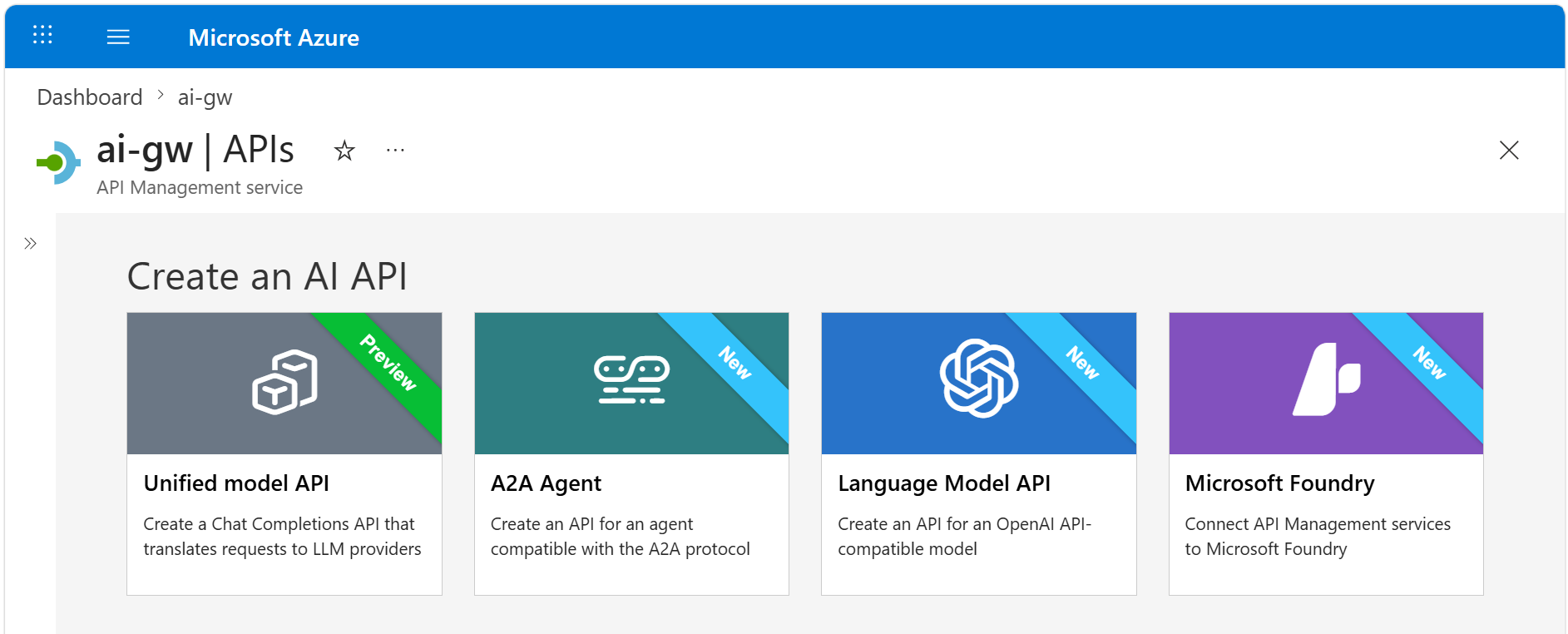
One API across model providers, content safety for MCP and A2A, deeper token observability, and A2A APIs reaching GA. Here are the new AI gateway capabilities in Azure API Management.
Multi-model, multi-protocol AI applications are quickly becoming the norm. Teams are mixing OpenAI, Anthropic, and Vertex AI models, exposing tools through MCP, and wiring agents together with A2A. As that surface grows, so does the work of keeping it secure, observable, and consistent.
Our ongoing strategy for the AI gateway capabilities in Azure API Management centers on that problem: providing one place to manage models, MCP tools, and agents, no matter which provider or protocol is behind them. The updates below are the latest steps in that direction.
Unified Model API (preview)
The headline change in this release: the Unified Model API lets clients speak one API format — OpenAI Chat Completions — while API Management transforms requests to the backend provider, whether that's a model using OpenAI Chat Completions or Anthropic Messages API.
By centralizing model access behind a single API layer, you can:
- Standardize on a single API format for clients, independently from the formats used by backend models.
- Unify observability, security, and governance with policies that apply across model providers.
- Configure failover across model providers.
- Decouple client-facing model names from backend model names using aliases.
Learn more about the unified model API.
Model aliases
Model aliases give clients a stable, provider-neutral name to use when calling a model. By assigning an alias like gpt or claude-sonnet, you decouple the client-facing model name from the actual backend deployment.
That makes a few common operations a lot easier:
- Upgrading a model. Update the alias target to point at a new version — no client code changes required.
- A/B tests. Shift traffic between backends behind the same alias using API Management's load balancing capabilities.
- Vendor swaps. Replace one provider with another without touching application code.
Model discovery
Developers can discover available models by calling the /models endpoint of the Unified Model API. API Management returns the list of model aliases, so apps and tools can adapt to what the platform team has published — without out-of-band documentation.
Anthropic and Vertex AI models (GA)
AI gateway policies and observability now work with Anthropic and Google Vertex AI models, alongside the providers we already support.
You can:
- Apply runtime policies such as content safety, token limits, and semantic caching to Anthropic and Vertex AI traffic.
- Collect logs, traces, and metrics for these models in the same place as the rest of your AI traffic.
If you're running a multi-provider setup, you no longer need a separate governance story for each vendor.
Learn more about AI gateway capabilities in API Management.
Anthropic API operations in Microsoft Foundry import
When you import a Microsoft Foundry resource as an API in Azure API Management, the import now creates operations for Anthropic APIs alongside the existing model APIs. In a few clicks, you can stand up an API that mediates traffic to Foundry models using either the OpenAI or Anthropic API format — no manual operation definitions needed — and then apply the same policies, security, and observability you use for the rest of your AI traffic.
Learn more about Microsoft Foundry import.
Token metrics for additional token types (preview)
Token tracking used to stop at prompt, completion, and total tokens. Modern models add cached, reasoning, and thinking tokens, which can make up a significant share of token consumption, cost, and latency.
API Management now logs metrics for these additional token types into Application Insights, across API formats (OpenAI Chat Completions, OpenAI Responses, and Anthropic Messages API) and providers (Microsoft Foundry, OpenAI, Amazon Bedrock, Google Vertex AI, and others).
With richer signals, your cost dashboards, budget alerts, and capacity planning can actually reflect how today's models behave.
Learn more about token metrics.
Content safety for MCP and A2A (GA)
The llm-content-safety policy now covers MCP and A2A traffic in addition to LLM traffic. That includes MCP tool-call arguments, MCP response text, and A2A payloads.
A couple of related improvements:
- llm-content-safety can now be configured directly as an outbound policy.
- Two new attributes — window-size and window-overlap-size — let you tune how messages exceeding the Azure Content Safety limit of 10,000 characters are chunked and forwarded for validation, balancing detection sensitivity with Azure Content Safety call volume.
The result is one consistent safety policy across LLM, MCP, and A2A flows instead of stitching together custom filters per protocol.
Learn more about the content safety policy.
A2A APIs (GA)
Support for Agent-to-Agent (A2A) APIs in API Management is now generally available. Agent APIs can now be governed with the same policies, identity, and observability you use for the rest of your APIs.
What you can do with A2A APIs in API Management:
- Mediate JSON-RPC runtime operations to your agent backend with full policy support — including the content safety improvements above.
- Expose and manage agent cards, automatically transformed by API Management to represent the managed agent API.
- Log traces to Application Insights using OpenTelemetry GenAI semantic conventions for deep correlation between API and agent execution traces.
What's new in GA, on top of the preview:
- Available in classic tiers, in addition to v2 tiers — bring A2A governance to existing API Management resources without migrating tiers.
- Richer diagnostic logging for A2A APIs, giving more actionable telemetry for monitoring and troubleshooting agent traffic.
Learn more about A2A support in API Management.
Related: Bring Your Own Model in Foundry Agent Service (GA)
Last month, Bring Your Own Model (BYOM) in Foundry Agent Service went GA. BYOM lets enterprise teams route Foundry agent model calls through their own infrastructure — typically for compliance, governance, or to reuse an existing model gateway.
This pairs naturally with the AI gateway capabilities in Azure API Management. Put API Management in front of your models, apply the policies and observability described above, and have Foundry agents call through it — getting consistent governance for both your direct AI traffic and your agent workloads.
Get started
Together, these updates make Azure API Management a more complete AI gateway: consistent governance, security, and observability across models from various providers, MCP tools, and agent interactions.
Some of these features are still rolling out. They will first become available in v2 tiers of API Management and in the AI release channel for classic tiers, then continue rolling out to the rest of classic tier resources over the following weeks.
Get started with the unified model API or explore the AI gateway capabilities in API Management.

 Microsoft