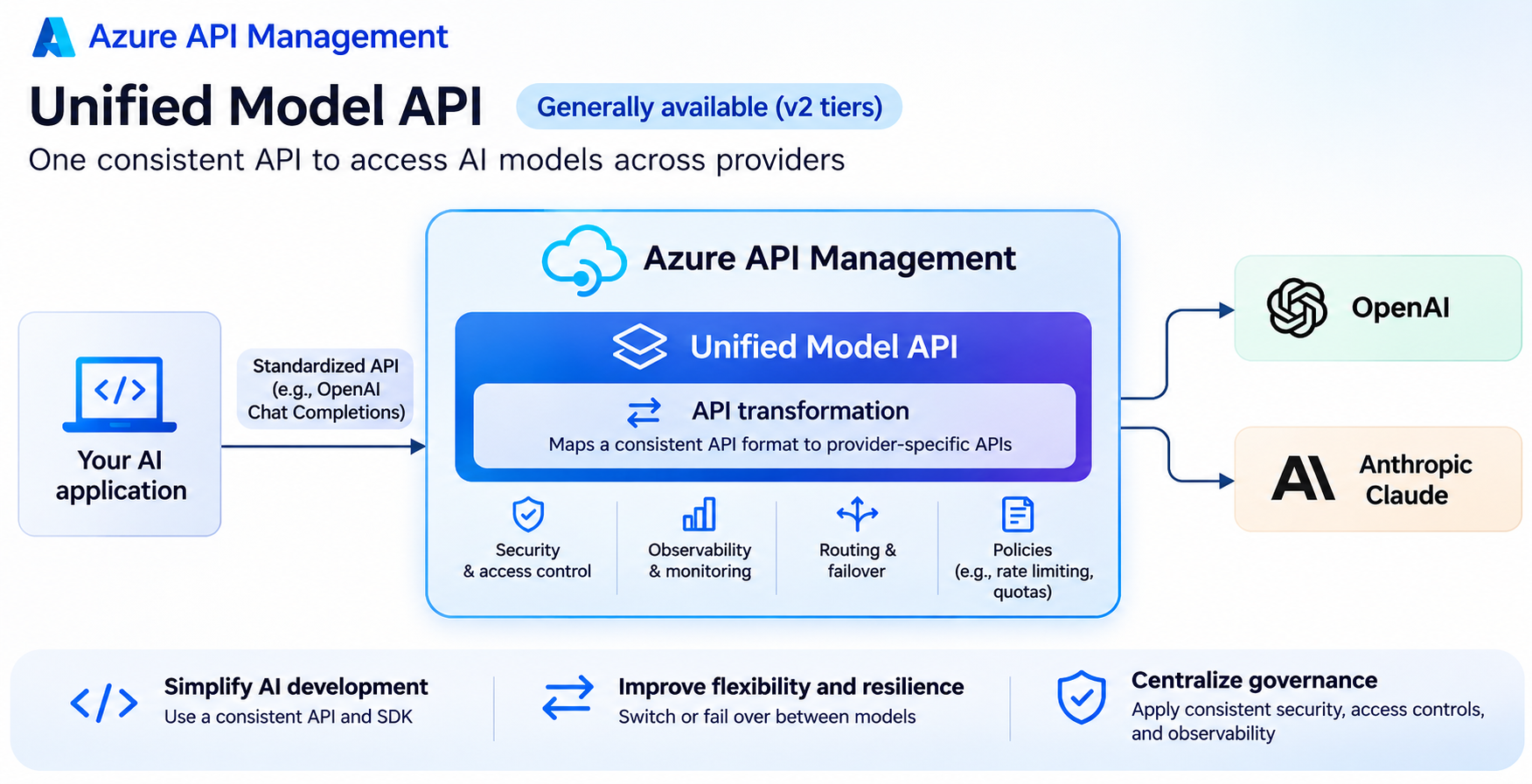
The Unified Model API in Azure API Management is now generally available in v2 tiers, enabling organizations to access and manage AI models from multiple providers through a consistent API interface. This capability simplifies the development of multi-model AI applications by abstracting provider-specific API differences and providing a unified experience for accessing supported large language models (LLMs).
As organizations increasingly adopt AI models from multiple providers, developers face challenges integrating different API formats, authentication mechanisms, SDKs, and request and response structures. These differences introduce additional development and maintenance overhead, create dependencies on individual model providers, and make it difficult to switch models or implement multi-model architectures.
With the Unified Model API, Azure API Management addresses these challenges by transforming requests and responses between a standardized client-facing API format and provider-specific model APIs. Developers can use a consistent interface, such as the OpenAI Chat Completions API, to interact with supported model providers, including OpenAI and Anthropic, without having to implement and maintain separate integrations for each provider.
The Unified Model API also enables organizations to take advantage of Azure API Management's existing gateway capabilities to centrally secure, monitor, and govern AI traffic across model providers.
With the Unified Model API, organizations can:
- Simplify multi-model AI development: Standardize on a single API format and compatible client SDKs to access models from different providers. Reduce provider-specific integration code, accelerate development, and simplify ongoing application maintenance.
- Improve model portability and flexibility: Switch between supported models and providers without requiring changes to the client-facing API contract. This enables organizations to evaluate and adopt new models based on performance, cost, availability, and evolving business requirements.
- Build more resilient AI applications: Use Azure API Management's backend management and routing capabilities to distribute requests across supported model backends and implement failover strategies. This helps improve application availability and reduces dependencies on a single model provider.
- Centralize security and governance: Apply Azure API Management policies to enforce authentication, authorization, rate limiting, and other access controls consistently across supported model providers. Organizations can manage AI model access through a centralized gateway rather than implementing security controls separately for each provider.
- Improve observability and operational management: Leverage Azure API Management's monitoring, logging, and diagnostics capabilities to gain visibility into AI API traffic, track operational performance, troubleshoot failures, and manage model integrations through a common platform.
- Accelerate adoption of new AI models: Integrate additional supported model providers behind the same standardized API interface, reducing the effort required to introduce new models into existing applications.
By abstracting provider-specific differences behind a unified API and combining model interoperability with enterprise-grade API management capabilities, Azure API Management helps organizations build AI applications that are more portable, resilient, secure, and easier to govern at scale.
The Unified Model API is generally available in supported Azure API Management v2 tiers.
Get started: Unified Model API documentation

 Microsoft