The first in our series of partner solutions that can help you not only survive, but innovate during the worldwide storage media constraints. Qumulo and Azure Storage can meet hybrid scale-out file storage needs and accelerate Enterprise AI and Analytics projects. Learn how in this post!
Move petabytes of enterprise file data to Azure without a big-bang migration and without moving every workload.
Unless you have spent the last two years in a cave without Internet access or television, you know firsthand how impactful AI has been on every aspect of our industry and society in general.
One of the impacts that has gained traction in Industry articles, blogs, and newsletters is the impact that AI Infrastructure buildout is having on storage media pricing and availability. I felt this personally when purchasing a laptop over the summer for my youngest son, an engineering major. Again, as I attempted to buy a hot spare for my home NAS (when RAID alone will not do - once an IT Pro, always an IT Pro). I spent 2x what I expected to on that laptop and decided to forego the 4x more expensive hot spare. I do have yet another kid in college after all. 😉
My personal experiences and recent conversations with customers and channel partners, like AHEAD, inspired me to think about how Azure Storage and our robust ecosystem of partners can help customers during what industry experts believe will be a prolonged event.
Whether you are facing long delays in delivery of a new on-premises array or drive shelves to expand an existing one, or are receiving “good for the next 14 days” quotes that are 4x to 10x higher than they were last year – we have the means to help. Azure Storage has capacity available worldwide, simple tooling to migrate data, and an outstanding partner ecosystem ready to meet every storage need.
I’ve always been a believer in “end-to-end” real-world solutions rather than visionary “marketecture.” This series of blog posts includes content co-authored with our partners Everpure, Qumulo, and Rubrik. We will not only cover the technical benefits of migrating on-premises data and applications to Azure – but HOW to do so, including right-sizing to achieve optimal price/performance when replacing legacy block, file, and data protection platforms via a FREE assessment.
Yesterday at Ignite, we shared how you can request an assessment of your NAS, SAN, and data protection appliances here and quickly find out if you qualify. For example, you must be a current Azure customer to qualify.
-Karl
Process and tooling to migrate to Qumulo on AzureSpend Less on Storage Infrastructure
Traditional scale-out NAS follows a familiar cycle: forecast growth, buy hardware, overprovision, expand again, pay ongoing maintenance, and eventually refresh the whole platform. Today, in the wake of media shortages, that refresh can cost far more and take far longer than expected, without delivering additional business value. Organizations can use the refresh cycle as a catalyst to modernize their data infrastructure with Qumulo and Microsoft Azure while improving price/performance and user experience.
Azure Native Qumulo (ANQ), co-engineered with Microsoft as an Azure Native ISV service, changes that model. It preserves the enterprise capabilities and familiar SMB and NFS access existing workloads require (lift and shift, no refactoring). It is cloud-flexible up and down, with no fixed capacity purchased up front. It scales capacity and performance independently and delivers NVMe performance with object storage economics. Instead of buying for future growth, you pay for what you use, reducing storage TCO, overprovisioning, maintenance, data center footprint, and recurring refreshes.
Migrate in Controlled Steps, Not a Big Bang
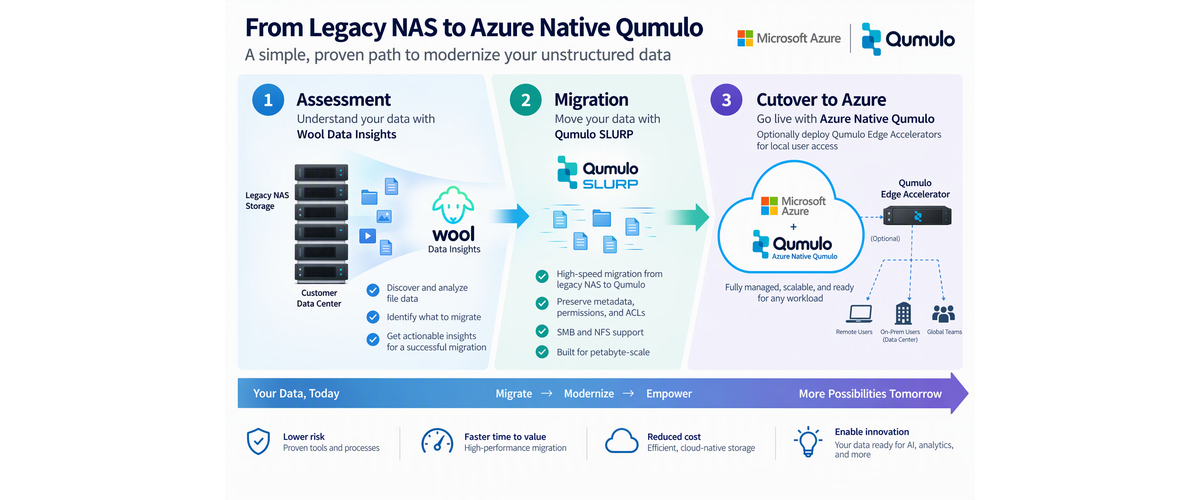
For petabyte-scale environments with thousands of users, permissions, and interconnected workflows, a single cutover creates unnecessary risk. A better approach is a controlled transition: assess, plan, migrate, and modernize.
- Assess. Wool Data provides specialized infrastructure assessments using Wool Data Insights, a lightweight agent that correlates storage, data protection, and compute. It shows capacity, utilization, performance, growth, and dependencies, so you can right-size the target instead of recreating the old NAS. The same report can also inform a move to Azure Elastic SAN and a data protection approach that reduces on-premises backup infrastructure.
- Plan around workloads. Decide what moves to ANQ, which workloads need local access, how to sequence the migration, what network requirements must be addressed, and where to deploy Edge Accelerators. Move the data first; move workloads when it makes sense.
- Migrate. Qumulo SLURP accelerates SMB and NFS migrations from third-party scale-out NAS using parallel transfers, snapshots, and incremental synchronization. It preserves critical file metadata and access controls, including NTFS ACLs and POSIX permissions, and moves up to one petabyte per day per 100 Gbps link, turning one perfect cutover into a manageable, incremental transition.
- Modernize. The next two sections will focus on how having your file data on ANQ allows you to improve remote user experience and leverage cloud-native analytics and AI capabilities inherent in the Microsoft Cloud.
Move the Data Without Disrupting the Business
Lower cost is even more compelling when users and applications do not have to change. The key is separating where the data lives from where it is accessed.
With ANQ and Qumulo Edge Accelerator, Azure becomes the primary home for enterprise unstructured data, while on-premises users and applications retain low-latency read and write access through the same SMB and NFS protocols. Edge Accelerators intelligently cache the data needed locally, whether on-premises, regionally, or across clouds, while ANQ maintains the authoritative dataset in Azure. There is no need to keep another complete copy on-premises, and very little changes for users or applications.
Because ANQ also provides S3-compatible object access, traditional applications keep using files while newer cloud-native applications can use the same data. The data can move to Azure before the applications do.
Put Your Data Closer to Innovation
Once the authoritative dataset resides in Azure, its role expands beyond file storage. Enterprise data previously tied to on-premises infrastructure becomes available to Microsoft AI Foundry for generative AI, retrieval-augmented generation (RAG), and agents, and to Microsoft Fabric for data engineering, analytics, and business intelligence. Years or decades of enterprise data can become the foundation for AI-powered search and discovery without building another copy or staging environment.
Modernization becomes a progression rather than an event: some workloads stay on-premises, others move to Azure, and new applications take advantage of Azure services as it makes sense. The storage conversation shifts from “Where should we put our next petabyte?” to “How does my data improve my customer experience, product features, and quality of decisions?”
Make the Next Storage Decision a Business Decision
Before purchasing or renewing another petabyte of scale-out NAS, ask yourself: How much of that data really needs to remain on-premises, and what more could your organization accomplish if that data were available across Azure and on-premises environments?
If your scale-out NAS is approaching capacity, renewal, or end of life, the default answer does not have to be another generation of the same infrastructure. Modernizing with Azure and Qumulo lets you spend less on storing enterprise data while creating more value from it.
Assess what you have. Plan around the workloads. Move the data at a controlled pace. Keep users connected without disruption. Then modernize applications on your schedule.
How Do You Get Started?
- Request a FREE Storage Assessment from Wool Data, sponsored by Microsoft
- Learn more about Azure Native Qumulo, also available on Microsoft Marketplace
- Estimate savings with the ANQ Pricing Calculator
- Explore Qumulo SLURP for migration
- Read “Unlocking AI Innovation with Azure Foundry and Azure Native Qumulo”
- Review the program launch from Ignite
By Michael King, Qumulo and Karl Rautenstrauch, Microsoft Azure

 Microsoft