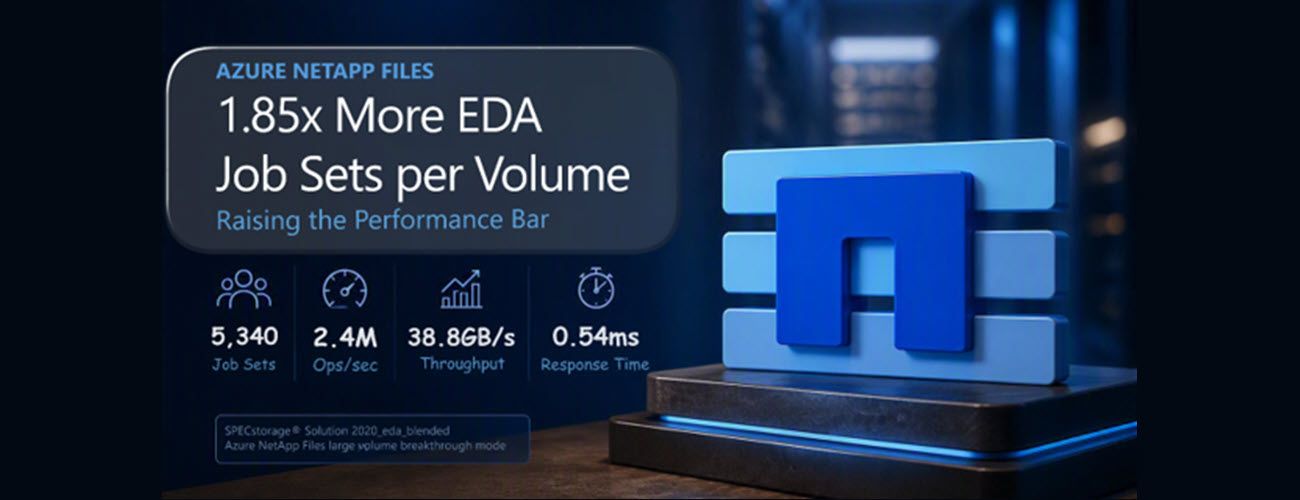
Azure NetApp Files raises the performance ceiling for cloud-based electronic design automation (EDA) with a new independently published SPECstorage® Solution 2020 EDA_BLENDED result for a single large volume in breakthrough mode: 5,340 job sets, 2.4 million operations per second, 38,776 MB/s peak throughput, and 0.54 ms overall response time. Delivering 1.85 times the job sets, operations, and throughput of the previous single-volume result while preserving sub-millisecond latency through most load points, the result enables more concurrent simulations, shorter regression cycles, and better utilization of compute and tool licenses without dataset sharding. Combined with proven linear scale-out and generally available Azure NetApp Files cache volumes that provide on-demand access to on-premises data, it gives EDA teams a practical foundation for high-performance cloud deployment and bursting.
Table of Contents
New benchmark proof with large volume breakthrough mode
The same volume, nearly double the performance
The scaling paradigm has not changed. The scale unit has.
And your data does not have to move first
Introduction
Chip design runs on concurrency. Thousands of simulation, synthesis and verification jobs hit the same project trees, tool libraries and scratch areas at once, and every one of them pays whatever the file system charges for a metadata lookup. As each new generation of silicon increases the scale, concurrency, and performance demands of EDA, Azure NetApp Files needs to keep pace by meeting the evolving storage requirements of these workloads in the cloud.
This article spotlights the next step in that story: Azure NetApp Files large volume breakthrough mode with a new SPECstorage® Solution 2020 EDA_BLENDED result for a single large volume - independently validated and published alongside every other submission in its category. It also covers what the newly generally available cache volumes add when the data your jobs need still lives on-premises.
For EDA teams the takeaway is practical. More concurrent work inside the same latency budget means shorter regression cycles, more design iterations per day, and compute grids and tool licenses that spend their time working rather than waiting on I/O - without sharding a dataset across volumes to get there.
Earlier this year we demonstrated that shared storage had stopped being the reason EDA stays on-premises. The evidence was a single Azure NetApp Files large volume in breakthrough mode, measured on SPECstorage® Solution 2020 EDA_BLENDED: 2,880 job sets, 1,296,040 ops/sec and 20,910 MB/s at a 0.51 ms overall response time.
Six of those volumes side by side scaled linearly to 17,280 job sets - the same architecture, simply multiplied. Both results are covered in Azure NetApp Files for EDA workloads: From revolution to breakthrough at scale and dissected in its technical companion, From Scale to Breakthrough: Azure NetApp Files Sets a New Cloud Benchmark for EDA Performance.
And the story continues.
Co-authors:
- Jitesh Mani, MSFT , Sr. Product Manager Azure Storage
- Ranga Sankar, Azure NetApp Files Product Manager
- Andy Chan, Azure NetApp Files HPC/EDA Principal Product Manager
- George Strother, Azure NetApp Files Product Manager
New benchmark proof with large volume breakthrough mode
Today, we are publishing a new result. This one is not simply about more linear scalability.
It is about further boosting the baseline; more single large volume breakthrough mode performance.
Our latest submission will tell you that:
|
A single Azure NetApp Files large volume breakthrough mode delivered 38,776 MB/s (36,980 MiB/s) of throughput and 2,403,131 operations per second at peak. |
|
SPECstorage® Solution 2020_eda_blended |
5,340 Job_Sets |
|
Overall response time |
0.54 ms |
|
Ops/sec at peak load |
2,403,131 |
|
Throughput at peak load |
38,776 MB/s |
|
Maximum latency at peak load |
2.043 ms |
One 150 TiB Azure NetApp Files large volume, Flexible service level, breakthrough mode enabled, six storage endpoints, 48 RHEL 9.8 clients mounting over NFSv3, single region, single availability zone. Tested August 2026.
Explore the results here: https://www.spec.org/storage2020/results/res2026q3/storage2020-20260901-00150.html.
The same volume, nearly double the performance
Against that first single-volume result - 2,880 job sets, 1,296,040 ops/sec, 20,910 MB/s - the new number is 1.85x higher on every measure: job sets, operations and bytes. The overall response time moved up only by three hundredths of a millisecond.
That last part is the one worth pausing on. Performance boosts are easy to admire and hard to use if they come with massive latency increases. EDA is not merely a throughput game; it is a concurrency game played under a latency budget.
A regression farm does not care that storage can go fast. It cares whether the ten-thousandth job of the afternoon still gets its metadata lookup answered in the same number of microseconds as the first. This volume held average latency under a millisecond all the way through 4,628 job sets - and 4,628 is already well past where the previous single volume finished.
The scaling paradigm has not changed. The scale unit has.
Here is the part we will leave to you. The scaling approach remains the same. What has evolved is the amount of performance and concurrency each volume contributes. Consider the earlier scale-out result: six large volumes delivered 17,280 job sets, exactly six times the 2,880 job sets achieved by a single volume. The architecture remained unchanged, scaling linearly without overprovisioning or hot spots, while sustaining a 0.60 ms overall response time and 125,474 MB/s of throughput.
|
That horizontal paradigm is unchanged and remains available to every customer. We’ve already proven volumes scale out linearly, |
What has changed is the size of the unit you are multiplying. We are deliberately not publishing a projection. You know your regression profile, your license pool and your deadline better than any benchmark does. Take the new single-volume number, apply the scaling behavior we have already demonstrated, and draw your own conclusion.
And your data does not have to move first
The other capability that just became generally available is Azure NetApp Files cache volumes, and the combination is more interesting than either part alone. A cache volume is a cloud-based cache of an origin volume that stays on-premises: only the actively used blocks are pulled into Azure on demand, reads are served at LAN-like speed once cached, and writes are acknowledged locally and written back asynchronously, so the origin remains the authoritative copy. No lengthy pre-staging, no second source of truth, no application changes - standard NFS and SMB, with origin permissions preserved.
For EDA, that is what bursting to the cloud always needed to be: send the work to where the capacity is - including when you are relocating jobs to get around a regional CPU or GPU shortage - and let the dataset follow the demand. Put that with an in-Azure volume that now sustains 2.4 million operations per second at half a millisecond, and "bursting" stops meaning "a slower copy of your environment, somewhere else." It means the same design environment, at the latency profile your flows were tuned for.
Already in the flow
None of this is theoretical. Microsoft Discovery is bringing agentic AI to HPC-scale chip design workflows - see Microsoft Discovery: Where HPC meets agentic AI for the next era of EDA. And with that, Synopsys Advances Agentic AI Chip Design with AMD and Microsoft, powered by Azure NetApp Files. Production EDA on Azure has stopped being the experiment. It is the flow.
Bringing it together
Last year, revolution. This spring, breakthrough at scale. Today, the single volume underneath it is 1.85x faster than when we started. Measured, published, and independently comparable – all while breaking down the walls between cloud and on-premises.
Storage no longer decides where and how big your regression can be. That decision is yours again. Contact us at askanf@microsoft.com to get you started.
Learn more
- What's new in Azure NetApp Files | September 2026
- Understand large volumes in Azure NetApp Files
- Understand Azure NetApp Files cache volumes
- Azure NetApp Files large volume breakthrough mode (Aug 2026)
- All published SPECstorage® Solution 2020_eda_blended results
SPEC® and SPECstorage® are registered trademarks of the Standard Performance Evaluation Corporation. Comparisons are between published SPECstorage® Solution 2020_eda_blended results for Azure NetApp Files large volume breakthrough mode. For the latest published results, see www.spec.org.

 Microsoft