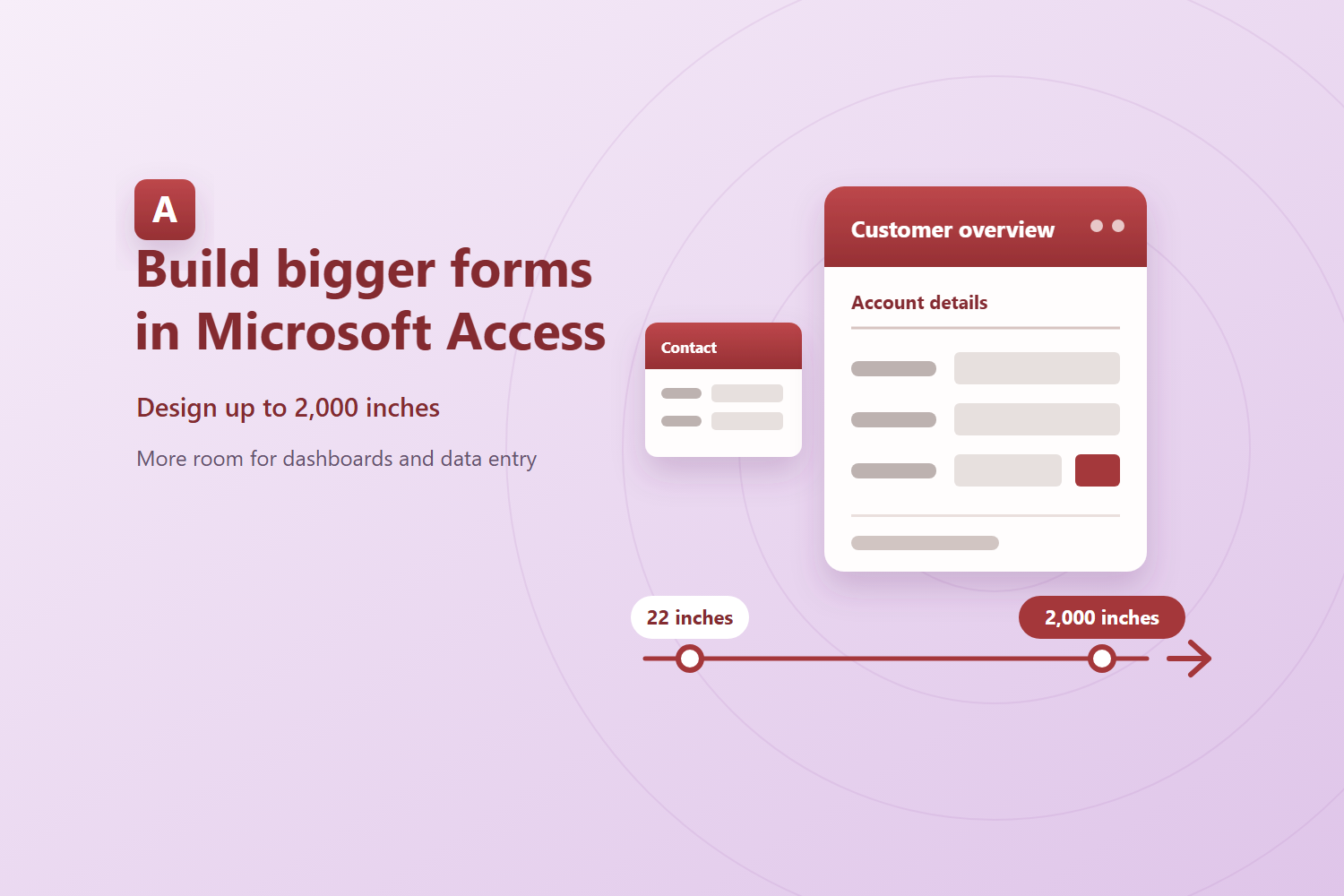
Big Forms expands the long standing 22 inch design limit to 2,000 inches, giving you substantially more room to create detailed interfaces, dashboards, and data entry experiences.
For many years, Microsoft Access forms were limited to 22 inches in width and in the height of an individual section. That size works well for many solutions, but it can become restrictive when you are building a wide dashboard, arranging many controls, designing for a large display, or creating a detailed data entry workflow.
With Big Forms, a form can be up to 2,000 inches wide, and each individual vertical dimension can be up to 2,000 inches. The combined height of all sections and their Design View section headers can be up to 2,100 inches.
Continue using the familiar Access design surface, property sheet, rulers, and scrollbars, with substantially more space available when your solution needs it.
More room for the solutions you already build
Wider layoutsExtend forms up to 2,000 inches wide for dashboards with more fields, controls, and content displayed next to each other. |
Taller sectionsUse up to 2,000 inches for an individual vertical dimension and up to 2,100 inches across all sections. |
Familiar design toolsEnter dimensions in the property sheet or resize controls directly on the design surface as you do today. |
How to create a bigger form
- Open your object in Design View.
Open an existing form, or create a new one. - Resize the design surface or a section.
Drag an edge beyond 22 inches, or enter a Width or Height value of up to 2,000 inches in the property sheet. - Position and size your controls.
Move controls into the expanded area or set larger Left, Top, Width, and Height values. - Save and reopen as usual.
Access preserves the expanded dimensions when you save the form.
|
Use Big Forms from VBA
You can read and set expanded dimensions through the existing VBA Properties collection. Values are expressed in twips, with 1,440 twips in one inch. The 2,000 inch maximum is 2,880,000 twips.
Public Sub ResizeCustomerOverview()
Const TwipsPerInch As Long = 1440

DoCmd.OpenForm "CustomerOverview", acDesign

With Forms("CustomerOverview")
    .Properties("Width").Value = 100 * TwipsPerInch
    .Section(acDetail).Properties("Height").Value = 50 * TwipsPerInch
    .Controls("Notes").Properties("Left").Value = 24 * TwipsPerInch
    .Controls("Notes").Properties("Width").Value = 60 * TwipsPerInch
End With

DoCmd.Save acForm, "CustomerOverview"
End Sub
No new property names are required. Use Properties("Left"), Properties("Top"), Properties("Width"), and Properties("Height") to work with the new larger limits.
|
Designed with compatibility in mind
Backward compatibility is determined for each form. Access only uses the new saved form format when a form actually exceeds a legacy limit. Forms that remain within the previous limits continue to use the existing format, even when they are saved by a version of Access that supports Big Forms.
When a form uses the expanded range, Access saves its full values in wider properties and marks that specific form as requiring Big Forms support. An earlier version of Access can still open the database and work with its other compatible objects. If someone tries to open the expanded form, Access displays a message explaining that the form requires a newer version.
|
|
Availability
Big Forms is rolling out on Current Channel, beginning with version 16.0.20430.20146. It is enabled for some customers now and is expected to reach everyone on Current Channel early next week. If you are on that build and do not yet see the expanded limits, check again in a few days.
|
Availability |
Rolling out on Current Channel |
|
Version |
16.0.20430.20146 or later |
|
Platform |
Microsoft Access for Windows |
To check your version, open Access and select File > Account > About Access.
Try Big Forms and tell us what you think
Use the expanded design surface with your forms, then share what works well and where you would like to see improvements.
Feature availability and release timing can vary by update channel.

 Microsoft