A lot has happened with Postgres at Microsoft over the past year. This is the 2026 edition of our annual “what’s new” blog post, with highlights from the past 12–13 months—across both our managed services on Azure and our work in the upstream open source project.
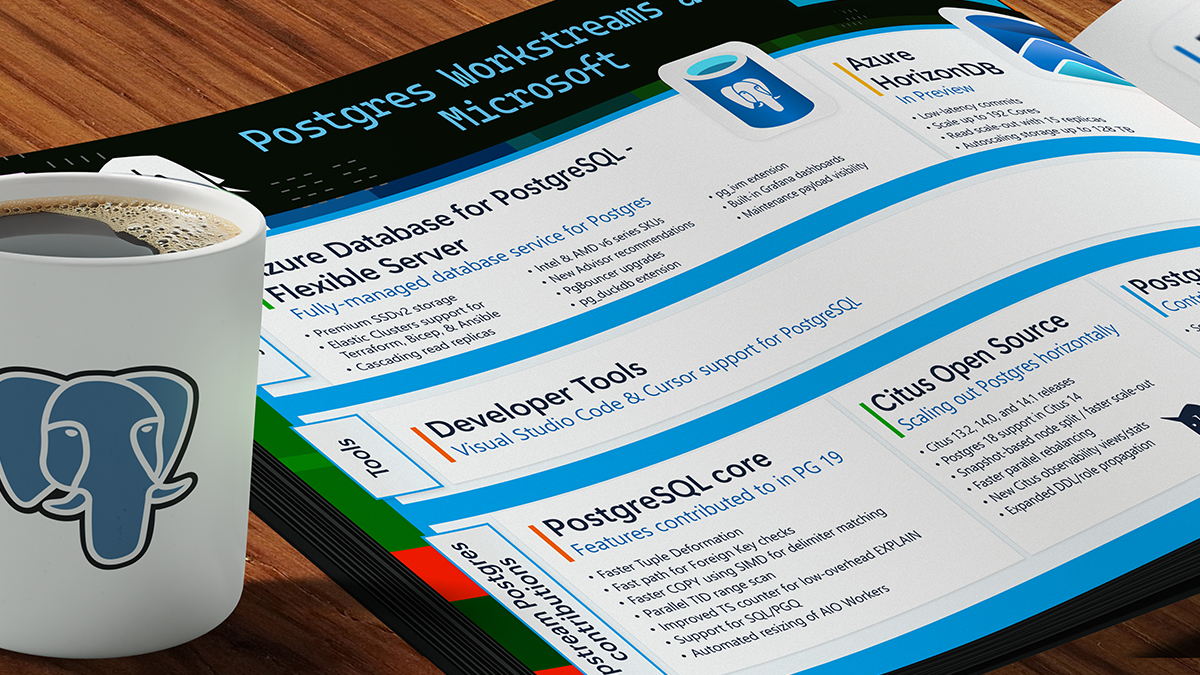
The infographic below pulls it all together—feature updates, new capabilities, and ongoing investments across our Postgres workstreams. You might notice it looks a bit different compared to last year: we redesigned the infographic to make space for two new sections—Azure HorizonDB (Preview) and Developer Tools.
The table of contents follows the structure of the hand-made infographic, with each bullet linking to that section. Jump to what you care about, or settle in ☕️ and read the whole thing.
- Azure Database for PostgreSQL flexible server
- Azure HorizonDB
- Developer Tools
- PostgreSQL core
- Citus open source
- Postgres Community
Figure 1: This infographic maps out the major workstreams across Microsoft’s Postgres efforts as of June 2026—from the managed database services on Azure, to VS Code and Cursor, to upstream contributions to the Postgres open source project. For much of the open source work, our contributions to PostgreSQL involve collaboration with people across the global PostgreSQL community, both inside and outside Microsoft.
Azure Database for PostgreSQL flexible server
Azure Database for PostgreSQL flexible server is a managed database service on Azure that meets the needs of large enterprises, small to medium-sized businesses, and early-stage startups. Flexible Server continues to grow in capability month over month, as evident in the monthly “feature recap” blog posts on Microsoft Tech Community (props to Gauri Kasar for publishing these) in June 2025, July, August, September, October, November, January 2026, February, March, April.
TIP ON NAMING: Throughout this post, we sometimes use the full name—Azure Database for PostgreSQL flexible server—and sometimes we just say “Flexible Server” for short. They mean the same thing. You might notice we use the two names interchangeably, so am flagging it here to avoid any confusion.
Performance & Scalability
- Premium SSDv2 storage: With the general availability of Premium SSDv2 storage, significant performance and cost-efficiency improvements are now available for IO-intensive workloads. With SSDv2, storage and performance can be scaled independently so you only pay for what you use. Premium SSDv2 adds flexible server storage scaling up to 64TB, with up to 80,000 IOPS and 1,200 MiB/s throughput. (link to docs)
- Elastic Clusters support for Terraform, Bicep, & Ansible: With the general availability of Elastic clusters, flexible server added built-in support for row-level and schema-level sharding of data across a cluster of servers. Built-on Citus open-source technology, elastic clusters provides horizontal scaling of workloads with all the enterprise features of flexible server. We’ve added infra-as-code support to deploy elastic clusters from Terraform, Bicep, and Ansible. (link to docs)
- Cascading read replicas: With the general availability of cascading read replicas, you can not only create read replicas from the primary, but from other replicas too—enabling up to 30 replicas, more efficient distribution of read traffic, and more flexibility for complex deployment topologies. (link to docs)
- Intel & AMD v6 series SKUs: The Intel & AMD v6 General Purpose and Memory Optimized SKUs deliver high-performance, massive scale and better price performance. Powered by 5th Gen Intel® Xeon® processor and AMD's fourth Generation EPYC™ 9004 processors you can scale up to 192 vCores and 1.8 TiB of memory. Using the NVMe protocol for data disk access you can leverage the maximum IOPS and throughput from high performance IO options like SSDv2. (link to docs)
- New Azure Advisor performance recommendations: Azure Advisor provides proactive performance, resiliency, and security recommendations for your workloads. We added Index scan insights to improve query efficiency, audit logging review to identify excessive logging, statistics monitoring with alerts on statistics resets, storage optimization recommendations, and connection management guidance. (link to docs)
- PgBouncer upgrades: PgBouncer is the built-in connection pooling feature for flexible server, providing the ability to scale to thousands of connections. Upgrading to 1.25.1 added enhanced protocol handling and important stability and security fixes. (link to docs)
- pg_duckdb extension (Preview): The
pg_duckdbextension combines PostgreSQL’s transactional performance and reliability with DuckDB’s analytical speed for large datasets. This makes a great combination for hybrid OLTP and OLAP environments where you need to run analytical queries directly in PostgreSQL without compromising on performance. (link to demo video)
- pg_ivm extension: The
pg_ivmextension implements Incremental View Maintenance (IVM), allowing materialized views to by updated more efficiently by only applying incremental changes when the underlying data changes—resulting in improved performance for large datasets where only a small subset of the data is modified. (link to repo)
Manageability
- Built-in Grafana monitoring dashboard: Grafana dashboards for your flexible server instances are now readily available from the Azure Portal in your Azure Database for PostgreSQL view. You can now visualize metrics and logs, correlate events by timestamp, and rapidly gain insights into performance, query behavior, and availability with built-in dashboards. (link to blog)
- Maintenance payload visibility: Maintenance updates to flexible server can include PostgreSQL minor version updates, security fixes, bug fixes and new functionality. It’s important to know what’s changing so you know what to expect, what improvements you can take advantage of, and whether to flag any concerns. You can now access the release notes for maintenance updates. (link to docs)
- Defer maintenance & Maintenance on demand: Using Custom Maintenance Windows (CMW) and System-managed Maintenance Windows (SMW) gives you control over when to apply flexible server maintenance updates. We’ve expanded that control with the ability to defer an upcoming maintenance update by up to 2 weeks, or to apply one on demand. These new options are available in the Azure Portal, with CLI and API support coming soon. (link to docs)
- PostgreSQL 18 (w/MVU & Terraform support): PostgreSQL 18 was made available on Azure on the same day as the community release, with a host of performance and security improvements . PG18 general availability added support for all Azure public regions, Major Version Upgrade, Entra ID authentication, and Terraform support. (link to blog)
- 5 new regions added: Austria East, Denmark East, Indonesia Central, Malaysia West, Chile Central: New Azure regions for flexible server are continually being added in response to customer demand. You can check out the region availability list to stay up to date with supported regions. (link to docs)
- HA expansion: Japan West: Existing regions are also being retrofitted to add availability zones which support zone-redundant High Availability. In this timeframe, we’ve added support for multi-zone deployment in Japan West. (link to docs)
Resiliency
- Zonal resiliency HA setting: Zone-redundant high Availability (HA) is the recommended and default HA configuration for maximum resiliency. The Azure Portal now includes a Zonal Resiliency setting that lets you select same-zone HA if a region doesn’t support zone-redundant HA—with automatic migration once capacity becomes available. (link to docs)
- Near-zero downtime scaling for HA-enabled servers: This feature minimizes downtime when you modify the storage and compute tiers. Scaling operations such as vCore or Compute tier operations can now HA failovers to maintain the connection string, reducing downtime to typically under 30 seconds. You don’t need to take any action to use this feature. (link to docs)
- Long term backups: Backups with Long Term Retention (LTR) enable you to keep backups for up to 10 years, enabling you to meet regulatory and audit-driven requirements for long-term data retention. (link to docs)
- Logical replication slot synchronization metric: A new metric called
logical_replication_slot_sync_statusprovides a binary signal to indicate whether logical replication slots are synchronized across High Availability (HA) primary and standby nodes. This adds a clear signal for failover readiness to help with scenarios where data continuity during failover is critical. (link to docs)
Security and networking
- Azure Confidential Computing: PostgreSQL flexible server instances can now run on Confidential Virtual Machines (CVMs) inside a Trusted Execution Environment (TEE)—a secure, isolated enclave with encrypted memory, enabling end-to-end security and enhanced privacy to meet the strictest security standards for regulated workloads. (link to docs)
- Entra ID group login using user credentials: You can authenticate to Azure Database for PostgreSQL with your Entra ID as a member of a Microsoft Entra group by creating a group principal. Managed identities and service principals are also supported as group members. (link to docs)
- Entra ID token refresh libraries for .NET, Python, Java: Using Entra ID for authentication throughout your application supports an identity-based security perimeter, simplifying how applications authenticate with Azure Database for PostgreSQL, but it also means your application needs to handle additional complexities like Entra token refresh. These libraries take care of the token refresh logic, making it easy to add token refresh support to your applications with minimal code changes. (link to libraries .NET, JavaScript, and Python)
- Credcheck, anon, ip4r extensions: We onboarded several extensions over the last year that help with compliance and regulatory requirements, including:
- anon: GA of the upgraded
anonextension, adding support for dynamic and static masking, anonymized exports, randonmization, and other advanced masking techniques. - credcheck: The
credcheckextension adds credential checks for usernames and password complexity. - ip4r: The
ip4rextension provides a set of data types for Ipv4 and Ipv6 network addresses which are useful for auditing, compliance, and intrusion detection. (link to docs: anon, credcheck, IP4R)
- anon: GA of the upgraded
- Priority connectivity for azure_pg_admin users: The
azure_pg_adminrole provides a way to perform privileged administrator operations without access to the superuser role, reducing the risk of privilege escalation. This role was updated to work with PG16’s stricter role hierarchy, allowing management of objects owned by any non-restricted role. It also ensures that at least one database connection is always available to admin users—even when the client connection pool is full—helping prevent lockout situations and making troubleshooting easier. (link to docs) - Defender security assessments (Preview): Two new Microsoft Defender for Cloud CSPM security recommendations for flexible server are now availability:
- Geo-redundant backups should be enabled for PostgreSQL Servers, and
require_secure_transportshould be set to "on" for PostgreSQL Servers
These assessments evaluate database configuration settings against recommended security practices, helping you manage risk and align with internal and industry standards. Additional security assessments will be added over time. (link to new recommendations) - VNET to Private Link migration (Preview): Previously, it wasn’t possible to migrate servers deployed inside a VNET to an updated secure network configuration based on Private Endpoint connectivity, which is simpler and more scalable. With the VNET to Private endpoint migration preview, you can use the Azure CLI, API or SDK to migrate your server without needing to recreate it. (link to docs)
- Extended CVE support for PG11, 12, 13: If you’re running a PostgreSQL version in flexible server that is no longer community supported like PG11, 12, or 13, it will continue to be patched with high priority CVEs for 3 years after the community retirement data as part of Azure Database for PostgreSQL extended support. (link to docs)
Integration
- Mirroring data to Microsoft Fabric: The general availability of Fabric mirroring in flexible server opens up near real-time replication of data from Azure Database for PostgreSQL to Microsoft Fabric—enabling the advanced analytics and reporting capabilities of Fabric without the need for extensive ETL. It also means your PostgreSQL server is free to run mission-critical transactional workloads without being affected by spikes in analytical reporting. (link to docs)
- Ansible module update: A new version of the Ansible collection for flexible server was released, adding support for support for Elastic clusters, PG18, virtual endpoints, on-demand backups, system-assigned identity, storage auto-grow, read replica switchover and more. (link to docs)
- Updated Go, Java, JavaScript, .NET & Python SDKs: The udpated SDKs for performance flexible server operations add PG18 support, improved Elastic cluster features and improved response codes. (link to SDKs: .NET, Go, Java, Javascript, Python)
- Upsert and Script activity in ADF and Azure Synapse: New capabilities were provided to make merging data into existing tables easier with the Upsert method, and to run custom SQL scripts as part of workflows enabled more streamlined ETL processes with Azure Data Factory and Azure Synapse. (link to Upsert Methodand script activity docs)
- Stable REST API release for 2025: The 2025-08-01 stable REST API release for Azure Database for PostgreSQL added support for the latest PostgreSQL major versions, Elastic Cluster and CMK enhancements. (link to released APIs)
- Azure Storage extension Parquet support: Parquet is a popular columnar storage format that is widely used in big data and analytics environments. With Parquet support in
azure_storage, you can now perform direct SQL-based reads and writes to Parquet files inazure_storage, making it easy to import and export data to and from PostgreSQL without needing external tools or scripts. (link to docs)
Migration service in Azure Database for PostgreSQL
- AI-assisted Oracle to PostgreSQL migration tool: Migration from one database type to another has traditionally been a complex, time-consuming and costly project. The emergence of AI-assisted migration tooling has dramatically reduced this cost. The AI-assisted migration tooling available with the VS Code PostgreSQL extension converts Oracle schema and application code to Azure Database for PostgreSQL flexible server. This tooling leverages GitHub Copilot, Microsoft Foundry, and custom Language Model tools to convert Oracle schema, database code and client applications into PostgreSQL-compatible formats and validates every change against a running flexible server instance. (Link to schema conversion docs, link to app conversion docs)
- Azure Migrate discovery & assessment: The first step in a database migration process is Discovery: understanding what you’re running and the state of migration readiness. Azure Migrate now provides PostgreSQL discovery and assessment to report on your on-prem PostgreSQL landscape, identify potential migration blockers, and learn tailored SKU and cost insights with a streamlined migration assessment. (link to docs)
- Migration with pgoutput plugin: Online migration to flexible server became generally available last June and we’ve continued to improve it. You can now leverage
pgoutput(used by PostgreSQL’s logical replication framework) for online migration with improved reliability and performance. The update provides improved compatibility with modern PostgreSQL deployments and reduces dependency on legacy decoding mechanisms, enabling functionality like fine-grained filtering using Publications, allowing migration of specific tables and filtering by operations. (link to docs) - AlloyDB & EDB migration sources: You can now migrate directly from AlloyDB and EDB Extended Server to PostgreSQL using the Azure Database for PostgreSQL Migration Service, with both online and offline migration support. (link to docs: AlloyDB, EDB)
AI capabilities in Flexible Server
- AI Functions (Preview): AI Functions add extraction, generation, classification, and re-ranking directly into SQL through the
azure_aiextension using an Azure OpenAI or Microsoft Foundry model. It replaces hundreds of lines of Python glue with a one-line SQL call. (link to docs) - pgvector 0.8.2 support: pgvector 0.8.2, focuses on stabilizing parallel HNSW index builds, fixing correctness issues and improving reliability, all important steps toward production-grade vector search. (link to docs)
- Microsoft Foundry integration (Preview): We've shipped a PostgreSQL connector for Microsoft Foundry built on the Model Context Protocol (MCP). Foundry agents can now explore your Postgres schema, retrieve records, run analytical queries, and perform vector similarity searches in natural language, secured by Microsoft Entra ID (link to docs)
- LangGraph/LangChain connector: The new native Azure Database for PostgreSQL connector for both frameworks gives agents first-class vector retrieval, checkpointing, and conversational memory backed by your Postgres instance with Entra ID authentication and production-grade reliability out of the box. (link to blog)
- Apache AGE extension support: Apache AGE is now supported on Azure Database for PostgreSQL, bringing graph queries to the same database that already holds your relational tables, JSON, vectors, and full-text indexes. (link to blog)
Try it out: Quickstart for Azure Database for PostgreSQL
The Quickstart: Create an Azure Database for PostgreSQL flexible server docs page walks you through how to get started deploying your own flexible server instance, including a link to a free Azure trial account.
Our Postgres team is hiring!
If you’re a deep Postgres expert—or a strong Linux systems engineer—this might be your moment. We’re continuing to grow the Postgres team at Microsoft. (link to Principal Software Engineer role; and link to Software Engineer II role)
As Affan Dar, the VP of Engineering for Postgres at Microsoft says all the time:
“We are always looking for strong Linux systems engineers and PostgreSQL experts to help us build the future of Postgres at Microsoft.”
Azure HorizonDB (Preview)
Azure HorizonDB launched in private preview last November, and at Microsoft Build in May 2026 we announced the public preview. If you want a quick overview, the excerpt below from the announcement blog post is a good place to start—or you can dive straight into some of the key HorizonDB features further down.
"Azure HorizonDB is built to meet the demands of security, resilience, scale, and performance—combining the flexibility developers expect from Postgres with the operational rigor enterprises require.
It extends the core Postgres engine with cloud-native capabilities such as integrated identity, fine-grained network and security controls, and seamless lifecycle management, while preserving full compatibility with the open ecosystem of extensions.HorizonDB introduces advanced, natively integrated capabilities like vector data support and AI model management, enabling new classes of intelligent applications without sacrificing transactional integrity or developer productivity."
—Excerpted from "Azure HorizonDB: Enterprise-Ready Postgres, Engineered for the AI Era" announcement blog post
- Low latency commits: The architecture of Azure HorizonDB (Preview) separates compute and storage, so storage is shared by all compute nodes. This shared storage architecture enables low-latency, millisecond commits within region providing critical support for tier-1, performance-sensitive workloads. (link to docs)
- Scale up to 192 Cores: Azure HorizonDB supports compute scaling up to 192 cores for both primary and replica instances, enabling the capacity needed to handle workload spikes. (link to docs)
- Read scale-out with 15 replicas: Support for up to 15 read replicas, with read connections automatically load-balanced across them to efficiently scale out read workloads. (link to docs)
- Autoscaling storage up to 128 TB: Support for storage auto-scaling up to 128 TB, eliminating the need to pre-provision storage size. Storage automatically shrinks as your data footprint decreases. (link to docs)
- Zone resilient storage: Azure HorizonDB leverages Azure Blob Storage, which is zone-resilient by default, to ensure zero data loss. (link to docs)
- Entra ID Authentication: Azure HorizonDB provides native integration with Microsoft Entra ID, enabling centralized identity and access management for PostgreSQL workloads. This integration supports secure, token-based authentication while allowing organizations to enforce enterprise security policies such as multi-factor authentication and conditional access.
- Private Endpoints : Azure HorizonDB supports Azure Private Endpoints, ensuring that database connectivity remains entirely within a customer’s private Azure VNET boundary. This capability minimizes exposure to the public internet and helps organizations satisfy stringent security, compliance, and regulatory requirements.
- Mirroring to Microsoft Fabric: Azure HorizonDB includes native mirroring to Microsoft Fabric, enabling near real-time replication of operational PostgreSQL data into analytics-ready OneLake storage. This capability simplifies modern analytics architectures by reducing dependency on complex ETL pipelines while supporting scalable BI, AI, and data engineering workloads.
- ~75 popular Postgres extensions: Azure HorizonDB is fully PostgreSQL-compatible and supports approximately ~75 popular extensions such as
pg_stat_statements,auto_explain,pg_duckdb,pg_diskann. It will continue to expand support for additional extensions, including both PostgreSQL and Azure-specific offerings such as AI extensions. (link to docs) - Full-text search with BM25 ranking (pg_textsearch):
pg_textsearchbrings BM25 the same relevance algorithm behind every major search engine directly into HorizonDB as a native extension. BM25 offers better relevance than PostgreSQL's built-ints_rank, and you can combine it with vector search in one SQL query for true hybrid retrieval. (link to docs) - DiskANN Advanced filtering: DiskANN Advanced Filtering offers lower latency on filtered vector search compared to traditional approaches, so a query like "find the most similar products under $50 in the Electronics category" runs at full DiskANN speed. (link to docs)
- AI model management: AI Model Management in Azure HorizonDB simplifies how you bring AI into your database. With a single step, it provisions fully managed AI models for embeddings, semantic ranking, and generation through Microsoft Foundry—and installs and configures the
azure_aiextension to enable AI functions likegenerate(),extract(),create_embeddings(), andrank()for immediate use directly in SQL. This removes the need for manual setup and context switching, with model provisioning, management, monitoring, and billing handled seamlessly within HorizonDB. (link to docs) - AI pipelines: AI Pipelines let you describe an AI workflow (chunking, embedding, extraction, generation, ranking, human approval) declaratively in SQL, and run it as a fault-tolerant pipeline that lives inside the database built on pg_durable. (link to docs)
- Durable functions (pg_durable):
pg_durableis an open source extension that lets you describe long-running workflows such as sequential steps, parallel fan-out, scheduled jobs, human-in-the-loop, and retries declaratively in SQL. And then you can run them as fault-tolerant durable functions that live inside the database. (link to GitHub Repo)
BACKSTORY: Beyond features, if you want to learn more about the story behind Azure HorizonDB, listen to the Talking Postgres podcast episode with guest Adam Prout, one of the founding architects of Azure HorizonDB.
Developer Tools
We launched a new IDE for PostgreSQL in VS Code in May 2025—and the response was strong, including a day at the top of Hacker News and over 170K views of the original blog post. One year later, the extension has more than 560K+ installs, we’ve kept building and adding more capabilities. Below are some of the highlights. We also recently added support for Cursor, available via the Open VSX Registry.
- VS Code extension to connect to any Postgres, anywhere: You can connect to any PostgreSQL database directly from the VS Code extension for PostgreSQL—whether it’s running locally, in a container, on-prem, or in any cloud. Connection profiles let you switch between environments without leaving the editor. (link to docs)
- One-click Dockerized Postgres + integrated psql: Local development is streamlined through the PostgreSQL extension in VS Code, including quick setup of a PostgreSQL environment and support for familiar tools like psql. This reduces the amount of manual setup needed to start querying. (link to docs)
- Object Explorer with cross-database search: Within VS Code, the PostgreSQL extension provides an Object Explorer for browsing tables, views, and functions across databases. You can also search across schemas and databases without manually navigating the full tree. (link to docs)
- Schema visualization: Schema visualization is built into the VS Code extension for PostgreSQL, making it easier to understand relationships between tables. This can be especially useful when working with unfamiliar or complex data models (link to docs)
- Intellisense query editor with CSV/JSON: The VS Code extension for PostgreSQL includes a query editor with IntelliSense that is schema aware. Query results are returned in a grid and can be exported to formats like CSV or JSON for further analysis. (link to docs)
- Query plan visualizer & Copilot analysis: Query plans can be visualized directly in VS Code using the PostgreSQL extension, helping surface bottlenecks and execution details. With GitHub Copilot, you can also get explanations and suggestions for improving query performance. (link to docs)
- Apache AGE Cypher graph visualization: Support for Apache AGE allows graph queries to be run and visualized as node-edge diagrams directly in VS Code. This enables exploration of graph data without requiring a separate visualization tool. (link to docs)
- Copilot Agent Mode tools (run SQL, design schemas, import CSV): When used with the VS Code extension for PostgreSQL, GitHub Copilot can operate in agent mode to assist with multi-step workflows such as running queries, designing schemas, or importing data. These actions are suggested in natural language while still requiring user confirmation. (link to docs)
- Copilot metrics intelligence in Server dashboard: The VS Code extension for PostgreSQL includes server dashboards that surface database performance metrics. GitHub Copilot can help interpret these signals and guide troubleshooting or optimization efforts. (link to docs)
- Entra authentication for Azure Database for PostgreSQL: Connections from the VS Code extension for PostgreSQL to Azure Database for PostgreSQL support Microsoft Entra ID authentication. This enables secure, passwordless access directly from the editor. (link to docs)
- Azure server browse, create, & manage in-IDE: Azure Database for PostgreSQL resources can be discovered, created, and managed directly within VS Code through the PostgreSQL extension. This reduces the need to switch to the Azure portal for common workflows. (link to docs)
- Cursor extension for PostgreSQL: An extension for PostgreSQL is also available in Cursor and other Open VSX-compatible editors, bringing the same database tooling into those environments. In Cursor, these workflows integrate with Cursor’s native AI experience while preserving the core Postgres capabilities. (link to blog post)
Contributing to PostgreSQL core
Microsoft continues to invest in our open-source PostgreSQL contributors team and reaffirms its commitment to open source. The team continues to drive large and ambitious projects in upstream PostgreSQL and make all those features available to all Postgres users.
The team has a broad range of expertise, and our contributions to Postgres span almost all areas in Postgres, including the Query Planner, Executor, Storage/IO subsystems, Security, Operational and Manageability improvements, new SQL features and much more.
Our commitment to supporting Postgres development hasn’t changed since Claire Giordano first wrote this back in August 2023:
In order to thrive, an open source ecosystem needs commercial support as well as volunteer efforts. Even open source developers need to eat! For the Postgres open source ecosystem to flourish, companies like Microsoft need to support the project by funding development in the Postgres core. Which we do.
PostgreSQL is a complex piece of software that runs mission-critical workloads across the globe. To provide the best possible experience on Azure, it follows that we need to thoroughly understand how it works. By having PostgreSQL committers and contributors on our team, they can share knowledge internally across different orgs, or directly answer internal questions regarding incidents or extension development.
Because today's cloud operates at a scale most on-prem solutions never encountered, unique cloud data center problems, often relating to performance, now require special attention. Our in-house team of deep Postgres experts are focused on tackling these cloud-scale issues upstream, in the Postgres core. Another benefit: our team's Postgres expertise gives Azure customers confidence in our cloud database services, too.
Commercial funding of PostgreSQL developers has another benefit: it gives developers the long-term stability to pursue the big things, the groundbreaking changes that are super important to the future. In particular, the Postgres contributor team at Microsoft is focused on some big architectural changes (example: Asynchronous IO) that you wouldn’t be able to do without the funding for a full-time, multi-year effort.
Highlights of our team’s Postgres 19 code contributions (so far!)
Big news: Postgres 19 Beta 1 just released, and PG 19 is expected to GA later this year, likely in September 2026.
Below are highlights from ~440 commits our Microsoft team authored or co-authored (so far) in Postgres 19.
And because attribution matters in open source, it must be said: the Postgres 19 work you’ll see below was done in collaboration with Postgres developers and contributors from around the world—including many outside Microsoft. That’s how the Postgres open source project works. We’re grateful to be part of it.
Figure 2: Team members at Microsoft that contribute to the upstream Postgres open source project.
Performance
- Faster Tuple Deformation: This work accelerates scans of tables with many fixed-width columns. The patches add a dedicated fast loop for columns at pre-calculated offsets and a smaller Attribute struct for reduced memory footprint. (link to optimize tuple deformation commit; link to CompactAttribute commit)
- Fast path for Foreign Key checks: A committed patch series that adds a faster path for foreign key checks. It avoids SPI by probing the referenced index directly, reuses execution state across trigger batches, and uses array-based index probes to reduce setup overhead. In the common case of bulk inserts into single-column, non-partitioned primary-key tables, it delivers about a 2.9x speedup. (link to commit series)
- Faster COPY using SIMD for delimiter matching: The
COPY FROMtext/CSV parsing was optimized by using SIMD instructions to process input data a chunk at a time, quickly skipping over bytes that don't contain special characters (delimiters, newlines, escapes) rather than checking byte-by-byte in the state machine. The performance speedups can be up to 60% in certain cases, with no regressions. (link to commit) - Parallel TID range scan: The change allows for queries that filter on
ctidranges to be executed by multiple parallel workers. This is particularly useful for logical replication initializers, data migration, and custom ETL scripts. (link to commit) - Improved TS counter for low-overhead EXPLAIN: The commit reduces the overhead of
EXPLAIN ANALYZEtiming by using the x86 RDTSC instruction directly. This reduces pipeline stalls which dominated the timing cost and makesEXPLAIN ANALYZEmuch faster. (link to commit) - On-access Visibility Map updates: The change allows us to mark pages all-visible during SELECT queries. This leads to more index-only scans, which previously had to wait for a Vacuum to run, and additionally also results in less I/O needed by Vacuum. (link to commit)
- Reduce Vacuum WAL generation: A series of changes to reduce WAL generation by Vacuum and
COPY FREEZE. After these commits, we no longer emit separate heap visible WAL records and instead include that information in other existing WAL records, halving the number of WAL records emitted per heap block for both heap vacuuming andCOPY FREEZE. This makes vacuum andCOPY FREEZEfaster and decreases disk space usage. (links to commits: d96f87332b3, add323da40a, 1252a4ee286)
New SQL Features:
- SQL/PGQ: SQL Property Graph Queries is Part 16 of the SQL:2023 ISO standard which lets you define graph structures on top of your existing relational tables and query them with a dedicated pattern matching syntax. This is a major new feature, led by Peter Eisentraut along with Ashutosh Bapat from our team. In practical terms, for PostgreSQL, this means you can now express things like social network traversals, dependency graphs, fraud detection paths, or supply chain analysis using concise graph syntax without leaving Postgres, without extensions, and without duplicating your data into a separate graph store. (link to commit)
Operational Improvements:
- Automated resizing of AIO workers: The patch automatically adjusts the I/O worker pool size for PostgreSQL's async I/O subsystem, replacing the old fixed
io_workerssetting with dynamic scaling that grows the pool under load and shrinks it back down after an idle timeout—so you no longer have to guess the right static worker count. (link to commit) - New EXPLAIN (IO) for better IO visibility: The change introduces a new
IOoption toEXPLAIN, which adds per-scan-node I/O instrumentation toEXPLAIN ANALYZEoutput. These apply to nodes backed by the ReadStream API’s and reports prefetch queue metrics (average and maximum distance, capacity) and I/O request stats. This gives you direct visibility into how the ReadStream/AIO layer is performing underneath each scan, instead of having to guess from BUFFERS alone. (link to commit)
Security and Reliability:
- CVE-2026-2006: The change modified an internal string length function to report ERROR if the input string ends in an incomplete multibyte character. The general philosophy was to raise encoding errors on a just-in-time basis—that is, the low-level multibyte string length functions now actively detect and reject truncated/incomplete characters rather than silently ignoring them. This hardens PostgreSQL's multibyte encoding handling, Incomplete characters in stored data are a sign of corruption or encoding bugs and surfacing them as errors is safer than silently computing wrong character counts. (link to commit)
- Online checksum enablement: Enabling checksums to detect data corruption was only available during initdb, or having to shut down the entire cluster and calculating the checksums on all the files. For larger production databases, that downtime is often unacceptable. This change allows you to enable this in a running cluster, and the checksums are calculated in the background. (link to commit)
- Server Side SNI support: PostgreSQL 19 adds server-side support for SNI, with a new configuration file $datadir/pg_hosts.conf that specifies the hostname/certificate/key pairs. The server inspects the hostname TLS extension in the SSL handshake and selects the right SSL certificate, key, and CA certificate to use for that connection. This means a single PostgreSQL instance can present different certificates depending on which hostname the client is connecting to. (link to commit)
Groundwork/Futures:
- Buffer Mgr Locking improvements: Andres Freund has been working on several improvements in the way buffer management and locking has been done, paving the way to use AIO for writes. The change also now performs buffer page un-lock and un-pin in a single atomic operation, showing some pgbench runs to see up to 25% improvement.
- Index Pre-fetching groundwork: Index pre-fetching did not make it for PG19, but a lot of the groundwork has been done in this cycle, including all the major design pieces, preliminary improvements in the AIO infrastructure and mitigation of any performance regressions. The feature is in good shape to land in PG19.
- Shared Buffer Elasticity groundwork: Ashutosh and Heikki have worked on improving shared memory management in PG 19. This would help support changing shared-buffers without server restart in a future release. In PG19, extensions using small shared memory structures can be created/loaded after startup without going through
shared_preload_librariesand without restarting the server. (link to commit)
The features above capture some highlights of the work done by the team at Microsoft for open-source PostgreSQL, but it’s not a comprehensive list—and certainly doesn’t reflect all the engineering work to review patches and mentor contributors across the project. Let’s look at some numbers:
Microsoft’s code contributions to Postgres 19 (to date) as of 31st May 2026
| Code contributions in Postgres 19 | 440 Commits with Microsoft authors or co-authors | 3,088 total commits to PG19 to date (from everyone) | 14.2% of commits have code authors from Microsoft |
| Patch Reviews in Postgres 19 | 907 Commits with reviews from the Microsoft Team | 5,603 total commits to PG18 to date (from everyone) | 16.2% of commits had reviews from team @ Microsoft |
To interpret the numbers, here are 3 things to keep in mind:
- Not all commits are created equal. Some commits are small; others are complex and high-impact. So while commits are a useful signal, they’re not a perfect measure of effort or impact. Still, it’s a metric many people care about, so we’re sharing it.
- Many commits have multiple authors (and reviewers): The 440 commits with Microsoft authors in Postgres 19 (as of May 31 2026) were authored by 19 different people on our team. But those commits were often co-authored by other contributors—both inside and outside Microsoft. That’s one of the things I love about the Postgres community: developers collaborating across companies, countries, and continents.
- Code is just one part of the story: Code and review contributions are essential to the Postgres project—but they’re not the whole picture. As you’ll see later in this post, our team also contributes in other ways: to extensions like Citus, and to the Postgres Community.
Citus Open Source
The Citus open source extension to Postgres is a good fit for data-intensive applications that need more compute, memory, or scale than a single Postgres node can handle.
With over 12.5K stars on GitHub, Citus is a popular extension that gives Postgres the superpower of distributed tables. You can download Citus open source, or you can use Citus on Azure via the Elastic Clusters feature in Azure Database for PostgreSQL.
New Citus open source features in last 13 months
The Citus open source extension scales out Postgres horizontally, using either row-based sharding or schema-based sharding, or both.
The Release Notes pages for Citus are online—and for Citus major releases you can often find a dedicated blog post as well:
- Mehmet Yilmaz’s release blog post titled, Distribute PostgreSQL 18 with Citus 14
- Check out the Citus 14.0 release notes that added PG18 support
Here are highlights of new Citus open source capabilities added in the last 13 months:
- Citus 13.2, 14.0, and 14.1 releases: You can find the release notes online for Citus 13.2, Citus 14.0, and for the latest release which is actually two paired minor releases, Citus 14.1/13.3.
- Postgres 18 support in Citus 14: Citus 14 primarily about PG18 compatibility, with upstream benefits like faster scans and maintenance via AIO; better index usage with skip-scan; uuidv7() for time-ordered UUIDs; OAuth authentication support; and temporal constraints flowing through once compatibility lands. (link to Citus 14.0 release notes)
- Snapshot-based node split / faster scale-out: From the release notes, “the snapshot based node-addition feature enables faster scale-out operations by adding a new worker node using a clone of an existing worker node. This significantly reduces rebalance times when adding new nodes to the cluster.” Why? Because the cloned work already contains a copy of the data. (link to release notes)
- Faster parallel shard rebalancing: Citus 13.2 explicitly improved rebalancer performance by parallelizing moves and removing logical-replication bottlenecks. (link to release notes)
- New Citus observability views/stats: Citus added new observability views and user-defined functions (UDFs) for distributed clusters. Citus 13.1 introduced
citus_stat_countersto expose Citus-specific counters collected whencitus.enable_stat_countersis enabled; and 13.1 also introducedcitus_nodesto show node name, port, role, and active status, as well as supporting UDFs to query/reset counters and identify whether the current node is primary.
Citus 13.2 addedcitus_stats(), which retrieves distributedpg_statsfor a Citus table, giving users more cluster-level visibility into statistics and node state. (link to citus stat counters in release notes; link to citus nodes view in release notes; link to citus_stats view in release notes) - Expanded DDL/role propagation: Citus 13.1 adds support for propagating more DDLS from the coordinator to ease role and database management in a Citus cluster, including support for: GRANT/REVOKE rights on table columns; REASSIGN OWNED BY commands; CREATE/DROP database commands; SECURITY LABEL on tables and columns; ALTER USER RENAME commands; ALTER DATABASE .. SET .. commands; and role management from worker nodes. (link to Citus 13.1 release notes)
- Planner/query performance improvements: Citus 13.2 includes outer join pushdown and local fast-path query optimization. (link to outer join pushdown in release notes; link to fast-path query optimization in release notes)
Postgres Community work
Given my role as head of Postgres open source community initiatives at Microsoft, it’s not a surprise: contributing to Postgres is something I care deeply about.
Last year, I gave a talk at PGConf EU that shared an analysis of contributions to Postgres v18, based on research I did with Daniel Gustafsson. And if you’ve ever raced sailboats, you know: every role matters.
One thing I’m quite proud of are the different ways the team at Microsoft contributes to the Postgres ecosystem. This Postgres Contributions infographic—inspired by a hand-drawn sketch by Cornelia Biacsics—shines a light on the ways we’re contributing to this ecosystem.
Figure 3: Infographic of the 8 different ways the team at Microsoft contributes to the Postgres ecosystem, from our Azure managed services to Postgres open-source community contributions.
Highlights from the Postgres community work done by our team at Microsoft
- Serve on organizing & talk selection teams for multiple Postgres events: The in-person Postgres community conferences are a great way to learn, share your expertise, and connect with other Postgres people. And if you lean into the “hallway track”, you might be surprised by the doors it can open.
Over the past 13 months, members of our Postgres team at Microsoft have served on the organizing committees or talk selection teams for these 9 Postgres community conferences, in time-order (oldest to most recent):
- PGConf.dev 2025 (Melanie Plageman)
- PGConf NYC 2025 (Daniel Gustafsson)
- PostgreSQL Down Under (PGDU) 2025 (Thomas Munro)
- Prague PostgreSQL Developers Day (P2D2) 2026 (Tomas Vondra)
- FOSSASIA PGDay 2026 (Amit Langote)
- PGConf India 2026 (Thomas Munro)
- Nordic PGDay 2026 (Daniel Gustafsson)
- PostgreSQL Conference Germany 2026 (Cornelia Biacsics)
- PGConf.dev 2026 (Melanie Plageman, Claire Giordano)
- Co-organize PGConf.dev annual PostgreSQL development conference: Special shout-out to Melanie Plageman, who is part of the team that organizes PGconf.dev, which in the last 3 years has become a “go to” event. This annual gathering (the successor to PGCon) is unique in how it brings together current and future PostgreSQL hackers from around the world to collaborate in person. (link to PGConfdev 2026 schedule)
- Sponsor 17 Postgres conferences around the world: Postgres community conferences don’t just happen—they rely on financial support to bring people together. Over the past ~13 months, our team at Microsoft has sponsored these 17 in-person Postgres events:
- PGConf.dev 2025 – Gold
- Hyderabad PG Days 2025 – Sponsor
- PGDay Austria 2025 - Silver
- PGDay UK 2025 – Benefactor
- PGDay Lowlands 2025 – Supporter
- PGDay Napoli 2025 – Supporter
- PGConf NYC 2025 – Platinum
- PGConf EU 2025 in Riga – Gold
- PG Down Under 2025 – Silver
- Prague PostgreSQL Developers Day (P2D2) 2026 – Bronze
- FOSSASIA PGDay 2026 - Silver
- PGConf India 2026 – Diamond
- Nordic PGDay 2026 – Supporter
- PostgreSQL Conference Germany 2026 – Silver
- PGConf.dev 2026 – Gold
- PG DATA 2026 (formerly PGDay Chicago) – Gold
- PGDay Boston 2026 – Silver
Figure 4: Logos of the PostgreSQL community conferences our Microsoft team is proud to have sponsored over the last 13 months—along with thanks and gratitude to the conference organizers for making these events happen.
- POSETTE: An Event for Postgres: POSETTE is a free & virtual developer conference organized by our Postgres team at Microsoft. Now in its 5th year, and aided by the fact that it’s virtual, it’s safe to say POSETTE is the largest Postgres event in the world—bringing together developers, users, contributors, and experts from across the globe to share their knowledge. (link to PosetteConf.com)
Last year’s event in June 2025 was a hit—and you can still watch all of last year’s talks on the POSETTE 2025 playlist on YouTube.
Special thanks to my teammates on the 2026 talk selection team—Daniel Gustafsson, Divya Bhargov, and Melanie Plageman—for reviewing all 238 of this year’s talk proposals. And of course POSETTE 2026 would not be happening without the full organizing team behind POSETTE 2026, nor without the partnership and financial support from AMD.
Looking ahead, POSETTE 2026 is coming up soon: 16-18 Jun, online. With 4 livestreams, 2 keynotes, 44 talks, and 50 speakers, there’s something for everyone.- Check out the schedule on the PosetteConf website.
- Register: To make sure you don’t get doublebooked, register for the POSETTE 2026 livestream(s) that works for you:
- If you attend live, the benefit is: you’ll be able to ask the speakers questions in the text chat on Discord while the talks are being livestreamed—and be part of the conversation. It’s a good way to connect with the speakers and the community.
- Can’t make it live? No problem, you can always catch the 2026 talks later on YouTube.
Figure 5: POSETTE: An Event for Postgres 2026 is a free and virtual developer event, organized by our Postgres team at Microsoft and now in its 5th year. This graphic gives you a map of the 44 talks in POSETTE 2026, from the keynotes to the Postgres core talks, Postgres ecosystem talks, and Azure Database talks too.
- Talking Postgres podcast: Hard to believe, but our monthly podcast is now over 3 years old—with 39 episodes published as of the date of writing. Focused on the human side of Postgres, the conversations dig into why people who work with Postgres do what they do—and how they got to where they are. (link to podcast)
In the past year alone, I’ve had the chance to talk with these amazing people: Adam Prout, Andres Freund, Boriss Mejías, Charles Feddersen, Gwen Shapira, Melanie Plageman, Rob Emanuele, Shireesh Thota, Simon Willison, Tomas Vondra, Luigi Nardi, Peter Cooper, and Peter Farkas.
You can find all episodes at Talking Postgres.com, on the YouTube playlist, or wherever you get your podcasts. Bonus: we record episodes live on the Microsoft Open Source Discord, where you can join the parallel live text chat during the show. It’s a fun way to connect with the community in real time. - Deliver 63 conference talks at Postgres events: Both in-person and virtually, our Postgres teams have been sharing their expertise with the user and developer community on the conference circuit—delivering 63 talks in the last 13 months.
- Organize Postgres user groups & meetups: User groups and meetups are a great way to learn and meet other Postgres users and contributors—but it takes work to make it all happen: to find locations, line up speakers, organize food and drink, and get the word out.
+1 to those on our team at Microsoft—and to everyone—who volunteer their time and partner with others in the Postgres community to help organize local Postgres user groups, including:
- Malmö PostgreSQL User Group (M-PUG): Daniel Gustafsson (link to meetup)
- Prague PostgreSQL Meetup: Tomas Vondra (link to meetup)
- PostgreSQL User Group Vienna: Cornelia Biacsics (link to meetup)
- Hosting local meetups at Microsoft: Shout-out to the people involved in making Microsoft offices available as venues for local Postgres meetups, including:
- Postgres Bangalore (PGBLR) Meetup: hosted at the Microsoft office in Feb 2026 (post by Nitin Jadhav about the meetup)
- Barcelona (+Valencia) PostgreSQL User Group: hosted at the Microsoft office in Oct 2025 (link to meeting #4 at Microsoft)
- Serve on Postgres core team, project committees, & PGCA Board of Directors: Every open source project needs governance, and there are many teams and efforts that comprise the project beyond code. Shout-out to:
- Andres Freund from Microsoft serves on the PostgreSQL Core Team.
- Melanie Plageman serves on the PostgreSQL Contributors committee.
- Noah Misch and Andres Freund serve on the PostgreSQL Security team.
- Claire Giordano serves on the board of directors for the PostgreSQL Community Association (PGCA) non-profit, an organization that stewards the PostgreSQL brand assets including trademarks and domain names. (link to PostgreSQL governance / link to PGCA non-profit)
- Benefactor sponsor of PostgreSQL Community Association (PGCA) non-profit: As of May 2026, Microsoft is a Benefactor sponsor of the PGCA non-profit and the PostgreSQL project, providing financial support to protect the PostgreSQL project’s trademarks and brand assets. (link to PGCA non-profit website)
- PostgreSQL developer meetings: Twice a year the developer community hosts invitation-only summits—typically coinciding with FOSDEM PGDay and PGConf.dev—to discuss “wicked problems”, technical issues, or development processes that are not easily addressed over email. Members of our Postgres contributor team have a seat at this table.
- Blogging: The blog platform where our Postgres team has been publishing the most in the last year—with 99 new posts—is on Microsoft Tech Community. Blogging continues to be a super useful way to share information—and when I’m researching something at 2AM, I’m definitely appreciative of all the Postgres people who take time to share information via blog! (link to the Microsoft Blog for PostgreSQL)
- Contribute to Patroni 4.0.x and 4.1.x: Patroni is a popular High Availability (HA) solution for Postgres. It helps you deploy, manage, and monitor HA clusters using streaming replication—and it’s open source. Alexander Kukushkin from our team is the technical lead and collaborates with engineers from different companies on Patroni.
In the last 13 months, Patroni added Postgres 18 support as well as support forpatronictl demote-clusterandpatronictl promote-clusterwhich automate switching of a Patroni cluster between primary and standby cluster roles.
I started to include individual release notes links for the last 13 months but there were too many to list: 5 minor releases and 1 new major release. (link to Patroni release notes)
Microsoft ❤️ Postgres
For the 4th year in a row, this blog post is a snapshot of the work our Postgres team at Microsoft has done over the last year. There are too many contributors to name—but without their efforts, this post would not exist.
As I wrap-up, I’m struck by just how many ways the team at Microsoft shows up for Postgres. We run a managed Postgres service on Azure—and in the past year, we’ve launched a new Postgres extension for VS Code as well as a new Postgres database service called Azure HorizonDB (in Preview). We contribute upstream to the PostgreSQL project with code, architecture, reviews, testing, extensions, volunteering in the community, organizing user groups, and more. We maintain open source projects like Citus and Patroni. To share expertise, we write blog posts and give talks. We sponsor and help organize conferences—including POSETTE, the world’s largest virtual event for Postgres. And yes, we even produce a monthly podcast.
And the infographic that pulls it all together? I think it's a work of art.
********************
Acknowledgements
In addition to significant contributions by this blog post’s co-authors Guy Bowerman (Azure Database for PostgreSQL chapter) and Sumedh Pathak (PostgreSQL core chapter), many thanks to people who contributed to this year’s blog post: Abe Omorogbe, Brian Holt, Denzil Ribeiro, Dingding Lu, Isaac Alves, My Nguyen, Shreya Aithal, and Silvano Coriani. I could not have pulled this together alone: thank you!

 Microsoft