windows 10
128 TopicsAllow Call feature on Your Phone app to work WITHOUT Bluetooth. use it over INTERNET or WIFI
Allow Call feature on Your Phone app to work WITHOUT Bluetooth. use it over INTERNET or WIFI my PC has no Bluetooth, majority of PCs don't, only laptops have it. it shouldn't be necessary to use Bluetooth to use call functionality in the Your Phone app. please let us answer or initiate calls over Internet/4G/WiFi/Local network. Thank you. Please Upvote this feedback if you want the same: https://aka.ms/AA863fj10KViews6likes0Comments
File History problems after installing KB5124008, KB5126052,KB5126146, KB5122878, and KB890830
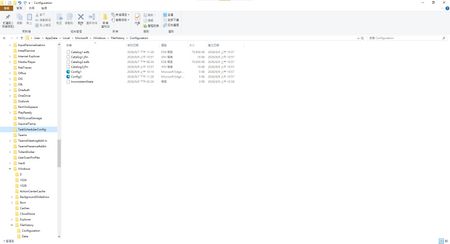
This morning, I ran Windows Update on two Windows 10/11 computers, but the file history feature stopped working completely after the update. Previously, after updating KB5120249 and KB5101684, files could still be backed up to the D: drive normally. The "Last Backup" time in "File History" is not updating correctly. Newly created or saved Word documents, pictures, videos, etc., still show "No previous version available" in "Content → Previous Versions". No folders were corrected; their dates are automatically updated. After running Windows Update again today, the file history feature stopped working on both computers. The File History panel pops up but cannot be used, prompting for a hard drive connection. (The hard drive is connected and I've confirmed it can read and write.) resulting in an "InconsistentState" entry in C:\Users\User\AppData\Local\Microsoft\Windows\FileHistory\Configuration. I'm very angry. If Microsoft doesn't address this, I'll keep complaining. If anyone else has encountered the same situation, please leave a comment below. You can also check Microsoft Q&A or the Microsoft Community Hub. The five updates installed are: September 8, 2026—KB5122878 (OS Builds 19045.7725 and 19044.7725) September 8, 2026-KB5126146 Cumulative Update for .NET Framework 3.5, 4.8 and 4.8.1 for Windows 10 Version 22H2 2026-09 Security Update (KB5124008) (26200.9445) 2026-09 .NET Framework Security Update (KB5126052) Windows Malicious Software Removal Tool x64 - v5.145 (KB890830) Deleting the %LocalAppData%\Microsoft\Windows\FileHistory folder also failed. Furthermore, "File History" itself is not listed in Microsoft's "Deprecated Features List." While other backup features suggest that Microsoft has no plans to discontinue it. Microsoft is going to pretend it doesn't exist. These worked normally before the update but stopped working afterward. This is to inform other users experiencing the same problem.5.7KViews5likes43Comments[FIXED] Win10 Build 19008 - Always and Constant High CPU usage: Speech Runtime Executable
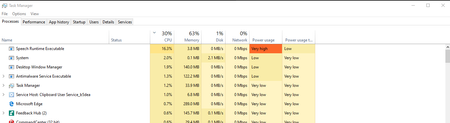
UPDATE: Fixed in build 19013 It has that much high CPU usage from the computer start to shut down. no idea why. if you have the same problem, please upvote this feedback and from the "Add similar feedback" section, add your own system details and upload a crashdump file for it (you can create it from the task manager) https://aka.ms/AA6dxnj3.5KViews4likes6CommentsBroken File History after July/August Updates (KB5101684 on Win11 25H2 / KB5120249 on Win10 22H2)
Hi everyone, I am writing to report a major regression bug with File History that was introduced in the recent Windows updates. This is happening across two entirely different machines with no settings changed, no system files modified, and no registry tweaks applied. The Issue: Windows 11 25H2 > after installing KB5101684 (July 29, 2026) Windows 10 22H2 > after installing KB5120249 (August 12, 2026) On both PCs backing up to a local drive (D:), the underlying files are actually being written to the drive, but the File History interface is completely broken: TheLast Backup time stamp in Control Panel frozen and fails to update automatically. In File Explorer, right-clicking new files > Properties> Previous Versions shows There are no previous versions available, making daily time-travel restoration impossible. Temporary Workaround: The only way to force it to sync is to go to Control Panel > File History > Select Drive, and re-select the D: drive again. This proves the backup engine works, but the automatic scheduling and catalog syncing are completely frozen by these updates. Please Help Upvote on Feedback Hub: I have already submitted this issue via the Feedback Hub but have received no official response yet. Since File History is critical for users who prefer local offline backups over OneDrive, we need to bring this to Microsoft’s attention immediately so they can patch it in the next cumulative update. If you are experiencing the same issue, please upvote my feedback link below:[Post your Feedback Hub sharing screenshot]420Views4likes1CommentShow available digital licenses in our Microsoft account in Windows 10 settings, activation
There needs to be a way to view available digital licenses inside our Microsoft account, I think in Windows settings => update and security => Activation would be the most suitable place. it has benefits, the most important one is so user can see their available licenses in their Microsoft account and make a wise decision based on that info. please upvote this feedback in feedback hub: https://aka.ms/AAbdhft50KViews4likes2CommentsWIF Build 19592: Icons on taskbar sometimes get replaced
I noticed sometimes icons of the Pinned programs on the taskbar get a while background around them, like this: and in some cases the icon itself is replaced with this placeholder (this is File Explorer) I haven't submitted a feedback on Feedback hub app yet, they happen very randomly at the moment and they are fixed usually after a minute or two. anyone else experiencing the same thing on this build?3KViews4likes11Comments[FIXED] Anyone else having OneDrive high CPU usage problem after upgrading to build 19564?
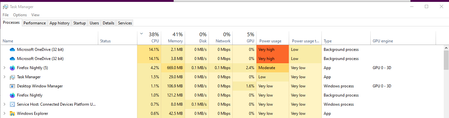
Feedback on Feedback hub app: https://aka.ms/AA7bbm6 please add more details to it. thank you Tried restarting my computer 2 times already with 5/6 hours intervals. I let it run like that for hours, hoping it will finish whatever it is doing but nope, it always stays like that. anyone else having this issue on the same exact build?Solved108KViews4likes37CommentsOptimize Windows 10 PC reset using the cloud
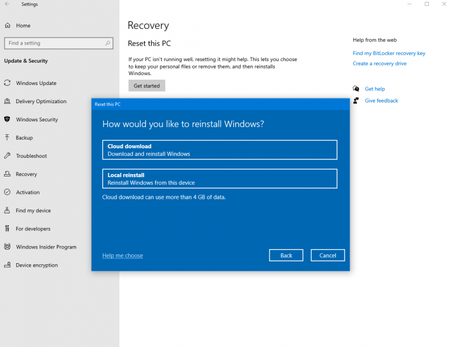
Cloud download You can use the new cloud download option to get Windows from the cloud to reinstall instead of reusing the existing Windows files to construct a fresh copy. This can be a more reliable way to reinstall Windows and, depending on internet speed, can be a faster as well. To achieve a similar result previously you would have to download Windows and create a USB stick, but because this is built-in to Windows it doesn’t require the extra steps of creating a USB stick to do the installation. How to use this feature For Windows 10 builds 18970 and newer you can initiate Reset this PC and select the cloud download option through Settings: Select the Start button, then select Settings > Update & Security > Recovery After selecting Keep my files or Remove everything you will see Cloud download or Local reinstall. The Cloud download option will connect to Windows Update over your current network connection. How this all works While all of this looks easy there are quite a few phases and operations to get through, they can be summarized as the following (Keep my files performs 2 additional steps in the second phase): Preparation phase While you are selecting options in the interface, in the background we are preparing and checking requirements Ensure the device is not on battery power Check that Windows Recovery Environment (Windows RE) is present and enabled Scan to see what optional features and languages are installed Check connectivity with the Windows Update and determine download size When you click “Reset” (see Figure 1: Final confirmation) the download begins. After this everything will continue without any interaction. When the download completes the offline phase will begin by rebooting into Windows RE (if the reset was initiated from Windows RE the system will not reboot and just continue) Offline phase Boot to Windows RE Apply image from the downloaded payload (Keep my files) Gather user profile from the previous OS and apply to the new OS Gather drivers from the previous OS Apply optional features and languages to the new OS Switch OS root folder from the previous OS to the new OS Delete downloaded payload Reboot into the new OS Apply drivers to the new OS Apply OEM customizations including preinstalled Windows apps Reboot to the Out-Of-Box-Experience (OOBE) (Keep my files) Skip OOBE and proceed to login screen What you can do if you can’t boot into Windows If the device isn’t able to boot into Windows you can initiate Reset this PC with the cloud download in the Windows Recovery Environment (Windows RE). If Windows is unable to boot after two consecutive failed attempts the device should boot into Windows RE automatically. Select Troubleshoot > Reset this PC, then select Keep my files or Remove everything, if you have a wired internet connection you can then select Cloud download (Connecting over wireless networking in Windows RE may be available depending on drivers loaded by the PC manufacturer) This new cloud download option will continue to enable you to reinstall Windows and get your device back to a healthy state. Whether it is initiated through Windows 10 Settings or Windows RE troubleshooting the phases and operations are nearly identical. As we continue to improve we are always interested in your ideas, please share them in Feedback Hub. https://insider.windows.com/en-us/articles/optimize-windows-10-pc-reset-using-the-cloud/14KViews3likes5Comments