virtual machines
71 Topics
Announcing General Availability of Azure Dl/D/E v6 VMs powered by Intel EMR processor & Azure Boost
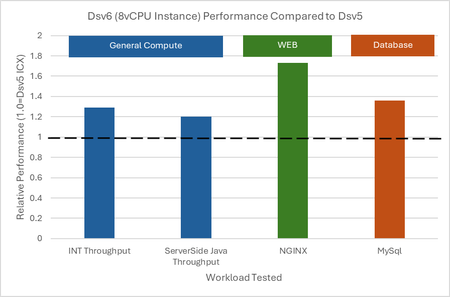
Today we are excited to announce General Availability of the new Azure General Purpose and Memory Optimized Virtual Machines powered by the 5 th Gen Intel® Xeon® processor (code-named Emerald Rapids). The new virtual machines are available in three different memory-to-core ratios and offer the option of with or without local NVMe SSD. The General Purpose families include Dlsv6, Dldsv6, Dsv6, and Ddsv6-series. The Memory Optimized families include Esv6 and Edsv6-series.10KViews11likes2CommentsAzure Automated Virtual Machine Recovery: Minimizing Downtime
Co-authors: Mukhtar Ahmed, Shekhar Agrawal, Harish Luckshetty, Vinay Nagarajan, Jie Su, Sri Harsha Kanukuntla, David Maldonado, Shardul Dabholkar. Keeping virtual machines running smoothly is essential for businesses across every industry. When a VM stays down for even a short period, the impact can cascade quickly; delayed financial transactions, stalled manufacturing lines, unavailable retail systems, or interruptions to healthcare services. This understanding led to the creation of this solution, with its primary goal of ensuring fast and reliable recovery times so customers can focus on their business priorities without worrying about manual recovery strategies. This feature helps ensure your business Service-Level Agreements are consistently met. When a VM experiences an issue, our system springs into action within seconds, working to restore your service as quickly as possible. It automatically executes the optimal recovery strategy, all without customer intervention. The feature operates continuously in the background, monitoring the health of VMs through multiple detection mechanisms. Lastly, it automatically selects the fastest recovery path based on the specific failure type. Getting Started The best part? Azure Automated VM Recovery requires no setup or configuration. Running quietly in the background, this service helps guarantee the highest level of recoverability and a smooth experience for every Azure customer. Your VMs are already benefiting from faster detection, smarter diagnosis, and optimized recovery strategies. The Importance of Automated VM Recovery Automated VM recovery is essential to keeping cloud services resilient, reliable, and interruption-free. Automated recovery ensures that the moment a failure occurs, the platform responds instantly with fast detection, intelligent diagnostics, and the optimal repair action, all without requiring customer intervention. Better experience for customers: By minimizing VM downtime, it helps customers keep their services online, avoiding disruptions and potential business losses. Stronger trust in Azure: Fast, reliable recovery builds customer confidence in Azure’s platform, reinforcing our reputation for dependability. Reduced financial impact for customers: The lower the downtime, the less time your customers will be impacted, reducing potential loss of revenue and minimizing business disruption during critical operations. Empowering internal teams: Automated monitoring and clear visibility into recovery metrics help teams track health, onboard easily, and identify opportunities for improvement with minimal effort. How Azure Automated VM Recovery Works: A Three-Stage Approach Azure automatically handles VM issues through a three-stage recovery framework: Detection, Diagnosis, and Mitigation. Detection From the moment a failure occurs, multiple parallel mechanisms identify issues quickly. Azure hardware devices send regular health signals, which are monitored for interruptions or degradation. At the application level, operational health is tracked via response times, error rates, and successful operations to detect software-level problems rapidly. Diagnosis Once detected, lightweight diagnostics determine the best recovery action without unnecessary delays. Diagnostics operates at multiple levels; host level checks asses underlying infrastructure, VM level diagnostics evaluate the virtual machine state and system-on-chip (SoC) level analysis examines hardware components. This includes network checks, resource utilization assessments, and service responsiveness tests. Detailed data is also collected for post-incident analysis, continuously improving diagnostic algorithms while active recovery proceeds. Mitigation Based on diagnostics, the system automatically executes the optimal recovery strategy, starting with the least disruptive methods and escalating as needed. Hardware failures may trigger VM migration, while software issues might be resolved with targeted service restarts. If needed, a host reset is performed while preserving virtual machine state, ensuring minimal disruption to running workloads. Post-mitigation health checks ensure full VM functionality before recovery is considered complete. Recovery Event Annotations Recovery Event Annotations are specialized annotations that provide detailed visibility into every stage of VM recovery, going beyond simple uptime metrics. These indicators act as custom monitoring metrics, breaking down each incident into precise time segments. For example, TTD (Time to Detect) measures the time between a VM becoming unhealthy and the system recognizing the issue, while TTDiag (Time to Diagnose) tracks the duration of diagnostic checks. By analyzing these segments, Recovery Timing Indicators help identify bottlenecks, optimize recovery steps, and improve overall reliability. Key benefits include: Understanding why some VMs recover faster than others. Identifying which diagnostics add value versus those that don’t. Highlighting opportunities that provide a faster path of recovery. Enabling early detection of regressions through event annotation-driven alerts. Establishing a common language across Azure teams for measuring and improving downtime. Customer Impact and Results Azure Automated VM Recovery demonstrates our commitment to not only high availability but also rapid recovery. By minimizing downtime, it helps customers build resilient applications and maintain business continuity during unexpected failures. Over the past 18 months, this solution has cut average VM downtime by more than half, significantly enhancing reliability and customer experience. Our ongoing goal is to provide a platform where customers can deploy workloads with confidence, knowing automated recovery will minimize disruptions.1.3KViews9likes1Comment
Revolutionizing Reliability: Introducing the Azure Failure Prediction and Detection (AFPD) system
As part of the journey to consistently improve Azure reliability and platform stability, we launched Azure Failure Prediction & Detection (AFPD), Azure’s premiere shift-left reliability solution. AFPD became operational in 2024, unifying failure prediction, detection, mitigation, and remediation services into a single end-to-end system with the goal of preventing Azure Compute customer workload interruptions and repairing nodes at scale. AFPD builds upon previous reliability solutions such as Project Narya, adding new best practices and fleet health management capabilities on top of pre-existing failure prediction and mitigation capabilities. The end-to-end AFPD system has proven to further reduce the overall number of reboots by over 36% and allows for a proactive approach to maintaining the cloud. This system operates for all Azure Compute General Purpose, Specialized Compute, High Performance Computing (HPC)/Artificial Intelligence (AI) workloads and select Azure Storage scenarios. For a deeper dive, you can read the whitepaper here, which won Best Paper Award at the 2025 IEEE Cloud Summit!3KViews9likes0CommentsNVMe-enabled Ebsv5 VMs offering 400K IOPS and 10GBps throughput now generally available
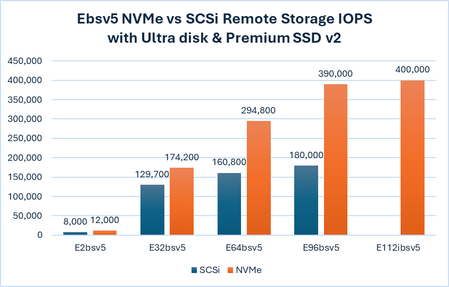
In September 2023, we announced the Public Preview of NVMe-enabled Ebsv5 VMs offering 400K IOPS and 10GBps throughput Virtual Machine (VM) sizes based on the 3rd Gen Intel® Xeon® Platinum 8370C processor offering higher remote storage performance with Azure Disks. The Ebsv5 VM family is designed for memory-intensive business-critical applications, relational database servers, and in-memory data analytics workloads. Today, we are announcing the general availability (GA) of accelerated remote storage performance using Azure Premium SSD v2 and Ultra disk within the existing NVMe-enabled Ebsv5 family. The higher storage performance is offered across all Ebsv5 sizes and delivers up to 400K IOPS (I/O operations per second) and 10GBps of remote disk storage throughput. This general availability of accelerated NVMe-Ebsv5 with increased remote storage performance is part of the Azure Boost family which upgrades the fleet with these new capabilities. The NVMe enabled Ebsv5 sizes offer up to 2x the performance of SCSI VM sizes with no additional cost, providing better price-performance. The VM pricing details are available here. The Ebsv5 and Ebdsv5 NVMe VM series In today's competitive business landscape, quickly processing, analyzing, and extracting insights from large volumes of data is essential. OLTP and OLAP applications, which handle real-time transactions, further highlight the need for powerful computing and storage solutions. Companies must adopt robust systems to manage increasing data demands efficiently while keeping costs in check. The Ebsv5 and Ebdsv5 VM family with NVMe, made generally available in May 2023, meets the performance requirements for many business-critical applications. However, some workloads require even higher VM-to-disk throughput and IOPS performance over Ultra or Premium SSD v2 disk options, which are now served by the accelerated NVMe Ebsv5 VM sizes. Ebsv5 series NVMe VM specifications The E2-112i vCPU sizes with the NVMe provide higher performance than the comparable Ebsv5 SCSI sizes for the same price. The accelerated NVMe-enabled sizes offer up to 400,000 IOPS and 10,000 MBps with Ultra disk and Premium V2 storage offerings. Note the Uncached IOPS/ throughput specs are the same as Ebdsv5 VMs Size vCPU Memory GiB Max uncached disk throughput IOPS/MBps (Ultra/Pv2-SSD) Max burst uncached disk throughput IOPS/MBps (Ultra/Pv2-SSD) Standard_E2bs_v5 2 16 12000/300 15000/1200 Standard_E4bs_v5 4 32 21400/600 30000/1200 Standard_E8bs_v5 8 64 44200/1200 60000/1200 Standard_E16bs_v5 16 128 88400/2300 96000/2600 Standard_E32bs_v5 32 256 174200/4800 180000/5200 Standard_E48bs_v5 48 384 253300/7300 260000/7850 Standard_E64bs_v5 64 512 294800/7800 310000/8500 Standard_E96bs_v5 96 672 390000/8500 390000/9000 Standard_E112ibs_v5 112i 672 400000/10000 400000/10000 For more information, system prerequisite, current restrictions of this offering, please visit Ebsv5/Ebdsv5 specification page. *Please note that you are required to create new Ultra disks for Ebsv5 NVMe for the upgraded performance in the following regions: uswestcentral-AZ01, usstagesc-AZ01, ussouth-AZ02, useast, uscentral-AZ03,uksouth, europewest, europenorth, brazilsouth-AZ03, australiasoutheast-AZ01, asiasoutheast, australiaeast-AZ02,AZ03 All the rest of the regions that aren't listed here doesn't require new Ultra disks creation for upgraded performance Customer Testimonials: We had the opportunity to collaborate with several Azure partners during the preview period. Below is the feedback from some of the partners on the performance of the new VMs: FlashGrid.io offers solutions to help organizations simplify the management and deployment of their mission-critical databases in the cloud while ensuring high availability, scalability, and performance. “With the recent update of the Ebsv5 NVMe VMs we are now measuring 10 GBPS of throughput and 400K IOPS per VM with Premium SSD v2 disks. That is 30 GBPS and over 1M IOPS in a FlashGrid Cluster with three Oracle RAC database nodes, which is an order of magnitude higher than a typical on-premises storage system” Getting started Learn more about the NVMe Ebsv5 and Ebdsv5 VMs by reading the FAQ. Learn more about the Azure Boost by reading the aka.ms/azureboost .For pricing information, check out Windows and Linux. Also, please verify the Ultra disk and Premium SSD V2 regional availability to pair with the NVMe-enabled Ebsv5 series. Finally, if you need help selecting the best VM for your workload, start with the virtual machine selector.3.3KViews6likes0CommentsAnnouncing the General Availability of the Next Generation of Azure Boost
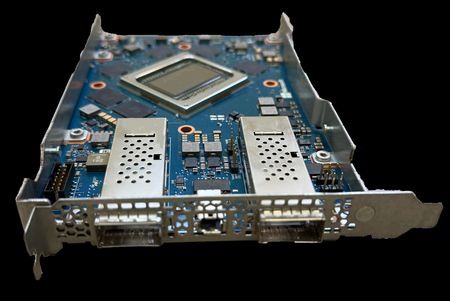
Starting May 7th, 2026, the new Esv7, Dsv7, and Dlsv7 virtual machines are generally available — and underneath them is a fundamentally new generation of Azure Boost. Not an incremental refresh. A platform that took over five years to build, with custom ASIC-hardened logic, a new network adapter, redesigned storage offload, and a security architecture that makes Azure Boost a Trusted Execution Environment in its own right. You’ll notice the performance: up to 400 Gbps networking, up to 1M remote storage IOPS, up to 21 million local NVMe IOPS. What you won’t see yet is everything this platform can do. These VMs tap into the first wave of capabilities from the new Boost generation — and over the coming months, new VM families and features will unlock additional capabilities and performance. What Makes This Generation Different Azure Boost offloads virtualization, networking, and storage onto purpose-built hardware, so your workloads get more of the server you paid for. That fundamental model hasn’t changed. What has changed — substantially — is the platform underneath. This generation of Azure Boost is built around a purpose-designed PCIe card that integrates three tightly coupled subsystems onto a single ASIC: A custom ASIC/FPGA hybrid accelerator — handles storage acceleration, virtual network encryption, remote storage encryption, and high-throughput data-path processing. This generation hardens significantly more critical data path logic into dedicated logic — moving functions that previously ran in software or in FPGA into application-specific silicon. Most data for high-speed networking and storage is now transferred through the ASIC without going through the FPGA or software, which we use only where we need programmable packet processing. The result is higher throughput at lower latency, with better power efficiency per I/O operation – a 2x improvement in power per throughput over our prior 200Gbps Boost generation. The ASIC also contains the trusted subsystems that form the foundation of Azure Boost’s confidential computing capabilities. The Microsoft Azure Network Adapter (MANA) — Microsoft’s custom-designed network interface, purpose-built for Azure. MANA delivers up to 400 Gbps of networking bandwidth with hardware-accelerated packet processing, high speed RDMA transport, dual top-of-rack active/active resiliency, and sub-second networking maintenance. It provides a consistent driver interface across hardware generations, so future platform upgrades won’t disrupt your networking stack. A dedicated System-on-Chip (SoC) — running the Azure Boost control plane, agent management, servicing, and diagnostics on Arm cores — physically isolated from both the customer VM and the ASIC/FPGA data path. The SoC manages the operational lifecycle of the card while the ASIC and FPGA handle customer I/O at wire speed. These three subsystems work as a single integrated platform. The ASIC and FPGA process your storage and networking data with hardware-enforced tenant isolation. MANA moves your packets. The SoC manages the device without ever touching your data. And all of it sits behind a hardware root of trust that attests the integrity of every component before the card is allowed to serve a single VM. This architecture is also what makes confidential I/O possible. The ASIC contains dedicated confidential data-flow logic in hard-IP, designed to handle encrypted VM memory directly over IDE-encrypted PCIe links — without bounce buffers, without software intermediaries. This hardware foundation ships with every card today; the confidential computing features that build on it will be exposed in upcoming VM SKUs. For customers, the practical impact is straightforward: faster I/O, more predictable performance, fewer host CPU cores consumed by platform overhead, and a security boundary that’s enforced in silicon — not just in software policy. Millions of additional sellable CPU cores have been released back to customer workloads as a result of the host core reductions this platform enables. The physical Boost card itself — a PCIe card with the central ASIC/FPGA hybrid accelerator, surrounding memory, MANA network ports, and Microsoft branding — is visible in the image above. Every new generation of Azure Boost-enabled server in the fleet will carry this card, and every new Intel v7-series VM runs on it. What the New VMs Deliver Today The Esv7 (memory-optimized), Dsv7 (general-purpose), and Dlsv7(general purpose) families are the first SKUs to ship on this Azure Boost generation in general availability. Powered by custom Intel® Xeon® 6 processors with frequencies up to 4.2 GHz and up to 2x higher memory bandwidth than v6, they deliver substantial generational gains across the board: Compute Up to 20% better general compute performance compared to v6 VMs Up to 25% better performance for compute-bound workloads like video transcoding, compression, and cryptography Up to 30% better database workload performance on the largest sizes Sizes up to 372 vCPUs and 2.8 TiB of memory — enabling larger in-memory databases, agentic AI workloads with larger context windows, and latency-sensitive applications that benefit from minimizing cross-node hops Networking Up to 400 Gbps of VM networking bandwidth on the largest Esv7/Edsv7 sizes Dual top-of-rack (TOR) active/active fabric — continuing the proven architecture from prior generations for higher throughput and faster failover under network events Storage Up to 800K remote storage IOPS and 20 GBps remote storage throughput per VM on Premium v2 SSD and Ultra Disk with the largest Esv7/Edsv7 sizes Up to 9.6 million local NVMe IOPS and 53 GBps local storage throughput with the largest Ddsv7/Edsv7 sizes — storage processing offloaded entirely to dedicated Azure Boost SSD hardware Customers are strongly encouraged to use the latest Microsoft Azure Network Adapter (MANA) drivers to ensure optimal performance and reliability on Azure Boost-enabled hardware. The latest drivers are available at https://aka.ms/mana. These are the capabilities the current VMs expose. The Azure Boost platform underneath has more in reserve — capabilities that will show up as new VM families ship throughout the year. For the full SKU lineup, sizing, and benchmarks, see the companion announcement: Announcing General Availability of Azure Dl/D/Esv7-series VMs based on Intel® Xeon® 6 processors. Azure Boost Confidential Device (ABCD): the Boost device joins the Confidential VM’s Trusted Compute Base through attested hardware and IDE-encrypted PCIe links. Built on a Hardware Root of Trust Performance is the visible part. Below the waterline, the bigger shift is what this generation enables for security: Azure Boost is now a full Trusted Execution Environment in its own right. That’s not a future promise — it’s the foundation shipping today, and it’s what powers the confidential computing capabilities already in production and the ones coming next. Security isn’t layered on top of Azure Boost — it’s the foundation the platform boots from. Every Azure Boost device is anchored by Cerberus, Microsoft’s open-sourced hardware root of trust, certified to NIST SP 800-193 for platform firmware resiliency. Cerberus measures and attests every critical firmware component before Boost is allowed to initialize. If anything is off, Boost doesn’t come up. You get a chain of trust that starts in hardware and extends all the way up to your workload: Hardware root of trust identity — every Azure Boost device has a unique, cryptographically-bound identity established at manufacturing. Measured and Secure Boot — every layer of Azure Boost firmware and software is measured and verified before execution. Continuous attestation — the Azure Attestation Service periodically validates that each Boost device in the fleet is running known-good, trusted firmware and software. Devices that fail attestation are taken out of service automatically. In practice, this means every Azure Boost device proves what it is before it’s allowed to touch your data — and keeps proving it continuously while your workloads run. Strong Isolation Between Azure Boost and Your Workloads By offloading virtualization, networking, and storage onto dedicated hardware, Azure Boost establishes a hard, physical isolation boundary between the platform infrastructure and your workloads: Control plane and data plane separation — hypervisor management, networking, and storage policy execution all run on the Azure Boost hardware, completely off your CPU and memory. Your VM has no path to reach Boost’s control surfaces. Reduced host attack surface — because Azure Boost owns the I/O path end-to-end, the host runs a minimal, hardened software stack with far fewer privileged components than a traditional hypervisor host. Memory-safe implementation — critical Azure Boost components are written in memory-safe languages, eliminating entire classes of vulnerabilities by construction. Per-tenant cryptographic isolation — networking and storage I/O are cryptographically segregated per tenant on the Azure Boost data path. The net effect: the attack surface between your VM and the platform infrastructure is smaller than any mainstream cloud hypervisor — by design, not by patch. Confidential Computing: What’s Shipped and What’s Coming This Boost generation doesn’t just promise confidential computing — parts of it are already in production, and the hardware foundation for what comes next is shipping on every card today. Shipped: Confidential VMs on Azure Boost Confidential VMs running on Azure Boost infrastructure are generally available today on Intel platforms, deployed on dedicated clusters. This makes them the first CVM SKU running on Azure Boost. Learn more here: https://learn.microsoft.com/en-us/azure/virtual-machines/sizes/general-purpose/dcesv6-series Coming: Azure Boost Confidential Device and Confidential I/O In traditional confidential computing, every I/O operation requires data to be copied from the VM’s private encrypted memory into a shared “bounce buffer” before it can be sent to devices like a NIC or storage controller. This exists because the VM’s memory is encrypted with a key that’s not accessible outside the CVM boundary — so devices can’t read it directly. The bounce buffer serves as an intermediary for DMA operations. The cost: every I/O operation requires an extra copy and an encrypt/decrypt cycle, increasing CPU usage and latency, and reducing networking and storage throughput. Azure Boost Confidential Device (ABCD) eliminates this tax. ABCD extends the Confidential VM’s Trusted Compute Base (TCB) into the Azure Boost TDISP enabled ASIC through attested hardware integration. Rather than transferring data to a shared buffer, the Boost device can access encrypted VM memory directly through an IDE-encrypted PCIe connection, using TDISP — a PCI-SIG standard supported by all major CPU vendors that allows CVMs to attest the hardware and firmware of devices granted DMA access to their memory. By avoiding intermediate buffers, this attested secure link maintains both the confidentiality and integrity of data, allowing information to move safely and efficiently between the CVM and the attested Boost hardware. The ASIC on the Boost card contains dedicated confidential data-flow logic in hard-IP, specifically designed to handle this encrypted traffic at wire speed. The Arm SoC and its agents remain outside the trust boundary — only the attested ASIC, FPGA and real-time firmware subsystems are included in the TCB. We are implementing TDISP across both Intel (via TDX Connect) and AMD (via SEV-SNP) platforms — because confidential I/O should not be limited to a single CPU vendor. The result: ABCD reduces CPU usage by eliminating bounce-buffer copies and redundant encryption cycles, freeing more vCPU resources for application workloads and enabling higher throughput through direct hardware offload of networking and storage. Benchmarks show attested confidential offloads performing at near parity with general-purpose VMs, with maintained security guarantees. The hardware foundation is shipping on every Azure Boost card today. The customer-facing SKUs that bring ABCD to virtual machines will enter preview on Intel later this year, with AMD following. Stay tuned. Why this matters for regulated customers For regulated industries and sovereign deployments, this answers a question that no amount of contractual language can resolve: how do you prove the infrastructure itself is trustworthy? Hardware root of trust and continuous attestation let you and your regulators verify — cryptographically, not contractually — that workloads run on known-good, policy-compliant hardware and firmware. That’s not a checkbox. It’s a fundamentally different assurance model. More Platform Capabilities Coming This Year The new Azure Boost generation powers more than today’s Esv7/Dsv7/Dlsv7 launch. Over the coming months, expect: Network-optimized VM families — new SKUs designed to expose the full networking capabilities of the Boost platform for customers who need maximum connections-per-second and packet processing performance. Guest RDMA — low-latency, lossless networking between VMs, extending RDMA beyond traditional HPC scenarios. This Boost generation is architected for region-wide RDMA, enabling distributed workloads to communicate across Availability Zones with minimal overhead. Broader SKU coverage — additional VM families across AMD, Arm-based processors, and GPUs will ship on this Boost generation, including remote storage encryption enablement by default, extending the platform’s performance and security benefits across the Azure Compute portfolio. We’ll share more details as each capability reaches preview and GA milestones. Available Today Deploy Esv7, Dsv7, or Dlsv7 today from the Azure portal, Azure CLI, or your preferred Infrastructure as a Code (IaC) tool. They’re the first to run on this generation of Azure Boost, and they won’t be the last. The platform underneath has more to give, and we’ll be showing what’s next throughout the year. To learn more: Azure Boost overview — https://learn.microsoft.com/azure/azure-boost/overview Esv7, Dsv7, and Dlsv7 VM announcement — Announcing General Availability of Azure Dl/D/Esv7-series VMs based on Intel® Xeon® 6 processors Azure Boost product page — https://azure.microsoft.com/products/virtual-machines/boost4.7KViews5likes0CommentsAnnouncing the preview of new Azure VMs based on the Azure Cobalt 100 processor
Today, Microsoft is announcing the preview of the new Azure Virtual Machines (VMs) featuring the Azure Cobalt 100 Arm-based processor. The Cobalt 100 processor is based on the Neoverse N-series (N2) Arm CPU design, which is optimized for the performance of scale out cloud-based applications. The preview includes the general purpose (Dpsv6-series and Dplsv6-series) and memory optimized (Epsv6-series) VM series. To request access to preview, please fill out this form. The new Dpsv6 and Dpdsv6 general purpose VMs are engineered to efficiently run scale-out workloads and cloud native computing solutions such as those running on Azure Kubernetes Service (AKS). These VMs are ideal for small to medium open-source databases, application servers and web servers. These VMs also excel with containerized applications and can be leveraged by Arm developers in CI/CD pipelines, development and test scenarios. The new Dplsv6 and Dpldsv6 VMs are ideal for media encoding, small databases, gaming servers, microservices and any workloads that do not require higher RAM per vCPU. Additionally, the Epsv6 and Epdsv6 memory-optimized VMs have higher memory per vCPU to meet the requirements of large databases, in-memory caching applications and data analytics workloads. All the new Cobalt 100 VMs enable customers to seamlessly run modern, dynamic, scalable applications. The Azure Cobalt 100 VMs can deliver up to 1.4x CPU performance, up to 1.5x performance on Java-based workloads and up to 2x performance on web servers, .NET applications and in-memory cache applications compared to previous generation Azure Arm-based VMs. These VMs support 4x local storage IOPS (with NVMe direct) and up to 1.5x network bandwidth compared to the previous generation Azure Arm-based VMs. You can select from a range of Azure virtual machines that meet the CPU performance and memory needs of your workloads. You can choose from three memory ratios for a given vCPU size, giving you the flexibility to select the configuration that works best for your workload. The new Dpsv6-series offers up to 96 vCPUs with 384 GiBs of RAM (4:1 memory-to-vCPU ratio). The new Dplsv6-series offers up to 96 vCPUs with 192 GiBs of RAM (2:1 memory-to-vCPU ratio). The new Epsv6-series offer up to 96 vCPUs with up to 672 GiBs of RAM (up to 8:1 memory-to-vCPU ratio) for more memory intensive workloads. All these VM series are available with and without a local disk so that customers can choose the option that best fits each workload. You can deploy these new VMs using existing methods including the Azure portal, SDKs, APIs, PowerShell, and the command-line interface (CLI). During the preview period, the VMs are available in the Central US, East US, East US 2, North Europe, Southeast Asia, West Europe, and West US 2 Azure regions. The number of regions will continue to expand in 2024 and beyond. Explore future regional availability options by visiting the Azure product availability page. During the preview, the new Azure Cobalt 100 VMs are available for free. However, your Azure subscription will be billed for fees and applicable taxes associated with use of other Azure resources and services, such as disk storage, used in the deployment of these preview VMs. The new virtual machines support all remote disk types such as Standard SSD, Standard HDD, Premium SSD and Ultra Disk storage. To learn more about various disk types and their regional availability, please refer to Azure managed disk type. Disk storage is billed separately from virtual machines. The new Azure Cobalt 100 VMs support a wide range of Linux OS distributions including Canonical Ubuntu, CentOS, Debian, Red Hat Enterprise Linux, SUSE Enterprise Linux, Alma Linux, Azure Linux (via AKS), Flatcar Linux and more. Client application developers can take advantage of Azure’s highly available, scalable, and secure platform to run cloud-based builds and test workflows. For Windows developers, Insider Preview of Windows 11 Pro and Enterprise are available for Azure Cobalt 100 VMs. Customers can access the full list of images in the Azure Marketplace. Microsoft has decades of experience with Arm-based technologies through collaborations with software and hardware partners. The preview of the Azure Cobalt 100 VMs continues to showcase Microsoft’s commitment to developing a vibrant Arm ecosystem to accelerate customer innovation and in helping customers build great solutions. Major developer platforms and languages, such as .NET, C++ and Java, provide native Arm support to take advantage of the benefits that this processor architecture brings. Microsoft continues to invest in optimizing these developer platforms and languages on Linux and Windows to leverage the capabilities of the latest Arm architecture. .NET 8 adds numerous optimizations for Arm and C++ similarly brings its share of Arm optimizations with the Visual Studio 17.8 release. Visual Studio 17.10 also introduces SQL Server Data Tools (SSDT) for the Arm native Visual Studio. For Java customers, the Microsoft Build of OpenJDK has been built with Arm compiler optimizations and has been certified on Linux and Windows on Arm architectures. GitHub Actions, GitHub's CI/CD workflow engine, is an integral part of many developers’ workflows, and is used to continuously build, test, and deploy apps. GitHub Actions is now available for Windows and Linux on Arm in 2 flavors – self-hosted runners that can be hosted on an Arm VM or Arm device, and GitHub hosted runners that is available in private beta with GA expected later this summer. Containers are a popular deployment target for many reasons - a streamlined development workflow, isolation and security, efficient resource utilization, portability, and reproducibility. Emphasizing its commitment to developer productivity, Docker is now investing in this area by ensuring that Docker Desktop runs natively on Windows on Arm. The rich ecosystem of applications and libraries, compiled natively to Windows on Arm, continues to grow. In addition to the Microsoft products and tools optimized for Arm64, developer and creator tools such as the Unity games editor, Blender, Docker, GIMP and important libraries such as Qt, are all on track to deliver Arm-native versions this year. Our customers have shared their perspective: "Ansys and Microsoft have a long history of collaboration, and we are excited to continue our joint work to advance semiconductor design via the Cobalt 100 chip and the power of Microsoft Azure," said John Lee, vice president and general manager of the semiconductor, electronics, and optics business unit at Ansys. "Through the combined strengths of Ansys simulation expertise and Microsoft's prowess in enabling EDA technologies, Cobalt 100-based solutions will empower designers to economically achieve optimal Power, Performance, and Area in their designs. Together, we will help propel the semiconductor industry into a new era of unparalleled efficiency and productivity.” “We’ve helped thousands of customers in EDA and Systems combine the performance and scalability of the cloud providing ease-of-use and instant access to our powerful computational software, which speeds time-to-market window for innovative designs. We are excited to work with Microsoft Azure on the new Arm-based Azure Cobalt 100 to provide our mutual customers with optimal performance as they tackle the ever-increasing demands of compute, memory capacity, and price performance for gigascale, advanced-node designs.” - Mahesh Turaga, VP of Cloud Business Development, Cadence. “At Elastic, we love working with the Microsoft teams, from silicon to models,” said Shay Banon, co-founder and chief technology officer at Elastic. “The rate of progress on the Azure team is impressive, and we are excited to collaborate with them to bring these benefits to our users as fast as possible.” “At MongoDB, we continuously explore cutting-edge technologies to enhance our solutions. We are currently evaluating Arm for its benefits and price performance, with promising results so far. We have also evaluated the Azure Cobalt 100 VM and are pleased with its capabilities, particularly in handling intensive workloads. We look forward to taking advantage of these advancements to provide best-in-class performance and even better experiences for our customers.” - Andrew Davidson, SVP, Products, MongoDB. "Semiconductor companies must balance the competing priorities of schedule, cost and performance as they develop their products in sustainable and efficient ways. An important aspect of doing this successfully is carefully matching software workloads with the appropriate computing platforms. The combination of Microsoft Azure Cobalt 100 Arm-based VMs with Siemens EDA software will provide our mutual customers with an excellent option to meet both their product development and corporate objectives. We continue to partner with Microsoft to create innovative solutions for the semiconductor industry.” - Craig Johnson, Vice President, Siemens EDA Cloud Solutions. “Snowflake, as an early adopter of Azure’s Arm technology, has successfully leveraged Arm-based VMs in Azure for our data warehouse workloads. We are now excited to elevate our performance further with Azure's Cobalt 100 VMs, anticipating significant enhancements in delivering superior customer experience.” - Gabe Bryant, Director of Engineering, Snowflake. “Teradata is thrilled to partner with Microsoft Azure, and their launch of the Cobalt 100 VMs. The density and efficiency benefits will further Teradata's existing price/performance advantage for AI and data-driven workloads, scaled on Teradata’s VantageCloud Lake offering” - Daniel Spurling, SVP, Product Management, Teradata. Here’s what our technology partners are saying: “Customized silicon plays a fundamental role in powering the AI-accelerated workloads of the future. This suite of Azure VMs, powered by the Neoverse CSS -based Azure Cobalt 100, marks a key milestone in our longstanding partnership with Microsoft to unlock new paths to performant, efficient computing and provides Azure users more choice and greater ability to innovate using the vast Arm software ecosystem.” -Dermot O’Driscoll, vice president of product solutions, Infrastructure Line of Business, Arm. “The adoption of Arm-based architectures on Microsoft Azure drives cost efficiency and significant performance enhancements. With the introduction of the Azure Cobalt 100 Arm-based VMs, we are excited that Ubuntu users will see up to a 40% increase in workload performance. Our collaboration with Microsoft ensures that users can fully capitalize on these advancements with Ubuntu and Ubuntu Pro, optimizing for diverse and demanding workloads including application servers, machine learning platforms, open-source databases, in-memory caches, and cloud-native applications on AKS. This collaboration underscores our dedication to providing robust and scalable solutions that advance the capabilities of developers and enterprises alike.” - Alexander Gallagher, Vice President of Public Cloud, Canonical. “Whether on Azure or in their own datacenter, Red Hat is committed to providing customers with the broadest possible choice in architectures across the hybrid cloud that best meet their unique business requirements. The Cobalt 100 Arm-based Azure VMs offer a new, powerful option for customers to potentially drive greater efficiencies and scale in their operations, and we look forward to exploring how we can best enable these Arm-based processors on Red Hat Enterprise Linux.” - Ronald Pacheco, senior director, Red Hat Enterprise Linux Product and Ecosystem Strategy, Red Hat. You can learn more about the new Azure Cobalt 100 VMs by visiting the specification pages: Dpsv6-series, Dpdsv6-series, Dplsv6-series, Dpldsv6-series, Epsv6-series, Epdsv6-series. Have any questions? Please reach us at Azure Support and our experts will be there to help you with your Azure journey. Additional resources: Sign-up form: Cobalt100-VM-Preview-Signup Demo: Cobalt 100 VM demo Related blogs: Arm Holdings Canonical Elastic35KViews5likes0CommentsAnnouncing public preview of new burstable VMs - Bsv2, Basv2 and Bpsv2
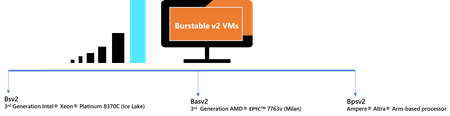
We are pleased to announce the public preview of the latest versions of the CPU burstable B family of Azure Virtual Machines. The new additions to the B family consist of 3 new VM series - Bsv2, Basv2, and Bpsv2, each based on the Intel® Xeon® Platinum 8370C, AMD EPYC™ 7763v, and Ampere® Altra® Arm-based processors respectively.25KViews5likes16Comments