sqlserverprotocols
69 Topicsmssql-python 1.8.0: friendlier Row access, Bulk Copy with MSI, and a refreshed ODBC driver
We just shipped mssql-python 1.8.0, the official Microsoft SQL Server driver for Python. This release focuses on day-to-day ergonomics, a long-requested authentication option for Bulk Copy, and a refresh of the bundled ODBC driver. pip install --upgrade mssql-python Highlights Row objects now support string-key indexing Row already supported integer indexing and attribute access. In 1.8.0 you can also index by column name, which is the pattern most users reach for first: cursor.execute("SELECT id, display_name FROM users WHERE id = ?", [42]) row = cursor.fetchone() row[0] # 42 - by index row.display_name # 'Ada' - by attribute row["display_name"] # 'Ada' - new in 1.8.0 If you set cursor.lowercase = True, string-key lookups become case-insensitive too, matching the casing behavior of attribute access. ActiveDirectoryMSI authentication for Bulk Copy Bulk Copy operations now support Authentication=ActiveDirectoryMSI, so workloads running with a managed identity (Azure VMs, App Service, Functions, Container Apps, AKS) can stream bulk inserts to Azure SQL without provisioning a separate credential. Bundled ODBC driver upgraded to 18.6.2.1 We've upgraded the bundled Microsoft ODBC Driver for SQL Server from 18.5.1.1 to 18.6.2.1. You pick up the upstream fixes and TLS/cert improvements just by upgrading the wheel. No separate ODBC install step. Bug fixes worth calling out Deferred connect-attribute use-after-free. Values passed to connection attributes set before connect are now stored in member buffers, so the driver no longer reads freed memory in some attribute-set paths. Connection string parsed multiple times in the auth path. The auth code path was reparsing the connection string several times per connect. It now operates on the already-parsed parameter dictionary, which is both faster and easier to reason about. Sensitive parameters (UID, PWD, Trusted_Connection, Authentication) are sanitized through a single canonical path before the ODBC handoff. executemany type annotation regression. seq_of_parameters now uses a covariant Sequence, so passing a list of tuples (or any covariant sequence type) type-checks cleanly again. Upgrading For most users, pip install --upgrade mssql-python is all you need. Nothing in this release is intentionally breaking. If you have type stubs or mypy pins that depended on the previous invariant seq_of_parameters annotation, you can drop the workaround. Thanks Thanks to everyone who filed issues, sent repros, and reviewed PRs in this cycle. The Row indexing and connection-string parsing work came directly from user-reported scenarios. Full changelog and PR list: microsoft/mssql-python releases.286Views0likes0CommentsAnnouncing the release of Microsoft OLE DB Driver 19.4.2 for SQL Server
We're pleased to announce the general availability (GA) release of Microsoft OLE DB Driver 19.4.2 for SQL Server. This is a maintenance update to the 19.4 line that improves TLS handling, raises a long-standing connection redirection limit, refreshes the bundled authentication library, and fixes accessibility issues in the UDL dialog. Download x64 / Arm64 installer x86 installer The 64-bit MSI continues to install the appropriate binary (x64 or Arm64) automatically based on the OS platform. MSOLEDBSQL 19 installs side by side with MSOLEDBSQL 18. Prerequisite: the Microsoft Visual C++ Redistributable must be installed before running the driver installer. What's new in 19.4.2 Features added Feature Details SSL/TLS improvements Improved SSL/TLS handling for better security and performance. 10 redirects per connection The driver no longer caps connection redirections at 2, which removes a long-standing failure mode for workloads that hit redirection-heavy topologies (for example, certain Azure SQL routing scenarios). Bugs fixed Fix Details UDL accessibility defects Fixed accessibility issues in the Universal Data Link (UDL) dialog. Updated authentication library Microsoft SQL Driver Authentication library (mssql-auth.dll) updated to version 1.1.3. mssql-auth.dll is the ADAL replacement introduced in 19.4.1 and is installed as part of the driver setup. Supported languages 19.4.2 is available in: Chinese (Simplified), Chinese (Traditional), Czech, English (United States), French, German, Italian, Japanese, Korean, Polish, Portuguese (Brazil), Russian, Spanish, and Turkish. Direct per-language download links are available in the Release notes and the Download page. Upgrading If you're on 19.4.1 or earlier in the 19.x line, an in-place upgrade is supported. As always, we recommend validating in a non-production environment first, especially if your application depends on the redirection or TLS behaviors touched in this release. Feedback Please file issues and feature requests on the Microsoft OLE DB Driver for SQL Server feedback site or via your usual support channel. Thanks to everyone who reported the UDL accessibility and redirection-limit issues that drove this release.753Views0likes0CommentsMicrosoft ODBC Driver 17.11.1 for SQL Server Released
We are pleased to announce the general availability of Microsoft ODBC Driver 17.11.1 for SQL Server, released on April 30, 2026. This servicing update delivers important bug fixes and expands Linux platform support. Key Highlights Stability and correctness fixes for parameter array processing, including accurate updates to SQL_ATTR_PARAMS_PROCESSED_PTR and improved row counting when SQL_PARAM_IGNORE is used in parameter arrays. Fixed a connection error that could occur when processing Data Classification metadata in ODBC asynchronous mode. Updated RPM packaging rules to allow installation of multiple driver versions side by side. Corrected XA recovery to ensure proper computation of transaction IDs and recovery of missing transactions. Debian package installation now honors license acceptance for successful completion. New Platform Support Platform Versions macOS 14, 15, 26 Debian 13 Red Hat Enterprise Linux 10 Oracle Linux 9, 10 SUSE Linux Enterprise Server 16 Ubuntu 24.04, 25.10 Alpine Linux 3.21, 3.22, 3.23 Download The driver is available for download from the Microsoft ODBC Driver for SQL Server documentation page. Linux Installation Install or update using your distribution's package manager: Debian/Ubuntu: sudo apt-get update sudo apt-get install msodbcsql17 Red Hat/Oracle Linux: sudo yum install msodbcsql17 SUSE: sudo zypper install msodbcsql17 Alpine: sudo apk add msodbcsql17 Feedback We welcome your feedback. Please report issues on the SQL Server feedback site or open an issue on the ODBC Driver GitHub repository.862Views0likes2Commentsgo-mssqldb v1.10.0: Better Reliability, Developer Experience, and Standards Compliance
We're excited to announce the release of go-mssqldb v1.10.0, the official Microsoft Go driver for SQL Server and Azure SQL Database. This release brings significant reliability improvements, better standards compliance, and a smoother developer onboarding experience. Highlights Detect Server-Aborted Transactions (XACT_ABORT) One of the most impactful fixes in this release addresses a subtle but dangerous bug: when SQL Server aborts a transaction due to XACT_ABORT ON, the driver now correctly detects this state. Previously, a silently aborted transaction could lead to subsequent statements being auto-committed outside the intended transaction boundary, potentially causing data integrity issues. The driver now returns a clear error when you attempt to use a connection whose transaction was server-aborted. (#370) Implement driver.DriverContext Interface The driver now implements Go's driver.DriverContext interface, enabling sql.OpenDB-style usage and better integration with connection pool configuration via sql.DB.SetConnMaxLifetime, SetMaxOpenConns, etc. This brings the driver in line with modern Go database/sql conventions. (#365) Surface Errors from Rows.Close() Previously, server errors that occurred during the token drain phase of Rows.Close() were silently swallowed. Now these errors are properly surfaced to callers, making it much easier to diagnose issues like permission errors or constraint violations that manifest during result set cleanup. (#361) Nullable Civil Types for Date/Time Parameters New nullable types (civil.NullDate, civil.NullTime, civil.NullDateTime) allow you to pass nullable date/time parameters without resorting to *time.Time or raw interface{} values. These integrate cleanly with the database/sql scanner and valuer interfaces. (#325) DevContainer for Instant Development Getting started with go-mssqldb development is now as simple as opening the repo in VS Code or GitHub Codespaces. The new devcontainer configuration includes a SQL Server instance, pre-configured environment variables, and all required tooling. (#317) All Changes Features Add devcontainer for VS Code and GitHub Codespaces (#317) Add FailoverPartnerSPN connection string parameter (#327) Add NewConnectorWithProcessQueryText for mssql driver compatibility (#341) Add nullable civil types for date/time parameters (#325) Bug Fixes Allow named pipe protocol support for ARM64 Windows (#232) Detect server-aborted transactions to prevent silent auto-commit with XACT_ABORT (#370) Expose TrustServerCertificate in msdsn.Config and URL round-trip (#312) Handle COLINFO and TABNAME TDS tokens returned by tables with triggers (#343) Implement driver.DriverContext interface (#365) Make readCancelConfirmation respect context cancellation (#359) Return interface{} scanType for sql_variant instead of nil (#362) Sanitize credentials from connection string parsing errors (#319) Surface server errors from Rows.Close() during token drain (#361) Upgrade go get github.com/microsoft/go-mssqldb@v1.10.0 This release requires Go 1.21+ and is fully compatible with SQL Server 2012 through 2022 and Azure SQL Database. Contributing We welcome contributions! The new devcontainer makes it easier than ever to get started. Open the repo in VS Code, reopen in the container, and you'll have a full development environment with SQL Server ready to go. GitHub Repository Documentation Report Issues236Views0likes0CommentsAnnouncing Microsoft.Data.SqlClient 6.1.5
We are pleased to announce the release of Microsoft.Data.SqlClient 6.1.5, the latest servicing update to the 6.1 line. This update focuses on connection performance, error propagation, and vector type metadata correctness. Install or update from NuGet: dotnet add package Microsoft.Data.SqlClient --version 6.1.5 Full release notes: 6.1.5 Release Notes What's in this release Faster connection opens for non-integrated authentication on native SNI A regression caused SPN (Service Principal Name) generation to run for non-integrated authentication modes, such as SQL authentication, on the native SNI path. That triggered unnecessary DNS lookups and could significantly slow down connection opens. This fix restores the expected behavior for affected .NET applications on Windows. (#3523, #3946) ExecuteScalar now propagates post-row server errors ExecuteScalar could previously hide errors when SQL Server returned row data followed by an error token. In those cases, errors such as conversion failures during WHERE clause evaluation were consumed during SqlDataReader.Close() instead of being thrown to the caller, which could leave transactions unexpectedly zombied. This fix ensures the error is surfaced correctly to application code. (#3736, #3947) Correct metadata type for vector float32 columns SqlDataReader.GetFieldType() and GetProviderSpecificFieldType() now return the correct type, SqlVector<float>, for vector float32 columns. Previously these APIs returned metadata that did not match the type-resolution behavior used by GetValue(). (#4104, #4151) Getting started If you are new to Microsoft.Data.SqlClient, check out the introduction documentation. For users of System.Data.SqlClient, please move migrate to Microsoft.Data.SqlClient now. See the porting cheat sheet. If you encounter any issues, please report them on the GitHub repository.443Views0likes0CommentsIntroducing Pacemaker HA Agent v2 for SQL Server on Linux (In Preview)
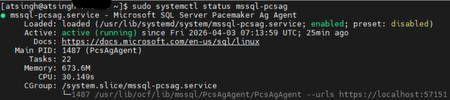
We are excited to introduce the next generation of high availability (HA) Agent for SQL Server on Linux: Pacemaker HA Agent v2. This release is a major step forward, designed to reduce planned and unplanned failover times, compared to the previous agent, based on internal engineering improvements. Why Pacemaker Is Required for SQL Server HA on Linux For users new to Linux, it’s important to understand how high availability works on this platform. On Windows Server, Always On availability groups use an underlying Windows Server Failover Cluster (WSFC) to: Monitor node health Detect failures Orchestrate automatic failovers Always On availability groups on Linux rely on an external cluster orchestrator for health monitoring and failover coordination, with Pacemaker HA Agent being one of the cluster orchestrators, responsible for: Monitoring node and application health Coordinating failover decisions Helping mitigate split‑brain scenarios through improved write‑lease evaluation Managing resources such as availability groups and listeners The Pacemaker HA Agent is the integration layer that allows Pacemaker to understand SQL Server health and manage availability groups safely. Evolution of the SQL Server Pacemaker HA Agent With SQL Server 2025 CU3 and later, Pacemaker HA Agent v2 is available in preview for Red Hat Enterprise Linux and Ubuntu through the mssql-server-ha package. Pacemaker HA agent v2 uses a service‑based architecture. The agent runs as a dedicated system service named mssql-pcsag, which is responsible for handling SQL Server–specific high availability operations and communication with Pacemaker. You can manage mssql-pcsag service by using standard system service controls to start, restart, status and stop this service by using the operating system's service manager (for example, systemctl). # Start the mssql-pcsag service sudo systemctl start mssql-pcsag # Restart the mssql-pcsag service sudo systemctl restart mssql-pcsag # Check the status of the mssql-pcsag service sudo systemctl status mssql-pcsag # Stop the mssql-pcsag service sudo systemctl stop mssql-pcsag Limitations of Pacemaker HA Agent v1 While the original agent enabled SQL Server HA on Linux, customers running production workloads encountered several challenges: Failover delays of 30 seconds to 2 minutes during planned or unplanned events Limited health detection, missing conditions such as I/O stalls and memory pressure Rigid failover behavior, unlike the flexible policies available on Windows (WSFC) Incomplete write‑lease handling, requiring custom logic No support for TLS1.3 for Pacemaker and SQL Server communications How Pacemaker HA Agent v2 Addresses These Gaps Pacemaker HA Agent v2 is a ground‑up improvement, designed to improve the reliability characteristics of SQL Server HA on Linux. 1. Faster & Smarter Failover Decisions The new agent introduces a service‑based health monitoring architecture, moving beyond basic polling. This allows SQL Server to report detailed diagnostic signals - improving detection speed and helping reduce failover delays in supported configurations. 2. Flexible Automatic Failover Policies inspired by the WSFC health model Pacemaker HA Agent v2 supports failure‑condition levels (1–5) and health‑check timeout model aligned with those available in Always On availability groups on Windows. This provides: Fine‑grained control over failover sensitivity, allowing administrators to tune when failover should occur. Improved detection of internal SQL Server conditions, such as memory pressure, internal deadlocks, orphaned spinlocks, and other engine‑level failures. Failover decisions are now driven by detailed diagnostics from sp_server_diagnostics, enabling faster and more accurate response to unhealthy states and providing enhanced resiliency capabilities for SQL Server AG on Linux. You can configure the failure condition level and health check timeout using the following commands: -- Setting failure condition level ALTER AVAILABILITY GROUP pacemakerag SET (FAILURE_CONDITION_LEVEL = 2); -- Setting health check timeout ALTER AVAILABILITY GROUP pacemakerag SET (HEALTH_CHECK_TIMEOUT = 60000); After applying the configuration, validate the setting using the sys.availability_groups DMV: 3. Robust Write Lease Validity Handling To prevent split‑brain scenarios, SQL Server on Linux uses an external write‑lease mechanism. In v1, lease information was not fully integrated into failover decisions. In v2, the agent actively evaluates the write-lease validity, before initiating transitions. This supports controlled role changes and improved data consistency behavior during failover events, depending on cluster configuration. 4. TLS 1.3 Support Pacemaker HA agent v2 includes design updates to support TLS 1.3–based communication for health checks and failover operations, when TLS 1.3 is enabled. Supported Versions & Distributions Pacemaker HA Agent v2 supports: SQL Server 2025 CU3 or later RHEL 9 or later Ubuntu 22.04 or higher. Preview upgrade & migration guidance for non-production environments New or existing non-prod deployments running SQL Server 2025 (17.x) can migrate from Pacemaker HA Agent v1 to v2 using following approach: Drop the existing AG resource sudo pcs resource delete <NameForAGResource> This temporarily pauses AG synchronization but does not delete the availability group (AG). After the resource is recreated, Pacemaker resumes management and AG synchronization automatically. Create a new AG resource using the v2 agent (ocf:mssql:agv2) sudo pcs resource create <NameForAGResource> ocf:mssql:agv2 ag_name=<AGName> meta failure-timeout=30s promotable notify=true Validate cluster health sudo pcs status Resume normal operations References Create and Configure an Availability Group for SQL Server on Linux - SQL Server | Microsoft Learn Thank You, Engineering: David Liao Attinder Pal Singh563Views2likes3CommentsMicrosoft.Data.SqlClient 7.0 Is Here: A Leaner, More Modular Driver for SQL Server
Today we're shipping the general availability release of Microsoft.Data.SqlClient 7.0, a major milestone for the .NET data provider for SQL Server. This release tackles the single most requested change in the repository's history, introduces powerful new extensibility points for authentication, and adds protocol-level features for Azure SQL Hyperscale, all while laying the groundwork for a more modular driver architecture. If you take away one thing from this post: the core SqlClient package is dramatically lighter now. Azure dependencies have been extracted into a separate package, and you only pull them in if you need them. dotnet add package Microsoft.Data.SqlClient --version 7.0.0 The #1 Request: A Lighter Package For years, the most upvoted issue in the SqlClient repository asked the same question: "Why does my console app that just talks to SQL Server pull in Azure.Identity, MSAL, and WebView2?" With 7.0, it doesn't anymore. We've extracted all Azure / Microsoft Entra authentication functionality into a new Microsoft.Data.SqlClient.Extensions.Azure package. The core driver no longer carries Azure.Core, Azure.Identity, Microsoft.Identity.Client, or any of their transitive dependencies. If you connect with SQL authentication or Windows integrated auth, your bin folder just got dramatically smaller. For teams that do use Entra authentication, the migration is straightforward. Add one package reference and you're done: dotnet add package Microsoft.Data.SqlClient.Extensions.Azure No code changes. No configuration changes. You can also now update Azure dependency versions on your own schedule, independent of driver releases. This is something library authors and enterprise teams have been asking for. Pluggable Authentication with SspiContextProvider Integrated authentication in containers and cross-domain environments has always been a pain point. Kerberos ticket management, sidecar processes, domain trust configuration: the workarounds were never simple. Version 7.0 introduces a new public SspiContextProvider API on SqlConnection that lets you take control of the authentication handshake. You provide the token exchange logic; the driver handles everything else. var connection = new SqlConnection(connectionString); connection.SspiContextProvider = new MyKerberosProvider(); connection.Open(); This opens the door to scenarios the driver never natively supported: authenticating across untrusted domains, using NTLM with explicit credentials, or implementing custom Kerberos negotiation in Kubernetes pods. A sample implementation is available in the repository. Async Read Performance: Packet Multiplexing (Preview) One of the most community-driven features in 7.0 is packet multiplexing, a change to how the driver processes TDS packets during asynchronous reads. Originally contributed by community member Wraith2, this work delivers a significant leap in async read performance for large result sets. Packet multiplexing was first introduced in 6.1 and has been refined across the 7.0 preview cycle with additional bug fixes and stability improvements. In 7.0, it ships behind two opt-in feature switches so we can gather broader real-world feedback before making it the default: AppContext.SetSwitch("Switch.Microsoft.Data.SqlClient.UseCompatibilityAsyncBehaviour", false); AppContext.SetSwitch("Switch.Microsoft.Data.SqlClient.UseCompatibilityProcessSni", false); Setting both switches to false enables the new async processing path. By default, the driver uses the existing (compatible) behavior. We need your help. If your application performs large async reads (ExecuteReaderAsync with big result sets, streaming scenarios, or bulk data retrieval), please try enabling these switches and let us know how it performs in your environment. File your results on GitHub Issues to help us move this toward on-by-default in a future release. Enhanced Routing for Azure SQL Azure SQL environments with named read replicas and gateway-based load balancing can now take advantage of enhanced routing, a TDS protocol feature that lets the server redirect connections to a specific server and database during login. This is entirely transparent to your application. No connection string changes, no code changes. The driver negotiates the capability automatically when the server supports it. .NET 10 Ready SqlClient 7.0 compiles and tests against the .NET 10 SDK, so you're ready for the next major .NET release on day one. Combined with continued support for .NET 8, .NET 9, .NET Framework 4.6.2+, and .NET Standard 2.0 (restored in 6.1), the driver covers the full spectrum of active .NET runtimes. ActiveDirectoryPassword Is Deprecated: Plan Your Migration As Microsoft moves toward mandatory multifactor authentication across its services, we've deprecated SqlAuthenticationMethod.ActiveDirectoryPassword (the ROPC flow). The method still works in 7.0, but it's marked [Obsolete] and will generate compiler warnings. Now is the time to move to a stronger alternative: Scenario Recommended Authentication Interactive / desktop apps Active Directory Interactive Service-to-service Active Directory Service Principal Azure-hosted workloads Active Directory Managed Identity Developer / CI environments Active Directory Default Quality of Life Improvements Beyond the headline features, 7.0 includes a collection of improvements that make the driver more reliable and easier to work with in production. Better retry logic. The new SqlConfigurableRetryFactory.BaselineTransientErrors property exposes the built-in transient error codes, so you can extend the default list with your own application-specific codes instead of copy-pasting error numbers from source. More app context switches. You can now set MultiSubnetFailover=true globally, ignore server-provided failover partners in Basic Availability Groups, and control async multi-packet behavior, all without modifying connection strings. Better diagnostics on .NET Framework. SqlClientDiagnosticListener is now enabled for SqlCommand on .NET Framework, closing a long-standing observability gap. Connection performance fix. A regression where SPN generation was unnecessarily triggered for SQL authentication connections on the native SNI path has been resolved. Performance improvements. Allocation reductions across Always Encrypted scenarios, SqlStatistics timing, and key store providers. Upgrading from 6.x For most applications, upgrading is a package version bump: dotnet add package Microsoft.Data.SqlClient --version 7.0.0 If you use Microsoft Entra authentication, also add: dotnet add package Microsoft.Data.SqlClient.Extensions.Azure If you use ActiveDirectoryPassword, you'll see a compiler warning. Start planning your migration to a supported auth method. Review the full release notes in release-notes/7.0 for the complete list of changes across all preview releases. Thank You to Our Contributors Open-source contributions are central to SqlClient's development. We'd like to recognize the community members who contributed to the 7.0 release: edwardneal · ErikEJ · MatthiasHuygelen · ShreyaLaxminarayan · tetolv · twsouthwick · Wraith2 What's Next We're continuing to invest in performance, modularity, and modern .NET alignment. Stay tuned for updates on the roadmap, and keep the feedback coming. Your issues and discussions directly shape what we build. NuGet: Microsoft.Data.SqlClient 7.0.0 GitHub: dotnet/SqlClient Issues & Feedback: github.com/dotnet/SqlClient/issues Docs: Microsoft.Data.SqlClient on Microsoft Learn4.2KViews2likes5CommentsSQL Server 2025 Preview: Now Supporting Ubuntu 24.04 and TLS 1.3
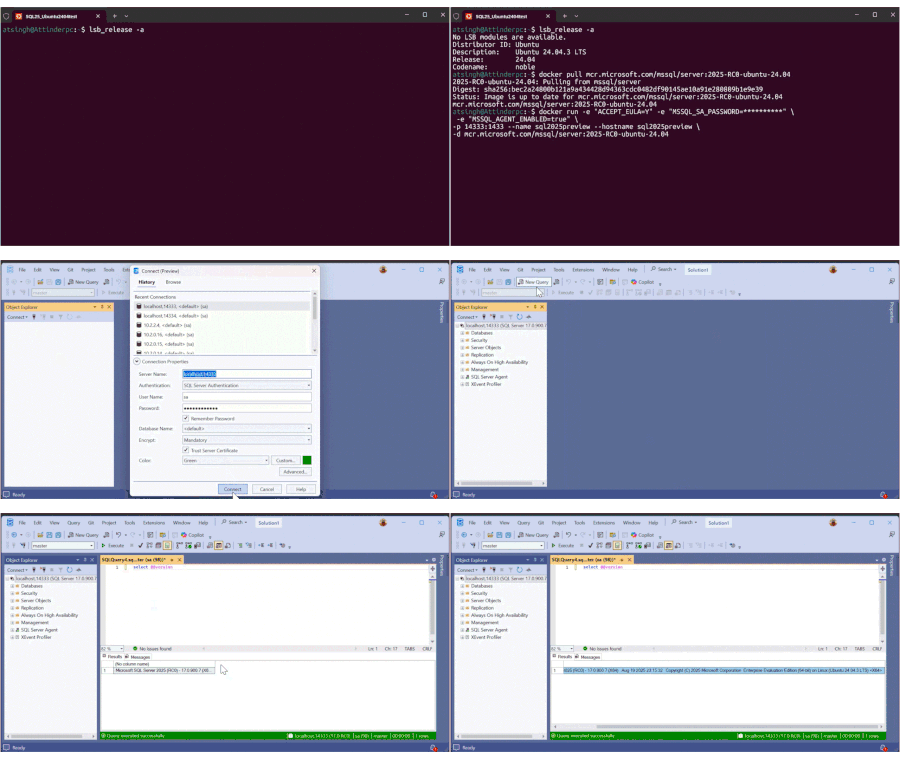
We are excited to introduce two key enhancements in the SQL Server 2025 Release Candidate 0 (RC0) for Linux: Ubuntu 24.04 and the addition of Transport Layer Security (TLS) 1.3 support. These updates enable developers, database administrators, and IT professionals to leverage the latest open-source technologies and security protocols, strengthening their data platforms. Ubuntu 24.04 Support in SQL Server 2025 RC0 SQL Server 2025 Preview now supports Ubuntu 24.04. This enables seamless deployment in Dev/Test environments using the Enterprise Evaluation Edition, which is valid for 180 days. Note: Production workloads on Ubuntu 24.04 are not yet supported; for production, use SQL Server 2022 on Ubuntu 22.04 or RHEL 9. How to Deploy SQL Server 2025 RC0 on Ubuntu 24.04 Getting started is easy! You can follow our Quickstart: Install SQL Server and create a database on Ubuntu to walks through everything—from prepping your system to installing and configuring SQL Server on Ubuntu. In this demo, I'll show you how to deploy SQL Server 2025 RC0 on Ubuntu 24.04 running inside WSL2. I've already set up Ubuntu 24.04 on WSL2 and Docker Desktop to manage containers. With just two commands, I was able to launch SQL Server 2025 RC0 in a container. I then connected to it using SQL Server Management Studio (SSMS), where you can see the version information displayed, confirming a successful deployment. lsb_release -a docker pull mcr.microsoft.com/mssql/server:2025-RC0-ubuntu-24.04 docker run -e "ACCEPT_EULA=Y" -e "MSSQL_SA_PASSWORD=<password>" \ -e "MSSQL_AGENT_ENABLED=true" \ -p 14333:1433 --name sql2025preview --hostname sql2025preview \ -d mcr.microsoft.com/mssql/server:2025-RC0-ubuntu-24.04 Here is the snippet of SQL Server ERRORLOG This shows the initial startup messages and confirms the SQL Server version running inside the container. TLS 1.3 Support in SQL Server 2025 RC0 Starting in SQL Server 2025 Preview (RC0), TLS 1.3 is enabled by default. To enable and validate TLS 1.3 for your SQL Server instance, follow the Learn guide: Encrypt Connections to SQL Server on Linux - SQL Server | Microsoft Learn Conclusion The addition of Ubuntu 24.04 and TLS 1.3 support in SQL Server 2025 Preview marks a significant step forward in providing modern, secure, and flexible data platform options. We encourage you to try out these new capabilities and share your feedback as we continue to improve SQL Server for the Linux ecosystem. We recommend you use any of the following options that suits you the best. 1) Send us an email with your feedback to sqlpreviewpackage@microsoft.com. 2) Another option would be to submit your comments directly on Azure Ideas (Use the SQL Server on Linux Group on the left side of the page) 3) Alternatively, you can open issues related to the preview packages Issues · microsoft/mssql-docker (github.com) on GitHub. We hope you give SQL Server 2025 preview on Ubuntu 24.04 a try and let us know what you think!1.2KViews0likes0Comments
Missing client protocols
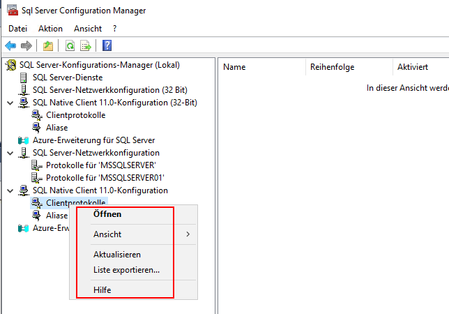
Hello everyone, I have a problem with one of my two SQL Server instances. The client protocols are missing for one of the instances. You can actually add these there (see https://learn.microsoft.com/en-us/sql/database-engine/configure-windows/configure-client-protocols?view=sql-server-ver16#ChangeDefault ) but unfortunately the Properties entry is missing (see image below). I have never had this before. Does anyone have any ideas? Thanks in advance, Frank3KViews0likes4Comments