sqlreleases
426 TopicsAnnouncing flexible provisioning for SQL Server on Linux Azure VMs (Public Preview)
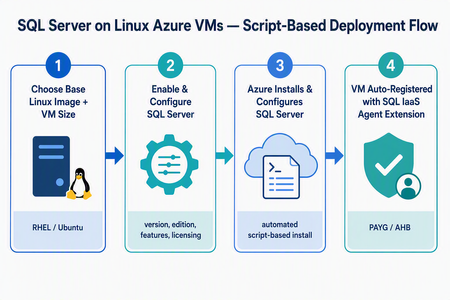
What’s changing We’re introducing a new script-based deployment experience for provisioning SQL Server on Linux Azure Virtual Machines (VMs). This experience replaces the earlier model that relied on pre-created SQL Server on Linux Marketplace images, which have been deprecated. Pre-created SQL Server on Linux Marketplace images are no longer available for new provisioning through the Azure portal, the Azure SQL hub, Azure CLI, or PowerShell. Instead, SQL Server is now installed and configured during VM provisioning using a flexible, automated, script-based workflow. The result is a more adaptable and supportable deployment model that keeps SQL Server on Linux Azure VMs fully supported, reduces image-maintenance overhead, and makes it easier to adopt the latest Linux distributions, VM families, and configuration options - all while giving you more control over your SQL Server setup. Why the new model matters Greater flexibility and control — choose your Linux distribution, SQL Server version, edition, and even bring your own mssql.conf to tailor the configuration. Faster access to innovation — new Linux versions and Azure capabilities are picked up automatically, without waiting for a new baked image to be published. Automatic registration built in — every VM is registered with the SQL IaaS Agent extension by default, unlocking licensing flexibility, compliance, and richer visibility. A dynamic, guided UI — the portal enables or disables options based on supported operating system, SQL Server, and licensing combinations, so you only see valid choices. Supported Linux distributions The script-based deployment experience supports the following distributions, and future versions are picked up automatically as they become supported — no manual intervention required: Distribution Supported versions Red Hat Enterprise Linux (RHEL) RHEL 9, RHEL 10 (and future versions) Ubuntu Ubuntu 22.04, Ubuntu 24.04, Ubuntu 26.04 (and future versions) Automatic registration applies to both Red Hat Enterprise Linux and Ubuntu, across all their supported versions. Automatic registration with the SQL IaaS Agent extension SQL Server on Linux VMs deployed through this experience are automatically registered with the SQL Server IaaS Agent extension. Registration creates a SQL virtual machine resource in Azure (separate from the VM resource) and unlocks: Licensing flexibility — choose Pay-As-You-Go (PAYG) or Azure Hybrid Benefit (AHB), and switch between them anytime with no downtime. Compliance — a simplified way to meet Azure Hybrid Benefit product-term requirements without per-resource registration forms. Visibility and telemetry — clear license-type visibility, subscription-level tracking, and better operational insight from the Azure portal, CLI, or PowerShell. Note: Automatic registration is enabled by default during deployment. You can unregister or re-register a VM after deployment through the Azure portal, Azure CLI, or PowerShell. The end-to-end flow at a glance Experience: The “Create a virtual machine” tab Use this flow if you’re starting from the familiar VM creation experience in the Azure portal. In the Azure portal, go to Virtual machines (or Create a resource → Virtual machine) and select Create. On the Basics tab, select your project details (subscription, resource group), instance details, and a supported Linux base image — RHEL 9, RHEL 10, Ubuntu 22.04, or Ubuntu 24.04. Choose your VM size, authentication, and inbound ports as usual. Go to the Advanced tab and select the Install SQL Server checkbox. This enables SQL Server provisioning on the VM. A new SQL Server settings tab becomes available. Open it to configure your SQL Server deployment: SQL Server version — e.g., SQL Server 2025 or SQL Server 2022. Edition — Enterprise, Standard, Developer, Express, and Evaluation editions (options adjust to the selected version). Licensing model — Pay-As-You-Go (PAYG, default) or Azure Hybrid Benefit (AHB). Advanced configuration — Upload a custom mssql.conf file to set SQL connectivity, Azure Key Vault integration, and the tuned performance profile. Select Review + create, review the configuration summary, and select Create. Azure provisions the VM, then automatically installs and configures SQL Server and registers the VM with the SQL IaaS Agent extension. Managing licensing after deployment Because your VM is registered with the SQL IaaS Agent extension, you can change the licensing model anytime — with no downtime and no restart of the VM or SQL Server service. Azure portal: Go to the SQL virtual machine resource → Settings → SQL Server configuration → Manage. Azure CLI az sql vm update -n <VM_NAME> -g <RESOURCE_GROUP> --license-type AHUB Azure PowerShell: Set-AzSqlVM -Name <VM_NAME> -ResourceGroupName <RESOURCE_GROUP> -LicenseType AHUB Note: Switching between PAYG and AHB is immediate, incurs no additional cost, and does not restart the VM or the SQL Server service. Wrapping up The move to script-based deployment modernizes how you provision SQL Server on Linux Azure VMs. By replacing deprecated pre-created Marketplace images with a flexible, automated, script-based flow — and by registering every VM with the SQL IaaS Agent extension automatically — you get more choice, faster access to new Linux and SQL Server versions, and a cleaner path to licensing flexibility, compliance, and visibility. Whether you start from the Create a virtual machine tab or the Azure SQL hub, you get the same guided experience across RHEL 9, RHEL 10, Ubuntu 22.04, Ubuntu 24.04, and future versions. Ready to try it? Head to a Create a virtual machine option in the Azure portal. We’d love your feedback — let us know how the new experience works for your workloads in the comments.46Views0likes0Comments
Cumulative Update #9 for SQL Server 2025 RTM
The 9th cumulative update release for SQL Server 2025 RTM is now available for download at the Microsoft Downloads site. Please note that registration is no longer required to download Cumulative updates. To learn more about the release or servicing model, please visit: CU9 KB Article: https://support.microsoft.com/help/5122048 Starting with SQL Server 2017, we adopted a new modern servicing model. Please refer to our blog for more details on Modern Servicing Model for SQL Server Microsoft® SQL Server® 2025 RTM Latest Cumulative Update: https://www.microsoft.com/download/details.aspx?familyid=10a21237-8b59-4fcd-b878-bfe8fcabdc7a Update Center for Microsoft SQL Server: https://learn.microsoft.com/en-us/troubleshoot/sql/releases/download-and-install-latest-updates332Views0likes0CommentsCumulative Update #27 for SQL Server 2022 RTM
The 27th cumulative update release for SQL Server 2022 RTM is now available for download at the Microsoft Downloads site. Please note that registration is no longer required to download Cumulative updates. To learn more about the release or servicing model, please visit: CU27 KB Article: https://support.microsoft.com/help/5104824 Starting with SQL Server 2017, we adopted a new modern servicing model. Please refer to our blog for more details on Modern Servicing Model for SQL Server Microsoft® SQL Server® 2022 RTM Latest Cumulative Update: https://www.microsoft.com/download/details.aspx?familyid=105013 Update Center for Microsoft SQL Server: https://learn.microsoft.com/en-us/troubleshoot/sql/releases/download-and-install-latest-updates267Views0likes0CommentsSQL Server 2016 Extended Security Updates: Stay Protected While You Modernize
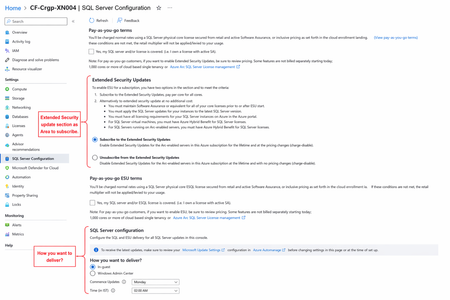
SQL Server 2016 reaches the end of extended support on July 14, 2026. After that date, instances that remain on SQL Server 2016 no longer receive regular security updates unless they are covered through Extended Security Updates (ESUs)). ESUs provide a time-bound security bridge for customers who need to maintain existing workloads while they upgrade to a supported SQL Server release or modernize to Azure SQL. SQL Server 2016 Extended Security Updates can be managed across multiple deployment models, including SQL Server enabled by Azure Arc for on-premises and other clouds, and SQL Server on Azure Virtual Machines. This provides a consistent protection path while customers assess modernization options and operational readiness. Today, we are making the Extended Security Updates subscription experience available in Azure so customers can enroll ahead of SQL Server 2016 reaching end of support, and be ready to receive Extended Security Updates when they are released. Why this matters now SQL Server follows a fixed lifecycle policy with mainstream support followed by extended support. Once SQL Server 2016 exits extended support, Extended Security Updates become the only for continued security coverage on that version. Extended Security Updates are intended as a temporary option for risk reduction, not as a long-term alternative to upgrade or modernization. For many production environments, the constraint is not awareness of the deadline but the complexity of the upgrade path. Application dependencies, validation requirements, change windows, and compliance controls sometimes make immediate migration impractical. Extended Security Updates help teams maintain security coverage during that transition period while they sequence remediation, testing, and platform changes. How SQL Server 2016 Extended Security Updates work Support window: SQL Server 2016 exits extended support on July 14, 2026. Extended Security Updates are available for up to three additional years, with coverage periods defined by the SQL Server 2016 lifecycle schedule through July 17, 2029. Supported scope and update model Eligible versions: SQL Server 2016. Extended Security Updates are also available for SQL Server 2014 until July 12, 2027. Eligible editions: Standard and Enterprise Update content: Extended Security Updates deliver critical security updates when applicable. They do not include new features, non-security bug fixes, non-critical security updates, or design changes. Operational note: SQL Server ESUs are not published on a fixed monthly cadence. They are released when qualifying vulnerabilities require a release. For Azure Arc-connected environments, Extended Security Updates subscriptions can be aligned to the deployment model, including virtual cores for VM-based deployments and physical cores for host-based scenarios. This gives organizations flexibility to match ESU coverage to how SQL Server is deployed and managed. How to acquire Extended Security Updates coverage Customers can acquire SQL Server ESU coverage in different ways depending on where SQL Server is running and how they prefer to purchase. For on-premises, edge, and other cloud environments, SQL Server enabled by Azure Arc provides the control plane to onboard instances, manage eligibility, and apply ESU subscription settings. For workloads already running on Azure Virtual Machines, customers can subscribe to ESU coverage through Azure-based controls. Customers can purchase that coverage as pay-as-you-go through Azure or through Volume Licensing on an annual basis for eligible licenses with active Software Assurance. When customers choose Volume Licensing, Azure Arc registration is still required to activate access to ESUs. SQL Server enabled by Azure Arc: Use Azure Arc to onboard eligible SQL Server instances outside Azure, manage Extended Security Updates subscription settings, and support both connected and qualifying disconnected scenarios. SQL Server on Azure Virtual Machines: Use Azure-based controls to subscribe to Extended Security Updates coverage for workloads running on Azure Virtual Machines. For SQL Server 2016, this now requires a paid ESU subscription rather than the previous no-additional-cost experience. Supported regions: Subscribing to Extended Security Updates for SQL Server on Azure VMs is only available in the supported regions listed. To subscribe to ESUs in an unsupported region, contact Microsoft Support to determine the appropriate ESU acquisition path. Volume Licensing: If you cannot subscribe to Extended Security Updates via Azure Arc, you can purchase through the Volume Licensing channel on an annual basis for eligible licenses with active Software Assurance. Talk to your Microsoft seller for more information. Azure Arc registration is still required to activate access to ESUs. Migrate to Azure SQL: Customers that are ready to modernize further can move to Azure SQL Database or Azure SQL Managed Instance, which removes Extended Security Updates dependency by moving to fully supported, cloud-managed SQL services. The following diagram summarizes how customers can obtain SQL Server 2016 Extended Security Updates coverage through Azure Arc and Azure Virtual Machines. What to do next Organizations still running SQL Server 2016 should use the remaining support window to assess estate readiness, determine the right Extended Security Updates subscription model, and define the target modernization path for each workload. For some environments, that means upgrading in place to a supported SQL Server version. For others, it means migrating and upgrading to Azure Virtual Machines or Azure SQL to simplify long-term operations. The important step is to make the transition plan executable before support ends. Learn more SQL Server end of support options SQL Server Extended Security Updates enabled by Azure Arc SQL Server enabled by Azure Arc Extend support for SQL Server with Azure VM SQL Server on Azure VM overview Migrate to Azure SQL3.9KViews0likes7CommentsSecurity Update for SQL Server 2025 RTM CU8
The Security Update for SQL Server 2025 RTM CU8 is now available for download at the Microsoft Download Center and Microsoft Update Catalog sites. This package cumulatively includes all previous security fixes for SQL Server 2025 RTM CUs, plus it includes the new security fixes detailed in the KB Article. Security Bulletins: CVE-2026-67378 - Security Update Guide - Microsoft - Microsoft SQL Server Denial of Service Vulnerability Security Update of SQL Server 2025 RTM CU8 KB Article: KB5122769 Microsoft Download Center: https://www.microsoft.com/download/details.aspx?familyid=65b5f47b-53bf-4b54-89e7-6aefaad8dc51 Microsoft Update Catalog: https://www.catalog.update.microsoft.com/Search.aspx?q=5122769 Latest Updates for Microsoft SQL Server: https://learn.microsoft.com/en-us/troubleshoot/sql/releases/download-and-install-latest-updates287Views0likes0CommentsSecurity Update for SQL Server 2025 RTM
The Security Update for SQL Server 2025 RTM GDR is now available for download at the Microsoft Download Center and Microsoft Update Catalog sites. This package cumulatively includes all previous security fixes for SQL Server 2025 RTM, plus it includes the new security fixes detailed in the KB Article. Security Bulletins: CVE-2026-67378 - Security Update Guide - Microsoft - Microsoft SQL Server Denial of Service Vulnerability Security Update of SQL Server 2025 RTM GDR KB Article: KB5122770 Microsoft Download Center: https://www.microsoft.com/download/details.aspx?familyid=0d644af6-717c-45d7-bf71-ce7e309d2ad7 Microsoft Update Catalog: https://www.catalog.update.microsoft.com/Search.aspx?q=5122770 Latest Updates for Microsoft SQL Server: https://learn.microsoft.com/en-us/troubleshoot/sql/releases/download-and-install-latest-updates209Views1like0CommentsSecurity Update for SQL Server 2022 RTM CU26
The Security Update for SQL Server 2022 RTM CU26 is now available for download at the Microsoft Download Center and Microsoft Update Catalog sites. This package cumulatively includes all previous security fixes for SQL Server 2022 RTM CUs, plus it includes the new security fixes detailed in the KB Article. Security Bulletins: CVE-2026-67378 - Security Update Guide - Microsoft - Microsoft SQL Server Denial of Service Vulnerability Security Update of SQL Server 2022 RTM CU26 KB Article: KB5122768 Microsoft Download Center: https://www.microsoft.com/download/details.aspx?familyid=d682ec86-56e1-45c3-a0fa-552f89f6e51e Microsoft Update Catalog: https://www.catalog.update.microsoft.com/Search.aspx?q=5122768 Latest Updates for Microsoft SQL Server: https://learn.microsoft.com/en-us/troubleshoot/sql/releases/download-and-install-latest-updates262Views0likes0CommentsSecurity Update for SQL Server 2022 RTM
The Security Update for SQL Server 2022 RTM GDR is now available for download at the Microsoft Download Center and Microsoft Update Catalog sites. This package cumulatively includes all previous security fixes for SQL Server 2022 RTM, plus it includes the new security fixes detailed in the KB Article. Security Bulletins: CVE-2026-67378 - Security Update Guide - Microsoft - Microsoft SQL Server Denial of Service Vulnerability Security Update of SQL Server 2022 RTM GDR KB Article: KB5122771 Microsoft Download Center: https://www.microsoft.com/download/details.aspx?familyid=7ce0ba48-9a1e-4298-b300-79f251385092 Microsoft Update Catalog: https://www.catalog.update.microsoft.com/Search.aspx?q=5122771 Latest Updates for Microsoft SQL Server: https://learn.microsoft.com/en-us/troubleshoot/sql/releases/download-and-install-latest-updates172Views0likes0CommentsSecurity Update for SQL Server 2019 RTM CU32
The Security Update for SQL Server 2019 RTM CU32 is now available for download at the Microsoft Download Center and Microsoft Update Catalog sites. This package cumulatively includes all previous security fixes for SQL Server 2019 RTM CUs, plus it includes the new security fixes detailed in the KB Article. Security Bulletins: CVE-2026-67378 - Security Update Guide - Microsoft - Microsoft SQL Server Denial of Service Vulnerability Security Update of SQL Server 2019 RTM CU32 KB Article: KB5122772 Microsoft Download Center: https://www.microsoft.com/download/details.aspx?familyid=cee52a4a-832a-447e-909d-0f629cab835f Microsoft Update Catalog: https://www.catalog.update.microsoft.com/Search.aspx?q=5122772 Latest Updates for Microsoft SQL Server: https://learn.microsoft.com/en-us/troubleshoot/sql/releases/download-and-install-latest-updates191Views0likes0CommentsSecurity Update for SQL Server 2019 RTM
The Security Update for SQL Server 2019 RTM GDR is now available for download at the Microsoft Download Center and Microsoft Update Catalog sites. This package cumulatively includes all previous security fixes for SQL Server 2019 RTM, plus it includes the new security fixes detailed in the KB Article. Security Bulletins: CVE-2026-67378 - Security Update Guide - Microsoft - Microsoft SQL Server Denial of Service Vulnerability Security Update of SQL Server 2019 RTM GDR KB Article: KB5122773 Microsoft Download Center: https://www.microsoft.com/download/details.aspx?familyid=e668fe5f-ea1e-41fb-97f7-1bc12e91150b Microsoft Update Catalog: https://www.catalog.update.microsoft.com/Search.aspx?q=5122773 Latest Updates for Microsoft SQL Server: https://learn.microsoft.com/en-us/troubleshoot/sql/releases/download-and-install-latest-updates151Views0likes0Comments