specification
1 TopicSpec-Driven Development for AI-Enabled Enterprise Systems
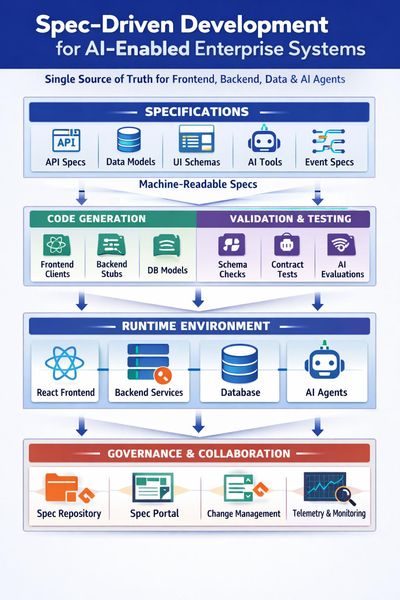
Spec-Driven Development for AI-Enabled Enterprise Systems How to make specs the single source of truth for your React frontends, backend services, data, and AI agents. If you are building an enterprise system with a React frontend, backend APIs and services, a database layer, and shared libraries, moving to Spec-Driven Development (SDD) can feel like a big cultural shift. For AI developers and engineers, though, it is a gift: structured, machine-readable specifications are exactly what both humans and AI coding agents need to stay aligned and productive. This post walks through how to structure specs, version contracts, design workflows, and integrate AI agents in a way that scales. Along the way, it references Microsoft’s public guidance on microservices, APIs, DevOps, and architecture so you can go deeper where needed. 1. Structuring specifications for an enterprise system For a serious enterprise system, treat specs as layered and modular rather than a single monolithic document. A good mental model is Domain-Driven Design (DDD) and bounded contexts (see https://learn.microsoft.com/azure/architecture/microservices/model/domain-analysis Business and domain layer This layer is technology-agnostic and captures: Business capabilities and problem statements Domain language and key entities Business rules and workflows Non-functional requirements (performance, security, compliance, SLAs) Solution and architecture layer Here you define how the system is shaped: System context and C4-style diagrams Service boundaries and ownership Integration patterns and event flows Data ownership and high-level models Microsoft’s microservices guidance is a solid reference: https://learn.microsoft.com/azure/architecture/microservices/. Implementation-oriented specs per component For each concrete component, keep a focused spec: Frontend / UI (React): screen catalogue, UX flows, state contracts, API dependencies, validation rules, accessibility and performance requirements. APIs / services: OpenAPI or AsyncAPI contracts, error models, authentication and authorisation, rate limits, SLAs, observability requirements. Database / schema: logical data model, ownership per service, migration strategy, retention, indexing, partitioning. Shared libraries: responsibilities, versioning policy, supported runtimes, compatibility matrix. Integrations: protocols, payloads, sequencing, idempotency, retry and backoff, SLAs, failure modes. In practice, this usually means: One “master” business and architecture spec per domain or product Separate specs per service or module (frontend app, each backend service, shared library, integration) Everything linked via IDs (for example REQ-123, SVC-ORDER-001) so you can trace from requirement to spec, implementation, and tests 2. Templates and standards that scale To keep things consistent across teams, use a base template that all components share, then extend it with technology-specific sections. This works well for both human readers and AI agents consuming the specs. Base specification template Every spec, regardless of component type, should include: Purpose and scope Stakeholders and dependencies Requirements mapping (list of requirement IDs covered) Architecture and interaction overview Contracts (APIs, events, data) Non-functional requirements Risks and open questions Test and acceptance criteria Extended templates per component Frontend: UX flows, wireframes or Figma links, accessibility, performance budgets, offline behaviour, error states. API / service: OpenAPI or AsyncAPI link, auth and authorisation, throttling, logging and metrics, health endpoints. See logging and monitoring guidance at https://learn.microsoft.com/azure/architecture/microservices/logging-monitoring Database: schema definition, migration plan, backup and restore, data lifecycle, multi-tenant strategy. Integration: sequence diagrams, error handling, retry and idempotency, message contracts, security. 3. Contracts, versioning, and change management API contracts For SDD, API contracts are first-class citizens. Define them via OpenAPI or AsyncAPI and treat the spec as the source of truth. Use contract testing to keep providers and consumers aligned, and version APIs explicitly (for example v1, v2) rather than breaking changes in place. Microsoft’s API design guidance is a good starting point: https://learn.microsoft.com/azure/architecture/best-practices/api-design and Azure API Management at https://learn.microsoft.com/azure/api-management/. Database migrations Any spec change that affects data should include a migration plan. Use migration tooling such as EF Core migrations, Flyway, or Liquibase, and treat migration scripts as code. Document backward-compatibility windows so APIs can support both old and new fields for a defined period. Shared DTOs and models Prefer sharing contracts (OpenAPI, JSON Schema) over large shared code libraries. If you must share code, version the shared library independently and document compatibility (for example, “Service A supports SharedLib 2.x”). Keep DTOs at the edges and map to internal domain models inside each service. Cross-service dependencies Capture dependencies explicitly in specs, such as “Order Service depends on Customer v1.3+ for endpoint /customers/{id}”. Use consumer-driven contracts and CI checks to prevent breaking changes. For event-driven systems, document event contracts and evolution rules. See event-driven architecture guidance at https://learn.microsoft.com/azure/architecture/reference-architectures/event-driven/event-driven-architecture-overview. Spec versioning and change management Version specs semantically (for example OrderServiceSpec v1.2.0) and record what changed, why, impact, and migration steps. Link spec versions to releases or tags in Git and to work items in Azure DevOps or GitHub Issues. Azure Boards is useful here: https://learn.microsoft.com/azure/devops/boards/?view=azure-devops. 4. A mature Spec-Driven Development workflow A realistic SDD workflow for AI-enabled teams might look like this: Discovery and domain analysis: capture business capabilities, domain language, and high-level workflows. Business and architecture specs: define bounded contexts, service boundaries, integration patterns, and NFRs. Contract design: design API specs (OpenAPI or AsyncAPI), event schemas, data models, and validation rules. Task generation: derive work items from specs, such as “Implement endpoint X”, “Add migration Y”, “Add UI flow Z”. This is a great place to use AI agents to read specs and generate tasks. Implementation: code is generated or written to satisfy the spec; the spec remains the reference, not the code. Validation and testing: contract tests, unit tests, integration tests, and end-to-end tests all trace back to spec IDs. Use quality gates in CI and CD, as described in Https://learn.microsoft.com/azure/architecture/framework/devops/devops-quality Review and sign-off: architecture and product review against the spec; update the spec if reality diverges. Release and observability: dashboards and alerts tied to specified SLIs and SLOs. 5. Governance, traceability, and avoiding drift Traceability across the lifecycle Use IDs everywhere: requirements, spec sections, tasks, tests, and deployment artefacts. In Azure DevOps or GitHub, link: Requirement (for example Azure DevOps Feature) Spec (stored in the repo) User stories and tasks Pull requests Tests Releases For key decisions, adopt Architecture Decision Records (ADRs). Microsoft’s guidance on ADRs is here: Https://learn.microsoft.com/azure/architecture/framework/devops/adrs Keeping humans and AI agents aligned To avoid implementation drift: Make specs as machine-readable as possible (OpenAPI, JSON Schema, YAML, BPMN). Enforce spec checks in CI: API implementation must match OpenAPI, DB schema must match migration plan, generated clients must be up to date. For AI coding agents, always provide the relevant spec files as context and constrain them to files linked to specific spec IDs. Add automated checks that compare generated code to contracts and fail builds when they diverge. 6. Enterprise best practices for repos and governance Example repository structure /docs /business /architecture /decisions (ADRs) /specs /frontend /services /orders /customers /integrations /data /src /frontend /services /shared /tests /ops /pipelines /infra-as-code Governance practices An architecture review group that reviews spec changes, not just code changes. Definition of Done includes: spec updated, tests linked, contracts validated. Regular “spec health” reviews to identify what is out of date or drifting. For broader architectural guidance, see: Azure microservices and DDD: https://learn.microsoft.com/azure/architecture/microservices/ Cloud design patterns: https://learn.microsoft.com/azure/architecture/patterns/ Azure Well-Architected Framework: https://learn.microsoft.com/azure/well-architected/ 7. Integrating AI and agentic workflows into SDD Spec-Driven Development is a natural fit for AI and multi-agent systems because specs provide structured, reliable context. Here are some practical patterns. LangGraph and multi-agent orchestration using Microsoft Agent Framework You can design a graph where: A “spec agent” reads and validates specs. An “implementation agent” writes or updates code based on those specs. A “test agent” generates tests from contracts and acceptance criteria. The graph flow can mirror your SDD workflow: Spec → Contract → Code → Tests → Review, with each agent responsible for a stage. MCP (Model Context Protocol) Expose your spec repository, OpenAPI definitions, and ADRs as MCP tools so agents can query the true source of truth instead of hallucinating. For example, provide a tool that returns the OpenAPI for a given service and version, or a tool that returns the ADRs relevant to a particular domain. Learn more about MCP at https://aka.ms/mcp-for-beginners BPMN and process flows Store BPMN diagrams as part of the spec. Agents can read them to generate workflow code, state machines, or tests. For process-oriented integrations, see Azure Logic Apps guidance at https://learn.microsoft.com/azure/logic-apps/. CI/CD pipelines on Azure In your pipelines, validate that implementation matches the spec: Contract tests for APIs and events Schema checks for databases Linting and static analysis for spec conformance Use pipeline gates to block deployments if contracts or migrations are out of sync. Azure Pipelines https://learn.microsoft.com/azure/devops/pipelines/?view=azure-devops GitHub Agentic Workflow Patterns https://github.github.com/gh-aw/ Where to start The key is not to boil the ocean. Pick one domain, such as “Orders”, and design a thin but end-to-end SDD flow: spec → contract → tasks → code → tests. Run it with your AI agents in the loop, learn where the friction is, and iterate. Once that feels natural, you can roll the patterns out across the rest of your system. For AI developers and engineers, SDD is more than process hygiene. It is how you give your agents high-quality, unambiguous context so they can generate code, tests, and documentation that actually match what the business needs. `46Views1like0Comments