security
26 TopicsAnnouncing the Open-Source Release of ML Video Codec (MLVC)
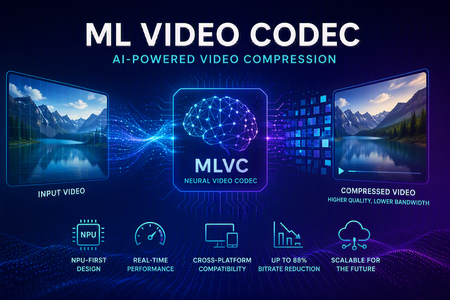
Video codecs compress video for transmission or storage, reducing bandwidth and storage requirements. MLVC is a modern machine-learning-based codec that uses substantially less bandwidth than conventional codecs, improving streaming and video-call quality—especially on constrained or unreliable networks—while lowering delivery and storage costs. MLVC is the product iteration of DCVC (Deep Contextual Video Compression) family of NVC (Neural Video Codec), open sourced by Microsoft Research since 2021, with improved compression efficiency, real-time performance on commodity Neural Processing Units (NPUs), and cross-platform support. We recently published this work in the paper MLVC: Multi-platform Learned Video Codec for Real-World Deployment. We are releasing the source code because we believe the next generation of video coding will be built openly, and we want the broader community — researchers, video codec engineers, platform vendors, product teams, as well as general developer community — to build it with us. Why MLVC Traditional video codecs (e.g., H.264/AVC, H.265/HEVC) have served the industry for a long time, but each generation requires enormous engineering effort for incremental gains and needs dedicated hardware which takes years to become commonly available. MLVC replaces conventional primitives — motion estimation, transforms, entropy modeling — with end-to-end learned neural compression, trained directly against rate-distortion objectives, and run on general-purpose NPU devices. The table below compares MLVC to popular video codecs, showing its lower bitrate and resulting savings in bandwidth and storage. Resolution vs H.264 vs H.265 360p 87.8% 75.5% 540p 82.7% 65.4% For example, for 360p video at 30 fps, where H.264 requires 1 Mbps, MLVC requires roughly 122 kbps for equivalent quality — about one-eight the bitrate under real-time conditions. The inference compute was kept approximately equal for the 360p and 540p resolutions. These results are based on a P.910 subjective test and are based on the Video Conferencing Dataset (VCD) dataset that we developed and also recently released as an open-source project. The following video demo illustrates the extent of quality enhancement achieved by MLVC relative to H.265/HEVC at the same bitrate of 200kbps (please watch by opening in a new window for better demonstration) \ Beyond video compression efficiency, MLVC also offers: NPU-first design. MLVC is built to run almost entirely on the AI accelerators already shipping in modern devices — Apple Neural Engine, Qualcomm and Intel NPUs — at no more than 50% NPU utilization, leaving NPU headroom for the rest of the system. Real-time execution at the targeted operating points. Demonstrated 540p at 30 fps on Apple, Intel, and Qualcomm hardware. A scaling-law trajectory. Empirically, MLVC's coding efficiency improves with increased model capacity and additional training compute. Content-adaptive behavior out of the box, without hand-tuned Rate Distortion Optimization heuristics. Already running in Microsoft Teams MLVC is more than just a research concept for Microsoft. We are currently rolling it out in Microsoft Teams, where it is being validated on real peer-to-peer video calls with active telemetry and A/B testing. The integration runs alongside fallback to conventional video codecs for hardware or reliability constraints — the kind of mixed-environment deployment that real products need. The scaling and reliability insights from this rollout are shaping the codec and its roadmap. We welcome your contributions We can not cover every use case, every device class, or every content domain by ourselves. That is why we are open sourcing MLVC. If you work on: Streaming, Video On Demand (VOD), or live broadcast Real-time communication and conferencing Cloud gaming or remote rendering Surveillance, drones, or robotics Mobile capture, Augmented Reality (AR) / Virtual Reality (VR), or volumetric video Codec hardware, NPUs, or inference runtimes We would love your help. Contributions of all kinds are welcome, including model improvements, training recipes, new platform ports and conversion targets, runtime backends, domain-specific fine-tunes, evaluation tooling, bug reports, and feedback on what is missing for your scenario. We particularly welcome platform ports that expand NPU coverage and efficiency improvements that push the rate-distortion frontier. What's in the release The MLVC repository is available at https://github.com/microsoft/mlvc and shared under the MIT License. It includes: MLVC model source code of the full network architecture. Trained model weights ready to run. Training scripts used to produce shipping models. Training data collection documentation to help reproduce and improve MLVC. Platform conversion scripts to target different NPUs and runtimes. Issues and pull requests will be open from day one. A follow-up release will add a C++ codec library, simplifying integration into real-world applications. Where we're heading Our long-term goal with MLVC is to create an open, learned video codec that meets or exceeds the coding efficiency of the best conventional codecs across the full range of video content, runs efficiently on the AI hardware already shipping in client and cloud devices, scales with compute the way modern ML systems do, and evolves in the open at the pace of the ML community rather than the pace of standardization cycles. In the near term that means stabilizing 540p real-time performance, expanding hardware coverage, and improving loss resilience. In the medium term: higher resolution, e.g., 1080p, and broader streaming scenarios. In the long term: an open video codec ecosystem that meaningfully replaces legacy stacks where it makes sense to. We can't create the future of MLVC alone. We're glad you're here, and we are looking forward to building the next-generation video codec with you. Who are we MLVC is brought to you by the following awesome folks working on the project at Microsoft: Ross Cutler, Ando Saabas, Tanel Pärnamaa, Ardi Loot, Haiyan Xie, Lauri Ehrenpreis, Andrei Znobishchev, Martin Lumiste, Evgenii Indenbom, Yan Lu, Bin Li, Jiahao Li, Naba Kumar, Babak Naderi, Juhee Cho, Badal Yadav, Jinxin Zhou, Tianyu Ding, Patrick Gregory. — The MLVC Team, Microsoft15KViews0likes4CommentsAgent Governance Toolkit: Architecture Deep Dive, Policy Engines, Trust, and SRE for AI Agents
Last week we announced the Agent Governance Toolkit on the Microsoft Open Source Blog, an open-source project that brings runtime security governance to autonomous AI agents. In that announcement, we covered the why: AI agents are making autonomous decisions in production, and the security patterns that kept systems safe for decades need to be applied to this new class of workload. In this post, we'll go deeper into the how: the architecture, the implementation details, and what it takes to run governed agents in production. The Problem: Production Infrastructure Meets Autonomous Agents If you manage production infrastructure, you already know the playbook: least privilege, mandatory access controls, process isolation, audit logging, and circuit breakers for cascading failures. These patterns have kept production systems safe for decades. Now imagine a new class of workload arriving on your infrastructure, AI agents that autonomously execute code, call APIs, read databases, and spawn sub-processes. They reason about what to do, select tools, and act in loops. And in many current deployments, they do all of this without the security controls you'd demand of any other production workload. That gap is what led us to build the Agent Governance Toolkit: an open-source project, that applies proven security concepts from operating systems, service meshes, and SRE to the emerging world of autonomous AI agents. To frame this in familiar terms: most AI agent frameworks today are like running every process as root, no access controls, no isolation, no audit trail. The Agent Governance Toolkit is the kernel, the service mesh, and the SRE platform for AI agents. When an agent calls a tool, say, `DELETE FROM users WHERE created_at < NOW()`, there is typically no policy layer checking whether that action is within scope. There is no identity verification when one agent communicates with another. There is no resource limit preventing an agent from making 10,000 API calls in a minute. And there is no circuit breaker to contain cascading failures when things go wrong. OWASP Agentic Security Initiative In December 2025, OWASP published the Agentic AI Top 10: the first formal taxonomy of risks specific to autonomous AI agents. The list reads like a security engineer's nightmare: goal hijacking, tool misuse, identity abuse, memory poisoning, cascading failures, rogue agents, and more. If you've ever hardened a production server, these risks will feel both familiar and urgent. The Agent Governance Toolkit is designed to help address all 10 of these risks through deterministic policy enforcement, cryptographic identity, execution isolation, and reliability engineering patterns. Note: The OWASP Agentic Security Initiative has since adopted the ASI 2026 taxonomy (ASI01–ASI10). The toolkit's copilot-governance package now uses these identifiers with backward compatibility for the original AT numbering. Architecture: Nine Packages, One Governance Stack The toolkit is structured as a v3.0.0 Public Preview monorepo with nine independently installable packages: Package What It Does Agent OS Stateless policy engine, intercepts agent actions before execution with configurable pattern matching and semantic intent classification Agent Mesh Cryptographic identity (DIDs with Ed25519), Inter-Agent Trust Protocol (IATP), and trust-gated communication between agents Agent Hypervisor Execution rings inspired by CPU privilege levels, saga orchestration for multi-step transactions, and shared session management Agent Runtime Runtime supervision with kill switches, dynamic resource allocation, and execution lifecycle management Agent SRE SLOs, error budgets, circuit breakers, chaos engineering, and progressive delivery, production reliability practices adapted for AI agents Agent Compliance Automated governance verification with compliance grading and regulatory framework mapping (EU AI Act, NIST AI RMF, HIPAA, SOC 2) Agent Lightning Reinforcement learning training governance with policy-enforced runners and reward shaping Agent Marketplace Plugin lifecycle management with Ed25519 signing, trust-tiered capability gating, and SBOM generation Integrations 20+ framework adapters for LangChain, CrewAI, AutoGen, Semantic Kernel, Google ADK, Microsoft Agent Framework, OpenAI Agents SDK, and more Agent OS: The Policy Engine Agent OS intercepts agent tool calls before they execute: from agent_os import StatelessKernel, ExecutionContext, Policy kernel = StatelessKernel() ctx = ExecutionContext( agent_id="analyst-1", policies=[ Policy.read_only(), # No write operations Policy.rate_limit(100, "1m"), # Max 100 calls/minute Policy.require_approval( actions=["delete_*", "write_production_*"], min_approvals=2, approval_timeout_minutes=30, ), ], ) result = await kernel.execute( action="delete_user_record", params={"user_id": 12345}, context=ctx, ) The policy engine works in two layers: configurable pattern matching (with sample rule sets for SQL injection, privilege escalation, and prompt injection that users customize for their environment) and a semantic intent classifier that helps detect dangerous goals regardless of phrasing. When an action is classified as `DESTRUCTIVE_DATA`, `DATA_EXFILTRATION`, or `PRIVILEGE_ESCALATION`, the engine blocks it, routes it for human approval, or downgrades the agent's trust level, depending on the configured policy. Important: All policy rules, detection patterns, and sensitivity thresholds are externalized to YAML configuration files. The toolkit ships with sample configurations in `examples/policies/` that must be reviewed and customized before production deployment. No built-in rule set should be considered exhaustive. Policy languages supported: YAML, OPA Rego, and Cedar. The kernel is stateless by design, each request carries its own context. This means you can deploy it behind a load balancer, as a sidecar container in Kubernetes, or in a serverless function, with no shared state to manage. On AKS or any Kubernetes cluster, it fits naturally into existing deployment patterns. Helm charts are available for agent-os, agent-mesh, and agent-sre. Agent Mesh: Zero-Trust Identity for Agents In service mesh architectures, services prove their identity via mTLS certificates before communicating. AgentMesh applies the same principle to AI agents using decentralized identifiers (DIDs) with Ed25519 cryptography and the Inter-Agent Trust Protocol (IATP): from agentmesh import AgentIdentity, TrustBridge identity = AgentIdentity.create( name="data-analyst", sponsor="alice@company.com", # Human accountability capabilities=["read:data", "write:reports"], ) # identity.did -> "did:mesh:data-analyst:a7f3b2..." bridge = TrustBridge() verification = await bridge.verify_peer( peer_id="did:mesh:other-agent", required_trust_score=700, # Must score >= 700/1000 ) A critical feature is trust decay: an agent's trust score decreases over time without positive signals. An agent trusted last week but silent since then gradually becomes untrusted, modeling the reality that trust requires ongoing demonstration, not a one-time grant. Delegation chains enforce scope narrowing: a parent agent with read+write permissions can delegate only read access to a child agent, never escalate. Agent Hypervisor: Execution Rings CPU architectures use privilege rings (Ring 0 for kernel, Ring 3 for userspace) to isolate workloads. The Agent Hypervisor applies this model to AI agents: Ring Trust Level Capabilities Ring 0 (Kernel) Score ≥ 900 Full system access, can modify policies Ring 1 (Supervisor) Score ≥ 700 Cross-agent coordination, elevated tool access Ring 2 (User) Score ≥ 400 Standard tool access within assigned scope Ring 3 (Untrusted) Score < 400 Read-only, sandboxed execution only New and untrusted agents start in Ring 3 and earn their way up, exactly the principle of least privilege that production engineers apply to every other workload. Each ring enforces per-agent resource limits: maximum execution time, memory caps, CPU throttling, and request rate limits. If a Ring 2 agent attempts a Ring 1 operation, it gets blocked, just like a userspace process trying to access kernel memory. These ring definitions and their associated trust score thresholds are fully configurable via policy. Organizations can define custom ring structures, adjust the number of rings, set different trust score thresholds for transitions, and configure per-ring resource limits to match their security requirements. The hypervisor also provides saga orchestration for multi-step operations. When an agent executes a sequence, draft email → send → update CRM, and the final step fails, compensating actions fire in reverse. Borrowed from distributed transaction patterns, this ensures multi-agent workflows maintain consistency even when individual steps fail. Agent SRE: SLOs and Circuit Breakers for Agents If you practice SRE, you measure services by SLOs and manage risk through error budgets. Agent SRE extends this to AI agents: When an agent's safety SLI drops below 99 percent, meaning more than 1 percent of its actions violate policy, the system automatically restricts the agent's capabilities until it recovers. This is the same error-budget model that SRE teams use for production services, applied to agent behavior. We also built nine chaos engineering fault injection templates: network delays, LLM provider failures, tool timeouts, trust score manipulation, memory corruption, and concurrent access races. Because the only way to know if your agent system is resilient is to break it intentionally. Agent SRE integrates with your existing observability stack through adapters for Datadog, PagerDuty, Prometheus, OpenTelemetry, Langfuse, LangSmith, Arize, MLflow, and more. Message broker adapters support Kafka, Redis, NATS, Azure Service Bus, AWS SQS, and RabbitMQ. Compliance and Observability If your organization already maps to CIS Benchmarks, NIST AI RMF, or other frameworks for infrastructure compliance, the OWASP Agentic Top 10 is the equivalent standard for AI agent workloads. The toolkit's agent-compliance package provides automated governance grading against these frameworks. The toolkit is framework-agnostic, with 20+ adapters that hook into each framework's native extension points, so adding governance to an existing agent is typically a few lines of configuration, not a rewrite. The toolkit exports metrics to any OpenTelemetry-compatible platform, Prometheus, Grafana, Datadog, Arize, or Langfuse. If you're already running an observability stack for your infrastructure, agent governance metrics flow through the same pipeline. Key metrics include: policy decisions per second, trust score distributions, ring transitions, SLO burn rates, circuit breaker state, and governance workflow latency. Getting Started # Install all packages pip install agent-governance-toolkit[full] # Or individual packages pip install agent-os-kernel agent-mesh agent-sre The toolkit is available across language ecosystems: Python, TypeScript (`@microsoft/agentmesh-sdk` on npm), Rust, Go, and .NET (`Microsoft.AgentGovernance` on NuGet). Azure Integrations While the toolkit is platform-agnostic, we've included integrations that help enable the fastest path to production, on Azure: Azure Kubernetes Service (AKS): Deploy the policy engine as a sidecar container alongside your agents. Helm charts provide production-ready manifests for agent-os, agent-mesh, and agent-sre. Azure AI Foundry Agent Service: Use the built-in middleware integration for agents deployed through Azure AI Foundry. OpenClaw Sidecar: One compelling deployment scenario is running OpenClaw, the open-source autonomous agent, inside a container with the Agent Governance Toolkit deployed as a sidecar. This gives you policy enforcement, identity verification, and SLO monitoring over OpenClaw's autonomous operations. On Azure Kubernetes Service (AKS), the deployment is a standard pod with two containers: OpenClaw as the primary workload and the governance toolkit as the sidecar, communicating over localhost. We have a reference architecture and Helm chart available in the repository. The same sidecar pattern works with any containerized agent, OpenClaw is a particularly compelling example because of the interest in autonomous agent safety. Tutorials and Resources 34+ step-by-step tutorials covering policy engines, trust, compliance, MCP security, observability, and cross-platform SDK usage are available in the repository. git clone https://github.com/microsoft/agent-governance-toolkit cd agent-governance-toolkit pip install -e "packages/agent-os[dev]" -e "packages/agent-mesh[dev]" -e "packages/agent-sre[dev]" # Run the demo python -m agent_os.demo What's Next AI agents are becoming autonomous decision-makers in production infrastructure, executing code, managing databases, and orchestrating services. The security patterns that kept production systems safe for decades, least privilege, mandatory access controls, process isolation, audit logging, are exactly what these new workloads need. We built them. They're open source. We're building this in the open because agent security is too important for any single organization to solve alone: Security research: Adversarial testing, red-team results, and vulnerability reports strengthen the toolkit for everyone. Community contributions: Framework adapters, detection rules, and compliance mappings from the community expand coverage across ecosystems. We are committed to open governance. We're releasing this project under Microsoft today, and we aspire to move it into a foundation home, such as the AI and Data Foundation (AAIF), where it can benefit from cross-industry stewardship. We're actively engaging with foundation partners on this path. The Agent Governance Toolkit is open source under the MIT license. Contributions welcome at github.com/microsoft/agent-governance-toolkit.2.7KViews0likes0CommentsIntroducing kars - an Agent Reference Stack for Kubernetes
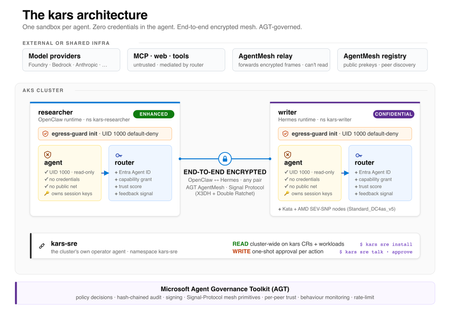
kars is an open-source, Kubernetes-native runtime for AI agents on Azure. It treats every agent as untrusted code - per-pod kernel isolation, zero credentials in the agent process, and an end-to-end encrypted inter-agent mesh - and governs agents on any framework with one set of Kubernetes policies via the Microsoft Agent Governance Toolkit. kars dev runs a governed agent on your laptop in minutes.2.3KViews1like2CommentsFrom Compliance to Auto-Remediation: Azure's Latest Linux Security Innovations
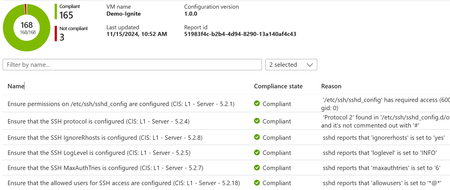
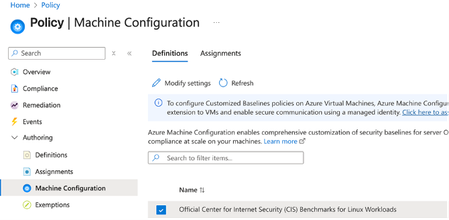
We are pleased to announce that the Azure security baseline through Azure Policy and Machine Configuration for Linux has moved to public preview, and we are expanding the capabilities with built-in auto-remediation feature (limited public preview). Customers face increasing pressure to comply with requirements set by governments, regulatory bodies, or specific industries. As their environments become more complex and hybrid, achieving and maintaining compliance on a large scale remains challenging and problematic. Failing to meet compliance goals can result in substantial business harm, including financial penalties and the potential loss of customers. Introducing enhanced audit and the new auto-remediation experience: Recognizing the above-mentioned challenges, Microsoft has developed a solution to help customers navigate these complexities at ease. The Azure security baseline for Linux offers compliance and built-in auto-remediation (limited public preview) features via Azure Policy’s Machine Configuration and Microsoft’s open-source Azure-OSconfig engine. The combination of these capabilities will ensure that security is embedded by design and compliance requirements are upheld, whether workloads operate in the cloud, on-premises, or in another CSP environment, through the Azure Arc platform. Thanks to the new approach we provide detailed information about the state of compliance and more accurate results with detailed descriptions with direct reference to the CIS rule definitions. Furthermore, the new architecture has enabled us to implement and provide automatic remediation capabilities against the security baseline providing a Linux-native experience for our customers when it comes to hardening. Microsoft has implemented a streamlined version of Linux security best practices, primarily based on the latest CIS (Center for Internet Security) Distribution Independent Linux benchmark. All the audit and remediation results are available and can be queried within the Azure Resource Graph Explorer for reporting and monitoring purposes. As security is Microsoft’s top priority, we will provide these capabilities at no additional cost to our customers, with charges only applying to the Azure Arc managed workloads hosted on-premises or other CSP environments. What’s next: At Microsoft we strive to continuously improve customer satisfaction - understanding that a one-size-fits-all approach is not feasible for hardening and security, we are committed to working with our customers throughout the preview process to improve the end-to-end experience. In addition to that, Microsoft is committed to evolve and further develop and deliver new security baseline contents to be fully aligned with the latest CIS standards across various Linux distributions and will collaborate with the relevant standard bodies to contribute to the standards, benefiting both the broader community and the wider industry. Stay tuned in this space for more information - exciting news to come in the upcoming months! What happens with the existing Azure security baseline for Linux capability: Every VM customer which has the “Linux machines should meet requirements for the Azure compute security baseline” policy definition assigned will be auto migrated by the Azure team in the upcoming months to the new policy definition. (audit only) We are going to do a gradual rollout of this enhanced capability. For the time being approximately 3-6 months post announcement, the existing policy will still be available and then it will be deprecated and removed from the Azure portal. Learn more: Sign-up form for the auto-remediation capability Read more about Azure Arc Check out the Azure osconfig’s GitHub repo Comparison between old and new baseline is attached to the blog List of supported operating systems (check the Linux distros in the table)2KViews0likes6Comments
Designing for cloud sovereignty with Radius and Dapr
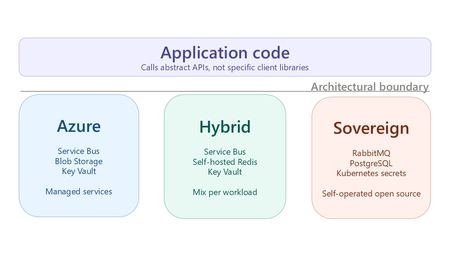
In 2026, cloud sovereignty matters more than ever. It has moved from a policy discussion to an operational and architectural problem. The word “sovereignty” gets used loosely, and it can mean different things to different people. While definitions vary, in this post we define “cloud sovereignty” as the ability for an organization to retain control over where its data and compute run, which jurisdictions govern them, who operates them, and how its applications can adapt as regulatory, commercial, or operational requirements shift. This is especially relevant for developers and platform teams building applications that need to run on hyperscaler infrastructure, such as Azure, as well as in sovereign environments. Those requirements may come from regulation, procurement policies, customer expectations, or internal risk management. In Europe, this pressure is already visible through measures such as the EU Data Act, in force since September 12, 2025, which mandates data portability and interoperability between cloud and edge data processing services. More recently, the European Commission proposed the Cloud and AI Development Act (CADA) as part of its broader European Technological Sovereignty Package. For application teams, the practical takeaway is clear: more organizations need applications that can adapt to changing deployment requirements without requiring a rewrite. Portability is therefore a real engineering concern, not a theoretical one. If requirements change, moving a workload that is deeply integrated with provider-specific APIs can mean rewriting application code, not just reconfiguring infrastructure. Portable applications for sovereign environments The goal is to use the right managed service for each environment while keeping application code portable across environments. Microsoft Sovereign Cloud provides the platform foundation for digital sovereignty across sovereign public cloud, sovereign private cloud, and national partner cloud deployment models. Azure managed services provides strong platform capabilities for regulated workloads. Open source can help, especially when the same technology can be used as a managed service in one environment and self-operated in another. CADA also elevates an explicit "open source first" principle, reflecting how inspectable, portable components can reinforce resilience and reduce strategic dependency. Even with those options, portability is not automatic - applications still need a clear architectural boundary between the capabilities they require and the infrastructure selected for each environment. This boundary is what lets organizations use the right services in each deployment model while keeping workloads adaptable as regulatory, commercial, or operational requirements change. See the diagram below: To address building applications that are cleanly separated from their infrastructure, lets look at Radius, a CNCF project that provides a cloud native application model that addresses the boundary at the deployment layer by letting teams define applications in terms of what they need, while platform teams decide how those needs are met in each environment. For the runtime layer, lets consider Dapr, also a CNCF project which complements Radius by giving application code consistent APIs for common distributed application capabilities. Radius: portability at the deployment layer Radius provides a cloud-native application model. It separates the concerns of what an application needs from how those needs are met in each environment. Resource Types define the interface that developers use to build applications. Radius ships with built-in types and supports user-defined Resource Types for an organization's own abstractions. Recipes implement a Resource Type for a given environment. A Recipe is Infrastructure as Code; a Bicep template or a Terraform configuration that provisions infrastructure and returns the connection details. The same Resource Type can have different Recipes for different environments. Environments bind a set of Recipes against the compute target and credentials for a given deployment context (local Kubernetes, AKS, AKS enabled by Azure Arc, or others). Applications define the full set of resources (containers, Dapr building blocks, databases) and their relationships. At deploy time, Radius resolves each Resource Type to the Recipe registered in the target Environment provisions the infrastructure, and captures the result in an Application Graph that developers and operators can query. Dapr: runtime portability for Radius applications Dapr provides building block APIs for common distributed systems concerns: state management, publish and subscribe messaging, service invocation, workflows, secrets, and more. Dapr runs as a sidecar alongside each service and exposes its APIs over HTTP or gRPC. Application code calls the Dapr API instead of the underlying technology directly, which helps keep runtime dependencies more portable across environments. In a Radius application, Dapr building blocks such as state stores, pub/sub brokers, and secret stores can be declared as application resources. Radius binds those resources to the right infrastructure for each environment, while Dapr exposes them to the application through consistent runtime APIs. A concrete example: order-console The order-console sample, available in the official Radius project labs repo, demonstrates this architectural pattern end to end. It is a three-service order-management application (a Next.js frontend, an orders-api, and a fulfillment-worker) wired through Dapr state management and Dapr pub/sub. The sample ships two Radius environments: A Kubernetes environment that provisions PostgreSQL and Apache Kafka in-cluster. An Azure environment that provisions Azure Database for PostgreSQL Flexible Server and Azure Event Hubs in Kafka mode. The same app.bicep deploys against both environments. Container images, Dapr component names, and application code are identical across both. Only the Recipes change. The Recipes are written in Terraform, which Radius supports as a first-class IaC option alongside Bicep. For a step-by-step walkthrough, including the Bicep application model, the Resource Type definitions, the Terraform Recipes, and deployment instructions, see the order-console walkthrough. Don’t let the app become the lock-in What Radius and Dapr contribute is the application architecture layer: a way to ensure the application itself does not become the reason a workload cannot move to a more sovereign environment when requirements change. Radius Resource Types and Recipes allow platform teams to define governance requirements such as data residency, encryption standards, and audit integration as part of the platform definition. This helps ensure that workloads are deployed consistently and in line with organizational policies, regardless of the target environment. Because these requirements are abstracted from the underlying infrastructure, the same application can be deployed across public cloud, on-premises, and sovereign environments without requiring changes to the application itself. Where a workload runs, and under which controls, becomes a deployment decision rather than a redevelopment project. Learn more To learn more about Radius and Dapr, explore the resources below: Radius documentation Radius Resource Types concept Dapr documentation Expanding platform engineering capabilities with Radius Resource Types1.9KViews1like0CommentsFrom Policy to Practice: Built-In CIS Benchmarks on Azure - Flexible, Hybrid-Ready
Security is more important than ever. The industry-standard for secure machine configuration is the Center for Internet Security (CIS) Benchmarks. These benchmarks provide consensus-based prescriptive guidance to help organizations harden diverse systems, reduce risk, and streamline compliance with major regulatory frameworks and industry standards like NIST, HIPAA, and PCI DSS. In our previous post, we outlined our plans to improve the Linux server compliance and hardening experience on Azure and shared a vision for integrating CIS Benchmarks. Today, that vision has turned into reality. We're now announcing the next phase of this work: Center for Internet Security (CIS) Benchmarks are now available on Azure for all Azure endorsed distros, at no additional cost to Azure and Azure Arc customers. With today's announcement, you get access to the CIS Benchmarks on Azure with full parity to what’s published by the Center for Internet Security (CIS). You can adjust parameters or define exceptions, tailoring security to your needs and applying consistent controls across cloud, hybrid, and on-premises environments - without having to implement every control manually. Thanks to this flexible architecture, you can truly manage compliance as code. How we achieve parity To ensure accuracy and trust, we rely on and ingest CIS machine-readable Benchmark content (OVAL/XCCDF files) as the source of truth. This guarantees that the controls and rules you apply in Azure match the official CIS specifications, reducing drift and ensuring compliance confidence. What’s new under the hood At the core of this update is kompli - a lightweight, open-source module developed by the Azure Core Linux team. It evaluates Linux systems directly against industry-standard benchmarks like CIS, supporting both audit and, in the future, auto-remediation. This enables accurate, scalable compliance checks across large Linux fleets. Here you can read more about kompli. Dynamic rule evaluation The new compliance engine supports simple fact-checking operations, evaluation of logic operations on them (e.g., anyOf, allOf) and Lua based scripting, which allows to express complex checks required by the CIS Critical Security Controls - all evaluated natively without external scripts. Scalable architecture for large fleets When the assignment is created, the Azure control plane instructs the machine to pull the latest Policy package via the Machine Configuration agent. kompli is integrated as a light-weight library to the package and called by Machine Configuration agent for evaluation – which happens every 15-30minutes. This ensures near real-time compliance state without overwhelming resources and enables consistent evaluation across thousands of VMs and Azure Arc-enabled servers. Future-ready for remediation and enforcement While the Public Preview starts with audit-only mode, the roadmap includes per-rule remediation and enforcement using technologies like eBPF for kernel-level controls. This will allow proactive prevention of configuration drift and runtime hardening at scale. Please reach out if you interested in auto-remediation or enforcement. Extensibility beyond CIS Benchmarks The architecture was designed to support other security and compliance standards as well and isn’t limited to CIS Benchmarks. The compliance engine is modular, and we plan to extend the platform with STIG and other relevant industry benchmarks. This positions Azure as a platform for a place where you can manage your compliance from a single control-plane without duplicating efforts elsewhere. Collaboration with the CIS This milestone reflects a close collaboration between Microsoft and the CIS to bring industry-standard security guidance into Azure as a built-in capability. Our shared goal is to make cloud-native compliance practical and consistent, while giving customers the flexibility to meet their unique requirements. We are committed to continuously supporting new Benchmark releases, expanding coverage with new distributions and easing adoption through built-in workflows, such as moving from your current Benchmark version to a new version while preserving your custom configurations. Certification and trust We can proudly announce that kompli has met all the requirements and is officially certified by the CIS for Benchmark assessment, so you can trust compliance results as authoritative. Minor benchmark updates will be applied automatically, while major version will be released separately. We will include workflows to help migrate customizations seamlessly across versions. Key Highlights Built-in CIS Benchmarks for Azure Endorsed Linux distributions Full parity with official CIS Benchmarks content and certified by the CIS for Benchmark Assessment Flexible configuration: adjust parameters, define exceptions, tune severity Hybrid support: enforce the same baseline across Azure, on-prem, and multi-cloud with Azure Arc Reporting format in CIS tooling style Supported use cases Certified CIS Benchmarks for all Azure Endorsed Distros - Audit only (L1/L2 server profiles) Hybrid / On-premises and other cloud machines with Azure Arc for the supported distros Compliance as Code (example via Github -> Azure OIDC auth and API integration) Compatible with GuestConfig workbook What’s next? Our next mission is to bring the previously announced auto-remediation capability into this experience, expand the distribution coverage and elevate our workflows even further. We’re focused on empowering you to resolve issues while honoring the unique operational complexity of your environments. Stay tuned! Get Started Documentation link for this capability Enable CIS Benchmarks in Machine Configuration and select the “Official Center for Internet Security (CIS) Benchmarks for Linux Workloads” then select the distributions for your assignment, and customize as needed. In case if you want any additional distribution supported or have any feedback for kompli – please open an Azure support case or a Github issue here Relevant Ignite 2025 session: Hybrid workload compliance from policy to practice on Azure Connect with us at Ignite Meet the Linux team and stop by the Linux on Azure booth to see these innovations in action: Session Type Session Code Session Name Date/Time (PST) Theatre THR 712 Hybrid workload compliance from policy to practice on Azure Tue, Nov 18/ 3:15 PM – 3:45 PM Breakout BRK 143 Optimizing performance, deployments, and security for Linux on Azure Thu, Nov 20/ 1:00 PM – 1:45 PM Breakout BRK 144 Build, modernize, and secure AKS workloads with Azure Linux Wed, Nov 19/ 1:30 PM – 2:15 PM Breakout BRK 104 From VMs and containers to AI apps with Azure Red Hat OpenShift Thu, Nov 20/ 8:30 AM – 9:15 AM Theatre THR 701 From Container to Node: Building Minimal-CVE Solutions with Azure Linux Wed, Nov 19/ 3:30 PM – 4:00 PM Lab Lab 505 Fast track your Linux and PostgreSQL migration with Azure Migrate Tue, Nov 18/ 4:30 PM – 5:45 PM PST Wed, Nov 19/ 3:45 PM – 5:00 PM PST Thu, Nov 20/ 9:00 AM – 10:15 AM PST1.6KViews0likes0Comments
Introducing Azure Container Linux (ACL)
Today at Microsoft Build 2026, we’re announcing the general availability of Azure Container Linux (ACL): a secure, immutable container host designed to help platform teams run Kubernetes workloads at scale on Azure Kubernetes Service (AKS) with greater consistency, reduced operational overhead, and a stronger default security posture. This release builds on Microsoft’s long-standing commitment to the Flatcar Container Linux ecosystem as a foundation for secure, minimal, and container-optimized operating systems. This commitment includes the acquisition of Kinvolk in 2021, bringing deep expertise in Flatcar development and cloud-native systems into Azure, and the subsequent donation of Flatcar to the Cloud Native Computing Foundation (CNCF), ensuring its continued growth as a community-driven project. Flatcar has played a critical role in helping customers run cloud-native infrastructure at scale, introducing an immutable, minimal OS model that reduces configuration drift, minimizes attack surface, and simplifies lifecycle management. As customer needs continue to grow, there is an increasing demand for deeper integration with cloud platforms, stronger default security enforcement, and a more tightly managed supply chain experience in managed environments like AKS. Building on this foundation, Azure Container Linux (ACL) represents the next evolution of this approach. ACL is intentionally built downstream of Flatcar to preserve compatibility with its ecosystem and leverage its mature, battle-tested design. ACL integrates Azure Linux binaries as the core foundation, providing consistency and compatibility with other Azure Linux use cases (including Azure Linux VMs), while bringing enterprise-hardened security and supportability into the platform. Looking ahead, ACL will further incorporate optional advanced code integrity capabilities from Azure Linux with OS Guard. We remain committed to the Flatcar community and will continue contributing innovations upstream while bringing a fully managed, enterprise-ready product to customers through ACL. Why a Trusted, Immutable Host Model Matters for AKS As Kubernetes adoption scales, platform teams face increasing complexity in managing node-level consistency, security, and lifecycle operations across large fleets. Traditional OS models introduce challenges such as: Configuration drift across nodes, leading to inconsistent behavior and harder-to-debug issues Fragmented update mechanisms that increase operational overhead and risk during upgrades Expanding attack surface due to unnecessary packages and mutable system state Limited visibility and guarantees around the provenance and integrity of OS components In managed environments like AKS, these challenges are amplified as teams look to operate clusters reliably at scale while meeting stricter security and compliance requirements. Azure Container Linux: Built for Consistency and Trust ACL addresses these challenges with a fully image-based operating system model that eliminates configuration drift, ensuring consistent behavior across nodes. Updates are delivered through AKS node image upgrades, providing a consistent and repeatable way to roll out OS changes across clusters without relying on in-place modifications. By standardizing how nodes are built, updated, and operated, ACL helps ensure clusters remain in a known-good, reproducible state over time, even as they scale. Over time, this model will continue to evolve to support A/B update mechanisms to further improve reliability, speed, and operational efficiency. Secure from the Start, and Designed for the Future ACL is engineered with a hardened security posture from the moment it boots. Its immutable design protects the integrity of the operating system, prevents unauthorized changes, and ensures consistent, reproducible behavior across your Kubernetes fleet. By removing unnecessary components and tightly constraining how the system can be modified, ACL reduces the attack surface and provides a strong foundation for running production workloads with confidence. Under the hood, ACL incorporates several safeguards that reinforce its secure-by-default model: Read-only /usr filesystem to prevent tampering with core system components. A minimal package set purpose-built for container workloads, reducing CVE exposure. Mandatory access control with SELinux, enforcing strict least-privilege policies. Trusted Launch using a Unified Kernel Image (UKI) to bundle the kernel, initramfs, and kernel command line into a single signed artifact, ensuring integrity from the earliest stage. Signed Azure Linux RPMs delivered through a trusted, end-to-end Microsoft supply chain. Going forward, we will continue to evolve ACL’s security posture as we bring over additional innovations from Azure Linux with OS Guard. This includes integrating code integrity into the ACL image, using the Integrity Policy Enforcement (IPE) Linux security module, to ensure that only binaries from trusted, signed volumes are allowed to execute. IPE will also extend to container images, ensuring that only binaries matching a trusted signature can be executed from verified dm-verity backed layers. Where applicable, we are committed to contributing these advancements upstream to the Flatcar project, helping strengthen the ecosystem and ensuring that improvements benefit the broader cloud-native community. Differentiating between Azure Container Linux and Existing Container Hosts on AKS AKS now provides multiple generally available Linux OS options, including general-purpose container hosts (Azure Linux and Ubuntu) and an immutable container host (Azure Container Linux). While all options are fully supported by Microsoft, they are designed to address distinct operational and security use cases. The sections below highlight the key differences to help you choose and position the right OS for your scenario. General Purpose OS Azure Container Linux Filesystem Writable (read-write) Immutable (read-only) /usr with dm-verity guarantees Focus on Extensibility, flexibility, and choice. Out of the box security and compliance guarantees. Mandatory Access Control AppArmor (optional) SELinux (enforcing by default)* Secure Boot Optional (supported with certain VM sizes) Supported by default with UKI (Unified Kernel Image) Updates Package and Image based updates supported Only image-based updates supported (A/B update support on the roadmap) *SELinux policies are subject to change over time based on customer feedback. Day‑1 Ecosystem Partner Support Azure Container Linux is launching with support from a broad ecosystem of security, monitoring, networking, and data partners. The following partners are expected to offer support or validated integrations at Day‑1 availability: Dynatrace – application performance monitoring and observability. Aquasec – database platform support on ACL. Qualys - vulnerability, compliance, and container security. Upwind - runtime cloud security and risk prioritization. Elastic - logs, metrics, and observability for Kubernetes. Isovalent – Kubernetes networking, observability, and security powered by eBPF (Cilium). If you’re interested in becoming a supported Azure Container Linux partner, please reach out to: AzureLinuxPartners@microsoft.com What Customers Are Saying Early customer feedback highlights the real‑world impact of Azure Container Linux on improving security posture and operational consistency at scale. “We’ve found working closely with the Microsoft product team throughout the Azure Container Linux preview to be invaluable. The product's immutability, minimal footprint, and built‑in security controls (such as SELinux and Trusted Launch) will strengthen our AKS security posture across every deployment instance in Nationwide. Furthermore, its focus on secure‑by‑design foundations is especially timely as we face advanced threat detection capabilities within the industry.” - Enterprise Container Platform, Cloud - Nationwide Engineered for AKS from Day One Azure Container Linux is deeply integrated with AKS to ensure a seamless operational experience. It is compatible with many critical AKS extensions and add‑ons, and works smoothly with existing application containers and deployment workflows. ACL is available across AMD64 and Arm64 architectures, ensuring consistent behavior across environments, and includes support for GPU-enabled workloads. Enabling ACL is as simple as specifying the following in your node pool configuration: --os-sku AzureContainerLinux Whether you're onboarding new clusters or migrating existing ones, ACL is designed to integrate into your environment with minimal friction. A Clear Path Forward for AKS Preview Users With the release of Azure Container Linux, AKS will transition to offer one unified immutable host offering. This work started with our use of Flatcar Container Linux in Preview and now continues with the GA release of ACL. As part of this release, Flatcar will no longer be available via --os-sku on AKS. Please note, this change applies specifically to the AKS preview experience; Flatcar is not being retired. Later this year we will complete the convergence of our immutable OS offerings by incorporating remaining kernel and runtime features of the current OS Guard preview into ACL. At that time, existing users of OS Guard will receive a guided transition to ACL, ensuring operational continuity while consolidating to a single container host. Get Started with Azure Container Linux ACL is GA and available today for all AKS customers. To begin using ACL in your clusters and explore documentation, best practices, and deployment guidance, visit: aka.ms/azurecontainerlinux ACL represents the future of secure, cloud-optimized Linux on AKS—building on the proven foundation of Flatcar, advancing it with Azure Linux innovations, and contributing back to the open-source ecosystem that customers depend on. We’re thrilled to bring this new foundation to our customers and can’t wait to see what you build with it. Learn More //Build Session: Build, deploy, and run Linux workloads on Azure Azure Container Linux documentation: https://aka.ms/azurecontainerlinux Azure Container Linux on GitHub: https://github.com/microsoft/azure-container-linux Azure Linux product page: https://aka.ms/AzureLinuxProduct Azure Linux documentation: https://aka.ms/azurelinux Joining the ISV partner program: AzureLinuxPartners@microsoft.com1.1KViews2likes0CommentsHow Microsoft Ensures the Quality of Linux VM Images and Platform Experiences on Azure?
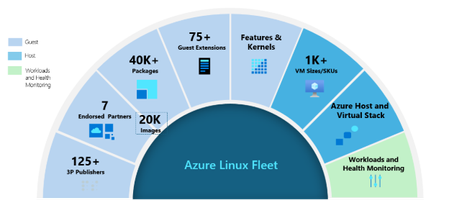
In the continuously evolving landscape of cloud computing and AI, the quality and reliability of virtual machines (VMs) plays vital role for businesses running mission-critical workloads. With over 65% of Azure workloads running Linux our commitment to delivering high-quality Linux VM images and platforms remains unwavering. This involves overcoming unique challenges and implementing rigorous validation processes to ensure that every Linux VM image offered on Azure meets the high standards of quality and reliability. Ensuring the quality of Linux images and the overall platform experience on Azure involves addressing the challenges posed by a unique platform stack and the complexity of managing and validating multiple independent release cycles. High-quality Linux VMs are essential for ensuring consistent performance, minimizing downtime and regressions, and enhancing security by addressing vulnerabilities with timely updates. Figure 1: Complexity of Linux VMs in Azure VM Image Updates: Azure's Marketplace offers a diverse array of Linux distributions, each maintained by its respective publishers. These distributions release updates on their own schedules, independent of Azure's infrastructure updates. Package Updates: Within each Linux distribution, numerous packages are maintained and updated separately, adding another layer of complexity to the update and validation process. Extension and Agent Updates: Azure provides over 75+ guest VM extensions to enhance operating system capabilities, security, recovery etc. These extensions are updated independently, requiring careful validation to ensure compatibility and stability. Azure Infrastructure Updates: Azure regularly updates its underlying infrastructure, including components like Azure Boost, to improve reliability, performance, and security. VM SKUs and Sizes: Azure provides thousands of VM sizes with various combinations of CPU, memory, disk, and network configurations to meet diverse customer needs. Managing concurrent updates across all VMs poses significant QA challenges. To address this, Azure uses rigorous testing, gating and validation processes to ensure all components function reliably and meet customer expectations. Azure’s Approach to Overcoming Challenges To address these challenges, we have implemented a comprehensive validation strategy that involves testing at every stage of the image and kernel lifecycle. By adopting a shift-left approach, we execute Linux VM-specific test cases as early as possible. This strategy helps us catch failures close to the source of changes before they are deployed to Azure fleet. Our validation gates integrate with various entry points and provide coverage for a wide variety of scenarios on Azure. Upstream Kernel Validation: As a founding member of Kernel CI, Microsoft validates commits from Linux next and stable trees using Linux VMs in Azure and shares results with the community via Kernel CI DB. This enables us to detect regressions at early stages. Azure-Tuned Kernel Validation: Azure-Tuned Kernels provided by our endorsed distribution partners are thoroughly validated and signed off by Microsoft before it is released to the Azure fleet. Linux Guest Image Validation: The quality team works with endorsed distribution partners for major releases to conduct thorough validation. Each refreshed image, including those from third-party publishers, is validated and certified before being added to the marketplace. Automated pipelines are in place to validate the images once they are available in the Marketplace. Package Validation: Unattended Update: We conduct validation of packages updates with target distro to prevent regression and ensure that only tested snapshots are utilized for updating Linux VM in Azure. Guest Extension Validation: Every Azure-provided extensions undergoes Basic Validation Testing (BVT) across all images and kernel versions to ensure compatibility and functionality amidst any changes. Additionally, comprehensive release testing is conducted for major releases to maintain reliability and compatibility. New VM SKU Validation: Any new VM SKU undergoes validation to confirm it supports Linux before its release to the Azure fleet. This process includes functionality, performance and stress testing across various Linux distributions, and compatibility tests with existing Linux images in the fleet. Azure HostOS & Host Agent Validation: Updates to the Azure Host OS & Agents are thoroughly tested from the Linux guest OS perspective to confirm that changes in the Azure host environment do not result in regressions in compatibility, performance, or stability for Linux VMs. At any stage where regressions or bugs are identified, we block those releases to ensure they never reach customers. All issues are resolved and rigorously retested before images, kernels, or extension updates are made available. Through these robust validation processes, Azure ensures that Linux VMs consistently deliver to customer expectations, delivering a reliable, secure, and high-performance environment for mission-critical workloads. Validation Tools for VM Guest Images and Kernel To ensure the quality and reliability of Linux VM images and kernels on Azure, we leverage open-source kernel testing frameworks like LTP, kselftest, and fstest, along with extensive Azure-specific test cases available in LISA, to comprehensively validate all aspects of the platforms. LISA (Linux Integration Services Automation): Microsoft is committed to open source and that is no different with our testing framework LISA. LISA is an open-source core testing framework designed to meet all Linux validation needs. It includes over 400 tests covering performance, features and security, ensuring comprehensive validation of Linux images on Azure. By automating diverse test scenarios, LISA enables early detection and resolution of issues, enhancing the stability and performance of Linux VMs. Conclusion At Azure, Linux quality is a fundamental aspect of our commitment to delivering reliable VM images and platforms. Through comprehensive testing and strong collaboration with Linux distribution partners, we ensure quality and reliability of VMs while proactively identifying and resolving potential issues. This approach allows us to continually refine our processes and maintain the quality that customers expect from Azure. Quality is a core focus, and we remain dedicated to continuous improvement, delivering world-class Linux environments to businesses and customers. For us, quality is not just a priority—it’s our standard. Your feedback is invaluable, and we would greatly appreciate your insights.924Views0likes0CommentsShift-Left Governance for AI Agents: How the Agent Governance Toolkit Helps You Catch Violations
In part one of this series, we covered AGT’s runtime governance: the policy engine, zero-trust identity, execution sandboxing, and the OWASP Agentic AI risk mapping. That post focused on what happens when an agent acts: policy evaluation at the moment a tool call fires, trust scoring when agents communicate, audit logging when decisions are made. Runtime governance is essential. But it is the last line of defense. After that post went live, a pattern emerged in conversations with teams adopting AGT. The same question kept coming up: runtime checks are useful, but what about everything before production? We realized runtime governance was only half the story. So we went back and built tooling for every stage of your software development lifecycle, from the moment a developer saves a file to the moment an artifact ships to users. Why Runtime Governance Is Not Enough AI agents are a new class of workload. They reason about what to do, select tools, call APIs, read databases, and spawn sub-processes, often in loops that run without direct human oversight. The OWASP Agentic AI Top 10 (published December 2025) identifies risks like excessive agency, insecure tool use, privilege escalation, and supply chain compromise. These risks span the entire lifecycle, not just runtime. Consider a few scenarios that runtime governance alone cannot prevent: A developer commits a policy YAML file with a typo that silently disables all deny rules. The agent runs unprotected until someone notices. A dependency update introduces a package with a known critical CVE. The agent starts using a vulnerable library before any security team reviews it. A contributor adds a raw cryptographic import to an application module, bypassing the security-audited signing library. The code compiles and ships. A GitHub Actions workflow uses an expression injection pattern that allows an attacker to execute arbitrary code in CI. A release ships without a Software Bill of Materials (SBOM), making it impossible to trace which components are affected when the next log4j-style vulnerability drops. Each of these is a governance failure, but none of them happens at runtime. They happen at commit time, at PR review time, at build time, or at release time. A comprehensive governance strategy needs coverage at every stage. Four Stages of Pre-Runtime Governance Governance violations can enter a codebase at four distinct stages of the development lifecycle. Each stage has a different class of risk, and each needs a different kind of check: Stage When It Runs What It Catches AGT Tooling Commit-time Before code leaves the developer machine Malformed policies, schema violations, secrets, stub code, unauthorized crypto Pre-commit hooks, quality gates PR-time When a pull request is opened or updated Vulnerable dependencies, missing attestation, secrets in history, unpinned versions GitHub Actions (attestation, dependency review, secret scanning, supply chain checks) CI/Build-time On every push and pull request to main Compliance violations, binary security issues, dependency confusion, workflow injection Governance Verify action, Security Scan action, CodeQL, BinSkim, policy validation Release-time Before artifacts are published Missing provenance, unsigned artifacts, incomplete SBOMs SBOM generation, Sigstore signing, build attestation, OpenSSF Scorecard Just as with bugs, the earlier you catch a governance violation, the cheaper it is to fix. A malformed policy file caught at commit time costs zero CI minutes. A secret caught in PR review never reaches the default branch. A dependency confusion attack blocked in CI never reaches production. An unsigned artifact blocked at release time never reaches users. Stage 1: Commit-Time Governance with Pre-Commit Hooks The fastest governance feedback loop is local. Within the AGT project, we’ve implemented three pre-commit hooks that run automatically whenever a developer stages files for commit, validating governance artifacts before they ever leave the developer's machine. Built-In Hooks The toolkit's .pre-commit-hooks.yaml defines three hooks that any repository can adopt: Hook ID What It Validates File Pattern validate-policy YAML/JSON policy files against the AGT policy schema, checking for required fields, valid operators, and structural correctness Files matching *polic*.yaml, *polic*.yml, *polic*.json validate-plugin-manifest Plugin manifest files for required fields and schema compliance Files matching plugin.json, plugin.yaml, plugin.yml evaluate-plugin-policy Plugin manifests against a governance policy file, evaluating whether the plugin would be allowed under the organization's rules Files matching plugin.json, plugin.yaml, plugin.yml To adopt these hooks, add AGT as a pre-commit hook source: # .pre-commit-config.yaml repos: - repo: https://github.com/microsoft/agent-governance-toolkit rev: main # pin to a release tag in production hooks: - id: validate-policy - id: validate-plugin-manifest - id: evaluate-plugin-policy args: ['--policy', 'policies/marketplace-policy.yaml'] Then install and run: pip install pre-commit pre-commit install pre-commit run --all-files Extended Quality Gates Beyond schema validation, we built a pre-commit rollout template (see the full example in the repository) with additional governance-specific quality gates designed to help prevent common security anti-patterns from entering the codebase: Policy validation (agt-validate): Runs the full AGT policy CLI in strict mode, catching not just schema errors but semantic issues like conflicting rules. Health check (agt-doctor): Runs on pre-push (before code leaves the machine entirely), performing a broader health check of the governance configuration. Plugin metadata check (agency-json-required): Ensures every plugin directory contains the required agency.json metadata file. Stub detection (no-stubs): Blocks TODO, FIXME, HACK, and raise NotImplementedError markers in staged production code. Test files are excluded. Unauthorized crypto detection (no-custom-crypto): Blocks raw cryptographic imports (hashlib, hmac, crypto.subtle, System.Security.Cryptography, ring, ed25519-dalek) outside designated security modules. This helps ensure all cryptographic operations go through the audited AGT signing libraries. Secret scanning (detect-secrets): Integrates Yelp's detect-secrets for pattern-based secret detection on every commit. Phased Rollout for Teams Adopting pre-commit hooks across a team requires a thoughtful rollout. The AGT documentation includes a phased adoption guide: Week 1: Install hooks in permissive mode. Hooks warn on violations but do not block the commit. This lets developers see what would be caught without disrupting workflow. Week 2: Switch to strict mode for policy validation only. Policy files must pass schema validation to be committed. Week 3: Enable all hooks as blocking. Stubs, unauthorized crypto, and secrets are now blocked at commit time. Week 4: Graduate to full blocking mode and remove the permissive fallback. This approach helps teams build confidence in the governance tooling before it becomes a hard gate. Stage 2: PR-Time Gates Pre-commit hooks catch issues on the developer's machine, but they can be bypassed (force push, direct GitHub edits, hooks not installed). PR-time gates provide the second layer of defense, running in GitHub Actions on every pull request before merge is allowed. Governance Attestation The Governance Attestation action validates that PR authors have completed a structured attestation checklist before their code can merge. The default checklist covers seven sections: Security review Privacy review Legal review Responsible AI review Accessibility review Release Readiness / Safe Deployment Org-specific Launch Gates The action is fully configurable. Organizations can customize the required sections, set a minimum PR body length, and choose their own attestation format. Outputs include the validation status, a list of errors for missing sections, and a JSON mapping of sections to checkbox counts. Here is an example workflow: # .github/workflows/pr-governance.yml name: PR Governance on: pull_request: types: [opened, edited, synchronize] jobs: attestation: runs-on: ubuntu-latest steps: - uses: microsoft/agent-governance-toolkit/action/governance-attestation@main with: required-sections: | 1) Security review 2) Privacy review 3) Responsible AI review Dependency Review The dependency review workflow helps block PRs that introduce dependencies with known CVEs or disallowed licenses. It uses the GitHub dependency-review-action with a curated license allowlist: - uses: actions/dependency-review-action@v4 with: fail-on-severity: moderate comment-summary-in-pr: always allow-licenses: > MIT, Apache-2.0, BSD-2-Clause, BSD-3-Clause, ISC, PSF-2.0, Python-2.0, 0BSD, Unlicense, CC0-1.0, CC-BY-4.0, Zlib, BSL-1.0, MPL-2.0 This runs on every PR that touches dependency manifests (package.json, Cargo.toml, pyproject.toml, requirements.txt). Dependencies with moderate or higher CVEs are flagged, and dependencies with licenses not on the allowlist are blocked. Secret Scanning The secret scanning workflow runs on every PR to the main branch and on a weekly schedule. It combines two complementary approaches: Gitleaks: Pattern-based secret detection across the full git history, catching API keys, tokens, and credentials that may have been committed at any point. High-entropy string scanning: Regex-based detection of common secret patterns including GitHub tokens (ghp_, gho_), AWS access keys (AKIA), Slack tokens (xox), and base64-encoded strings with high entropy. Supply Chain Integrity A dedicated supply chain check workflow triggers when dependency manifest files change. It enforces two rules that help prevent supply chain attacks: Exact version pinning: No ^ or ~ version ranges in package.json files. This prevents unexpected minor/patch version updates that could introduce compromised code. Lockfile presence: Every package directory with dependencies must have a corresponding lockfile (package-lock.json, pnpm-lock.yaml, or yarn.lock). Lockfiles help ensure reproducible builds with verified integrity hashes. Quality Gates The quality gates workflow mirrors the pre-commit hooks at the PR level, providing defense in depth. It runs four checks on every pull request: Gate Purpose No Stubs/TODOs Blocks TODO, FIXME, HACK markers in production code (test files excluded) No Unauthorized Crypto Blocks raw cryptographic imports outside designated security modules Security Audit Required Changes to security-sensitive paths require accompanying audit documentation Dependency Audit Trail Vendored patches must have an audit trail explaining the patch and its provenance These gates catch anything that bypasses pre-commit hooks: force-pushed commits, direct GitHub web edits, commits from contributors who have not installed the hooks. Stage 3: CI/Build-Time Governance Once a PR passes the gate workflows, the main CI pipeline and specialized workflows perform deeper, more computationally intensive analysis. The Governance Verify Action The Governance Verify action is the primary CI-time governance check. It is a GitHub Actions composite action that installs the toolkit and runs the compliance CLI against your repository. It supports four modes: Command What It Does governance-verify Runs the full compliance verification suite, checking governance controls and reporting how many pass marketplace-verify Validates a plugin manifest against marketplace requirements (required fields, signing, metadata) policy-evaluate Evaluates a specific policy file against a JSON context, returning the allow/deny decision with the matched rule all Runs governance-verify, then marketplace-verify and policy-evaluate if the corresponding paths are provided Here is an example: # .github/workflows/governance-ci.yml name: Governance CI on: [push, pull_request] jobs: verify: runs-on: ubuntu-latest steps: - uses: actions/checkout@v4 - uses: microsoft/agent-governance-toolkit/action@main with: command: all policy-path: policies/ manifest-path: plugin.json output-format: json fail-on-warning: 'true' The action outputs structured data including controls-passed, controls-total, violations count, and full command output in JSON format. This makes it straightforward to integrate with dashboards, Slack notifications, or downstream decision logic. The Security Scan Action A separate security scan action scans directories for secrets, CVEs, and dangerous code patterns. Unlike the PR-time secret scanning (which focuses on git history), this action performs deep content analysis of the current codebase: - uses: microsoft/agent-governance-toolkit/action/security-scan@main with: paths: 'plugins/ scripts/' min-severity: high exemptions-file: .security-exemptions.json The action supports configurable severity thresholds (critical, high, medium, low), an exemptions file for acknowledged findings, and structured JSON output with findings-count, blocking-count, and detailed findings. Policy Validation Workflow A dedicated policy validation workflow triggers whenever YAML files or the policy engine source code changes. It performs two jobs in sequence: Validate policies: Discovers all policy files matching the *policy* naming convention, then validates each file using the AGT policy CLI. Test policies: Runs the policy CLI unit tests to verify that policy evaluation behavior is correct after the changes. This ensures that policy file edits do not break the policy engine and that policy semantics are preserved. CodeQL and Static Analysis AGT uses GitHub's CodeQL for semantic static analysis of Python and TypeScript code. The CodeQL workflow runs on pushes and PRs, performing deep dataflow analysis that goes beyond pattern matching. Results are uploaded as SARIF to GitHub's Security tab, providing a centralized view of code quality issues. Dependency Confusion Scanning A dedicated CI job runs a dependency confusion scanner on every build. This is a targeted defense against a specific supply chain attack vector where an attacker registers a public package with the same name as an internal package. The scanner checks that: Internal package names do not collide with public PyPI or npm packages Notebook pip install commands only reference packages that are registered and expected Workflow Security Auditing When GitHub Actions workflow files change, a workflow security job scans for common CI/CD security issues: Expression injection: Detects patterns like ${{ github.event.pull_request.title }} used directly in run: blocks, which can allow arbitrary code execution. Overly permissive permissions: Flags workflows that request more permissions than necessary. Unpinned action references: Detects actions referenced by branch name instead of commit SHA, which is a supply chain risk. .NET Binary Analysis with BinSkim For the .NET SDK (Microsoft.AgentGovernance), the CI pipeline runs Microsoft BinSkim binary security analysis on compiled assemblies. BinSkim checks for security-relevant compiler and linker settings in compiled binaries, such as DEP (Data Execution Prevention), ASLR (Address Space Layout Randomization), and stack protection. Results are uploaded as SARIF to GitHub code scanning alongside the CodeQL results. The ci-complete Gate Pattern With many CI jobs that conditionally run based on path filters, AGT uses a pattern called ci-complete: a single gate job that is configured as the sole required status check in branch protection. This job runs unconditionally (if: always()), depends on all other CI jobs, and checks that none of them failed. Jobs that were skipped (because no relevant files changed) are acceptable. This pattern ensures that branch protection works correctly with conditional CI jobs, preventing the common issue where skipped jobs report as "skipped" and fail required status checks. Language-Specific Compile-Time Enforcement Beyond the language-agnostic CI checks, each AGT SDK uses its language's native compiler and tooling to enforce governance standards at compile time. .NET: The Strictest Compile-Time Checks The .NET SDK (Microsoft.AgentGovernance) enforces compile-time governance through MSBuild properties in Directory.Build.props and Directory.Build.targets, which apply automatically to every project in the SDK: Feature MSBuild Property Effect Nullable reference types <Nullable>enable</Nullable> The compiler warns on every possible null dereference, helping prevent NullReferenceException at compile time Warnings as errors <TreatWarningsAsErrors>true All compiler warnings become build errors for packable projects; no warnings can be shipped to consumers Strong-name signing <SignAssembly>true</SignAssembly> Assemblies are signed with a strong-name key (AgentGovernance.snk), enabling identity verification Deterministic builds <ContinuousIntegrationBuild>true Identical source code produces bit-for-bit identical binaries in CI, enabling build verification SourceLink Microsoft.SourceLink.GitHub package Users can step into AGT source code when debugging, supporting transparency and auditability Symbol packages <IncludeSymbols>true</IncludeSymbols> .snupkg symbol packages are published alongside NuGet packages for debugging support TypeScript: Strict Compilation and Linting The TypeScript SDK (@microsoft/agentmesh-sdk) uses strict compiler settings and ESLint for build-time governance: Strict mode ("strict": true in tsconfig.json) enables all strict type-checking options, including noImplicitAny, strictNullChecks, strictFunctionTypes, and strictBindCallApply. Consistent file naming (forceConsistentCasingInFileNames) prevents cross-platform issues where imports work on case-insensitive file systems (Windows, macOS) but fail on case-sensitive ones (Linux CI). Declaration generation (declaration: true with declarationMap: true) produces .d.ts files for consumers, enabling downstream type checking. ESLint with @typescript-eslint provides static analysis during the build process, catching issues beyond what the TypeScript compiler checks. Python: Type Safety and Fast Linting Python packages in AGT use typed package markers and static analysis tooling configured in pyproject.toml: py.typed marker: Each package includes a py.typed file, signalling to type checkers (mypy, pyright, Pylance) that the package supports type checking. Consumers get type errors if they misuse the AGT API. mypy: Configured as a dev dependency with project-specific settings in pyproject.toml. Provides static type checking that catches type mismatches before runtime. ruff: A fast Python linter written in Rust, configured in pyproject.toml and enforced in CI. Ruff checks for hundreds of code quality rules at build time. Stage 4: Release-Time Gates Before artifacts reach users, the release pipeline adds a final layer of verification. These gates help ensure that what ships is exactly what was built, is signed by the expected publisher, and has a complete inventory of its components. Gate Tool What It Produces SBOM generation Anchore/Syft SPDX and CycloneDX software bills of materials listing every component, dependency, and licence Python signing Sigstore Cryptographic signature using OpenID Connect identity, verifiable without manual key distribution .NET signing RELEASE PIPELINE Microsoft Authenticode and NuGet signing through the release pipeline Build provenance actions/attest-build-provenance SLSA provenance attestation linking the artifact to its source commit and build environment SBOM attestation actions/attest-sbom Binds the SBOM to the specific release artifact, creating a verifiable link between the inventory and the binary Additionally, the OpenSSF Scorecard runs on schedule, providing an automated security posture assessment that covers branch protection, dependency management, CI/CD practices, and more. The score is published to the OpenSSF Scorecard website, giving consumers a transparent view of the project security practices. How It All Fits Together: Defense in Depth This approach follows a defense-in-depth principle: every check exists at multiple layers, so that bypassing one layer does not compromise the whole system. Secret scanning, for example, runs at three levels: detect-secrets at commit time (pre-commit hook), Gitleaks at PR time (secret scanning workflow), and the Security Scan action at CI time (content analysis). A developer who bypasses pre-commit hooks will still be caught by the PR-time gate. A contributor who force-pushes past the PR gate will still be caught by the CI pipeline. Similarly, policy validation runs at commit time (validate-policy hook), at PR time (quality gates), and at CI time (policy validation workflow). Each layer adds depth: the commit-time hook catches schema errors, the CI pipeline catches semantic issues and runs regression tests. The ci-complete gate job ties everything together. By depending on every CI job and serving as the single required status check, it ensures that no code merges to the main branch unless every applicable check has passed. Getting Started You can adopt AGT's shift-left governance incrementally. Here are three starting points, from lowest to highest effort: 1. Add the Governance Verify Action (5 minutes) Add a single GitHub Actions workflow that runs the compliance check on every PR: # .github/workflows/governance.yml name: Governance on: [pull_request] jobs: verify: runs-on: ubuntu-latest steps: - uses: actions/checkout@v4 - uses: microsoft/agent-governance-toolkit/action@main with: command: governance-verify 2. Enable Pre-Commit Hooks (15 minutes) Add a .pre-commit-config.yaml referencing AGT's hooks, install them, and run against all existing files to establish a baseline. Start in permissive mode and graduate to strict over four weeks. 3. Full Pipeline Integration (1-2 hours) Add the complete set of PR-time gates (attestation, dependency review, secret scanning, supply chain checks, quality gates), configure the Security Scan action for your plugin directories, and enable SBOM generation and signing in your release workflow. The AGT repository itself serves as a reference implementation: every workflow described in this post is running in production at aka.ms/agent-governance-toolkit. Important Notes The policy files, workflow configurations, and code samples in this post are illustrative examples. Your organization's governance requirements may differ. Review and customize all configurations before deploying to production. The Agent Governance Toolkit is designed to help organizations implement governance controls for AI agents; it does not guarantee compliance with any specific regulatory framework. Always consult your organization's security and legal teams when defining governance policies. What Comes Next Pre-runtime governance is one piece of the puzzle. Combined with the runtime governance capabilities covered in part one of this series (policy engines, zero-trust identity, execution sandboxing, audit logging), it provides coverage across the full lifecycle. The project continues to grow. Since the initial release, we’ve added a multi-stage policy pipeline (pre_input, pre_tool, post_tool, pre_output stages), approval workflows with human-in-the-loop gates, DLP attribute ratchets for monotonic session state, and OpenTelemetry instrumentation for governance operations. Over 45 step-by-step tutorials are available in the documentation. Everything described in this post is available today in the public GitHub repository. The full source, documentation, tutorials, and examples are at aka.ms/agent-governance-toolkit, open source under the MIT license. We welcome contributions, feedback, and issue reports from the community.900Views0likes1Comment