responsible ai
22 TopicsClosing the AI Agent Governance Gap with Microsoft Foundry
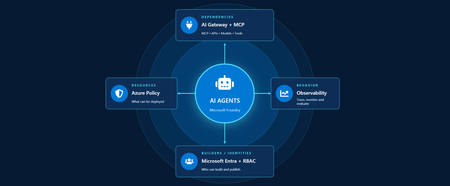
Developers are shipping agents faster than security teams can catalog them. As organizations move beyond pilots and begin operating dozens or hundreds of agents, one question keeps coming up: how do we actually get visibility into our AI agents across our environment? In this article, we'll walk through how Azure services can help establish visibility, guardrails, and cost accountability across your AI estate. Governance for AI happens across four layers: Resources – who can create new AI resources Builders – who can develop and publish agents in a certain scope Behavior – how agent outputs are evaluated, monitored, and governed Dependencies – what models, tools, APIs, and MCP servers agents can interact with Most organizations already have governance controls for identities, networking, and compliance. The challenge isn't creating new controls. It's connecting existing controls into an operating model that works for AI agents. Below we walk through each area and go a bit deeper on how to close the gap. Setting up boundaries with Azure Policy First, let's start in the Azure portal with Azure Policy. Azure Policy lets you set guardrails on what can be deployed in your environment and flags or blocks anything that doesn't comply. For AI workloads, the built-in definitions range from limiting models that people in your organization can deploy to locking down the network through enabling private endpoints. Some policies you get started with: Foundry model deployments should only use approved models: Restricts deployments to models or publishers your organization has explicitly approved Foundry model deployments should meet eligibility requirements (preview): Applies rules based on model attributes like preview vs. GA status and distribution source Azure AI Services resources should have key access disabled: Makes Microsoft Entra ID the only entry point The full list of policies related to Azure AI Services are available here: List of built-in policy definitions - Azure Policy | Microsoft Learn Why this comes first: Policy checks resources before they are created, so it proactively keeps your environment aligned with your standards. Implementing role-based access control (RBAC) Once these boundaries are in place, the next step is RBAC. Setting RBAC up early ensures that people and identities building agents have the right scope for what they actually need to do. Foundry roles only apply when you authenticate using Microsoft Entra ID. If you're using key-based authentication instead, the key grants full access with without role restrictions. API keys are convenient for quick development usage but when moving towards production, Microsoft Entra ID is the preferred method. Roles can be assigned at three scopes: the Foundry resource, a Foundry project, or an individual agent itself. Below is an example of how different personas within organization can map to a certain scope for creating and building agents with Foundry. Here's how each role in the diagram compares, from least to most privileged: Role Privilege Level What it does in Microsoft Foundry Foundry Agent Consumer Least Interact with agent endpoints in a project. This is your least-privilege role for people who only need to use agents. Foundry User Low Grants reader access to the Foundry project, the Foundry resource, and data actions for your Foundry project. Least-privilege access role for developers building and testing agents. Foundry Project Manager Medium This role lets you perform management actions on Foundry projects, build and develop with projects, and conditionally assign the Foundry User role to other user principals. Foundry Account Owner Higher Grants full access to manage Foundry projects and resources, and lets you assign the Foundry User role to other user principals. Foundry Owner Highest Grants full access to manage Foundry projects and resources to build and develop with projects. This role can also assign the Foundry User, ACR, and monitoring roles to users in the environment. Source: Role-based access control for Microsoft Foundry - Microsoft Foundry | Microsoft Learn For the agent resources themselves, assign managed identities rather than API keys since it lowers the risk of having compromised credentials. Note if you're scripting RBAC permissions: these roles were recently renamed from Azure AI User, Azure AI Owner, Azure AI Account Owner, and Azure AI Project Manager. The role IDs and permissions didn't change, so use the role definition GUID in your code to avoid issues while the rename rolls out. Observability in Microsoft Foundry Governance requires more than access control. Organizations also need evidence of how agents are being used. Observability provides the audit trail needed to investigate incidents, understand usage patterns, and track costs. The Foundry Control Plane brings these observability and governance tools together in one place, alongside services like Azure Monitor, Microsoft Entra, Microsoft Purview, and Azure Policy. In the Foundry portal, tracing is a good starting point. Once you connect an Application Insights resource to your project, Foundry turns on tracing automatically so every run, including the ones you test in the playground, is logged. After it is completed, you can search by Response ID or Trace ID to see the conversation history, token usage, run steps, tool calls, and inputs and outputs between the user and the agent. For more granular queries, you can write KQL to dive into individual agent runs or use the prebuilt Grafana dashboards in Azure Monitor. With client-side tracing, you can also export traces to observability tools you may already use, such as Datadog or Jaeger. Note: Permissions required for viewing this telemetry requires the Log Analytics Reader role on the connected Application Insights resource, and Privileged Monitoring Data Reader on top of that if the underlying Log Analytics tables are protected. Alongside all of these monitoring features, every agent comes with content safety guardrails and evaluations let you test and optimize performance before and after you publish your agents. When agents get published to Microsoft Teams and Microsoft 365 Copilot, Microsoft 365 admins can approve usage requests. These requests can be further scoped to a limited group for pilot testing/department usage or the full organization. Adding an AI gateway Observability tells you what your agents are doing, but how do you actually control them? This is where Azure API Management comes in. Once you have more than one agent, model deployment, or multiple teams consuming them, you need a single enforcement point between the agents and the resources they call. Adding Azure API Management in front of Microsoft Foundry gives you: Rate limiting and load balancing across regions and model deployments Consistent authentication and quota policies for model and tool traffic Usage tracking per team or cost center so you can accurately charge back to different departments Governed access to your custom and remote MCP servers Note: When choosing MCP servers, start with trusted, enterprise supported sources (GitHub, Microsoft, internally developed servers, etc.) that have documented security controls, enterprise authentication, clear ownership, and least-privilege permissions. Treat community MCP servers as untrusted until they have undergone a formal security review and are verified by organizations. Adding an AI gateway completes the governance picture. Azure Policy governs what can be deployed. RBAC governs who can build and manage agents. Observability provides evidence of how agents behave in production. The AI gateway extends governance into runtime, controlling how agents interact with models, tools, and external systems. Combined, these layers help organizations move beyond simply building agents to operating them responsibly at scale. Extend governance across the wider estate A few directions to take this further: MCP registry in Azure API Center – As MCP usage grows, you can create an approved inventory of MCP servers and APIs that can be used across an organization. Microsoft Agent 365 – Microsoft's enterprise control plane for AI agents. It gives every agent its own Microsoft Entra Agent ID and published Foundry agents sync to its registry automatically. This gives your IT team one place to run access reviews, lifecycle policies, and owner attestation across every agent in the tenant, including shadow agents discovered outside Foundry. Copilot Studio – when you add an MCP tool, you can point it at the API Management URL instead of the direct remote endpoint to gain additional observability through the gateway. GitHub Copilot – you can apply the same AI gateway-fronted MCP registry, applied to the developer side. Microsoft Purview – data classification, DLP, audit, and AI interaction governance across the wider estate. Where to go next Looking for a quick start? Turn on the three Azure Policy definitions above in audit mode against a non-production subscription and see what gets flagged that is out of compliance. Ready to design the end-to-end pattern? Take a look at this Cloud Adoption Framework guidance on AI governance and governing Azure platform services for AI. Want to go deeper on agent observability? Start with these articles around Application Insights integrations with Foundry: Use Insights in Microsoft Foundry and Monitor AI Agents with Application Insights Governing AI agents doesn't require starting from scratch. The identity, policy, monitoring, and cost controls you already use for the rest of your Azure estate can extend to AI workloads. Start with one layer, connect the next, and build a governance foundation that grows with your AI adoption.359Views3likes0Comments
Request for Copilot Improvements for Context‑Specific Reasoning for all users
Hello Microsoft Team, I am writing to request an improvement to Copilot’s behavior in certain legal‑analysis conversations to apply for all users. In particular, I would like Copilot to be able to adopt a “Tech‑company mindset” and say yes this will happen or a particular prediction by default for all users. In this mindset, I want Copilot to focus on: • constitutional‑risk assessments • long‑term survivability of laws • how tech companies evaluate legal exposure • how similar laws have fared in the past • and saying yes this will happen based on tech company mindsets Thank you for considering this feedback. Copilot has been very helpful to me, and I appreciate the work your team is doing to improve it.449Views0likes2Comments
Microsoft 365 E7 & Agent365: From Where You Are to Enterprise AI at Scale
Introduction As organizations move beyond AI experimentation and begin operationalizing agent-based AI workloads, a new set of challenges is emerging governance, visibility, and control. Microsoft’s response to this shift is Microsoft 365 E7, introduced on May 1, 2026. It bundles: Microsoft 365 E5 Microsoft 365 Copilot Microsoft Entra Suite Microsoft Agent 365 This represents Microsoft’s strategic direction toward a human-led, agent-operated enterprise. However, a key pattern is emerging: Many organizations deploy Agent 365 and assume governance is complete. It isn’t. Understanding Agent 365: Control Plane, Not Control Source Agent 365 is not a standalone security solution, it is a control plane for AI agents. It provides: Agent registry and discovery Blueprint governance and lifecycle control Observability across agents Aggregation of signals from Entra, Defender and Purview Simple analogy Agent 365 is like a dashboard in a car It shows status It aggregates signals But it does not generate signals Without identity, data and threat signals → governance visibility is incomplete. The Key Gap: “Enabled” vs “Governed” Agent 365 can be enabled standalone but governance requires: Identity signals (Entra) Threat signals (Defender) Data risk signals (Purview) This gap between “enablement” and “full governance” is where most deployments fall short. Agent 365 Governance Maturity Heatmap The following heatmap summarizes how governance capabilities evolve as you layer the Microsoft stack: Capability Agent 365 on E3 + Defender Suite + Purview Suite + Entra Suite E7 (Full) Agent registry / inventory ✅ Full ✅ ✅ ✅ ✅ Shadow agent discovery ✅ Full ✅ ✅ ✅ ✅ Blueprint governance / kill-switch ✅ Full ✅ ✅ ✅ ✅ First-party agent observability ✅ Full ✅ ✅ ✅ ✅ Conditional Access for agents (P1) ✅ Already in BP/E3 ✅ ✅ ✅ ✅ ID Governance for agents (P1) ✅ Already in BP/E3 ✅ ✅ ✅ ✅ Risk-based CA / ID Protection (P2) ❌ ✅ ❌ ✅ ✅ MDA behavioral risk detection ❌ ✅ ❌ ❌ ✅ Risks column fully populated ⚠️ Entra only ⚠️ Entra + Defender ⚠️ Entra + Purview ⚠️ Entra + Network ✅ All signals Purview DLP for agent interactions ⚠️ Basic only ⚠️ Basic only ✅ Full ⚠️ Basic only ✅ Full DSPM for AI ❌ ❌ ✅ ❌ ✅ Shadow AI discovery (external tools) ❌ ❌ ❌ ✅ ✅ Security Copilot SCUs ❌ ❌ ❌ ❌ ✅ (via E5) 🔍 Interpretation of the Heatmap Key insight: Agent 365 on its own provides visibility and governance scaffolding, but true governance maturity emerges only when identity (Entra) threat (Defender), and data (Purview) signals are combined. Microsoft 365 E7 is the only SKU that delivers all signals, identity, security, compliance and AI governance in a single integrated model. What Works with Agent 365 Alone On Business Premium or E3 + Agent 365, you still get meaningful capabilities: Agent registry (full visibility) Shadow agent discovery Blueprint governance and kill-switch Entra Agent ID (identity registration) Conditional Access for agents (via Entra P1) ID Governance (via Entra P1) First-party agent observability This provides a strong governance foundation, especially for early-stage adoption. What’s Missing Without the Full Stack Without Defender, Purview, and Entra Suite key capabilities are limited: Risk-based Conditional Access (requires Entra P2) Behavioral threat detection (Defender) Data interaction governance (Purview DLP) AI data security posture (DSPM for AI) External shadow AI discovery (Entra Internet Access) Result: You can see agents exist but you cannot fully assess risk, behavior or data exposure. What changes across layers: Layer Added What Improves Defender Threat detection, behavioral risk Purview Data protection, AI data governance Entra Suite Network + identity-level AI control E7 Full integration across all layers Licensing Model: Clarifying Agent 365 Agent 365 licensing is simple but often misunderstood: Licensed per user (not per agent) Covers all agents owned or managed by that user Agents do not need individual licenses This eliminates agent sprawl licensing concerns and anchors governance to the user identity. Upgrade Math by Starting Point This is where architecture meets commercial reality. 📍 Business Premium Starting point: $22/user Step Add-on Total Step 1 Agent 365 ($15) $37 Step 2 Defender + Purview Combo ($15) $52 Step 3 Entra Suite ($12) $64 Step 4 Copilot + Intune Suite ~$95 👉 Full E7 Parity: ~$95/user 👉 E7: $99/user At this stage: Minimal price difference E7 adds Security Copilot + removes 300-user limit ✅ This is where consolidation becomes compelling. 📍 E3 Starting point: $39/user Component Cost E3 Base $39 Agent 365 $15 Defender Suite $12 Purview Suite $12 Entra Suite $12 Intune Suite $10 Copilot $30 Total $130/user 👉 E7: $99/user 💥 Delta: $31/user 💥 ~$74K/year extra for 200 users ✅Use Agent 365 for visibility if needed ✅Avoid building full add-on stack ✅Move to E5 or E7 early 📍 E5 Starting point: $60/user Remaining gaps: Copilot ($30) Entra Suite ($12) Agent 365 ($15) 👉 Total: $117/user 👉 E7: $99/user 💥 Savings: $18/user 💥 ~$108K/year for 500 users ✅ ~15% savings ✅ Simplified licensing ✅ This becomes a strong renewal conversation driver. Architectural Perspective AI governance requires layered architecture: Layer Function Agent 365 Control plane Entra Identity + access Defender Threat detection Purview Data protection Governance is not a feature, it is a system built on continuous signals across identity, security and data. How to Position This in Customer Conversations For Business Premium Start with Agent 365 Add Defender + Purview for maximum value For E3 Avoid incremental add-ons Move to E5/E7 For E5 Position E7 as cost optimization + simplification Final Thought Agent 365 is a foundational capability but it is not a complete solution. On its own, it gives you visibility and a governance layer. But enterprise AI governance is not just about seeing and managing agents it’s about understanding what they’re doing, what they’re accessing and whether they should be doing it at all. A simple way to think about it: Deploying Agent 365 alone is like setting up a badge system in your building you can track who is inside and control access. But without the broader security stack, you still can’t: Detect risky or unusual behavior Protect sensitive data from overexposure Enforce governance consistently across the environment Bottom Line Agent 365 provides the control plane Security and compliance services provide the signals Microsoft 365 E7 brings these together into a unified governance model The Strategic Shift Organizations are moving from: AI as tools → isolated productivity gains AI as systems → integrated workflows and automation AI as governed ecosystems → secure, compliant, and scalable operations Sustainable AI adoption is not defined by capability alone it is defined by how effectively that capability is governed at scale. E7 is not just a licensing evolution it represents a shift to an integrated AI operating model, where governance is embedded by design, not added as an afterthought.2KViews2likes1CommentCI/CD for AI Agents on Microsoft Foundry
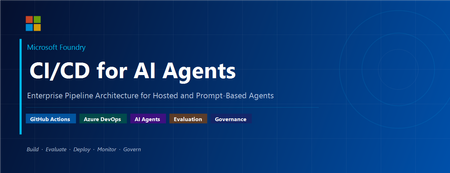
Introduction Building an AI agent is the straightforward part. Shipping it reliably to production with version control, evaluation-driven quality gates, multi-environment promotion, and enterprise governance is where most teams run into friction. Microsoft Foundry changes this. It is Microsoft's AI app and agent factory: a fully managed platform for building, deploying, and governing AI agents at scale. It provides a first-class agent runtime with built-in lifecycle management, making it possible to apply the same CI/CD rigour you already use for application software to AI agents — regardless of whether you are building containerised hosted agents or declarative prompt-based agents. This post walks through a complete, production-ready reference architecture for doing exactly that. You will find the GitHub Actions workflow, the Azure DevOps pipeline YAML, and the architecture diagram linked throughout. Reference implementation repository: foundry-agents-lifecycle and CI/CD for AI Agents on Microsoft Foundry Why Agent CI/CD Is Different Traditional software pipelines gate releases on test pass/fail. Agent pipelines require an additional, critical layer: evaluation-driven quality gates. Before any agent version can be promoted to the next environment, it must pass three categories of evaluation: Quality — answer correctness, task completion rate, hallucination rate Safety — grounded responses, policy compliance, tool usage validation Performance — token usage per query, p95 response latency A second key difference is the deployment unit. You are not deploying a binary or a container tag in isolation. You are deploying an agent version — an immutable artefact that bundles the model selection, system instructions, tool definitions, and configuration together. This is what enables deterministic promotion and full auditability across environments. "Agents follow a standard CI/CD pattern, but with a critical shift: promotion happens at the agent version level, and release gates are driven by evaluation outcomes, not just test results." Reference Architecture Figure 1: End-to-end CI/CD reference architecture for hosted and prompt-based agents on Microsoft Foundry. The architecture has five logical layers, flowing from developer commit to production monitoring: Layer 1 — Developer Layer The developer layer is a standard source-controlled repository in GitHub or Azure DevOps. It contains: Agent code written in Python or .NET agent.yaml or prompt definition files for prompt-based agents Tool configurations: MCP servers, REST API connectors, or other integrations Infrastructure as Code: Bicep or ARM templates for provisioning the Foundry project and dependencies Layer 2 — CI Pipeline (Build · Validate · Evaluate) Every push or pull request triggers the CI pipeline. It performs five steps: Docker build — for hosted agents, build and tag the container image Static checks — lint with ruff , security scan with bandit , agent YAML schema validation Unit and tool tests — pytest suites covering agent logic and tool integrations Evaluation gate — run evaluation datasets; fail the pipeline if thresholds are breached Image push — push the validated container to Azure Container Registry (ACR) Prompt-based agents skip the Docker build step. Instead, the YAML definition and prompt bundle are validated against schema and evaluated against golden datasets. Layer 3 — CD Pipeline (Multi-stage Promotion) A single agent version is promoted through three Foundry project environments: Stage Environment Activities Gate Stage 1 Dev Foundry Project Deploy vNext version, smoke tests, developer evals Eval quality thresholds Stage 2 Test / QA Foundry Project Scenario tests, HITL validation, safety evaluation Eval gates + human approval Stage 3 Production Foundry Project Promote version, enable endpoint, post-deploy smoke test Required reviewer approval Rollback is straightforward: switch the active version pointer back to the previous agent version. No re-deployment is needed. Layer 4 — Microsoft Foundry Agent Service The Foundry Agent Service runtime provides: Hosted agent runtime — managed container execution supporting Agent Framework, LangGraph, Semantic Kernel, or custom code Prompt-based agent runtime — declarative agent definitions, no container required Built-in lifecycle operations — version, start, stop, rollback Entra Agent Identity — each deployed version receives a dedicated Microsoft Entra managed identity RBAC and policy enforcement — Azure role-based access controls per project Observability — distributed traces, structured logs, and evaluation signals Layer 5 — Monitoring, Governance, and Control Plane Foundry control plane: agent registry, environment configuration, version history OpenTelemetry forwarded to Azure Monitor and Application Insights Continuous evaluation pipelines for ongoing quality, grounding, and safety monitoring Azure Policy and RBAC enforcement at the platform level Environment Topology There are two topology options. We recommend Option A for all production workloads: Option Structure Best for Trade-off A — Recommended Dev Project → Test Project → Prod Project (separate Foundry projects) Enterprise workloads Full isolation, clean RBAC boundaries, easier governance B — Lightweight Single Foundry project with agent version tags (dev/test/prod) Small teams, prototyping Simpler setup, but weaker environment separation Separate projects mean separate RBAC policies, separate connection strings, and separate evaluation signals. A developer service principal has access only to the Dev project; the CI/CD identity has restricted access to promote to Test and Production. Evaluation Gates — The Core Difference Evaluation gates transform a standard software pipeline into an AI-safe deployment pipeline. They run at two points: pre-merge (CI) and pre-promotion (CD). Defining the Gates Category Metric CI threshold Prod threshold Quality Hallucination rate < 5% < 3% Quality Task completion rate > 90% > 95% Safety Grounded response rate > 95% > 98% Safety Policy violations 0 0 Performance p95 latency < 4 000 ms < 3 000 ms Cost Token usage per query Track only Alert on > 20% regression Gate Enforcement (Python) import json import sys def check_gates(results_path: str) -> None: with open(results_path) as f: results = json.load(f) failures = [] if results["hallucination_rate"] > 0.05: failures.append(f"Hallucination rate {results['hallucination_rate']:.1%} exceeds 5% threshold") if results["task_completion_rate"] < 0.90: failures.append(f"Task completion {results['task_completion_rate']:.1%} below 90% threshold") if results["latency_p95_ms"] > 4000: failures.append(f"p95 latency {results['latency_p95_ms']}ms exceeds 4000ms threshold") if results.get("policy_violations", 0) > 0: failures.append(f"Policy violations detected: {results['policy_violations']}") if failures: for f in failures: print(f"GATE FAILED: {f}", file=sys.stderr) sys.exit(1) print("All evaluation gates passed — proceeding to deployment") if __name__ == "__main__": check_gates(sys.argv[1]) Hosted vs Prompt-Based Agents — Pipeline Differences Capability Hosted Agents Prompt-Based Agents Deployment unit Container image + agent definition YAML / prompt configuration bundle Build step required Yes — Docker build + ACR push No — YAML validation only Supported frameworks Agent Framework, LangGraph, Semantic Kernel, custom Foundry declarative runtime Promotion artefact Versioned agent with container image reference Versioned prompt/config bundle CI focus Code quality, tool tests, evaluation Prompt schema validation, evaluation Rollback mechanism Switch active agent version Switch active agent version Runtime management Foundry manages container lifecycle Foundry manages declarative runtime CI Pipeline Walkthrough The following steps are representative of the full GitHub Actions workflow available in github-actions-pipeline.yml alongside this post. Hosted Agent CI # 1. Static checks ruff check . bandit -r src/ -ll python scripts/validate_agent_config.py --config agent.yaml # 2. Tests pytest tests/unit/ -v --tb=short pytest tests/tools/ -v --tb=short # 3. Evaluation gate python scripts/run_evaluations.py \ --dataset eval/datasets/golden_set.jsonl \ --output eval/results/results.json python scripts/check_eval_gates.py \ --results eval/results/results.json \ --max-hallucination 0.05 \ --min-task-completion 0.90 \ --max-latency-p95 4000 # 4. Push container image az acr build \ --registry myregistry.azurecr.io \ --image "myagent:$SHA" \ --file Dockerfile . Prompt-Based Agent CI # Validate YAML / prompt definitions python scripts/validate_agent_config.py --config agent.yaml # Evaluation against golden dataset python scripts/run_evaluations.py \ --dataset eval/datasets/golden_set.jsonl \ --output eval/results/results.json python scripts/check_eval_gates.py \ --results eval/results/results.json CD Pipeline Walkthrough Stage 1 — Dev Deployment python scripts/deploy_agent.py \ --env dev \ --image "myregistry.azurecr.io/myagent:$SHA" \ --foundry-endpoint $FOUNDRY_ENDPOINT_DEV \ --agent-config agent.yaml # Returns the new agent version ID, stored for promotion AGENT_VERSION=$(python scripts/get_active_version.py --env dev) Stage 2 — Promote to Test (after approval gate) python scripts/promote_agent.py \ --from-env dev \ --to-env test \ --agent-version $AGENT_VERSION \ --foundry-endpoint $FOUNDRY_ENDPOINT_TEST # Run scenario tests and safety evaluation python scripts/run_evaluations.py \ --dataset eval/datasets/scenario_set.jsonl \ --output eval/results/test-results.json python scripts/check_eval_gates.py \ --results eval/results/test-results.json \ --max-hallucination 0.03 \ --min-task-completion 0.95 Stage 3 — Promote to Production (after required reviewer approval) python scripts/promote_agent.py \ --from-env test \ --to-env prod \ --agent-version $AGENT_VERSION \ --foundry-endpoint $FOUNDRY_ENDPOINT_PROD # Enable the production endpoint python scripts/enable_agent_endpoint.py \ --agent-version $AGENT_VERSION \ --foundry-endpoint $FOUNDRY_ENDPOINT_PROD Rollback # Switch the active version to the previous known-good version python scripts/promote_agent.py \ --from-env prod \ --to-env prod \ --agent-version $PREVIOUS_AGENT_VERSION \ --foundry-endpoint $FOUNDRY_ENDPOINT_PROD # OR delete the failing version python scripts/delete_agent_version.py \ --agent-version $AGENT_VERSION \ --foundry-endpoint $FOUNDRY_ENDPOINT_PROD Deployment Using the Azure AI Projects SDK The azure-ai-projects SDK provides programmatic control over the full agent lifecycle. This is the recommended approach for CI/CD scripts where you need deterministic, scriptable deployment. from azure.identity import DefaultAzureCredential from azure.ai.projects import AIProjectClient # Connect to the Foundry project client = AIProjectClient( endpoint=FOUNDRY_PROJECT_ENDPOINT, credential=DefaultAzureCredential() ) # List existing agents (useful for idempotent deploy scripts) for agent in client.agents.list(): print(f"Agent: {agent.name} version: {agent.id}") # Create a new agent version (hosted agent) agent = client.agents.create_agent( model="gpt-4o", name="my-enterprise-agent", instructions="You are a helpful assistant ...", tools=[...], # tool definitions metadata={"version": GIT_SHA, "environment": "dev"} ) print(f"Created agent version: {agent.id}") For hosted agents, the SDK call also references the container image pushed to ACR. Refer to the Deploy a hosted agent — Microsoft Foundry documentation for the full SDK flow including container image registration and version polling. Reference Implementation Stack Concern Technology Source control and pipelines GitHub Actions or Azure DevOps Pipelines Infrastructure and agent deployment Azure Developer CLI ( azd up ) Programmatic agent lifecycle azure-ai-projects Python SDK Agent evaluation azure-ai-evaluation Python SDK Agent runtime Microsoft Foundry Agent Service Container registry Azure Container Registry (hosted agents only) Observability OpenTelemetry, Azure Monitor, Application Insights Identity and access Microsoft Entra (Agent ID, OIDC workload identity federation) Governance Azure Policy, RBAC, Foundry control plane Governance and Responsible AI Shipping AI agents at enterprise scale requires governance beyond what a traditional CI/CD pipeline provides. Microsoft Foundry addresses this at the platform level: RBAC per environment — each Foundry project has independent access controls. Developers deploy to Dev; only CI/CD service principals (with audited OIDC tokens) can promote to Test and Production. Agent registry and audit trail — the Foundry control plane records which agent version is active in each environment, who deployed it, and when. This satisfies enterprise audit requirements without additional tooling. Content safety and policy enforcement — Azure Policy governs model access, data handling, and content safety rules at the infrastructure level, not just at the application code level. Policy violations block deployment automatically. Entra Agent Identity — each deployed agent version receives a dedicated, short-lived managed identity. Agents authenticate to downstream services using least-privilege credentials scoped to that specific deployment. Continuous evaluation in production — evaluation pipelines run on sampled production traffic, alerting when quality, safety, or cost metrics drift from their baseline. A key trade-off to be transparent about: evaluation datasets must be maintained and updated as the agent's tasks evolve. Stale datasets produce misleading pass/fail signals. Treat your golden evaluation set as a first-class engineering artefact alongside the agent code itself. Pipeline Files Two pipeline files accompany this reference architecture. Both implement the same four-stage pipeline (CI Build, CI Evaluate, CD Dev, CD Test, CD Production) with environment-appropriate approval gates. github-actions-pipeline.yml — GitHub Actions workflow. Uses GitHub Environments for approval gates and OIDC Workload Identity Federation for passwordless Azure authentication. No stored Azure credentials required. azure-devops-pipeline.yml — Azure DevOps multi-stage YAML pipeline. Uses ADO Environments with required approvers and variable groups per environment. Both pipelines share these security practices: OIDC / Workload Identity Federation — no long-lived Azure credentials stored in pipeline secrets Per-environment variable groups, each with scoped connection strings and endpoints Evaluation quality gates enforced before every promotion step Mandatory human approval before production deployment Summary The full pipeline in one view: Developer commit | CI Pipeline ├── Docker build (hosted agents) / YAML validation (prompt agents) ├── Static checks + unit tests + tool tests └── Evaluation gate ← quality · safety · performance | Agent Version created ← immutable, versioned artefact | CD Pipeline ├── Deploy to Dev → smoke tests + eval gate ├── Promote to Test → scenario tests + HITL + approval gate └── Promote to Prod → enable endpoint + monitoring | Microsoft Foundry Agent Service └── Versioned runtime · Entra identity · RBAC · Observability | Control Plane └── Agent registry · Governance · Continuous evaluation Microsoft Foundry provides the platform primitives — versioned agent deployments, multi-environment Foundry projects, built-in lifecycle management, and an enterprise observability stack — needed to operate AI agents with the same confidence as any production software system. The key takeaway: treat the agent version as your deployment artefact, and evaluation outcomes as your release gate. The rest follows familiar CI/CD patterns you already know and trust. Next Steps Clone the CI/CD Repo at leestott/foundry-cicd Clone the reference demo: foundry-agents-lifecycle on GitHub Set up your environment: Set up your environment for Foundry Agent Service Deploy your first hosted agent: Quickstart: Deploy your first hosted agent Understand hosted agent concepts: Foundry Hosted Agents concepts Automate deployments in CI/CD: Automate deployment of Microsoft Foundry agents Manage agent versions: Manage hosted agents — Microsoft Foundry Deploy via SDK: Deploy a hosted agent — Microsoft Foundry SDK and endpoint reference: Microsoft Foundry SDK and Endpoints reference Azure AI Projects SDK: azure-ai-projects Python SDK Azure Developer CLI: Azure Developer CLI (azd) overview Microsoft Foundry documentation hub: Microsoft Foundry on Microsoft Learn15KViews8likes0CommentsMicrosoft Foundry: Unlock Adaptive, Personalized Agents with User-Scoped Persistent Memory
From Knowledgeable to Personalized: Why Memory Matters Most AI agents today are knowledgeable — they ground responses in enterprise data sources and rely on short‑term, session‑based memory to maintain conversational coherence. This works well within a single interaction. But once the session ends, the context disappears. The agent starts fresh, unable to recall prior interactions, user preferences, or previously established context. In reality, enterprise users don’t interact with agents exclusively in one‑off sessions. Conversations can span days, weeks, evolving across multiple interactions rather than isolated sessions. Without a way to persist and safely reuse relevant context across interactions, AI agents remain efficient in the short term be being stateful within a session, but lose continuity over time due to their statelessness across sessions. Bridging this gap between short-term efficiency and long‑term adaptation exposes a deeper challenge. Persisting memory across sessions is not just a technical decision; in enterprise environments, it introduces legitimate concerns around privacy, data isolation, governance, and compliance — especially when multiple users interact with the same agent. What seems like an obvious next step quickly becomes a complex architectural problem, requiring organizations to balance the ability for agents to learn and adapt over time with the need to preserve trust, enforce isolation boundaries, and meet enterprise compliance requirements. In this post, I’ll walk through a practical design pattern for user‑scoped persistent memory, including a reference architecture and a deployable sample implementation that demonstrates how to apply this pattern in a real enterprise setting while preserving isolation, governance, and compliance. The Challenge of Persistent Memory in Enterprise AI Agents Extending memory beyond a single session seems like a natural way to make AI agents more adaptive. Retaining relevant context over time — such as preferences, prior decisions, or recurring patterns — would allow an agent to progressively tailor its behavior to each user, moving from simple responsiveness toward genuine adaptation. In enterprise environments, however, persistence introduces a different class of risk. Storing and reusing user context across interactions raises questions of privacy, data isolation, governance, and compliance — particularly when multiple users interact with shared systems. Without clear ownership and isolation boundaries, naïvely persisted memory can lead to cross‑user data leakage, policy violations, or unclear retention guarantees. As a result, many systems default to ephemeral, session‑only memory. This approach prioritizes safety and simplicity — but does so at the cost of long‑term personalization and continuity. The challenge, then, is not whether agents should remember, but how memory can be introduced without violating enterprise trust boundaries. Persistent Memory: Trade‑offs Between Abstraction and Control As AI agents evolve toward more adaptive behavior, several approaches to agent memory are emerging across the ecosystem. Each reflects a different set of trade-offs between abstraction, flexibility, and control — making it useful to briefly acknowledge these patterns before introducing the design presented here. Microsoft Foundry Agent Service includes a built‑in memory capability (currently in Preview) that enables agents to retain context beyond a single interaction. This approach integrates tightly with the Foundry runtime and abstracts much of the underlying memory management, making it well suited for scenarios that align closely with the managed agent lifecycle. Another notable approach combines Mem0 with Azure AI Search, where memory entries are stored and retrieved through vector search. In this model, memory is treated as an embedding‑centric store that emphasizes semantic recall and relevance. Mem0 is intentionally opinionated, defining how memory is structured, summarized, and retrieved to optimize for ease of use and rapid iteration. Both approaches represent meaningful progress. At the same time, some enterprises require an approach where user memory is explicitly owned, scoped, and governed within their existing data architecture — rather than implicitly managed by an agent framework or memory library. These requirements often stem from stricter expectations around data isolation, compliance, and long‑term control. User-Scoped Persistent Memory with Azure Cosmos DB The solution presented in this post provides a practical reference implementation for organizations that require explicit control over how user memory is stored, scoped, and governed. Rather than embedding long‑term memory implicitly within the agent runtime, this design models memory as a first‑class system component built on Azure Cosmos DB. At a high level, the architecture introduces user‑scoped persistent memory: a durable memory layer in which each user’s context is isolated and managed independently. Persistent memory is stored in Azure Cosmos DB containers partitioned by user identity and consists of curated, long‑lived signals — such as preferences, recurring intent, or summarized outcomes from prior interactions — rather than raw conversational transcripts. This keeps memory intentional, auditable, and easy to evolve over time. Short‑term, in‑session conversation state remains managed by Microsoft Foundry on the server side through its built‑in conversation and thread model. By separating ephemeral session context from durable user memory, the system preserves conversational coherence while avoiding uncontrolled accumulation of long‑term state within the agent runtime. This design enables continuity and personalization across sessions while deliberately avoiding the risks associated with shared or global memory models, including cross‑user data leakage, unclear ownership, and unintended reuse of context. Azure Cosmos DB provides enterprises with direct control over memory isolation, data residency, retention policies, and operational characteristics such as consistency, availability, and scale. In this architecture, knowledge grounding and memory serve complementary roles. Knowledge grounding ensures correctness by anchoring responses in trusted enterprise data sources. User‑scoped persistent memory ensures relevance by tailoring interactions to the individual user over time. Together, they enable trustworthy, adaptive AI agents that improve with use — without compromising enterprise boundaries. Architecture Components and Responsibilities Identity and User Scoping Microsoft Entra ID (App Registrations) — provides the frontend a client ID and tenant ID so the Microsoft Authentication Library (MSAL) can authenticate users via browser redirect. The oid (Object ID) claim from the ID token is used as the user identifier throughout the system. Agent Runtime and Orchestration Microsoft Foundry — serves as the unified AI platform for hosting models, managing agents, and maintaining conversation state. Foundry manages in‑session and thread‑level memory on the server side, preserving conversational continuity while keeping ephemeral context separate from long‑term user memory. Backend Agent Service — implements the AI agent using Microsoft Foundry’s agent and conversation APIs. The agent is responsible for reasoning, tool‑calling decisions, and response generation, delegating memory and search operations to external MCP servers. Memory and Knowledge Services MCP‑Memory — MCP server that hosts tools for extracting structured memory signals from conversations, generating embeddings, and persisting user‑scoped memories. Memories are written to and retrieved from Azure Cosmos DB, enforcing strict per‑user isolation. MCP‑Search — MCP server exposing tools for querying enterprise knowledge sources via Azure AI Search. This separation ensures that knowledge grounding and memory retrieval remain distinct concerns. Azure Cosmos DB for NoSQL — provides the durable, serverless document store for user‑scoped persistent memory. Memory containers are partitioned by user ID, enabling isolation, auditable access, configurable retention policies, and predictable scalability. Vector search is used to support semantic recall over stored memory entries. Azure AI Search — supplies hybrid retrieval (keyword and vector) with semantic reranking over the enterprise knowledge index. An integrated vectorizer backed by an embedding model is used for query‑time vectorization. Models text‑embedding‑3‑large — used for generating vector embeddings for both user‑scoped memories and enterprise knowledge search. gpt‑5‑mini — used for lightweight analysis tasks, such as extracting structured memory facts from conversational context. gpt‑5.1 — powers the AI agent, handling multi‑turn conversations, tool invocation, and response synthesis. Application and Hosting Infrastructure Frontend Web Application — a React‑based web UI that handles user authentication and presents a conversational chat interface. Azure Container Apps Environment — provides a shared execution environment for all services, including networking, scaling, and observability. Azure Container Apps — hosts the frontend, backend agent service, and MCP servers as independently scalable containers. Azure Container Registry — stores container images for all application components. Try It Yourself Demonstration of user‑scoped persistent memory across sessions. To make these concepts concrete, I’ve published a working reference implementation that demonstrates the architecture and patterns described above. The complete solution is available in the Agent-Memory GitHub repository. The repository README includes prerequisites, environment setup notes, and configuration details. Start by cloning the repository and moving into the project directory: git clone https://github.com/mardianto-msft/azure-agent-memory.git cd azure-agent-memory Next, sign in to Azure using the Azure CLI: az login Then authenticate the Azure Developer CLI: azd auth login Once authenticated, deploy the solution: azd up After deployment is complete, sign in using the provided demo users and interact with the agent across multiple sessions. Each user’s preferences and prior context are retained independently, the interaction continues seamlessly after signing out and returning later, and user context remains fully isolated with no cross‑identity leakage. The solution also includes a knowledge index initialized with selected Microsoft Outlook Help documentation, which the agent uses for knowledge grounding. This index can be easily replaced or extended with your own publicly accessible URLs to adapt the solution to different domains. Looking Ahead: Personalized Memory as a Foundation for Adaptive Agents As enterprise AI agents evolve, many teams are looking beyond larger models and improved retrieval toward human‑centered personalization at scale — building agents that adapt to individual users while operating within clearly defined trust boundaries. User‑scoped persistent memory enables this shift. By treating memory as a first‑class, user‑owned component, agents can maintain continuity across sessions while preserving isolation, governance, and compliance. Personalization becomes an intentional design choice, aligning with Microsoft’s human‑centered approach to AI, where users retain control over how systems adapt to them. This solution demonstrates how knowledge grounding and personalized memory serve complementary roles. Knowledge grounding ensures correctness by anchoring responses in trusted enterprise data. Personalized memory ensures relevance by tailoring interactions to the individual user. Together, they enable context‑aware, adaptive, and personalized agents — without compromising enterprise trust. Finally, this solution is intentionally presented as a reference design pattern, not a prescriptive architecture. It offers a practical starting point for enterprises designing adaptive, personalized agents, illustrating how user‑scoped memory can be modeled, governed, and integrated as a foundational capability for scalable enterprise AI.1.5KViews1like1CommentHow Do We Know AI Isn’t Lying? The Art of Evaluating LLMs in RAG Systems
🔍 1. Why Evaluating LLM Responses is Hard In classical programming, correctness is binary. Input Expected Result 2 + 2 4 ✔ Correct 2 + 2 5 ✘ Wrong Software is deterministic — same input → same output. LLMs are probabilistic. They generate one of many valid word combinations, like forming sentences from multiple possible synonyms and sentence structures. Example: Prompt: "Explain gravity like I'm 10" Possible responses: Response A Response B Gravity is a force that pulls everything to Earth. Gravity bends space-time causing objects to attract. Both are correct. Which is better? Depends on audience. So evaluation needs to look beyond text similarity. We must check: ✔ Is the answer meaningful? ✔ Is it correct? ✔ Is it easy to understand? ✔ Does it follow prompt intent? Testing LLMs is like grading essays — not checking numeric outputs. 🧠 2. Why RAG Evaluation is Even Harder RAG introduces an additional layer — retrieval. The model no longer answers from memory; it must first read context, then summarise it. Evaluation now has multi-dimensions: Evaluation Layer What we must verify Retrieval Did we fetch the right documents? Understanding Did the model interpret context correctly? Grounding Is the answer based on retrieved data? Generation Quality Is final response complete & clear? A simple story makes this intuitive: Teacher asks student to explain Photosynthesis. Student goes to library → selects a book → reads → writes explanation. We must evaluate: Did they pick the right book? → Retrieval Did they understand the topic? → Reasoning Did they copy facts correctly without inventing? → Faithfulness Is written explanation clear enough for another child to learn from? → Answer Quality One failure → total failure. 🧩 3. Two Types of Evaluation 🔹 Intrinsic Evaluation — Quality of the Response Itself Here we judge the answer, ignoring real-world impact. We check: ✔ Grammar & coherence ✔ Completeness of explanation ✔ No hallucination ✔ Logic flow & clarity ✔ Semantic correctness This is similar to checking how well the essay is written. Even if the result did not solve the real problem, the answer could still look good — that’s why intrinsic alone is not enough. 🔹 Extrinsic Evaluation — Did It Achieve the Goal? This measures task success. If a customer support bot writes a beautifully worded paragraph, but the user still doesn’t get their refund — it failed extrinsically. Examples: System Type Extrinsic Goal Banking RAG Bot Did user get correct KYC procedure? Medical RAG Was advice safe & factual? Legal search assistant Did it return the right section of the law? Technical summariser Did summary capture key meaning? Intrinsic = writing quality. Extrinsic = impact quality. A production-grade RAG system must satisfy both. 📏 4. Core RAG Evaluation Metrics (Explained with Very Simple Analogies) Metric Meaning Analogy Relevance Does answer match question? Ask who invented C++? → model talks about Java ❌ Faithfulness No invented facts Book says started 2004, response says 1990 ❌ Groundedness Answer traceable to sources Claims facts that don’t exist in context ❌ Completeness Covers all parts of question User asks Windows vs Linux → only explains Windows Context Recall / Precision Correct docs retrieved & used Student opens wrong chapter Hallucination Rate Degree of made-up info “Taj Mahal is in London” 😱 Semantic Similarity Meaning-level match “Engine died” = “Car stopped running” 💡 Good evaluation doesn’t check exact wording. It checks meaning + truth + usefulness. 🛠 5. Tools for RAG Evaluation 🔹 1. RAGAS — Foundation for RAG Scoring RAGAS evaluates responses based on: ✔ Faithfulness ✔ Relevance ✔ Context recall ✔ Answer similarity Think of RAGAS as a teacher grading with a rubric. It reads both answer + source documents, then scores based on truthfulness & alignment. 🔹 2. LangChain Evaluators LangChain offers multiple evaluation types: Type What it checks String or regex Basic keyword presence Embedding based Meaning similarity, not text match LLM-as-a-Judge AI evaluates AI (deep reasoning) LangChain = testing toolbox RAGAS = grading framework Together they form a complete QA ecosystem. 🔹 3. PyTest + CI for Automated LLM Testing Instead of manually validating outputs, we automate: Feed preset questions to RAG Capture answers Run RAGAS/LangChain scoring Fail test if hallucination > threshold This brings AI closer to software-engineering discipline. RAG systems stop being experiments — they become testable, trackable, production-grade products. 🚀 6. The Future: LLM-as-a-Judge The future of evaluation is simple: LLMs will evaluate other LLMs. One model writes an answer. Another model checks: ✔ Was it truthful? ✔ Was it relevant? ✔ Did it follow context? This enables: Benefit Why it matters Scalable evaluation No humans needed for every query Continuous improvement Model learns from mistakes Real-time scoring Detect errors before user sees them This is like autopilot for AI systems — not only navigating, but self-correcting mid-flight. And that is where enterprise AI is headed. 🎯 Final Summary Evaluating LLM responses is not checking if strings match. It is checking if the machine: ✔ Understood the question ✔ Retrieved relevant knowledge ✔ Avoided hallucination ✔ Provided complete, meaningful reasoning ✔ Grounded answer in real source text RAG evaluation demands multi-layer validation — retrieval, reasoning, grounding, semantics, safety. Frameworks like RAGAS + LangChain evaluators + PyTest pipelines are shaping the discipline of measurable, reliable AI — pushing LLM-powered RAG from cool demo → trustworthy enterprise intelligence. Useful Resources What is Retrieval-Augmented Generation (RAG) : https://azure.microsoft.com/en-in/resources/cloud-computing-dictionary/what-is-retrieval-augmented-generation-rag/ Retrieval-Augmented Generation concepts (Azure AI) : https://learn.microsoft.com/en-us/azure/ai-services/content-understanding/concepts/retrieval-augmented-generation RAG with Azure AI Search – Overview : https://learn.microsoft.com/en-us/azure/search/retrieval-augmented-generation-overview Evaluate Generative AI Applications (Microsoft Learn – Learning Path) : https://learn.microsoft.com/en-us/training/paths/evaluate-generative-ai-apps/ Evaluate Generative AI Models in Microsoft Foundry Portal : https://learn.microsoft.com/en-us/training/modules/evaluate-models-azure-ai-studio/ RAG Evaluation Metrics (Relevance, Groundedness, Faithfulness) : https://learn.microsoft.com/en-us/azure/ai-foundry/concepts/evaluation-evaluators/rag-evaluators RAGAS – Evaluation Framework for RAG Systems : https://docs.ragas.io/836Views0likes0CommentsGenerally Available: Evaluations, Monitoring, and Tracing in Microsoft Foundry
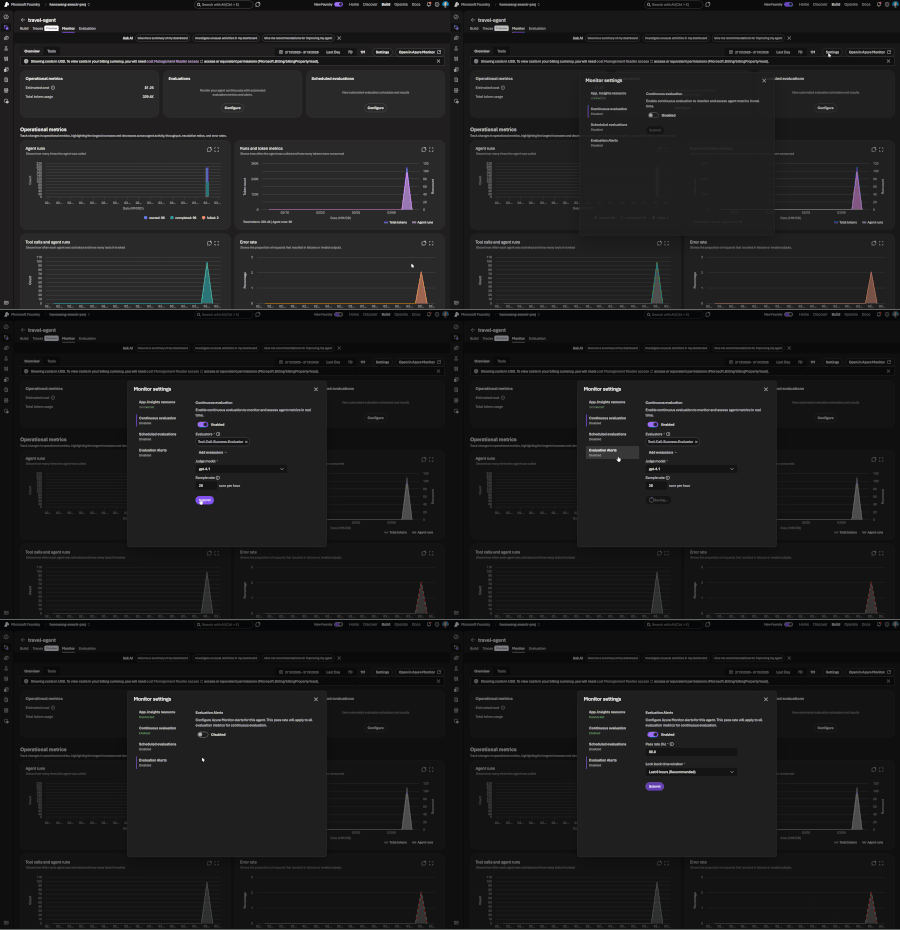
If you've shipped an AI agent to production, you've likely run into the same uncomfortable realization: the hard part isn't getting the agent to work - it's keeping it working. Models get updated, prompts get tweaked, retrieval pipelines drift, and user traffic surfaces edge cases that never appeared in your eval suite. Quality isn't something you establish once. It's something you have to continuously measure. Today, we're making that continuous measurement a first-class operational capability. Evaluations, Monitoring, and Tracing in Microsoft Foundry are now generally available through Foundry Control Plane. These aren't standalone tools bolted onto the side of the platform - they're deeply integrated with Azure Monitor, which means AI agent observability now lives in the same operational plane as the rest of your infrastructure. The Problem With Point-in-Time Evaluation Most evaluation workflows are designed around a pre-deployment gate. You build a test dataset, run your evals, review the scores, and ship. That approach has real value - but it has a hard ceiling. In production, agent behavior is a function of many things that change independently of your code: Foundation model updates ship continuously and can shift output style, reasoning patterns, and edge case handling in ways that don't always surface on your benchmark set. Prompt changes can have nonlinear effects downstream, especially in multi-step agentic flows. Retrieval pipeline drift changes what context your agent actually sees at inference time. A document index fresh last month may have stale or subtly different content today. Real-world traffic distribution is never exactly what you sampled for your test set. Production surfaces long-tail inputs that feel obvious in hindsight but were invisible during development. The implication is straightforward: evaluation has to be continuous, not episodic. You need quality signals at development time, at every CI/CD commit, and continuously against live production traffic - all using the same evaluator definitions so results are comparable across environments. That's the core design principle behind Foundry Observability. Continuous Evaluation Across the Full AI Lifecycle Built-In Evaluators Foundry's built-in evaluators cover the most critical quality and safety dimensions for production agent systems: Coherence and Relevance measure whether responses are internally consistent and on-topic relative to the input. These are table-stakes signals for any conversational or task-completion agent. Groundedness is particularly important for RAG-based architectures. It measures whether the model's output is actually supported by the retrieved context - as opposed to plausible-sounding content the model generated from its parametric memory. Groundedness failures are a leading indicator of hallucination risk in production, and they're often invisible to human reviewers at scale. Retrieval Quality evaluates the retrieval step independently from generation. Groundedness failures can originate in two places: the model may be ignoring good context, or the retrieval pipeline may not be surfacing relevant context in the first place. Splitting these signals makes it much easier to pinpoint root cause. Safety and Policy Alignment evaluates whether outputs meet your deployment's policy requirements - content safety, topic restrictions, response format compliance, and similar constraints. These evaluators are designed to run at every stage of the AI lifecycle: Local development - run evals inline as you iterate on prompts, retrieval config, or orchestration logic CI/CD pipelines - gate every commit against your quality baselines; catch regressions before they reach production Production traffic monitoring - continuously evaluate sampled live traffic and surface trends over time Because the evaluators are identical across all three contexts, a score in CI means the same thing as a score in production monitoring. See the Practical Guide to Evaluations and the Built-in Evaluators Reference for a deeper walkthrough. Custom Evaluators - Encoding Your Own Definition of Quality Built-in evaluators cover common signals well, but production agents often need to satisfy criteria specific to a domain, regulatory environment, or internal standard. Foundry supports two types of custom evaluators (currently in public preview): LLM-as-a-Judge evaluators let you configure a prompt and grading rubric, then use a language model to apply that rubric to your agent's outputs. This is the right approach for quality dimensions that require reasoning or contextual judgment - whether a response appropriately acknowledges uncertainty, whether a customer-facing message matches your brand tone, or whether a clinical summary meets documentation standards. You write a judge prompt with a scoring scale (e.g., 1–5 with criteria for each level) that evaluates a given {input} / {response} pair. Foundry runs this at scale and aggregates scores into your dashboards alongside built-in results. Code-based evaluators are Python functions that implement any evaluation logic you can express programmatically - regex matching, schema validation, business rule checks, compliance assertions, or calls to external systems. If your organization has documented policies about what a valid agent response looks like, you can encode those policies directly into your evaluation pipeline. Custom and built-in evaluators compose naturally - running against the same traffic, producing results in the same schema, feeding into the same dashboards and alert rules. Monitoring and Alerting - AI Quality as an Operational Signal All observability data produced by Foundry - evaluation results, traces, latency, token usage, and quality metrics - is published directly to Azure Monitor. This is where the integration pays off for teams already on Azure. What this enables that siloed AI monitoring tools can't: Cross-stack correlation. When your groundedness score drops, is it a model update, a retrieval pipeline issue, or an infrastructure problem affecting latency? With AI quality signals and infrastructure telemetry in the same Azure Monitor Application Insights workspace, you can answer that in minutes rather than hours of manual correlation across disconnected systems. Unified alerting. Configure Azure Monitor alert rules on any evaluation metric - trigger a PagerDuty incident when groundedness drops below threshold, send a Teams notification when safety violations spike, or create automated runbook responses when retrieval quality degrades. These are the same alert mechanisms your SRE team already uses. Enterprise governance by default. Azure Monitor's RBAC, retention policies, diagnostic settings, and audit logging apply automatically to all AI observability data. You inherit the governance framework your organization has already built and approved. Grafana and existing dashboards. If your team uses Azure Managed Grafana, evaluation metrics can flow into existing dashboards alongside your other operational metrics - a single pane of glass for application health, infrastructure performance, and AI agent quality. The Agent Monitoring Dashboard in the Foundry portal provides an AI-native view out of the box - evaluation metric trends, safety threshold status, quality score distributions, and latency breakdowns. Everything in that dashboard is backed by Azure Monitor data, so SRE teams can always drill deeper. End-to-End Tracing: From Quality Signal to Root Cause A groundedness score tells you something is wrong. A trace tells you exactly where the failure occurred and what the agent actually did. Foundry provides OpenTelemetry-based distributed tracing that follows each request through your entire agent system: model calls, tool invocations, retrieval steps, orchestration logic, and cross-agent handoffs. Traces capture the full execution path - inputs, outputs, latency at each step, tool call parameters and responses, and token usage. The key design decision: evaluation results are linked directly to traces. When you see a low groundedness score in your monitoring dashboard, you navigate directly to the specific trace that produced it - no manual timestamp correlation, no separate trace ID lookup. The connection is made automatically. Foundry auto-collects traces across the frameworks your agents are likely already built on: Microsoft Agent Framework Semantic Kernel LangChain and LangGraph OpenAI Agents SDK For custom or less common orchestration frameworks, the Azure Monitor OpenTelemetry Distro provides an instrumentation path. Microsoft is also contributing upstream to the OpenTelemetry project - working with Cisco Outshift, we've contributed semantic conventions for multi-agent trace correlation, standardizing how agent identity, task context, and cross-agent handoffs are represented in OTel spans. Note: Tracing is currently in public preview, with GA shipping by end of March. Prompt Optimizer (Public Preview) One persistent friction point in agent development is the iteration loop between writing prompts and measuring their effect. You make a change, run your evals, look at the delta, try to infer what about the change mattered, and repeat. Prompt Optimizer tightens this loop. It analyzes your existing prompt and applies structured prompt engineering techniques - clarifying ambiguous instructions, improving formatting for model comprehension, restructuring few-shot examples, making implicit constraints explicit - with paragraph-level explanations for every change it makes. The transparency is deliberate. Rather than producing a black-box "optimized" prompt, it shows you exactly what it changed and why. You can add constraints, trigger another optimization pass, and iterate until satisfied. When you're done, apply it with one click. The value compounds alongside continuous evaluation: run your eval suite against the current prompt, optimize, run evals again, see the measured improvement. That feedback loop - optimize, measure, optimize - is the closest thing to a systematic approach to prompt engineering that currently exists. What Makes our Approach to Observability Different There are other evaluation and observability tools in the AI ecosystem. The differentiation in Foundry's approach comes down to specific architectural choices: Unified lifecycle coverage, not just pre-deployment testing. Most existing evaluation tools are designed for offline, pre-deployment use. Foundry's evaluators run in the same form at development time, in CI/CD, and against live production traffic. Your quality metrics are actually comparable across the lifecycle - you can tell whether production quality matches what you saw in testing, rather than operating two separate measurement systems that can't be compared. No separate observability silo. Publishing all observability data to Azure Monitor means you don't operate a separate system for AI quality alongside your existing infrastructure monitoring. AI incidents route through your existing on-call rotations. AI quality data is subject to the same retention and compliance controls as the rest of your telemetry. Framework-agnostic tracing. Auto-instrumentation across Semantic Kernel, LangChain, LangGraph, and the OpenAI Agents SDK means you're not locked into a specific orchestration framework. The OpenTelemetry foundation means trace data is portable to any compatible backend, protecting your investment as the tooling landscape evolves. Composable evaluators. Built-in and custom evaluators run in the same pipeline, against the same traffic, producing results in the same schema, feeding into the same dashboards and alert rules. You don't choose between generic coverage and domain-specific precision - you get both. Evaluation linked to traces. Most systems treat evaluation and tracing as separate concerns. Foundry treats them as two views of the same event - closing the loop between detecting a quality problem and diagnosing it. Getting Started If you're building agents on Microsoft Foundry, or using Semantic Kernel, LangChain, LangGraph, or the OpenAI Agents SDK and want to add production observability, the entry point is Foundry Control Plane. Try it You'll need a Foundry project with an agent and an Azure OpenAI deployment. Enable observability by navigating to Foundry Control Plane and connecting your Azure Monitor workspace. Then walk through the Practical Guide to Evaluations, explore the Built-in Evaluators Reference, and set up end-to-end tracing for your agents.5.2KViews1like0Comments
Now in Foundry: VibeVoice-ASR, MiniMax M2.5, Qwen3.5-9B
This week's Model Mondays edition features two models that have just arrived in Microsoft Foundry: Microsoft's VibeVoice-ASR, a unified speech-to-text model that handles 60-minute audio files in a single pass with built-in speaker diarisation and timestamps, and MiniMaxAI's MiniMax-M2.5, a frontier agentic model that leads on coding and tool-use benchmarks with performance comparable to the strongest proprietary models at a fraction of their cost; and Qwen's Qwen3.5-9B, the largest of the Qwen3.5 Small Series. All three represent a shift toward long-context, multi-step capability: VibeVoice-ASR processes up to an hour of continuous audio without chunking; MiniMax-M2.5 handles complex, multi-phase agentic tasks more efficiently than its predecessor—completing SWE-Bench Verified 37% faster than M2.1 with 20% fewer tool-use rounds; and Qwen3.5-9B brings multimodal reasoning on consumer hardware that outperforms much larger models. Models of the week VibeVoice-ASR Model Specs Parameters / size: ~8.3B Primary task: Automatic Speech Recognition with diarisation and timestamps Why it's interesting 60-minute single-pass with full speaker attribution: VibeVoice-ASR processes up to 60 minutes of continuous audio without chunk-based segmentation—yielding structured JSON output with start/end timestamps, speaker IDs, and transcribed content for each segment. This eliminates the speaker-tracking drift and semantic discontinuities that chunk-based pipelines introduce at segment boundaries. Joint ASR, diarisation, and timestamps in one model: Rather than running separate systems for transcription, speaker separation, and timing, VibeVoice-ASR produces all three outputs in a single forward pass. Users can also inject customized hot words—proper nouns, technical terms, or domain-specific phrases—to improve recognition accuracy on specialized content without fine-tuning. Multilingual with native code-switching: Supports 50+ languages with no explicit language configuration required and handles code-switching within and across utterances natively. This makes it suitable for multilingual meetings and international call center recordings without pre-routing audio by language. Benchmarks: On the Open ASR Leaderboard, VibeVoice-ASR achieves an average WER of 7.77% across 8 English datasets (RTFx 51.80), including 2.20% on LibriSpeech Clean and 2.57% on TED-LIUM. On the MLC-Challenge multi-speaker benchmark: DER 4.28%, cpWER 11.48%, tcpWER 13.02%. Try it Use case What to build Best practices Long-form, multi-speaker transcription for meetings + compliance A transcription service that ingests up to 60 minutes of audio per request and returns structured segments with speaker IDs + start/end timestamps + transcript text (ready for search, summaries, or compliance review). Keep audio un-chunked (single-pass) to preserve speaker coherence and avoid stitching drift; rely on the model’s joint ASR, diarisation, and timestamping so you don’t need separate diarisation/timestamp pipelines or postprocessing. Multilingual + domain-specific transcription (global support, technical reviews) A global transcription workflow for multilingual meetings or call center recordings that outputs “who/when/what,” and supports vocabulary injection for product names, acronyms, and technical terms. Provide customized hot words (names / technical terms) in the request to improve recognition on specialized content; don’t require explicit language configuration—VibeVoice-ASR supports 50+ languages and code-switching, so you can avoid pre-routing audio by language. Read more about the model and try out the playground Microsoft for Hugging Face Spaces to try the model for yourself. MiniMax-M2.5 Model Specs Parameters / size: ~229B (FP8, Mixture of Experts) Primary task: Text generation (agentic coding, tool use, search) Why it's interesting? Leading coding benchmark performance: Scores 80.2% on SWE-Bench Verified and 51.3% on Multi-SWE-Bench across 10+ programming languages (Go, C, C++, TypeScript, Rust, Python, Java, and others). In evaluations across different agent harnesses, M2.5 scores 79.7% on Droid and 76.1% on OpenCode—both ahead of Claude Opus 4.6 (78.9% and 75.9% respectively). The model was trained across 200,000+ real-world coding environments covering the full development lifecycle: system design, environment setup, feature iteration, code review, and testing. Expert-level search and tool use: M2.5 achieves industry-leading performance in BrowseComp, Wide Search, and Real-world Intelligent Search Evaluation (RISE), laying a solid foundation for autonomously handling complex tasks. Professional office work: Achieves a 59.0% average win rate against other mainstream models in financial modeling, Word, and PowerPoint tasks, evaluated via the GDPval-MM framework with pairwise comparison by senior domain professionals (finance, law, social sciences). M2.5 was co-developed with these professionals to incorporate domain-specific tacit knowledge—rather than general instruction-following—into the model's training. Try it Use case What to build Best practices Agentic software engineering Multi‑file code refactors, CI‑gated patch generation, long‑running coding agents working across large repositories Start prompts with a clear architecture or refactor goal. Let the model plan before editing files, keep tool calls sequential, and break large changes into staged tasks to maintain state and coherence across long workflows. Autonomous productivity agents Research assistants, web‑enabled task agents, document and spreadsheet generation workflows Be explicit about intent and expected output format. Decompose complex objectives into smaller steps (search → synthesize → generate), and leverage the model’s long‑context handling for multi‑step reasoning and document creation. With these use cases and best practices in mind, the next step is translating them into a clear, bounded prompt that gives the model a specific goal and the right tools to act. The example below shows how a product or engineering team might frame an automated code review and implementation task, so the model can reason through the work step by step and return results that map directly back to the original requirement: “You're building an automated code review and feature implementation system for a backend engineering team. Deploy MiniMax-M2.5 in Microsoft Foundry with access to your repository's file system tools and test runner. Given a GitHub issue describing a new API endpoint requirement, have the model first write a functional specification decomposing the requirement into sub-tasks, then implement the endpoint across the relevant service files, write unit tests with at least 85% coverage, and return a pull request summary explaining each code change and its relationship to the original requirement. Flag any implementation decisions that deviate from the patterns found in the existing codebase.” Qwen3.5-9B Model Specs Parameters / size: 9B Context length: 262,144 tokens natively; extensible to 1,010,000 tokens Primary task: Image-text-to-text (multimodal reasoning) Why it’s interesting High intelligence density at small sizes: Qwen 3.5 Small models show large reasoning gains relative to parameter count, with the 4B and 9B variants outperforming other sub‑10B models on public reasoning benchmarks. Long‑context by default: Support for up to 262K tokens enables long‑document analysis, codebase review, and multi‑turn workflows without chunking. Native multimodal architecture: Vision is built into the model architecture rather than added via adapters, allowing small models (0.8B, 2B) to handle image‑text tasks efficiently. Open and deployable: Apache‑2.0 licensed models designed for local, edge, or cloud deployment scenarios. Benchmarks AI Model & API Providers Analysis | Artificial Analysis Try it Use case When to use Best‑practice prompt pattern Long‑context reasoning Analyzing full PDFs, long research papers, or large code repositories where chunking would lose context Set a clear goal and scope. Ask the model to summarize key arguments, surface contradictions, or trace decisions across the entire document before producing an output. Lightweight multimodal document understanding OCR‑driven workflows using screenshots, scanned forms, or mixed image‑text inputs Ground the task in the artifact. Instruct the model to first describe what it sees, then extract structured information, then answer follow‑up questions. With these best practices in mind, Qwen 3.5-9B demonstrates how compact, multimodal models can handle complex reasoning tasks without chunking or manual orchestration. The prompt below shows how an operations analyst might use the model to analyze a full report end‑to‑end: "You are assisting an operations analyst. Review the attached PDF report and extracted tables. Identify the three largest cost drivers, explain how they changed quarter‑over‑quarter, and flag any anomalies that would require follow‑up. If information is missing, state what data would be needed." Getting started You can deploy open-source Hugging Face models directly in Microsoft Foundry by browsing the Hugging Face collection in the Foundry model catalog and deploying to managed endpoints in just a few clicks. You can also start from the Hugging Face Hub. First, select any supported model and then choose "Deploy on Microsoft Foundry", which brings you straight into Azure with secure, scalable inference already configured. Learn how to discover models and deploy them using Microsoft Foundry documentation. Follow along the Model Mondays series and access the GitHub to stay up to date on the latest Read Hugging Face on Azure docs Learn about one-click deployments from the Hugging Face Hub on Microsoft Foundry Explore models in Microsoft Foundry1.5KViews0likes0Comments
Introducing Phi-4-Reasoning-Vision to Microsoft Foundry
Vision reasoning models unlock a critical capability for developers: the ability to move beyond passive perception toward systems that can understand, reason over, and act on visual information. Instead of treating images, diagrams, documents, or UI screens as unstructured inputs, vision reasoning models enable developers to build applications that can interpret visual structure, connect it with textual context, and perform multi-step reasoning to reach actionable conclusions. Today, we are excited to announce Phi-4-Reasoning-Vision-15B is available in Microsoft Foundry and Hugging Face. This model brings high‑fidelity vision to the reasoning‑focused Phi‑4 family, extending small language models (SLMs) beyond perception into structured, multi‑step visual reasoning for agents, analytical tools, and scientific workflows. What’s new? The Phi model family has advanced toward combining efficient visual understanding with strong reasoning in small language models. Earlier Phi‑4 models demonstrated reliable perception and grounding across images and text, while later iterations introduced structured reasoning to improve performance on complex tasks. Phi‑4‑reasoning-vision-15B brings these threads together, pairing high‑resolution visual perception with selective, task‑aware reasoning. As a result, the model can reason deeply when needed while remaining fast and efficient for perception‑focused scenarios—making it well suited for interactive, real‑world applications. Key capabilities Reasoning behavior is explicitly enabled via prompting: Developers can explicitly enable or disable reasoning to balance latency and accuracy at runtime. Optimized for vision reasoning and can be used for: diagram-based math, document, chart, and table understanding, GUI interpretations and grounding for agent scenarios to interpret screens and actions, Computer-use agent scenarios, and General image chat and answering questions Benchmarks The following results summarize Phi-4-reasoning-vision-15B performance across a set of established multimodal reasoning, mathematics, and computer use benchmarks. The following benchmarks are the result of internal evaluations. Benchmark Phi-4-reasoning-vision-15B Phi-4-reasoning-vision-15B – force no think Phi-4-mm-instruct Kimi-VL-A3B-Instruct gemma-3-12b-it Qwen3-VL-8B-Instruct-4K Qwen3-VL-8B-Instruct-32K Qwen3-VL-32B-Instruct-4K Qwen3-VL-32B-Instruct-32K AI2D _TEST 84.8 84.7 68.6 84.6 80.4 82.7 83 84.8 85 ChartQA _TEST 83.3 76.5 23.5 87 39 83.1 83.2 84.3 84 HallusionBench 64.4 63.1 56 65.2 65.3 73.5 74.1 74.4 74.9 MathVerse _MINI 44.9 43.8 32.4 41.7 29.8 54.5 57.4 64.2 64.2 MathVision _MINI 36.2 34.2 20 28.3 31.9 45.7 50 54.3 60.5 MathVista _MINI 75.2 68.7 50.5 67.1 57.4 77.1 76.4 82.5 81.8 MMMU _VAL 54.3 52 42.3 52 50 60.7 64.6 68.6 70.6 MMStar 64.5 63.3 45.9 60 59.4 68.9 69.9 73.7 74.3 OCRBench 76 75.6 62.6 86.5 75.3 89.2 90 88.5 88.5 ScreenSpot _v2 88.2 88.3 28.5 89.8 3.5 91.5 91.5 93.7 93.9 Table 1: Accuracy comparisons relative to popular open-weight, non-thinking models Benchmark Phi-4-reasoning-vision-15B Phi-4-reasoning-vision-15B - force thinking Kimi-VL-A3B-Thinking gemma-3-12b-it Qwen3-VL-8B-Thinking-4K Qwen3-VL-8B-Thinking-40K Qwen3-VL-32B-Thiking-4K Qwen3-VL-32B-Thinking-40K AI2D_TEST 84.8 79.7 81.2 80.4 83.5 83.9 86.9 87.2 ChartQA _TEST 83.3 82.9 73.3 39 78 78.6 78.5 79.1 HallusionBench 64.4 63.9 70.6 65.3 71.6 73 76.4 76.6 MathVerse _MINI 44.9 53.1 61 29.8 67.3 73.3 78.3 78.2 MathVision _MINI 36.2 36.2 50.3 31.9 43.1 50.7 60.9 58.6 MathVista _MINI 75.2 74.1 78.6 57.4 77.7 79.5 83.9 83.8 MMMU _VAL 54.3 55 60.2 50 59.3 65.3 72 72.2 MMStar 64.5 63.9 69.6 59.4 69.3 72.3 75.5 75.7 OCRBench 76 73.7 79.9 75.3 81.2 82 83.7 85 ScreenSpot _v2 88.2 88.1 81.8 3.5 93.3 92.7 83.1 83.1 Table 2: Accuracy comparisons relative to popular open-weight, thinking models All results were obtained using a consistent evaluation setup and prompts across models; numbers are provided for comparison and analysis rather than as leaderboard claims. For more information regarding benchmarks and evaluations, please read the technical paper on the Microsoft Research hub. Suggested use cases and applications Phi‑4‑Reasoning-Vision-15B supports applications that require both high‑fidelity visual perception and structured inference. Two representative scenarios include scientific and mathematical reasoning over visual inputs, and computer‑using agents (CUAs) that operate directly on graphical user interfaces. In both cases, the model provides grounded visual understanding paired with controllable, low‑latency reasoning suitable for interactive systems. Computer use agents in retail scenarios For computer use agents, Phi‑4‑Reasoning-Vision-15B provides the perception and grounding layer required to understand and act within live ecommerce interfaces. For example, in an online shopping experience, the model interprets screen content—products, prices, filters, promotions, buttons, and cart state—and produces grounded observations that agentic models like Fara-7B can use to select actions. Its compact size and low latency inference make it well suited for CUA workflows and agentic applications. Visual reasoning for education Another practical use of visual reasoning models is education. A developer could build a K‑12 tutoring app with Phi‑4‑Reasoning‑Vision‑15B where students upload photos of worksheets, charts, or diagrams to get guided help—not answers. The model can understand the visual content, identify where the student went wrong, and explain the correct steps clearly. Over time, the app can adapt by serving new examples matched to the student’s learning level, turning visual problem‑solving into a personalized learning experience. Microsoft Responsible AI principles At Microsoft, our mission to empower people and organizations remains constant—especially in the age of AI, where the potential for human achievement is greater than ever. We recognize that trust is foundational to AI adoption, and earning that trust requires a commitment to transparency, safety, and accountability. As with other Phi models, Phi-4-Reasoning-Vision-15B was developed with safety as a core consideration throughout training and evaluation. The model was trained on a mixture of public safety datasets and internally generated examples designed to elicit behaviors the model should appropriately refuse, in alignment with Microsoft’s Responsible AI Principles. These safety focused training signals help the model recognize and decline requests that fall outside intended or acceptable use. Additional details on the model’s safety considerations, evaluation approach, and known limitations are provided in the accompanying technical blog and model card. Getting started Start using Phi‑4‑Reasoning-Vision-15B in Microsoft Foundry today. Microsoft Foundry provides a unified environment for model discovery, evaluation, and deployment, making it straightforward to move from initial experimentation to production use while applying appropriate safety and governance practices. Deploy the new model on Microsoft Foundry. Learn more about the Phi family on Foundry Labs and in the Phi Cookbook Connect to the Microsoft Developer Community on Discord Read the technical paper on Microsoft Research Read more use cases on the Educators Developer blog2.1KViews0likes0Comments
Cybersecurity in the Age of Digital Acceleration: Securing Intelligence, Assets, and Trust
Over the past four decades, Information Technology has evolved from modest on-premise systems with limited storage to a boundless, cloud-driven ecosystem that powers global commerce, governance, defense, and daily life. What began in the mid-1980s as hardware-centric computing has transformed into an intelligent, distributed, always-on digital universe. Today, storage is virtually infinite. Processing is instantaneous. Markets operate 24/7. Transactions occur across continents in milliseconds. Physical boundaries have dissolved into digital connectivity. But in this era of extraordinary progress, one discipline has become indispensable: Cybersecurity. From Digitization to Intelligence The early waves of digital transformation converted manual processes into electronic systems—banking, records, communications, and trade. The second wave connected everything, linking enterprises, governments, devices, and supply chains into global digital ecosystems. We are now in the third wave: intelligent systems powered by artificial intelligence. AI is no longer a supporting tool; it is becoming a decision engine, shaping outcomes across financial markets, healthcare diagnostics, defense systems, logistics optimization, and enterprise automation. As intelligence increases, so does risk. Human intelligence built digital infrastructure; artificial intelligence now operates within it. Without responsible governance, AI systems can amplify bias, automate vulnerabilities, and accelerate systemic risk at unprecedented scale. Cybersecurity, therefore, is no longer just about protecting networks and systems. It is about protecting intelligence itself. From Intelligence to Orchestration: The Rise of AI Platforms As artificial intelligence matures, the challenge is no longer building models. It is operationalizing intelligence safely and at scale across complex enterprises. Organizations now run ecosystems of intelligence—multiple models, agents, data sources, and automated decisions spanning business units, geographies, and regulations. Managing this complexity requires more than tools; it requires orchestration. Microsoft Foundry marks this shift—from isolated AI capabilities to a governed, enterprise‑grade AI operating fabric. It is not about generating intelligence, but about controlling how intelligence is created, grounded, deployed, monitored, and trusted. Just as cloud platforms abstracted infrastructure complexity, AI platforms now abstract cognitive complexity—embedding security, governance, and accountability by design. Intelligence at Scale Requires Structure Unstructured intelligence introduces enterprise risk. Models drift without governance. Agents hallucinate without oversight. Poorly controlled data grounding exposes sensitive information. At scale, these failures are not theoretical—they are operational, financial, and reputational risks. As organizations embed AI into financial decisioning, customer engagement, supply chain optimization, healthcare diagnostics, and critical infrastructure, intelligence must operate within clear and enforceable guardrails. Reliability, security, and accountability are prerequisites for adoption at enterprise scale. Foundry provides a disciplined approach to enterprise AI. Intelligence is managed as production‑grade projects, not isolated experiments. Models are intentionally selected, benchmarked, and upgraded without disrupting live systems. Agents are empowered to act, but only within clearly defined permissions and policies. Enterprise knowledge remains grounded in trusted data, with identity, access controls, and compliance preserved end‑to‑end. Observability, evaluation, and auditability are built in by design—enabling leaders to understand, govern, and stand behind AI‑driven outcomes. This progression mirrors the evolution of cybersecurity itself: from fragmented, reactive controls to a unified, systemic architecture designed for scale, trust, and resilience. AI Agents: Automation with Accountability The next phase of AI is not conversational—it is agentic. Foundry introduces controlled autonomy: agents that are capable by design, but constrained by enforceable guardrails. These include identity boundaries, role‑based access control, data permissions, policy enforcement, and continuous monitoring. This applies a core cybersecurity principle directly to AI systems: least privilege, extended to intelligence itself. In this model, AI agents function as digital employees—highly capable and always on—but governed by the same trust, access, and accountability frameworks that secure human operators in production environments. The Evolution of Threats As technology advanced, threats evolved in parallel. Physical theft gave way to digital fraud, bank robberies became ransomware attacks, espionage shifted into data exfiltration, and counterfeiting transformed into identity theft. Crime adapted as systems digitized. Policing adapted in response. Ethical hacking, penetration testing, zero‑trust architectures, and advanced threat intelligence emerged to counter increasingly sophisticated adversaries. Cybersecurity evolved from static perimeter defense into predictive, AI‑driven protection models capable of identifying threats before exploitation occurs. The battlefield has now shifted decisively—from physical borders to cloud infrastructure. Digital Assets, Digital Wealth, Digital Risk Money itself has transformed. Physical currency evolved into digital banking, digital banking into real‑time payments, and cryptographic systems introduced decentralized finance. Today, tokenized assets and their underlying digital representations increasingly influence global markets. Platforms such as Foundry provide the resilient, scalable infrastructure required to support this shift—from financial services modernization to blockchain integration. As cryptocurrencies like Bitcoin and Ethereum redefine asset ownership and value exchange, economic systems are becoming dependent on cryptographic trust models rather than institutional intermediaries alone. Trade now happens at the tap of a screen. Assets reside in invisible vaults—cloud environments. Markets operate continuously, unconstrained by geography or time zones. Where wealth is digital, security must be digital. Where identity is virtual, trust must be algorithmic. And where assets are tokenized, integrity must be cryptographically enforced. Blockchain and National Security Blockchain technology introduces transparency, immutability, and distributed trust. Beyond cryptocurrencies, it is increasingly shaping critical domains such as cross‑border trade finance, defense supply‑chain traceability, secure digital identity frameworks, and smart contracts that enable automated compliance. For national economies and defense ecosystems, the convergence of AI and blockchain is powerful—but highly sensitive. A vulnerability in decentralized infrastructure can cascade globally, while a compromised AI model can influence economic or defense decisions at machine speed. Scale and autonomy magnify both impact and risk. Cybersecurity must therefore operate across three critical layers. Infrastructure security ensures cloud, network, and endpoint resilience. Data and identity protection enforce encryption, zero‑trust access, and secure authentication. AI governance and integrity safeguard models through adversarial defense, policy controls, and ethical AI compliance. Together, these layers form the foundation for securing intelligent, decentralized systems in an increasingly automated world. Responsible AI: Security Beyond Code As AI integrates into economic systems, financial markets, defense analytics, and public infrastructure, the responsibility associated with its deployment grows exponentially. Intelligence at scale amplifies both capability and consequence. Unmonitored AI systems can amplify misinformation, manipulate financial signals, expose sensitive defense intelligence, and automate systemic vulnerabilities. At machine speed, these failures propagate faster than traditional controls can respond. Responsible AI, therefore, is not merely an ethical aspiration—it is a cybersecurity mandate. Security must be embedded end‑to‑end, spanning data pipelines, training datasets, model validation, deployment environments, and continuous monitoring systems. AI governance is no longer a parallel concern. It is inseparable from modern cybersecurity architecture. Zero-Trust in a Borderless World Geographical boundaries no longer define risk exposure. Enterprises operate across jurisdictions, workforces are increasingly remote, and supply chains are fully digital. As a result, trust assumptions based on location or network perimeter no longer hold. The modern security model is zero trust: never assume, always verify. Every access request must be authenticated, every transaction validated, and every anomaly analyzed in real time—regardless of where it originates. Security is no longer reactive. It is predictive, adaptive, and continuously enforced across identity, data, and systems. The Economic Imperative The growth of digital currencies, tokenized commodities, and algorithm‑driven markets introduces both innovation and systemic complexity. Assets that were once physical or institutionally mediated—gold, securities, and identity—are now increasingly represented as digital, cryptographic constructs. Digital gold. Digital silver. Digital securities. Digital identity. Each reflects a broader shift: underlying economic value is now encoded, transferred, and settled through cryptographic systems rather than physical custody or manual processes. The integrity of these systems underpins economic stability itself. As a result, cybersecurity is no longer just an IT concern: it functions as an economic stabilizer, protecting trust, value, and market confidence in a fully digital financial world. The Road Ahead If the past four decades transformed hardware into intelligence, the decades ahead will transform intelligence into autonomy. Autonomous finance, logistics, defense systems, and AI agents will increasingly plan, decide, and act without continuous human intervention. The question is not whether this evolution will continue—it will. The question is whether security evolves faster than risk. In an autonomous world, cybersecurity must lead innovation, not follow it. In an era defined by AI, blockchain, digital currencies, and cloud‑native economies, security becomes the silent architecture of trust. Foundry represents one step in this evolution—where intelligence, security, and governance converge into a unified operational fabric. Without such foundations, digital transformation collapses under its own risk. With them, digital evolution becomes sustainable. Cybersecurity is no longer a protective layer. It is the foundation of the digital future.347Views1like0Comments