preview
342 TopicsWhat’s New in Azure Confidential Computing — Ignite 2026
Protecting the workloads that matter most Useful AI depends on the records and expertise that organizations work hardest to protect such as patient information, financial histories, proprietary models and the context an agent uses to act. Customers want to put that information to work without exposing it more widely. They also need to bring existing sensitive applications forward, choose infrastructure that fits the workload, and keep those systems reliable as they grow. At Ignite 2026, Azure Confidential Computing is advancing both needs. New CPU and GPU options give customers more ways to protect records and models during processing. Confidential container capabilities make that protection easier to adopt in application platforms, while migration, encryption and recovery improvements help teams move and operate sensitive workloads with less disruption. Here are the highlights: A confidential bare-metal technology showcase on NVIDIA Vera Rubin NVL72, with a single-node, four-GPU AI demonstration. A gated preview of 5 th generation AMD EPYC™ (“Turin”) processor v7 confidential VMs, with more general-purpose and memory-optimized choices for sensitive workloads. Intel TDX v6 platform improvements and a protected-I/O technology showcase for next-generation Confidential VMs with TDX Connect and Azure Boost Confidential Device. Generally available migration and large OS-disk encryption capabilities, with further progress in backup and confidential data-disk protection. Intel TDX support for confidential AKS worker nodes (generally available with Azure Container Linux and in preview with Ubuntu 26.04), alongside engineering investments in next-generation Confidential Child Capable VMs, confidential enclaves, and pod-level confidential containers on AKS, plus progress in confidential databases and controlled collaboration. A Project Nova-based demonstration using zero-knowledge proofs to verify that a financial transaction meets agreed conditions without revealing the underlying balances or sensitive records. Confidential AI: verify before sharing Confidential AI needs to protect both sides of an interaction: the customer’s prompts and private context, and the model owner’s weights and intellectual property. Hardware-backed trusted execution environments protect data in use. Attestation provides signed evidence about the environment; authorization and key-release policies decide whether sensitive assets should become available to it. Confidential computing addresses protection during processing. Neither replaces application permissions, careful handling of logs and tool calls, or the governance needed for a particular deployment. Our work with NVIDIA on Vera Rubin NVL72, or VR72, starts with confidential bare-metal instances. The Ignite technology showcase uses one compute node with four Rubin GPUs to run a 397-billion-parameter model through vLLM. It collects CPU and GPU evidence and uses a minimal local verifier to check signatures, token binding and expected GPU measurements before demonstrating inference. In this bare-metal model, the tenant’s host operating system and runtime are inside the trusted computing base. Customers control that stack and must secure it accordingly. Figure 1. The confidential bare-metal architecture includes the tenant host OS in the trusted computing base; UEFI and BMC are outside it. Remote attestation is an architectural direction, while the Ignite demonstration uses a local verifier. Source: “Confidential AI at rack scale,” C-BMI architecture figure. VR72 confidential VMs, AKS and Kata-based confidential containers, and Microsoft Foundry integration remain in development. Customers building today can start with Azure’s existing NVIDIA H100 confidential GPU VMs while evaluating the isolation, attestation and operating model their workload needs. Our reference architecture for protecting sensitive AI with NVIDIA H100 and Protopia offers another way to explore that design. More choice for confidential compute AMD EPYC™ (“Turin”) processor v7 CVM: more confidential VM choices The gated preview of our next-generation confidential VMs brings 5 th generation AMD EPYC™ (“Turin”) processor to six series: DCasv7, DCadsv7, DCalsv7, DCaldsv7, ECasv7 and ECadsv7. General-purpose and memory-optimized options, different memory-to-vCPU ratios, and configurations with or without local disks give customers more room to match infrastructure to the workload. The platform combines AMD SEV-SNP with Azure Boost, Microsoft Azure Network Adapter (MANA), and NVMe support for local and remote storage. Secure AVIC adds protection for interrupt handling in SEV-SNP guests. Together, these changes target the compute, memory and I/O demands of sensitive enterprise applications without making one benchmark stand in for every workload. For details, please refer to https://aka.ms/cvm-turin-preview. Intel TDX: v6 improvements and protected-I/O showcase For Intel TDX v6 confidential VMs, improvements include NVMe remote storage, posted interrupts, timer virtualization and local sealing. Customers should compare performance against a matched configuration and their own application behavior. Storage, networking and workload concurrency all matter; there is no single confidentiality-overhead number that describes every deployment. For the next generation of confidential VMs, we are demonstrating protected I/O with Intel TDX Connect and Azure Boost Confidential Device (ABCD). Device attestation, TEE Device Interface Security Protocol (TDISP) and encrypted links extend the design beyond CPU memory to the devices a confidential workload uses. This technology demonstration is separate from the current v6 improvements; it is not a general-availability or public-enrollment announcement. We also continue to make progress on live migration for Intel TDX, building on the demonstration at Build. Azure Local confidential computing Confidential VMs powered by AMD SEV-SNP are now generally available on supported AMD EPYC Genoa processors, providing hardware-backed memory encryption and attestation to help protect sensitive workloads while running. We're also expanding hardware choice with Intel TDX-based confidential VMs in preview on Intel Xeon processors. We're soon extending confidential computing to GPU-accelerated AI workloads with preview support for confidential GPUs on Azure Local. This enables organizations to run sensitive AI inference workloads with additional hardware-backed protection for data in use, helping bring confidential AI capabilities to customer-controlled infrastructure. From confidential AKS nodes to protected application workloads Platform teams running Kubernetes on Azure already use confidential AKS worker nodes on AMD SEV-SNP to run a worker node inside a hardware-backed VM boundary. At Ignite, we are expanding confidential AKS worker nodes to Intel TDX, now generally available with Azure Container Linux and in preview with Ubuntu 26.04. In the worker-node model, pods scheduled onto a node share that VM's protection boundary, which fits clusters where workloads and node administrators belong to the same trust domain. When a specific service handles signing keys, credentials, or regulated records that must stay isolated from the surrounding host OS and node operators, the trust boundary needs to shrink to the workload itself. Today, confidential containers on Azure Container Instances provide a managed container option for workload-scoped, attested execution and policy enforcement. We are also building the next generation of Confidential Child Capable VMs on AMD EPYC processors with AMD SEV-SNP. In this model, a customer-operated parent VM manages lifecycle, scheduling, I/O, and availability, while a hardware-isolated child environment helps protect sensitive code and memory and helps keep the parent OS and parent-level administrators outside the child's memory confidentiality boundary within AMD's documented threat model. We are building two workload experiences on top of these upcoming Confidential Child Capable VMs: confidential enclaves, a feature for splitting a single sensitive component out of a parent VM, and next-generation support in confidential containers on AKS (built on Kata Containers and the Confidential Containers project) for per-pod isolation. Both capabilities are under active development and planned for a future release. Make confidential workloads easier to operate Protection during execution is only useful if organizations can also migrate, recover and maintain the workload. Two generally available capabilities remove important migration barriers: Azure Migrate support for eligible moves to confidential VMs, and Large OS Disk Encryption for confidential VM migrations. Large OS Disk Encryption supports OS disks larger than 127 GB, including customer-managed-key configurations. Supported combinations cover Windows, Ubuntu, Red Hat Enterprise Linux and Rocky Linux. Teams still need to check their source platform, guest image and target configuration. Source machines and replication paths need their own controls; confidential protection begins when the target runs in the supported trusted execution environment and meets its key-release conditions. Azure Backup for confidential VMs is in public preview for supported v6-series VMs with OS-disk encryption, using platform-managed or customer-managed keys. Use the current Azure Backup support matrix to plan restore behavior rather than assuming parity with every standard VM backup feature. Confidential Data Disk Encryption, in private preview, addresses another part of the lifecycle. It encrypts attached data disks inside the confidential guest before data reaches the host, with customer-managed keys released under authorization and attestation policy. A protected data foundation for AI and collaboration Models are only one part of an AI system. Databases hold the business records, retrieved context and agent memory that make those systems useful. SQL Server on Azure confidential VMs and Azure Local gives customers control of the database and guest software stack, together with responsibility for patching, backup and availability. Azure Database for PostgreSQL flexible server provides a managed confidential-computing option within its documented processor and regional support. We are working to broaden database deployment choices. For now, customers should plan against the current PostgreSQL support matrix rather than assume every confidential VM family or region is available through the managed service. A managed database has a wider, Microsoft-managed trust boundary. PostgreSQL’s documented offering does not expose remote attestation to customers, so its control model should not be equated with a customer-managed confidential offering. Azure Confidential Clean Rooms, in limited preview, applies this thinking across organizations. Participants can securely analyze privacy sensitive datasets from multiple collaborators with confidential compute-enabled Spark SQL-based big data analytics protecting their raw data from other collaborators and from the Azure operator. Campaign reach and measurement, and collaboration in financial services, illustrate the opportunity. Prove the fact without sharing the record Confidential computing protects sensitive information while it is processed. Zero-knowledge proofs provide a complementary capability, enabling independent verification of specific claims without revealing the underlying data. Across regulated industries, organizations need to establish trust while protecting confidential information. Project Nova explores how zero-knowledge proofs can enable privacy-preserving transactions, interoperability, and regulatory assurance across organizational boundaries. In financial services, zero-knowledge proofs could enable cross-chain settlement by verifying transaction conditions across networks, support selective disclosure of sensitive financial information, and provide regulators with independent assurance of compliance without exposing underlying records. Beyond financial services, healthcare organizations could verify patient eligibility without sharing medical histories; AI systems could prove defined computations or policy checks without exposing sensitive inputs; and supply chains could demonstrate compliance or product provenance without revealing confidential supplier relationships. Project Nova aims to enable trusted verification with greater privacy and less unnecessary data sharing. ACC portfolio of services and capabilities ACC spans infrastructure, containers, data, AI, and foundational security services, giving customers multiple ways to protect sensitive workloads while they are in use. The portfolio is designed to meet customers where their workloads run today, while extending confidential computing to emerging AI and sovereignty scenarios. Get started and go deeper Start with the Azure Confidential Computing portfolio in our docs pages to find the deployment model and supported configuration that fit your application. Test attestation, key release and recovery together, follow the Azure Confidential Computing blog for deeper product guidance and see our GitHub repo for code and sample applications that take advantage of our technology.Announcing gated preview of next-gen Azure confidential VMs with 5th Generation AMD EPYC™ processor
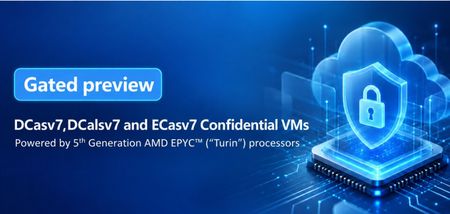
Today, we’re announcing the gated preview of Azure’s next generation v7 confidential virtual machines (CVMs), powered by 5 th Generation AMD EPYC™ (“Turin”) processor with Secure Encrypted Virtualization (SEV). The gated preview includes six new VM series spanning general-purpose and memory-optimized configurations, with options both with and without local disks. These CVMs are designed for organizations running data-sensitive, regulatory and digital sovereignty workloads. The AMD EPYC “Turin” processor’s Zen 5 cores provide higher memory bandwidth and improved instructions per clock compared with the previous generation, supporting compute-intensive work such as AI and machine learning, scientific simulations, and financial analytics. AMD EPYC “Turin” CVMs introduce Secure AVIC (Advanced Virtual Interrupt Controller) which helps in securing interrupt injection from a malicious hypervisor and better performance for APIC (Advanced Programmable Interrupt Controller) accesses in SEV with Secure Nested Paging (SNP) guests. The new CVMs incorporate the latest Azure Boost technology for improved performance and security, use the Microsoft Azure Network Adapter (MANA) for next-generation network interface that provides stable, forward-compatible drivers on Windows and Linux with accelerated networking, and support the NVMe protocol for both local and remote disks. DCasv7 DCadsv7 DCalsv7 DCaldsv7 ECasv7 ECadsv7 vCPU 2-160 2-160 2-160 2-160 2-160 2-160 Memory 8-640 8-640 4-320 4-320 16-1020 16-1020 Memory to vCPU ratio 4:1 4:1 2:1 2:1 8:1 8:1 Note: Memory to vCPU ratio varies for 160-vCPU EC-series VM. Windows Server 2025 Datacenter (G2), 2025 Datacenter G2 Azure, Windows Server 2025 Azure Edition, Windows Server 2025 Azure Edition Core, Windows Server 2025 Server Core (Core G2), Ubuntu 22.04 LTS and Ubuntu 24.04 LTS are supported guest operating systems with more OS support planned in phases. Performance improvements for demanding workloads Compared with equivalent-sized, previous-generation confidential VMs: Up to 45% higher memory bandwidth and 64% lower memory latency under load at 8 vCPU, and 43% higher bandwidth with 71% lower latency under load at 32 vCPU on Windows CVM. Up to 43% higher CPU benchmark performance, measured with CoreMark on an 8-vCPU Windows VM. Up to 42% higher Java benchmark throughput, measured with SPECjbb critical-IOPS on an 8-vCPU Windows VM. Up to 56% higher SHA-512 hashing throughput, measured with OpenSSL on an 8-vCPU Linux VM. Up to 43% more web requests per second and 47.2% lower average response latency, measured with ASP.NET Core on a 32-vCPU Linux VM. Note: These are preliminary performance data and may vary depending on VM configuration and workload parameters. In partnership with AMD “AMD and Microsoft have worked together for years to advance confidential computing in Azure, and this next generation represents another important step forward. By combining 5th Gen AMD EPYC processors with AMD Secure Encrypted Virtualization and Azure’s latest infrastructure innovation, we’re delivering the security, performance, and scale customers need for their most sensitive workloads.” Steve Berg, Corporate Vice President & General Manager, Cloud Business Group, AMD Early customer feedback “Azure customers don’t have to wait to put the latest confidential computing hardware to work. Anjuna Seaglass now runs on Azure’s new v7 confidential VMs, powered by 5th Gen AMD EPYC processors with AMD SEV-SNP, so teams can protect their workloads on the newest infrastructure from day one. Through our early access partnership with Microsoft, we’ve already validated the security and performance of Seaglass on AMD processors, giving Azure customers the confidence to adopt it immediately.” Ofir Azoulay-Rozanes, Director of Product Management, Anjuna Security "Early access to Microsoft’s latest Turin v7 Confidential VMs enables us to offer customers accelerated computing performance, enhanced security, and greater efficiency. With EscrowAI, customers can seamlessly leverage these next-generation Confidential VMs without modifying their existing algorithms. This allows them to benefit from the latest advancements in confidential computing while EscrowAI handles the underlying infrastructure complexity." Sudish Mogli, VP of Engineering, BeeKeeper AI Get started with the gated preview The gated preview is available in South Central US and UK South, with Central US availability planned for December 2026. To request access, please fill out the gated preview sign-up form.Unlock trusted data collaboration in financial services with Azure Confidential Clean Rooms
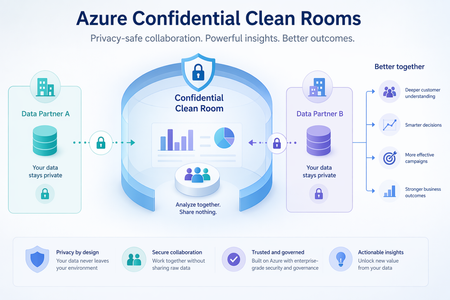
Why trusted data collaboration is now a business imperative Financial institutions increasingly need insights that no organization can produce alone. A bank may need another institution’s signals to detect a fraud network; prime brokers may need a consolidated view of counterparty exposure; and banks and insurers may need to identify patterns across payments, accounts, and claims. The analysis is valuable, but exposing raw customer, transaction, position, order, or claims data may not be possible. That tension is sharper when a regulated institution like a bank collaborates outside the regulated perimeter. A bank and retailer may want to identify customers eligible for a jointly funded offer and measure its results, yet the bank remains accountable for confidentiality, permitted use, security, and third-party risk. Regulators may likewise need system-wide insight without creating another central store of sensitive records. What these scenarios require is controlled joint analysis: participants can retain control of their data, computation can be limited to an approved purpose, and privacy controls can help reduce the risk of individuals being re-identified from the output. Azure Confidential Clean Rooms (ACCR) provides that governed collaboration boundary. Multiple organizations—including, where appropriate, a regulator or market authority—can run an agreed analysis over combined sensitive data while helping protect the underlying datasets from disclosure to other participants and the Azure operator. Computation runs in a hardware-backed Trusted Execution Environment (TEE), with participant-controlled approvals, verifiable execution, constrained outputs, and audit evidence. Where financial-services leaders can create value Start with a business problem whose answer depends on data held by several organizations—and where conventional data sharing creates unacceptable privacy, competitive, or regulatory exposure. Fight financial crime with a broader line of sight The challenge: fraud rings, mule networks, scams, and money-laundering activity cross institutional boundaries, while each firm sees only a fragment of the pattern. The opportunity: combine approved risk signals to help identify suspicious connections while helping protect sensitive data from being accessed by partners See concentrated risk before it becomes a crisis The challenge: no single prime broker or lender has a complete view of a counterparty’s leverage, collateral needs, or borrowing across the market. The opportunity: calculate aggregate exposure and concentration indicators while helping limit disclosure of each participant’s positions or commitments. Detect market abuse across fragmented venues The challenge: spoofing, wash trading, front-running, and coordinated manipulation can remain invisible when surveillance is confined to one firm or venue. The opportunity: analyse approved order and trade signals across participants while helping protect proprietary strategies and client activity. Grow customer value without exchanging customer lists The challenge: banks, insurers, and commerce partners want to identify shared customers, upsell products, improve relevance, and measure outcomes, but cannot freely exchange identifiable customer or purchase data. The opportunity: identify privacy-protected overlaps, create eligible audiences, and measure agreed outcomes while helping avoid disclosure of either organisation’s full customer book. Improve financing and collateral decisions The challenge: fragmented holdings and commitments make it difficult to match securities, optimise collateral, or understand syndicated-loan and private-credit exposure. The opportunity: identify matches and calculate approved aggregate measures across combined books while helping limit disclosure of client holdings or individual commitments. Why BFSI leaders should use Azure Confidential Clean Rooms For business, risk, data, and technology leaders, the value is not simply another analytics platform. It is a way to pursue opportunities that previously stalled because no participant was willing—or permitted—to reveal its data. Make collaboration commercially viable: answer shared questions while helping institutions avoid merging customer, transaction, position, or order-level books. Help avoid centralized data pooling — Collaborators can keep source datasets in their own storage instead of copying them into a shared repository. The confidential environment verifies that expected code is running before it securely retrieves authorized data for temporary processing. This can reduce unnecessary data movement and exposure while supporting an approved analysis across partners. Help keep participants in control: data owners can retain their encryption keys and approve the datasets and queries used in each collaboration. Build verifiable trust: hardware-backed isolation and cryptographic attestation help verify that approved code is running in an approved confidential environment before keys are released. Reduce unnecessary disclosure: : minimum-group-size thresholds can help reduce the risk of exposing individuals or small cohorts. Give assurance teams evidence: approvals, build provenance, open-source components, and tamper-resistant audit trails can support security, privacy, legal, risk, and compliance reviews. As an example, multiparty analytics with Spark SQL in Azure Confidential Clean Rooms can be used by banks to jointly identify anti-money laundering (AML) patterns that span institutions while helping avoid centralized pooling and limit disclosure of raw customer data. Shared tokenized identifiers can enable transactions linked to the same counterparty to be matched, while an agreed query can identify structuring, follow the flow of funds, and flag beneficiaries connected to multiple banks. Try the Azure Confidential Clean Rooms preview Choose a high-value scenario that no participant can solve alone—such as cross-bank fraud detection, shared counterparty-risk analysis, or privacy-preserving customer matching. Sign up for the ACCR for Analytics preview. Learn more Sign-up: Preview of multiparty analytics with Azure Confidential Clean Rooms Preview blog: Multiparty analytics with Azure Confidential Clean Rooms Azure documentation: Confidential Clean RoomsNow in public preview: Green screen feature in Teams Meetings
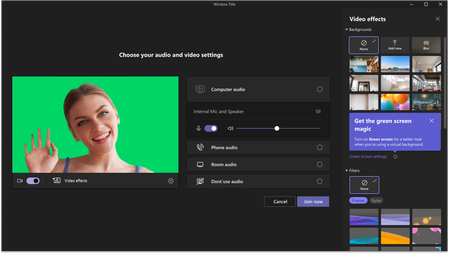
Description Microsoft Teams now supports a green screen feature which provides an enhanced virtual background effect. Green screen improves the sharpness and definition of the virtual background effect around your face, head, ears, and hair. It also allows you to show a prop or other object in your hand to be more visible to other meeting participants. Green screen requires a solid color screen or a background wall behind you. The screen or background wall must be flat without stains or other irregularities. Users must apply a background effect in Teams meetings to enable the green screen effect and should carefully select the backdrop color so that the effect is applied correctly and better quality is achieved. Flighting status Available to everyone in Public Preview channel. How to enable Please make sure that you have applied a background effect in Teams meeting before enabling the green screen effect and chosen the correct backdrop color so that the effect is applied correctly. Please also ensure you have a solid color screen or clean background wall behind you. After you join a meeting, click the “More” icon in the meeting toolbar, go to “Video effects.” When the “Video effects” panel page is open, go to “Green Screen Settings” in Backgrounds section and click the link to turn on the Green screen toggle button under “Teams settings -> Devices -> Green screen.” Click the backdrop icon and move your mouse cursor into the Preview box to manually pick backdrop color. For example, avoid picking a color that matches your clothing or props you intend to show on camera. Return to your meeting. Note 1: If you need information about enabling the public preview itself, see “Enable the public preview for Teams” below. Note 2: To be able to use this feature, user needs to be in Public Preview. Other meeting participants are not required to be in Public Preview. Supported clients and platforms Windows macOS iOS Android Linux Google Chrome Firefox Safari Microsoft Edge Yes Yes Known issues None Known limitations Supported only on Windows and macOS devices with Intel and AMD chips. Mac M1/M2 are not supported. Green screen will automatically disable background blur and Together Mode while being compatible with Presenter modes like Standout, Side-by-Side and Reporter, PowerPoint Live Standout, and background replacement (JPEG/PNG). Transparent or translucent objects cannot produce a good green screen effect. If the object is too thin, it cannot be properly detected for the green screen effect. Enable your Teams client for the public preview First, IT admins need to set an update policy that turns on Show preview features. Learn how at Public preview in Microsoft Teams - Microsoft Teams | Microsoft Docs. Users then choose to join the public preview individually. Learn how at Get early access to new Teams features - Office Support (microsoft.com) Send us your feedback Got feedback on features in the public preview or other areas of Teams? Let us know straight from Teams via Help > Give feedback. This is on the bottom left of your client. Thank you, Preview Team Quality & Customer Obsession, Microsoft Teams
Missing "Make a test call" function?
Just noticed that the "Make a test call" button seems to be missing in Preview (23088.1500.1978.6338). "Old" version has this in Settings -> Devices. Haven't found any mention of this in official documentation or similar posts in forums. Missing for everyone else too?Improve Campaign Reach and Measurement with Azure Confidential Clean Rooms
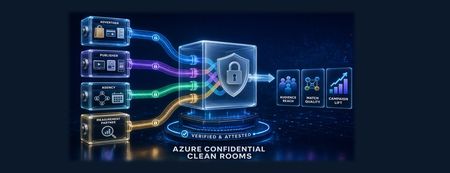
Why campaign performance now depends on trusted data collaboration For many years, third-party cookies helped advertisers, publishers, and measurement partners recognize users across parts of the open web. That model continues to evolve as browsers and mobile platforms introduce stronger privacy protections and limit access to certain cross-site and device-level identifiers. As a result, some advertisers and publishers are placing greater emphasis on the first-party data they collect directly to support audience activation and campaign measurement. Advertising partnerships may involve identifiers and behavioral data covered by privacy, data-protection, or industry rules. Data that has been altered to reduce direct identification—such as hashed email addresses or advertising identifiers—may still be linked to individuals and should not automatically be considered anonymous. Depending on the law and context, it may be treated as personally identifiable information (PII) or personal data under the European Union’s General Data Protection Regulation (GDPR). Organizations must have an appropriate legal basis and a clear purpose for using such data. The European Union’s Digital Markets Act (DMA) also affects how designated digital platforms combine certain personal data across services. In the United States, health information held by organizations covered by the Health Insurance Portability and Accountability Act (HIPAA) may be subject to additional restrictions, including for some marketing uses. The requirements for each collaboration depend on the parties, data, purpose, consent or authorization, and jurisdiction. Together, these changes create a practical challenge: campaign analysis increasingly depends on combining detailed records held by different organizations, but privacy, security, and governance obligations make unrestricted exchange of customer-level data difficult. Advertisers and publishers therefore need a controlled way to match audiences and measure outcomes using only authorized data—without exposing or freely sharing the underlying records. Azure Confidential Clean Rooms is designed to address this challenge. It allows each party’s detailed data to be used for an agreed analysis while helping protect raw data from access by other participants. This provides a controlled, verifiable environment for audience matching and campaign measurement without unrestricted file sharing. What campaign leaders should look for: the potential to broaden addressable audiences, strengthen evidence of campaign lift, reduce operational risk, and establish a repeatable model for trusted collaboration across media and measurement partners. Campaign decisions with secure multiparty analytics Azure Confidential Clean Rooms is a fully managed service that enables advertisers, publishers, agencies, and measurement partners to analyze sensitive datasets together while helping protect each participant’s raw data. The current preview supports analytics through Spark SQL queries agreed by the participants. These queries run in a hardware-protected environment called a Trusted Execution Environment (TEE), helping protect participants’ raw data from other collaborators and the Azure operator throughout its lifecycle. For a deeper explanation of the technology and architecture, see our earlier blog, Preview of multiparty analytics with Azure Confidential Clean Rooms. The following scenarios show how this model supports specific campaign decisions: Audience activation — Which high-value customers might this media partner reach? The advertiser contributes first-party customer data, such as securely transformed contact details, postal addresses, loyalty IDs, and purchase history. The publisher contributes its audience-matching data, on-site behavior, and consented interest or demographic segments. Azure Confidential Clean Rooms can compare identifiers that the participants have agreed to use for matching and release a reachable audience segment without exposing the underlying records. Campaign leaders can use the result to estimate potential reach and direct investment toward more relevant audiences. Identity enrichment — Can we improve match quality while protecting partner data? An agency or identity partner can contribute a third dataset to connect approved identifiers across email, mobile advertising IDs, devices, or households and add consented demographic or business attributes. Because the matching happens inside the confidential clean room, participants may improve match rates without exposing the identity partner’s underlying data or copying another party’s identifiers. Stronger matching can help expand reach and reduce media waste caused by fragmented customer identities. Measurement and attribution — Did the campaign contribute to additional business outcomes? The publisher contributes ad-exposure records, while the advertiser contributes outcomes such as purchases, order values, subscriptions, or app installs. Comparing these approved datasets can help measure unique reach and frequency, results across publishers, and the difference between groups that were and were not exposed to the campaign. For example, a retailer and a streaming publisher can compare exposure data with purchase outcomes to estimate campaign lift without revealing who saw a specific ad or made a purchase. This can give campaign leaders stronger evidence for campaign optimization and future budget allocation. These scenarios can help campaign leaders assess whether secure data collaboration may improve audience reach, matching quality, or confidence in campaign measurement. Why campaign leaders should consider Azure Confidential Clean Rooms The collaboration model is designed to give each participant greater control over how its data is accessed, used, and shared. Four capabilities are central to building trust among advertisers, publishers, agencies, and measurement partners: No centralized data pooling — Collaborators can keep source datasets in their own storage instead of copying them into a shared, permanent repository. The confidential environment verifies that expected code is running before it securely retrieves authorized data for temporary processing. This can reduce unnecessary data movement and exposure while supporting an approved analysis across partners. Controlled release of approved results — Before analysis begins, collaborators can agree which data may be used, approve the analysis, and specify who may receive the results. Safeguards can also prevent results for very small groups from being released, helping reduce the risk of identifying an individual. Verifiable governance and tamper-resistant audit trails — Participants can verify key properties of the environment instead of relying only on the clean-room provider’s claims. Open-source components and hardware-backed verification help participants confirm that the expected Microsoft-provided code is running. Tamper-resistant audit trails generated in the confidential environment can support compliance reviews. Data protection throughout the process — Each party can encrypt its data before it leaves its environment. Participants allow access to encryption keys only after the confidential environment verifies that expected code is running. Try Azure Confidential Clean Rooms Consider a campaign where better partner data could help improve audience reach, matching quality, or measurement confidence. Sign up to participate in a preview of multiparty analytics with Azure Confidential Clean Rooms. The Microsoft team will contact you to discuss the campaign scenario, participating datasets, and governance requirements. Learn more Sign-up: Preview of multiparty analytics with Azure Confidential Clean Rooms Preview blog: Multiparty analytics with Azure Confidential Clean Rooms Azure documentation: Confidential Clean RoomsPreview of multiparty analytics with Azure Confidential Clean Rooms
Today, we are excited to announce the preview of multiparty analytics feature of Azure Confidential Clean Rooms, a fully managed service that allows customers and their partners to securely analyze privacy-sensitive datasets from multiple parties. It uses confidential compute enabled Apache Spark-based big-data analytics (Spark SQL) which helps protect their raw data from other collaborators and from the Azure operator by performing computations in a Trusted Execution Environment (TEE). Privacy-sensitive datasets include personally identifiable information (PII), protected health information (PHI) and cryptographic secrets. Organizations across industries are increasingly looking to supplement their data with data from business partners, to build a complete view of their business. For example, brands, publishers, and their partners need to collaborate using datasets containing Intellectual Property (IP) to improve the relevance of their campaigns. Confidential data clean rooms help solve this challenge by enabling organizations to share and analyze granular datasets in a secure environment that helps prevent raw data exfiltration—protecting intellectual property, preserving customer privacy, and addressing concerns around regulatory compliance. You can sign up for the preview here Key Features Fully Managed: Azure takes care of the infrastructure provisioning and scaling with no user intervention. This significantly reduces your onboarding effort allowing you to focus on the queries and insights, not on infra management. Confidential Spark SQL: Spark SQL allows you to query large datasets and run complex queries in a distributed computing environment. In the confidential computing enabled version, the Spark driver and executors are fully attested policy-governed enclaves running as virtual nodes on confidential Azure Container Instances (ACI) which helps prevent exfiltration of collaborators’ data during query execution. Governance: Helps manage membership to cleanrooms, enables and verifies approval for queries from relevant collaborators before executing them and verifies consent to access sensitive collaborator data. It also helps generate tamper-resistant audit trails containing salient clean room events. This is made possible with the help of an implementation of the Confidential Consortium Framework (CCF). Telemetry: Throughout every clean-room run, detailed logs are streamed out in real time to monitor performance, troubleshoot issues, and keep the analytics healthy — all without ever exposing the collaborators’ data at any time. Verifiable trust: Cryptographic remote attestation viz. full attestation based on confidential hardware reports allows independent verification of the TEE along with along with all components that are part of it, without just trusting the cloud provider, before sensitive data and decryption keys are made available to the TEE Open-source containers: All Microsoft provided cleanroom containers and sidecars are open-sourced here and can be verified for provenance and integrity guarantees using GitHub artifact attestation Use Cases Multi-party confidential big-data analytics unlocks value in scenarios where data sensitivity, regulatory pressure, or competitive concerns previously blocked collaboration. These are some early scenarios that can benefit from this. Media & Advertising Collaboration of advertiser CRM data with publisher data for audience targeting and segment activation. Collaboration of audience data with measurement partners for measurement and attribution. Banking & Finance Collaboration between banks and insurance firms to upsell relevant products to existing bank customers without sharing raw data from either side Collaboration with retailers to generate customized offers for bank customers, without exposing either party’s underlying data. Government & Public Sector Secure collaboration of data across government departments to deliver better citizen welfare outcomes. Secure collaboration between government and private enterprises on shared-interest workloads such as traffic monitoring and weather systems. Healthcare Enable healthcare firms — including biopharma organizations — to combine their data with third-party institutions to accelerate clinical development, like identifying eligible participants for a clinical trial, without exposing underlying patient data. Combine patient datasets across hospitals to study disease patterns or outcomes without exposing sensitive protected health information. "A higher standard for protecting user privacy and trust, the phase-out of third-party cookies, and global regulations demand more sophisticated data collaboration tools to support advertising marketplaces. Azure Confidential Cleanrooms (ACCR) provides a secure, feature-rich, and flexible foundation to implement privacy-preserving functions and enable insights without sharing privacy-sensitive data outside of organization boundaries. Built on the Azure Confidential Compute (ACC) platform and offering cohesion with Azure's diverse set of services, ACCR offers the attestation, audit, fine-grained access control, and verifiable trust tools required for secure and privacy-safe data collaboration in today's world." — Andrei Mackenzie, Engineering Manager, Microsoft AI "Azure Confidential Clean Rooms enabled our team to evaluate how clean room capabilities can support secure, governed data collaboration at scale. Through the Proof-of-Concept (PoC), we explored how privacy-preserving workflows, trusted access controls, and scalable compute can create a stronger foundation for responsibly leveraging first-party data. This helps reduce operational friction while supporting business growth, improving customer engagement, and enabling more relevant customer experiences." — Nic Dregne, Director, Microsoft AdTech Engineering Beyond Spark SQL Realizing other multi-party scenarios like custom analytics, ML training and inferencing on Azure Confidential Clean Rooms is in our roadmap. If you have such a scenario to be realized, you can fill in and submit the preview signup form with the details of your scenario and we’ll get back to you. Learn More · Signup for the preview of Azure Confidential Clean Rooms for Analytics · Confidential Consortium Framework (CCF) · Virtual Nodes on Azure Container Instances
Would Microsoft Teams SDK for Python (Preview) affect marketplace submission
Hi, I need to know if it's possible to publish a custom teams app and get validated to have the app in marketplace for public if it's developed using Teams SDK with python which is mentioned as still in preview. Teams SDK is now generally available for JavaScript and C#, supports Python in developer preview https://learn.microsoft.com/en-us/microsoftteams/platform/bots/overview https://learn.microsoft.com/en-us/microsoftteams/platform/resources/dev-preview/developer-preview-intro?tabs=new-teams-client https://github.com/microsoft/teams.py Thank you!387Views0likes2CommentsPreview exited, now GA: Out of Office Scheduling
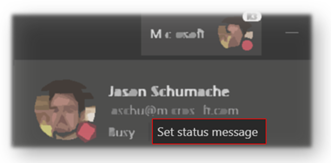
Description Set up a message to let others know you're on vacation or not available to reply. Your out of office status will also sync with your Outlook calendar, your presence and contact card information. Flighting status Rolling out this week on Desktop and Web. How to enable Two ways to access the Out of Office feature 1) Through "Profile" Click profile then Set status message Click Schedule out of office 2) Through "Settings" Click Settings General -> Out of Office -> Schedule Now, from within the Scheduler Include an Out of Office message Note – Text is required to be compatible with Outlook scheduling. Click Save Options Send replies outside my organization Include text to auto reply Send replies only during a time period Pick dates and times to begin and end the Out of office status message and presence state. Outlook You will be able to see your changes in Outlook as well as update them there. How to Disable Change the Turn on automatic reply setting in Teams radio button to off and save Change the Send automatic replies setting in Outlook to off and save Note: If you need information about enabling the public preview itself, see “Enable the public preview for Teams” below. Microsoft 365 workloads and dependencies Product, workload, or area Dependency (Yes/No) If yes, version requirements and other dependencies Exchange No Sharepoint, files No Skype for Business No Outlook add-in No Azure AD No OneDrive No Office No Supported clients and platforms Windows 10 macOS iOS Android Linux Chrome Firefox Safari Edge Internet Explorer Yes Yes - - Yes Yes Yes Yes Yes - Known issues None Known limitations As mentioned in the guide an Out of Office Message needs to be included for Teams to save the configuration and set your presence to Out of Office. Enable your Teams client for the public preview First, IT admins need to set an update policy that turns on Show preview features. Learn how at Public preview in Microsoft Teams - Microsoft Teams | Microsoft Docs. Users then choose to join the public preview individually. See Get early access to new Teams features - Office Support (microsoft.com) for instructions. Summary of public preview features For a history of features in the Office and Teams public previews, see Release Notes Current Channel (Preview) - Office release notes | Microsoft Docs. Send us your feedback Got feedback on features in the public preview or other areas of Teams? Let us know straight from Teams via Help > Give feedback. Thank you, Preview Team Jason Schumaker Quality & Customer Obsession, Microsoft Teams